

Quick Answer: An OEM flashlight runtime test should verify how long production units maintain an agreed light output under controlled battery, operating mode, and environmental conditions. For importers, distributors, and private-label brands sourcing rechargeable LED flashlights from manufacturers in Ningbo, China, the acceptance plan should identify the approved battery, starting brightness, minimum usable output, measurement interval, and required operating duration. Buyers should also define individual sample limits, batch release rules, and packaging claims before production. Whether the flashlights are intended for outdoor retail, industrial maintenance, or emergency preparedness markets, shipment approval should depend on documented performance rather than battery capacity or advertised maximum brightness alone.
A flashlight that achieves its advertised maximum brightness immediately after activation may not maintain sufficient illumination throughout its intended operating period.
For overseas buyers, the commercial concern is not simply whether an approved sample performs well. It is whether finished production units consistently deliver the performance that customers expect.
Ningbo Brightenlux Electric Appliance Co., Ltd. manufactures portable LED lighting products in Ningbo, Zhejiang, China, and provides OEM/ODM support for international flashlight purchasing programs.
This guide explains how buyers can establish measurable runtime requirements and connect them to production inspection, shipment approval, and product packaging.
1. How Should Buyers Establish OEM Flashlight Runtime Test Conditions?
Reliable runtime comparisons require consistent testing conditions.
A flashlight tested in a cool laboratory with a newly charged battery may behave differently from the same model tested in a warm environment with a partially charged cell.
Before comparing production samples, the buyer and manufacturer should approve a common test procedure.
Flashlight Runtime Test Conditions
| Test Parameter | Required Control |
|---|---|
| Product identity | Exact model, SKU and specification revision |
| Battery | Approved cell or battery pack |
| Battery condition | Defined charging and starting condition |
| Operating mode | Specified High, Medium, Low or other mode |
| Ambient temperature | Agreed temperature and allowable variation |
| Airflow | Controlled and documented |
| Product orientation | Consistent mounting or placement |
| Beam focus | Fixed approved position where adjustable |
| Measurement equipment | Suitable calibrated optical instruments |
| Recording interval | Predefined time intervals |
| Runtime endpoint | Agreed output threshold or termination condition |
| Safety conditions | Approved operating limits and monitoring |
The test procedure should represent the approved product configuration and intended purchasing requirement.
For example, an outdoor flashlight buyer may prioritize continuous medium-mode performance, while a maintenance equipment distributor may require sufficient illumination for a defined inspection task.
These applications may require different runtime acceptance thresholds even when the same flashlight platform is used.
Avoid Uncontrolled Cooling
Additional airflow can influence flashlight temperature and output regulation.
A flashlight positioned directly in front of a cooling fan may not behave like one operating under ordinary conditions.
Cooling arrangements, fixtures, and surrounding conditions should therefore follow the approved test method rather than being changed to obtain more favorable results.
2. Why Is Battery Identity Essential for Rechargeable Flashlight Runtime Validation?
Battery capacity alone does not establish flashlight runtime.
Two batteries with the same advertised capacity may differ in usable energy, discharge characteristics, protection circuitry, internal resistance, and performance under load.
For this reason, buyers should control the exact battery used during both product qualification and production testing.
Battery Identity Checklist
| Battery Information | Required Record |
|---|---|
| Battery manufacturer | Approved manufacturer |
| Cell model | Exact cell identification |
| Battery format | 16340, 18650, 21700, 26650 or other approved format |
| Battery chemistry | Approved electrical configuration |
| Nominal voltage | Manufacturer specification |
| Rated capacity | Approved capacity and rating conditions |
| Protection configuration | Applicable cell or pack design |
| Batch number | Traceable production lot |
| Charging method | Approved charger or charging input |
| Battery inclusion | Included or excluded from retail package |
| Alternative cells | Written approval and validation requirements |
A manufacturer should not substitute a battery solely because its physical dimensions and printed capacity appear similar.
Any proposed substitution affecting runtime, charging, or safety should undergo appropriate engineering review and approval.
Battery-Included vs. Battery-Excluded Flashlights
For battery-inclusive products, runtime evidence should relate to the battery configuration supplied with the commercial order.
For battery-excluded products, the report must identify the approved reference battery used during testing.
Marketing materials should not imply that an optional battery is included.
Battery Preparation Before Testing
Inspect the battery and flashlight for visible damage. Charge using the approved equipment and procedure, and follow any required conditioning or stabilization period.
A full-charge indicator alone should not replace the defined battery preparation procedure.
Do not charge or operate products showing swelling, leakage, unusual heating, or suspected electrical damage.
3. How Should Flashlight Modes and Runtime Brightness Thresholds Be Defined?
One of the most common mistakes in rechargeable flashlight sourcing is comparing runtime figures without knowing the associated brightness level.
A flashlight may operate for eight hours in Low mode but provide substantially less operating time at High output.
Both figures may be legitimate, provided the conditions and endpoints are clearly identified.
Three Different Runtime Measurements
| Runtime Measurement | Definition | Commercial Purpose |
|---|---|---|
| Standard-reported runtime | Duration determined using the specified performance-standard method | Consistent product reporting |
| Task-usable runtime | Time during which output remains above an agreed practical threshold | Application suitability |
| Total on-time | Time until the flashlight switches off | Supplementary operating information |
These measurements should not be used interchangeably.
ANSI/PLATO FL 1 Runtime Testing
The ANSI/PLATO FL 1-2025 Flashlight Basic Performance Standard establishes standardized methods for reporting portable lighting performance.
According to PLATO's explanation of the 2025 testing procedures, conventional modes use the output at 30 seconds as the runtime reference, with the endpoint reached when output declines to 10% of that reference.
Short-Duration Elevated Brightness modes use a different method involving measurements during the first 1–10 seconds and an endpoint at 90% of the highest output measured during that interval.
This distinction is important when evaluating Turbo or Boost claims.
Formal standard-based reporting must follow the complete applicable test procedure rather than relying solely on these summarized definitions.
Define a Separate Useful Brightness Threshold
A standardized runtime endpoint may not represent the minimum illumination required for a particular task.
For that reason, buyers can establish an additional contractual requirement.
For example:
| Performance Item | Illustrative Buyer Requirement |
|---|---|
| Operating mode | Medium |
| Initial output | 250–320 lumens at 30 seconds |
| Minimum useful output | 120 lumens |
| Required useful runtime | At least 180 minutes |
| Unintended interruption | Not permitted |
| Output after thermal reduction | Must remain above agreed threshold during the required period |
These values are hypothetical purchasing requirements, not Brightenlux product specifications or mandatory industry limits.
The actual limits should be established using representative samples and the intended application.
4. Which Brightenlux Flashlights Are Suitable for Runtime Evaluation?
Brightenlux publishes rechargeable flashlight platforms with different battery formats, output levels, and working-time ranges.
These products provide useful starting points for OEM runtime evaluation.
Brightenlux Rechargeable Flashlight Comparison
| Product Model | Published Maximum Output | Included Battery | Published Working Time |
|---|---|---|---|
| BT-FL8078 | 1000 lm | 16340, 800mAh | 2–3 hours |
| BT-FL8088 | 1500 lm | 21700, 4000mAh | 4–8 hours |
| BT-FL8032 | 2000 lm | 26650, 5000mAh | 4–5 hours |
The figures above are published catalog specifications. They do not establish that maximum brightness is maintained throughout the entire listed working-time range.
The exact operating modes, output curves, test conditions, and applicable acceptance limits should be confirmed before commercial approval.
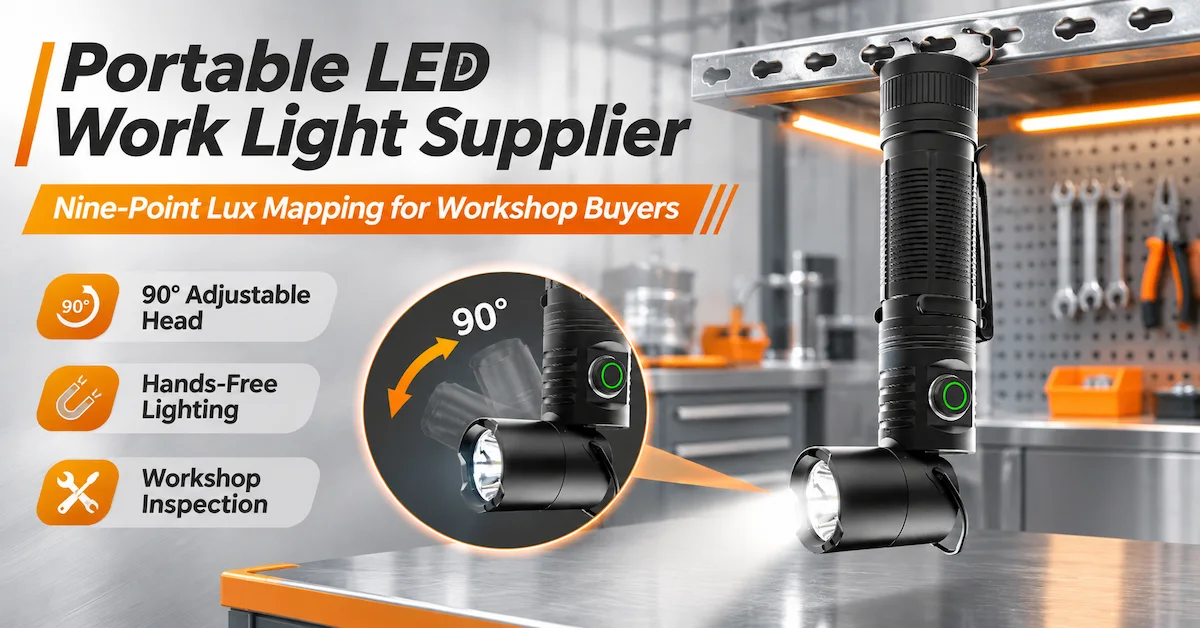
BT-FL8078: Compact 90-Degree Rechargeable Flashlight
The Brightenlux BT-FL8078 Rechargeable Flashlight uses an SST25 LED, an included 800mAh battery, Type-C charging, and a magnetic tail.
Its compact right-angle design provides a reference platform for close-range maintenance and portable inspection lighting.
For runtime evaluation, buyers should establish the required working mode and minimum usable output for the intended inspection task.
BT-FL8088: 21700 Rechargeable Flashlight
The Brightenlux BT-FL8088 1500LM Flashlight combines an SST40 LED with an included 4000mAh battery and multiple lighting modes.
Its published working time is 4–8 hours.
Buyers should request separate output-versus-time records for the modes relevant to their retail or maintenance lighting programs.
BT-FL8032: High-Power Rechargeable Flashlight
The Brightenlux BT-FL8032 2000LM Flashlight features an XHP50 LED, an included 5000mAh battery, adjustable beam focus, and twist-out Type-C charging.
For this platform, the runtime procedure should document the selected focus position, operating mode, output reduction behavior, and agreed useful illumination threshold.
5. How Should Flashlight Runtime Testing Data Be Recorded?
An effective OEM flashlight runtime test should generate an output-versus-time record rather than only a final duration.
A single runtime figure cannot explain whether the product maintains stable illumination, gradually dims, experiences thermal step-down, or shuts off unexpectedly.
Recommended Runtime Testing Workflow
- Confirm the product model, production batch, and specification revision.
- Identify the approved battery and its batch information.
- Prepare the battery according to the agreed charging procedure.
- Establish the required environmental and measurement conditions.
- Activate the specified operating mode.
- Record initial output and subsequent readings at defined intervals.
- Monitor output changes, temperature, and unexpected interruptions.
- Determine the agreed runtime endpoint.
- Save the original measurement data and test conditions.
- Compare the results with the approved acceptance limits.
Select the Correct Measurement Equipment
An appropriately configured integrating sphere can be used to measure total luminous flux when results are required in lumens.
A fixed-position illuminance meter can support comparative monitoring in lux when the beam geometry, measurement distance, alignment, and focus remain controlled.
Lux readings should not be presented as total lumen measurements without a validated measurement method.
Equipment should be suitable for the expected output range, calibrated as required, and configured to capture early output changes and thermal regulation.
Example Runtime Recording Sheet
The following hypothetical data illustrate a Medium-mode runtime record.
| Elapsed Time | Light Output | Output Retention | Observation |
|---|---|---|---|
| 30 seconds | 280 lm | 100% | Initial reference |
| 10 minutes | 270 lm | 96.4% | Normal operation |
| 30 minutes | 255 lm | 91.1% | Gradual reduction |
| 60 minutes | 240 lm | 85.7% | Continuous operation |
| 120 minutes | 190 lm | 67.9% | Above task threshold |
| 180 minutes | 145 lm | 51.8% | Meets three-hour checkpoint |
| 210 minutes | 110 lm | 39.3% | Below task threshold |
These values are illustrative checkpoints, not complete laboratory records or measured Brightenlux performance.
If the minimum useful output is 120 lumens, additional measurements around the threshold are needed to establish the actual crossing time.
Flashlight Runtime & Useful Output
Illustrative Medium-mode checkpoints — not measured Brightenlux data.
Seven example readings from 280 lumens at 30 seconds to 110 lumens at 210 minutes. At 180 minutes output is 145 lumens, above the 120 lumen example minimum. Connected points do not represent continuous measurements.0601201802403000306090120150180210Minimum: 120 lm180 min: 145 lmLight output (lm)Operating time (minutes)Output Retention Formula
Output retention (%) = Current measured output ÷ Initial reference output × 100
Output retention helps buyers compare the operating behavior of multiple production units.
However, an absolute brightness threshold remains important because two flashlights may retain the same percentage of different starting outputs.
Record Temperature Alongside Light Output
Temperature records can help identify whether output reductions are associated with thermal regulation or another performance change.
Record the measurement location, instrument, ambient temperature, and applicable limits.
Do not bypass protective electronics or continue operating a product beyond its approved safe conditions simply to extend the measured runtime.
6. How Should Flashlight Batch Acceptance Criteria Be Established?
Flashlight batch acceptance criteria should be agreed before production begins.
The purpose is to prevent disputes after inspection when a buyer considers the runtime insufficient but the supplier considers the product functional.
Establish Three Acceptance Gates
| Acceptance Gate | Requirement |
|---|---|
| Configuration gate | Correct battery, LED, driver and approved product revision |
| Performance gate | Agreed starting output, useful runtime and operating behavior |
| Release gate | Completed records, acceptable sample results and other required shipment checks |
A flashlight should not pass merely because its measured runtime exceeds the target if its battery or electronic configuration differs from the approved version.
Individual Sample vs. Batch Average
A batch average can hide individual units that fail to meet customer expectations.
If a purchase specification requires at least three hours of useful illumination per tested unit, one short-running flashlight should not automatically be accepted because other samples perform better.
Buyers should determine:
- Minimum runtime per tested unit.
- Acceptable initial output range.
- Required output at specified checkpoints.
- Permitted output variation between samples.
- Acceptable thermal regulation behavior.
- Rules for premature shutdown and interruptions.
- Sampling quantity and permitted failures.
- Measurement uncertainty and decision rules.
- Failed-lot containment and re-inspection requirements.
Select Production Samples Correctly
Runtime samples should be selected from the defined production lot using an agreed sampling procedure.
Where appropriate, selection should represent different production periods, battery batches, cartons, or assembly groups.
Avoid combining unrelated product revisions or materially different battery configurations into one acceptance group without a justified sampling plan.
Long-duration runtime tests may use a dedicated performance-verification sample rather than the same sample quantity used for routine appearance or packaging inspections.
The sample size should reflect purchasing risk, lot size, historical performance, testing resources, and the agreed statistical approach.
A small zero-failure sample does not prove that the entire production lot is defect-free.
7. Practical Example: How to Decide Whether a Flashlight Batch Passes
Consider a hypothetical outdoor equipment distributor purchasing 1,000 rechargeable LED flashlights.
The buyer requires a Medium mode that provides useful illumination for a minimum of 180 minutes.
Example Contractual Test Requirements
| Test Requirement | Illustrative Acceptance Limit |
|---|---|
| Production lot | 1,000 units |
| Runtime test sample | 8 finished units |
| Starting output | 250–320 lumens at 30 seconds |
| Minimum useful output | 120 lumens |
| Minimum useful runtime | 180 minutes |
| Permitted runtime failures | 0 in the defined sample |
| Unapproved battery substitutions | Not permitted |
| Unsafe operating behavior | Not permitted |
This is a buyer-defined demonstration plan, not a statistically validated sampling recommendation, an ISO AQL table, or an actual Brightenlux inspection record.
Example Batch Runtime Results
| Sample | Initial Output | Output at 180 Minutes | Useful Runtime | Result |
|---|---|---|---|---|
| F01 | 285 lm | 158 lm | 202 min | Pass |
| F02 | 272 lm | 144 lm | 194 min | Pass |
| F03 | 290 lm | 131 lm | 188 min | Pass |
| F04 | 265 lm | 123 lm | 181 min | Pass |
| F05 | 278 lm | 112 lm | 176 min | Fail |
| F06 | 295 lm | 151 lm | 199 min | Pass |
| F07 | 280 lm | 136 lm | 190 min | Pass |
| F08 | 268 lm | 127 lm | 185 min | Pass |
Batch Decision
- Average useful runtime: approximately 189.4 minutes.
- Minimum useful runtime: 176 minutes.
- Passing samples: 7 of 8.
- Failed samples: 1 of 8.
- Final runtime acceptance decision: Fail under the example rule.
Although the average runtime exceeds the required 180 minutes, sample F05 fails the individual-unit requirement.
The lot should therefore remain on hold pending authorized investigation and disposition.
This demonstrates why an average performance value should not replace agreed individual sample limits.
Actual decisions close to a threshold must also account for the approved measurement uncertainty and decision rules.
Flashlight Batch Runtime Acceptance Tool
Edit the contractual runtime threshold and eight illustrative sample readings. This tool evaluates useful runtime only; it does not select an ANSI or ISO sampling plan or authorize shipment.
Illustrative data only. Actual shipment release requires authorized approval and compliance with all agreed requirements.
Pass, Hold and Reject Matrix
| Inspection Finding | Recommended Decision |
|---|---|
| All runtime samples meet the agreed limits | Runtime acceptance criteria met |
| Individual sample falls below minimum runtime | Fail runtime criterion and hold lot |
| Incorrect battery or unauthorized component | Hold pending configuration investigation |
| Incomplete runtime records | Hold pending valid evidence |
| Measurement equipment or procedure invalid | Invalidate affected test and investigate |
| Unsafe thermal or electrical behavior | Stop testing and initiate safety review |
| Packaging claim exceeds verified evidence | Hold affected packaging or shipment |
Passing the runtime criterion does not automatically authorize shipment. All other required inspection, safety, documentation, and commercial release conditions must also be satisfied.
8. What Should Buyers Do When a Production Batch Fails Runtime Testing?
A failed runtime test should trigger a documented investigation.
The cause may involve battery variation, charging preparation, driver performance, thermal regulation, assembly conditions, or measurement error.
Common Runtime Failure Investigations
| Observed Problem | Potential Investigation Area |
|---|---|
| Lower initial brightness | LED, driver, optics or battery condition |
| Early output reduction | Thermal behavior or driver regulation |
| Short useful runtime | Battery characteristics or electrical load |
| Unexpected shutdown | Protection behavior, electrical connection or control circuit |
| Inconsistent results between units | Component variation or production process |
| Unstable test measurements | Equipment, fixture or measurement procedure |
These are possible investigation areas, not confirmed diagnoses.
The affected production lot should be contained while qualified personnel determine the actual cause.
Corrective Action and Re-inspection
An appropriate corrective action process should identify:
- The affected production and battery batches.
- The confirmed root cause.
- Any approved component or process corrections.
- The scope of sorting, replacement, or rework.
- The required repeat validation.
- The authorized re-inspection procedure.
- The final release decision.
Repeatedly selecting new samples until the batch passes is not a substitute for corrective action.
Any component substitution affecting product safety or declared performance must receive appropriate technical approval before shipment.
9. How Should Runtime Claims Be Controlled on OEM Flashlight Packaging?
Packaging claims should accurately represent the approved commercial product and supporting test evidence.
A runtime figure approved for Low mode should not be presented in a way that implies the same duration at maximum brightness.
Runtime Claim Control Matrix
| Proposed Packaging Claim | Required Supporting Evidence |
|---|---|
| Up to 8 hours | Verified operating mode and runtime method |
| 1500 lumens | Applicable output measurement and product configuration |
| 3 hours of useful illumination | Defined minimum output and test duration |
| High-mode runtime | Verified High-mode output curve and endpoint |
| Turbo brightness | Applicable short-duration output evidence |
| Rechargeable battery included | Approved commercial package configuration |
| Battery capacity | Evidence for the actual supplied battery |
Avoid Combining Unrelated Performance Figures
Potentially misleading claim:
1500 Lumens — 8 Hours
If the maximum output and longest runtime belong to different operating modes, this presentation may create an incorrect impression.
A clearer claim structure would separate:
- Maximum output: verified value.
- High-mode runtime: verified duration.
- Medium-mode runtime: verified duration.
- Low-mode runtime: verified duration.
- Battery configuration and relevant test conditions.
The final values must come from applicable product evidence rather than illustrative figures in this guide.
Link Test Evidence to Packaging Revisions
The product approval file should connect the exact SKU, approved battery, performance report, packaging revision, user manual, and destination-market requirements.
If the LED, battery, driver, firmware, or other performance-related components change, evaluate whether existing runtime claims remain supported.
For private-label buyers, this helps prevent outdated packaging from being used with a modified production configuration.
10. What Runtime Testing Fields Should OEM Buyers Include in an RFQ?
A technically detailed request for quotation helps the manufacturer evaluate whether an existing flashlight platform can meet the buyer's performance requirements.
It also allows testing costs, engineering requirements, sample schedules, and inspection arrangements to be discussed before the purchase order is confirmed.
OEM Flashlight Runtime Test RFQ Checklist
| RFQ Field | Required Buyer Information |
|---|---|
| Buyer and market | Company, destination country and sales channel |
| Application | Outdoor, inspection, patrol or emergency lighting |
| Reference model | Existing Brightenlux model or product specification |
| Required modes | High, Medium, Low or approved special modes |
| Initial brightness | Target and acceptable range |
| Battery format | Required or approved configuration |
| Battery inclusion | Included or excluded |
| Useful output threshold | Minimum required illumination |
| Minimum runtime | Required duration by mode |
| Standardized reporting | Applicable standard and edition, where required |
| Test environment | Temperature, airflow and orientation |
| Measurement method | Approved instruments and optical metric |
| Recording interval | Output and temperature logging requirements |
| Thermal behavior | Permitted regulation and operating limits |
| Sampling plan | Lot definition and sample quantity |
| Acceptance rules | Individual limits and permitted failures |
| Evidence | Raw data, curves, report and traceability records |
| Packaging | Approved runtime claims and artwork |
| Failed-lot policy | Containment, corrective action and re-inspection |
| Commercial requirements | Quantity, customization, costs and delivery schedule |
Request the Supplier's Technical Response
A useful quotation should distinguish between existing standard product capabilities and requirements that need additional engineering or validation.
Buyers should ask the manufacturer to identify:
- Proposed flashlight platform.
- Approved battery configuration.
- Available performance evidence.
- Additional testing requirements.
- Sample development and approval schedule.
- Production inspection arrangements.
- Testing costs and potential delivery implications.
Brightenlux provides LED flashlight platforms and OEM/ODM development support for international lighting purchasing programs.
For broader customized flashlight procurement requirements, review the Brightenlux OEM Flashlight Manufacturer Guide.
Detailed product requirements can also be prepared using the Flashlight OEM Specification Template.
11. Frequently Asked Questions
1. What is an OEM flashlight runtime test?
It is a documented performance evaluation that measures how long a flashlight operates under defined battery, lighting mode, environmental, and output conditions. OEM buyers use the results to support sample approval, production acceptance, and commercial performance claims.
2. Does higher battery capacity always mean longer flashlight runtime?
No. Runtime also depends on LED power demand, driver efficiency, battery discharge behavior, output regulation, temperature, and the selected operating mode.
3. What is the difference between maximum brightness and sustained brightness?
Maximum brightness describes the highest output achieved under the applicable measurement conditions. Sustained brightness describes the illumination maintained over a defined operating period. Both should be evaluated when establishing purchasing requirements.
4. What is the ANSI/PLATO FL 1 runtime endpoint?
For conventional lighting modes, the published PLATO explanation identifies an endpoint at 10% of the output measured at 30 seconds. The 2025 edition provides a different method for qualifying short-duration elevated brightness modes.
5. How many flashlights should be selected for a batch runtime test?
There is no universal sample quantity for every OEM order. The plan should reflect lot size, performance risk, product history, testing resources, and agreed statistical or contractual requirements.
6. Can a batch pass if its average runtime meets the target?
Not necessarily. If the contract requires every tested unit to meet a minimum runtime, an individual failure cannot be overridden simply by a higher batch average.
7. Should flashlight runtime testing be performed in every lighting mode?
Test the modes necessary to support the product's purchasing requirements and published claims. Routine production verification may prioritize selected modes, while qualification testing may require broader coverage.
8. Does USB-C charging guarantee consistent runtime?
No. USB-C identifies a connector interface. Runtime depends on the battery, charging implementation, driver, LED, operating mode, thermal conditions, and other product characteristics.
9. When should rechargeable flashlight runtime validation be repeated?
Review the need for repeat validation when the battery, LED, driver, firmware, thermal design, charging configuration, or other performance-related components change. Repeat-order verification should also follow the agreed production control plan.
10. How can buyers arrange runtime testing requirements with Brightenlux?
Provide the target application, reference model, approved battery, lighting modes, useful output threshold, required operating duration, sampling plan, packaging claims, and expected production schedule when requesting a quotation.
Conclusion
A successful OEM flashlight runtime test connects product performance with measurable purchasing requirements.
For importers, distributors, and private-label lighting brands, runtime should not be evaluated solely through battery capacity, maximum lumen figures, or a single approved sample.
A reliable acceptance plan identifies the production configuration, controls test conditions, records light output over time, establishes minimum individual performance requirements, and links the results to shipment approval and packaging claims.
Brightenlux offers rechargeable LED flashlight platforms and OEM/ODM support for international lighting procurement programs.
Whether you are sourcing compact inspection flashlights, rechargeable outdoor lights, or high-output private-label products, establish your performance requirements before confirming bulk production.
Approve the runtime specification before production. Verify the production batch before shipment.
Browse Brightenlux LED Flashlight Products
Explore OEM/ODM Outdoor Lighting Solutions
Contact Brightenlux for an OEM Flashlight Quotation and Runtime Validation Discussion