

A quick buying rule: when an OEM flashlight manufacturer only offers logo printing, the job is barely OEM. For a working program, the buyer still needs one build sheet, a sample that matches it, final box artwork, inspection limits, and a reorder record. Miss one of those and the second shipment can quietly differ from the first. In many launches, the least risky choice is a field-tested rechargeable body plus two or three changes customers will notice; every signed-off detail then goes into the production file.
That answer sounds simple. The work behind it is not. Set two black aluminum torches side by side and the shells may fool you; open them, and the LED, cell, driver, charging board, seals, switch, reflector, and finish can tell eight different stories. Customers experience those hidden choices as beam shape, run time, charging quirks, heat, grip, warranty claims, and sometimes returned cartons. A good sourcing decision therefore starts with the user and the sales channel, not with a lumen number or the lowest line on a quotation.
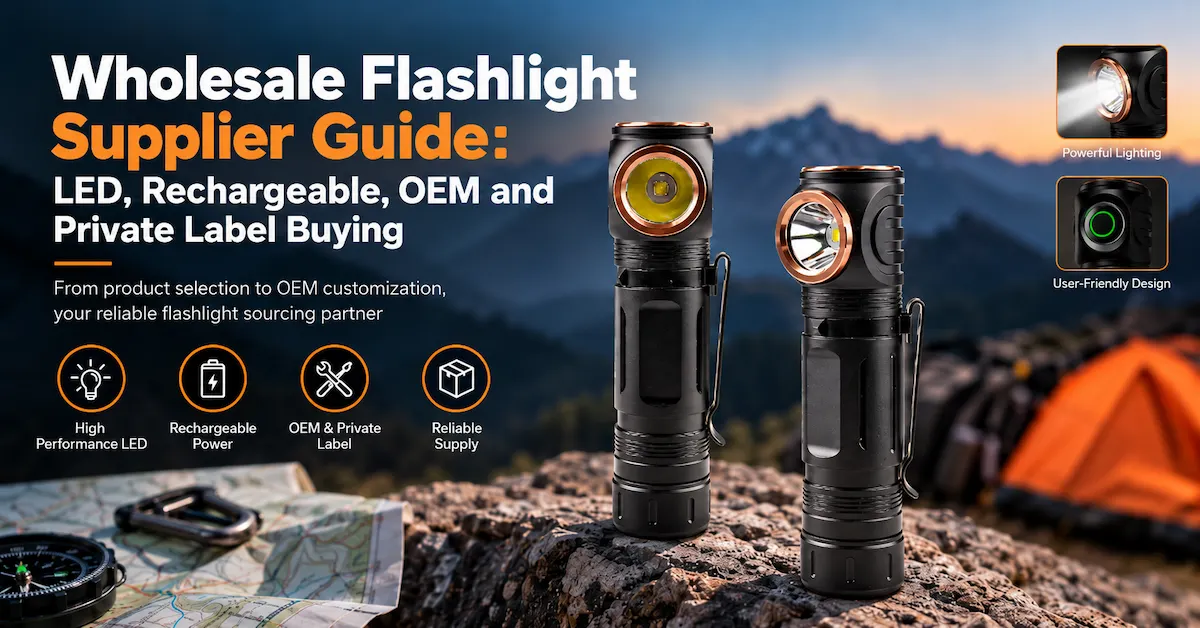
This guide uses Brightenlux's public product pages as practical examples. The current range includes compact dual-power lights, 18650 and 21700 rechargeable platforms, magnetic-tail models, adjustable-head lights, red-light modes, and right-angle products. Public specifications are useful for shortlisting. Treat the web specification as a shortlist, then verify the purchased version against its PO, signed sample, test evidence, packaging proof, and destination rules.
Where an OEM flashlight manufacturer earns its fee
Here, OEM describes a factory building a light for another company's label and selling plan, with the agreed details locked for that program. The donor model might already exist. The buyer can still choose the approved mix of body, LED, beam, battery, charge port, mode order, accessories, color, mark, instructions, and pack. The important word is agreed. If a preference lives only in chat, the production floor cannot reliably follow it; put it on a drawing, BOM, artwork file, or numbered approval sample.
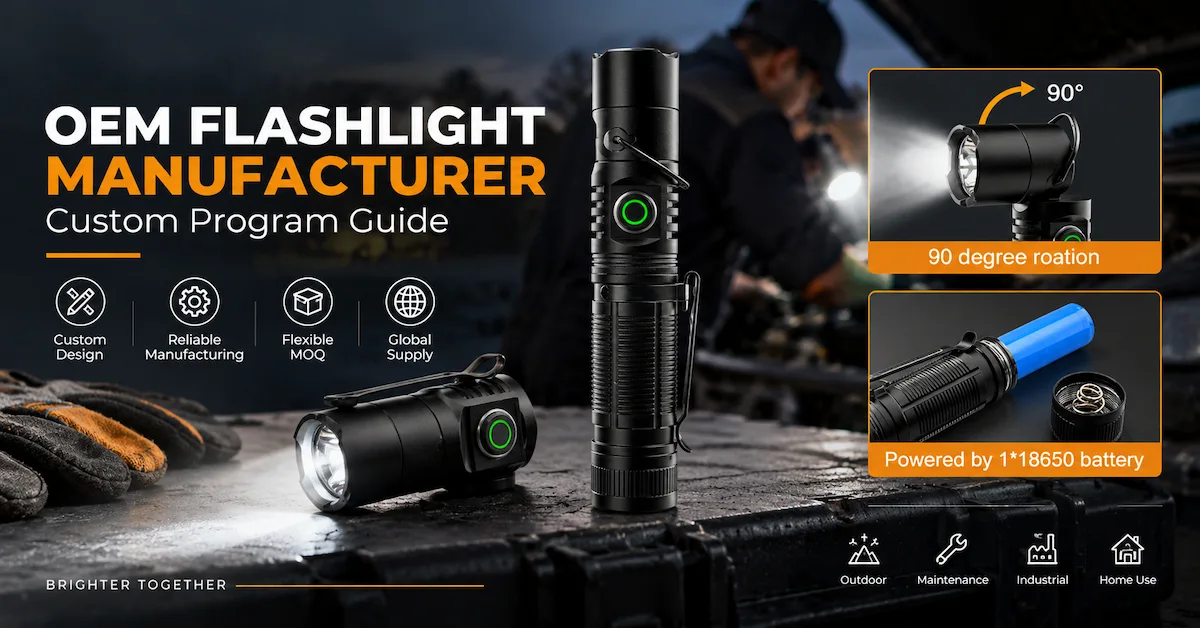
The amount of work varies sharply from one brief to the next. A retailer testing a new outdoor category may want a reliable existing model with a laser logo and a clear retail box. A professional tool brand may need a different switch sequence, magnetic tail, battery capacity, charge indicator, clip, or accessory kit. An industrial distributor may care less about a new housing and more about traceable production, stable cells, a practical beam, and packaging that technicians can understand quickly.
Use the first call to draw three columns with the OEM flashlight manufacturer: leave as proven, alter for this order, and engineer from scratch. A logo or carton edit usually clears quickly. A different driver, lens stack, seal geometry, or switch logic needs engineers, trial units, and a firmer approval route.
Choose the manufacturing route before you choose the SKU
Several supplier descriptions overlap online, yet they imply different work. Buyers lose time when they ask for full custom development but only need a branded stock model, or when they expect deep engineering from a reseller set up for standard wholesale orders. The comparison below gives each route a clear commercial role.
| Sourcing route | Typical changes | Best fit | Main buyer risk |
|---|---|---|---|
| Wholesale flashlight supplier | Existing model and standard package | Fast replenishment or range testing | Weak differentiation |
| Private label flashlight manufacturer | Logo, color, packaging, manual, barcode | Brands entering a category quickly | Branding approved before product details |
| OEM flashlight manufacturer | Controlled configuration, accessories, functions, packaging | A differentiated but manufacturable program | Specification drift between sample and production |
| Custom flashlight manufacturer | New structure, optics, electronics, controls, or tooling | Application-specific products with a clear business case | Cost and timing expand without a frozen brief |
The labels matter less than the scope written into the project. Ask the supplier to restate the requested changes, identify tooling or engineering work, and flag anything that remains standard. If a new finish, battery, driver, or package changes the minimum quantity or lead time, that effect should be visible before sample approval.
Begin with the user job, not the brightest claim
A flashlight used for a hotel maintenance cart is not the same product as a trail light, a patrol torch, a vehicle-emergency light, or a compact retail item. The user job determines which compromises are acceptable. A wide, even beam may be more useful for close inspection than maximum throw. A magnetic tail can matter more than an extra mode. Dual power earns its place in an emergency kit, where AA cells remain easy to find; a 21700 format better serves buyers willing to accept a thicker grip for longer use.
Before asking for a price, finish this line in plain English: “A [user] needs this light for [task], in [setting], and we will sell it through [channel] at [position].” Then add the non-negotiables. If the sentence is vague, the quotation will be vague too. A capable supplier can recommend a platform only when it understands what the product is meant to accomplish.
A useful first brief includes
- Target user, primary task, and realistic operating environment.
- Beam preference: flood, spot, adjustable focus, right-angle, or mixed task lighting.
- Expected runtime by mode rather than one isolated maximum figure.
- Battery format, replaceability, charging interface, and indicator behavior.
- Handling details such as grip, clip, magnet, head angle, switch position, and glove use.
- Destination market, retail channel, packaging language, and required documents.
- Opening quantity, forecast range, launch date, and expected reorder window.
Four Brightenlux product platforms worth comparing
A catalogue becomes useful when products are compared as platforms rather than isolated photos. The examples below show how different architectures can answer different briefs. They are not a promise that every feature can be combined in one model. They are a starting point for a focused technical conversation.
| Public product platform | Power and charging | Notable handling | Possible program role |
|---|---|---|---|
| 600-lumen dual-power adjustable-focus flashlight | Rechargeable battery or 2 AA cells; Type-C | Adjustable focus and aluminum body | Emergency, general retail, or travel kit |
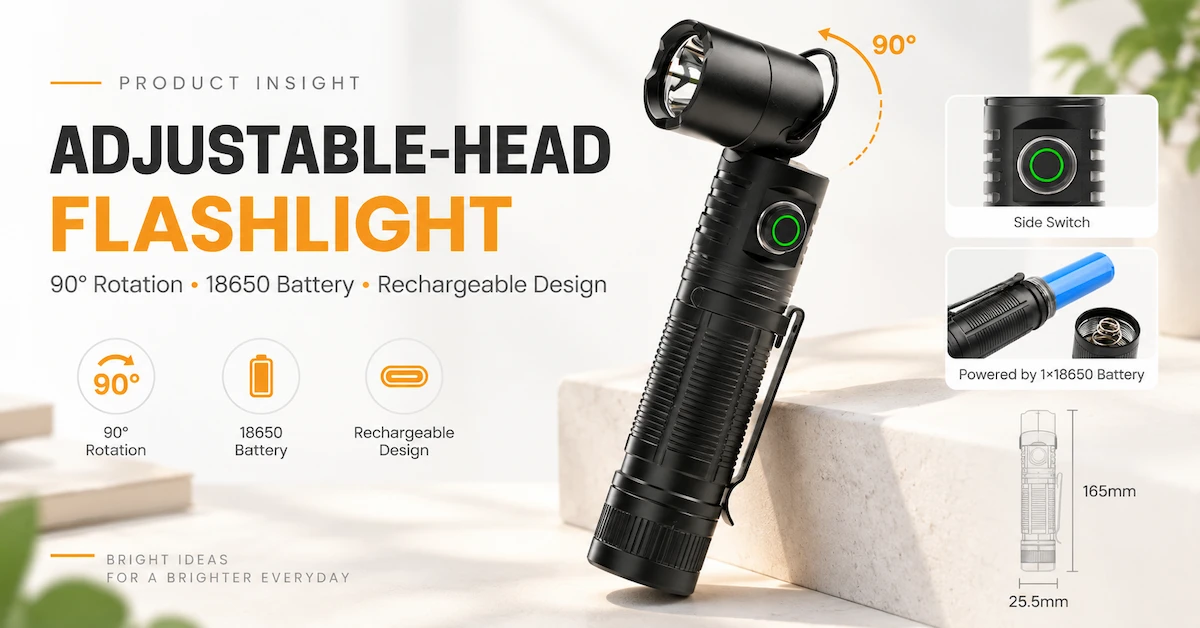
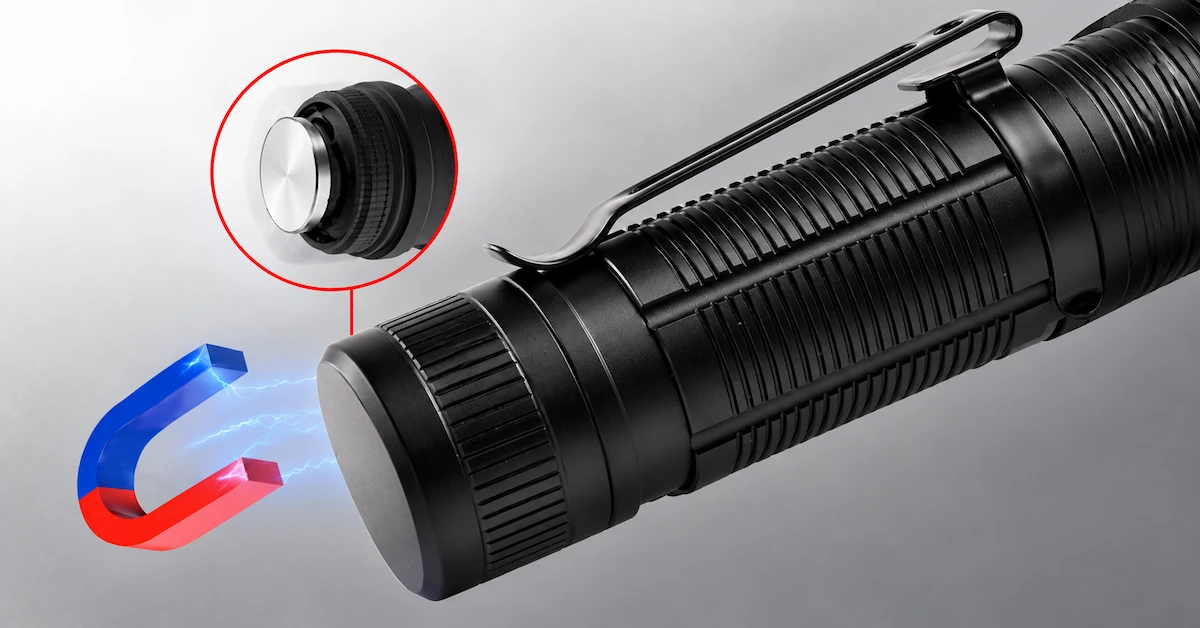
| 1000-lumen adjustable-head SST40 flashlight | 2200mAh 18650 platform; Type-C | Adjustable head, magnetic tail, multiple modes | Workshop, inspection, or utility range |
| 1000-lumen SST25 flashlight with red modes | 18650 battery; Type-C indicator | Magnetic tail, red modes, headstrap option | Outdoor, service kit, or hands-free bundle |
| 1500-lumen SST40 21700 flashlight | 4000mAh 21700 platform; Type-C | Magnetic tail, strobe, headstrap option | Step-up outdoor or professional model |
The table uses information currently visible on the product pages. Before using any number on packaging or in advertising, confirm the production configuration and the evidence behind it. Even a small change in LED bin, cell, driver, or thermal design can alter performance. An OEM flashlight manufacturer should be willing to mark which claims belong to the exact sample being approved.
Battery architecture is a commercial choice
Battery selection shapes the product body, weight, runtime strategy, charging time, peak output, shipping documents, replacement policy, and retail message. It should not be chosen only because a competitor uses the same cell size. An 18650 platform can support a compact, familiar rechargeable format. A 21700 platform creates room for more capacity and a higher-output positioning, but usually increases diameter and weight. A built-in compact cell may suit a right-angle or pocket model where handling matters most.
Brightenlux's public 600-lumen model adds another option: a rechargeable battery plus 2 AA compatibility. That dual-power architecture can be useful in emergency, travel, or institutional programs where users may not always have access to a charger. The trade-off is a different internal structure and a more detailed user explanation.
When a buyer searches for a rechargeable flashlight manufacturer, the questions should extend beyond capacity. Ask about cell model, protection, charging circuit, indicator logic, cable specification, charge time, runtime test conditions, storage guidance, and change control. An OEM rechargeable flashlight program needs a clear electrical reference, not simply the words “USB-C rechargeable” on a carton.
LED, optics, heat, and beam belong in one conversation
The LED name alone does not define the result. Think of the light as a chain: LED to optic, optic to driver, driver to cell, then heat through the body. The mode program sits across the lot. A spectacular first minute is no bargain if the beam falls away just when a technician settles into the job. For close work, a smooth beam may matter more than distance. For trail scanning, the balance between a central hotspot and surrounding spill becomes important.
A serious LED flashlight manufacturer should be able to discuss the complete light path. Request beam photos at a known distance, measured data under stated conditions, and a runtime curve or test record when those claims influence the purchase. Put every sample on one marked bench, point it at the same wall, fix the distance, and begin with equally charged cells. Otherwise, eye adaptation can make the late sample look better simply because the room or viewer changed.
Thermal behavior deserves a simple touch test and a longer bench test. Note when the body becomes warm, whether output changes, and whether the switch area or charging components behave normally. If a buyer asks a custom LED flashlight supplier to raise output without changing the housing, battery, or driver, the supplier should explain the consequence rather than agreeing automatically.
Freeze the specification before approving artwork
Artwork is visible, so teams often approve it first. That sequence feels productive but creates avoidable rework. The product definition should lead. Lock the model code, main components, mode sequence, battery, charging behavior, accessories, labels, and performance claims before the final package proof. Otherwise the box may describe a sample that no longer exists.
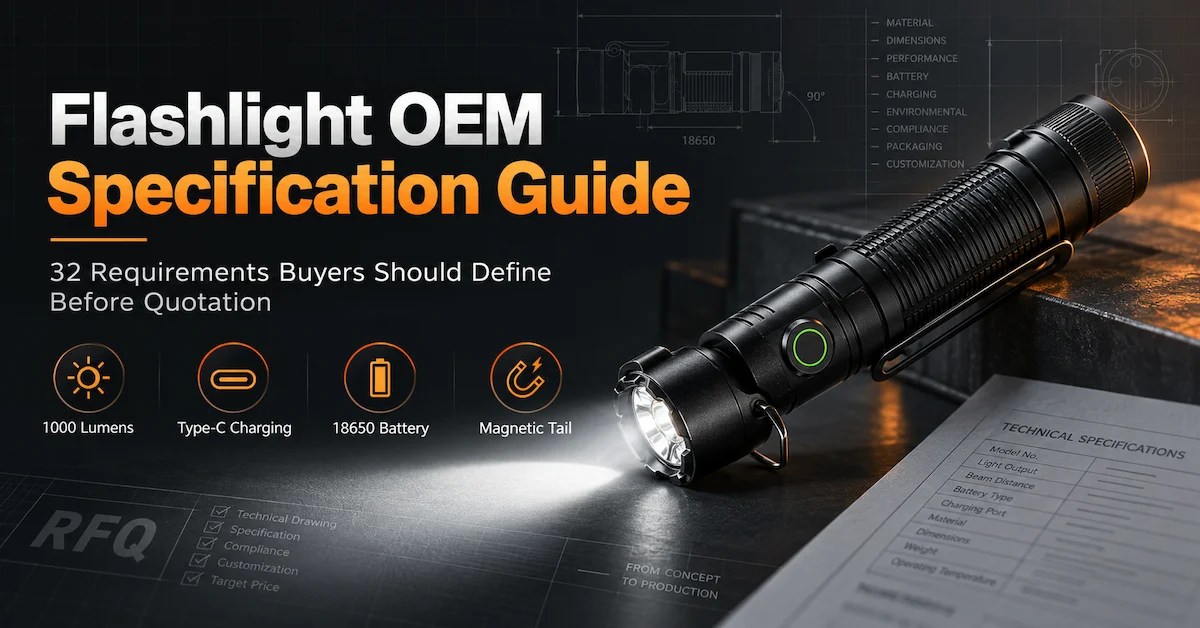
A compact specification sheet can be one or two pages. It should still identify the details that cannot change without approval. Include product photos, dimensions, material and finish, LED and optics reference, battery arrangement, charging interface, modes, indicator behavior, included accessories, logo method, package contents, carton quantity, and the inspection tests. Add the approved sample number and date. When a substitute part appears, ask for the reason and a side-by-side record; repeat approval whenever form, fit, function, safety, claims, or appearance moves.
This discipline is where an OEM flashlight manufacturer proves its value. Consistency is not created by a friendly chat history. It is created by a product reference that engineering, purchasing, production, inspection, and the buyer can all read the same way.
Run samples like a small decision project
Treat each sample as a temporary production reference, not as a desk keepsake. Label it, photograph its arrival condition, note the build, then run the checks from the brief. If three people are reviewing the light, use the same short score sheet. One person can examine handling, another can check charging and runtime, and another can review packaging and commercial fit. The result is more useful than a group message saying the sample “looks good.”
Practical sample checks
- First-use clarity: Can a new user install or charge the battery and find the main mode without guessing?
- Switch behavior: Is the button easy to find, consistent, and protected from accidental activation?
- Beam usefulness: Does the beam suit the actual distance and task? Check artifacts, dark rings, and spill.
- Runtime behavior: Observe useful output over time, not only the advertised maximum mode.
- Charging: Check connector fit, indicator logic, temperature, cable access, and full-charge behavior.
- Mechanical handling: Inspect threads, clip, magnet, head angle, seals, lens, bezel, and battery contact.
- Finish and branding: Look for color consistency, print or engraving quality, scratches, and logo alignment.
- Package accuracy: Confirm claims, warnings, accessories, language, barcode, and model identity.
Record every requested change in a dated sample report. “Make the switch better” is too subjective. “Increase the side-button actuation force so it does not activate during pocket carry; submit the revised unit for confirmation” gives the supplier something testable. The same standard applies to color, beam, logo position, magnet strength, or packaging.
Send your flashlight RFQ to Brightenlux →
Include destination market, application, quantity, target performance, customization and launch date.
Quality control should follow the way the customer uses the light
Quality control is most useful when it follows the product from incoming components to packed cartons. Incoming checks can cover LEDs, cells, housings, lenses, reflectors, seals, switches, boards, magnets, clips, cables, and printed materials. In-process checks can cover polarity, soldering, assembly fit, sealing, optical alignment, mode logic, charging, and appearance. Final checks can verify function, accessories, labels, package contents, carton count, and the agreed sampling plan.
Ask what happens after a failed result. A ticked checklist proves little when nobody owns the failure. A workable response names the lot, holds suspect pieces, finds the cause, adjusts the process, and shows evidence before release. On reorders, that response depends on disciplined change control as much as it did on the first inspection. A cheaper cell or driver substitution can alter runtime, charging, brightness, or customer experience even when the housing looks unchanged.
A dependable OEM flashlight manufacturer should also help the buyer match claims to current evidence. Requirements vary by battery configuration, destination, sales channel, and product use. Ask for the documents that apply to the ordered model and market, then check model names, component scope, dates, and report ownership. Avoid treating a generic logo on a PDF as proof for every flashlight in the catalogue.
Design private-label packaging for questions, not decoration
Packaging has two jobs: protect the product and help the next person understand it. The front should identify the product and its main use. The side or back can explain power, charging, modes, accessories, dimensions, warnings, and market-specific information. A clear package reduces pre-sale confusion and preventable returns. It also gives distributors and retail staff a consistent explanation.
Working with a private label flashlight manufacturer should include a documented artwork workflow: dieline, copy draft, product claims check, barcode check, legal or importer information, color proof, and production proof. Keep the approved file revision with the product specification. A box revision cannot stay closed when its battery, accessory set, or mode order changes; reopen the artwork and check every affected claim.
For some programs, the custom flashlight manufacturer also sources the insert, tray, sleeve, or kit box. Measure the finished bundle only after the product and accessories stop moving, then confirm carton construction. A package quoted too early can become the wrong size or fail to protect the revised configuration.
MOQ and price make sense only when the scope is visible
A minimum order quantity is not a universal factory personality test. It depends on the model, materials, logo method, color, packaging, battery, production schedule, and whether components can be shared with current work. A standard model with an existing package can often support a different opening quantity from a new housing color, custom board, special cell, or printed gift box.
Ask the supplier to quote tiers against one stable specification. Make the quote readable: show the light, branding, package, tooling, tests, samples, inspection, and freight on separate lines. Write the Incoterm and the expiry date beside the numbers. When a smaller run costs more per unit, weigh that surcharge against cash tied up in unsold stock. A small launch can be commercially sensible when it tests a new channel, but only if the buyer understands which customizations are realistic at that volume.
A wholesale flashlight supplier relationship may be the right first step for a reseller that needs speed and standard products. An OEM relationship becomes more useful when the buyer needs controlled changes and repeatable brand presentation. Neither route is automatically superior; the route must match the launch risk and the reason customers will choose the product.
How to compare a flashlight manufacturer in China
Geography can explain supply-chain access, but it does not replace supplier verification. When evaluating a flashlight manufacturer China buyer teams should verify the legal business, facility, engineering ownership, production scope, quality system, export experience, and communication process relevant to the project. The goal is to learn who controls the result and who merely forwards messages.
Request a process map for the proposed model. Which parts are made internally? Which are purchased? Who approves incoming cells and LEDs? Where are boards assembled? How are housings finished? Who performs final assembly and testing? If a cell delivery slips or a plating batch fails, who calls the buyer, who contains the units, and who approves the next move? Outsourcing is normal; losing sight of an outsourced step that changes the finished light isn't.
| Evaluation area | Evidence to request | Warning sign |
|---|---|---|
| Product definition | Marked specification and approved sample | Important details remain only in chat |
| Component control | BOM controls and change approval process | Substitution is treated as routine |
| Production quality | Incoming, in-process, and final inspection records | Only finished samples are shown |
| Claim support | Model-specific test method and current documents | One report is used for unrelated models |
| Repeat-order readiness | Revision history, retained references, and forecast plan | Each reorder begins from memory |
Build the RFQ so quotations are comparable
A vague inquiry invites assumptions. A useful request for quotation gives each supplier the same context and asks it to flag deviations. Include the application, target market, product reference, desired changes, battery and charging preference, beam and runtime needs, protection expectations, accessories, logo, packaging, order tiers, schedule, delivery term, and evidence required. Attach reference images, but explain which features matter; otherwise a supplier may copy the appearance while missing the function.
Ask for a response in columns: requirement, offered specification, deviation, evidence, lead time, and cost effect. This turns the quote into a decision document. It also reveals whether the supplier understood the request. When an OEM flashlight manufacturer proposes an alternative, require a reason. A different battery or housing may be a smart way to hit the target cost, but the trade-off should be explicit.
Ten lines that belong in the first RFQ
- End user and primary application.
- Destination country and sales channel.
- Reference model or preferred form factor.
- Required light behavior and operating modes.
- Battery, charging, indicator, and runtime expectation.
- Housing, finish, clip, magnet, seal, and accessory needs.
- Logo, color, package, manual, and barcode requirements.
- Opening quantity plus two realistic reorder tiers.
- Sample, testing, inspection, and documentation expectations.
- Target approval, production, and shipment dates.
Common sourcing mistakes that cost more than they save
Approving a photo instead of a configuration
A product photo cannot show the cell, driver, charge behavior, seals, or component revision. Use it to identify the model, then approve the details that determine performance and customer experience.
Comparing quotations with different assumptions
One price may include a battery, cable, printed box, and inspection; another may not. Normalize the scope before deciding which offer is cheaper.
Changing too many variables in the first order
Every new color, component, function, accessory, and package adds an approval point. Begin with the changes that create visible customer value. Earn deeper customization through a controlled launch and real feedback.
Treating the golden sample as the only record
A physical sample matters, but it can be lost, damaged, or misunderstood. Pair it with a specification, artwork revision, test record, and clear model code.
Writing marketing claims before evidence arrives
“Waterproof,” runtime, lumen, distance, and charging claims need product-specific support and careful wording. Create the content after the configuration and evidence are settled.
FAQ about OEM flashlight manufacturing
OEM or private label: where is the line?
Private label work commonly begins with a finished model and changes the customer-facing pieces: brand mark, body color, box, manual, and barcode. OEM can include those items plus controlled changes to configuration, functions, components, or accessories. In real projects the terms overlap, so buyers should define the scope rather than rely on the label.
How should I choose an OEM flashlight manufacturer?
Start with the user job and a written brief. Give points for clear engineering replies, a suitable base model, controlled samples, stable parts, sensible inspection records, supported claims, accurate packs, delivery planning, and repeat-order discipline. Choose the team that can discuss a compromise plainly and build the signed-off light again, not the one that fills a quotation with the most features.
18650 or 21700: which one fits the brief?
There isn't a universal winner. An 18650 platform can support a compact, familiar format. A 21700 platform can offer more capacity and suit a higher-output or longer-runtime position, but may create a larger and heavier product. Evaluate the cell, driver, thermal design, charge time, runtime, and user preference together.
Can an OEM flashlight include USB-C charging?
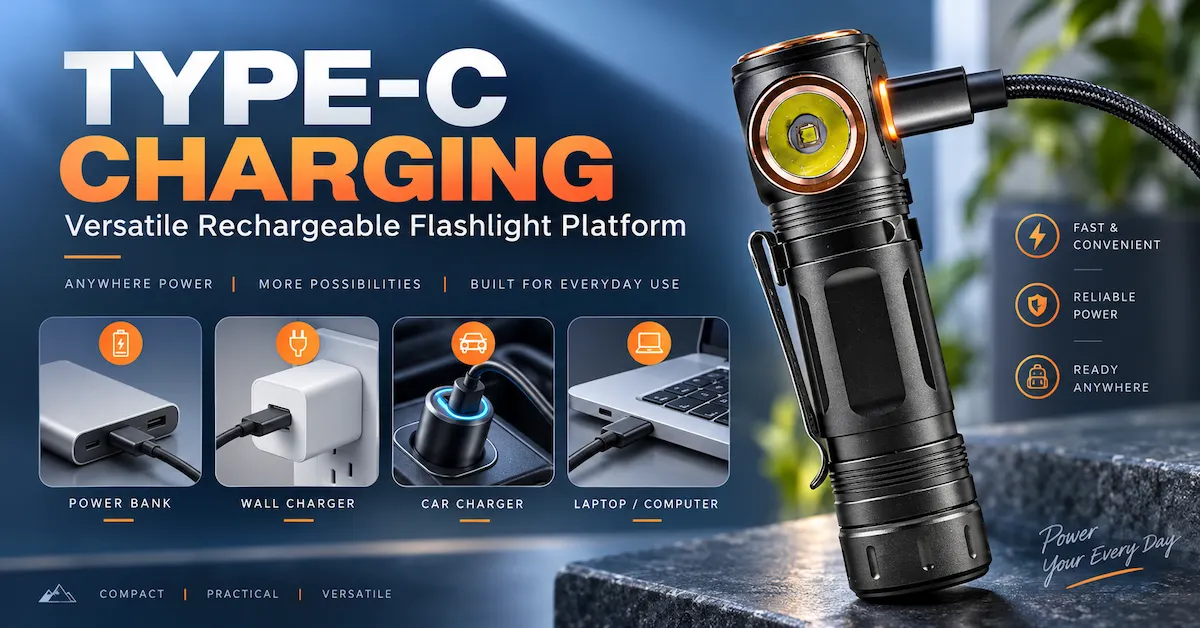
Yes. Several Brightenlux public product pages show Type-C rechargeable platforms. Buyers should still confirm the connector design, cable, input specification, charge time, indicator logic, battery protection, and test method for the ordered model.
What can be customized without new tooling?
Depending on the product, logo, package, manual, barcode, color, accessories, and some configurations may be possible without a completely new housing tool. Electrical, optical, or structural changes may require engineering, new parts, or tooling. Ask for a change-by-change assessment.
How many samples are needed before production?
The number depends on the depth of change and the risk. A straightforward branded model may need a product sample and a packaging proof. A revised electrical or structural configuration may require engineering samples, corrected samples, a signed approval unit, and a pilot or pre-production check. Define approval stages before work begins.
How do I keep repeat orders consistent?
Maintain one controlled package of references: specification, BOM controls, approved sample code, artwork, inspection criteria, test evidence, deviations, and revision history. Require written approval for substitutions. Share a forecast early enough for the supplier to plan stable components.
Turn the next inquiry into an actionable product brief
Price comes after a useful first move: a one-page brief. It gives the supplier enough context to recommend a platform instead of guessing at one. State the application, market, quantity, battery preference, beam, runtime, handling, branding, package, and launch schedule. Mention which items are fixed and which can change. That gives the OEM flashlight manufacturer room to propose a manufacturable answer without guessing.
Brightenlux currently presents dual-power, 18650, 21700, adjustable-head, magnetic-tail, red-mode, and right-angle rechargeable flashlight platforms on its website. Buyers can review the current flashlight products and select two or three references for comparison. From there, the discussion can move to samples, branding, packaging, evidence, quantity tiers, and a realistic production plan.
Start Your Custom Flashlight RFQ →
Tell us the market, application, quantity, customization and target launch date.
Planning a branded flashlight line? Contact Brightenlux with your target user, destination market, preferred product links, opening quantity, customization list, and required delivery window. A precise inquiry makes it easier to recommend a suitable platform, identify the real development work, and prepare a quotation that your team can evaluate.