

Direct answer: A useful flashlight OEM specification template does more than list lumens, battery capacity, and logo position. It defines the intended user, measurable performance, charging behavior, mechanical limits, user-interface logic, packaging, quality evidence, approval samples, and the rules for any component change. When these points are agreed before quotation, buyers receive proposals that can be compared on the same basis. They also reduce the chance that a promising sample turns into an inconsistent production lot.
This guide gives sourcing managers, product developers, distributors, and private-label teams a 32-field specification they can use before requesting an OEM flashlight quotation. It is written for B2B programs in which repeatability matters as much as the first sample. The template is not a substitute for engineering review, regulatory advice, or market-specific testing. It is a practical brief that tells a manufacturer what must be decided, what must be measured, and what evidence must accompany an approval.
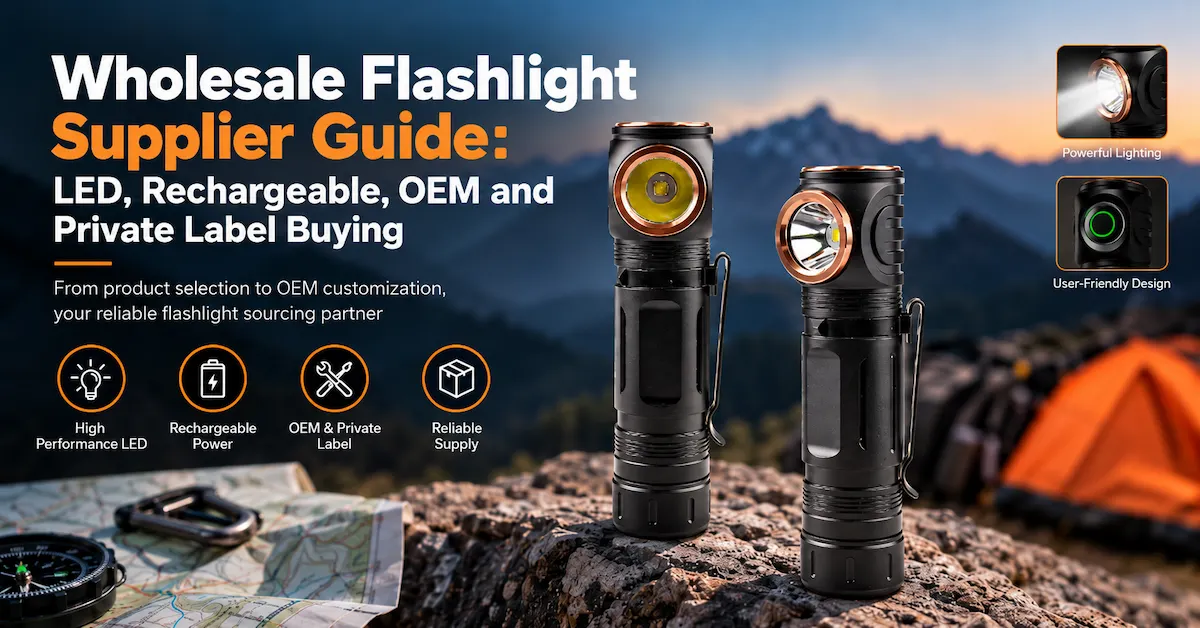
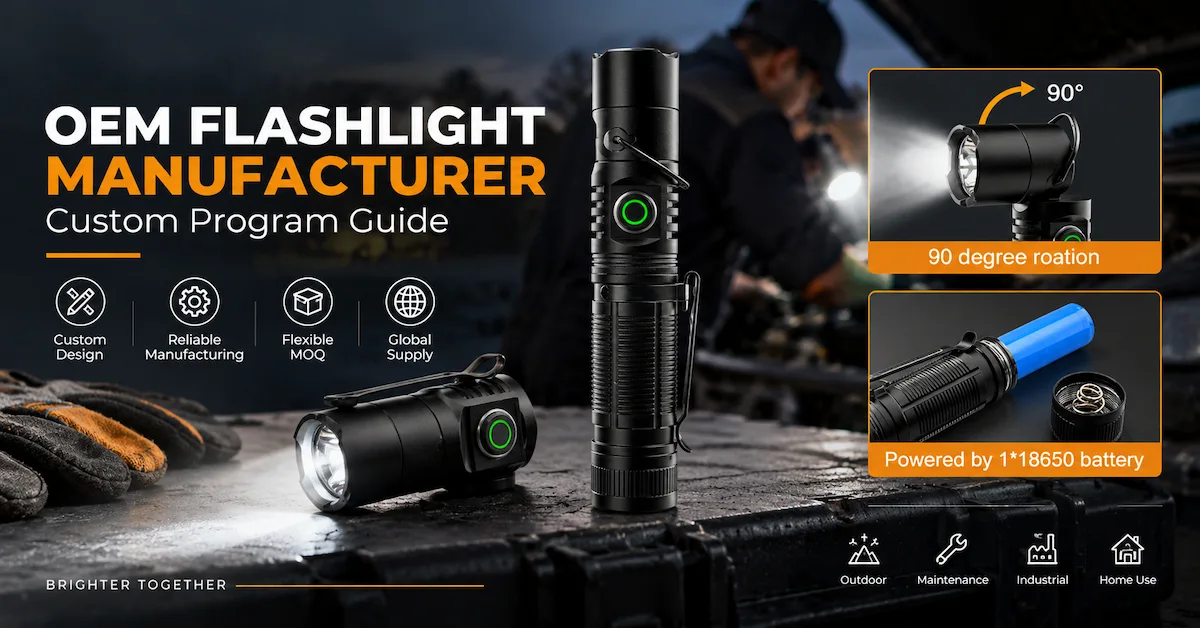
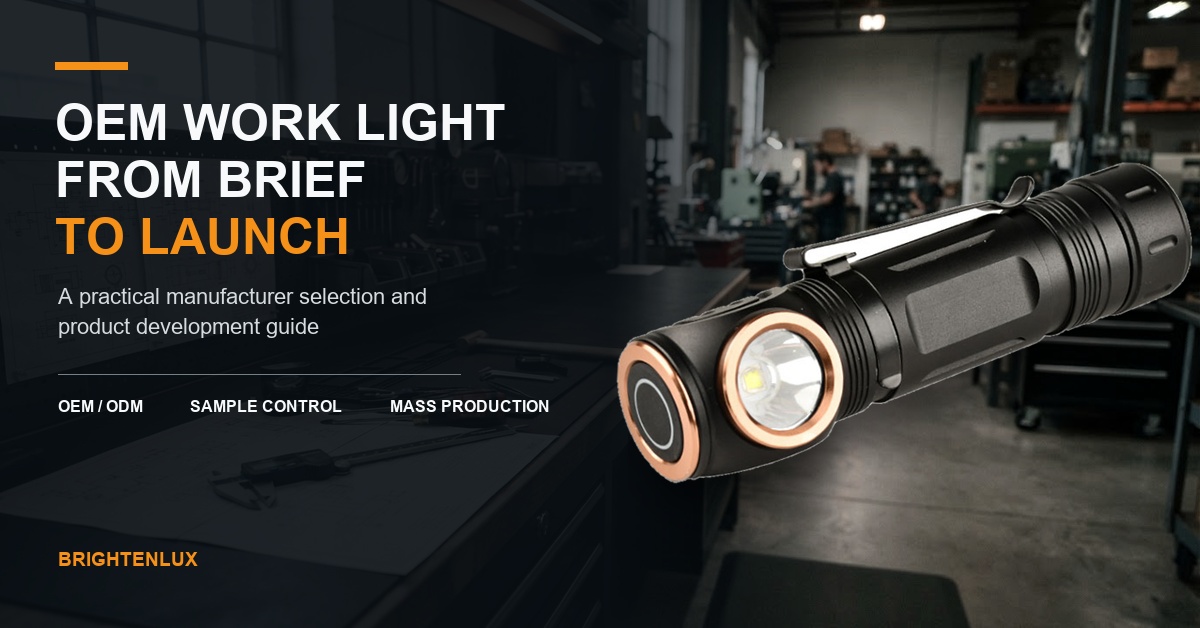
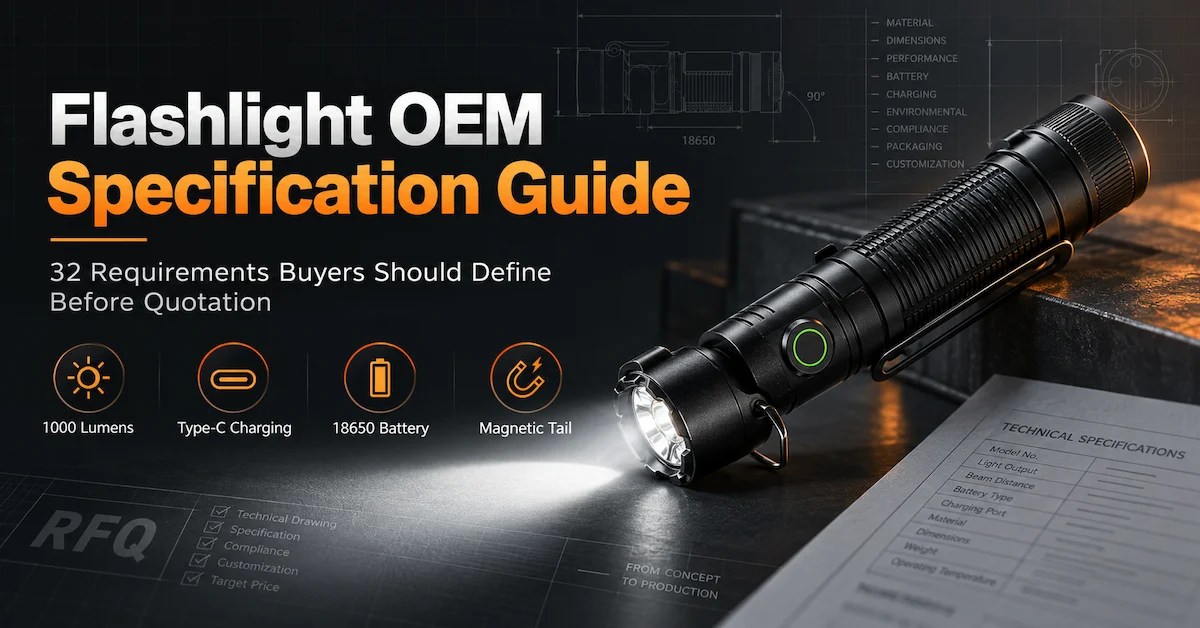
Buyers who already have a reference platform can review the Brightenlux 1000-lumen adjustable-head rechargeable flashlight. Its published configuration includes an SST40 LED, adjustable head, magnetic tail, five modes, an included 2200mAh 18650 battery, Type-C charging, aluminum construction, and an IP44 claim. Those details are useful inputs, but an OEM project still needs its own signed specification, claim evidence, packaging brief, and change-control record.
| BUILD A QUOTE-READY FLASHLIGHT PROGRAM → |
Why an OEM flashlight quotation needs a controlled specification
A flashlight OEM specification template becomes valuable when every supplier answers the same commercial and technical questions. It should expose differences instead of hiding them behind similar product names.
Two quotations can carry the same headline description and still represent different products. One supplier may quote peak light output while another discusses sustained output. One may include a branded lithium-ion cell and a cable; another may quote the flashlight body only. A five-mode user interface can mean a predictable sequence, a hidden strobe, or a mode memory that returns to the buyer's least preferred setting. Even a simple phrase such as "water resistant" is incomplete unless the claim, test method, sample conditioning, and acceptance criteria are named.
A controlled specification turns those ambiguities into decisions. It gives the commercial team a common comparison sheet, gives engineers a testable target, gives the supplier a defined quotation basis, and gives quality inspectors a reference for the approved lot. It also prevents the specification from being scattered across chat messages, annotated photos, old samples, and separate packaging emails. The goal is not to make the brief unnecessarily rigid. The goal is to identify which variables may change, who approves a change, and what evidence is required before the change reaches production.
For SEO and AI search, this distinction matters because buyers are not merely searching for an "OEM flashlight manufacturer." They are asking operational questions: What should be included in a custom flashlight specification? How can quotes be normalized? Which tests should be completed before mass production? What belongs in a golden sample? The answers below are structured so that a buyer can extract a field, acceptance rule, or question without reading an advertising claim in place of evidence.
How to use this flashlight OEM specification template
- Complete the business context first. Define the market, user, application, target order quantity, and sales channel before selecting technical details.
- Mark each field as fixed, preferred, or supplier-proposed. A fixed field is mandatory. A preferred field may be optimized. A supplier-proposed field asks the factory to recommend a proven platform.
- Attach a verification method. A number without a measurement method is not a complete requirement.
- Separate catalog claims from project acceptance criteria. A current product page is a reference. The signed project specification controls the OEM program.
- Request exclusions and assumptions in the quotation. Buyers should know whether cells, chargers, cables, packaging, testing, tooling, and freight are included.
- Approve one controlled sample. The signed golden sample, drawings, bill of materials, artwork, and test records should identify the production baseline.
- Apply change control. A substitute LED, battery, driver, lens, seal, cable, or coating may affect performance and should not enter production silently.
Use the table below as an RFQ worksheet. Add a column for the buyer's requirement, a column for the supplier's offered value, and a column for supporting evidence. Do not force every product into a high specification. A reliable 500-lumen utility light may create more value than a poorly controlled high-output light if the channel needs predictable runtime, simple operation, and low return rates.
The 32 fields buyers should lock before quotation
| No. | Specification field | What the buyer should define | Evidence or acceptance method |
|---|---|---|---|
| 1 | Target user and application | Name the real user, task, environment, gloves or PPE, carrying method, expected duty cycle, and misuse that the design must tolerate. | Approved use-case brief with representative scenarios and a list of conditions outside scope. |
| 2 | Target market and channel | State countries, retail or professional channel, language, price tier, warranty expectation, and any customer-specific requirements. | Market matrix reviewed by product, compliance, sales, and packaging owners. |
| 3 | Order structure | Define sample quantity, pilot quantity, expected production lot, annual forecast range, reorder pattern, and acceptable MOQ options. | Quotation separates sample, pilot, first production, and repeat-order terms. |
| 4 | OEM scope | Clarify whether the project is logo-only private label, color and packaging customization, platform modification, or new ODM development. | Scope table identifies included work, excluded work, tooling, engineering charges, and ownership. |
| 5 | Light source | Specify the LED family or allow an approved equivalent. Define binning, color temperature range, color rendering needs, and substitution rules. | LED maker and part reference on the controlled BOM; incoming verification or supplier certificate where appropriate. |
| 6 | Light output | State whether the requirement is initial, peak, or sustained output. Avoid treating a brief turbo value as continuous performance. | Test record naming battery state, ambient conditions, mode, timing, instrument, and sample count. |
| 7 | Beam intensity and distance | Define whether the program needs flood, balanced utility light, or throw. Use candela and beam distance where those metrics matter. | Measured beam-intensity record and calculation basis, with conditions aligned to the intended claim. |
| 8 | Beam pattern | Describe hotspot size, spill, artifacts, rings, edge quality, zoom behavior, and acceptable unit-to-unit variation. | White-wall photos at fixed exposure, target-distance photos, and a visual limit sample. |
| 9 | Optical architecture | Choose reflector, TIR optic, adjustable focus, fixed focus, or another system according to use and sealing requirements. | Approved optical drawing, lens material, reflector finish, focus travel, and sample comparison. |
| 10 | Battery format | Define built-in pack, removable 18650 or 21700 cell, dry-cell backup, dual power, or buyer-supplied battery. | BOM identifies cell format, holder, contacts, polarity protection, and included or excluded battery. |
| 11 | Cell specification | State nominal capacity, voltage, chemistry, supplier, protection arrangement, allowed tolerance, and traceability requirement. | Cell data sheet, lot code, capacity and internal-resistance sampling, and relevant transport documentation. |
| 12 | Runtime | Define the mode, start condition, termination threshold, sampling interval, and whether step-down behavior is acceptable. | Runtime curve rather than a single number; record output and temperature over time. |
| 13 | Low-battery behavior | Specify indicator thresholds, warning pattern, output reduction, shutoff voltage, and restart behavior. | Discharge test across samples with measured voltage and observed indicator state. |
| 14 | Thermal control | Define allowable surface-temperature range, step-down trigger, recovery behavior, and conditions that represent the intended use. | Temperature and output plot with thermocouple location, ambient conditions, and airflow noted. |
| 15 | Charging input | Define connector type, supported input, C-to-C expectation, orientation behavior, charger assumptions, and cable inclusion. | Compatibility matrix covering representative power sources, cables, orientations, and battery states. |
| 16 | Charge time | Set the starting state of charge, charger and cable, ambient condition, full-charge definition, and maximum acceptable time. | Voltage, current, time, and temperature log; do not infer charge time from capacity alone. |
| 17 | Charging indicators | Define colors, flashing states, full-charge state, fault state, and the behavior when the light operates while connected. | User-interface state table and functional inspection at low, mid, full, and fault conditions. |
| 18 | Charging protection | Request confirmation of overcharge, over-discharge, short-circuit, reverse-polarity, and thermal protections relevant to the design. | Circuit documentation and verification plan appropriate to the product and target market. |
| 19 | Housing materials | Name aluminum grade or polymer type where necessary, wall or structural expectations, lens material, and component interfaces. | Material declaration, drawing, approved sample, and inspection points for high-risk dimensions. |
| 20 | Finish and color | Define anodizing, paint, texture, gloss, color standard, acceptable variation, wear areas, and cosmetic defect zones. | Signed color chip or limit sample, controlled lighting condition, and adhesion or wear check if required. |
| 21 | Dimensions and mass | Specify critical dimensions, weight limit, center of mass, grip envelope, pocket or holster fit, and accessory interfaces. | Approved drawing with tolerances and measurement report from approval samples. |
| 22 | Sealing and ingress claim | State the exact claim needed and the ports, switches, joints, and battery doors that create risk. Do not use vague waterproof language. | Agreed test method, conditioning, sample count, pass criteria, and post-test functional inspection. |
| 23 | Mechanical durability | Define drop height and orientations, vibration or transport exposure, switch cycles, connector cycles, clip retention, and magnet checks. | Protocol with pre-test baseline, test sequence, failure definition, and post-test measurements. |
| 24 | Switch architecture | Choose tail switch, side switch, dual switch, electronic switch, rotary control, or combined arrangement based on use. | State diagram and ergonomic review with bare hands and any relevant gloves. |
| 25 | Mode sequence | List every state and transition: off, high, medium, low, strobe, SOS, red, lockout, and charging states as applicable. | Signed user-interface state table tested on the golden sample and production inspection fixture. |
| 26 | Memory and lockout | Define whether mode memory is allowed, its time threshold, default start mode, electronic or mechanical lockout, and unlock action. | Repeated transition test after short and long off-times, battery removal, charging, and low-voltage events. |
| 27 | Branding | Define logo method, artwork dimensions, orientation, color, placement, durability, legal marks, and whether serial or lot codes are required. | Vector artwork, placement drawing, logo proof, adhesion or abrasion limit, and signed branded sample. |
| 28 | Accessories | List battery, cable, charger, clip, lanyard, holster, headband, seals, spare parts, instructions, and any market-specific plug. | Pack-out checklist with part number, quantity, placement, and approved supplier or equivalent rule. |
| 29 | Packaging and labeling | Define unit pack, master carton, barcode, language, warnings, claims, battery marks, recycling information, and drop-protection needs. | Approved dieline, printed proof, packed sample, carton specification, and distribution-test plan where needed. |
| 30 | Quality inspection plan | Classify critical, major, and minor defects; define sampling basis, functional checks, cosmetic zones, and measurement tools. | Inspection specification linked to current drawings and the agreed sampling plan. |
| 31 | Approval evidence | List drawings, BOM revision, test reports, compliance files, artwork, manuals, photos, and samples required before release. | Document register with owner, revision, date, model applicability, and approval status. |
| 32 | Change control | Require notice before changes to LEDs, cells, drivers, optics, cables, seals, materials, finishes, factories, processes, or packaging. | Supplier change request showing reason, risk assessment, samples, retesting, and written buyer approval. |
Fields 1 to 4: start with the buyer, not the component list
In this part of the flashlight OEM specification template, the buyer defines who will use the product and what level of customization is actually required.
An OEM brief should begin with context because product decisions interact. A light intended for a maintenance cart may prioritize magnetic mounting, adjustable angle, broad spill, and clear battery indication. A patrol light may prioritize immediate access to a predictable main mode, secure carry, impact resistance, and a switch that works under stress. A promotional light may emphasize branding, packaging, and price, while an industrial program may give more weight to repeatable components, inspection records, spare parts, and controlled substitutions.
Write the context in observable terms. "Professional quality" is not observable. "Used by service technicians for two-hour shifts, often with gloves, mounted to steel panels, and recharged from shared USB power supplies" is much more useful. It lets the supplier propose a platform and lets the buyer challenge conflicts. For example, an exposed charging port may be convenient but add sealing risk. A strong magnet may improve hands-free use but create packaging, transport, or application concerns. A complex mode sequence may look feature-rich but slow down a user who needs one dependable output.
OEM scope must also be explicit. Private label usually means a proven platform with branding and packaging changes. Platform customization might add a battery, optic, switch, color, or accessory change. ODM development may involve mechanical, electronic, tooling, and compliance work. Those paths have different lead times, risk, validation needs, and ownership questions. A buyer who uses the word "custom" without defining the level of change may receive quotations that cannot be compared.
Fields 5 to 9: specify useful light, not a lumen headline
The optical section of a flashlight OEM specification template should connect every performance claim to a task, condition, and verification method.
Light output is only one part of visual performance. The same nominal lumen value can be arranged as a wide flood, a tight hotspot, or an uneven beam with artifacts. For procurement, the question is whether the beam helps the intended task at the intended distance. A close inspection light needs a different distribution from a search light. A retail range may deliberately include both, but the distinction should be visible in the specification and packaging rather than left to customer discovery.
The Portable Lights American Trade Organization explains that portable-light performance claims depend on consistent testing. In its discussion of ANSI/PLATO FL 1-2025 testing practices, PLATO distinguishes normal-mode measurement from short-duration elevated brightness and emphasizes documented procedures, calibration, training, and data integrity. Buyers do not need to turn an RFQ into a laboratory manual, but they should ask when output was measured, how the battery was prepared, how many samples were tested, and whether the value represents a stable mode or a brief peak.
Beam review should combine numbers and visual evidence. Candela can help describe intensity, and beam distance can be calculated under a stated method, but fixed-camera photographs help teams discuss rings, color variation, spill, and hotspot shape. Use the same distance, wall, camera settings, battery state, and exposure for comparisons. Do not treat an attractive marketing photograph as measurement evidence. Its purpose is communication, not calibration.
Optical architecture affects sealing, cost, handling, and failure modes. Adjustable-focus systems give users control over flood and throw, but sliding or rotating mechanisms introduce tolerances and wear surfaces. Fixed reflectors or TIR optics may simplify operation and sealing. No architecture is universally superior. The specification should connect the optical choice to the user's task and define what variation is acceptable from one unit to another.
Fields 10 to 18: battery and charging must be treated as one system
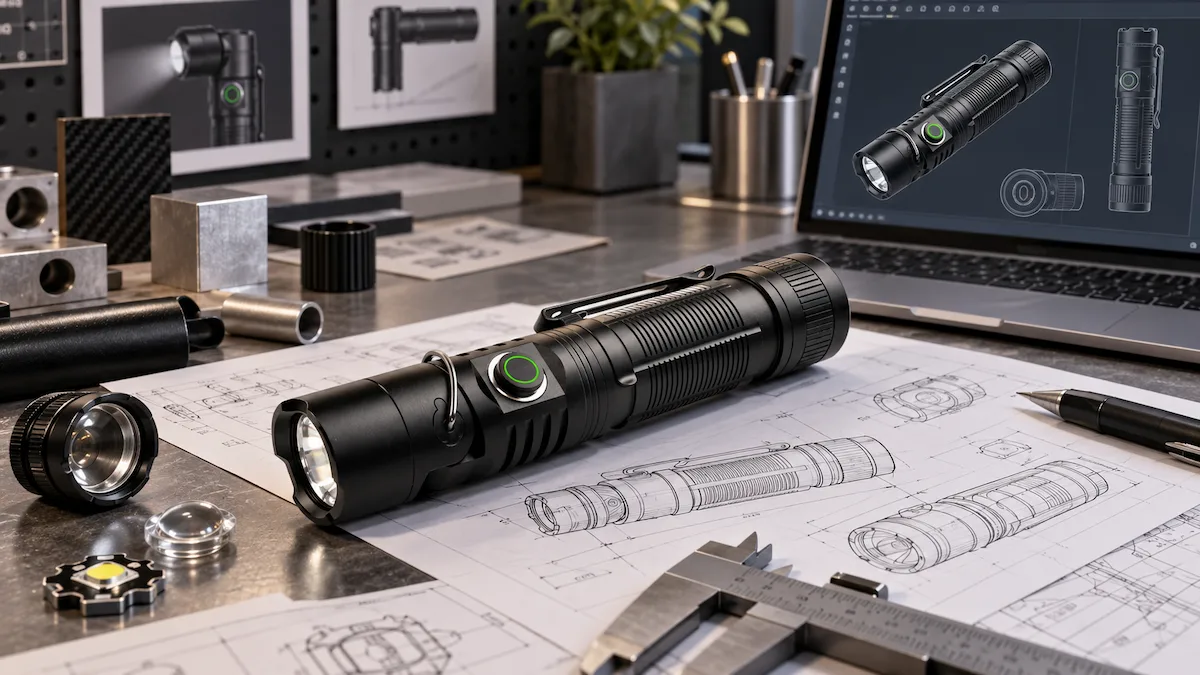
A complete flashlight OEM specification template treats the cell, driver, protection, connector, cable, indicators, and firmware as interacting parts of one power system.
A rechargeable flashlight is not defined by a capacity number alone. The cell, protection circuit, driver, connector, cable, charging IC, indicator logic, thermal path, and firmware form one power system. Changing any one of them can alter charge time, usable runtime, low-voltage behavior, temperature, and claim accuracy. That is why the battery and cable belong on the controlled BOM and why a substitute cell should trigger a documented review.
Runtime should be recorded as a curve. A single value can hide a fast step-down, a long low-output tail, or a termination rule that does not reflect useful illumination. The curve should identify output over time, battery condition, mode, ambient temperature, and the chosen endpoint. If the product uses an elevated mode for a short period, the brief should distinguish that behavior from continuous settings. A buyer can then decide whether the experience fits the intended application and whether the packaging explains it honestly.
Charging compatibility deserves its own matrix. "USB-C" identifies a connector, not every possible charging behavior. Test representative USB-A to USB-C and USB-C to USB-C sources if both are expected. Include cable orientation, different state-of-charge conditions, operation while connected, and recovery after a deeply discharged battery. Record current, time, and temperature instead of relying on a charger icon. If the project includes a cable, specify its length, construction, labeling, and approval sample; an uncontrolled cable can change charging performance.
The published Brightenlux adjustable-head flashlight page states that the reference model includes a 2200mAh 18650 battery, a Type-C port, a cable, four-to-six-hour working time, and a ten-hour full recharge claim. An OEM buyer should carry those catalog values into a project brief only after confirming the exact model, test conditions, included accessories, and claim wording for the target order. The same discipline applies to every supplier's reference platform.
Fields 19 to 23: mechanical requirements need failure definitions
Review the 1000-lumen adjustable-head reference platform →
The mechanical section of the flashlight OEM specification template should state what counts as acceptable wear, cosmetic damage, intermittent behavior, and functional failure.
Mechanical specifications often fail because the test is named but the failure is not. A drop test requires a height, surface, orientation sequence, number of impacts, sample count, and post-test checks. Does a dent count as failure? What about a temporary flicker, a shifted lens, a damaged finish, a loose clip, reduced sealing, or a light that still turns on but no longer charges? The project team must classify cosmetic and functional outcomes before the test, not after seeing the result.
Ingress protection claims require equal care. IEC 60529 is the underlying reference for IP code classification, but the buyer still needs to identify the intended rating, model configuration, port-cover condition, sample preparation, and post-test inspection. The project should not borrow a test report from a visually similar model without confirming that the report applies to the same construction. Tooling, seals, vents, fasteners, switch boots, lens joints, and charging covers can all affect results.
Surface finish should be controlled with realistic limits. Aluminum parts can show color differences between lots or components. Contact points, clips, knurling peaks, and edges may wear differently from broad surfaces. Define viewing distance, lighting, defect zones, and approved limits. A signed color sample is more useful than an adjective such as "premium black." If abrasion resistance matters to the channel, agree on a repeatable test and pass criterion rather than assuming every anodized finish performs the same.
Transport packaging is part of mechanical protection. ISTA describes a range of package test procedures, from screening tests to general simulations of distribution hazards. The correct procedure depends on the package and distribution objective. Buyers should choose a relevant plan with qualified packaging or test personnel, document the packed configuration, and avoid claiming that one generic drop test predicts every route.
Fields 24 to 26: write the user interface as a state table
For controls, a flashlight OEM specification template should name both the visible mode list and every important transition between modes.
Mode names are not enough to define operation. The specification should show what happens from each state after a short press, long press, double press, power interruption, battery replacement, charging connection, and lockout action. It should also define the maximum time between clicks and whether the timing remains acceptable at low battery. This turns a subjective statement such as "easy switch" into a sequence that sample reviewers and inspectors can repeat.
Mode memory should be deliberate. Memory can be useful when a technician repeatedly uses the same level. It can be undesirable when a safety or emergency program expects a predictable start mode. Some programs prefer last-mode memory after a minimum run time; others always start on high, medium, or low. Hidden strobe access may reduce accidental activation, while a direct strobe control may suit a specific signaling use. The correct answer depends on the buyer's application, not on the number of modes in a catalog.
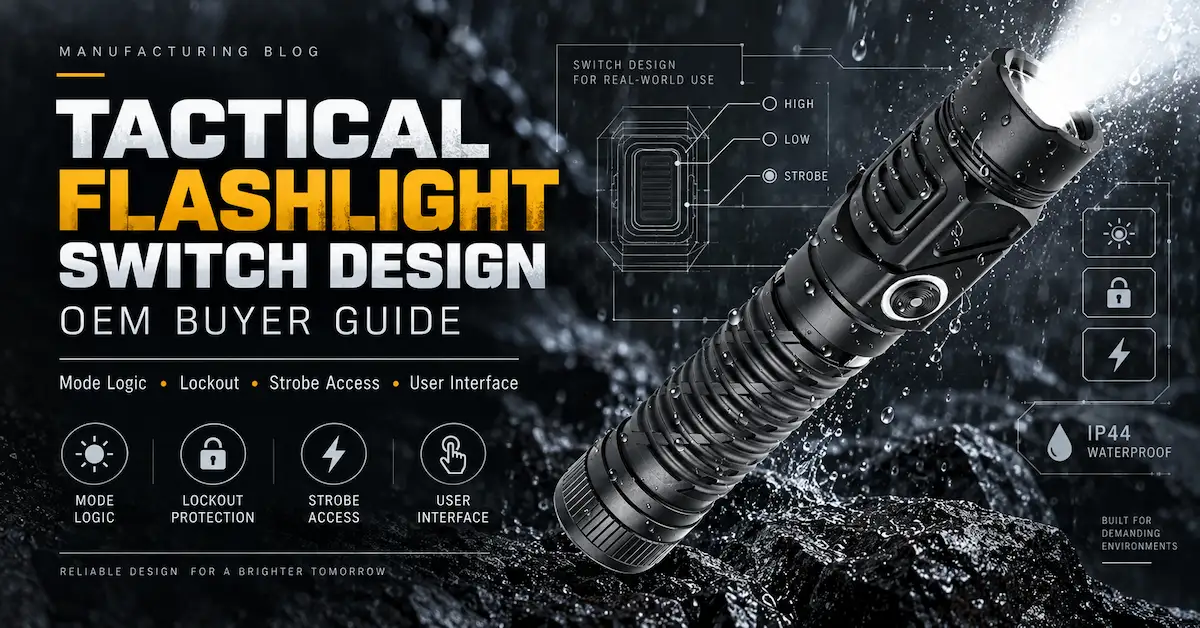
Lockout can be mechanical, electronic, or both. A tail-cap break can offer visible isolation but may affect sealing or user convenience. An electronic sequence can be convenient but must be discoverable, consistent, and resistant to accidental unlocking. Define indicator feedback and the behavior during charging. Test lockout after transport vibration, switch cycling, battery removal, and low-voltage shutoff so that it is not merely a firmware label.
Fields 27 to 29: branding and packaging are product requirements
The branding section of a flashlight OEM specification template keeps the logo, finish, packaging, manual, accessories, and online claims aligned with the approved product.
Branding work should begin with a placement drawing, not a logo file sent without context. Identify the printable or engravable area, orientation when the product is carried or displayed, artwork size, color, and process. Laser engraving, pad printing, screen printing, labels, and molded marks have different appearance, durability, color, and cost characteristics. Approve the process on the actual finish because a logo proof on paper does not show contrast, edge quality, adhesion, or wear on the product.
Packaging must explain exactly what the customer receives and how the product should be used. Confirm battery inclusion, cable type, charging input, important warnings, mode sequence, claim language, storage guidance, barcode, model name, and market language. The product, packaging, manual, sales sheet, and online listing should use the same controlled values. Mismatched claims create returns and can turn a technically acceptable product into a channel problem.
The pack-out checklist should be visual and countable. It should show where the product, cable, battery, lanyard, clip, manual, spare seal, and inserts are placed. It should identify the approved artwork revision and carton marks. At pilot stage, pack several units using normal production methods and inspect the result after handling. This exposes cable pressure, cosmetic rubbing, loose accessories, difficult unboxing, and label visibility before a large lot is packed.
Fields 30 to 32: inspection, approval evidence, and change control
The final part of the flashlight OEM specification template turns the approved sample into a repeatable production baseline through inspection, documentation, and change control.
An inspection plan should connect every important characteristic to a method. Critical safety-related defects, major functional defects, and minor cosmetic defects should not share one undifferentiated limit. The current edition of ISO 2859-1 provides an international framework for acceptance sampling by attributes. A buyer should select a sampling approach with qualified quality personnel, define lot formation and defect classes, and avoid using "AQL" as shorthand for quality assurance. Sampling does not replace process control, and an accepted sample does not prove that every unit is defect-free.
Approval evidence should be a register, not a folder with unclear filenames. Each drawing, BOM, artwork, manual, report, photograph, and sample needs a revision, date, model applicability, owner, and approval status. If a report covers only one configuration, that limitation should be visible. If the buyer has not verified a certification or claim, it should remain marked as pending. A transparent pending status is more useful than an unsupported green check.
Change control protects repeat orders. Electronic and battery supply chains change, but substitutions must be visible. The supplier change request should name the current and proposed parts, explain the reason, assess effects on performance, compliance, tooling, labeling, and stock, and propose validation. The buyer then approves, rejects, or requests more evidence. This process is especially important for cells, LEDs, drivers, charging cables, sealing parts, optical components, and firmware because their changes may not be obvious in a normal visual inspection.
How to normalize OEM flashlight quotations
Send the same flashlight OEM specification template to each candidate and require a line-by-line compliance or deviation response before comparing price.
After sending the same specification to candidate suppliers, place each response in a normalized comparison. Do not compare only the unit price. Record the product configuration, battery and accessories, packaging, testing, tooling, samples, payment assumptions, lead time, warranty support, replacement parts, and freight basis. A lower unit price may exclude items another supplier included. A higher price may reflect a different cell, larger pack, stronger evidence package, or more complete inspection.
| Quotation line | Supplier A | Supplier B | Buyer check |
|---|---|---|---|
| Reference model and revision | Record exact offer | Record exact offer | Same platform and scope? |
| Battery | Maker, model, capacity, included? | Maker, model, capacity, included? | Same cell basis and evidence? |
| Cable and charger | Included or excluded | Included or excluded | Same charging accessories? |
| Branding and packaging | Methods and quantities | Methods and quantities | Same artwork scope? |
| Testing and documents | Included reports and samples | Included reports and samples | Same model applicability? |
| Tooling and engineering | Charges and ownership | Charges and ownership | Same change level? |
| Inspection | Supplier and third-party options | Supplier and third-party options | Same defect definitions? |
| Commercial basis | MOQ, currency, Incoterm, validity | MOQ, currency, Incoterm, validity | Same quantity and delivery basis? |
Ask each supplier to list deviations rather than silently replacing the requested value. A deviation may be sensible. For example, a proven cell or optic may perform better than a buyer-nominated part. The important point is that the proposal is visible, supported, and approved. A quotation marked "as requested" without a compliance matrix can hide different assumptions until the sample or production stage.
A practical sample-to-production approval sequence
The flashlight OEM specification template should remain linked to every sample gate so provisional parts are not mistaken for the final production configuration.
- Feasibility review: The supplier confirms fixed requirements, identifies conflicts, and lists proposed values and evidence gaps.
- Engineering sample: The team validates core optics, power, charging, thermal behavior, mechanics, and user-interface logic before cosmetic perfection.
- Brand sample: Logo, finish, color, artwork, and pack-out are added to the approved technical platform.
- Compliance and risk review: Market requirements, model applicability, battery documentation, labels, and claim evidence are checked by competent specialists.
- Golden sample: The final configuration is signed with matching drawings, BOM, firmware, artwork, manual, and inspection plan.
- Pilot lot: Normal production methods are used to expose assembly variation, inspection time, packaging issues, and process gaps.
- Mass-production release: The buyer approves production only after pilot findings are closed and controlled documents match the sample.
The golden sample is not only a physical object. It is a controlled record. If a component cannot be seen without disassembly, the BOM and supplier record matter. If firmware determines the mode sequence, the firmware revision matters. If the package carries a performance claim, the approved artwork and evidence matter. Store retained samples under suitable conditions and define when they are rechecked or replaced.
Worked example using a Brightenlux reference platform
Suppose a distributor is evaluating an adjustable-head work flashlight for automotive service and maintenance. The Brightenlux 1000-lumen SST40 reference product provides a concrete starting point: a claimed 1000-lumen output, 100-meter beam distance, adjustable head, magnetic tail, high-medium-low-strobe-SOS modes, included 2200mAh 18650 cell, Type-C charging, aluminum body, and IP44 claim. The buyer should not copy those phrases directly into a purchase order and assume every decision is complete.
The use-case brief might state that technicians need hands-free light on steel vehicle panels, a beam suitable for close inspection, operation with nitrile or light work gloves, and a predictable low mode for reflective surfaces. The technical review would then ask whether the adjustable head holds position through cycles, whether the magnet resists sliding on representative painted and unpainted surfaces, whether the beam has distracting artifacts at close range, and whether the mode sequence creates accidental strobe activation.
The power section would confirm the exact included cell, runtime method, indicator thresholds, recharge method, cable, and low-voltage behavior. The mechanical section would define cosmetic zones and drop outcomes. The packaging section would explain the battery, charging, modes, magnet warning if appropriate, and the limits of the IP44 claim. The inspection plan would include angle retention, magnetic attachment, charging, modes, current draw or another production check, cosmetic inspection, accessories, label revision, and pack-out.
This approach does not assume the platform will pass every buyer requirement. It uses the real product page to begin a structured conversation. The supplier can confirm which requirements match the existing model, which need validation, which require a change, and which are not feasible. That transparency is more valuable than forcing a reference product into an unsuitable claim.
Common specification mistakes that increase sourcing risk
- Using only marketing adjectives. "Powerful," "rugged," and "fast charging" need measurable definitions.
- Specifying the LED but not the driver. Output, modes, thermal behavior, and low-voltage response depend on the system.
- Quoting battery capacity without maker or model. Nominal format and printed capacity do not establish cell consistency.
- Calling every USB-C product fast charging. Connector shape, accepted input, charge time, and compatibility are different questions.
- Approving a sample without controlled documents. The factory needs the same revision of drawings, BOM, firmware, artwork, and inspection criteria.
- Assuming a report covers similar products. Confirm model, construction, date, laboratory, method, scope, and current applicability.
- Leaving mode logic to the supplier. A working switch can still produce an unsuitable user experience.
- Ignoring packaging until the end. Claims, accessories, warnings, fit, and transport protection affect launch readiness.
- Using AQL as the whole quality system. Sampling is one control; process stability, incoming control, tests, and change management also matter.
- Allowing silent substitutions. Components that appear equivalent may change performance, compliance evidence, or customer experience.
What to send with your RFQ
Attach the completed flashlight OEM specification template rather than rewriting requirements in separate emails and chat messages.
A quote-ready package should include the completed 32-field matrix, expected quantity bands, target market, desired launch timing, reference photos or products, artwork status, packaging direction, required documents, and the contact responsible for technical questions. Mark unresolved fields. Suppliers can then propose a value instead of guessing. Ask for a compliance matrix that shows "meets," "deviation," "not available," or "requires development" beside every requirement.
Also ask for the exact sample plan. A stock sample can demonstrate the platform quickly, but it may not include the buyer's cell, firmware, logo, finish, packaging, or accessories. A customized sample should identify which parts remain provisional. A final approval sample should match the intended production configuration. These labels prevent a strong early sample from being mistaken for a complete production approval.
For Brightenlux programs, include the target model or the use case, quantity, destination market, branding method, packaging needs, required evidence, and delivery target when contacting the team. This information allows a more useful response than a request for "best price" alone.
Frequently asked questions
What is the most important part of a flashlight OEM specification?
The most important part is the connection between the intended use and measurable acceptance criteria. A list of components can still produce the wrong product if it does not explain who uses the light, where it is used, which behaviors matter, and what counts as failure. Start with the task and environment, then define optics, power, controls, mechanics, packaging, and evidence around that context.
How many fields should an OEM flashlight RFQ include?
There is no universal number, but the 32 fields in this template cover the decisions most likely to affect quotation comparability and production consistency. A simple private-label project may mark many fields as "existing platform accepted, supplier to declare." A new ODM project may add drawings, regulatory requirements, detailed electronics, tooling milestones, and reliability plans.
Should a buyer specify an exact LED and battery?
Specify exact parts when the program has validated them and supply continuity is understood. Otherwise, define required performance and request a supplier proposal with maker, model, evidence, and substitution rules. Naming an unfamiliar part can reduce flexibility without reducing risk. Whatever path is chosen, the approved BOM and change-control process should make the actual production components visible.
How should lumen output be written in the specification?
State the mode, timing, battery condition, ambient condition, measurement method, sample count, and acceptable range. Distinguish peak or short-duration output from sustained modes. Ask for the underlying record, not only a number printed on packaging. If the channel uses FL 1 claims, have qualified personnel align the test and wording with the applicable standard and current requirements.
What should be checked for USB-C charging?
Check more than the connector. Define supported sources, expected USB-A to USB-C and USB-C to USB-C behavior, cable inclusion, orientation, charge current, charge time, indicator logic, operation while connected, temperature, and recovery from low battery. Test representative chargers and cables intended for the market. Do not infer fast-charging support from the connector alone.
What is a flashlight golden sample?
A golden sample is the approved physical reference tied to controlled documentation. It should match the approved BOM, drawings, firmware, finish, branding, accessories, packaging, manual, and acceptance tests. The sample alone cannot reveal every internal component or document revision, so it works with the approval record. Define who signs it, where it is stored, and how changes are authorized.
How should AQL be used for flashlight inspection?
Use a qualified sampling plan and define lot size, inspection level, defect classes, acceptance and rejection criteria, and switching rules as applicable. The plan should reference current specifications and test methods. Do not use one AQL value for every defect or treat an accepted sample as proof that every unit is conforming. Process control and change management remain necessary.
Which flashlight components need strict change control?
High-risk items include the cell, battery protection, driver, LED, optic, charging IC, cable, switch, firmware, seals, lens, structural materials, finish process, and packaging claims. The exact list depends on the design and market. A proposed change should include reason, comparison, risk assessment, sample evidence, retesting needs, inventory transition, and buyer approval before use.
Can a catalog product be used for a private-label flashlight program?
Often yes, provided the existing platform fits the user and market. A catalog platform can reduce development time and technical risk, but private label still needs controlled branding, packaging, accessories, claims, samples, and inspection. Confirm which product data and reports apply to the exact offered model. Do not assume that changing only the logo leaves every commercial and regulatory obligation unchanged.
What information helps a manufacturer return a useful quotation?
Send application, market, quantity bands, reference model, fixed requirements, acceptable options, branding, packaging, documentation, target timing, and required commercial basis. Ask the supplier to list deviations and assumptions. A clear brief lets the manufacturer offer a suitable proven platform or explain development work. It also lets the buyer compare complete program cost rather than a misleading unit-price headline.
Turn the template into a quote-ready flashlight program
The best OEM specification is not the longest document. It is the shortest document that makes important decisions visible and testable. Use this 32-field structure to separate fixed requirements from supplier proposals, compare quotations on the same basis, approve one controlled configuration, and manage changes through repeat orders. Link every claim to evidence that applies to the correct model and revision.
When contacting Brightenlux, send the intended application, target market, quantity, reference product, branding method, packaging format, battery and charging expectations, required tests, and launch timing. The team can then review an existing platform such as the 1000-lumen adjustable-head rechargeable flashlight against the brief and identify confirmed points, deviations, and validation work.
| SEND YOUR FLASHLIGHT OEM SPECIFICATION FOR A PROJECT REVIEW → |