

Quick Answer: When sourcing multiple models from an OEM flashlight factory China partner, buyers should approve a separate product configuration for every SKU and verify that batteries, accessories, labels, and cartons match that configuration throughout production. A reliable control plan combines SKU-specific bills of materials, segregated material kits, line-clearance checks, first-off approval, in-process verification, and documented packing release. These controls help prevent wrong-model shipments and protect consistency across repeat orders.
A flashlight can pass a functional test and still be the wrong product for the customer.
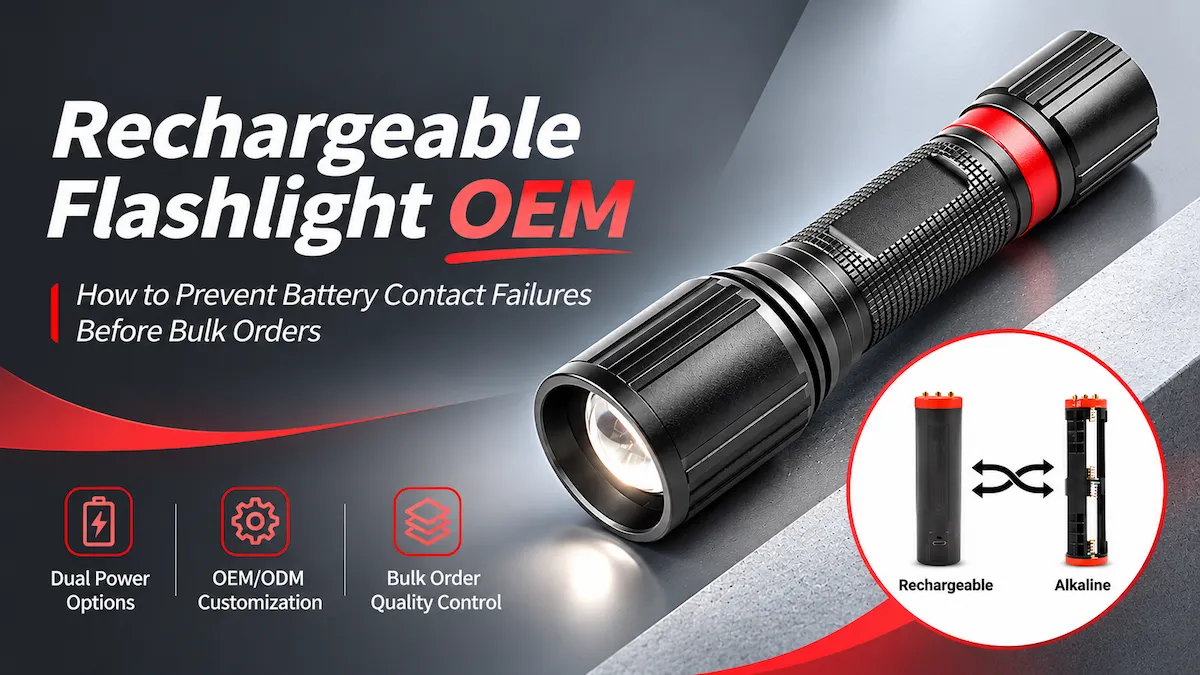
Consider an importer ordering three rechargeable flashlight models for different retail channels. One model is supplied without a battery. Another includes a 26650 rechargeable cell. A third supports an included lithium battery or an alternative dry-battery arrangement.
All three may look similar in photographs. If product specifications, accessory kits, and retail packaging are not properly controlled, the shipment could contain incorrect battery configurations, mismatched instruction manuals, or cartons carrying the wrong product identity.
These errors are particularly troublesome for private-label brands because the factory's internal model number may not be visible on the final retail package.
The challenge is not simply whether a factory can manufacture a flashlight. It is whether the factory can consistently produce, identify, pack, and release the correct flashlight variant.
This guide focuses on that specific production-management problem. For broader factory selection and supplier evaluation, see the existing Brightenlux Flashlight Factory China Guide.
1. Why Are Multi-SKU OEM Flashlight Orders More Difficult to Control?
A multi-SKU order contains more than one distinguishable product configuration. The variants may differ in battery type, lighting modes, housing finish, charging arrangement, accessories, branding, destination-market labels, or retail packaging. Each difference introduces an additional opportunity for incorrect material selection or identification.
Similar appearance does not mean identical construction
Two rechargeable flashlights may have nearly identical external dimensions but use different cells, drivers, or operating modes. A production operator cannot reliably identify every configuration from appearance alone.
Battery inclusion changes the commercial product
A flashlight sold with an included rechargeable battery is not commercially identical to a battery-excluded package. The difference affects package contents, customer expectations, procurement cost, and potentially applicable transport arrangements.
Private-label packaging adds another identity layer
The manufacturer's model number, importer's internal SKU, retailer barcode, and packaging artwork may all identify the same finished product. Those references must remain connected.
More variants mean more changeovers
When production moves between models or branding versions, material bins, fixtures, work instructions, packaging components, and finished-goods identification may need to change. If the previous configuration is not removed or clearly segregated, components can enter the next production run.
Common Multi-SKU Production Risks
| Production Difference | Potential Error | Buyer Impact |
|---|---|---|
| Battery format | Incorrect battery supplied | Product incompatibility or incorrect shipment |
| Battery inclusion | Missing or unexpected battery | Customer complaints and replacement work |
| Lighting-mode configuration | Wrong operating sequence | Product does not match approved specification |
| Logo or housing finish | Incorrect branded variant | Retail inventory mismatch |
| Charging accessories | Missing or incorrect accessory | Incomplete package |
| Instruction manual | Wrong model or language | Incorrect product information |
| Retail barcode | Incorrect GTIN or SKU association | Warehouse and marketplace errors |
| Master carton | Different models packed together unintentionally | Receiving and distribution problems |
The objective is to prevent these problems at their source rather than rely entirely on final inspection.
2. Which Buyers Need a Multi-SKU Factory Control Plan?
Multi-SKU production control is especially relevant to businesses purchasing several models or private-label variants under one manufacturing program.
Outdoor equipment brands
An outdoor brand may offer compact EDC flashlights, high-output rechargeable models, and emergency lighting products. Each product may require different batteries, accessories, packaging, and user instructions.
Flashlight wholesalers and distributors
Distributors often carry several models across different price points. A wrong-model carton can create receiving errors, stock discrepancies, and incorrect deliveries to downstream retailers.
Private-label and e-commerce brands
A private-label flashlight range may use consistent visual branding across products with different technical configurations. That consistency can improve brand recognition but make incorrect variants more difficult to distinguish during packing.
Industrial and maintenance suppliers
Professional tool distributors may order several flashlight types for different tasks. They need clear differences between portable inspection products, rechargeable flashlights, and hands-free lighting models.
When is this level of control unnecessary?
A straightforward purchase of one unchanged catalogue flashlight in a single packaging configuration generally requires fewer variant-management controls. The basic requirements for product quality, safety, traceability, and shipment accuracy still apply.
For more complex orders, however, SKU-level controls should be established before production begins.
3. Which Brightenlux Flashlight Platforms Illustrate the Risk?
Brightenlux publishes rechargeable LED flashlight models using different battery configurations and operating features. These products demonstrate why overseas buyers should request model-specific production and packing information.
Brightenlux Product Configuration Comparison
| Brightenlux Model | Published LED / Output | Battery Configuration | Key Procurement Difference |
|---|---|---|---|
| BT-FL8034 | OSRAM P9 / up to 1000lm | 18650 rechargeable battery, not included by default | Battery-excluded configuration |
| BT-FL8088 | SST40 / up to 1500lm | Included 21700 4000mAh battery | Different battery platform |
| BT-FL8032 | XHP50 / up to 2000lm | Included 26650 5000mAh battery | Larger battery included |
| BT-FL8104 | High-power LED / up to 1000lm | Included 18650 2200mAh or alternative 3 × AAA configuration | Dual-power product arrangement |
These are manufacturer-published product specifications, not independently verified production data. Alternative configuration feasibility and available accessories must be confirmed for the proposed order.
BT-FL8034: Control battery-excluded packaging
The Brightenlux BT-FL8034 1000LM Rechargeable Flashlight uses an OSRAM P9 LED, adjustable focus, and Type-C charging. Its published configuration specifies an 18650 rechargeable battery that is not included by default.
This creates an important packaging-control question: Does the final purchase order require a battery-excluded product or a separately negotiated battery-included kit?
The supplier should confirm the approved commercial package and identify any additional battery requirements before quoting.
BT-FL8088: Control the 21700 battery configuration
The Brightenlux BT-FL8088 1500LM Rechargeable Flashlight is published with an included 21700 4000mAh battery and magnetic tail.
For a multi-model order, the 21700 configuration should have its own product identity, approved battery specification, and packing record.
BT-FL8032: Control the included 26650 battery
The Brightenlux BT-FL8032 2000LM Rechargeable Flashlight features an XHP50 LED, adjustable focus, and an included 26650 5000mAh rechargeable battery.
This model is relevant when comparing packages containing different cylindrical battery sizes. The factory should be able to demonstrate how the approved battery configuration is identified and controlled for that model.
BT-FL8104: Control dual-power product information
The Brightenlux BT-FL8104 Twist-Focus Flashlight is published with an included 18650 2200mAh lithium battery or an alternative three-AAA power arrangement. The three AAA batteries are not listed as included.
Buyers should clarify the exact battery carrier, supplied accessories, user instructions, and permitted operating arrangements. An alternative battery option must not be interpreted as permission to recharge disposable primary cells.
Key sourcing lesson
These products are useful examples of different configurations within a manufacturer's flashlight range. They do not establish that every configuration is available for customization, or that every model can be produced on the same assembly line.
A buyer must confirm the proposed production arrangement and approved specifications for each order.
4. How Should an OEM Flashlight Factory Define Each SKU?
The foundation of multi-SKU production is a controlled product definition. Each saleable configuration should have an unambiguous identity linking its commercial requirements to the approved manufacturing specification.
Use a SKU master record
A SKU master identifies which technical and commercial features belong to a particular product. For OEM orders, it should connect the buyer's SKU with the manufacturer's reference model, approved component list, packaging artwork, and relevant inspection requirements.
Recommended SKU Master Fields
| Field | Required Information |
|---|---|
| Buyer SKU | Unique product identifier |
| Factory model | Manufacturer reference model |
| Product revision | Approved engineering version |
| LED and optics | Approved configuration |
| Battery type | Exact permitted cell or pack |
| Battery inclusion | Included, excluded, or specified alternative |
| Charging arrangement | Approved charging interface and accessories |
| Housing finish | Approved material, colour and finish |
| Logo | Artwork file and application method |
| Manual | Correct product and destination language |
| Retail packaging | Approved box artwork revision |
| Barcode | Assigned retailer GTIN or other controlled identifier |
| Master carton | Units per carton and carton identification |
| Quality plan | Relevant tests, limits and sampling requirements |
Keep the specification and quotation aligned
A supplier quotation should identify which configuration it covers. Otherwise, a buyer may compare prices for products with different battery inclusion, accessories, or packaging specifications.
Example: Buyer-Created SKU Structure
The following identifiers are illustrative buyer-side codes, not official Brightenlux product numbers.
| Example SKU | Reference Platform | Proposed Commercial Identity |
|---|---|---|
| OUT-18650-NB | BT-FL8034 | Rechargeable platform, battery excluded |
| OUT-21700-BI | BT-FL8088 | 21700 battery-included retail kit |
| PRO-26650-BI | BT-FL8032 | 26650 battery-included retail kit |
| DUAL-18650-AAA | BT-FL8104 | Approved dual-power retail configuration |
The retailer or importer should confirm the exact final package contents before approving these commercial variants.
5. How Should Materials Be Prepared Before Multi-SKU Production?
Correct material selection begins before the assembly line starts. A production plan that lists only the flashlight model may be insufficient when batteries, packaging, labels, and accessories differ.
Step 1: Confirm the current purchase-order revision
The production team should work from the approved purchase order, SKU matrix, bill of materials, and artwork revisions. Superseded documents should be clearly distinguished from current instructions.
Step 2: Identify critical components
For the applicable model, critical items may include:
- LED and optical components.
- Driver and charging electronics.
- Battery cells or packs.
- Electrical contacts and switches.
- Housing and sealing components.
- Battery carriers.
- Charging cables and accessories.
- Printed labels and manuals.
The exact list depends on the flashlight architecture.
Step 3: Prepare SKU-specific material kits
Materials issued to production should be identified by the appropriate work order and product configuration. Where practical, distinct kits can help reduce selection errors.
Step 4: Separate similar components
Components with similar appearance but different specifications should not be stored or issued in a way that encourages accidental substitution.
Examples include batteries of different capacities, visually similar drivers, identical-colour housings carrying different internal components, and nearly identical retail cartons.
Step 5: Check quantities before assembly
The factory should reconcile the material kit against the production quantity and approved bill of materials. Shortages and substitution requests should trigger a documented review rather than informal replacement.
Step 6: Record material changes
If an approved component lot changes during production, the affected work order and finished-goods population should remain identifiable. This supports corrective action if a later issue is discovered.
Buyer action: Ask the factory to demonstrate how one selected SKU is translated into a material kit and connected to the corresponding work order.
6. How Can a Factory Prevent Errors During Production Line Changeovers?
Line changeover is the transition from one product configuration to another. For multi-SKU OEM flashlight production, this may involve changing mechanical parts, electronics, accessories, labels, work instructions, or test settings.
The greatest risk arises when materials or information from the previous configuration remain in use.
A practical line-clearance procedure
Before the next SKU begins, the factory should confirm that the previous production run has been appropriately closed. Relevant steps include removing or accounting for unused components, separating completed goods, clearing previous labels, and displaying the current work instructions.
Ten-Point Line-Changeover Checklist
| Checkpoint | Required Verification |
|---|---|
| 1. Work order | Correct SKU and approved revision |
| 2. Previous materials | Removed, returned or identified |
| 3. New material kit | Matches current SKU |
| 4. Battery configuration | Correct approved battery or exclusion |
| 5. Housing and finish | Correct physical variant |
| 6. Electronics | Correct driver, charging and mode configuration |
| 7. Fixtures | Appropriate for the current product |
| 8. Work instructions | Current and accessible |
| 9. Retail labels | Correct artwork and product identity |
| 10. First-off approval | Authorized before routine production |
First-off verification is essential
The first completed units after a changeover should be checked against the approved configuration. This is a practical way to detect errors before a large number of products are assembled or packed.
The sample quantity and inspection criteria should be agreed according to product and process risk.
Questions to ask the factory
Can the production team show the current SKU and revision? How are leftover components identified after a previous order? Who authorizes the new configuration? What happens when a first-off inspection fails?
The answers provide more useful evidence than a general statement that the factory has quality control.
7. What Should Be Checked During First-Off Flashlight Approval?
First-off inspection verifies that the initial products from a new production setup match the intended configuration. It is not a substitute for full engineering qualification. Instead, it checks whether the approved product has been correctly transferred to the current production process.
Recommended First-Off Verification
| Inspection Area | What to Confirm |
|---|---|
| Product identity | Correct model and buyer SKU |
| Physical construction | Matches approved reference |
| Battery configuration | Correct battery or agreed exclusion |
| Lighting function | Approved operating modes |
| Charging | Correct function for rechargeable configuration |
| Switch operation | Correct operating sequence |
| Housing | Approved finish and markings |
| Accessories | Correct supplied components |
| Manual | Correct model and destination language |
| Retail package | Correct artwork and product identity |
| Barcode | Matches approved SKU record |
Record the result
A first-off inspection record should identify the product revision, work order, inspected units, acceptance criteria, findings, and responsible approver.
If the result is unacceptable, the production team should investigate and correct the issue before authorizing routine output.
Retain an approved reference
A controlled reference sample, technical drawings, and relevant electronic specifications help the production team determine whether the manufactured configuration matches the buyer's requirements.
However, a physical sample alone cannot fully define hidden components, firmware, battery sourcing, or packaging instructions. Those details need supporting documentation.
8. How Should OEM Flashlight Packaging Be Verified?
Packaging is often the final point where a correct product can become an incorrect retail SKU. For a private-label importer, the retail package may be the only information available to the retailer or end customer.
Verify physical contents
The factory should confirm that the package contains the correct flashlight, approved battery arrangement, accessories, and manual.
For battery-excluded configurations, the absence of a battery must match the agreed commercial specification and required product information.
Verify the product identity
The retail label and carton identifier should match the SKU being packed. This is particularly important when several models share similar brand colours or product images.
Verify instructions and claims
The manual should correspond to the actual product. Incorrect charging instructions, incompatible battery information, or a performance claim copied from another model can create customer confusion and other risks.
Verify carton quantities
The factory should reconcile the number of packed units with the work order and carton plan.
Three-Way Packing Verification
| Reference | Verification Question |
|---|---|
| Approved SKU master | Which product should this package contain? |
| Actual product and accessories | What has been physically packed? |
| Retail label and carton | What product does the package identify? |
Packing should be released only when the three records agree.
For higher-volume programs, appropriately designed barcode scanning or other error-proofing systems may help reduce manual identification errors.
Buyers should ask which systems the factory actually uses instead of assuming scanning is already implemented.
9. Should Different Flashlight Variants Have Different Barcodes?
Retail product identification should distinguish configurations that represent different trade items.
The official GS1 guidance on assigning GTINs to products and variations explains that products and their relevant variations require appropriate unique GTIN identification.
For a private-label flashlight range, this matters when different products are sold under similar packaging designs.
Examples of potentially distinct retail items
- The same flashlight sold in different colours.
- A battery-included kit versus a battery-excluded product.
- Different flashlight models.
- Different retail configurations with distinguishable commercial contents.
Exact GTIN allocation should follow the applicable GS1 rules and the product owner's retail requirements.
What buyers should provide
Importers should supply or approve the correct GTIN information and connect it to the corresponding artwork and SKU master.
The manufacturer should not independently substitute barcode numbers or reuse packaging from another variant without authorization.
Barcode and SKU Verification Matrix
| Data Element | Buyer Control |
|---|---|
| Internal SKU | Unique commercial identifier |
| Manufacturer model | Correct production reference |
| GTIN, where applicable | Approved product identifier |
| Artwork revision | Approved file version |
| Product description | Matches actual configuration |
| Package contents | Matches quoted and approved kit |
| Carton label | Corresponds to packed goods |
Practical benefit: Correct identification helps retailers, warehouses, and distributors distinguish similar flashlight products before errors reach customers.
10. What Quality Inspections Are Needed for Multi-SKU Orders?
A production inspection plan should match the risks of the specific products being manufactured. Not every characteristic requires the same inspection method or frequency.
Product-specific functional verification
Depending on the model, relevant checks may include:
- LED activation.
- Operating-mode sequence.
- Battery configuration.
- Charging function.
- Switch operation.
- Mechanical assembly.
- Surface appearance.
- Accessories and packing contents.
SKU identity checks
Some high-risk identification characteristics may justify verification on every package or at defined production checkpoints.
The appropriate approach depends on process capability, automation, defect consequences, and commercial requirements.
Lot-by-lot acceptance sampling
The official ISO 2859-1:2026 standard for sampling inspection by attributes provides a framework for AQL-indexed lot-by-lot acceptance sampling.
Buyers can use applicable sampling methods when defining inspection plans.
However, a mixed-model shipment should not be treated as one homogeneous product without considering the differences between its configurations and inspection characteristics.
The buyer and supplier should define the inspection population, lot structure, sampling plan, defect classification, and decision rules before inspection.
Suggested Multi-SKU Inspection Plan
| Stage | Main Objective | Typical Evidence |
|---|---|---|
| Incoming inspection | Verify approved critical components | Receiving and inspection records |
| Pre-production | Confirm correct SKU and materials | Work-order and kitting records |
| First-off inspection | Confirm correct setup | Approved inspection record |
| In-process inspection | Detect assembly and configuration deviations | Process inspection results |
| Functional verification | Check applicable product operations | Test records |
| Packing verification | Confirm contents and identity | Packaging checks |
| Lot acceptance | Evaluate defined production lots | Inspection report |
| Shipment release | Confirm approved quantities and documents | Release record |
Sampled inspection cannot guarantee that every unit is correct. For issues that can create significant safety or regulatory risk, additional controls may be necessary.
Do not confuse testing references with certifications
Referencing ISO sampling methods does not mean the factory or finished flashlight has received an ISO product certification.
Buyers should request actual records showing which methods were used and what results were obtained.
11. How Do Multi-SKU Controls Affect Factory Costs and Lead Times?
A mixed-model order may create additional complexity even when its total quantity is substantial. The factory may need separate materials, production setups, first-off inspections, artwork, packaging, or shipment documentation.
Main Commercial Cost Drivers
| Cost Area | Why It May Change |
|---|---|
| Material purchasing | Different battery and electronics requirements |
| Production setup | Additional model changeovers |
| Packaging | Different boxes, labels and manuals |
| Logo application | Separate artwork or marking setups |
| Inspection | SKU-specific functional and packing checks |
| Inventory | Separate component and finished-goods control |
| Transport preparation | Different battery-inclusion configurations |
| Rework | Correction of identified production or packing errors |
Ask for SKU-specific quotation details
A single total-order price may conceal differences between product configurations. Request pricing by SKU and quantity, including relevant packaging, battery inclusion, customization, testing, and setup charges.
How should MOQ be evaluated?
The minimum order quantity may depend on the specific model, battery, custom colour, logo process, packaging, and production setup.
There is no universally applicable Brightenlux MOQ for every OEM project. Buyers should request a written quotation showing which minimum applies to each variant and whether order consolidation is possible.
How should lead time be evaluated?
Ask for separate milestones covering specification approval, material preparation, sample approval, production scheduling, assembly, inspection, packing, and dispatch.
A multi-SKU order may require additional coordination, but the actual schedule must be confirmed for the proposed products.
Do not assume that ordering several models together will automatically reduce manufacturing time or cost.
12. What OEM/ODM Customization Should Be Discussed With Brightenlux?
Ningbo Brightenlux Electric Appliance Co., Ltd. presents itself as a China-based manufacturer of portable outdoor LED lighting products and offers OEM/ODM customization services.
Its published range includes LED flashlights, headlamps, camping lights, and other portable lighting categories.
For multi-SKU programs, the most useful starting point is to identify the appropriate existing product platforms and then define the requested commercial or engineering changes.
Potential customization topics
These may include:
- Brand logo and marking.
- Housing colour or surface finish.
- Retail packaging artwork.
- Product labels and manuals.
- Battery-included or battery-excluded commercial configurations.
- Accessories and kits.
- Model-specific functional requirements.
- Packaging and carton specifications.
Not every change is available on every existing product.
Changes affecting the battery, charging system, electronics, housing, or safety-related features may require engineering review, validation, or new tooling.
Standard product, private label or new development?
| Sourcing Route | Typical Scope | Main Buyer Requirement |
|---|---|---|
| Existing catalogue model | Approved standard configuration | Confirm exact product and package |
| Private-label variation | Logo, artwork, packaging or agreed cosmetic changes | Control branding and SKU identity |
| OEM customization | Buyer-defined product modifications | Controlled specifications and validation |
| ODM development | Manufacturer-supported design adaptation or new development | Define responsibilities, revisions and ownership |
What should be confirmed before production?
Request clarification of manufacturing scope, critical component sourcing, customization feasibility, sample approval requirements, and quality-control evidence.
The factory's published product range is a useful starting point, but each OEM order still requires its own confirmed technical and commercial specification.
13. What Should Buyers Include in an OEM Flashlight Factory China RFQ?
An RFQ for a multi-SKU program should distinguish product-level requirements from order-level requirements.
The supplier needs to know not only which flashlight models are required but also how the final variants should be identified, produced, tested, and packed.
Multi-SKU OEM RFQ Checklist
| RFQ Field | Information to Provide |
|---|---|
| Company and market | Importer, brand, destination country |
| Application | Outdoor, industrial, emergency or retail |
| Reference models | Factory model numbers |
| Number of SKUs | Separate commercial variants |
| Forecast quantity | Quantity per SKU and total order |
| Battery configuration | Exact approved type and inclusion |
| Functional requirements | Lighting modes, charging, switching |
| Customization | Logo, finish, materials, accessories |
| Packaging | Box, artwork, manual, labels, barcode |
| Quality requirements | First-off, in-process, final inspection |
| Changeover requirements | Material and line-clearance controls |
| Traceability | Work order, lot or other agreed identifier |
| Commercial terms | MOQ, unit price, setup charges |
| Schedule | Samples, approvals, production and dispatch |
Five documents to request before confirming the order
- A SKU-by-SKU quotation with included and excluded components.
- A proposed configuration matrix and approved sample plan.
- A packaging and accessory list for every SKU.
- A production inspection and changeover-control proposal.
- A commercial schedule identifying approval and manufacturing milestones.
For significant or customized programs, additional drawings, component specifications, testing evidence, or quality agreements may be necessary.
Questions to Include in Your Inquiry
Ask the factory:
- Can the proposed models be manufactured under one coordinated order?
- Which configurations are standard products and which require modification?
- How are batteries and accessories controlled separately for each SKU?
- How are production changeovers verified?
- Will first-off approval be recorded for each distinct configuration?
- How are product and carton labels checked?
- Which tests are performed on every unit and which use sampling?
- How are approved changes documented during production?
- What production records are available to the buyer?
- What MOQ, setup charges and delivery milestones apply to each SKU?
Request an OEM Flashlight Production Proposal
If you are planning a private-label flashlight range or mixed-model wholesale order, begin with the models you want to purchase and the configurations required for each sales channel.
Send Brightenlux your target market, SKU list, estimated quantities, battery preferences, logo artwork, packaging requirements, and quality expectations.
Ask the team to confirm which product platforms are suitable, what customization is feasible, and which inspection or production controls can be documented for your specific order.
14. Frequently Asked Questions About OEM Flashlight Manufacturing in China
1. What should I check when choosing an OEM flashlight factory in China?
Check whether the proposed factory can identify the actual production site, confirm the specifications of each flashlight model, provide representative samples, manage approved components, and document relevant inspection and production controls. For multi-SKU orders, pay particular attention to battery configuration, packing accuracy, product identification, and line-changeover procedures.
2. Can a China OEM flashlight factory produce several models in one order?
Potentially, yes. The feasibility depends on the manufacturer's available platforms, component sourcing, production scheduling, customization requirements, and commercial minimums. The buyer should submit a model-by-model quantity and specification matrix and request a coordinated production proposal.
3. How can I prevent wrong batteries from being packed with flashlights?
Specify the approved battery and inclusion status for every SKU. Connect that information to the bill of materials, production work order, accessory kit, packaging instructions, and inspection checklist. Require verification of the actual package contents before release.
4. What is the difference between an OEM flashlight and a private-label flashlight?
A private-label program typically uses an existing product platform with agreed branding or packaging changes. OEM customization can involve more detailed buyer-defined modifications. The practical distinction depends on the scope of design responsibility, manufacturing changes, component control, and validation.
5. Why is line clearance important in flashlight production?
Line clearance helps prevent materials, documents, labels, or unfinished products from a previous production run entering a new one. It is particularly relevant when different flashlight models use similar housings but different batteries, electronics, or packaging.
6. Should every flashlight SKU have its own barcode?
Where a product is identified using GS1 GTINs, distinct trade items and relevant variations must follow the applicable GS1 identification rules. Buyers should confirm the correct GTIN allocation for each retail configuration and ensure the approved barcode matches the product and packaging.
7. Does an AQL inspection guarantee that all flashlights are defect-free?
No. Acceptance sampling evaluates defined lots according to an agreed sampling plan and acceptance criteria. It does not guarantee that every unit conforms. Appropriate process controls and additional checks may be needed for important product characteristics.
8. Can the same battery be used across different rechargeable flashlight models?
Not automatically. Battery compatibility depends on physical dimensions, electrical characteristics, protection arrangements, charging requirements, and the flashlight's approved design. A shared nominal battery format does not establish interchangeability.
9. What affects OEM flashlight MOQ and lead time?
Relevant factors include model selection, quantity per SKU, batteries, custom components, logo process, packaging artwork, tooling, material availability, required testing, and production scheduling. MOQ and lead time should be confirmed for the exact proposed configuration instead of relying on a universal estimate.
10. How can I request a quotation from Brightenlux?
Prepare a shortlist of required flashlight models and provide the intended application, destination market, quantities, battery configurations, branding, packaging, accessories, inspection requirements, and target schedule. Submit this information through the Brightenlux Contact Us page to discuss available products, OEM feasibility, samples, and commercial terms.
Conclusion
Choosing an OEM flashlight factory China partner is not only a question of manufacturing capability or unit price.
For importers, wholesalers, and private-label lighting brands purchasing multiple flashlight models, product configuration control is a critical part of a successful manufacturing program.
Different batteries, charging arrangements, accessories, retail labels, and packaging designs create opportunities for SKU mix-ups even when individual products function correctly.
An effective sourcing approach begins by defining every commercial variant and connecting it to its approved technical specification.
The factory should then establish appropriate controls for material identification, production changeovers, first-off approval, in-process checks, packing verification, and shipment release.
Retail identifiers and inspection plans should support—not replace—these production controls.
Brightenlux offers several published rechargeable flashlight platforms with different battery configurations, making its catalogue a practical starting point for overseas buyers planning multi-model product ranges.
Before confirming bulk production, buyers should request a SKU-specific quotation, sample approval plan, packaging matrix, and agreed quality-control requirements.
The most valuable outcome is not simply receiving the correct quantity of flashlights. It is receiving the correct product configuration in every approved retail and wholesale package.
To discuss an OEM flashlight manufacturing program, review the existing Brightenlux flashlight range and contact Brightenlux with your model list, branding requirements, battery configurations, and estimated order quantities.