

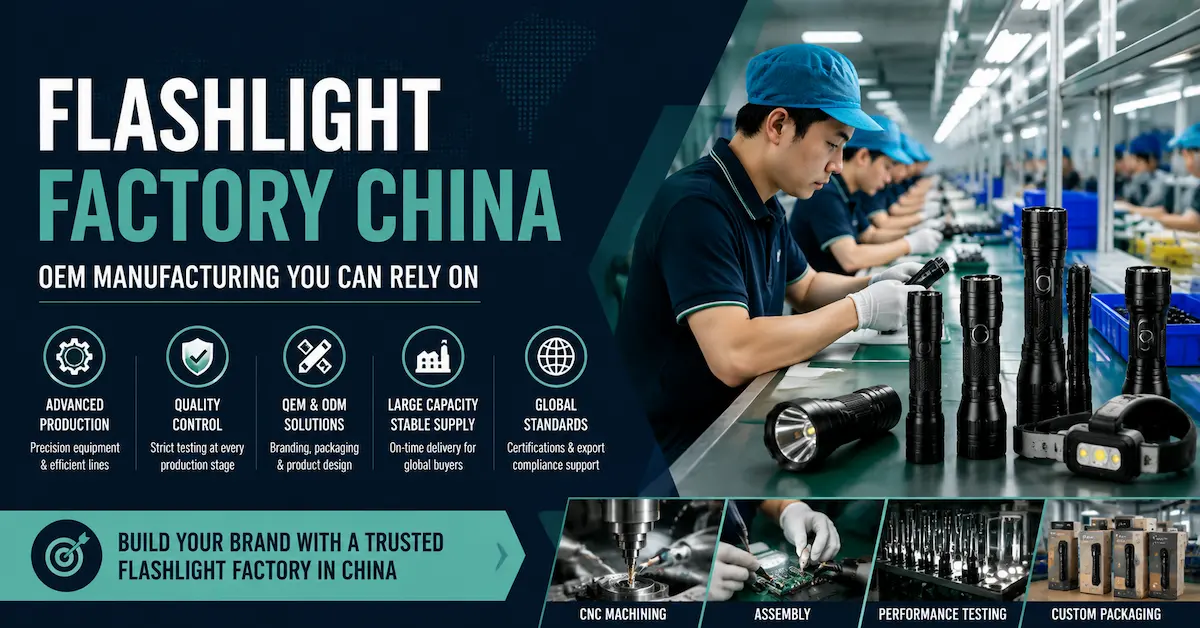
Why Choose a Flashlight Factory China Partner for Your Business?
For importers, distributors, outdoor brands, and private-label companies, selecting the right flashlight factory China partner is a strategic decision that affects product quality, pricing stability, customization ability, and long-term market competitiveness.
A factory is not only a place where flashlights are assembled. A professional manufacturer manages product development, component sourcing, production control, testing, packaging, and continuous improvement.
Many buyers make the mistake of choosing suppliers only by:
- Lowest quotation
- Largest product catalog
- Highest lumen claims
- Fastest delivery promise
However, these factors alone do not show whether a supplier can consistently deliver qualified products.
A reliable flashlight factory should demonstrate:
- Stable manufacturing capability
- Controlled production processes
- OEM/ODM development experience
- Reliable component management
- Quality inspection systems
- Transparent communication
- Long-term cooperation capability
Brightenlux is a portable lighting manufacturer providing LED flashlights, rechargeable flashlights, headlamps, working lights, camping lights, and customized lighting solutions for global customers.
Buyers can explore the available product range through the Brightenlux products page before preparing a sourcing plan.
Flashlight Factory China vs Trading Company: What Buyers Should Know
Before selecting a supplier, buyers should understand the difference between a manufacturing factory and a trading company.
Both business models can provide sourcing support, but their capabilities are different.
| Comparison | Flashlight Factory China | Trading Company |
|---|---|---|
| Product development | Direct communication with engineering and production teams | Usually depends on external factories |
| Customization ability | Stronger OEM/ODM flexibility | Depends on factory resources |
| Production control | Direct control of assembly and inspection | Limited visibility |
| Cost structure | Usually closer to manufacturing cost | May include additional sourcing margins |
| Technical communication | Faster access to engineers | Often through sales intermediaries |
| Quality tracking | Easier batch traceability | Depends on supplier management |
| Product modification | More practical for new projects | May require finding another factory |
However, a trading company is not automatically unsuitable. Some trading companies have strong supplier networks and can provide value through sourcing, communication, and market knowledge.
The key question is not:
“Factory or trading company?”
The better question is:
“Which supplier model can provide the product control, communication efficiency, and service level required for this project?”
For OEM and private-label flashlight projects, direct cooperation with a capable flashlight factory China partner often provides better visibility into product development and manufacturing decisions.
Key Manufacturing Capabilities to Evaluate in a Flashlight Factory China
A professional flashlight factory should demonstrate capabilities across the entire product lifecycle.
A complete manufacturing capability includes:
- Product design support
- Component sourcing
- Prototype development
- Production assembly
- Testing and inspection
- Packaging
- Export preparation
- After-sales support
Buyers should evaluate the factory based on evidence rather than marketing claims.
Production Equipment and Assembly Capability
A flashlight factory's production capability determines whether it can maintain consistency when order volume increases.
Important areas include:
Assembly Lines
A mature flashlight manufacturer should have organized assembly processes covering:
- Component preparation
- PCB installation
- LED installation
- Battery compartment assembly
- Switch installation
- Lens and reflector assembly
- Housing assembly
- Functional testing
- Packaging
A well-organized assembly line reduces:
- Assembly errors
- Missing components
- Production delays
- Batch inconsistency
Production Flexibility
Different buyers require different production models.
For example:
- Distributors may need stable standard models.
- Private-label brands may need packaging customization.
- Outdoor brands may require product modifications.
- Industrial customers may require application-specific features.
A capable factory should be able to support different order types without affecting quality consistency.
LED, Driver, Battery and Component Management
A flashlight is a complete electronic and mechanical system.
The factory's component management capability directly affects product reliability.
Important components include:
| Component | Buyer Evaluation Focus |
|---|---|
| LED emitter | Brand, specification, output consistency |
| Driver board | Current control, efficiency, stability |
| Battery system | Compatibility, capacity, protection |
| Charging circuit | USB-C performance and safety |
| Switch | Durability and operating experience |
| Reflector/lens | Beam quality and optical performance |
| Housing | Material, machining, heat dissipation |
| Sealing parts | Water and dust protection |
A professional OEM flashlight factory should have clear component specifications instead of changing parts only based on price.
For example, replacing an LED driver or battery cell without approval may change:
- Brightness
- Runtime
- Charging behavior
- Product lifespan
- Customer experience
Therefore, component control is a critical part of supplier evaluation.
CNC Machining and Flashlight Housing Production
Many premium flashlights use aluminum alloy housings because they provide:
- Durability
- Better heat dissipation
- Professional appearance
- Improved impact resistance
Buyers evaluating a flashlight factory should understand how the housing is produced.
Key processes may include:
CNC Machining
CNC machining affects:
- Body dimensions
- Thread accuracy
- Battery compartment fit
- Switch alignment
- Overall product quality
Poor machining can create:
- Loose threads
- Battery contact problems
- Water sealing issues
- Poor user experience
Surface Treatment
Common finishing processes include:
- Anodizing
- Sandblasting
- Laser engraving
- Printing
- Coating
Surface treatment affects both appearance and durability.
For private-label brands, consistent finishing is especially important because the flashlight represents the customer's own brand.
Flashlight Factory China Production Process Overview
A reliable factory should have a clear manufacturing workflow.
Typical production process:
| Stage | Main Activities |
|---|---|
| Product review | Confirm specifications, drawings, BOM |
| Material preparation | Prepare LED, PCB, battery, housing and accessories |
| Incoming inspection | Check materials before production |
| Assembly | Complete mechanical and electronic assembly |
| Functional testing | Check lighting, charging and operation |
| Appearance inspection | Verify finish, logo and packaging |
| Final QC | Confirm shipment quality |
| Packing | Prepare export-ready cartons |
This process helps prevent quality problems from reaching customers.
A factory that can explain its workflow clearly usually has better production management maturity.
How a Professional Flashlight Factory Controls Quality
Quality control should not happen only before shipment.
A reliable manufacturer applies inspection throughout production.
Incoming Material Inspection
Before assembly begins, factories should verify:
- LED components
- Battery specifications
- PCB quality
- Housing dimensions
- Charging components
- Packaging materials
Using uncontrolled materials creates risks that final inspection may not detect.
In-Process Production Inspection
During assembly, quality checks may include:
- PCB installation
- LED positioning
- Screw tightening
- Waterproof sealing
- Battery contact
- Switch operation
Early detection reduces rework costs.
Functional Performance Testing
A professional flashlight factory should test:
- Lighting modes
- Charging function
- Runtime
- Switch operation
- Beam performance
- Battery installation
- Accessories
The testing method should match the approved product specification.
Final Inspection Before Shipment
Before shipment, final inspection should confirm:
- Correct model
- Correct quantity
- Correct packaging
- Correct accessories
- Correct labels
- No visible defects
For B2B buyers, final inspection records provide evidence that the delivered goods match the approved sample.
OEM and ODM Capabilities of Chinese Flashlight Factories
One major reason buyers choose a flashlight factory China partner is customization capability.
OEM and ODM services allow brands to create products that match their market positioning.
Logo and Branding Customization
Common OEM options include:
- Laser logo engraving
- Printing
- Product color customization
- Brand labels
- Customized manuals
This is suitable for:
- Retail brands
- Promotional companies
- Distributors
- Corporate customers
Packaging Customization
Packaging is an important part of private-label products.
Customization may include:
- Retail boxes
- Color packaging
- User manuals
- Barcode labels
- Product inserts
- Master carton design
A complete OEM program should control both the product and customer-facing materials.
Product Configuration Changes
Depending on factory capability, customization may include:
- LED selection
- Battery configuration
- Charging method
- Accessories
- Switch functions
- Product appearance
However, deeper changes should be evaluated carefully because they may affect:
- Testing requirements
- Production cost
- Lead time
- Minimum order quantity
New Product Development
ODM projects require stronger engineering capability.
Examples include:
- New flashlight structure
- Custom housing
- Special application lighting
- New optical design
- Modified electronics
A capable ODM flashlight factory should support:
- Requirement analysis
- Prototype development
- Sample testing
- Design improvement
- Mass production transfer
Production Capacity and Lead Time Evaluation
Capacity is not only about factory size.
Buyers should evaluate:
- Number of production lines
- Workforce stability
- Equipment capability
- Supplier network
- Production scheduling system
- Quality management ability
A larger factory is not always better.
The right supplier is one that can support:
- Current order volume
- Future growth
- Required customization
- Quality expectations
When discussing lead time, buyers should separate:
- Sample development time
- Material preparation
- Production time
- Inspection time
- Packaging time
- Shipping preparation
Factory Certifications and Compliance Support
Certifications and compliance documents should match the actual product and market.
Buyers should ask:
- Which certifications apply to this model?
- Are reports available for this exact configuration?
- Are batteries included in the documentation?
- Are packaging and labels compliant with the target market?
A responsible flashlight manufacturer should provide supporting information rather than simply listing certificates.
Compliance requirements may vary depending on:
- Country
- Product category
- Battery type
- Sales channel
- Customer requirements
How to Audit a Flashlight Factory China Supplier
Before long-term cooperation, buyers should evaluate the supplier systematically.
A factory audit may include:
Company Capability
Check:
- Factory location
- Production history
- Main products
- Customer markets
- Manufacturing scope
Production Capability
Review:
- Assembly areas
- Testing equipment
- Production workflow
- Material storage
Quality System
Evaluate:
- Incoming inspection
- Production inspection
- Final inspection
- Defect handling process
Engineering Capability
Ask about:
- Product modification
- Prototype development
- Technical support
- Problem-solving ability
Common Mistakes When Selecting a Flashlight Factory
Choosing Only Based on Price
Low pricing may come from:
- Lower-grade components
- Reduced inspection
- Limited customization
- Uncontrolled substitutions
Ignoring Technical Communication
A factory should understand:
- Application
- Target market
- Performance requirements
- Customer expectations
Approving Samples Without Documentation
A sample should become a controlled reference including:
- Specification
- BOM
- Packaging
- Testing requirements
Selecting a Factory Without Considering Future Growth
A supplier should support:
- Repeat orders
- Product updates
- New models
- Market expansion
Frequently Asked Questions About Flashlight Factory China
What is a flashlight factory China?
A flashlight factory China is a manufacturer located in China that designs, produces, assembles, tests, and supplies flashlight products. Many factories also provide OEM and ODM services for international brands and distributors.
How do I verify a flashlight factory in China?
Buyers should review factory background, production capability, product range, quality procedures, sample consistency, engineering support, and manufacturing evidence before cooperation.
What is the difference between OEM and ODM flashlight manufacturing?
OEM usually involves customizing existing products with branding, packaging, or selected configurations. ODM involves deeper product development such as structure, electronics, optics, or new product design.
Can a flashlight factory customize products for private labels?
Yes. Many Chinese flashlight factories support logo customization, packaging design, color options, accessories, and product modifications depending on the project requirements.
How long does flashlight production usually take?
Lead time depends on product complexity, materials, customization requirements, order quantity, and production schedule. Customized products usually require more time than standard models.
Should I choose a large flashlight factory or a specialized factory?
The best choice depends on your project. Large factories may provide higher capacity, while specialized manufacturers may offer stronger product knowledge and flexibility for specific flashlight categories.
Conclusion
Choosing the right flashlight factory China partner requires evaluating much more than product price.
A reliable manufacturer should provide:
- Stable production capability
- Controlled component sourcing
- Consistent quality management
- OEM/ODM support
- Clear communication
- Long-term cooperation value
For importers, distributors, and private-label brands, the goal is not simply finding a supplier that can produce flashlights.
The goal is finding a manufacturing partner that can continuously deliver the right product, at the right quality level, with the flexibility needed for market growth.
Brightenlux provides portable lighting solutions including LED flashlights, rechargeable flashlights, headlamps, camping lights, and customized lighting products for global customers.
Explore the Brightenlux product portfolio, learn more about the company's manufacturing background, or contact the team through the Brightenlux contact page to discuss OEM and private-label flashlight projects.