

How to Source an OEM Flashlight from China Without Guessing at the Important Details

Choosing an OEM flashlight China supplier is not simply a matter of finding a compact body, adding a logo, and placing an order. For outdoor, utility, emergency, and promotional products, the real decision is whether a supplier can turn a general flashlight concept into a controlled, repeatable product. Buyers need to clarify the optical system, power arrangement, housing, controls, inspection requirements, packaging, and ownership of the final design before comparing quotations. This article explains the main sourcing routes and provides a practical framework for deciding whether a standard product, a customized OEM model, or an ODM relationship is the better fit.
The sourcing decision in brief
| Sourcing route | What it usually means | Best suited to | Main caution |
|---|---|---|---|
| Standard product with branding | An existing flashlight receives selected branding or packaging changes | Promotional products, fast market tests, and straightforward resale | Limited control over the beam, body, battery system, and user interface |
| OEM customization | A buyer supplies requirements and the manufacturer modifies or produces the product accordingly | Retail brands, outdoor equipment companies, and utility product ranges | Requirements must be documented well enough to prevent interpretation gaps |
| ODM development | The supplier contributes an existing platform, design, or engineering solution for adaptation | Teams that need a differentiated product but do not want to develop every component internally | Clarify what is proprietary, shared, or exclusive before commercial discussions proceed |
The right option depends less on the label and more on the amount of control required. A buyer who only needs a logo and a printed box should not pay for unnecessary redesign. Conversely, a brand selling a flashlight as a serious outdoor tool should not assume that a visually attractive sample proves production suitability.
Start with the use case, not the housing
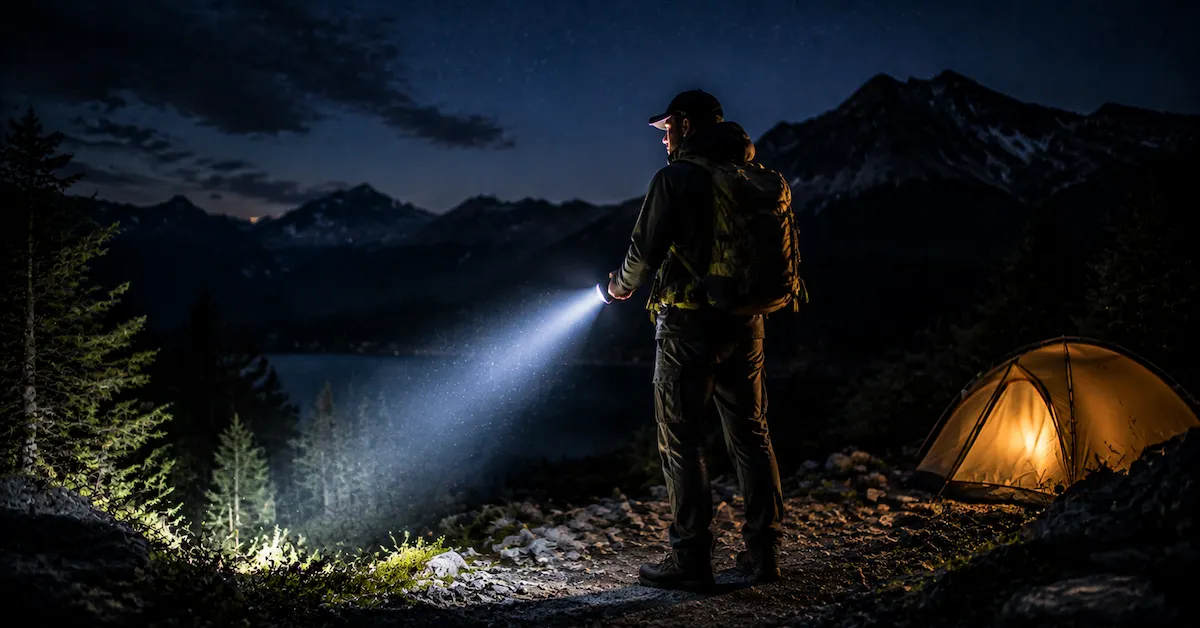
The visible product is a compact handheld LED flashlight intended to direct a concentrated beam toward uneven ground and vegetation during a night hike. That suggests several possible markets: hiking, camping, emergency carry, inspection, security, utility work, and outdoor equipment. These applications overlap, but they do not impose identical requirements.
For trail navigation, beam shape and practical handling may matter more than a large number printed on a specification sheet. An inspection user may care about consistent illumination of a nearby surface, switch operation with gloves, and resistance to frequent handling. A promotional buyer may prioritize appearance, packaging, logo placement, and cost control. A security or emergency buyer may place greater emphasis on reliable activation, battery storage, and environmental protection.
Before contacting suppliers, write a short product brief that answers five basic questions:
- Who will use the flashlight, and in what conditions?
- Is the beam intended for close inspection, trail finding, or longer-range illumination?
- Will the product be carried in a pocket, clipped to equipment, stored in a vehicle, or packed in an emergency kit?
- Does the product need branding only, or a new body, optical arrangement, control layout, or package?
- Which performance and safety characteristics are mandatory, and which are negotiable?
This exercise prevents a common sourcing error: asking for a “high-quality flashlight” without defining what quality means in the intended application.
What to examine in the flashlight construction
Optical system and beam behavior
The front light source, reflector, lens, and surrounding bezel determine how the beam is formed. A focused forward beam is visible in the supplied product image, but the image does not establish brightness, beam distance, beam angle, LED model, optical efficiency, or consistency between units. Those details require supplier documentation and sample evaluation.
Ask whether the supplier can describe the LED module and optical configuration, then request a sample for practical assessment. Walk outside after dark. Check the central beam, spill light, dark rings, uneven patches, and whether the beam remains useful at the expected working distance. A flashlight that looks bright against a wall may perform poorly on a trail if the beam is too narrow or has distracting artifacts.
Housing, grip, and controls
The product appears to use a dark, compact housing, but its material and finish cannot be confirmed from the image. Common industry approaches include molded polymer and anodized aluminum, yet those should remain options for discussion rather than assumed product facts. Housing selection affects perceived quality, weight, machining or molding requirements, heat management, and branding methods.
Control placement deserves an equally practical review. Determine whether the switch is on the tail, side, or front, and whether users can operate it without changing grip. Confirm how accidental activation is prevented during transport. If the flashlight is meant for outdoor use, test the control with cold hands, gloves, or wet fingers where relevant. A small control detail can create a disproportionate number of returns.
Power and serviceability
Battery type, charging method, runtime, low-voltage behavior, and battery-compartment construction are not visible in the product image and must not be inferred. These are central commercial decisions. A replaceable battery may suit emergency storage or remote use, while an integrated rechargeable system may simplify everyday use. Each approach brings different packaging, user instructions, shipping, and service considerations.
Ask the supplier to state the proposed battery configuration, charging interface, protection features, and expected operating modes in writing. If runtime is important, define the measurement conditions rather than accepting a single unqualified figure. Brightness settings, battery condition, temperature, and test method can all change the result.
Working with an OEM or ODM flashlight supplier
An experienced ODM flashlight supplier may offer a useful starting platform, particularly when the buyer wants a differentiated product without designing every part from the ground up. The supplier may have existing knowledge of LED integration, optical assembly, battery compartments, molded or machined housings, and packaging coordination. That does not remove the need for buyer-side engineering review.
Ask suppliers to separate existing platform features from proposed custom work. A quotation should make clear which elements are already available, which require tooling or engineering changes, and which are exclusive to the buyer. Clarify ownership or permitted use of drawings, molds, artwork, firmware if applicable, and customized components. “Custom” can mean anything from a logo on an existing product to a substantially new assembly.
For OEM projects, send the same brief to each candidate. Include target application, preferred form factor, branding locations, packaging expectations, battery preference, operating modes, and required validation. This makes quotations more comparable. If a supplier responds with a broad product catalogue but does not address the critical requirements, treat that as a signal to ask more precise questions rather than assuming the gaps will be resolved later.
Sampling and supplier evaluation
Samples should be evaluated as products, not just as sales demonstrations. Inspect the body for sharp edges, inconsistent joints, loose components, unstable standing surfaces, and difficult battery access. Operate every switch repeatedly. Examine the lens and reflector under normal lighting. Check the beam outdoors and in a dark indoor space. Record observations with photographs and a simple acceptance checklist.
It is also useful to ask how production units will be checked. A responsible discussion should cover incoming components, assembly checks, functional operation, cosmetic inspection, battery or charging checks where relevant, and final packaging review. Do not turn general industry practice into a claimed factory capability; ask the supplier to explain its actual process and provide supporting records where the project justifies them.
Certifications, ingress protection, impact performance, warranty terms, manufacturing capacity, lead time, and test results are all product- and supplier-specific. None can be confirmed from the supplied image. If any of these are required for market access or customer contracts, list them as formal deliverables and verify them before approval.
Common mistakes buyers make
- Comparing only unit price: A low quotation may exclude tooling, packaging changes, testing, shipping preparation, or engineering work.
- Using vague performance language: Terms such as “powerful,” “long range,” and “waterproof” need measurable definitions and agreed test conditions.
- Approving one attractive sample: A sample confirms that one unit exists; it does not establish production consistency.
- Ignoring the package: Battery information, charging instructions, warnings, and branding can affect the user experience and the sales channel.
- Leaving the change process informal: A revised switch, lens, battery, or housing finish should be approved through controlled documentation, not casual messages alone.
A practical buyer checklist
Before moving toward a purchase order, request a consolidated specification covering the flashlight body, materials, finish, LED and optical arrangement, controls, battery, charging method, operating modes, dimensions, weight, packaging, labels, and inspection requirements. Mark unknown items clearly. It is better to show “to be confirmed” than to let a supplier make an assumption that later becomes a production change.
Then compare suppliers on more than responsiveness. Review how clearly they answer technical questions, whether they distinguish standard from custom features, how they handle sample revisions, and whether commercial documents match the technical discussion. A supplier that asks sensible questions about the use case may be more useful than one that immediately promises every requested feature.
Frequently asked questions
Can the pictured flashlight be specified from the image alone?
No. The image indicates a handheld LED flashlight with a concentrated forward beam and outdoor use context. It does not verify lumens, runtime, battery type, materials, ratings, dimensions, certifications, or construction details.
Should a buyer choose OEM or ODM?
Choose OEM customization when the requirements and design direction are already defined. Consider ODM when an existing supplier platform can shorten development and the buyer accepts a clearer separation between proprietary and shared features.
What should be tested first?
Start with beam usefulness, controls, grip, battery access, charging or replacement procedure, visible build quality, and basic operation across the intended use conditions. Add formal environmental or compliance testing when the market or application requires it.
Next step for a sourcing team
Convert the product image and intended application into a one-page technical brief, then send it to several qualified manufacturers for comparable responses. Request sample details, a proposed bill of materials or feature description, customization boundaries, inspection approach, and a clear list of assumptions. The strongest sourcing decision will not necessarily come from the supplier with the most impressive catalogue. It will come from the supplier that can make the unknowns visible, test the important ones, and hold the approved flashlight configuration steady through production.