

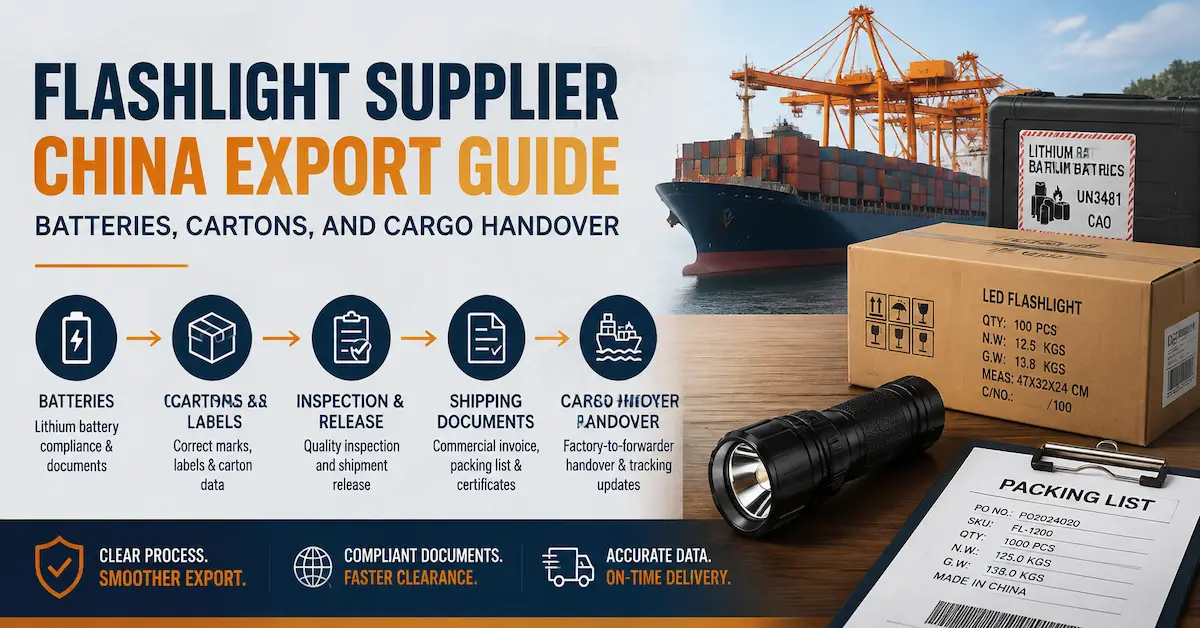
Flashlight Supplier China Export Guide: Batteries, Cartons, and Cargo Handover
A buyer searching "flashlight supplier China" needs more than a product and a factory quotation. The order must also become transport-ready cargo. That requires a frozen product configuration, correct lithium-battery evidence when applicable, controlled labels and cartons, accurate packing data, an agreed Incoterm, a shipment-release decision, and a document pack that the forwarder and importer can actually use.
This guide is for importers, distributors, private-label brands, promotional buyers, industrial suppliers, and sourcing teams that have shortlisted a Chinese flashlight source or approved a sample. It does not repeat a supplier-selection or factory-audit guide. Its focus begins after the commercial product has been defined: how to prevent the handoff from production to freight from changing the product, delaying the booking, creating unexpected charges, or producing incomplete import records.
The short answer: control the shipment before the carton closes
Export problems are cheaper to solve while the order is still on the factory floor. Before packing begins, the buyer and supplier should agree who owns product approval, battery and transport evidence, inspection release, carton marks, barcodes, shipping instructions, booking data, export documents, import clearance, and exception decisions. The purchase order should refer to those responsibilities instead of leaving them to last-minute messages.
A practical shipment-control system connects six items:
- Approved product. The unit, battery, charger or cable, accessories, artwork, warnings, and packaging match the controlled order definition.
- Traceable cargo. Unit, lot, inner carton, master carton, pallet, and packing-list identities can be reconciled.
- Transport eligibility. The battery configuration, test summary, packing method, marks, labels, and carrier acceptance are checked for the actual route and mode.
- Commercial allocation. The Incoterm, named place, freight scope, insurance decision, destination charges, duty, tax, and broker tasks are understood.
- Release gate. Inspection, document review, payment, and booking do not contradict one another.
- Evidence retention. The importer can later identify what shipped, under which documents, and to which customer or warehouse.
A supplier can help prepare these items, but the importer remains responsible for understanding the destination market and its own contractual and regulatory duties. Freight forwarders, customs brokers, test laboratories, dangerous-goods specialists, and legal advisers should be engaged where their expertise is required.
What to send a flashlight supplier China team before booking
The phrase "please arrange shipping" hides decisions that affect price, timing, risk, and document quality. Build a one-page export brief before the production order is released. The brief should be version-controlled and shared with the supplier and the buyer's nominated logistics parties.
Include the following fields:
- Buyer, seller, manufacturer, exporter, importer of record, customs broker, freight forwarder, consignee, and notify party.
- Product names, model numbers, purchase-order lines, quantities, battery configuration, accessories, and destination market.
- Agreed Incoterm rule, year, and precise named place or port.
- Requested cargo-ready window, required-delivery context, and who may authorize schedule changes.
- Preferred transport mode, route constraints, consolidation plan, and carrier restrictions.
- Unit pack, inner carton, master carton, pallet, barcode, label, carton-mark, and document requirements.
- Inspection method, release owner, evidence deadline, and treatment of rework or short shipment.
- Commercial invoice, packing list, transport document, origin evidence, battery evidence, test reports, declarations, and other destination-specific records.
Do not complete unknown fields with assumptions. Mark them as open, assign an owner, and set a decision date. A blank field is visible risk; an invented answer can become a customs, carrier, or compliance problem.
Choose an Incoterm by responsibility, not by the lowest quotation
Incoterms rules define specific cost, task, and risk allocations between seller and buyer. They do not by themselves determine product ownership, payment timing, quality acceptance, governing law, sanctions screening, or every document required by customs. The sales contract should state the chosen Incoterm rule, "Incoterms 2020," and the exact named place.
| Rule | Where delivery and risk transfer occur | Why a buyer may use it | Control point to clarify |
|---|---|---|---|
| EXW | At the seller's named premises or place, before loading under the rule | The buyer wants broad control of pickup and main carriage | Who loads, handles China export clearance, and supplies usable export evidence |
| FCA | When goods are delivered to the buyer's carrier at the named place | Useful for multimodal and container movements with a buyer-nominated carrier | Whether delivery is at the seller's premises or another place, because loading duties differ |
| FOB | When goods are on board the buyer-nominated vessel at the named port of shipment | Common in sea or inland-waterway trade where the buyer controls main carriage | It is not a general rule for every container, air, rail, or courier shipment |
| CIF | Risk transfers on board at shipment, while the seller contracts carriage and specified insurance to the named destination port | The buyer wants the seller to arrange sea carriage and minimum required insurance under the rule | Risk transfer is earlier than the destination named in the quotation; destination charges also need review |
| DAP | At the named destination, ready for unloading | The seller organizes carriage to a buyer-defined destination | The buyer generally handles import clearance and unloading; local charges and delays need allocation |
| DDP | At the named destination, import-cleared and ready for unloading | The buyer seeks a seller-managed delivered scope | Confirm the seller can lawfully and operationally perform import, duty, tax, registration, and record obligations |
This table is a planning summary, not a substitute for the official ICC rules or contract advice. Small wording differences matter. "FOB China," "door to door," or "shipping included" is not precise enough. Name the location, terminal, port, warehouse, or address and define excluded charges.
For a flashlight supplier China transaction, also decide who controls the forwarder. A supplier-nominated forwarder may simplify origin coordination, but the buyer still needs visibility into routing, transit points, destination agents, local charges, and document release. A buyer-nominated forwarder can increase transparency, but only when pickup, export clearance, and factory communication are clearly assigned.
Separate cargo-ready date from vessel, flight, and delivery dates
Production completion is not the same as shipment departure. A cargo-ready date should mean the goods have passed the agreed release gate, are packed, counted, marked, and supported by final packing data. Booking cutoffs, dangerous-goods acceptance, pickup capacity, terminal receiving, customs procedures, security screening, weather, schedule changes, transshipment, and destination clearance occur afterward.
Use separate milestones:
- Production complete. Manufacturing is finished, but inspection or packing may remain.
- Inspection-ready. The agreed quantity and representative cartons are available for examination.
- Cargo ready. Released goods, final cartons, marks, weights, dimensions, and documents are available.
- Pickup date. The carrier or truck collects the goods.
- Origin cutoff. Cargo and documents must reach the required origin point.
- Planned departure. The booked flight, vessel, rail service, or line-haul movement is scheduled.
- Actual departure. The cargo has departed according to carrier evidence.
- Planned arrival. The expected arrival at a port, terminal, or destination is not a promise of customs release.
- Available delivery. Import clearance, local release, appointments, and final delivery conditions are satisfied.
Attach evidence to each milestone and record which dates are estimates. A buyer planning a retail launch should build commercial contingency around the complete chain, not calculate backward from an optimistic production finish.
Lithium-battery configuration controls the transport path
A rechargeable flashlight may contain a lithium-ion cell or battery, ship with a battery packed beside the product, or ship without a battery. Those are not interchangeable descriptions. The configuration influences classification, packing, marking, documentation, carrier acceptance, routing, and cost. Button cells, replaceable cylindrical cells, built-in packs, power-bank functions, chargers, spare batteries, and mixed cartons may require different treatment.
Confirm the exact battery identity
Before booking, record the battery manufacturer, model, chemistry, nominal voltage, capacity, watt-hour rating, cell or battery status, quantity per flashlight, quantity per package, protection arrangement, and whether it is installed, packed with equipment, or shipped separately. Link that identity to the approved BOM and production lot.
The product name alone is not enough. Two flashlights with the same housing can use different cells, and two cells with the same printed capacity can have different manufacturers or test evidence. An unapproved battery substitution can invalidate transport preparation as well as product approval.
Review the UN 38.3 test summary against the supplied battery
The UN Manual of Tests and Criteria includes the subsection 38.3 test framework used for lithium cells and batteries. Manufacturers and distributors are expected to make a test summary available in the required context. The buyer should compare manufacturer, model, physical description, ratings, test-laboratory information, report references, and signatures or responsible-party details with the battery actually supplied.
A file named "UN38.3.pdf" is not sufficient when it describes a different cell, pack, voltage, capacity, or manufacturer. Ask how the flashlight supplier China team links the test summary to receiving records and the finished-goods lot. If the product uses a pack assembled from tested cells, confirm whether the relevant battery configuration is properly represented rather than assuming the cell report automatically covers the pack.
Confirm mode, route, carrier, and forwarder acceptance
Air transport requirements are governed through the applicable dangerous-goods framework and carrier variations; sea transport uses the IMDG Code framework; road, rail, and national rules may also apply. Requirements and carrier policies change. Give the forwarder the exact configuration and evidence early, then obtain written acceptance for the planned mode and route.
Do not wait until pickup to discover that a service does not accept the battery, route, state of charge, package, or document set. A valid test summary does not guarantee that every courier, airline, vessel operator, consolidation service, or destination will accept the shipment.
Engineer packaging for product protection and transport control
Retail packaging, transport packaging, and dangerous-goods preparation serve different purposes. A printed gift box may sell the product but fail to prevent switch activation, connector damage, battery movement, abrasion, moisture exposure, or carton collapse. The master carton must survive the selected distribution route while preserving label visibility and count accuracy.
| Packaging layer | Primary job | Buyer verification | Typical failure |
|---|---|---|---|
| Product protection | Prevent scratches, impact, contamination, activation, and accessory loss | Shake, fit, switch protection, lens protection, cable and accessory retention | The light arrives activated, scratched, loose, or incomplete |
| Retail unit pack | Present the correct model, claims, warnings, barcode, and included contents | Approved artwork revision, language, model, barcode scan, contents check | Wrong claims, old artwork, unreadable code, or market-mismatched warning |
| Inner carton | Control count and stabilize retail packs | Quantity, orientation, separator, label, and match to packing list | Mixed models or count errors hidden inside master cartons |
| Master carton | Support handling, stacking, identification, and distribution | Dimensions, gross and net weight, closure, marks, label position, carton count | Crushing, opening, overweight handling, or lost lot identity |
| Pallet or unit load | Combine cartons for mechanical handling and route stability | Pallet specification, overhang, stack pattern, edge protection, wrap, labels | Unstable load, hidden marks, excess volume, or destination rejection |
Package validation should reflect the route. Courier parcels, airfreight pallets, LCL consolidation, FCL loading, warehouse conveyors, and retail distribution expose cartons to different handling. Ask for a pack-out sample and measured carton data before mass packaging. Where formal transit testing is required, define the method and acceptance criteria rather than using the phrase "export packing" as a specification.
Freeze artwork, warnings, barcodes, and country-of-origin decisions
Labels can block a shipment even when the flashlight functions correctly. Product and packaging requirements vary by market, product category, battery, sales channel, customer, and claim. The buyer should obtain market-specific advice and approve a controlled label matrix before printing.
The matrix can map every required element to its location:
- Brand, model, product description, electrical ratings, battery information, and charger or input information.
- Warnings, operating limits, disposal or recycling marks, compliance marks, responsible economic-operator details, and required languages where applicable.
- Country-of-origin marking and any destination customs or customer rules.
- GTIN or other barcode, retailer SKU, serial or lot code, carton code, and pallet label.
- Transport marks and labels required for the actual battery configuration and mode.
GS1 standards can support globally unique product identification and barcode structure, but a valid barcode number does not prove the printed symbol scans well. Verify data ownership, symbology, size, quiet zones, contrast, placement, print quality, and the relationship between unit, case, and pallet codes. Scan samples from production print, not only a PDF proof.
Control translations as artwork, not as informal text. A last-minute language change can alter line breaks, warnings, font size, or legal meaning. Keep approved PDFs, editable source files, revision numbers, and sign-off records together.
Make packing data a controlled production output
Freight quotations, bookings, warehouse plans, and customs documents depend on accurate quantities, weights, and dimensions. Estimates are useful early, but final documents should use verified production data. The flashlight supplier should explain when and how final measurements are taken.
Reconcile these figures:
- Ordered quantity, produced quantity, accepted quantity, packed quantity, samples, spares, short shipment, and overage.
- Units per retail pack, units per inner carton, units per master carton, and total cartons.
- Net weight per unit and shipment, gross weight per carton and shipment, and pallet weight when used.
- External master-carton dimensions and total cubic volume.
- Model, color, battery variant, language, destination, lot, and purchase-order line by carton range.
Use arithmetic checks. Total units should equal the sum of carton quantities. Shipment gross weight should reconcile with carton weights and pallets within an explained tolerance. Volume should derive from external carton dimensions and carton count. A mixed last carton needs a distinct entry or mark rather than being hidden in an average.
Forward estimated data to the freight partner early for planning, but label it as estimated. Send final data at the agreed cutoff and flag changes. Silent changes in carton count, dimensions, or battery configuration can invalidate a quotation or booking.
Release the shipment with evidence, not a calendar date
A factory saying "goods are ready" should trigger a release check, not automatic payment or pickup. The exact gate depends on the contract, but it should answer whether the right product, quantity, packaging, documents, and corrective actions are complete.
Build the gate around observable evidence:
- Product identity. Model, revision, battery, accessories, artwork, language, and packaging match the approved order.
- Quantity reconciliation. Accepted and packed quantities agree with the purchase order and any authorized variance.
- Inspection status. Required in-process, final, or third-party inspection is complete; open defects have written disposition.
- Transport readiness. Battery evidence, packing, marks, carrier acceptance, and final cargo data match the planned movement.
- Document readiness. Draft commercial and transport data have been reviewed before irreversible issue.
- Financial gate. Payment terms and document release are aligned with the contract without overriding quality holds.
Do not let a booked departure pressure the team into releasing an unapproved change or unresolved critical defect. Rebooking has cost, but shipping a nonconforming or unaccepted battery product can create larger losses and fewer recovery options.
Build a shipment document pack with clear ownership
Document names vary by route and destination. Create a matrix that states who drafts, verifies, issues, receives, and retains each record. The importer, broker, and forwarder should confirm the final list.
| Document or data set | Primary purpose | Key reconciliation | Common control failure |
|---|---|---|---|
| Commercial invoice | Commercial and customs declaration input | Seller, buyer, product description, values, currency, Incoterm, quantities, origin | Descriptions or values do not match the order or broker instructions |
| Packing list | Physical shipment structure | Models, quantities, cartons, weights, dimensions, marks, pallets | Estimated figures remain after final packing |
| Transport document | Carrier receipt and carriage information | Shipper, consignee, notify party, packages, weight, route, release method | Draft is approved without checking names, numbers, or release instructions |
| Battery transport evidence | Support classification and carrier acceptance | Exact cell or battery, configuration, ratings, test summary, package and route | Generic or mismatched report is reused |
| Origin evidence | Support origin declaration or preferential treatment when applicable | Exporter, manufacturer, product, classification, origin rule, invoice | Requested after shipment without confirming eligibility or format |
| Product compliance file | Support market access, customer review, or post-market records | Exact model, battery, charger, reports, declarations, labels, responsible parties | Reports describe a different construction or obsolete revision |
| Inspection and release file | Show why the lot was approved to ship | PO, lot, sample, results, defects, rework, approvals, final quantity | The forwarder collects before final disposition |
Review drafts early. Names and addresses must match the parties' agreed legal and customs data. Product descriptions should be understandable and consistent without relying only on internal model codes. HS classification, origin, value, and admissibility decisions belong with qualified customs professionals; the supplier can provide product facts but should not make unsupported destination conclusions.
Match the transport mode to the order, not to habit
There is no universally best mode. Product value, battery configuration, volume, urgency, route, damage risk, customs plan, warehouse date, service availability, and budget determine the practical choice. Obtain current quotes and acceptance from qualified providers.
| Mode | Where it may fit | Important limitation | Data needed early |
|---|---|---|---|
| Courier or parcel | Samples, documents, or small eligible consignments | Battery, service, value, size, destination, and account restrictions may apply | Exact product, battery configuration, pieces, weight, dimensions, value, destination |
| Air freight | Time-sensitive commercial cargo with an accepted route | Dangerous-goods preparation, chargeable weight, capacity, security, and carrier variations | Battery details, packing, gross weight, dimensions, readiness, airport pair |
| Sea LCL | Volumes below a dedicated container where consolidation is suitable | More handling, consolidation cutoffs, minimum charges, and destination-fee exposure | Cartons, volume, weight, battery status, origin and destination depots, stackability |
| Sea FCL | Larger loads or programs needing dedicated-container control | Container utilization, loading plan, weight distribution, seal control, demurrage and detention | Load plan, carton dimensions, pallet plan, weight, readiness, port, equipment type |
| Rail, truck, or multimodal | Specific corridors where a provider offers an accepted service | Border, route, battery, transshipment, customs, and service conditions vary | Complete route, terminals, classification, equipment, transit points, handover responsibilities |
A low headline freight rate can exclude pickup, export handling, documentation, screening, dangerous-goods fees, terminal charges, destination handling, customs brokerage, duty, tax, delivery, appointments, waiting time, or storage. Compare quotes against the same scope and Incoterm.
Control consolidation and mixed orders at carton level
Buyers often combine flashlights with headlamps, work lights, accessories, spare batteries, displays, or goods from other suppliers. Consolidation can reduce fragmented shipments, but it adds interfaces. The consolidator needs reliable cargo-ready dates, packing data, battery details, labels, documents, and authority to reject nonconforming cargo.
Set rules before any factory sends goods to the consolidation warehouse:
- Each supplier uses a unique shipment and carton reference.
- Every carton identifies PO, model, quantity, lot, destination, and carton sequence.
- Mixed models or batteries require explicit packing-list detail.
- The warehouse records received quantity, visible condition, dimensions, weight, and exceptions.
- Repacking, relabeling, palletizing, or document changes require buyer authorization.
- Battery compatibility and carrier acceptance are reviewed for the complete consolidated load.
- Final documents reconcile all suppliers and the entity acting as exporter where applicable.
A consolidation warehouse should not become an uncontrolled repair station. If damaged cartons, wrong marks, or missing evidence are found, define whether the factory corrects them, the warehouse performs authorized work, or the cargo is held.
Run a structured handover from factory to forwarder
The handover point is where product control can become logistics ambiguity. Hold a short readiness review before pickup. Include the buyer's sourcing owner, supplier shipping contact, quality release owner, and forwarder operations contact.
Confirm:
- The released purchase-order lines and quantities.
- The final carton and pallet counts, gross weight, net weight, dimensions, and volume.
- The battery configuration and the evidence supplied to the forwarder.
- The exact pickup address, contact, hours, loading equipment, and vehicle constraints.
- The booked service, Incoterm point, origin cutoff, document cutoff, and planned route.
- The carton marks, pallet labels, seal plan, and photo or tally evidence at loading.
- The draft invoice, packing list, shipping instruction, and transport-document review owner.
- The escalation contacts for short pickup, damage, refusal, delay, or document discrepancy.
Ask the forwarder to confirm receipt of critical instructions. Sending a file is not proof that the operational team used it. After pickup, obtain carrier or warehouse evidence showing package count and condition, then reconcile any difference immediately.
Manage exceptions with controlled decisions
Most shipments encounter some variation. The goal is not to pretend variation never occurs; it is to stop small changes from becoming undocumented commercial risk. Create an exception log with owner, time, evidence, decision, cost, schedule effect, affected cartons, and closure.
Examples include:
- A battery or accessory differs from the approved order.
- The final quantity is short or exceeds the authorized tolerance.
- Carton dimensions or weight differ materially from the booking data.
- A label, barcode, warning, or carton mark is wrong.
- Inspection fails or rework is incomplete near the cutoff.
- The forwarder rejects the battery evidence or package.
- The planned service is canceled, rolled, rerouted, or replaced.
- Invoice, packing list, transport document, or origin data disagree.
Separate product authorization from logistics authorization. A forwarder can propose a new route but should not approve an unverified battery change. A supplier can correct a packing list but should not alter declared customs data without the responsible parties' review. Record who has authority for each decision.
Reconcile landed cost after delivery
A shipment-control process should end with evidence, not with the carrier's delivery scan. Compare estimated and actual costs by scope: factory charge, origin transport, export handling, documentation, screening, main carriage, insurance, terminal fees, brokerage, duty, tax, destination handling, storage, appointments, and delivery.
Investigate variance rather than only recording a higher total. The cause may be incorrect dimensions, late data, missed cutoff, battery surcharge, route change, reclassification, destination agent fee, customs query, inspection hold, or warehouse delay. Feed the result back into the next export brief and quotation comparison.
Also close the document file. Retain the approved PO and revisions, product and battery identity, inspection release, final invoice and packing list, transport document, customs entry, duty and tax records, origin evidence, delivery evidence, and exception decisions according to applicable legal and company retention requirements.
How Brightenlux can support a flashlight supplier China shipment
Brightenlux publicly describes itself as a Zhejiang lighting manufacturer established in 2014, with more than 10,000 square metres, more than 150 employees, a broad portable-lighting range, and buyers in more than 50 countries. These public company-profile statements should be verified by a representative before publication or contractual use.
For an export discussion, send the exact product or brief, destination, battery requirement, unit-pack artwork, carton rules, barcode data, requested Incoterm and named place, nominated forwarder details, inspection plan, and required document list. Ask which data are preliminary, when final packing information will be available, and which processes or logistics activities are handled by third parties.
Review the portable-lighting range, confirm public company information on the Brightenlux profile, or send an export-ready sourcing brief. A useful first exchange should align the product, battery, pack-out, release evidence, and freight handover before the buyer compares a final landed scope.
25-point flashlight supplier China export checklist
- Freeze model, revision, quantity, battery, accessories, artwork, and destination.
- Name the seller, manufacturer, exporter, importer, broker, forwarder, consignee, and notify party.
- State the Incoterm rule, Incoterms year, and precise named place.
- Define what freight, insurance, origin, destination, duty, and tax charges are included.
- Separate production-complete, inspection-ready, cargo-ready, pickup, and departure milestones.
- Confirm the exact lithium cell or battery manufacturer, model, ratings, and configuration.
- Match the UN 38.3 test summary to the supplied cell or battery.
- Obtain written route and carrier acceptance from the responsible logistics provider.
- Freeze transport packing, retail packing, warnings, labels, and carton marks.
- Verify barcodes using production print samples.
- Confirm destination languages and responsible-party details with qualified advisers.
- Approve a physical pack-out sample before mass packing.
- Measure final master-carton external dimensions and gross weight.
- Reconcile ordered, accepted, packed, spare, short, and overage quantities.
- Map every carton range to PO, model, quantity, battery variant, and lot.
- Complete inspection and close blocking defects before pickup authorization.
- Review draft invoice and packing list against final cargo.
- Confirm shipping instructions, release method, consignee, and notify-party data.
- Validate origin, classification, value, and import instructions with customs professionals.
- Control consolidation, repacking, relabeling, and palletization changes.
- Record loading quantity, condition, pallet or carton count, and seal where applicable.
- Obtain evidence of pickup, actual departure, arrival, customs release, and delivery.
- Log route, cost, quantity, document, and damage exceptions.
- Reconcile estimated and actual landed-cost components.
- Retain the complete product, transport, customs, and release record set.
Frequently asked questions
Which Incoterm is best when buying from a flashlight supplier China company?
No single Incoterm is best for every order. Choose according to who can perform export clearance, nominate the carrier, control main carriage, manage destination charges, complete import clearance, and retain the required records. State the precise named place and Incoterms 2020, then compare quotations against the same responsibility scope.
Can rechargeable flashlights ship by air?
They may be accepted by air when the exact battery configuration, test evidence, packing, marks, labels, documentation, route, carrier rules, and current dangerous-goods requirements are satisfied. Acceptance varies by service and carrier. Give full details to a qualified forwarder early and obtain confirmation before committing to a delivery plan.
Is a UN 38.3 report enough for shipment?
No. The evidence must match the actual cell or battery, and transport preparation also depends on configuration, watt-hour rating, condition, quantity, packing, marking, labeling, documents, mode, route, and carrier variations. Review the test summary and the entire shipment plan with qualified specialists.
Should the supplier or buyer appoint the freight forwarder?
Either model can work when responsibility and visibility are clear. A supplier-appointed forwarder may simplify origin coordination. A buyer-appointed forwarder may improve route and cost control. Compare complete scope, destination-agent terms, data access, dangerous-goods capability, exception handling, and document-release processes rather than appointment alone.
When should the final balance be paid?
Payment timing is a commercial and risk decision defined by the contract. Align it with objective gates such as accepted quantity, inspection status, corrective-action closure, final packing data, transport readiness, and required document drafts. Payment should not silently authorize shipment of unresolved nonconforming goods.
What information is needed for an accurate freight quotation?
Provide pickup and delivery points, Incoterm scope, product description, battery configuration, package count, gross weight, external dimensions, volume, stackability, cargo value, readiness date, preferred mode, route constraints, destination, and required services. Label estimates clearly and replace them with final production data before cutoff.
How can buyers prevent surprise destination charges?
Request a written, itemized origin, main-carriage, and destination scope from the contractual provider. Identify terminal handling, documentation, brokerage, duty, tax, storage, demurrage, detention, appointments, delivery, and agent fees. Confirm which charges are estimates, pass-through items, or excluded under the Incoterm and service agreement.
Final takeaway
A successful China flashlight order is not complete when production stops. It is complete when the approved units, battery configuration, cartons, labels, packing data, inspection release, carrier acceptance, commercial allocation, and documents describe the same physical cargo.
When evaluating a flashlight supplier China offer, ask who will own each handoff and what evidence will close it. Freeze decisions early, measure final cargo, review document drafts, and keep product approval separate from schedule pressure. That discipline gives the buyer a shipment that is easier to book, verify, clear, deliver, investigate, and repeat.
References and verification resources
- International Chamber of Commerce: Incoterms rules
- UNECE: Lithium-battery transport resources
- IATA: Lithium batteries in air cargo
- International Maritime Organization: IMDG Code
- GS1 barcode standards
- Official EU General Product Safety Regulation text
Incoterms, transport rules, carrier policies, customs requirements, product regulations, and market-access obligations can change. Verify the current requirements for the exact flashlight, battery, package, route, mode, destination, sales channel, and contracting parties with qualified professionals before booking or importing cargo.