

A motion sensor headlamp supplier should help buyers choose a wearable light that works without requiring the user to press a small switch every time illumination is needed—while still offering predictable manual controls, appropriate battery reserve, stable fit, and verifiable product claims. For industrial maintenance, campsite work, and outdoor retail, the best purchase is not automatically the brightest or most complicated sensor model. It is the headlamp whose gesture controls fit the way people actually move and whose approved configuration can be reordered consistently.
Gloved technicians may need both hands on tools. Campers may have wet or dirty fingers. Hikers may want a quick way to change illumination without fumbling for a switch. These are different operating contexts, so a good supplier conversation begins with the task, ambient conditions, type of glove, work distance, and acceptable risk of accidental switching. This article explains how to translate those requirements into a shortlist of real Brightenlux headlamp products, sample tests, commercial comparisons, and a practical OEM/ODM request.
Brightenlux is the portable-lighting brand of Ningbo Brightenlux Electric Appliance Co., Ltd.. Several official product pages describe headlamps with motion-sensor switches, including BT-HL9004 Sensor, BT-HL9105C, and BT-HL9002. Their figures below are manufacturer-published product claims, not independent laboratory results. Order-specific sensor behavior, included components, water-resistance evidence, MOQ, price, and production lead time must be confirmed before any bulk commitment.
Compare Sensor Headlamp Models Request an OEM Sample & Quote
1. What Does a Motion Sensor Headlamp Supplier Actually Need to Prove?
A buyer searching for a motion sensor headlamp supplier generally wants more than a device that turns on once when someone waves at it. The commercial requirement is a head-worn lighting system that supports a specific task without slowing the user down or introducing unpredictable switching. That means its optical output, touchless control, manual fallback, mounting, battery, charging, and assembly quality must work together.
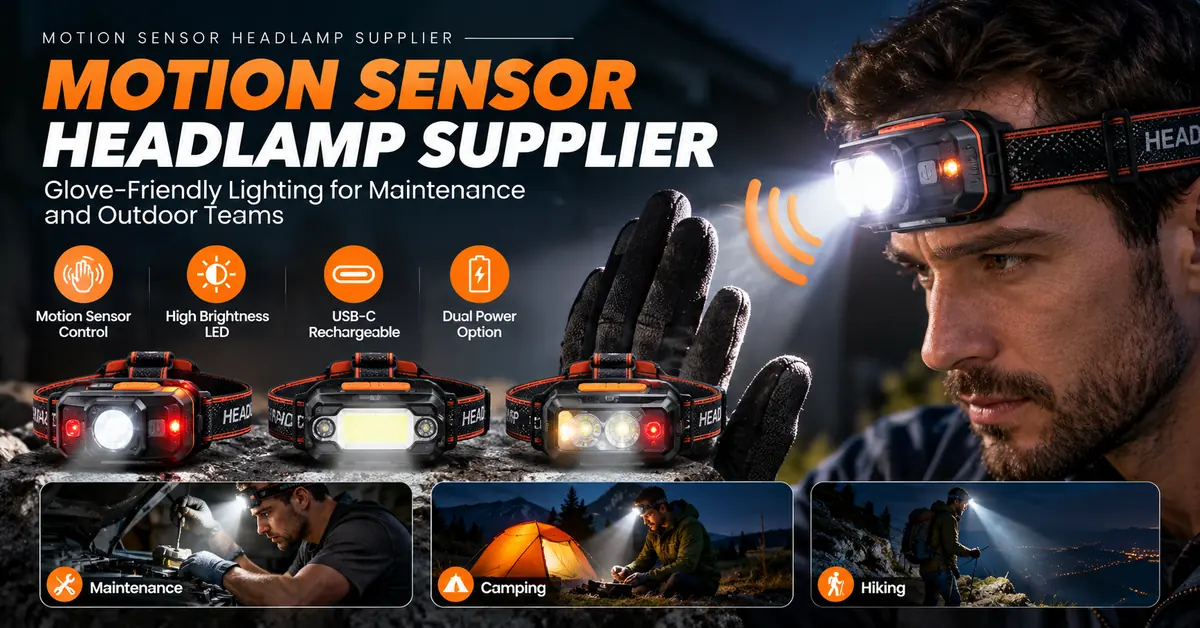
A video of a hand wave demonstrates one function. It does not show whether the sensor remains usable with coated work gloves, whether a nearby sleeve causes an unwanted response, whether the operator can disable sensing deliberately, or how the lamp behaves when its battery becomes low. Those questions matter in the customer's real workflow. A supplier should identify the offered model and provide a current operating diagram, a sample representing the proposed production build, and a plan for verifying functions important to the buyer.
Best-fit buying groups include industrial tool wholesalers, general facilities-maintenance distributors, camping and trekking brands, outdoor e-commerce labels, mobile-repair kit integrators, and private-label companies building a hands-free category. These groups may want similar-looking products but different features. A factory that asks about the application before recommending a SKU is helping reduce risk.
Out-of-scope applications require special care. A standard outdoor headlamp is not automatically intrinsically safe, explosion-protected, helmet-certified, a regulated rescue signal, or appropriate for use on energized electrical equipment. If a customer works in a hazardous atmosphere, requires a particular PPE certification, or needs life-safety lighting, specify and independently verify those requirements rather than assuming a general retail sensor lamp qualifies.
2. Define the Work Before Selecting Touchless Controls
Start with a short field-use description. “Technician inspecting a shut-down machine, wearing oil-resistant gloves, bending into a cabinet for 30 minutes” is far more useful than “professional headlamp, high brightness.” Likewise, “family camper preparing food and moving between a tent and table” leads to a different lighting requirement than “hiker navigating an unlit trail.”
For industrial maintenance, ask whether the light stays on throughout the work cycle or is frequently toggled. If the operator reaches into a confined space with both hands, accidental shutoff may be more frustrating than having to press a physical switch once at the beginning. An easily accessible sensor-disable control can be valuable even when wave control is a key selling point.
For camping, warm or diffused close-range light can matter more than a long-range narrow beam. Gestures can help when hands are damp, although nearby companions or fabric movement may affect the user experience. For active hiking, a stable headband, secure tilt, and predictable beam matter; a gestural interface that is useful at a campsite may be unnecessary on a moving trail.
The decision table below gives buyers a starting point. It is a task-planning tool, not proof that any particular Brightenlux model has already passed these use cases.
| Intended User or Task | Preferred Lighting Behavior | Gesture-Control Question | Additional Buying Check |
|---|---|---|---|
| Gloved mechanical maintenance | Stable medium output, directional or broad beam | Can an intended wave toggle the lamp without repeated accidental changes? | Fit, switch accessibility and safe work positioning |
| Campsite cooking and setup | Comfortable broad light and easy mode changes | Can the operator disable sensing near tents and companions? | Warm/cool mode, low brightness and charging routine |
| General facility inspection | Hands-free illumination across variable distances | Does a hand close to a wall or helmet cause nuisance switching? | Strap comfort, runtime and cable compatibility |
| Hiking or walking outdoors | Stable beam and intuitive control | Is gesture control useful while moving, or better switched off? | Weight with battery, tilt, beam and rain evidence |
| Private-label multipurpose kit | Simple instructions and broad user appeal | Is the gesture feature easy to explain in a short manual? | Pack-out, warranty support and reorder identity |
3. “Motion Sensor” Does Not Specify the Sensor Technology
The expression motion sensor headlamp often refers to a gesture-activated lamp, but it does not tell the buyer which component is inside or how the sensing algorithm works. A supplier may use active optical proximity sensing, reflected infrared light, or another design. Passive infrared (PIR) presence detection is not the same operating concept as a short-range hand-wave switch. Do not label a Brightenlux model as PIR unless its circuit description confirms that architecture.
For sourcing, the most useful question is functional: what is the permitted sensing area, what type of gesture produces a response, which switch enables sensing, and which state follows a gesture? Ask for an operating-state diagram rather than deducing details from promotional wording.
An interface can include manual-on, manual-off, sensing-enabled, sensing-disabled, standby and last-mode memory. These states are not necessarily interchangeable. A product may need an initial button press to enable sensor mode before wave gestures work. Another may exit sensor mode after a long press. The current instructions for the exact SKU must define how it behaves.
Where the customer uses headwear, thick gloves or moving equipment, agree the gesture envelope as part of the project: hand movement, distance, direction and speed that should cause the intended action. Confirm whether other nearby objects might trigger the sensor and what happens when it is disabled. Avoid invented universal sensing distances because the official Brightenlux pages reviewed do not publish a common measurement for all sensor models.
For detailed preproduction event logging, Brightenlux already has a dedicated Headlamp Sensor False Trigger Testing guide. This article takes a broader sourcing and usability perspective; the linked technical guide is more appropriate when your engineering team needs a full false-trigger counting protocol.
4. Which Brightenlux Sensor Headlamps Are Worth Comparing?
One advantage of working with a real motion sensor headlamp supplier is the ability to shortlist documented product platforms. The products below appear on Brightenlux's own product pages. Compare their lighting architecture and buyer use, not only their maximum output figures. The manufacturer lists IP ratings and runtimes on certain pages, but the actual test evidence and exact pack-out need review for the quoted production revision.
| Brightenlux Reference | Manufacturer-Published Configuration | Gesture Feature | Potential Buyer Application | Confirm Before Ordering |
|---|---|---|---|---|
| BT-HL9004 Sensor — 450+ lm | SST20 focused white LED; twist focus; red modes; 1100mAh rechargeable lithium or 3×AAA; Type-C; IP44 listed | Right-side sensing switch; wave to toggle | General repair, outdoor utility, adjustable-beam headlamp | Battery carrier, focus travel, sensor sequence and IP evidence |
| BT-HL9105C — 500+ lm | XTE plus warm/cool COB; 1100mAh rechargeable lithium or 3×AAA; Type-C; IP67 listed; memory | Sensor-enable switch, gesture operation | Close-work, camping, mixed warm/cool lighting | Finished weight discrepancy, true runtime, supplied accessories and IP report |
| BT-HL9002 — 600 lm | Dual XPG2; red mode; 1800mAh rechargeable cell; Type-C; battery indicator; about 5h stated | Side switch enables sensor mode | Feature-led retail, visible battery state, general outdoor use | Gesture map, exact working mode, charge input and output test |
| BT-HL9105B — 600+ lm | XTE plus colored 3030 SMD LEDs; rechargeable or AAA option; Type-C; IP67 listed | Product description advertises wave activation | Hybrid-power, multicolor headlamp concept | Conflicting battery-capacity and weight text; current specification and actual modes |
Important data checks: The BT-HL9105C page displays both 60g and 100g descriptions. The BT-HL9105B page contains an apparent “11100mAh” typo alongside “1100mAh” text, plus differing weight statements. Do not copy those ambiguous specifications onto your carton. Obtain the current dimensional drawing and weigh an actual sample with its supplied battery and headband. The RGB BT-HL9001 page also has a sensor-related title while its specification says no sensor control; exclude it from a sensor shortlist until the supplier clarifies the actual build.
For a sourcing-first shortlist, BT-HL9004 Sensor is the clearest starting point when adjustable focus and red lighting matter; BT-HL9105C provides a distinct warm/cool COB and hybrid-power discussion; BT-HL9002 offers a separate battery-indicator and dual-emitter positioning. These are candidate product roles, not rankings based on independently measured performance.
Explore the Sensor Headlamp Portfolio Ask for Model-Specific Samples
5. Compare Real Beam Needs: COB Flood, Focused Spot and Warm Light
A sensor is only a control feature. A good headlamp still has to illuminate the work. For maintenance and camping, the buyer should evaluate what the wearer sees at the intended distance, not how many lumens the catalogue highlights. A focused beam can reveal a distant fitting or route feature, while a broad near-field beam can reduce the need to turn the head repeatedly during close work. Neither light pattern is universally better.
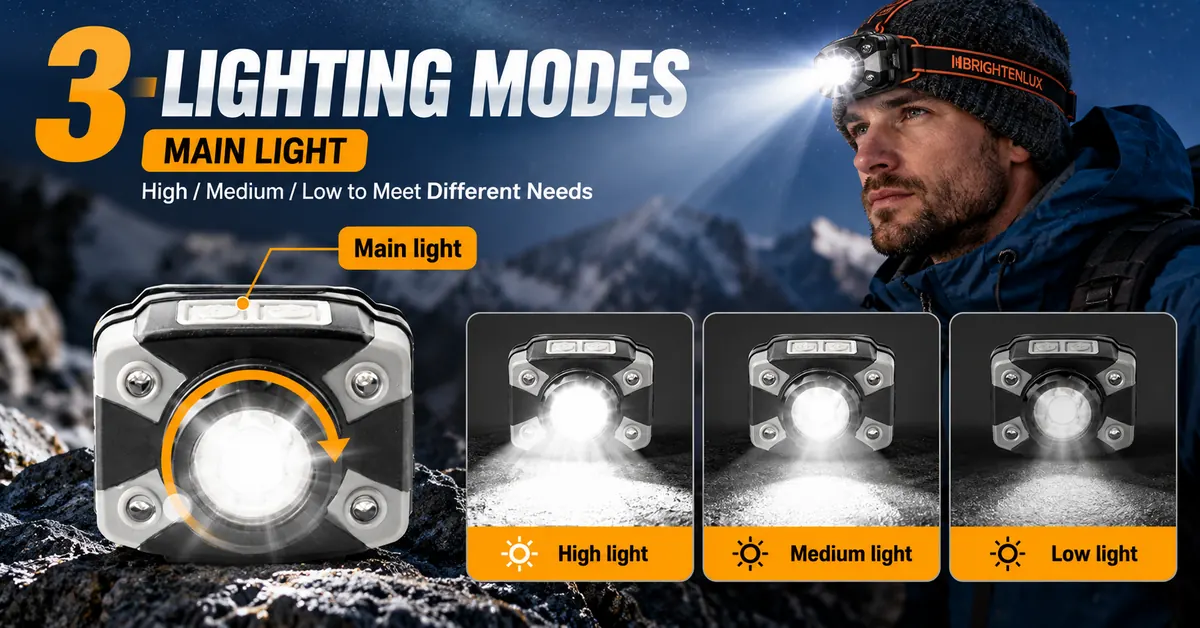
BT-HL9004 Sensor publishes a twist-focus SST20 main light, with red auxiliary LEDs. That makes it a useful reference for buyers who want to test adjustable beam geometry. The supplier should explain how turning the head changes the beam, whether the adjustment stays stable during movement and whether the mechanism's sealing claim still applies to normal use.
BT-HL9105C instead highlights warm and cool COB modes. That may suit close equipment work, campsite reading or tasks where a less concentrated beam is preferred. Warm/cool options do not by themselves prove accurate colour rendition or a particular colour temperature; ask for CCT or CRI measurements only if those properties matter to your customer.
The two-emitter BT-HL9002 has a different technical and retail proposition. A buyer might value a visible battery indicator and red lighting, but should still compare beam width, hotspots, comfort and the time that usable output is maintained at the chosen mode.
For a practical sample review, work with one consistent set of distances, a defined subject, and fixed camera exposure when photographing beams. A dramatic night image is a marketing asset, not a substitute for photometric evidence.
6. Glove-Friendly Controls: A Practical Acceptance Checklist
The central advantage of a motion sensor headlamp supplier is being able to test touchless convenience with the gloves and movements your users actually make. A gloved-work study should be short enough to repeat but detailed enough to reveal whether the sensor improves the task. Begin by defining an intentional switching gesture; then observe whether ordinary movements are being mistaken for commands.
The primary glove trial can include a thin fabric glove, a coated maintenance glove and a bulkier cold-weather glove if those represent the customer's audience. Use the actual glove type in the purchase specification rather than treating “works with gloves” as an unqualified promise. Test both a deliberate wave and normal non-command motions: adjusting a headband, reaching for a tool, brushing past a wall or turning toward a coworker.
Observe the response, the operator's confidence that the light has reached the expected state, and whether manual controls remain usable without taking gloves off. Record how long it takes new users to find and disable sensor mode. That last point can affect customer satisfaction more than a faster response measured on a laboratory fixture.
A small usability trial should ask each participant to perform the task with sensing enabled and then with sensing disabled, using the same light and beam mode. Interview them about accidental state changes, fatigue, hand movements and preference. If sensing makes one job faster but another more frustrating, that is a useful product-positioning result—not necessarily a defect.
Do not present a fixed pass-rate, response time or gesture distance as an industry standard without a defined test. Agree sample size, conditions and acceptable outcome with the buyer's QA team. Reserve a formal failure-counting protocol for the dedicated sensor test plan already linked above.
7. Sensor Mode Should Be Optional, Not a Point of Failure
A wearable headlamp may be used in tasks where unexpected darkness is merely inconvenient and others where it could interrupt work. In either case, manual fallback is an essential buying question. Ask whether the lamp continues to operate normally if the user turns sensing off, whether a long press ends sensing or only switches the LED off, and how the device behaves when powered up again.
Some Brightenlux pages identify separate left and right switches for lighting modes and sensing. That helps frame a useful sample test, but the exact press sequence should be confirmed on the quoted version. The package manual must reproduce that sequence accurately. If a sensor-enabled state can persist during storage, buyers should assess whether a sleeve, bag or incidental movement may discharge the battery; ask about any transport-lock function without assuming it exists.
During a task, the wearer should be able to choose between gesture convenience and steady, predictable output. A private-label brand may want clear labeling such as “Sensor On” and “Sensor Off” where the physical interface supports it. This is a proposed user-experience improvement, not proof that every Brightenlux headlamp includes those labels.
Include a short troubleshooting section in the user manual: what to do when a gesture does not work, how to switch to manual mode, how to clean the sensor window according to manufacturer instructions, and how to check battery state. Fewer ambiguous returns begin with clearer instructions.
8. Battery Choice: Rechargeable Lithium or Hybrid AAA Backup?
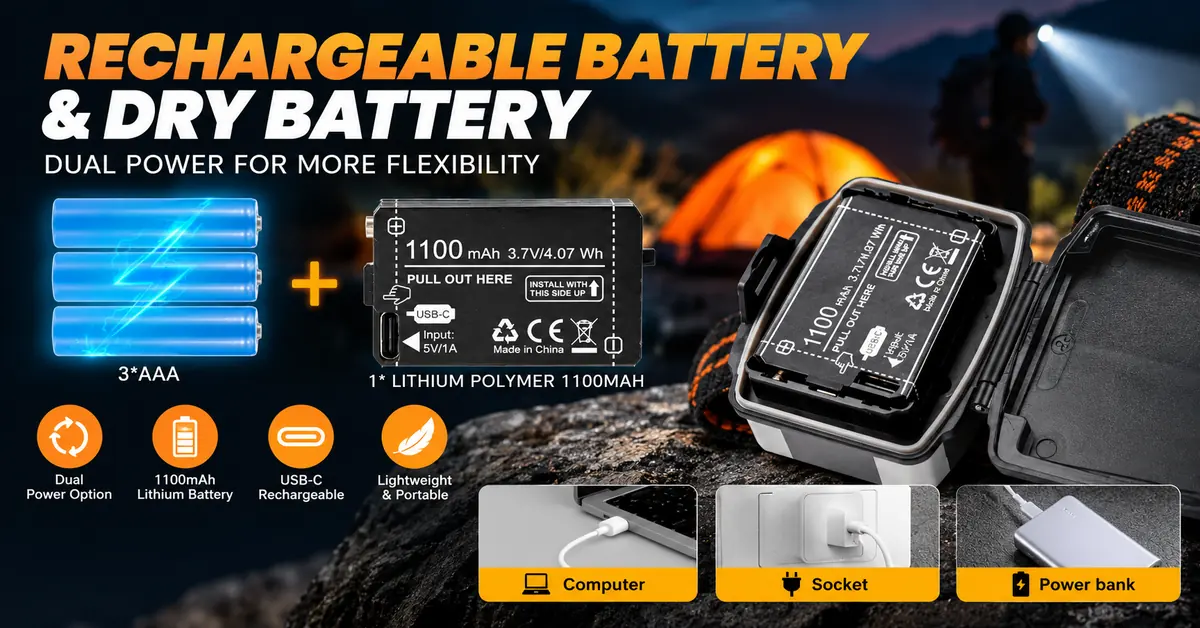
Power systems create meaningful differences among these models. BT-HL9004 Sensor and BT-HL9105C are advertised with an included rechargeable lithium battery and an alternative three-AAA power option. BT-HL9002 has a published 1800mAh included lithium cell and a four-level power indicator. These are distinct product platforms. Do not assume they use the same cell size, battery carrier, charging logic or accessories.
Hybrid power can appeal to field workers or campers who may not have convenient charging. But buyers must check whether the alternative AAA holder ships in the standard carton, how the user changes the power source, and whether any mode or runtime differs with AAA cells. The quoted kit needs its own pack-out record; a product photograph is not an accessory commitment.
USB-C is convenient, but the connector does not automatically prove USB Power Delivery, compatibility with every C-to-C cable or any particular charging time. Confirm input electrical ratings, charging-state indicators, compatible adapter guidance and the manufacturer-tested recharge period. Battery runtime figures such as “3–10 hours” apply only to unspecified or varied operating modes unless a mode-specific chart is supplied. A customer working for two hours in a medium setting needs sustained usable output, not a peak-output number.
For battery transport, the actual cell/pack and route determine documents and requirements. Ask for the relevant lithium battery test-summary and shipment records, including UN Manual of Tests and Criteria, Part III, subsection 38.3 where applicable. Those records are separate from brightness and water-resistance tests.
9. Comfort, Headband Fit and Mounting Under Real Movement
A sensor-enabled headlamp can still be a poor product if it bounces or points in the wrong direction. Require a fully assembled wearable weight including the supplied cell and headband—not an unspecified bare housing weight. This is particularly important for models whose product descriptions list conflicting values.
Fit trials should reflect the target market. Check a bare head or thin cap for recreational use, and any permitted headwear arrangement for professional applications. Do not assume a standard elastic strap is a certified hard-hat mounting system. If a customer needs helmet clips, compatibility with PPE or a particular attachment approval, identify that as an independent engineering requirement.
Observe whether the lamp creeps downward when someone bends forward, whether tilt adjustment stays in place, and whether strap edges or a battery compartment irritate the wearer during the expected working period. With gloves, test whether the wearer can adjust aim without catching the strap or accidentally covering the sensor. In cold conditions, evaluate elasticity and button feel on actual samples if these are important to the target market.
A procurement review can be simple: record wear time, user scenario, required adjustments, observed movement and a small number of consistent ratings such as comfort and beam stability. These buyer-generated observations should remain separate from manufacturer-published photometric claims.
10. IP Ratings and Field Durability Must Be Model-Specific
Headlamps may be worn in rain, perspiration or dusty environments, but enclosure ratings must be stated precisely. Brightenlux lists IP44 for BT-HL9004 Sensor and IP67 for BT-HL9105C and BT-HL9105B. These are manufacturer website claims; confirm the corresponding test report for the exact quoted product and revision before using them on packaging.
The technical reference IEC 60529, Degrees of protection provided by enclosures (IP Code), describes defined solid and water ingress classifications. An IP67 claim does not mean unlimited submersion, chemical resistance, suitability for pressure washing or that a charging port may be left open in rain. Some products can be splash-resistant while providing adequate performance for their actual user job; a higher number is not a universal value judgment.
A practical durability screen may cover normal rain exposure within the product's claimed rating, headband adjustment, repeated button operation, connector-cover handling and lens fogging. The sensor window deserves attention because contamination can affect interface usability even when harmful enclosure ingress has not occurred. Test sensor behavior and ingress separately, and do not treat one successful bench demonstration as proof of the other.
If the buyer targets solvent-heavy industrial cleaning, abrasive environments, or hazardous locations, obtain specialist assessment. Standard outdoor housing claims are not substitutes for chemical compatibility or safety-related approvals.
11. Request Two Technical Evidence Packages: Light and Gesture
The motion sensor headlamp supplier evaluation should produce two distinguishable evidence packages. One describes lighting and battery performance; the other describes the gesture-control interface. Mixing them into a single “tested” claim makes it difficult to understand what was actually verified.
For lighting, request measured output by mode, runtime conditions, beam information, charging parameters and any claimed ingress evidence. ANSI/PLATO FL 1-2025 is a relevant framework for portable-light performance reporting. It introduces specific treatment of short-duration elevated-brightness modes such as Turbo; those figures should not be silently presented as sustained output. Referring to the standard does not mean an individual Brightenlux headlamp has been certified under it.
For gesture controls, request the operating-state map, sensor enabling procedure, defined gesture envelope, trial conditions, observed unintended changes and response behavior. The buyer should be able to tell what happened to a specific sample in a specific state. This is particularly useful when comparing manual-only and sensor-enabled operation under gloves.
| Evidence Package | Questions the Buyer Should Ask | What to File With the Approved Sample |
|---|---|---|
| Optical output | What beam and brightness are useful at the working distance? | Mode-by-mode output, beam photos with conditions, test method |
| Runtime and charging | How long does the chosen working mode remain usable? | Battery ID, charge input, output-versus-time record |
| Gesture interface | What action toggles the light and what cannot? | Switch-state map, positive and nuisance trial observations |
| Wearability | Does it fit the intended user over the task period? | Complete weight, strap/tilt photos, user-trial notes |
| Environmental claims | Which product revision was tested to the advertised IP rating? | Test report, configuration, scope and conditions |
| Pack-out and labeling | Does every retail claim match the delivered kit? | Approved manual, carton, barcode, components and artwork |
12. Build a Channel-Specific Product Range Without Overlapping SKUs
A private-label company sourcing several headlamps should avoid offering multiple near-identical models with no understandable difference. Make one customer job the reason for each proposed SKU. Brightenlux's public offerings suggest three distinct conceptual roles, but buyers should confirm current availability and customization terms before describing them as an agreed program.
Utility / Adjustable Beam: BT-HL9004 Sensor as a starting reference for buyers who need twist focus, red light and rechargeable/AAA flexibility. It suits a product story about beam placement and gloved maintenance, subject to validation.
Comfort / Broad Task Light: BT-HL9105C as a reference for warm/cool COB illumination and an alternative power source. It is relevant to campsite setup, nearby work and users who want a less concentrated beam. Confirm the product's conflicting published weight.
Feature-Led / Visible Battery Status: BT-HL9002 as a reference for dual XPG2, a four-level battery display, a rechargeable 1800mAh listing and a sensor-enable control. That can create a different retail value proposition, although mode definitions and actual test evidence remain critical.
Do not position every product as universally “industrial grade” or “professional rescue.” The brand may want a basic utility tier, a core camping/maintenance tier, and a more feature-led outdoor tier. Each should have its own description, verified claims, FAQ and after-sales documentation. A smaller, clearly differentiated range may be easier to sell and support than a collection built only around maximum lumen figures.
13. OEM/ODM: Separate Logo Customization From Sensor Redesign
Brightenlux publicly offers OEM/ODM discussions and private-label support for portable lighting. For a motion sensor headlamp supplier, the customization boundary is particularly important because changing a switch, sensor window or circuit can change the user interface and invalidate previous test evidence.
Presentation changes may include logo position, approved headband graphics, manual language, barcode and retail carton artwork. These still need a physical sample and confirmation of process-specific MOQ and cost. Accessory changes may include a different strap, carry bag or approved mounting part, but fit and retention should be reevaluated.
Functional changes—such as gesture sensitivity, mode order, default sensor state, different control logic, battery pack, LED or optics—require engineering feasibility and a separate test plan. A request for a different sensor-enable gesture is not simply a printing change. New firmware or sensor hardware may alter charging behavior, standby drain or false activations, so the buyer should expect a new sample and relevant regression checks.
A new ODM headlamp with an original enclosure or electronic architecture may need tooling, drawings, design verification, pilot builds and longer commercial negotiation. Do not assume a small logo-printing MOQ applies to that project. A quotation should distinguish standard model, branded version, configuration adaptation and original development rather than use the word “custom” for all four.
Discuss OEM Headlamp Customization Request Brand-Specific MOQ & Pricing
14. Manufacturing and Quality Control: Freeze the Sensor Build
A successful sample is only a starting point. In bulk production, small differences in sensor alignment, housing tolerance, button feel, headband materials or charging components can change the user experience. The buyer should require a golden sample, a revision-controlled bill of materials and a written inspection plan before releasing a significant order.
Incoming controls may cover the LED, lens or reflector, sensor parts, control board, switch, battery, USB connector, gasket, strap and packaging components. During assembly, ask how the sensor window and circuit are positioned, how controls are tested, and how the product's mode sequence is verified. Final inspection should confirm correct function and the agreed retail pack-out.
Create distinct checks for manual lighting, sensor-enabled operation, battery/charging, cosmetic appearance, mounting, and packaging. A factory statement such as “100% checked” is less informative than a model-specific description of what is checked on every unit and what is sampled. For critical tests, agree the method, sample size and release decision in advance.
Change control is just as important at reorder. If the sensor board, window colour, firmware, LED bin, cell supplier, strap or seal is changed, ask what needs reapproval. Even visually identical units may have a different sensing envelope or runtime. The manufacturer should be able to trace an issue to a production lot and proposed corrective action.
Brightenlux's company profile describes its manufacturing facility and teams. These are supplier-published facts and do not replace an order-specific factory audit or a complete headlamp QC report.
15. MOQ, Sample Timing, Capacity and Commercial Risk
When reviewing a quote from a motion sensor headlamp supplier, confirm what the unit price actually includes. Is the lithium cell present? Is an AAA carrier supplied for hybrid models? Does the package include a Type-C cable? Are straps, clips, instructions and branded cartons included? Is the stated IP evidence valid for the offered revision? These questions can change the landed cost more than a small headline discount.
Compare at least two pricing scenarios for the same frozen specification: a buyer-funded sample or pilot quantity and a realistic initial wholesale quantity. Request separate lines for logo printing, packaging, special accessories, revalidation, tooling and freight terms. Without that breakdown, one “cheap” quote may simply exclude components needed for sale.
MOQ and lead time vary by the exact model and change requested. A standard existing headlamp and a new sensor PCB are different commercial situations. Ask for milestones: current platform availability, sample preparation, artwork approval, affected testing, material readiness, mass production, inspection and dispatch. Do not publish a company-wide fixed MOQ or days-to-shipment unless Brightenlux confirms it for the chosen configuration.
For spare parts and repeat orders, define how a buyer reports a dead battery, broken strap, sensor issue or failed charge port. A product family that is easy to identify, service and reorder can be more valuable than a low first-order price if it reduces support friction.
16. A Six-Step Field Pilot Before the Bulk Order
A short field pilot helps a distributor determine whether a gesture headlamp fits its customer base. It should be designed around normal user activity rather than only a bench demonstration. The sequence below is a recommended buyer workflow, not a published Brightenlux qualification procedure.
- Register the candidate. Record official model, revision, battery, supplied accessories, current instructions and sample photographs.
- Choose representative wearers. Include the relevant glove types, headwear, lighting distances and tasks. Record the task, not just an overall satisfaction score.
- Compare manual and sensor mode. Ask users to complete the same safe task in both states. Note deliberate gestures, awkward controls and unrequested changes.
- Evaluate lighting and reserve. Use a defined working mode over the planned activity period; note beam usefulness, stable output and low-battery behavior.
- Inspect comfort and durability. Review strap security, head tilt, sweat/rain conditions within the specified scope, and pack-away behavior.
- Approve or revise. Freeze the sample and written configuration if it meets the agreed user job. Otherwise record the needed change and retest affected functions.
Do not extrapolate a few sample observations into a universal sensor reliability percentage. If the project needs quantitative false-trigger limits, use a statistically appropriate test design and refer to the site's preproduction sensor test guide. The field pilot answers the larger commercial question: does the feature actually help the intended customer?
17. A Quote-Ready RFQ for Sensor Headlamp Wholesale
An effective request for quotation allows a motion sensor headlamp supplier to propose an existing model, identify needed modifications and flag unsupported requirements before pricing. The RFQ should be sufficiently precise that two suppliers are answering the same question.
| RFQ Field | Include in Your Brief | Request From Brightenlux |
|---|---|---|
| Buyer and market | Country, import role, sales channel, forecast quantity | Market-relevant documents and current model options |
| Work scenario | Glove material, task, movement, typical viewing distance | Suggested model and its suitability limitations |
| Sensor behavior | Enable/disable logic, intended wave, unacceptable activation | Current switch map, sensing description and sample plan |
| Optical job | Close flood vs focused spot, low-mode use, desired color options | Model-specific beam and output evidence |
| Power | Battery type, runtime at selected mode, AAA backup need | Exact cell/pack, Type-C input, accessories, charge tests |
| Wearability | Full wearable weight, headwear, strap, tilt | Measured sample and fit evidence |
| Environment | Expected rain, dust, cleaning, storage | Applicable IP report and use instructions |
| Branding | Logo, packaging, language, accessories | Available customization, MOQ by option, artwork proof |
| QC and reorders | Golden sample, lot identification, change approvals | Inspection plan, revision control and support process |
| Commercial terms | Pilot and bulk quantities, target date, Incoterm | Itemized quote, lead-time stages and exclusions |
Send the target product link where you have one. For example, if the project concerns warm/cool task lighting, point to BT-HL9105C and identify the requirements that must remain unchanged. If the project instead needs adjustable focus and red light, start with BT-HL9004 Sensor. Ask which details are already available, which can be branded, and which require engineering review.
Send Your Sensor Headlamp RFQ Review Brightenlux's Manufacturing Background
18. Frequently Asked Questions About Motion Sensor Headlamp Procurement
1. What does a motion sensor headlamp supplier provide beyond the headlamp itself?
A useful supplier provides an identified product configuration, current operating instructions, suitable sample options, lighting and power specifications, available OEM/ODM scope, and a quotation that explains pack-out, MOQ, documentation and quality conditions. Buyers should confirm what has actually been tested and what still requires engineering approval.
2. Is a motion sensor headlamp always a PIR headlamp?
No. “Motion sensor” can describe different technologies and operating principles. Many head-worn products advertise short-range hand-wave activation, which should not automatically be equated with passive infrared presence detection. Ask for the sensor architecture, intended gesture range and exact state transitions on the offered model.
3. Which Brightenlux model is suitable for gloved maintenance?
BT-HL9004 Sensor is a relevant starting sample because its published features include twist-focus white light, red modes, hybrid power and gesture switching. BT-HL9105C offers a different broad COB and warm/cool lighting concept. Final choice needs a task-based glove trial, not just a catalogue feature comparison.
4. Can a motion sensor headlamp be operated manually?
Brightenlux lists separate mode and sensor controls on several models. The exact off, standby, enabled, disabled and memory behavior must be verified on the chosen unit and described accurately in the manual. Buyers should test both gesture and manual modes before production approval.
5. Does USB-C mean all headlamps support the same fast charger?
No. Type-C describes the connector, not universal compatibility with every cable, adapter or charging protocol. Obtain the electrical input rating, included cable specification, charging time under defined conditions and any restrictions from the manufacturer.
6. Are rechargeable/AAA hybrid headlamps better for every buyer?
Not automatically. Hybrid power can be useful when charging is uncertain, but it adds accessory and instruction questions. Confirm whether the AAA holder is supplied, which cells are included, how switching works and how performance changes. For some retail users, a simpler rechargeable-only model may be preferable.
7. Is the Brightenlux BT-HL9105C really 60 grams?
The current product page contains conflicting weight statements, including 60g and 100g. Buyers should request a current specification and measure the finished wearable sample with its battery and strap before printing a weight claim or comparing it with other models.
8. Does IP67 prove the gesture sensor will work reliably in rain?
No. IEC 60529 addresses defined enclosure ingress conditions; it is not a sensor false-trigger or gesture-recognition test. Verify the product's applicable IP evidence separately from actual sensor behavior with the cover clean and under relevant permitted exposure conditions.
9. Can Brightenlux customize a sensor headlamp for private-label orders?
Brightenlux advertises OEM/ODM support. Logo, band graphics and packaging may be available under a model-specific quotation. Changes to sensor logic, optics, electrical architecture or enclosure need feasibility review and possibly new tests. MOQ, tooling and lead time depend on the exact scope.
10. What should I include in a motion sensor headlamp wholesale enquiry?
Share the destination market, buyer channel, intended user task, glove and headwear conditions, preferred model, sensor control requirements, beam needs, battery and charging preferences, anticipated quantities, branding, testing evidence and schedule. Use Brightenlux Contact Us to request a current sample and itemized proposal.
Conclusion
A motion sensor headlamp supplier should be evaluated on whether its product makes a real task easier while remaining predictable, comfortable, testable and repeatable. For gloved workers, campers, hikers and outdoor brands, the strongest buying decision combines a task-based gesture review, suitable beam pattern, manual fallback, verified battery and ingress information, clear accessories, and controlled production specifications. Maximum lumens and a “smart sensor” label alone are not enough.
Brightenlux offers published gesture-control platforms including BT-HL9004 Sensor, BT-HL9105C and BT-HL9002. Start with the official product pages, confirm the disputed or missing model-level facts and request samples under your intended use conditions. To discuss an OEM/ODM program, send Brightenlux a model-specific RFQ with your market, glove tasks, expected quantity, branding scope and acceptance requirements. The objective is a headlamp customers can use confidently—and a configuration your business can reorder with confidence.
Explore Brightenlux Sensor Headlamps Request Your OEM/Wholesale Quote