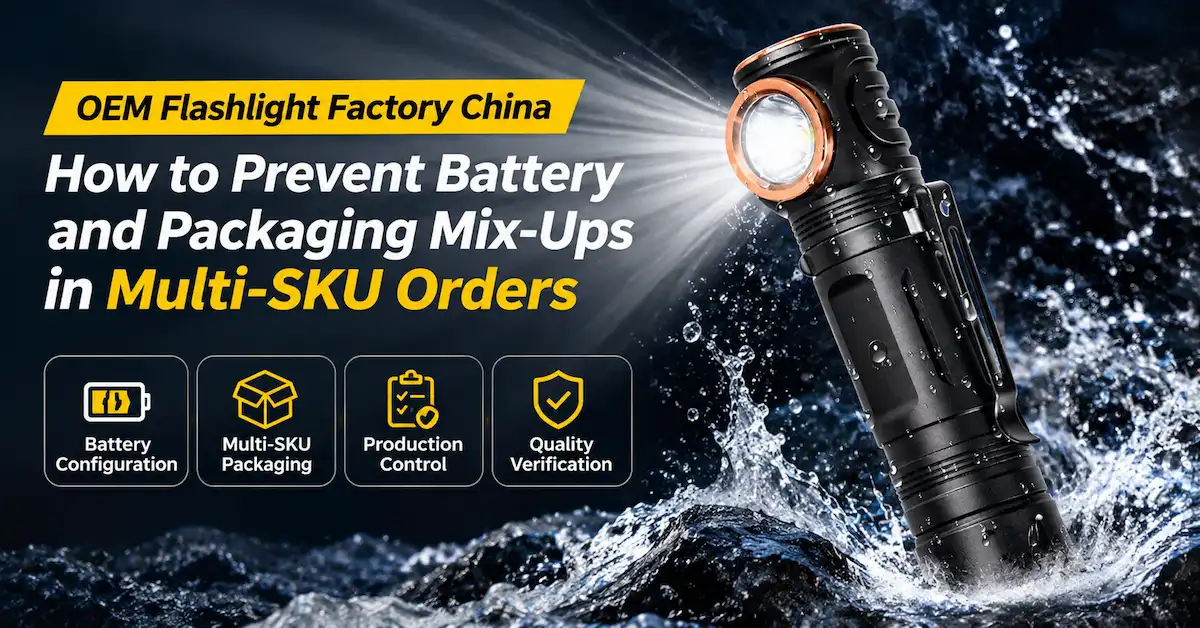


Quick Answer: A rechargeable LED light AQL inspection helps importers, distributors, and OEM purchasing teams determine whether a finished production lot meets agreed acceptance requirements. For rechargeable flashlights, headlamps, and camping lights sourced from manufacturers in Ningbo, China, inspectors should establish defect classifications, select an appropriate sampling plan, and verify appearance, lighting functions, charging behavior, temperature rise, accessories, and packaging. Acceptance decisions must follow predefined acceptance and rejection numbers, with separate controls for safety-critical failures. Whether inspecting products before shipment or upon arrival at a distribution warehouse, buyers should document every finding and resolve unacceptable deviations before releasing inventory into their target markets.
A rechargeable LED light can perform correctly during sample approval but still develop assembly, charging, appearance, or packaging inconsistencies during bulk production.
The purpose of incoming inspection is to identify these problems before products enter distribution.
Ningbo Brightenlux Electric Appliance Co., Ltd. is a portable lighting manufacturer based in Ningbo, Zhejiang, China, offering LED flashlights, headlamps, camping lights, and OEM/ODM product development support.
For international lighting buyers, an agreed quality acceptance plan provides a practical connection between approved product specifications, manufacturing control, and commercial shipment decisions.
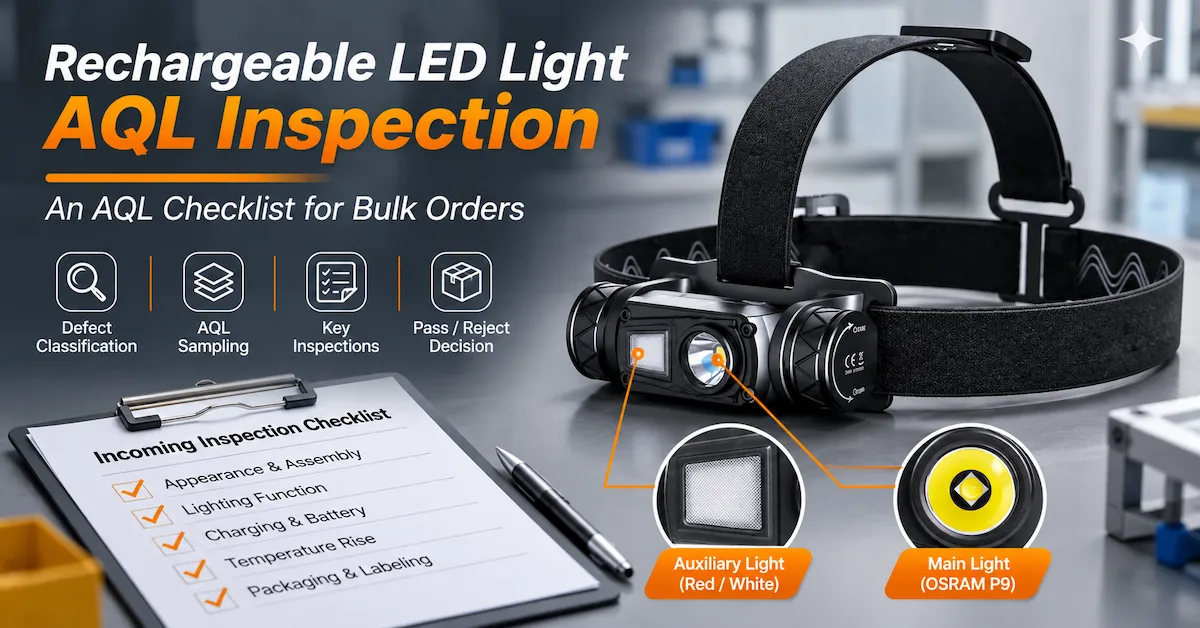
1. How Should Rechargeable LED Light Defects Be Classified?
Before selecting an AQL sampling plan, buyers and manufacturers must agree on how individual defects will be classified.
Not every scratch, charging failure, or assembly deviation presents the same level of risk.
A practical rechargeable LED light AQL inspection generally distinguishes between critical, major, and minor defects.
Critical, Major and Minor Defect Classification
| Defect Classification | Definition | Illustrative LED Light Defects |
|---|---|---|
| Critical | A condition presenting an unacceptable safety risk or serious compliance issue | Battery swelling, dangerous overheating, exposed hazardous electrical parts |
| Major | A defect significantly affecting intended operation, usability, or commercial acceptance | Charging failure, missing required lighting mode, incorrect battery, loose charging connector |
| Minor | A deviation that does not materially affect intended performance or safety | Small cosmetic marks within a nonfunctional area, slight noncritical printing imperfections |
The exact classification depends on the product specification, application, safety assessment, and destination-market requirements.
For example, an incorrect battery may be classified as a major defect when it causes a configuration mismatch, but it must be treated more seriously if the substitution introduces electrical or thermal hazards.
Rechargeable LED Light Defect Reference Table
| Inspection Finding | Suggested Classification |
|---|---|
| Battery swelling or leakage | Critical |
| Evidence of electrical burning | Critical |
| Dangerous accessible sharp edge | Critical |
| Missing required safety protection | Critical |
| Flashlight cannot switch on | Major |
| Charging function does not operate | Major |
| Incorrect approved battery configuration | Major or critical |
| Required magnetic mounting function fails | Major |
| Headlamp strap cannot secure properly | Major |
| Incorrect product barcode | Major |
| Missing required charging cable | Major |
| Significant housing damage | Major |
| Small cosmetic scratch outside critical zones | Minor, if permitted |
| Slight nonfunctional printing variation | Minor, if permitted |
These are proposed purchasing classifications, not Brightenlux's published factory acceptance criteria.
Buyers should establish a defect reference library with photographs, written descriptions, and approved boundary samples before bulk inspection.
2. How Do Buyers Establish a Rechargeable LED Light AQL Inspection Plan?
AQL stands for Acceptance Quality Limit.
It is an indexing parameter used in acceptance sampling systems. It should not be interpreted as a guaranteed maximum percentage of defective products in every accepted shipment.
The current ISO 2859-1:2026 standard provides an internationally recognized framework for attribute-based acceptance sampling of continuing production lots.
Step 1: Define the Inspection Lot
An inspection lot should contain products that can reasonably be evaluated together under the agreed sampling procedure.
Record the product model, purchase order, manufacturing batch, specification revision, battery configuration, packaging version, and quantity.
Different flashlight models, battery configurations, or production revisions should not automatically be combined into one inspection lot.
Combining unrelated products may conceal quality differences.
Step 2: Select the Inspection Level and Sampling Scheme
The buyer and supplier should establish:
- Applicable sampling standard and edition.
- Inspection lot size.
- Inspection level.
- Normal, tightened, reduced, or other applicable inspection status.
- Single, double, or multiple sampling method.
- AQL values by relevant defect classification.
- Sample size and acceptance/rejection numbers.
- Switching rules and previous lot history.
For isolated orders where switching rules cannot meaningfully be applied, qualified quality personnel may consider the alternative framework in ISO 2859-2:2020.
Step 3: Select Samples Randomly
Samples should be drawn from the entire defined lot rather than supplied only from conveniently accessible cartons.
Random selection should cover different cartons and relevant storage locations without allowing inspectors to choose only visually acceptable products.
Record carton numbers and sample identification so that findings remain traceable.
Step 4: Separate Safety Controls From Routine Sampling
Safety-critical requirements may require dedicated screening, production controls, engineering validation, or specialized testing beyond routine AQL inspection.
A zero-acceptance sampling rule means that no critical nonconforming units may be found within the defined sample. It does not prove that the entire lot contains zero critical defects.
Illustrative Sampling Plan
The following example uses a historical single-normal-sampling arrangement to demonstrate how an inspection decision works.
| Sampling Parameter | Illustrative Requirement |
|---|---|
| Inspection lot | 1,000 units |
| Inspection level | General Level II |
| Sample size code | J |
| Sample quantity | 80 units |
| Critical defects | Separate zero-acceptance contractual rule |
| Major defects | Example AQL 2.5 |
| Minor defects | Example AQL 4.0 |
| Major Ac / Re | 5 / 6 |
| Minor Ac / Re | 7 / 8 |
The numerical example can be traced to the historical sampling tables described in this AQL sampling chart reference.
It is provided for training and quotation discussions only. It is not a verified table entry from ISO 2859-1:2026, a mandatory lighting industry requirement, or Brightenlux's actual inspection plan.
For real orders, obtain the applicable values from the agreed current standard and qualified inspection personnel.
3. Which Rechargeable LED Light Products Require Different Inspection Checks?
A single flashlight quality inspection checklist should not be applied without considering the actual product configuration.
A rechargeable flashlight, multifunction headlamp, and camping lantern have different charging systems, mechanical structures, accessories, and operating requirements.
Brightenlux Product Comparison and Inspection Focus
| Product Model | Published Specifications | Recommended Inspection Focus |
|---|---|---|
| BT-FL8088 Rechargeable Flashlight | 1500 lm, SST40 LED, 21700 4000mAh battery included, Type-C | Charging indicator, magnetic tail, mode operation, accessories |
| BT-HL9040 Rechargeable Headlamp | 800 lm, 18650 2200mAh battery included, white and red lighting, Type-C | Headstrap, lighting sequence, side LEDs, charging |
| BT-PL4031R Camping Lantern | 2000 lm, 6600mAh total battery capacity, dimmable COB lighting, power bank function | Dimming, color modes, diffuser condition, power bank operation |
The specifications above are taken from Brightenlux's public product pages. Final purchasing specifications and acceptance limits should be confirmed for each OEM configuration.
BT-FL8088: Rechargeable LED Flashlight
The BT-FL8088 1500LM Rechargeable LED Flashlight includes a magnetic tail, charging indicator, rechargeable battery, and accessories.
Inspectors should verify the approved magnetic function, charging behavior, mode sequence, battery configuration, and included package contents.
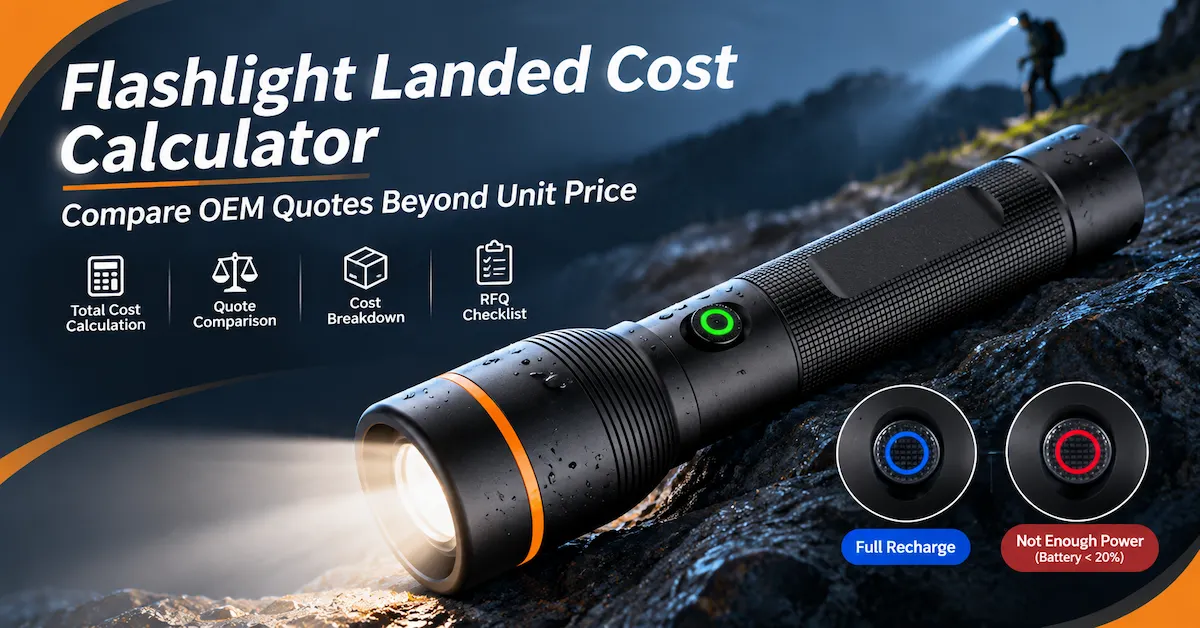
The published charging indicator uses red during charging and green when fully charged. This behavior should be checked against the approved product specification.
BT-HL9040: Multifunction Rechargeable Headlamp
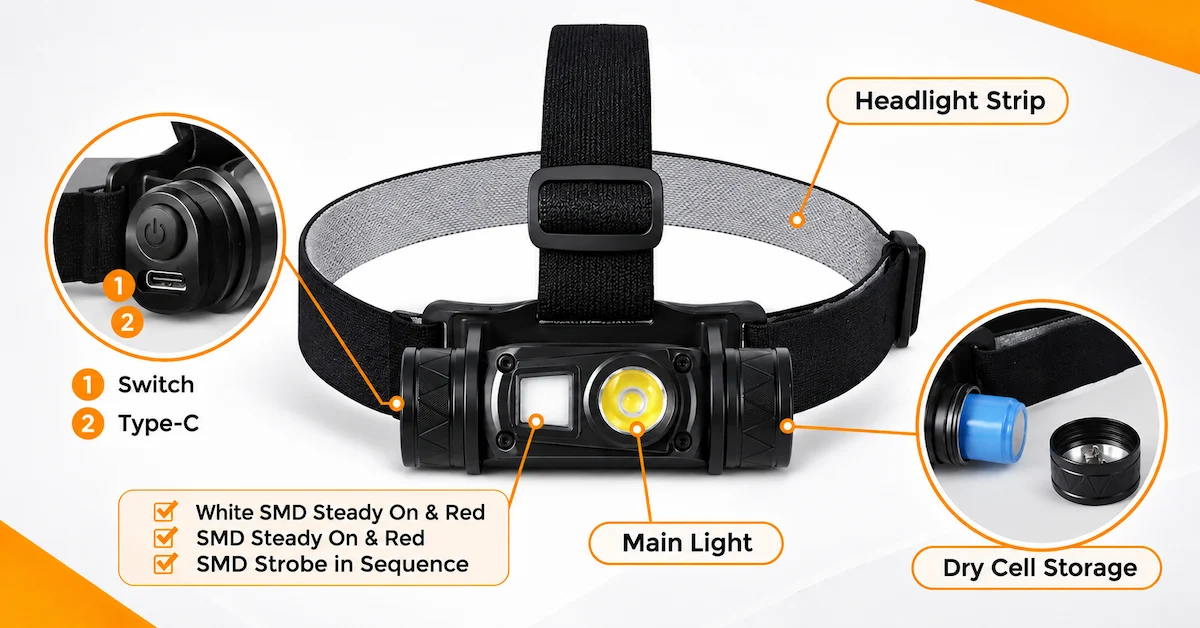
The BT-HL9040 800LM Rechargeable LED Headlamp combines a main LED with white and red side lighting.
Inspection should confirm the complete operating sequence, correct battery and cable inclusion, headstrap condition, and secure mechanical fit.
BT-PL4031R: Rechargeable Camping Lantern
The BT-PL4031R 2000LM Rechargeable Camping Lantern features multiple lighting colors, dimming, and a power bank function.
Its inspection plan should include diffuser appearance, lighting uniformity, dimming response, switch operation, battery configuration, and approved power-output requirements.
These product-specific differences demonstrate why inspectors need a separate acceptance specification for each SKU.
4. Appearance and Mechanical Inspection Checklist
Appearance inspection should be performed under agreed lighting conditions using approved product samples, drawings, and cosmetic boundary references.
Do not introduce subjective appearance requirements after production has been completed.
| Inspection Item | Inspection Method | Acceptance Requirement |
|---|---|---|
| Product identity | Compare model and SKU | Matches purchase order |
| Housing finish | Visual inspection | Matches approved finish |
| Scratches and dents | Inspect defined cosmetic zones | Within agreed limits |
| Lens or diffuser | Inspect under suitable lighting | No unacceptable damage |
| Logo | Compare approved artwork | Correct position and appearance |
| Switch assembly | Visual and functional check | Secure and operational |
| Threads and end caps | Operate under approved method | Correct engagement |
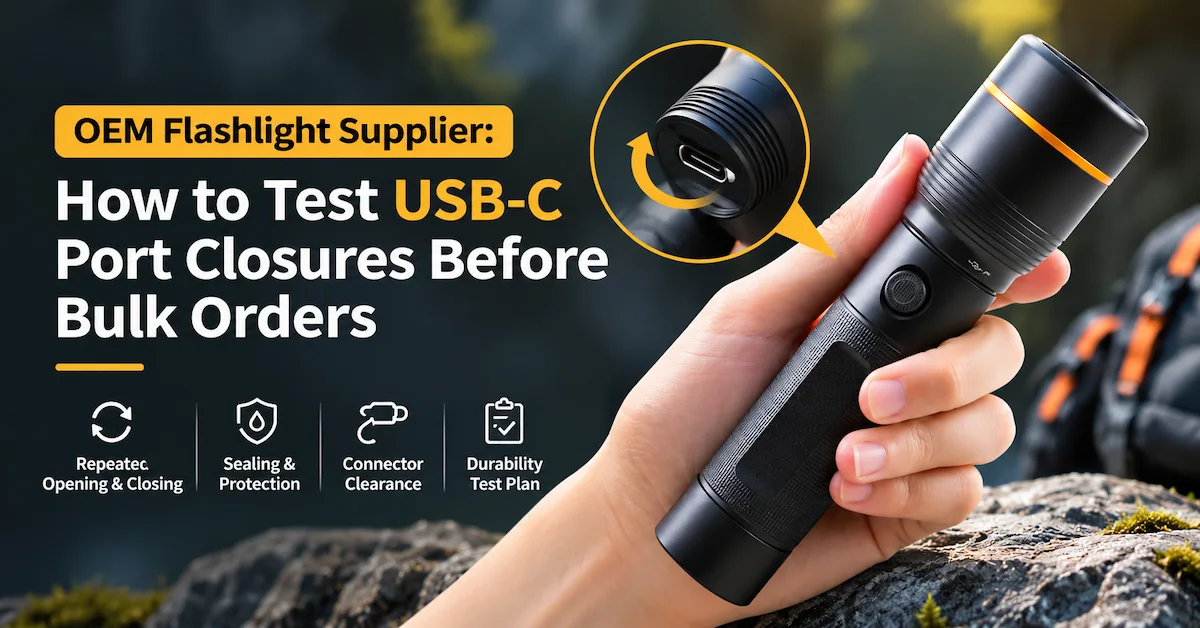
| Charging port | Visual inspection | Correct position, no damage |
| Port cover | Check fit and closure | Matches approved design |
| Magnetic tail | Approved retention check | Meets agreed requirement |
| Headstrap and clip | Inspect and operate | Correct assembly and retention |
| Product dimensions | Calibrated measuring tools | Within approved tolerances |
Inspectors should record actual measurements where dimensional tolerances apply rather than simply marking the product as visually acceptable.
For an OEM product, the approved color, logo, packaging, and component configuration should remain consistent with the signed specification.
5. Functional and Optical Inspection Checklist
A finished rechargeable light must perform the functions required for its intended market.
Routine inspection can identify missing modes, intermittent operation, incorrect switching behavior, and obvious optical defects.
Lighting Function Inspection
| Inspection Item | What to Verify |
|---|---|
| Power on/off | Reliable response |
| Mode switching | Correct approved operating sequence |
| Brightness settings | All required levels available |
| Strobe or SOS | Correct operation when specified |
| Red or auxiliary lighting | Correct color and function |
| Dimming | Expected adjustment behavior |
| Memory function | Correct recall where specified |
| Motion sensor | Correct activation where specified |
| Beam adjustment | Smooth operation where applicable |
| LED operation | No unintended interruption or flicker |
The inspector should operate the complete sequence rather than checking only the highest brightness mode.
For example, a headlamp that illuminates normally but cannot activate its required red-light function may still be commercially unacceptable.
Optical Performance Verification
Visual comparison can reveal obvious beam irregularities, lens contamination, or inconsistent light appearance.
However, visually judging brightness is not equivalent to measuring total luminous flux.
Where lumen output, beam distance, runtime, or color characteristics are contractual requirements, use suitable equipment, defined test conditions, and qualified test procedures.
A complete runtime or laboratory optical test may require a separate performance-verification plan rather than routine testing of every AQL sample.
6. Battery and Charging Inspection Checklist
Charging failures can create immediate customer complaints and product returns.
Battery and charging inspection should therefore be connected to the approved electrical configuration.
Before Applying Power
Check the battery type, installation condition, polarity markings, enclosure condition, and approved charging accessories.
A product showing swelling, leakage, burning, or other suspected battery damage must not be energized or charged for routine inspection.
Isolate the unit and follow the applicable site safety procedures.
Charging Inspection Requirements
| Inspection Item | Required Verification |
|---|---|
| Battery format | Matches approved configuration |
| Battery inclusion | Included or excluded as contracted |
| Battery condition | No visible unacceptable damage |
| Charging connector | Correct interface and secure fit |
| Charging initiation | Operates under approved input conditions |
| Charging indicator | Matches specified behavior |
| Charging current | Within the approved electrical specification |
| Charging completion | Correct behavior under the validated method |
| Cable | Correct supplied configuration |
| Battery protection evidence | Required model-specific documentation available |
A USB Type-C connector alone does not establish compatibility with every charging adapter, charging protocol, or USB-C power source.
The inspection instruction should identify the supported input configuration and the equipment used to verify it.
Routine charging checks should also be distinguished from full-cycle battery evaluation and electrical safety testing.
For products incorporating power bank functions, output operation should be evaluated separately against the approved specification.
7. How Should Temperature Rise Be Checked During Inspection?
Temperature rise is an important consideration for high-output rechargeable lighting products.
LEDs, driver circuits, charging electronics, and batteries can generate heat during operation.
A metal housing may feel warm under normal use, but temperature alone cannot determine whether a product is safe without considering the design and applicable requirements.
Thermal Inspection Record
| Parameter | Information to Record |
|---|---|
| Product model | Exact inspected SKU |
| Operating mode | Agreed brightness or charging condition |
| Ambient temperature | Measured before and during the test |
| Starting battery condition | Defined test starting condition |
| Measurement location | Housing, switch area, charging area or approved internal location |
| Operating duration | Agreed test duration |
| Maximum measured temperature | Actual recorded result |
| Temperature rise | Difference from the defined ambient reference |
| Acceptance limit | Approved engineering or safety requirement |
| Final result | Pass, fail or further evaluation required |
Temperature Rise Formula
Temperature rise (ΔT) = Measured surface temperature − Ambient temperature
For an illustrative measurement:
- Ambient temperature: 25°C.
- Measured housing temperature: 43°C.
- Temperature rise: 18°C.
This numerical example does not establish a safe operating temperature or a pass/fail limit for any Brightenlux product.
The acceptable temperature depends on the measurement location, accessible materials, contact conditions, operating mode, battery system, applicable requirements, and validated product design.
Use appropriate calibrated instruments and approved methods. Infrared readings may be unreliable when surface emissivity and reflections are not properly considered.
Unusual temperature rise, battery swelling, smoke, or burning odors require immediate cessation of testing and escalation to qualified personnel.
8. Packaging and Labeling Inspection Checklist
A technically functional rechargeable LED light can still fail incoming inspection because its packaging or labeling does not match the purchase order.
Packaging is particularly important for OEM brands, retail chains, e-commerce sellers, and overseas distributors.
| Packaging Inspection Item | Acceptance Requirement |
|---|---|
| Retail box | Correct approved artwork |
| Product model | Matches packed product |
| Barcode | Correct code and readable |
| User manual | Correct revision and required language |
| Charging instructions | Matches approved product configuration |
| Safety warnings | Required information present |
| Battery information | Accurate for the actual configuration |
| Accessories | Complete according to packing list |
| Internal protection | Matches approved packaging |
| Master carton quantity | Correct unit count |
| Carton markings | Correct order and shipping information |
| Carton condition | No unacceptable damage or contamination |
Destination-Market Verification
Product claims, electrical information, warnings, labels, and supporting documentation should be reviewed for the actual destination market.
Importers supplying European, North American, or other international markets may have different documentation and labeling obligations.
A mark printed on a retail box is not, by itself, proof that the exact SKU meets all applicable requirements.
Where rechargeable lithium batteries are supplied, transport-related packaging and documentation must also be verified separately by qualified personnel.
9. Rechargeable LED Light AQL Inspection Pass and Reject Matrix
Once inspection is completed, the recorded number of nonconforming units must be compared against the agreed sampling plan.
Ac represents the acceptance number.
Re represents the rejection number.
The following matrix uses the illustrative 80-unit single-sampling example introduced earlier.
Example Acceptance and Rejection Criteria
| Defect Class | Sample Size | Acceptance Number (Ac) | Rejection Number (Re) |
|---|---|---|---|
| Critical | 80 | 0 | 1 |
| Major | 80 | 5 | 6 |
| Minor | 80 | 7 | 8 |
For this example, each sampled unit is counted once according to its most severe defect, while every individual finding is recorded separately. The actual counting method must follow the agreed inspection plan.
Five Example Inspection Outcomes
| Scenario | Critical Units | Major Units | Minor Units | Decision |
|---|---|---|---|---|
| A | 0 | 3 | 4 | Pass sampling criteria |
| B | 0 | 5 | 7 | Pass sampling criteria |
| C | 0 | 6 | 2 | Reject |
| D | 0 | 2 | 8 | Reject |
| AND | 1 | 0 | 0 | Reject and initiate safety review |
These are hypothetical inspection results, not records from actual Brightenlux production batches.
A sampling pass does not automatically authorize shipment or warehouse release.
Any mandatory safety checks, unresolved documentation issues, quantity discrepancies, or other contractual release requirements must also be satisfied.
Example: Why a Lot Can Fail With Only One Defect
Suppose an inspector examines 80 rechargeable flashlights and finds one unit with a swollen battery.
Under the example critical-defect rule, the lot fails even if every other sampled unit appears acceptable.
The battery condition requires immediate containment and investigation rather than averaging the defect against the remaining units.
Incoming Inspection vs. Pre-Shipment Inspection
| Comparison | Pre-Shipment Inspection | Incoming Inspection |
|---|---|---|
| Inspection location | Factory or supplier warehouse | Importer's receiving warehouse |
| Main purpose | Prevent unacceptable goods from being shipped | Prevent unacceptable goods from entering inventory |
| Additional focus | Production completeness and pack-out | Transit damage and received quantity |
| Failed result | Hold shipment pending disposition | Quarantine affected inventory |
| Final approval | Authorized shipment release | Authorized inventory release |
An LED light pre-shipment inspection can reduce receiving risks, but it does not replace verification of transport damage, shipment identity, and actual received goods.
Separate inspections should not have their results combined casually into a single AQL decision.
10. What Should Buyers Do When a Rechargeable LED Light Lot Fails Inspection?
A failed inspection should trigger an organized nonconformance process rather than an informal agreement to ship or distribute the goods.
Nonconforming Product Management Workflow
- Place the lot on hold. Prevent unauthorized shipment or inventory release.
- Identify affected products. Record SKU, lot numbers, cartons, and inspection findings.
- Contain the problem. Segregate affected products and investigate related inventory.
- Determine the root cause. Review relevant materials, components, processes, and production records.
- Agree on disposition. Decide whether sorting, replacement, approved rework, return, or rejection is appropriate.
- Verify corrective action. Confirm that the cause has been addressed and affected goods have been controlled.
- Perform authorized re-inspection. Follow the agreed rules for resubmitted lots and new sample selection.
- Document final release. Record the responsible approval authority and supporting evidence.
Corrective Action Examples
| Nonconformity | Possible Corrective Action |
|---|---|
| Incorrect barcode | Verify SKU mapping and replace incorrect labels |
| Missing cable | Investigate packing process and correct affected pack-outs |
| Inconsistent logo | Review marking setup and approved artwork |
| Failed lighting mode | Investigate assembly, electronics or configuration |
| Charging failure | Investigate the approved charging circuit and battery configuration |
| Abnormal heating | Isolate goods and obtain qualified engineering assessment |
Corrective actions must be appropriate to the actual cause.
Repeatedly drawing new samples until a rejected lot passes is not a valid substitute for containment, corrective action, and authorized resubmission.
Unsafe or legally noncompliant products should not be released through a commercial concession.
11. Rechargeable LED Light Incoming Inspection Report Template
The following report template can be adapted for different flashlight, headlamp, work light, and camping lantern purchasing programs.
Part A: General Inspection Information
| Report Field | Information |
|---|---|
| Inspection report number | __________ |
| Buyer/company | __________ |
| Supplier/manufacturer | __________ |
| Purchase order number | __________ |
| Product model and SKU | __________ |
| Specification revision | __________ |
| Production lot number | __________ |
| Ordered quantity | __________ |
| Presented or received quantity | __________ |
| Inspection location | __________ |
| Inspection date | __________ |
| Inspector | __________ |
| Destination market | __________ |
Part B: Sampling Plan
| Sampling Field | Information |
|---|---|
| Applicable standard and edition | __________ |
| Lot size | __________ |
| Inspection level | __________ |
| Inspection status | __________ |
| Sampling method | __________ |
| Sample size code | __________ |
| Sample quantity | __________ |
| Counting method | __________ |
| Critical acceptance rule | __________ |
| Major AQL and Ac/Re | __________ |
| Minor AQL and Ac/Re | __________ |
| Sample and carton identification | __________ |
Part C: Inspection Results
| Inspection Area | Quantity Checked | Nonconforming Units | Result |
|---|---|---|---|
| Product identity | ___ | ___ | ___ |
| Appearance | ___ | ___ | ___ |
| Mechanical assembly | ___ | ___ | ___ |
| Lighting functionality | ___ | ___ | ___ |
| Battery configuration | ___ | ___ | ___ |
| Charging | ___ | ___ | ___ |
| Temperature rise | ___ | ___ | ___ |
| Accessories | ___ | ___ | ___ |
| Packaging | ___ | ___ | ___ |
| Labeling | ___ | ___ | ___ |
Separate functional or specialized test sample sizes should be documented. A test performed on fewer units should not be presented as having covered the full AQL sample.
Part D: Defect and Evidence Register
| Sample ID | Defect Description | Classification | Photo Reference | Disposition |
|---|---|---|---|---|
| ___ | ___ | ___ | ___ | ___ |
| ___ | ___ | ___ | ___ | ___ |
| ___ | ___ | ___ | ___ | ___ |
Attach relevant photographs, measurement records, equipment identification, and applicable test reports.
Part E: Final Lot Decision
| Final Decision Field | Result |
|---|---|
| Critical nonconforming units | __________ |
| Major nonconforming units | __________ |
| Minor nonconforming units | __________ |
| Sampling decision | Pass / Reject / Pending |
| Separate safety and performance checks | Pass / Fail / Pending |
| Outstanding documentation | __________ |
| Corrective action reference | __________ |
| Re-inspection required | Yes / No |
| Final disposition | Release / Hold / Reject |
| Authorized approver | __________ |
| Approval date | __________ |
An effective flashlight quality inspection checklist should produce an inspection report that allows another qualified person to understand how the final decision was made.
12. How Should OEM Buyers Define Inspection Requirements Before Quotation?
Inspection requirements should be established during RFQ preparation rather than introduced for the first time after production.
Different products, testing methods, acceptance criteria, and inspection arrangements can affect commercial cost and delivery schedules.
OEM Lighting Quality RFQ Checklist
| RFQ Requirement | Information Buyers Should Provide |
|---|---|
| Buyer and sales channel | Importer, distributor, retailer or brand |
| Product application | Outdoor, maintenance, camping or emergency lighting |
| Destination market | Country or region |
| Reference model | Existing Brightenlux model or approved design |
| Product quantity | Initial order and expected repeat orders |
| Battery and charging | Approved configuration and requirements |
| Lighting functions | Required modes and performance |
| Materials and finish | Approved construction and appearance |
| Defect classification | Critical, major and minor definitions |
| Sampling plan | Standard, edition, level, AQL and decision rules |
| Thermal requirements | Test conditions and acceptance limits |
| Packaging | Approved artwork, labels and accessories |
| Inspection arrangement | Supplier, buyer or independent inspection |
| Required evidence | Applicable reports and technical documentation |
| Failed-lot policy | Containment, rework, replacement and re-inspection |
| Delivery schedule | Production and inspection milestones |
Brightenlux offers portable LED lighting product platforms and OEM/ODM development support for international B2B purchasing programs.
Buyers can discuss the intended configuration, packaging, inspection scope, quality acceptance requirements, and project-specific testing arrangements before confirming the purchase order.
For a broader explanation of customized flashlight procurement, review the Brightenlux OEM Flashlight Manufacturer Guide.
For detailed product specification preparation, refer to the Flashlight OEM Specification Template.
13. Frequently Asked Questions
1. What is rechargeable LED light AQL inspection?
It is an acceptance sampling process used to evaluate finished rechargeable lighting products against predefined quality requirements and lot acceptance criteria.
2. Is AQL 2.5 a mandatory requirement for LED flashlights?
No. The appropriate AQL depends on product risks, buyer requirements, contractual terms, and the applicable sampling scheme. AQL 2.5 is not a universal lighting industry requirement.
3. Does passing AQL inspection mean every product is defect-free?
No. Sampling supports a statistical lot acceptance decision. It does not prove that all uninspected units conform.
4. How many rechargeable LED lights should be inspected in a bulk order?
The sample size depends on the defined lot, applicable standard, inspection level, AQL, and sampling status. The correct plan should be established before inspection begins.
5. What is the difference between incoming inspection and pre-shipment inspection?
Pre-shipment inspection evaluates products before dispatch. Incoming inspection evaluates products after receipt and can additionally identify transportation damage, quantity discrepancies, and receiving-related issues.
6. Should every sampled flashlight undergo a charging test?
Routine charging checks should follow the agreed inspection scope. Full charging cycles, battery capacity testing, and electrical safety assessments may require separate test programs.
7. What temperature rise is acceptable for rechargeable LED lights?
There is no universal temperature rise limit suitable for every portable light. Acceptance requirements depend on product construction, measurement location, operating conditions, and applicable safety requirements.
8. Can buyers use the same inspection checklist for flashlights and headlamps?
A common inspection framework can be shared, but product-specific requirements must be added for functions, batteries, charging systems, accessories, mounting arrangements, and intended applications.
9. What happens when an LED lighting shipment fails AQL inspection?
The affected lot should be placed on hold. The supplier and buyer should investigate the cause, establish corrective action, agree on disposition, and perform any required re-inspection before release.
10. How can buyers arrange OEM flashlight inspection requirements with Brightenlux?
Provide the target market, product model, required configuration, order quantity, approved specifications, defect classifications, sampling plan, testing scope, packaging requirements, and expected inspection schedule when requesting a quotation.
Conclusion
A reliable rechargeable LED light AQL inspection requires more than selecting samples and checking whether each light switches on.
It connects the approved product specification with defect classification, documented inspection methods, defined acceptance criteria, and controlled release decisions.
For importers, distributors, and OEM brands, this approach can help identify quality deviations before products reach customers and reduce avoidable commercial exposure from nonconforming bulk orders.
Brightenlux manufactures portable LED lighting products in China and provides OEM/ODM support for overseas lighting purchasing programs.
Whether sourcing rechargeable flashlights, multifunction headlamps, or camping lanterns, buyers should establish clear inspection requirements before confirming production.
Define the inspection standard before production. Verify the finished products before release.
Browse Brightenlux LED Lighting Products
Explore OEM/ODM Outdoor Lighting Solutions
Contact Brightenlux to Discuss Your OEM Lighting Quality Requirements