

Rechargeable Flashlight Supplier Guide for Wholesale Buyers
A rechargeable flashlight supplier is not only a source for handheld lights. For B2B buyers, the choice affects product reliability, packaging, battery communication, and how well the flashlight performs when used at a dock, campsite, service vehicle, storage area, or emergency drawer. The item may look simple, but sourcing problems often come from small details: weak charging hardware, inconsistent beam control, poor switch feel, or a housing that does not feel secure in the hand. This guide helps wholesale buyers evaluate suppliers with practical criteria before committing to a program.
What Wholesale Buyers Really Need from a Rechargeable Flashlight Supplier
Most buyers search for a rechargeable flashlight supplier because they need predictable products, not just attractive samples. A flashlight is often used when conditions are inconvenient: after sunset, inside a dark compartment, near a fuse box, or during outdoor work. The end user expects a concentrated white beam that switches on quickly and feels dependable. For sourcing teams, the larger question is whether the supply chain can deliver that same experience across batches. A reliable supplier should communicate clearly about product structure, charging method, battery approach, housing finish, packaging options, and assembly consistency. If those details are unclear at the quotation stage, the risk usually grows later.
Market Fit: Where Compact Rechargeable Flashlights Sell Best
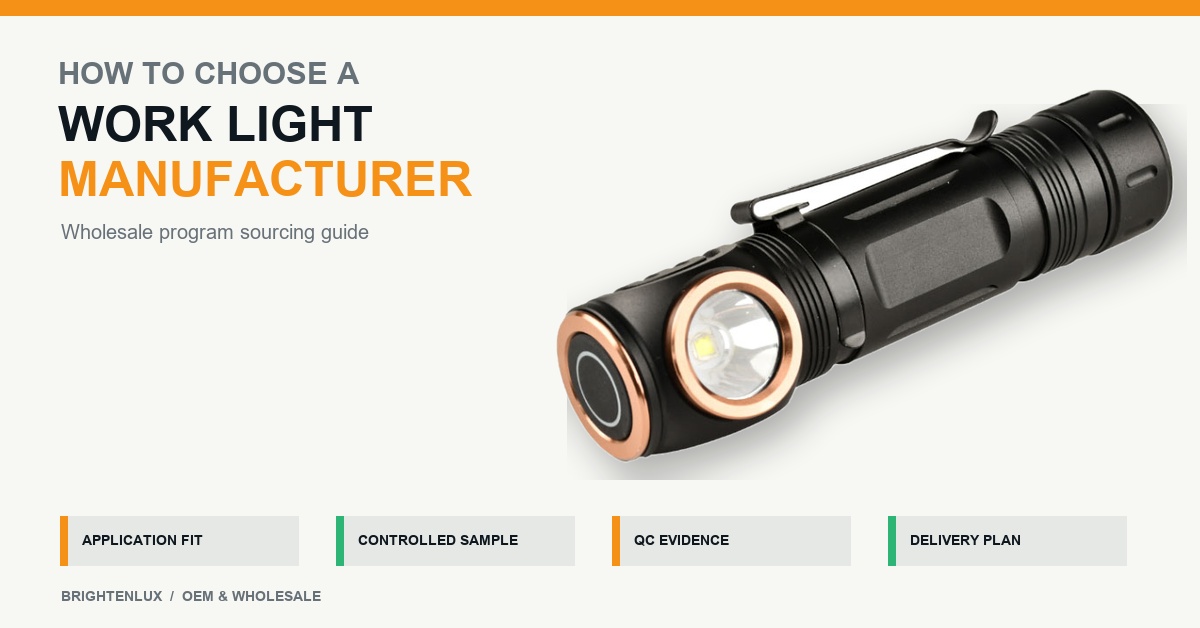
The common product in this category is a portable cylindrical LED flashlight with a black body and focused white beam. That familiar shape works because it is easy to store, carry, and use without explanation. Boating and fishing buyers value a compact light for checking tackle, dock areas, storage compartments, and lines after sunset. Camping users want fast access and controlled light for simple outdoor tasks. Home and automotive emergency kits need a product that turns on easily without a complicated learning curve. Industrial users may also prefer a modest handheld beam for maintenance, night rounds, and task inspection when large floodlighting is unnecessary.
Quick Checklist Before Placing a Wholesale Order
Before comparing price alone, buyers should check whether the flashlight fits the user scenario and whether the supplier can explain the product clearly. A sample photo cannot show switch quality, beam alignment, or how secure the body feels during real handling. Use the checklist below as an early filter before deeper negotiations or private-label discussions.
| Check Point | Why It Matters |
|---|---|
| Housing finish | Matte or semi-matte surfaces may be easier to grip than glossy shells, especially with gloves or wet hands. |
| Beam pattern | A focused white beam helps with bags, deck areas, corners, and short-distance walking. |
| Charging method | The connector and charging approach should suit the intended market and user habits. |
| Battery information | The supplier should clearly state what battery approach is used and how users should care for it. |
| Assembly consistency | Lens fit, switch feel, and body alignment affect perceived quality. |
| Packaging format | Retail, promotional, industrial, and bulk buyers may need different packaging solutions. |
For current product categories, buyers can review Brightenlux lighting options at Brightenlux products.
Supplier Qualities That Matter More Than Marketing Claims
A good rechargeable flashlight manufacturer should do more than send a bright sample. Buyers need repeatable production, stable communication, and control over details that influence performance. In flashlight sourcing, small changes can affect the product noticeably. A different reflector or optic may alter beam concentration. A switch change may affect user confidence. A slight molding change may change the way the body sits in the hand. Ask how the supplier manages component sourcing and final assembly. Is the body design fixed? Are electronics standardized across models? Can finish, branding, or packaging be adjusted for a different channel? These questions are not dramatic, but they prevent avoidable sourcing problems.
Direct supplier communication can also help when building a catalog or private-label line. A direct relationship may give buyers more room to align the flashlight with utility packaging, retail presentation, or bulk supply requirements. However, the supplier must still explain product architecture clearly enough for your technical and purchasing teams to review.
How to Evaluate Samples Like Both an Engineer and a Buyer
When a sample arrives, do not judge it only by the first flash of light. Press the switch repeatedly and check whether the action feels stable. Inspect the bezel, lens fit, and body joints. Hold the flashlight with gloves if your end users may work that way. Look for beam centering, obvious rattle, loose parts, or a housing that feels weak during normal handling. These practical checks reveal whether the product is suitable for real use, not just catalog photography. If you are considering an LED rechargeable flashlight wholesale order, ask whether the sample came from the same production route expected for future supply.
Buyers should also separate useful features from unnecessary complexity. For basic utility, camping, home, automotive, or dock use, simple operation can be an advantage. A flashlight that is difficult to understand may disappoint users even if it looks advanced on paper. Do not assume ruggedness from appearance alone, and do not accept vague answers about battery safety or charging design. Even without test data in hand, the supplier should be able to describe the battery type, charging interface, and user care instructions in plain language.
Questions to Ask Before You Commit
A focused supplier questionnaire is often more useful than a long form full of generic requests. Start with the product details that influence performance and repeatability. Ask what battery and charging system the model uses. Confirm whether the body design is fixed or whether finish and branding can be customized. Ask which parts are standard across the range and which are model-specific. Clarify how assembly consistency is checked and what documentation is available for end users or import review. Also discuss packaging expectations early, because the same flashlight may require different presentation for emergency kits, contractor supply, retail shelves, or promotional distribution.
Bulk buyers should also ask whether the supplier can support ongoing replenishment, not only a first order. A sample can look acceptable, but the commercial value depends on whether later batches remain consistent. If your team is ready to discuss specifications or sample needs, you can contact Brightenlux through the contact page or send a sourcing request via inquiry.
Buying Takeaway for Sourcing Teams
A compact rechargeable flashlight is simple only on the surface. In practice, it combines optics, battery design, charging clarity, molding quality, assembly control, packaging, and end-user convenience. The best supplier is the one that keeps those pieces aligned without making the ordering process harder than necessary. If your target market includes boating, fishing, camping, dock work, maintenance, automotive kits, or general night-use utility, focus first on beam concentration, hand feel, charging explanation, and batch consistency. Price matters, but it should not be the only filter. A flashlight that fails when needed is costly in ways that may not appear on the purchase order.
The next step is straightforward: request a sample, a clear specification sheet, and a plain-language explanation of the charging and battery configuration. That gives your sourcing and technical teams enough information to compare options without guessing. It also reveals whether the supplier understands real-world use or is only repeating product listing language.
FAQ
What should wholesale buyers check first in a rechargeable flashlight sample?
Start with practical handling details: switch feel, lens fit, body alignment, grip comfort, and beam centering. Then confirm the charging method and battery information with the supplier. A sample should not only look bright; it should feel consistent, easy to operate, and suitable for the target use environment.
Is a direct rechargeable flashlight manufacturer better than a trading channel?
A direct manufacturer relationship can be useful when buyers need product consistency, packaging alignment, branding discussion, or clearer technical communication. However, the value depends on how well the supplier manages components, assembly, and documentation. The best choice is the source that can explain and repeat the product reliably.
Why is beam quality important for LED rechargeable flashlight wholesale programs?
Beam quality affects real user experience. A focused white beam helps users inspect bags, corners, docks, storage spaces, or short walking paths. A poorly controlled beam may appear bright in a short demonstration but feel uncomfortable or inefficient during actual use, especially in utility and outdoor situations.
How should buyers handle packaging requirements?
Packaging should match the sales channel. Emergency kits may need simple shelf-friendly packaging and clear instructions, while contractor or institutional buyers may prefer bulk packing and stable carton organization. Discuss packaging early because commercial requirements can differ even when the flashlight model itself remains the same.