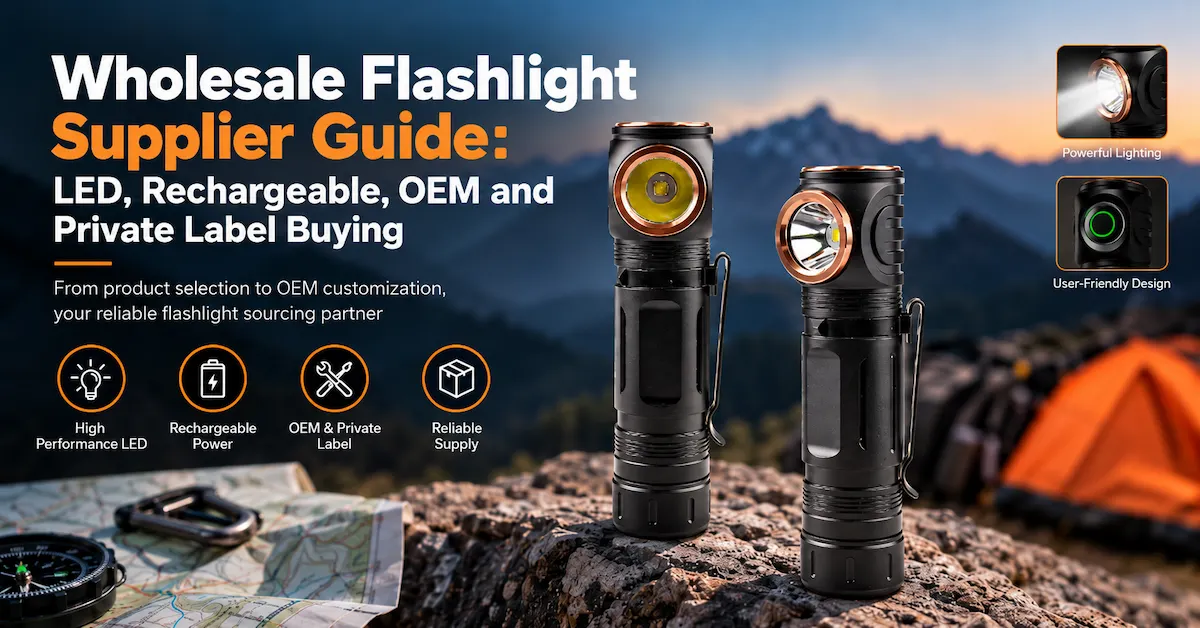


OEM Headlamp Manufacturer Cost Guide: Pricing, MOQ, Samples and Lead Time
An OEM headlamp manufacturer cannot provide a meaningful final price from a product name alone. Unit cost, minimum order quantity, sample schedule, and production timing depend on the complete configuration: lighting system, battery, housing material, headband, customization depth, packaging, testing needs, order plan, and destination market. When buyers compare quotations before aligning these variables, they may receive prices for different products without realizing it.
A better sourcing process separates the lamp itself from packaging, samples, tooling, and schedule risk. This guide follows a nine-step SEO and sourcing structure for B2B buyers: define the platform, separate customization levels, identify cost drivers, clarify packaging, understand MOQ, plan samples, review tooling, manage lead time, and prepare a complete inquiry. If you already know your application and target range, start by reviewing the Brightenlux products and shortlisting two or three suitable headlamp platforms before requesting an OEM quotation.
Step 1: Define the Product Platform Before Asking for Price
Catalog images can hide expensive differences. Two headlamps may look similar but use different batteries, drivers, tilt joints, headbands, charging ports, housings, packaging, and inspection requirements. A useful quotation describes a complete build rather than only a unit price. A transparent OEM headlamp manufacturer should identify the differences that affect cost instead of presenting unlike products as directly comparable.
The first sourcing question should be: what platform are we pricing? A lightweight plastic retail model, aluminum outdoor lamp, hybrid-power unit, and industrial work headlamp can require different materials, assembly methods, and validation work. If a quotation is much lower than others, ask which specification, component, process, packaging item, or service is different. The goal is not to force every supplier to match the lowest number; the goal is to compare the same product.
Step 2: Choose the Correct OEM Project Level
OEM headlamp projects usually fall into three levels. Each level changes the cost structure, sample requirement, MOQ, and lead-time risk.
Private label on an existing model
This is usually the simplest route. The approved lamp construction stays in place while the logo, color, strap branding, labels, instructions, packaging, barcode, and accessories may be adjusted. Because the electrical and mechanical design does not restart from zero, this option often suits a first category launch, seasonal retail program, regional-language packaging, or fixed delivery event.
Configuration-based OEM
At this level, the buyer keeps an established housing or product platform but changes selected functional items. Depending on feasibility, these may include LED arrangement, optic, color temperature, mode order, auxiliary colors, sensor behavior, battery capacity, charging input, strap, or bundled accessories. These changes require more validation than logo work because one adjustment can affect current, heat, runtime, beam shape, weight, charging behavior, or component availability.
New product development
When the brief requires a new body shape, mold, optical layout, PCB, firmware, battery arrangement, or mechanical concept, the project becomes product development. Separate lines may be needed for design work, prototypes, tools, test fixtures, pilot production, laboratory work, and later engineering revisions. This can be reasonable when expected sales and brand positioning require a product that catalog platforms cannot deliver, but it is a poor fit for a first order that is only testing market interest.
Step 3: Identify the Main Headlamp Cost Drivers
The lamp itself contains several major cost drivers. The LED model number alone does not describe the light a customer will experience. Driver current, reflector, lens, diffuser, LED count, color temperature, beam angle, and heat path all shape performance and cost. Instead of specifying only a peak output target, define the task, useful distance, beam preference, continuous mode, runtime expectation, and acceptable weight.
Battery selection is another major factor in rechargeable headlamp cost. Buyers should confirm cell format, rated capacity, nominal voltage, protection approach, replaceability, and whether the battery is included. A higher-capacity battery may increase weight, size, charging time, and price, so it should be matched to the actual use case rather than chosen only for a larger printed number.
Charging design also matters. USB-C may be expected in many channels, but the connector alone does not define charging performance. Cable quality, input specification, charge controller, indicator behavior, port cover, and packaging all affect the quotation. If a wall adapter is required, destination-market plugs and compliance become additional project items.
Housing materials, headband design, ingress-protection targets, and mode logic should also be reviewed. Engineering plastics can support lightweight and complex shapes, while aluminum can support a more technical market position and help with heat movement, but it can also add material, finishing, and weight. Strap width, elasticity, weave, printing, stitching, buckles, top strap, silicone grip, rear battery support, and helmet compatibility can affect both cost and user experience.
Step 4: Treat Packaging as Part of Product Cost
Packaging is not only decoration. It affects presentation, protection, freight, compliance information, warehouse handling, and e-commerce survival. Common options include plain boxes, color boxes, hanging boxes, blister or display formats, molded inserts, paper inserts, pouches, gift boxes, and transit cartons. A compact box may reduce freight volume but fail to protect the product or present it well. A premium box may support a stronger retail position but add material, assembly, volume, and schedule requirements.
When requesting packaging prices, prepare the following information:
- Sales channel and display method.
- Box size requirements or shelf restrictions.
- Color count, finish, and artwork expectations.
- Manual languages and page count.
- Barcode, labels, recycling marks, warnings, and importer information.
- Included battery, cable, strap, clips, pouch, or other accessories.
- E-commerce parcel or drop requirements.
- Master carton quantity and carton-mark requirements.
This information helps the manufacturer quote the packaging as a real part of the product rather than a late-stage extra.
Step 5: Understand What Really Determines MOQ
MOQ is not one factory-wide number. It is the highest practical minimum created by the product, components, customization, packaging, and production setup. A supplier may be able to assemble a limited number of samples while requiring a larger production order for custom-colored plastic, printed straps, special batteries, or printed packaging.
A standard model in an existing color and packaging normally has the most flexible starting quantity, although availability still depends on component stock and production planning. Logo MOQ depends on printing or marking setup, artwork approval, surface, position, color count, and whether parts are marked before or after assembly. Custom color may require dedicated material preparation, molding, finishing, and color matching. Custom packaging can also create its own minimum because packaging suppliers have setup and run quantities.
For productive MOQ discussions, buyers can consider using an existing housing color for the first order, starting with standard electronics, differentiating through packaging or accessories, using a label or sleeve before a fully custom box, combining forecasted orders under one component purchase where practical, or accepting excess custom packaging or components. The lowest MOQ is not always the lowest-risk option because very small production runs can carry high setup cost per unit.
Step 6: Plan Sample Stages and Sample Cost
Sample charges depend on what the buyer needs to approve. A standard sample, logo sample, packaging proof, functional prototype, tooling prototype, and pilot production run do not serve the same purpose. Express freight is normally a separate item unless agreed otherwise.
| Sample type | Main purpose | Cost elements to confirm |
|---|---|---|
| Standard sample | Evaluate an existing product platform | Product, handling, available accessories, courier |
| Logo sample | Approve position, size, color, and appearance | Printing or marking setup, artwork preparation, product |
| Packaging proof | Review artwork, structure, and contents | Digital proof, mock-up, print setup, inserts |
| Functional sample | Validate selected electrical or mechanical changes | Engineering, parts, manual assembly, testing |
| Tooling prototype | Confirm new shape and fit before production tooling | Design, 3D print or machining, finishing, iterations |
| Pilot production | Check production-intent process and consistency | Material setup, line setup, inspection, test records |
Ask whether sample charges are refundable against an order, but do not judge a supplier only by free-sample offers. A carefully prepared engineering sample has real labor and material cost. The more important questions are whether the sample is traceable, representative, and documented.
Step 7: Clarify Tooling and Development Charges
New molds, dies, fixtures, test equipment, optical parts, PCB development, and industrial design may need separate quotation lines. Tooling cost should be evaluated against expected lifetime volume, but ownership and responsibility should also be clear. Amortizing tooling into the unit price may simplify cash flow, yet it should not hide total cost or tool-control questions.
A tooling agreement should state the exact tools and parts included, ownership and permitted use, expected tool life, maintenance responsibility, approval stages, modification limits, storage period, storage conditions, replacement responsibility after wear or damage, transfer rules, and treatment of engineering changes after approval. These details reduce disputes after the buyer has invested in a custom product path.
Step 8: Separate Production Lead Time from Project Lead Time
Lead time should be divided into decisions and stages. A single production-time statement may refer only to mass production after artwork, samples, deposits, materials, and documents are approved. For a private-label project, the sequence usually includes model selection, quotation, standard sample, logo and packaging artwork, approval, material preparation, production, final inspection, and shipment.
Configuration-based projects add engineering review, component sourcing, sample preparation, performance testing, and possible revisions. If the buyer changes the brief after sample approval, affected tests and dates should be reset. New product development can add industrial design, mechanical design, electronic design, prototypes, tooling, tool trials, engineering samples, validation, pilot production, compliance work, packaging, and mass production. Buyers with fixed retail launch dates should build contingency into the schedule.
Step 9: Prepare a Complete OEM Inquiry
A complete inquiry helps an OEM headlamp manufacturer provide a quotation that can actually be compared. Include the target application, preferred platform, target user, destination market, branding requirements, packaging type, battery preference, charging interface, headband requirements, accessory list, inspection expectations, estimated order plan, and required sample stage. If you are unsure which platform is suitable, send the application and channel details through the Brightenlux inquiry page so the discussion can begin with practical options.
Buyers who need direct support can also contact Brightenlux with their product brief. A focused request for two or three defined platforms will usually produce a clearer OEM discussion than a general request for the best rechargeable headlamp.
FAQ: OEM Headlamp Pricing, MOQ, Samples, and Lead Time
Can an OEM headlamp manufacturer quote from a product name only?
No. A product name does not define the LED system, battery, housing, strap, customization, packaging, testing, order plan, or destination market. These variables are needed for a meaningful quotation.
Why do headlamp quotations vary so much?
Quotations may be based on different components, materials, packaging, inspection depth, or customization levels. Similar appearance does not mean the same build.
Is private label faster than new product development?
Usually, yes. Private label work keeps the approved lamp construction in place, while new development may require design, prototypes, tooling, validation, and pilot production.
What creates MOQ for a custom headlamp?
MOQ can come from the finished product, custom colors, logo process, printed packaging, batteries, PCBs, straps, optics, or other nonstandard components.
Should buyers request free samples?
Free samples are less important than representative, traceable, and documented samples. Engineering samples and functional prototypes require real material and labor, so their cost should be evaluated in context.