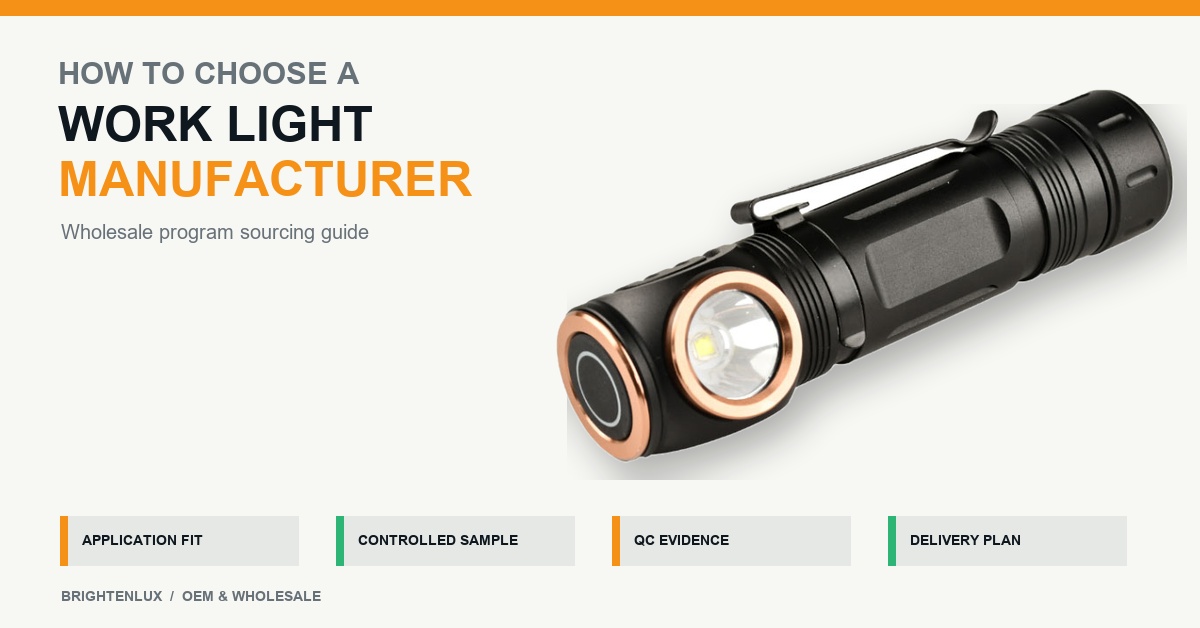


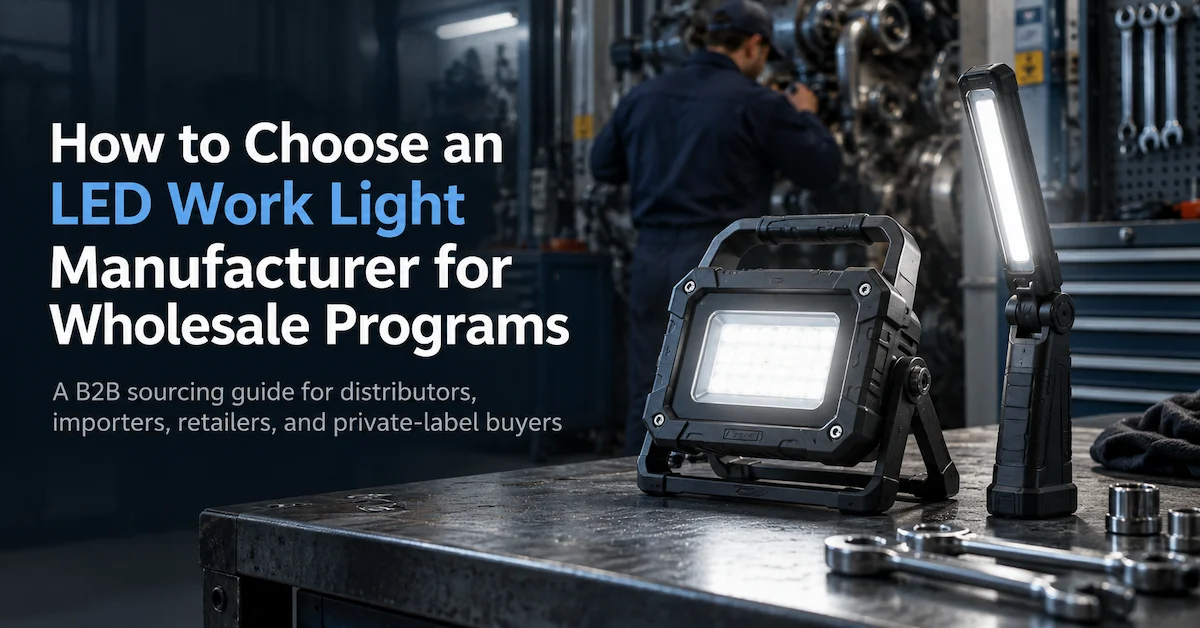
Choosing an LED work light manufacturer should begin with the job to be done and end with evidence that the approved configuration can be repeated. For wholesale buyers, the right partner is not simply the factory with a bright product photo or an attractive unit price. A useful supplier helps connect a real work site to a controlled product definition: beam pattern, power system, mechanical structure, packaging, inspection points and change control.
This guide is written for distributors, importers, brand owners, retailers, service companies and project buyers who need to compare LED work light supplier options without relying on vague catalog claims. It follows a practical nine-step sourcing process that can be used before sampling, during quotation review and before repeat orders. Buyers can review the Brightenlux lighting product range for relevant portable lighting platforms, then confirm model-specific figures, certifications, MOQ, lead time and warranty terms for the exact project.
Direct Answer: What Should a Wholesale Buyer Expect?
A capable LED work light manufacturer should help translate the end user’s work into a defined product, explain the trade-offs between output, runtime, size and cost, provide a sample for a stated purpose, control approved components and processes, inspect finished goods and communicate changes before shipment. A reliable supplier should also separate confirmed specifications from proposals and explain how customization may affect price, MOQ and timing.
There is no single best work light for every channel. A mechanic, electrician, warehouse operator, construction crew, emergency buyer and home workshop user may all require different beam shapes, mounting methods, battery systems and packaging. The strongest sourcing decision is the one that matches the product to the job while keeping claims, evidence and commercial assumptions aligned.
Nine-Step SEO and Sourcing Framework for Manufacturer Selection
The following nine steps combine search-friendly buyer questions with practical B2B sourcing controls. They help teams move from general research to a repeatable wholesale program.
| Step | Buyer Question | Document to Request or Create |
|---|---|---|
| 1 | What work must the light support? | Application brief |
| 2 | Which product architecture fits? | Platform comparison |
| 3 | What beam and brightness are useful? | Model-specific specification |
| 4 | Which power system fits the working day? | Battery and charging requirements |
| 5 | How will users operate and mount it? | Control and mechanical checklist |
| 6 | What environment will it face? | Protection and test evidence notes |
| 7 | How should samples be compared? | Sample test record |
| 8 | What customization is required? | Private label or OEM scope |
| 9 | How will repeat orders stay consistent? | Approved specification and change-control file |
Step 1: Start with the Application, Not the Catalog
Begin by describing where and how the work light will be used. Typical situations include vehicle repair, construction finishing, electrical maintenance, warehouses, inspection benches, emergency response and home workshops. Note the distance to the work surface, whether the user needs both hands free, whether the light will be placed on the floor or held in one hand, and whether dust, splash, oil or vibration is expected.
These details determine whether a compact pen light, folding floodlight, tripod-ready area light, magnetic inspection lamp or hybrid spotlight is appropriate. A catalog shortlist becomes useful only after the user journey is clear. In the RFQ, ask the factory to recommend a platform based on the application and to identify which assumptions affect the recommendation.
Step 2: Choose the Right Work-Light Architecture
Product architecture influences more than appearance. A handheld floodlight emphasizes portability and broad coverage. A folding panel can aim light around an engine bay. A bar-style inspection lamp can fit narrow spaces, while a stand-mounted unit can cover a larger work zone. Mounting, stability, heat dissipation, packaging volume and retail explanation are all affected by this early choice.
Ask which existing platforms share components and which features are fixed. Shared housings or common parts may simplify future line extensions, but only when the optical and mechanical requirements still fit the job. Record the agreed model revision so that later quotations, samples and packaging artwork refer to the same product definition.
Step 3: Specify Useful Brightness and Beam Performance

Do not make lumens the only decision factor. Define the working area, beam spread, glare tolerance, working distance and desired low setting. A repair technician may need a wide, even flood that reveals surface detail. A safety inspector may need a more directional beam to reach a distant label. The manufacturer should explain whether an output statement is peak or sustained and what test conditions support it.
Ask how output is measured and whether a diffuser, lens or optical change affects the visual result. Avoid copying figures from a different model or turning an estimate into a permanent claim. For wholesale programs, the safest specification is model-specific and tied to the approved sample and production configuration.
Step 4: Build a Practical Power System
Power design should reflect shift length, charging access, storage conditions and destination-market expectations. Buyers may compare replaceable batteries, built-in rechargeable cells, removable packs or hybrid input depending on the channel. For rechargeable products, define the connector, charge indicator, charge-time target, protection behavior and whether the lamp can operate while charging. For replaceable batteries, document the accepted format and battery-door design.
A rechargeable work light manufacturer should distinguish confirmed battery capacity from a proposal and identify any logistics or storage limitations that affect the launch plan. If runtime is important to the program, compare samples using the same method and the same mode rather than relying on unmatched claims.
Step 5: Review Controls, Mounting and Mechanical Details
Work lights are often used while the operator is wearing gloves, standing in a confined space or moving between tasks. Button location, tactile feedback, mode sequence, memory behavior and accidental-activation protection matter. Decide whether the product needs simple high and low settings, multiple brightness levels, a warning function, a separate spotlight or independent control of different light sources.
Inspect the handle, base, magnets, hooks, hinges, pivot stops, tripod thread, battery door, charging cover and lens protection. A magnetic base should hold on the intended steel surface without making the product awkward to remove. A folding joint should feel deliberate and retain its angle after repeated adjustments. These details often decide whether a wholesale product earns repeat orders.
Step 6: Use Environment and Ergonomics as Specifications
Describe temperature, humidity, dust, splash, oil exposure, impact risk and storage conditions. Avoid assuming that a rubber cover automatically creates a waterproof product or that an IP claim from another model applies to the product being quoted. Define the intended protection level and ask what test method and production configuration support the claim.
Ergonomics should also be tested early. A light can be technically bright but still tiring if it is top-heavy, slippery or difficult to aim. Ask for weight with the battery installed, center of gravity, handle clearance, control reach and angle range for folding sections. Review glare when the lamp is placed at eye level and confirm whether the low mode remains useful. Clear ergonomics can also reduce retail returns because users understand how the product should be positioned.
Step 7: Compare Samples Under the Same Conditions
Request a named sample revision and test it in the intended environment. Operate every mode, charge it fully, measure practical runtime with the same method, place it on representative surfaces, use the magnet and hinge repeatedly, and inspect the lens and housing after handling. A sample should answer a decision question: does the beam fit the work, does the battery support the expected use, and do the controls feel dependable?
Keep a written sample test record. Note what is confirmed, what is proposed and what remains open. If the answer depends on a component, test condition or customization, keep that dependency visible. This prevents a purchasing team from converting an early estimate into a final specification by mistake.
Step 8: Separate Private Label from OEM Development

Logo printing, color selection, packaging and manuals are usually private-label activities. New optics, a different housing, revised electronics, a new battery format or a special mounting solution move the project toward OEM or ODM development. Tell the supplier which changes are mandatory and which can be proposed. This allows the manufacturer to explain sample stages, tooling implications, approval gates and the information needed to freeze a production-intent specification.
Packaging should be discussed at the same time. A professional work light may be sold in a hardware aisle, online carton, service-kit bundle or project shipment. Define the retail box, master carton, inserts, cable, charger, manual, barcode, warning copy and display expectations. Ask whether packaging minimums differ from finished-product minimums, and keep artwork revisions under control.
Step 9: Control Communication, RFQ Comparison and Repeat Orders
Supplier communication is part of manufacturing quality. During evaluation, watch whether answers address the exact question, name assumptions and track revisions. Ask for a concise specification table, quotation notes, sample status and an open-issue list. Fast replies are helpful, but accurate replies are more important. If an alternative component is proposed, require the impact on output, runtime, cost, schedule and approval status.
A strong RFQ includes market, application, product architecture, light requirements, battery, charging, materials, accessories, decoration, packaging, quantity, testing, trade term and target timing. Mark each item as required, preferred or open to proposal. Before the first purchase, define the approved sample, drawing or photo references, component list, artwork master, packaging revision, inspection responsibility and change-notification process. Repeatability is the real test of supplier fit.
How to Prepare an Inquiry for Brightenlux
To receive a useful recommendation, state the target market, application, launch or annual quantity, desired light architecture, battery preference, decoration, packaging, test needs and timing. Ask for a recommended platform, a model-specific specification and a list of decisions still required. Product-specific figures, certifications, MOQ, lead time and warranty terms should be confirmed for the exact model and order.
For project discussion, buyers can send details through the Brightenlux contact page or submit a sourcing request through Brightenlux inquiry. A focused inquiry helps compare supplier answers fairly and reduces the risk of late changes after sampling.
FAQ
What is the first question to ask an LED work light manufacturer?
Start by asking which product platform best fits the actual application. Describe the work site, mounting method, beam need, power preference and packaging channel before discussing price.
Should buyers choose the brightest work light available?
Not necessarily. Useful brightness depends on beam spread, glare, working distance, low-mode usability and sustained performance. The specification should be confirmed for the exact model.
What should be included in a wholesale RFQ?
Include market, application, product architecture, light requirements, battery, charging, materials, accessories, branding, packaging, quantity, testing needs, trade term and target timing.
How can repeat orders remain consistent?
Control the approved sample, model revision, component list, artwork, packaging file, inspection responsibility and change-notification process. Record what is confirmed and what remains conditional.