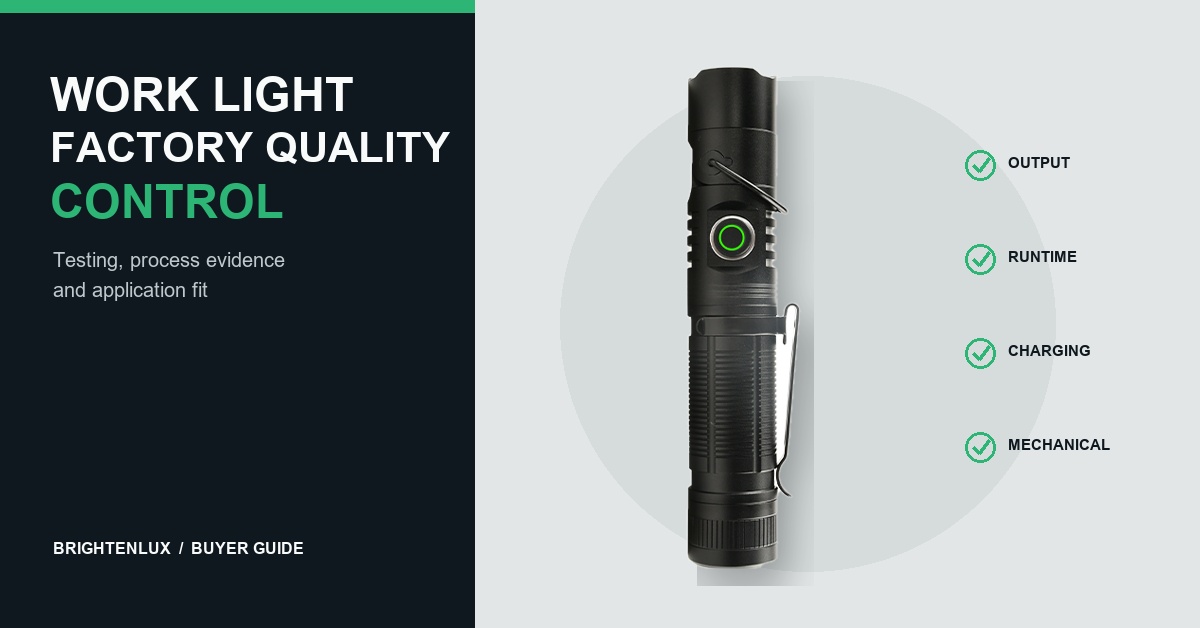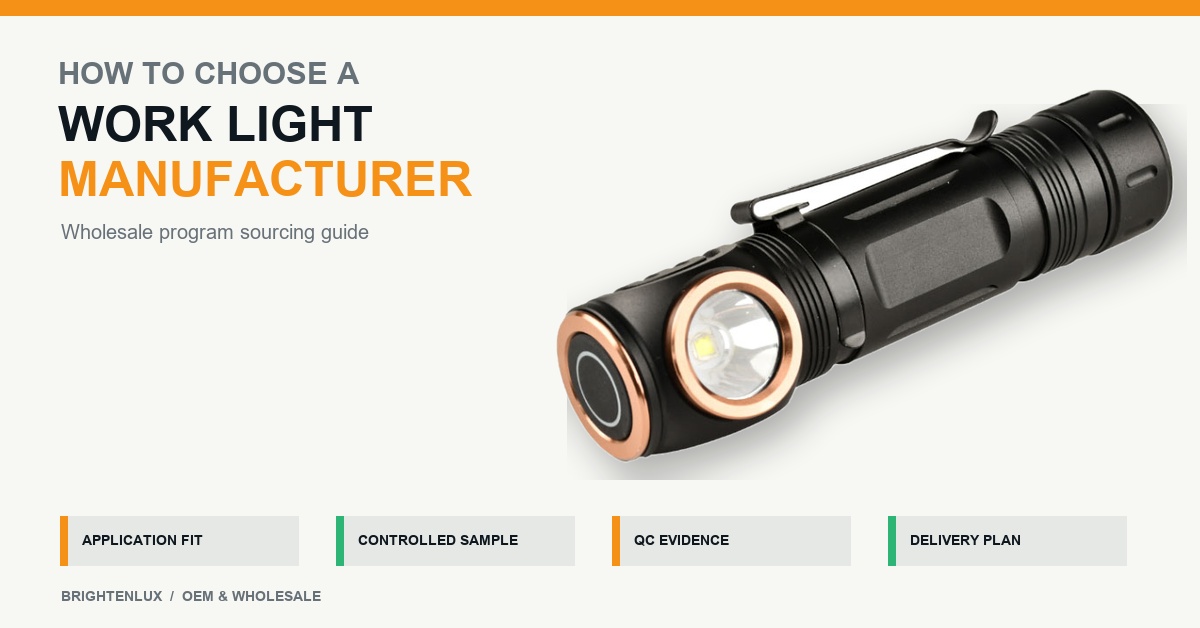


Choosing an LED work light factory China sourcing option should begin with the actual job the product needs to perform and end with evidence that the approved configuration can be reproduced consistently in mass production. For distributors, importers, private-label brands and other wholesale buyers, quality cannot be judged from a bright product photo, a lumen figure or an attractive quotation alone. A work light needs to perform through repeated charging, repositioning, transport, dirty-glove operation, long working periods and the environmental conditions expected in its target application.
A capable factory should therefore connect application requirements with product specifications, incoming component control, electronics assembly, optical performance, battery and charging behavior, mechanical durability, inspection and change control. Buyers can review the Brightenlux product range when identifying suitable portable lighting platforms, but model-specific specifications, certifications, MOQ, lead time, warranty and customization requirements should be confirmed for the exact project.
Step 1: Define the Application Before Comparing Factories
Before comparing suppliers, define who will use the work light and what task it needs to support. A mechanic working inside an engine bay has different requirements from an electrician inspecting a cabinet, a construction worker illuminating a temporary work zone or an emergency-response buyer preparing a roadside lighting kit.
The application determines important details such as beam shape, working distance, mounting method, battery system, charging access, operating controls and packaging. Instead of asking a supplier simply for its “best work light,” buyers should describe the actual operating environment and ask which existing product platform fits those conditions. The Brightenlux work, repair and field-service lighting page provides an application-oriented starting point for this discussion.
When evaluating an LED work light factory China sourcing program, this application-based approach also makes quotations easier to compare. Two products with similar advertised brightness may have very different housings, battery systems, mounting structures and sustained operating characteristics. The lowest unit price therefore does not necessarily represent the best wholesale program.
Step 2: Translate Real Applications into Test Requirements
Field conditions should become part of the quality plan rather than remaining marketing descriptions. Typical applications can include vehicle maintenance, construction finishing, electrical inspection, warehouses, workshops, emergency kits, outdoor maintenance and home DIY tasks.
For each application, buyers should document expected operating duration, working distance, required illumination area and whether the product will be handheld, magnetic, hanging or freestanding. The same brief should record repositioning frequency, charging availability, dust, splash, oil and contamination exposure, vibration, transport conditions and the expected storage environment.
These conditions determine what needs closer testing. A folding work light used repeatedly in automotive repair, for example, may require particular attention to hinge retention, magnets and control accessibility. A wide-area work light may require greater attention to beam uniformity, stability and thermal behavior.
Quality testing should therefore be tied to the exact product and intended application rather than to a general statement that the factory has a quality-control system.
Step 3: Create an Approved Product Specification
Before approving a sample or placing a production order, create a controlled specification for the exact product configuration. Depending on the model, this may include the LED configuration, driver, battery or cell, protection circuit, lens or diffuser, switch, charging interface, cable, housing material, magnets, hooks, hinges, mounting parts, labels, accessories and packaging.
The purpose is straightforward: the production unit should match the product that was actually evaluated and approved.
If a battery, LED, driver, charger, lens or other critical component changes after sample approval, performance may change even when the outside appearance remains almost identical. The specification should therefore distinguish between three types of information.
| Specification Status | Meaning | Buyer Action |
|---|---|---|
| Confirmed | Already verified for the selected configuration | Record the approved value and supporting reference |
| Proposed | Suggested by the supplier but still awaiting approval | Keep the item open until the required review is complete |
| Conditional | Dependent on quantity, customization, testing or component selection | Document the condition before treating the value as final |
This distinction is especially useful in OEM work light development projects, where early discussions often contain estimates that should not automatically become final production claims.
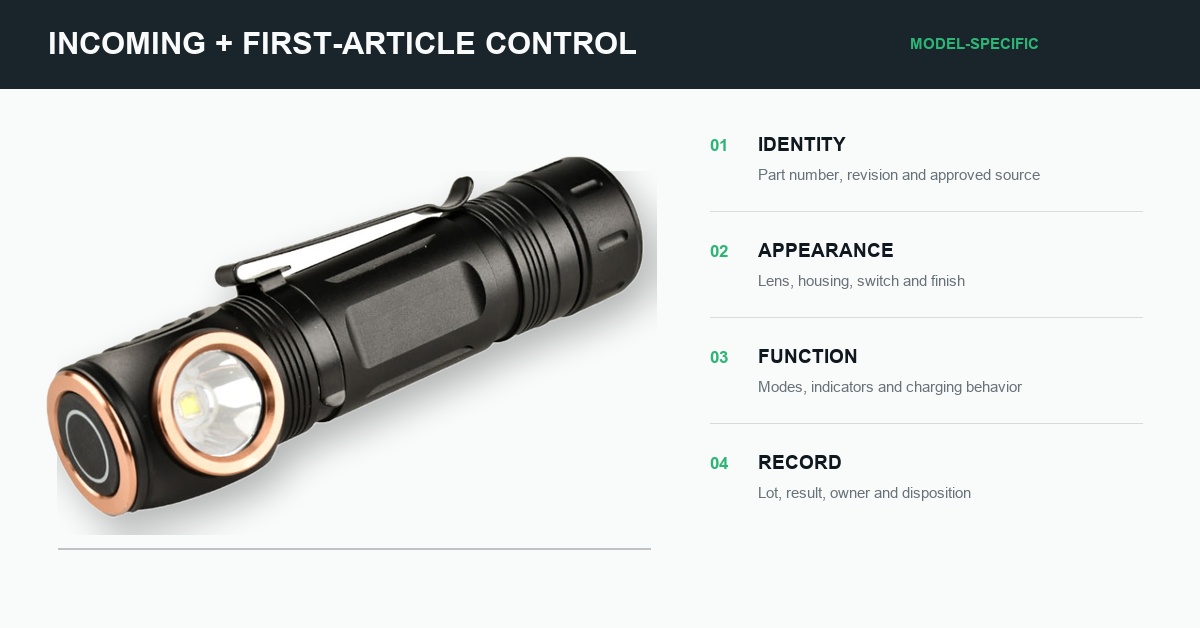
Step 4: Check Incoming Critical Components
Incoming material inspection is one of the earliest opportunities to prevent an incorrect or unapproved component from entering production. Critical components may include LEDs, drivers, batteries or cells, protection boards, charging components, switches, lenses, diffusers, magnets, cables and housing materials. The exact list depends on the work-light architecture.
For critical parts, buyers should understand how the factory controls component identity, revisions, batch information, visible condition, sampling and substitution approval.
| Control Point | What Buyers Should Review |
|---|---|
| Component identity | Part number, model or approved reference |
| Revision | Whether the component matches the approved version |
| Lot information | Whether critical batches can be traced |
| Visual condition | Damage, contamination or obvious defects |
| Sampling | Which components are sampled and at what stage |
| Substitution | How alternative components are proposed and approved |
A general factory presentation is useful for initial qualification, but model-specific records provide stronger evidence for a wholesale program. Buyers reviewing the Brightenlux company profile should treat that background information as an introduction to the business, not as a substitute for inspection and test records covering the selected product.
Step 5: Review Electronics Assembly and Functional Control
A work light that turns on during final inspection is not automatically free from assembly risks. Buyers should understand how electronics assembly controls component identification, polarity, soldering quality, rework and functional settings.
If the product includes multiple modes, battery indicators, memory functions, sensors or charging logic, those functions should also be checked against the approved configuration. A mode sequence or indicator behavior that differs from the approved sample can affect usability even when the lamp appears to work normally.
Different inspection stages answer different questions. Incoming inspection verifies components before assembly. First-article checks help verify the initial production setup. In-process inspection catches problems while they are still visible and correctable. Final inspection evaluates finished units before shipment.
For an LED work light factory China wholesale program, buyers should ask how these stages relate to the selected model instead of relying solely on a final light-on test.
Step 6: Verify Beam Quality, Runtime and Charging
Optical Performance
Brightness alone does not define a useful work light. Buyers should also review beam spread, uniformity, glare, optical artifacts and the usefulness of lower modes. Depending on the product architecture, inspection may include LED positioning, reflector or light-guide alignment, diffuser cleanliness, lens condition, beam symmetry, visible color consistency and low-mode usability.
A mechanic working close to an engine may benefit more from a broad, even beam than from a narrow high-intensity spot. Conversely, inspection at greater distance may require a more directional beam. The test method should therefore reflect the application rather than treating the highest lumen figure as the only acceptance criterion.
Runtime
Runtime comparisons are meaningful only when the test conditions are consistent. A useful test record should identify the battery starting condition, selected operating mode, ambient conditions, measurement intervals and test endpoint.
Buyers should also distinguish between peak brightness and sustained useful output. A product may begin at a high output but reduce output as the battery discharges or the system manages temperature. For wholesale sourcing, runtime claims should be connected to the exact battery and production-intent configuration rather than copied from another model.
Charging
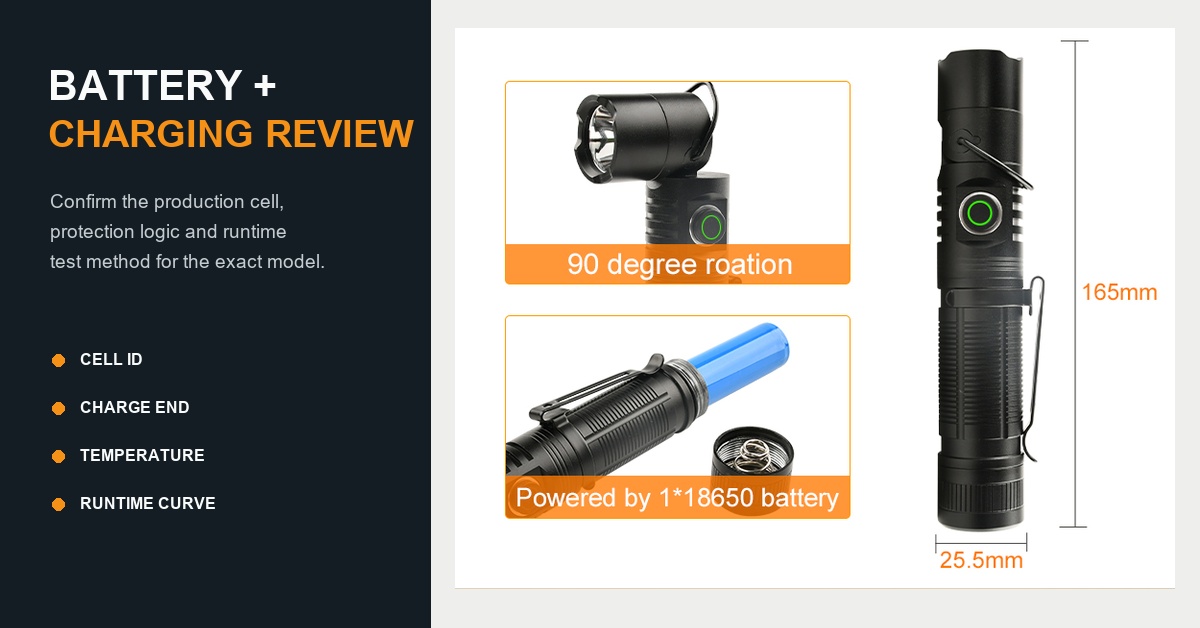
Rechargeable products should also be evaluated for connector fit, indicator behavior, charging completion and abnormal temperature rise. The charging review should use the specified cable and power source so that the results relate to the intended product configuration.
If the product is designed to operate while charging or provide power-bank functionality, those functions should be confirmed separately for the exact model. A Type-C connector by itself should not be interpreted as proof of every charging feature or protocol.
Step 7: Test Mechanical Durability and Mounting
Work lights are frequently repositioned, dropped, folded, attached and removed. The parts users touch repeatedly deserve particular attention. Depending on the design, these can include buttons, folding joints, pivot stops, handles, hooks, magnets, tripod threads, battery doors, charging-port covers, stands and bases.
Repeated cycling can reveal loosening, cracking, loss of retention or changes in switch feel that a simple visual inspection may miss. Mounting performance also matters because a work light that cannot maintain its position may not illuminate the intended work area.
A magnetic model should therefore be tested on representative compatible steel surfaces. For a portable option such as the Brightenlux adjustable-head magnetic flashlight, buyers should evaluate attachment, aiming and control access in the intended repair or inspection setting rather than assuming that the presence of a magnet proves suitability for every task.
A folding light should retain the intended angle after repeated adjustment. A freestanding product should remain stable in the positions customers are expected to use. For tripod-ready models, buyers should verify thread fit, balance and practical positioning rather than assuming the presence of a threaded hole proves compatibility with every installation.
Step 8: Match Environmental Testing to the Intended Market
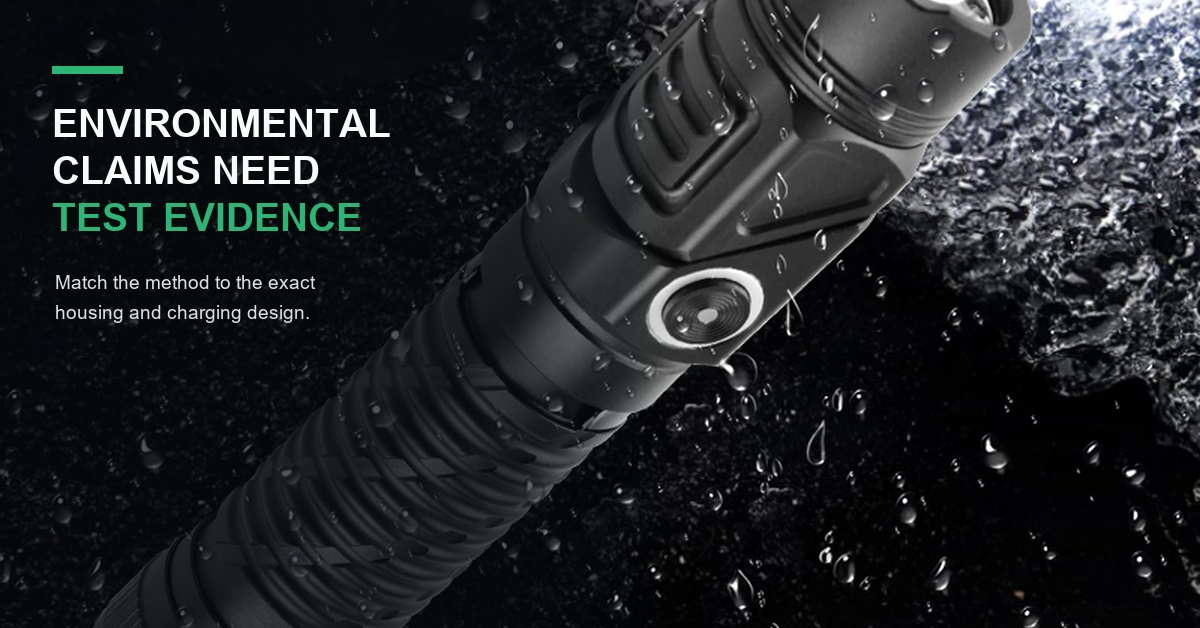
Environmental requirements should be defined before testing. Depending on the intended application, buyers may need to consider dust, splash, rain, humidity, temperature, oil exposure, cleaning agents, vibration or impact. Not every product needs the same protection level.
A rubber charging cover or gasket should not automatically be treated as evidence of waterproof performance. Likewise, a protection claim established for one housing or charging design should not automatically be transferred to another model.
If an environmental rating is important to the wholesale program, ask what exact configuration and test method support the claim. The test record should identify relevant conditions such as sample configuration, duration, orientation and post-test functionality.
This approach prevents a broad catalog statement from becoming an unsupported product-specific claim.
Step 9: Inspect Production, Packaging and Shipment Records
Quality control should continue after the sample is approved. During production, useful inspection points can include incoming materials, first-article approval, assembly checks, functional inspection, cosmetic inspection and final sampling.
Workmanship criteria should also reflect the target sales channel. Typical issues can include molding flash, sink marks, excessive gaps, scratches, contamination, printing defects, lens haze, misalignment and loose components. An approved sample and clear defect references help buyers and inspectors apply the same expectations.
Packaging deserves equal attention because a technically sound work light can still arrive damaged if the retail box or master carton does not restrain the product properly. Buyers should check the contents, internal protection and product positioning before approving the final packing configuration.
For a wholesale program, the shipment file can include the following records.
| Shipment Record | Purpose |
|---|---|
| Approved sample reference | Identifies the agreed product configuration |
| Inspection report | Records production inspection results |
| Defect photographs | Provides evidence of identified issues |
| Quantity record | Supports shipment verification |
| Packing list | Confirms pack-out configuration |
| Test results | Links relevant testing to the shipment |
| Approved deviations | Records accepted exceptions |
| Retained sample | Supports future comparison or investigation |
Traceability should remain practical. Useful information can include model, revision, production date, critical component lot information, inspection status and retained sample reference.
The objective is not paperwork for its own sake. It is to make a suspected component change or quality issue searchable if a problem occurs after shipment.
How to Evaluate an LED Work Light Factory China for Wholesale Orders
When comparing an LED work light factory China sourcing option for a wholesale, distributor or private-label program, buyers should evaluate more than factory size and quoted price. A stronger evaluation asks whether the supplier can connect the intended application to a controlled product specification and provide evidence that production units continue to match the approved sample.
The broader process of choosing an LED work light manufacturer for wholesale programs should connect application selection, quotations, sample approval and repeat-order control. Quality testing is most useful when it supports those purchasing decisions rather than operating as a separate checklist.
A practical supplier comparison can focus on five questions.
| Evaluation Area | Key Question |
|---|---|
| Application knowledge | Does the supplier understand how and where the product will be used? |
| Product definition | Is the exact configuration clearly documented? |
| Testing | Are optical, runtime, charging and mechanical checks repeatable? |
| Production control | Are critical components and assembly stages controlled? |
| Repeat-order consistency | Are revisions, substitutions and approved changes documented? |
For importers and distributors, repeatability becomes especially important after the first successful order. The goal is not simply to receive a good sample. The goal is to establish a product configuration that can remain controlled across subsequent production runs.
How to Prepare an LED Work Light RFQ
A detailed request for quotation helps a factory respond with something more useful than a generic catalog and price list. Include the destination market, sales channel, intended application, estimated order quantity and preferred work-light architecture. Then define the required beam characteristics, battery preference, charging requirements, mounting method, branding, packaging format, accessories, required test evidence and target schedule.
Mark each requirement as required, preferred or open to supplier proposal. This makes it easier to distinguish true project requirements from features that can still be optimized around cost, availability or existing product platforms.
For Brightenlux projects, buyers can provide the application, market, quantity and customization requirements through the Brightenlux inquiry page. The request should identify which product details are already fixed and which decisions still require a supplier recommendation.
Exact product specifications, certifications, MOQ, lead time, testing requirements, customization scope and warranty conditions should be confirmed for the selected model and purchase order.
FAQ
What should buyers check when evaluating an LED work light factory China sourcing option?
Buyers should check whether the factory can match a work light to the intended application, document the approved configuration, control critical components, perform relevant optical, charging and mechanical checks, inspect production and communicate component or specification changes before shipment.
Is the brightest LED work light always the best choice?
No. Beam distribution, glare, working distance, mounting, sustained output, runtime and low-mode usability can be more important than maximum advertised brightness. The right specification depends on the intended job.
What should be tested on a rechargeable LED work light?
Important areas can include beam performance, runtime, charging behavior, connector fit, indicator operation, temperature behavior, controls, hinges, magnets, hooks and other mechanical parts relevant to the selected model.
Why should buyers test the approved sample under real application conditions?
A specification sheet cannot fully show ergonomics, beam usefulness, mounting stability or control accessibility. Testing the sample in the intended environment helps determine whether the product actually fits the user’s work.
How can buyers maintain quality across repeat wholesale orders?
Keep a controlled product specification, approved sample reference, artwork and packaging revisions, inspection requirements and change-notification process. Critical component substitutions or configuration changes should be reviewed before they enter production.
Conclusion
Choosing an LED work light factory China sourcing option is ultimately a repeatability decision. A successful first sample matters, but wholesale buyers also need confidence that the same approved configuration can be controlled during production and reproduced for future orders.
Start with the application, define the product architecture, document critical specifications, verify optical and power performance, test mechanical features, match environmental requirements to real use and maintain clear production and shipment records. This turns supplier selection from a comparison of catalog claims into a structured sourcing process built around evidence, application fit and repeat-order consistency.
To discuss a specific portable lighting project, contact the Brightenlux team with your intended application, target market, order quantity, customization scope and required test evidence. Confirm the selected model’s specifications and commercial terms before moving from sample evaluation to production approval.