

How Should B2B Buyers Choose a Flashlight Manufacturer?
A flashlight manufacturer should be evaluated as a complete product-development and supply partner, not simply as a factory that can assemble an LED, battery, and aluminum tube.
For importers, distributors, outdoor brands, industrial suppliers, emergency-product companies, and private-label businesses, the real sourcing challenge is consistency. A flashlight that performs well as one sample must still meet the approved specification when hundreds or thousands of units are produced, packaged, shipped, and reordered.
That means buyers need to evaluate product architecture, beam design, battery configuration, charging electronics, enclosure construction, environmental protection, quality control, customization, documentation, and repeat-order capability together.
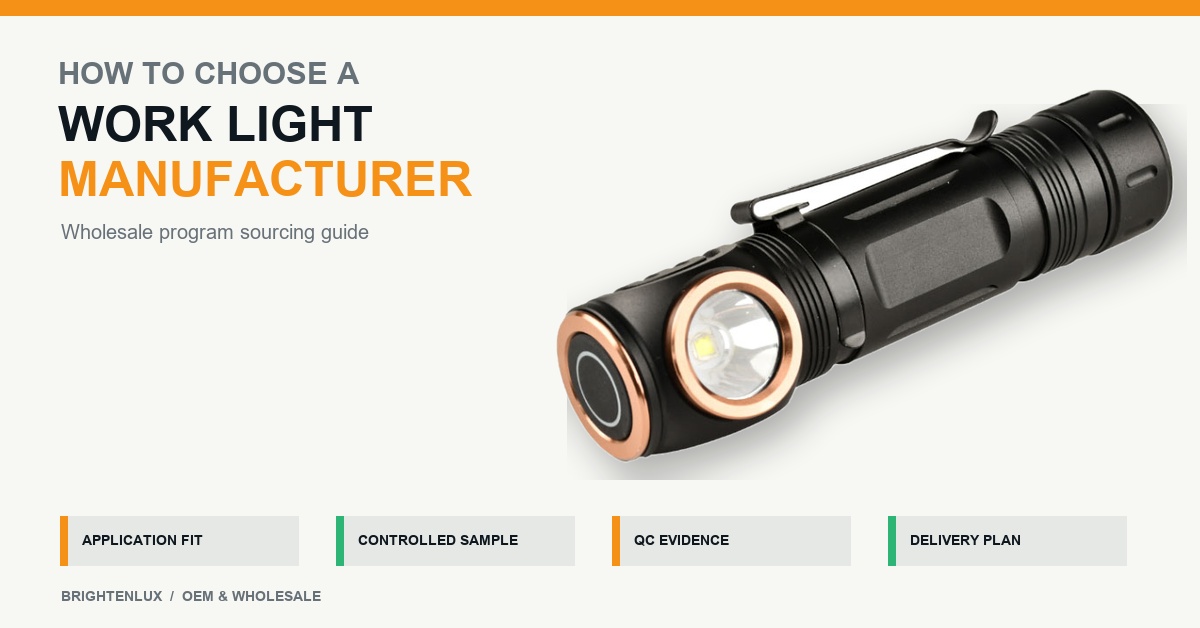
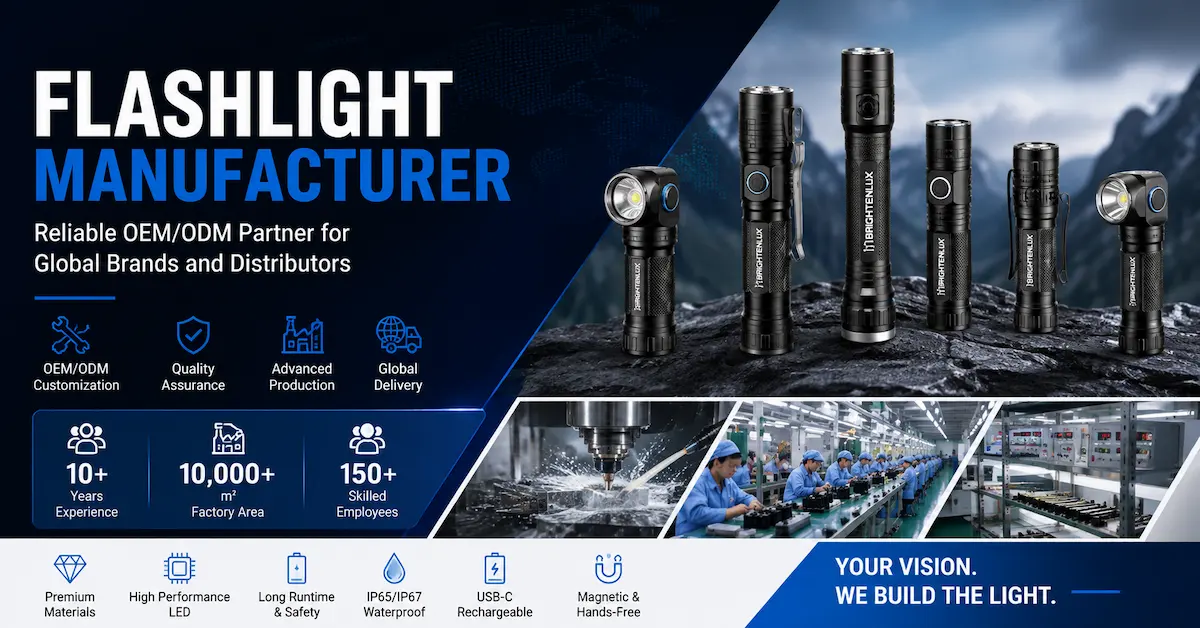
Brightenlux is a China-based outdoor lighting manufacturer established in 2014. Its current product range includes LED flashlights, headlamps, camping lights, work lights, bicycle lights, and other portable lighting products, while its flashlight catalog includes rechargeable, magnetic, adjustable-focus, long-range, right-angle, and high-output configurations.
Buyers can first review the Brightenlux product range to understand the available product architectures before discussing customization.
Quick Answer: What Makes a Reliable Flashlight Manufacturer?
A reliable flashlight manufacturer should be able to explain and control five things clearly:
- Product engineering — LED, optics, battery, PCB, charging, housing, sealing, switch, and thermal behavior.
- Performance verification — brightness, runtime, beam distance, ingress protection, and other measurable specifications.
- Manufacturing consistency — whether approved samples can be reproduced in bulk.
- OEM/ODM flexibility — logo, packaging, colors, accessories, battery configuration, and product modifications.
- Commercial scalability — whether the supplier can support repeat orders without uncontrolled specification changes.
For B2B buyers, the best factory is therefore not automatically the one offering the highest lumen number or the lowest initial quotation. It is the supplier whose product platform, manufacturing control, and commercial model fit the intended market.
Why “Flashlight Manufacturer” Is a Different Search Intent From “Flashlight Supplier”
A buyer searching for a flashlight supplier may simply want available products and pricing.
A buyer searching for a flashlight manufacturer usually has a deeper commercial requirement:
- private-label development,
- OEM branding,
- product modification,
- exclusive configurations,
- stable repeat orders,
- quality documentation,
- or long-term sourcing.
This distinction changes how a factory should be evaluated.
| Sourcing Need | Catalog Supplier | Flashlight Manufacturer |
|---|---|---|
| Ready-made models | Usually available | Usually available |
| Custom logo | Often possible | Usually expected |
| Custom packaging | May be limited | Common OEM requirement |
| Battery configuration | Often fixed | May offer alternatives |
| Functional modification | Limited | Depends on engineering capability |
| New product development | Rare | Possible through ODM |
| Production control | Indirect or unclear | Should be directly managed |
| Repeat-order consistency | Depends on source | Should be specification-controlled |
A strong manufacturing partner should make clear which elements are fixed, which are customizable, and which changes require engineering or tooling.
Start With the Product Architecture Before Comparing Prices
Two flashlights with similar external dimensions can have very different internal systems.
Before comparing quotations, a sourcing team should break the product into functional modules.
LED and Optical System
The light engine includes more than the LED itself.
Important elements include:
- LED type,
- reflector geometry,
- lens,
- beam angle,
- focal system,
- fixed or adjustable focus,
- and optical alignment.
Brightenlux's current LED flashlight category includes models using SST20, SST25, SST40, white-laser LED configurations, adjustable-focus systems, twist zoom, and fixed long-range designs.
This matters because an LED name does not tell a buyer everything about field performance.
A powerful LED paired with the wrong reflector may produce a beam that is impressive at the center but unsuitable for the target application.
Battery System
Common flashlight projects may use:
- 16340,
- 18650,
- 21700,
- 26650,
- replaceable dry batteries,
- built-in lithium batteries,
- or dual-power systems.
Battery choice influences:
- body diameter,
- product weight,
- runtime,
- charging strategy,
- maximum output,
- replacement convenience,
- and product positioning.
A compact EDC flashlight and a high-output outdoor flashlight therefore should not automatically use the same battery architecture.
Charging Electronics
For rechargeable models, buyers should define:
- USB-C or another connector,
- C-to-C compatibility if required,
- input rating,
- charging indicator,
- charging time,
- battery protection,
- port cover design,
- and power-bank functionality where relevant.
Brightenlux's current flashlight range includes multiple Type-C rechargeable models across different battery and output configurations.
Housing and Mechanical Design
The flashlight body determines much of the user experience.
Buyers should inspect:
- aluminum or polymer construction,
- wall thickness,
- grip texture,
- surface finish,
- thread quality,
- O-rings,
- switch placement,
- belt clip,
- magnetic tail,
- adjustable head,
- and access to the battery compartment.
These features should be evaluated in relation to the application rather than simply counted as selling points.
Do Not Use Lumens as the Only Manufacturer Comparison
One of the easiest ways to make a poor sourcing decision is to compare factories by maximum claimed lumen output.
Portable-light performance involves several metrics.
The ANSI/PLATO FL 1-2025 standard establishes standardized measurement and reporting methods for portable lighting attributes including light output, beam distance, peak beam intensity, runtime, impact resistance, and protection against water and dust.
Buyers researching performance terminology can review the ANSI/PLATO FL 1 standard information.
Light Output
Lumens indicate total light output, but a higher lumen figure does not automatically mean the light will illuminate farther.
Beam Distance
Beam distance is particularly important for:
- search,
- patrol,
- security,
- outdoor navigation,
- and long-range inspection.
Peak Beam Intensity
Beam intensity helps explain how concentrated the light is.
Two flashlights with similar lumens can produce very different beam behavior if one emphasizes flood illumination while another concentrates light into a smaller hotspot.
Runtime
Runtime is commercially important because buyers frequently have to balance brightness against battery capacity, thermal behavior, body size, and cost.
For sourcing purposes, ask for performance by mode rather than accepting one runtime number without context.
Match the Beam to the Real Application
Different buyer segments need different beam characteristics.
| Application | Preferred Beam Characteristic | Other Important Features |
| Camping | Balanced flood and distance | Rechargeability, runtime |
| Hiking | Usable spill with forward reach | Low weight, weather resistance |
| Security patrol | Longer focused beam | Multiple modes, durable body |
| Search | Long beam distance | Large battery, high sustained output |
| Automotive repair | Broad close-range illumination | Magnet, right-angle design |
| Industrial inspection | Controlled task beam | Clip, compact body |
| Emergency kits | Simple, predictable operation | Reliable power system |
| EDC retail | Compact general-purpose beam | Size, appearance, charging |
This is why a professional LED flashlight manufacturer should ask what the product is expected to do before recommending a model.
If a buyer only provides “1000 lumens, rechargeable, black,” the factory still lacks enough information to choose the right optical and mechanical platform.
Waterproofing Must Be Specified, Not Assumed
Terms such as “waterproof” or “all-weather” are too vague for a technical purchasing specification.
IEC 60529 defines the IP Code used to classify enclosure protection against ingress by solids and liquids.
Buyers can review the IEC guidance on IP ratings when defining environmental requirements.
A procurement specification should therefore use a defined rating where protection matters.
Brightenlux's current flashlight catalog demonstrates that different products are designed for different protection levels rather than every model carrying the same IP specification.
For sourcing teams, the lesson is simple:
Specify the environment first, then choose the required protection level.
Do not pay for unnecessary protection in a basic retail product, but do not accept an inadequately protected enclosure for wet outdoor, rescue, or industrial applications.
Which Buyers Need a True Flashlight Manufacturer?
The answer depends on how much control the buyer needs over the product.
Importers and Distributors
They typically need:
- stable product availability,
- multiple models,
- consistent specifications,
- export packaging,
- documentation,
- and reliable repeat orders.
Their primary risk is inconsistency between batches.
Private-Label Brands
They usually need more control over:
- branding,
- packaging,
- color,
- accessories,
- user manuals,
- product positioning,
- and sometimes features.
A private-label customer should therefore evaluate OEM flexibility before discussing large volumes.
Outdoor Brands
Important considerations include:
- beam design,
- runtime,
- size,
- battery system,
- waterproof protection,
- operating modes,
- and weight.
Industrial and MRO Distributors
For maintenance, inspection, automotive, and workshop applications, buyers may prioritize:
- magnetic tails,
- right-angle bodies,
- clips,
- hands-free positioning,
- charging convenience,
- and robust switches.
Emergency and Preparedness Suppliers
Their requirements may emphasize:
- simple operation,
- battery availability,
- long storage periods,
- backup power options,
- and predictable runtime.
E-Commerce Sellers
These buyers often need:
- differentiation,
- visually understandable features,
- manageable first-order quantities,
- branded packaging,
- and the ability to test demand before scaling.
The best flashlight factory for a large industrial distributor may therefore be different from the best partner for a new private-label outdoor brand.
How to Evaluate a Flashlight Factory Before Sampling
A professional supplier evaluation should move from company-level evidence to product-level evidence.
Step 1: Verify the Business Scope
Check whether portable lighting is a core business or a minor trading category.
Brightenlux describes itself as an outdoor lighting manufacturer focused on LED flashlights, headlamps, camping lights, working lights, bicycle lights, and related lighting products. The company states that it was established in 2014 and operates a factory exceeding 10,000 square meters in Zhejiang.
More company information is available on the Brightenlux About Us page.
Step 2: Review Product Breadth
Product breadth can indicate whether the factory has reusable platforms for different buyer segments.
Brightenlux's current flashlight category includes Type-C rechargeable lights, magnetic-tail models, right-angle designs, adjustable-focus products, long-range white-laser models, and products using different rechargeable battery formats.
Review the Brightenlux LED flashlight category to compare available configurations.
Step 3: Ask What Is Actually Customizable
Do not assume every feature can be changed.
Separate the project into:
Cosmetic Customization
- logo,
- product color,
- engraving,
- printed markings.
Packaging Customization
- retail box,
- insert,
- barcode,
- manual,
- master carton.
Configuration Customization
- battery,
- accessories,
- lighting modes,
- LED choice where supported,
- charging cable.
Engineering Customization
- housing structure,
- PCB,
- optics,
- tooling,
- custom electronics.
The deeper the requested change, the more important ODM and engineering capability become.
Step 4: Request a Written Specification
A sample should have a reference specification.
Without one, it becomes difficult to prove whether future bulk production has changed.
What Should Be Included in a Flashlight Sample Approval Sheet?
A useful sample approval document can include:
| Area | What to Record |
| Model | Exact product code |
| LED | Agreed LED type |
| Output | Agreed performance claim |
| Battery | Type and capacity |
| Charging | Connector and input requirement |
| Modes | Exact operating sequence |
| Optics | Fixed, zoom, spot, flood |
| Housing | Material and finish |
| Waterproofing | Agreed IP rating |
| Magnet/clip | Required configuration |
| Logo | Size, position, process |
| Packaging | Box, insert, labels, accessories |
| Documentation | Required market documents |
The objective is to transform “approved sample” into a controlled commercial specification.
That becomes particularly important when purchasing moves from a few samples to repeat container orders.
Quality Control Should Focus on Failure Risk
A good flashlight manufacturer should be evaluated according to the failures most likely to affect the end customer.
Potential inspection points include:
Appearance
- scratches,
- color variation,
- machining marks,
- printing quality,
- logo position.
Mechanical Operation
- switch feel,
- thread engagement,
- zoom movement,
- clip installation,
- magnet fit,
- battery cap closure.
Electrical Operation
- lighting modes,
- charging,
- battery indicator,
- reverse-polarity behavior where applicable,
- power-bank function where specified.
Optical Performance
- beam consistency,
- LED centering,
- obvious color variation,
- focus movement,
- hotspot alignment.
Packaging
- correct accessories,
- manuals,
- labels,
- barcodes,
- retail boxes,
- quantity per carton.
Brightenlux states on its website that it operates a strict production-management system and offers OEM/ODM customization. Its site also lists product-testing and factory-audit credentials; buyers should verify the documentation applicable to the exact SKU and destination market rather than assuming every listed document applies identically to every flashlight.
OEM vs ODM: Which One Does Your Project Need?
The terms are often used together, but they represent different levels of development.
OEM Flashlight Projects
OEM is usually suitable when an existing platform already meets most of the requirement.
Typical changes may include:
- logo,
- packaging,
- color,
- accessories,
- manual,
- labeling,
- battery options where available.
This approach can reduce development complexity.
ODM Flashlight Projects
ODM is more appropriate when the buyer needs deeper modification.
The project may involve:
- different housing architecture,
- alternative optics,
- new electronics,
- changed switch logic,
- specific battery systems,
- additional functions,
- or new tooling.
A serious ODM discussion should begin with a product requirement, not with a logo file.
Brightenlux promotes OEM and ODM services and low-MOQ logo customization on its website.
For custom projects, buyers can use the Brightenlux Contact Us page to submit product and market requirements.
How to Compare Flashlight Manufacturer Quotations Correctly
A factory quotation only becomes meaningful when every supplier is quoting approximately the same specification.
Do Not Compare These as Equal Products
Supplier A:
- 21700 battery,
- metal housing,
- magnetic tail,
- USB-C,
- higher IP protection.
Supplier B:
- smaller battery,
- different LED,
- no magnet,
- simpler packaging,
- lower protection level.
A lower price from Supplier B does not prove better value.
Normalize the RFQ
Send every manufacturer the same requirements:
- application,
- lumen range,
- beam type,
- battery,
- charging,
- runtime target,
- IP requirement,
- housing,
- dimensions,
- accessories,
- logo,
- packaging,
- certifications or testing needs,
- order quantity,
- target market.
Only then can you compare pricing logically.
What Actually Drives Flashlight Cost?
Flashlight cost is usually the result of several interacting choices.
| Cost Driver | Procurement Impact |
| LED selection | Component cost and performance positioning |
| Battery | Capacity and cell type affect BOM |
| Optics | Reflector, lens, and zoom structure add complexity |
| Charging circuit | More functions increase electronics cost |
| Housing | Material and machining affect price |
| Surface finish | Process and appearance requirements matter |
| Waterproof design | Sealing can increase complexity |
| Magnet/clip | Additional components increase BOM |
| Packaging | Retail presentation can materially affect cost |
| Accessories | Battery, cable, strap, case, etc. |
| Customization | Printing, color, tooling, packaging |
| Quantity | Influences production and purchasing efficiency |
A good OEM flashlight manufacturer should help a buyer determine which features create customer value and which merely increase cost.
Common Mistakes When Selecting a Flashlight Manufacturer
Choosing the Lowest Price Before Freezing Specifications
This creates misleading comparisons because suppliers may be quoting different batteries, LEDs, housing materials, or accessories.
Comparing Only Lumen Claims
Performance should be considered together with beam distance, runtime, intensity, battery capacity, and thermal behavior. ANSI/PLATO FL 1 provides standardized terminology for several of these performance metrics.
Assuming “Waterproof” Means the Same Thing Everywhere
Specify the required IP classification and verify the applicable documentation. IEC 60529 provides the IP protection framework.
Approving a Sample Without a Specification
This makes it difficult to control subsequent production.
Customizing Too Much on the First Order
For a new market, an existing proven platform with controlled branding changes may create less development risk than immediately redesigning the complete product.
Ignoring Packaging Until Production
For retail and private-label projects, packaging is part of the product and should be approved with the product specification.
Assuming Company-Level Certifications Apply to Every SKU
Always verify model-specific and destination-specific requirements.
Flashlight Manufacturer Evaluation Checklist
Before choosing a manufacturing partner, ask:
- Is portable lighting a core business?
- What flashlight categories are manufactured?
- Which LED platforms are available?
- Which battery systems are supported?
- Which products support USB-C?
- Are fixed and adjustable beams available?
- Which models support magnetic mounting?
- What IP ratings are available?
- Which specifications can be customized?
- What requires new tooling?
- Can the supplier support OEM packaging?
- Can the supplier support ODM development?
- How is the approved sample documented?
- How are specification changes controlled?
- Which inspections are performed?
- Which test or compliance documents are available for the selected model?
- How are repeat orders kept consistent?
- What changes when the order scales?
- Who handles technical communication?
- What information is needed for an accurate quotation?
These questions shift supplier evaluation away from marketing language and toward controllable evidence.
Why Product Platform Breadth Matters for OEM Buyers
A manufacturer with multiple established product architectures can often give buyers more ways to position a product without rebuilding it from zero.
For example, Brightenlux's current flashlight catalog includes:
- compact Type-C rechargeable flashlights,
- 18650-based products,
- 21700-based products,
- magnetic-tail flashlights,
- 90-degree right-angle lights,
- adjustable-focus models,
- long-range models,
- power-bank configurations,
- and different environmental-protection levels.
That type of range can be useful when a distributor needs several price tiers or when a private-label brand wants different products for camping, maintenance, inspection, emergency, and outdoor-use collections.
It also makes internal linking between product knowledge and procurement content more useful. Buyers interested specifically in charging systems can continue to the rechargeable flashlight product category.
How to Send a Better Flashlight RFQ
Instead of writing:
“Send price for your best flashlight.”
send information that allows the manufacturer to make a technical recommendation.
Basic RFQ Template
Application:
Camping / inspection / patrol / emergency / automotive / EDC
Target Market:
Country or region
Brightness Requirement:
Target range rather than an arbitrary maximum
Beam:
Spot / flood / adjustable / long range
Battery:
18650 / 21700 / other / open to recommendation
Charging:
USB-C / C-to-C requirement / no rechargeable function
Runtime:
Required operating duration
Water Protection:
Required IP level or real use environment
Housing:
Aluminum / polymer / open to recommendation
Functions:
Magnet / zoom / red light / strobe / power bank / indicator
Customization:
Logo / color / packaging / accessories / manual
Order Plan:
Sample quantity + estimated production quantity
Compliance Requirements:
Destination-market requirements
This information helps turn the first supplier conversation into an engineering and sourcing discussion rather than a catalog exchange.
Frequently Asked Questions About Flashlight Manufacturers
What does a flashlight manufacturer do?
A flashlight manufacturer develops or produces portable lighting products by integrating LEDs, optics, electronics, batteries, housings, switches, sealing, charging systems, and packaging into a repeatable production specification. Manufacturing capability can range from assembly of existing platforms to deeper OEM and ODM development.
How do I verify whether a flashlight supplier is really a manufacturer?
Review its business scope, factory information, product range, manufacturing equipment where available, engineering capability, samples, production documentation, quality procedures, and ability to discuss technical specifications in detail. Factory audits or visits can provide additional verification.
What should I ask before ordering flashlight samples?
Provide the target application, beam requirement, brightness range, battery, charging method, IP requirement, dimensions, features, branding, packaging, target market, and expected order quantity.
Should I choose an OEM flashlight manufacturer or an ODM manufacturer?
Choose OEM when an existing product platform already meets most requirements and mainly needs branding or configuration changes. ODM is more suitable when deeper mechanical, optical, electronic, or functional development is required.
How important is ANSI/PLATO FL 1 when sourcing flashlights?
ANSI/PLATO FL 1 provides standardized methods for reporting important portable-light metrics such as light output, beam distance, peak beam intensity, runtime, impact resistance, and water/dust protection. It can help buyers use more consistent terminology when comparing performance.
What IP rating should an outdoor flashlight have?
There is no single correct rating for every outdoor flashlight. The appropriate level depends on actual exposure to rain, water, dust, and the intended use. Buyers should specify the required environmental conditions and use IEC 60529 terminology when defining ingress protection.
Is a higher-lumen flashlight always better?
No. The correct product depends on usable beam, runtime, battery capacity, beam distance, thermal behavior, size, weight, and application. Maximum output should be treated as one specification among several.
Can flashlight manufacturers customize private-label products?
Many manufacturers offer some level of logo, packaging, color, accessory, or configuration customization. More significant changes may require an ODM project. Brightenlux currently advertises OEM/ODM services and low-MOQ logo customization.
What causes price differences between two flashlight factories?
Differences may come from LED choice, battery, electronics, optical components, housing material, machining, waterproof construction, accessories, packaging, testing requirements, customization, and quantity. Compare suppliers against the same written specification.
What should be finalized before mass production?
Finalize the approved sample, technical specification, LED, battery, charging system, modes, housing, finish, IP requirement, accessories, logo, packaging, labels, inspection requirements, and applicable documentation before production begins.
Conclusion
Choosing a flashlight manufacturer is ultimately a supplier-qualification decision, not a catalog-shopping exercise.
The strongest B2B sourcing process starts by defining the real application, translating that application into technical requirements, comparing manufacturers against the same RFQ, approving a documented sample, and controlling the specification before production scales.
For importers, distributors, outdoor brands, industrial suppliers, private-label companies, and emergency-product buyers, this approach reduces the risk of selecting a flashlight that looks competitive on paper but fails to deliver the expected beam, runtime, construction, packaging, or repeat-order consistency.
Brightenlux has focused on outdoor lighting manufacturing for more than ten years and currently offers a broad range of flashlight platforms alongside headlamps, camping lights, and other portable lighting products. The company also advertises OEM/ODM and customization services for B2B customers.
Buyers can explore Brightenlux products, learn more about the Brightenlux manufacturing background, or contact Brightenlux with the intended application, battery, beam, charging, IP, branding, packaging, and order requirements for a more focused sourcing discussion.