

Quick Answer: Private label flashlight packaging requirements should connect every printed performance claim, battery specification, charging instruction, barcode, and safety statement to an approved product configuration and supporting evidence. For importers, distributors, and outdoor lighting brands sourcing OEM flashlights from manufacturers in Ningbo, China, packaging should not enter mass printing until technical, commercial, language, and destination-market requirements have been reviewed. Buyers should verify runtime conditions, IP ratings, battery inclusion, charging compatibility, accessory lists, and applicable regulatory markings. Whether selling through European retailers, North American distributors, or international e-commerce channels, a controlled print approval process helps prevent misleading claims, incorrect packaging, and avoidable reprinting costs.
A flashlight may satisfy its approved technical specification but still create commercial problems if its retail packaging describes a different product.
A battery capacity copied from an earlier model, an unsupported waterproof claim, or an incorrect barcode can affect thousands of finished retail packages.
These problems are particularly important for private-label brands because customers associate the printed information with the brand itself, regardless of which factory manufactures the product.
Ningbo Brightenlux Electric Appliance Co., Ltd. manufactures portable LED lighting products in Ningbo, Zhejiang, China, and provides OEM/ODM support for international lighting purchasing programs.
This guide helps buyers establish a controlled packaging approval system before committing to bulk printing and production.
1. What Are the Essential Private Label Flashlight Packaging Requirements?
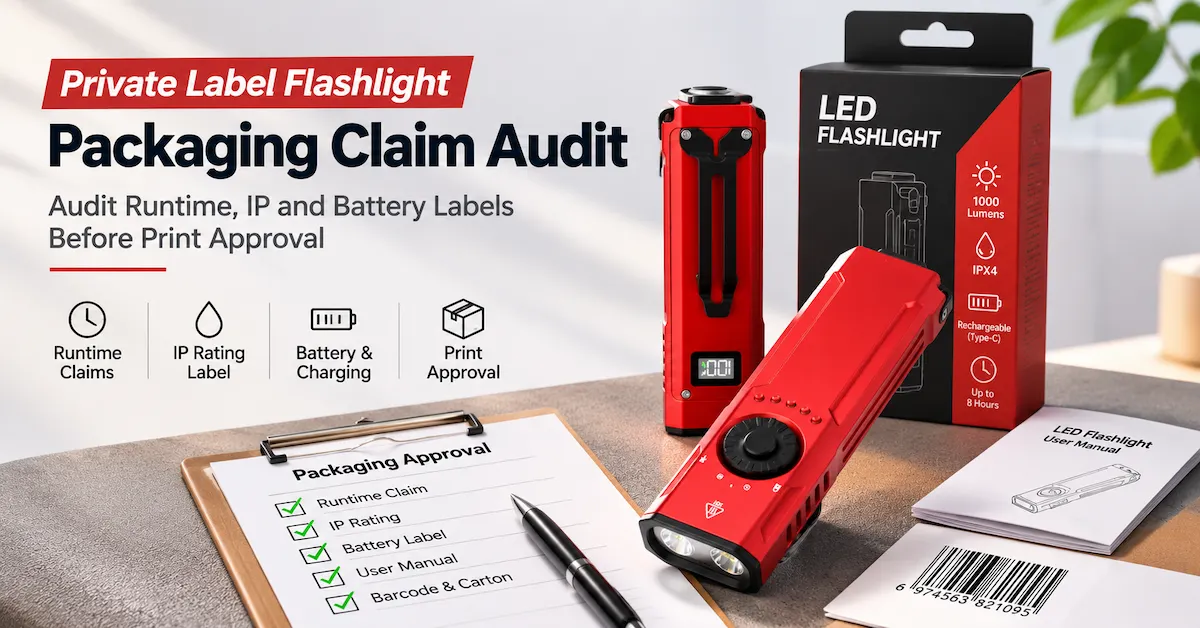
A reliable packaging approval process begins with a documented relationship between the physical flashlight and its printed information.
The packaging team should not independently select product specifications from catalog descriptions, marketing photographs, or previous artwork.
Instead, every technical statement should have an identifiable source.
Flashlight Packaging Claim Evidence Matrix
| Printed Claim | Required Supporting Evidence | Approval Responsibility |
|---|---|---|
| Maximum lumen output | Applicable optical performance report | Engineering and quality |
| Operating runtime | Mode-specific runtime evidence | Engineering and quality |
| IP rating | Applicable ingress-protection test evidence | Quality and compliance |
| Battery capacity | Approved battery specification | Engineering |
| Battery included | Approved commercial configuration | Purchasing |
| USB Type-C charging | Approved electrical configuration | Engineering |
| Charging time | Defined charging test conditions | Engineering |
| Lighting modes | Approved operating sequence | Product manager and quality |
| Accessories included | Approved packing list | Purchasing and production |
| Country of origin | Applicable origin determination | Trade compliance |
| Regulatory markings | Applicable conformity documentation | Compliance |
| Barcode | Approved product identification record | Brand owner |
| Recycling information | Applicable material and market requirements | Compliance |
An effective flashlight packaging claim audit should distinguish between verified statements, proposed marketing wording, pending test results, and claims that must be removed.
A proposed performance target is not automatically an approved marketing claim.
Allocate Information to the Correct Packaging Panel
| Packaging Area | Recommended Content |
|---|---|
| Front panel | Product name, approved image and primary supported claims |
| Back panel | Product specifications, operating features and accessories |
| Side panel | Battery configuration, charging information and relevant instructions |
| Bottom panel | Barcode, traceability and applicable product identification |
| Instruction leaflet | Operating procedures and required safety information |
| Product body | Identification and markings required on the product itself |
| Master carton | Logistics identification and shipment information |
The exact placement of legally required information must follow the applicable market rules. A convenient packaging location does not necessarily satisfy a mandatory product-marking requirement.
2. How Should IP Ratings and Waterproof Claims Be Audited?
Ingress-protection claims can strongly influence purchasing decisions, particularly for outdoor, camping, maintenance, and emergency flashlights.
However, the words waterproof, water-resistant, splash-resistant, and dustproof should not be used interchangeably.
The IEC 60529 standard establishes the IP Code for classifying enclosure protection.
Common IP Rating Packaging Interpretations
| IP Rating | General Interpretation | Packaging Precaution |
|---|---|---|
| IPX4 | Protection against splashing water under specified test conditions | Do not claim a verified dust-protection rating |
| IP44 | Protection against solid objects of the specified size and splashing water | Do not describe the product as dustproof or suitable for immersion |
| IPX5 | Protection against specified water jets | Do not imply immersion protection |
| IPX7 | Protection under specified temporary immersion conditions | Confirm applicable limitations |
| IP67 | Dust-tight protection and specified temporary immersion protection | Do not imply unlimited underwater use |
An IP rating applies to the configuration and conditions covered by its supporting evidence.
For rechargeable flashlights, charging-port covers, seals, end caps, housing joints, and assembly revisions may affect the applicability of an existing report.
Avoid Expanding the Scope of a Verified Claim
Potentially misleading wording:
Fully Waterproof — Use Anywhere
More specific wording, where supported:
IPX4 Splash Resistant
A charging-port protection feature should also not be interpreted as evidence that the flashlight can be safely charged in wet conditions.
If an IP test requires a particular closure or assembly configuration, relevant user instructions should explain that condition accurately.
For additional guidance on performance evidence, review the Brightenlux Flashlight Claims Verification Guide.
3. How Should Runtime and Brightness Claims Appear on Flashlight Packaging?
Maximum light output and maximum operating time frequently refer to different lighting modes.
Printing them together without context can create a misleading impression about continuous performance.
For example, a flashlight may achieve its highest brightness briefly while its longest operating time occurs in a lower-output mode.
Runtime and Brightness Claim Audit
| Proposed Claim | Evidence Required Before Printing |
|---|---|
| Maximum 1500 lumens | Verified maximum-output measurement |
| Up to 8 hours | Identified operating mode and runtime method |
| 3 hours in Medium mode | Medium-mode performance evidence |
| Constant brightness | Output-versus-time evidence supporting the statement |
| Turbo or Boost mode | Applicable short-duration output measurement |
| Long-lasting battery | Defined and supportable commercial wording |
The ANSI/PLATO FL 1-2025 Flashlight Basic Performance Standard provides standardized methods for portable lighting performance reporting, including runtime and short-duration elevated brightness.
Buyers using standard-based performance claims should confirm that their supporting reports follow the applicable method and edition.
Separate Maximum Output From Maximum Runtime
Avoid a presentation such as:
1500 Lumens — 8 Hours
Unless supporting evidence establishes that the flashlight delivers the implied performance under the same conditions.
A clearer packaging structure would identify:
- Maximum light output.
- Operating mode associated with the stated runtime.
- Approved battery configuration.
- Relevant test conditions and limitations.
The final numerical values must come from applicable product evidence.
For US sales, the FTC's advertising substantiation policy emphasizes the need for adequate evidence supporting objective express and implied claims before they are communicated to consumers.
This principle is particularly relevant when evaluating the overall impression created by adjacent numbers, icons, photographs, and promotional wording.
4. What Battery and Charging Information Should Flashlight Packaging Include?
Battery configuration is one of the most commercially sensitive elements of private label flashlight packaging requirements.
Customers should understand what powers the product, whether a battery is included, and how the flashlight should be charged.
Battery Label Review Checklist
| Information | Required Verification |
|---|---|
| Battery format | Matches the approved cell or pack |
| Battery chemistry | Correct technical description |
| Rated capacity | Supported by applicable battery documentation |
| Nominal voltage | Matches the approved configuration |
| Battery quantity | Correct number of supplied cells |
| Battery inclusion | Clearly identified |
| Replaceability | Consistent with the actual product design |
| Charging requirements | Matches validated electrical specifications |
| Disposal information | Meets applicable market requirements |
| Safety instructions | Reflects the approved product risk assessment |
Battery Included vs. Battery Not Included
A rechargeable flashlight does not necessarily include a battery in its standard sales package.
If the approved order excludes the battery, the packaging should clearly communicate this fact.
Example wording:
Compatible with one approved 18650 rechargeable battery. Battery not included.
For a battery-inclusive configuration, the capacity and format should match the actual battery supplied with the product.
A battery-excluded model should not inherit battery-inclusive packaging from a similar-looking SKU.
Verify Charging Terminology
| Charging Statement | Verification Requirement |
|---|---|
| USB Type-C rechargeable | Correct connector and supported charging configuration |
| Charging cable included | Approved packing list |
| Charging adapter included | Actual adapter inclusion |
| Fast charging | Verified charging performance and supported conditions |
| Power bank function | Approved output capability |
| Digital battery display | Verified display functionality |
| Charging indicator | Correct indicator behavior |
A Type-C connector does not automatically establish USB Power Delivery support, fast-charging capability, or compatibility with every charging adapter.
Avoid adding charging specifications or certification logos based solely on the connector's physical appearance.
5. Brightenlux Flashlight Packaging Requirements: Three Product Examples
Brightenlux offers rechargeable flashlight platforms with different battery formats, lighting modes, environmental ratings, and accessory configurations.
These differences demonstrate why private-label artwork should be controlled at SKU level.
Product Configuration and Packaging Comparison
| Product Model | Published Maximum Output | Published Working Time | Battery Configuration | Published IP Rating |
|---|---|---|---|---|
| BT-FL8034 | 1000 lm | 4–5 hours | 18650, not included by default | IP44 |
| BT-FL8088 | 1500 lm | 4–8 hours | 21700 4000mAh, included | IPX4 |
| BT-FL8078 | 1000 lm | 2–3 hours | 16340 800mAh, included | IPX4 |
These figures are published catalog specifications, not independent test results or automatic authorization for printed packaging claims.
BT-FL8034: Battery-Excluded Rechargeable Flashlight
The Brightenlux BT-FL8034 1000LM Rechargeable Flashlight features an OSRAM P9 LED, adjustable focus, twist-out Type-C charging, and a published IP44 rating.
Its standard catalog configuration identifies a rechargeable battery that is not included.
The packaging audit should prioritize battery inclusion, compatible battery requirements, approved runtime evidence, and charging instructions.
BT-FL8088: Compact Magnetic Rechargeable Flashlight
The Brightenlux BT-FL8088 1500LM Rechargeable Flashlight includes a 21700 4000mAh battery, magnetic tail, Type-C charging, and multiple accessories.
The product page identifies red and green charging-status indications.
Before artwork approval, confirm the approved battery, accessory pack-out, charging indicator behavior, and the operating mode associated with any printed runtime claim.
BT-FL8078: Right-Angle Inspection Flashlight
The Brightenlux BT-FL8078 1000LM Right-Angle Flashlight uses an 800mAh battery and incorporates a magnetic tail, headstrap, and plastic mount.
Its published protection rating is IPX4.
The artwork should accurately communicate the approved accessories, mounting options, charging requirements, and splash-resistance limitations.
Why SKU-Specific Packaging Matters
Even when two flashlights share similar appearance or charging interfaces, their battery capacities, operating modes, and protection ratings may differ.
Using one generic technical information panel across multiple SKUs can introduce avoidable errors.
6. How Should Multilingual Instructions Be Reviewed?
Multilingual instructions should communicate the same approved product information across every language version.
Translation errors can change the meaning of warnings, charging restrictions, battery compatibility, or operating instructions.
Flashlight Instruction Manual Checklist
| Manual Section | Required Content Review |
|---|---|
| Product identification | Correct model and product illustration |
| Package contents | Approved product and accessory list |
| Switch operation | Actual button functions |
| Lighting modes | Correct operating sequence |
| Battery installation | Approved installation procedure, where applicable |
| Charging | Supported input and charging method |
| Indicators | Correct charging and battery-status meanings |
| Safety precautions | Approved risk-related instructions |
| Cleaning | Appropriate product maintenance |
| Storage | Relevant battery and storage precautions |
| Disposal | Applicable product and battery disposal information |
| Customer support | Approved responsible contact details |
Recommended Translation Approval Process
- Freeze the approved source-language manual.
- Create a controlled technical terminology list.
- Translate into the languages required for the destination market.
- Arrange technical review by qualified language reviewers.
- Confirm all warnings, units, symbols, and numerical values.
- Review the final printed layout for readability.
- Approve a separate revision for each language version.
Translation quality should not be assessed solely through automated translation tools.
The final manual must match the actual product configuration, including any approved changes to switches, charging systems, lighting modes, or included accessories.
7. How Should Flashlight Barcodes and Master Carton Markings Be Verified?
A barcode is part of the product identification system, not simply a decorative packaging element.
An incorrect code can cause inventory discrepancies, retail receiving delays, marketplace listing problems, and inaccurate product identification.
Retail Barcode Verification
| Verification Item | Approval Requirement |
|---|---|
| GTIN ownership | Confirm the authorized allocation |
| SKU mapping | Barcode corresponds to the correct trade item |
| Check digit | Valid for the assigned number |
| Symbol format | Suitable for the sales and scanning environment |
| Print contrast | Meets applicable specifications |
| Quiet zones | Required clear space maintained |
| Barcode dimensions | Appropriate for the intended application |
| Placement | Suitable for scanning after package assembly |
| Printed verification | Meets agreed verification requirements |
According to GS1 barcode print-quality guidance, suitable verification equipment measures symbol characteristics and produces a quality grade against the relevant requirements.
A successful scan with a mobile phone alone does not establish full barcode print compliance.
A product configuration or packaging quantity change should also trigger a review of whether a new GTIN is required under the applicable allocation rules.
Master Carton Marking Checklist
| Carton Information | Required Confirmation |
|---|---|
| Customer name or reference | Matches shipping instructions |
| Purchase order number | Correct commercial order |
| Product SKU | Matches carton contents |
| Carton quantity | Actual units per carton |
| Carton number | Correct shipment sequence where required |
| Gross and net weight | Approved shipment information |
| Carton dimensions | Matches finished packaging |
| Country of origin | Correct applicable information |
| Handling markings | Appropriate for the shipment |
| Battery transport markings | As required for the actual shipping configuration |
Transport markings should be reviewed separately from consumer retail labels.
Lithium battery shipping requirements depend on battery configuration, shipment classification, transportation mode, and applicable transport rules.
8. What Is the Correct Flashlight Packaging Print Approval Workflow?
A packaging design should pass several approval stages before bulk printing begins.
Approving visual appearance alone is insufficient.
Seven-Stage Print Approval Process
| Stage | Main Approval Requirement | Release Condition |
|---|---|---|
| 1. Product configuration freeze | Approved SKU, battery and accessories | Technical configuration confirmed |
| 2. Claim evidence review | Every printed claim linked to evidence | Unsupported claims removed or resolved |
| 3. Artwork development | Correct dieline and product information | Design draft ready for review |
| 4. Language and compliance review | Required instructions, markings and warnings | Market-specific requirements checked |
| 5. Digital artwork approval | Complete final layout and content | Authorized written approval |
| 6. Physical print proof | Color, dimensions, legibility and barcode quality | Printed proof accepted |
| 7. Production print release | Correct artwork revision and printing instructions | Authorized mass-print approval |
Illustrative Flashlight Packaging Claim Audit
Consider a hypothetical private-label order of 5,000 flashlights using a battery-excluded product configuration.
The artwork contains four proposed claims:
| Artwork Statement | Audit Finding | Required Action |
|---|---|---|
| Battery included | Does not match order configuration | Remove or correct |
| Fully waterproof | Exceeds available IP44 description | Replace with supported wording |
| 1000 lumens for 5 hours | Mode-specific supporting evidence missing | Hold the combined claim |
| USB Type-C rechargeable | Matches the approved configuration | Eligible for technical approval |
In this example, the artwork must remain on hold until the discrepancies are resolved.
The figures and findings are illustrative and do not represent an actual Brightenlux customer order or inspection report.
Packaging Print Approval Record
| Approval Field | Record |
|---|---|
| Purchase order | __________ |
| Product model and SKU | __________ |
| Product specification revision | __________ |
| Approved battery configuration | __________ |
| Destination market | __________ |
| Artwork revision | __________ |
| Instruction manual revision | __________ |
| Claim register reference | __________ |
| Test report references | __________ |
| Barcode verification record | __________ |
| Physical proof reference | __________ |
| Technical approval | __________ |
| Buyer approval | __________ |
| Compliance approval | __________ |
| Final status | Approve / Hold / Reject |
| Approval date | __________ |
An approval status should identify the exact artwork and product revision authorized for printing.
9. How Should Packaging Artwork Versions Be Controlled?
OEM flashlight label compliance extends beyond the first production order.
A product may undergo battery, LED, driver, charging, supplier, or packaging changes during repeat production.
If the artwork remains unchanged while the product changes, previously accurate information can become incorrect.
Packaging Version Control Register
| Controlled Document | Identification Requirement |
|---|---|
| Product specification | SKU and revision number |
| Battery specification | Approved model and revision |
| Retail box artwork | Artwork number and revision |
| User manual | Language and revision |
| Claim evidence matrix | Approval record reference |
| Barcode file | Approved trade-item identifier |
| Master carton artwork | Carton specification revision |
| Physical print proof | Sample reference and approval date |
Changes That Require Packaging Review
| Product Change | Potential Packaging Impact |
|---|---|
| Battery capacity change | Capacity, runtime and charging information |
| Battery inclusion change | Package contents and retail descriptions |
| LED or driver change | Brightness, modes and runtime claims |
| Seal or housing change | Applicability of IP evidence |
| Charging circuit change | Electrical information and instructions |
| Accessory change | Package contents and product images |
| Importer change | Responsible business identification |
| Target market change | Language and regulatory markings |
Not every change requires a complete packaging redesign, but every relevant change should be evaluated.
Manage Obsolete Printed Packaging
When a new artwork revision is approved, record the remaining quantity of obsolete boxes, labels, manuals, and master cartons.
Determine whether they can be used for an unchanged configuration, require an authorized compliant correction, or must be withdrawn from production.
Do not mix packaging revisions simply to consume old inventory.
A controlled packaging revision system helps prevent repeated printing errors and improves traceability during future orders.
10. What Market Compliance Requirements Should Private Label Buyers Consider?
Private label flashlight packaging requirements vary according to the destination market, product design, battery configuration, and the responsibilities of the businesses placing the product on the market.
A single international packaging design should not be assumed to satisfy every jurisdiction.
Destination-Market Review Matrix
| Market | Main Areas to Review |
|---|---|
| European Union | Applicable product safety, conformity marking, economic operator information, battery and packaging rules |
| United States | Substantiated performance claims, country-of-origin marking, applicable product and battery requirements |
| Great Britain | Applicable product safety, conformity marking, traceability and consumer instructions |
| Northern Ireland | Applicable Northern Ireland and EU-related product requirements |
| Other markets | Local labeling, language, importer and product-specific requirements |
European Union: Private-Label Responsibility
Under Article 13 of the EU General Product Safety Regulation, Regulation (EU) 2023/988, a business placing a product on the market under its own name or trademark may be treated as the manufacturer for the purposes of that regulation.
This is particularly relevant to private-label flashlight brands.
Buyers should determine which general and product-specific obligations apply, including:
- Product identification and traceability.
- Relevant economic operator information.
- Required safety instructions and languages.
- Applicable electrical and environmental legislation.
- Supporting conformity documentation.
For rechargeable battery configurations, review the EU Battery Regulation, Regulation (EU) 2023/1542.
Its marking, labeling, and information obligations depend on the battery category and applicable implementation dates.
The EU Packaging and Packaging Waste Regulation, Regulation (EU) 2025/40 generally began applying on 12 August 2026, while several specific packaging-label requirements follow later implementation schedules.
Buyers should therefore review the applicable rules at the intended market-placement date rather than copying future or outdated symbols onto current artwork.
United States: Product Claims and Origin Marking
Objective performance statements should be supported by appropriate evidence.
Importers should also verify applicable country-of-origin marking requirements, battery-related requirements, and any product-specific federal or state obligations.
An outdoor photograph or US-based brand identity should not be used to create a misleading impression about manufacturing origin.
Great Britain and Northern Ireland
Marking and conformity requirements should be reviewed separately for Great Britain and Northern Ireland.
The official GOV.UK product safety guidance for manufacturers and importers provides a starting point for reviewing relevant safety, marking, and traceability obligations.
A conformity symbol should only be printed when the corresponding legal requirements and supporting documentation have been established.
This article provides a procurement review framework, not a complete legal determination for any individual SKU.
11. What Packaging Requirements Should Buyers Include in an OEM Flashlight RFQ?
Packaging requirements should be discussed before the commercial quotation and production schedule are finalized.
Artwork revisions, multilingual instructions, barcode verification, physical print proofs, and regulatory review can affect project costs and lead times.
Private Label Flashlight Packaging RFQ Checklist
| RFQ Field | Information Buyers Should Provide |
|---|---|
| Brand and sales channel | Retail, wholesale, industrial or e-commerce |
| Destination market | Countries and regions |
| Reference flashlight | Model and approved configuration |
| Order quantity | Initial and expected repeat orders |
| Battery requirements | Format, capacity and inclusion |
| Performance claims | Proposed output, runtime and IP statements |
| Charging information | Approved charging specifications |
| Packaging structure | Retail box, insert or other approved format |
| Brand artwork | Logo, colors and design guidelines |
| Languages | Required translations |
| Barcode | Authorized product identification |
| Regulatory information | Applicable approved markings and contacts |
| Testing documents | Required claim-supporting evidence |
| Print proof | Physical proof and verification requirements |
| Artwork approval | Responsible approval personnel |
| Version control | Revision and change-management procedure |
| Delivery schedule | Artwork, proofing, printing and production milestones |
Request separate confirmation of packaging minimum order quantities, artwork setup expenses, proofing costs, printing schedules, and any additional validation requirements.
These commercial conditions should be based on the specific project rather than assumed from a previous order.
For broader branded product development guidance, review the Brightenlux Private Label Flashlight Manufacturer Guide.
Buyers planning customized product platforms can also consult the OEM Flashlight Manufacturer Guide.
Brightenlux provides portable LED lighting platforms and OEM/ODM customization support for international purchasing programs. Product configuration, branding, packaging, and project-specific technical requirements can be discussed before production approval.
12. Frequently Asked Questions
1. What are the main private label flashlight packaging requirements?
They include accurate product identification, supported performance claims, battery and charging information, approved accessories, instructions, traceability, barcode information, and applicable destination-market markings.
2. Can a flashlight with an IPX4 rating be labeled waterproof?
Broad waterproof wording may imply protection beyond the supported rating. A more precise splash-resistance statement is generally preferable when IPX4 evidence applies to the approved configuration.
3. Can maximum brightness and maximum runtime appear together on packaging?
Yes, provided their presentation does not misleadingly imply simultaneous performance. Identify the relevant modes and conditions supported by the applicable test evidence.
4. Should the packaging state whether a rechargeable battery is included?
Yes. Battery inclusion should accurately reflect the approved commercial configuration so buyers understand what is supplied with the flashlight.
5. Does a USB Type-C connector mean the product supports fast charging?
No. Fast-charging claims require evidence of the actual supported charging performance and applicable conditions.
6. Who should provide the barcode for a private-label flashlight?
The responsible business should confirm authorized GTIN allocation and product mapping. The manufacturer or printer can then apply the approved barcode artwork.
7. Is a digital packaging mock-up sufficient for mass-print approval?
A digital mock-up is useful for content and layout review. A physical proof helps verify print quality, dimensions, readability, colors, and barcode performance before bulk printing.
8. Can one instruction manual be used for multiple flashlight models?
Only when its information accurately applies to all covered models and clearly identifies relevant differences. Otherwise, SKU-specific instructions should be maintained.
9. When should flashlight packaging claims be reviewed again?
Review them whenever a relevant product component, battery, performance specification, accessory, artwork revision, economic operator, destination market, or applicable requirement changes.
10. How can buyers discuss custom flashlight packaging with Brightenlux?
Provide the reference model, battery configuration, proposed claims, brand artwork, packaging format, required languages, destination market, order quantity, and print approval requirements when requesting an OEM quotation.
13. Conclusion
Effective private label flashlight packaging requirements connect the actual product with accurate consumer information, documented performance evidence, and controlled print approval.
For importers, distributors, and international lighting brands, packaging should not be treated as the final decorative step before shipment.
It is a commercial and technical document that communicates product performance, configuration, operating instructions, and relevant safety information to customers.
By establishing a flashlight packaging claim audit, reviewing multilingual instructions, verifying barcodes, and maintaining artwork revision records, buyers can reduce avoidable labeling errors and protect the consistency of future private-label orders.
Brightenlux offers rechargeable flashlight platforms and OEM/ODM support for international portable lighting purchasing programs.
Whether developing a new outdoor flashlight range, introducing a private-label retail collection, or updating an existing product assortment, establish the approved product configuration and packaging information before bulk printing.
Verify the product. Approve the claims. Control the artwork before printing.