

Why a flashlight claim needs an approval record
A buyer may receive a sample that looks convincing, a quote based on an apparently similar platform, and carton artwork copied from a previous project. Those three items can describe three different configurations. A battery option might change between sample and quotation. A charging port might be revised after photography. A “high” mode may step down within minutes, while the package simply says “5 hours.” The difficulty is not merely that a number may be wrong. It is that nobody can later reconstruct which number belonged to which build.
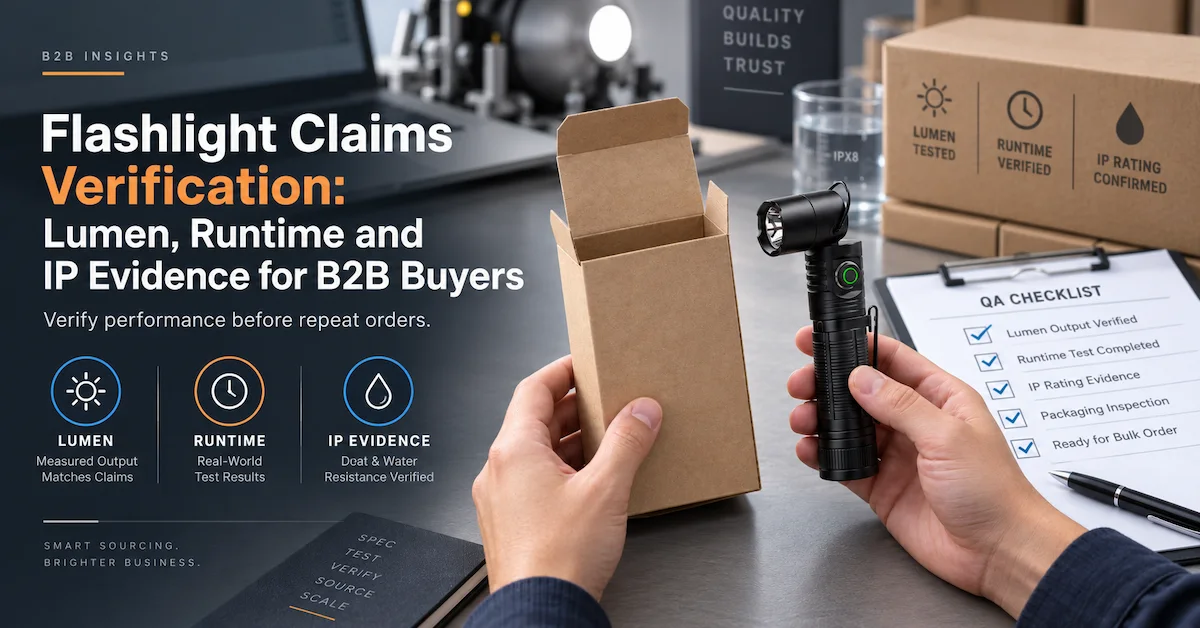
In a wholesale program, the cost of that ambiguity appears in channel returns, disputed invoices, edited listings, relabeling, and an uncomfortable conversation with the next buyer. A product manager needs a document that connects the physical sample, bill of materials, measurement, packaging claim and destination market. The document does not have to be elaborate. It does have to identify the same product consistently. If the team cannot point to one approved reference, it should not release the claim to print.
This is a commercial investigation and RFQ-intent guide, not a general explanation of what a lumen is. It is written for the purchaser who must decide which flashlight manufacturer can support a repeatable branded or distributor program. A useful end state is a quote package that a competing supplier can answer without guessing, together with a short evidence list that makes quotations comparable.
Start with one controlled configuration
Give the proposed product a buyer-controlled project code. Record the exact LED or optical assembly, cell format and whether a cell is included, charging arrangement, switch sequence, material and finish, lens or reflector, seal design, accessories, and packaging. Attach dated photographs of the actual approval sample. If the manufacturer offers several cell capacities or alternate emitters, treat each as a separate configuration until equivalence is demonstrated. A general catalog title cannot do the work of a controlled specification.
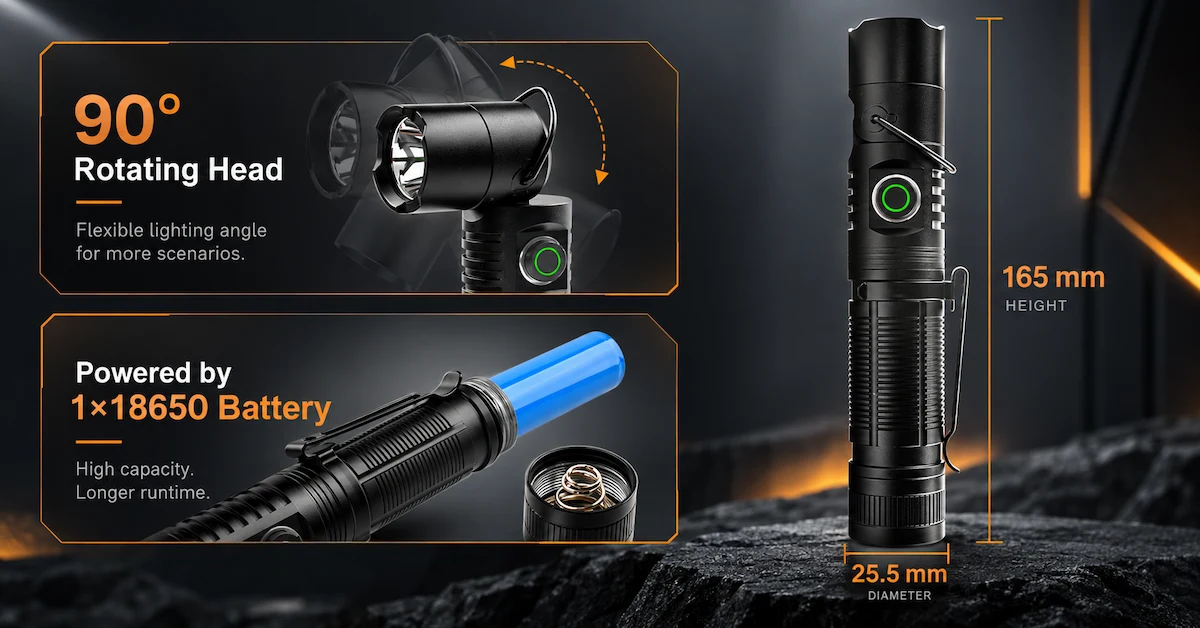
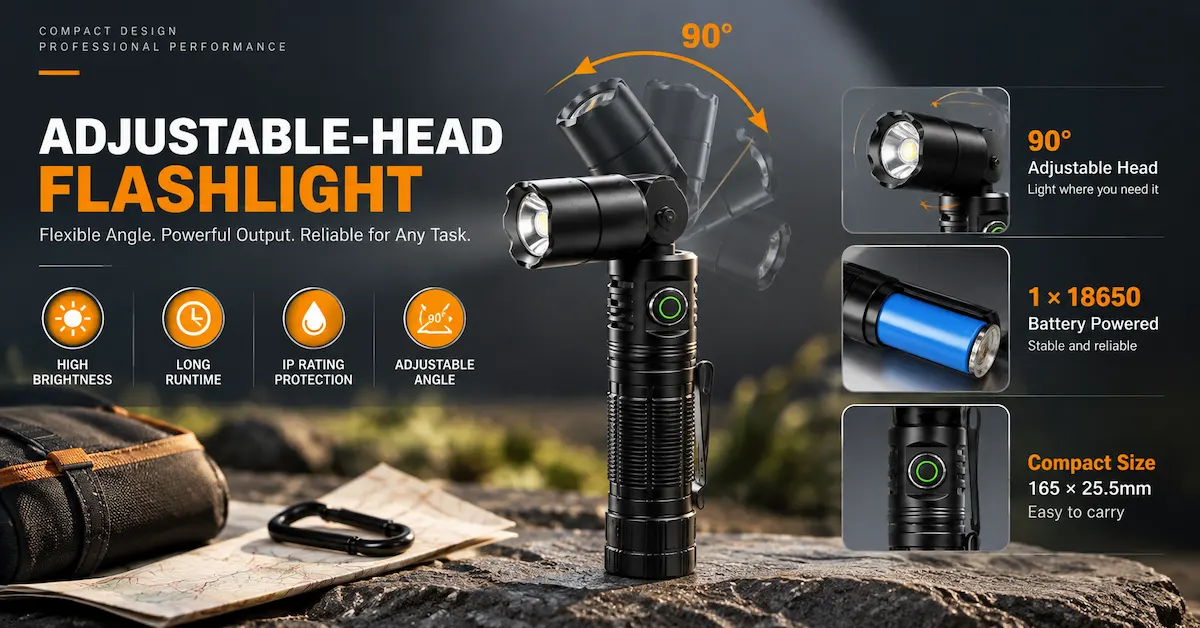
For example, Brightenlux's adjustable-head SST40 flashlight listing describes 1,000 lumens, a 100-meter beam distance, an included 2,200 mAh 18650 cell, an adjustable head, a magnetic tail, Type-C charging and IP44. The page also states a four-to-six-hour working time and a ten-hour full recharge. Those statements are useful for building an RFQ, but the buyer must ask which mode, battery sample, ambient condition and end criterion apply before reproducing them on a box. The apparent contrast between “fast charging” language and a listed ten-hour charge time is precisely the sort of wording that merits clarification before copy approval.
A second catalog example, the XHP50 zoom flashlight listing, describes a 2,000-lumen maximum, an included 4,000 mAh 21700 cell, up to five hours of use, a Type-C port under a twist-out head and IP44. It is a different architecture, not a higher-priced version of the first example. The battery, beam control and port protection each create different verification questions. Do not combine their claims into one comparison chart without labeling the model and test configuration.
Translate marketing copy into measurable requirements
The buyer's claim register should contain one row per statement that appears in a listing, instruction sheet, carton, sales deck or tender response. It should distinguish a public claim from a buyer-requested target. A proposed target is not a measured result. A supplier may offer a different, defensible test method; settle that difference before paying for tooling or print plates. The approval record should also state who can change a claim, because copywriters and engineers often work from different document versions.
| Claim to approve | Question to ask the factory | Evidence to request | Artwork decision |
|---|---|---|---|
| “1,000 lumens” | Which mode, cell, measurement timing and method? | Sample ID, output method and dated results | Print only the verified configuration and wording |
| “100 m beam” | How was distance derived, with what focus position? | Peak-intensity record and method | Do not imply useful task illumination at every point |
| “4–6 hours” | Which mode and end-of-test threshold? | Output-versus-time trace, cell details | Name the mode and avoid a single unqualified runtime |
| “IP44” | Which enclosure and sample state were tested? | Applicable ingress test report and sample identity | Use IP44 accurately; avoid immersion language |
| “rechargeable” | Is the cell included, and what is the charge method? | Approved pack-out, charger/cable and charging checks | Match the actual retail contents |
| “aluminum body” | Which components are aluminum, and which are polymer? | Material callouts on drawing or BOM | Do not turn a partial construction into “all-metal” |
The table is a buyer's proposed approval framework, not a report of tests performed by Brightenlux. A specific contract can set tolerances, sample size and remedy only after both parties agree on the edition of the method and the approved build. Requiring proof without specifying what counts as proof creates the same dispute as having no requirement at all.
Choose a recognized vocabulary for light performance
The ANSI/PLATO FL 1-2025 Flashlight Basic Performance Standard is the relevant industry standard for defining measurement methods and performance claims for portable lights. The standard itself is a licensed document; a search-result snippet is not a test procedure. In your RFQ, cite the edition you require, purchase or access the full standard where necessary, and agree how the supplier's facility or laboratory will apply it. Do not stamp an ANSI/PLATO mark on artwork just because a supplier has quoted a lumen number.
Output, beam distance, peak beam intensity and runtime answer different questions. Lumens describe total emitted light under a specified method. Candela describes intensity in a direction; beam distance is derived from intensity under a defined threshold, not an observation that a worker will see every object clearly at that distance. Runtime depends on the standard's endpoint, the mode, battery and thermal behavior. A large peak figure can coexist with a much lower useful output after step-down. The procurement brief should ask for a curve, not only a headline value.
Define the distinction between a claim and its marketing interpretation. “Up to 2,000 lumens” can be a maximum-mode claim. It is not a promise that the light will hold 2,000 lumens for five hours. A product image showing a bright beam does not verify a measured distance. A smartphone exposure comparison is not an output test. If the intended customer is a mechanic, inspector or utility crew, request task-specific checks such as sustained close-range illumination and control usability while gloved, in addition to standardized optical measurements.
Output and thermal step-down
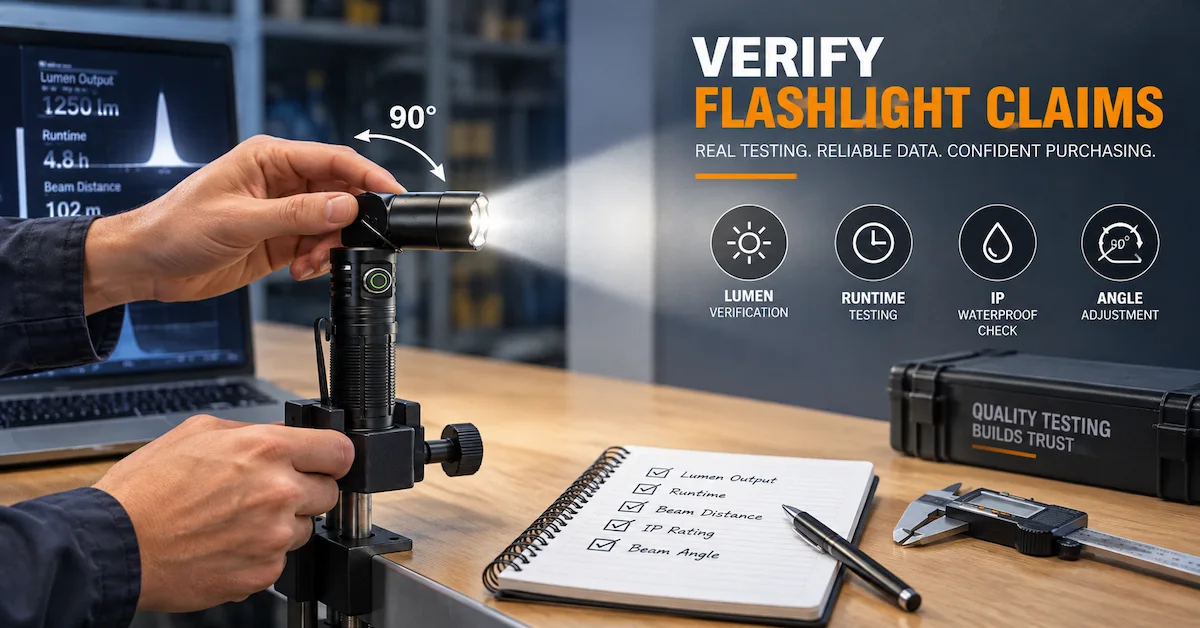
Ask the supplier to record the product's configuration, the cell's nominal specification and state of charge, ambient condition, output at the required standard interval, and output at meaningful later intervals. A 30-second result, a five-minute result and an hour-long trace serve different purchase decisions. In a compact flashlight, heat and battery voltage can change output. The buyer should decide whether a high initial value or sustained working level is more important for the application, then request both rather than forcing the factory to defend only one number.
For a pilot order, include a witnessed or independently repeated measurement on samples selected from the production lot. The exact sample count and acceptance rule belong in the purchase agreement. If a result differs from the reference, first verify cell charge, mode selection, optical focus, instrument calibration and thermal environment. Do not treat a single uncalibrated phone-app reading as proof of fraud, and do not let an unexplained outlier disappear from the record. Record the investigation and disposition.
Beam distance and focus
For a fixed reflector, identify the tested mode and reference orientation. For a zoomable model, identify the focus position, because the same light can produce a broad near-field beam and a narrow spot. A quoted beam-distance figure is easy to misread as a guaranteed working distance; the actual task may demand edge illumination, color recognition or low glare that the headline figure does not describe. Ask for beam photographs taken with fixed exposure for visual comparison, but keep them separate from photometric records.
Prepare a simple use-case sheet: close inspection at arm's length, walking route illumination, long-range location of an object, or signaling. Rank those tasks. A buyer who wants a service-vehicle light may prefer an adjustable head and magnetic tail over a focused long throw. A buyer selling outdoor search tools may accept a narrower beam but insist on a stable high-output duration. The “best” optical result depends on the task, not on which box has the largest numeral.
Runtime and battery configuration
Runtime should name the mode, cell model or approved equivalent, initial charge, temperature range, endpoint and whether the product automatically steps down. Ask for the light-output curve and note whether low mode or high mode underlies the claim. “Up to five hours” on a product page is not a complete consumer-facing assertion unless the condition is available to the buyer. If different cells are permitted, measure the production-approved cell, not a demonstration cell selected for its exceptional capacity.
Track battery sourcing by manufacturer and lot where practical. Ask whether the cell is protected, whether the product includes it, whether a second cell can be used, and what happens when the cell's dimensions vary within normal tolerance. For Type-C charging, verify the port's mechanical access, indicator logic, charge termination and cable compatibility on the approved build. A supplier's stated nominal mAh rating is not a flashlight runtime measurement. Buyers should not convert mAh to hours with a simple division unless the power draw, voltage and operating curve are understood.
Document the included contents in one pack-out photograph: light, cell, cable, clip, headband, manual and any spare seal. The public adjustable-head example describes an included 18650 cell and USB cable; the XHP50 example describes an included 21700 cell. Those differences affect price, packaging, shipping and customer support. If the quotation excludes the battery, the carton and listing must not silently retain “battery included” from the catalog sample.
IP44 is a rating, not a promise of immersion
The IEC 60529 standard on degrees of protection provided by enclosures (IP Code) provides the framework behind an IP claim. The two digits describe different protection characteristics. In ordinary procurement language, IP44 is a limited ingress-resistance claim, not permission to submerge the light or call it an underwater torch. The exact qualification depends on the tested enclosure, conditions and standard edition. Ask the supplier for the report or plan to test the final configuration; do not infer that a photo in rain proves the rating.
Examine the finished assembly that customers will receive. A twist-out charging head, removable tail cap, O-ring, switch boot, lens joint and charging port can all change the ingress path. A report for a different charging-port design does not automatically follow the current SKU. Decide whether the test applies with the charging cover fully closed and whether a user instruction is required. If marketing wants the word “waterproof,” challenge it: for an IP44-listed product, “splash-resistant when properly closed” is generally a more precise description than an unqualified “waterproof.”
If the target market or application requires more protection, ask for a different enclosure and validated rating rather than stretching the current copy. This matters to a flashlight supplier China program intended for wet roadside kits: the RFQ should say whether occasional rain, washdown or immersion is actually expected. The appropriate answer may be a different product, not a stronger adjective in the title.
Check construction and handling claims separately
“Durable aluminum body” can describe the tube while the switch carrier, lens or end cap uses another material. Request a drawing with material callouts and finish specification; check the actual sample under both diffuse light and normal store lighting. For anodized surfaces, agree on acceptable variation, abrasion checks and cosmetic zones. For a magnetic tail, test on the surfaces customers will use, with the light at the expected angle and with vibration or movement if that is part of the application. A magnet that holds a static sample on a thick steel plate may behave differently on painted bodywork or thin sheet metal.
Where an impact claim will appear, define the test orientation, height, surface, number of drops and post-test functions. A marketing image with a “drop resistant” icon is not a test report. Inspect clip retention, head hinge, switch feel and charge-port access after handling. A buyer's acceptance sheet should separate critical safety and function defects from cosmetic variation. A scratch on a hidden surface and a charging failure should not receive the same disposition.
Photographs are still useful evidence when correctly labeled. Capture the approved sample from repeatable angles, including the switch, port, cell compartment, markings and carton contents. The photo is an identity control, not proof of a lumen or IP value. Keep raw test records and approved copy together so that a later product-page edit can be traced to the evidence that justified it.
Approve the listing, carton and RFQ as one system
Before release, compare every channel's wording line by line. The website might say “Type-C rechargeable,” the box might say “fast charge,” and a distributor sheet might say “USB-C included.” They imply different things. Record the charging time, cable included, cell included, and compatible input as separate fields. The same exercise applies to “IP44 waterproof,” “weather resistant,” and “splash resistant.” If the physical sample or test evidence supports only one formulation, standardize on that formulation.
Do a literal pack-out audit on an approved final carton. Check product model, battery marking, language, accessories, safety instructions, warnings, importer details where applicable, barcode ownership and market-specific requirements. The factory should not be asked to certify a destination market generically. Identify the exact SKU and jurisdiction, then obtain the relevant documentation from qualified parties. A regulatory icon copied from another product is a liability, not a shortcut.
A useful sign-off page has a revision number, SKU, sample ID, date, owner, approved claim, test reference, artwork file name, and approval signatures or equivalent digital record. If any component affecting a claim changes, that record triggers a fresh review. A replacement cell, LED bin, optic, switch boot or charging board can affect performance or safety even when the outside looks identical. The issue is not whether change is forbidden; it is whether the buyer can approve it knowingly before shipment.
Make the RFQ specific to the type of supplier relationship
A buyer searching for a flashlight manufacturer may be asking for several different things. A simple stock-product purchase requires confirmation of the current SKU and pack-out. A private-label order changes artwork and sometimes finish while retaining the underlying platform. A custom project may change the optical or electrical design and require a new validation plan. The evidence burden rises with the scope of change. Do not send the same two-line inquiry to every supplier and expect comparable quotes.
If the search is for an LED flashlight manufacturer, specify whether the decision hinges on long-range intensity, flood illumination, or sustained output. The linked catalog example includes a white-laser LED and a claimed 600-meter range; that is a different optical question from a close-work light. Ask for the appropriate measurement record and distinguish laser/LED marketing terminology from a verified optical configuration. A compact indoor inspection lamp should not be selected merely because another model advertises a longer beam.
A rechargeable flashlight manufacturer RFQ needs the approved cell and charging system, not just “USB-C.” Ask whether the 21700 cell is included, what the replacement-cell policy is, how charging status is displayed and how the product is packed for shipment. Battery sourcing, runtime and charging claims should remain tied to the same sample. If your retailer will sell in multiple markets, list each market and intended package language at the inquiry stage.
For an OEM flashlight manufacturer, attach a controlled change list: which existing features remain, which are optional, and which require redesign. An angled head, magnet, cell format and switch sequence each affect more than appearance. Ask for a revised drawing and a validation matrix for altered parts. A logo alone does not justify calling a product custom-engineered; conversely, a changed cell or charging board cannot be treated as a cosmetic private-label adjustment.
A private label flashlight manufacturer inquiry should include the exact product reference, logo position, color tolerance, artwork language, barcode ownership, packaging structure and signed sample process. The linked compact 700-lumen listing is a concrete platform to discuss, not a promise that every listed customization is available at any quantity. Request a project-specific minimum order quantity and lead-time breakdown; neither should be invented from a generic website statement.
A custom flashlight manufacturer conversation should start with the use case and non-negotiable functions. If a buyer changes the head angle, magnetic mounting or charging location, ask how the changes affect sealing, balance, thermal performance and serviceability. State who pays for tooling, who owns it, how the first article is approved and what triggers requalification. The RFQ should invite a proposed method, not demand a headline number without a test plan.
A wholesale flashlight supplier may be asked to support a tiered range rather than one SKU. The linked 300-lumen product can play a different assortment role from a 2,000-lumen model. Ask for a SKU matrix with distinct customer jobs, actual packed contents and stable reorder codes. Otherwise, two lights with similar cartons and unclear claims may compete with each other on the shelf while creating avoidable returns.
Finally, a portable flashlight manufacturer inquiry should include pocket dimensions, weight with cell, clip retention, accidental activation risk and the intended carrying method. Portability is not established by a studio photograph. A retailer may need the unit to fit a blister or peg hook; a field-service buyer may value glove-friendly control and a secure clip more highly. The physical task should determine the acceptance test.
Use a two-stage sample and production approval
First approve an engineering or pre-production sample against the intended claim register. Photograph its markings and pack-out, retain one sealed reference where practical, and record any deviations. Do not approve a sample by email with “looks good” if the quotation and artwork still describe an earlier battery or mode sequence. An approval is meaningful only when every critical feature can be traced to a revision.
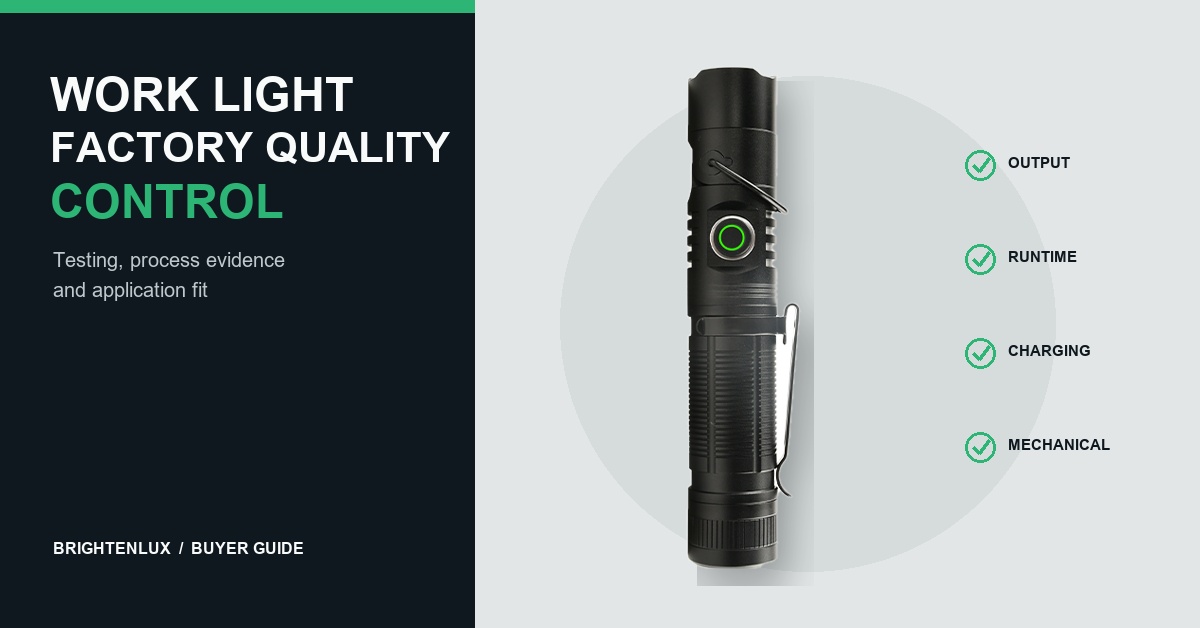
Second, select samples from the production lot according to a mutually agreed inspection plan. A golden sample can help with appearance and function, but it cannot replace production checks or a measurement method. Verify the high-risk claims again on representative units, and check the carton against the signed artwork. If a unit fails, quarantine the affected lot or agreed portion, investigate cause and document corrective action before a release decision. Avoid an automatic rule that a single low reading condemns an entire shipment; the contract should define retest, sampling and remedy.
Run a separate fit-for-use trial with the buyer's actual operators. A service mechanic may discover that the adjustable head falls under vibration; a gloved user may find the mode sequence difficult; a retailer may see that the magnetic tail creates a pack-out concern. Those observations are not substitutes for standard tests, but they are the original application evidence that a generic catalog cannot provide. Record them with date, user group, conditions and sample ID. If a field trial changes a feature, update the claims and product images before release.
| Gate | Buyer deliverable | Supplier deliverable | Stop condition |
|---|---|---|---|
| RFQ | Use case, markets, target volume, draft claim register | Configuration proposal, options, quote assumptions | Two parties quote different pack-outs |
| Sample | Application trial and written feedback | Identified build, drawing/BOM, proposed test records | Claims lack a test condition or sample ID |
| Artwork | Final copy, languages and channel list | Claim-to-evidence sign-off and pack-out photo | Print wording exceeds verified configuration |
| Production | Approved reference and inspection plan | Lot traceability, inspection and change records | Unapproved component or packaging substitution |
| Reorder | Returns and field feedback | Revision comparison and corrective action if needed | Old artwork used for a changed build |
These are proposed commercial gates, not a claim that any named supplier already follows them. They help a purchaser distinguish “we can make a sample” from “we can supply the same approved product repeatedly.” For some low-risk stock orders, the process can be compact. For custom or multi-market projects, the extra controls are usually less costly than a relabeling exercise after launch.
Compare quotations on evidence, not only unit price
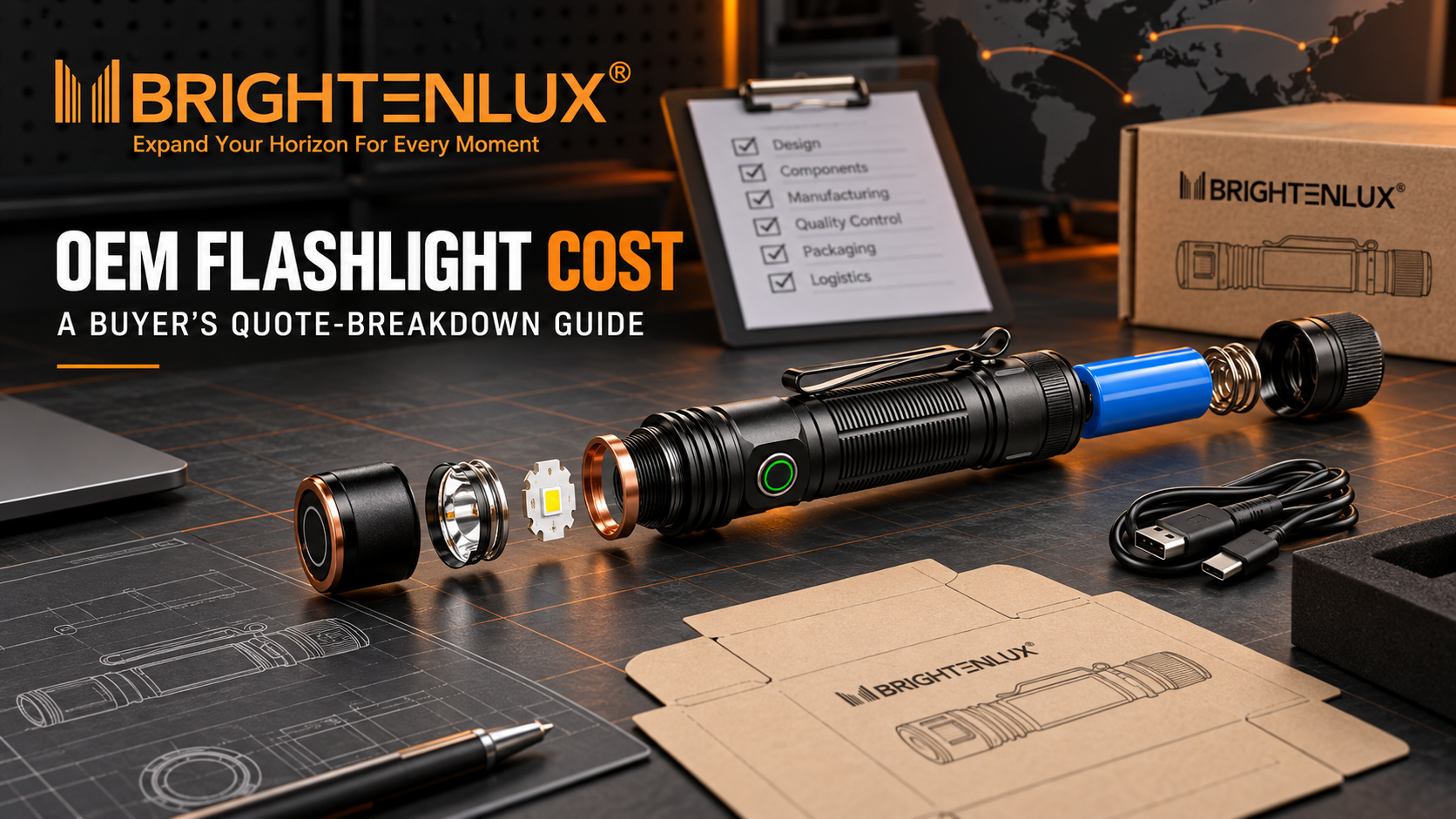
A quote is incomplete if one supplier includes a cell, cable, tested packaging and destination-market documents while another prices a bare light. Build a landed comparison with separate lines for the approved light configuration, battery, accessories, packaging, artwork setup, tooling, tests, inspection, freight and replacement allowance. Keep currency, Incoterm, quantity breaks and validity date visible. A lower unit price may be a different product; a higher unit price may include a responsibility that the cheaper quote leaves with the buyer.
Ask each candidate to identify the origin of the product photos and test data. Are the images of the actual current build, a previous revision, or a concept rendering? Are the optical records from an approved production configuration? Does a rating apply to the complete assembly? Who maintains the drawing and can notify the buyer of changes? If a factory cannot answer immediately, give it a chance to gather evidence. Score the quality and specificity of the eventual answer, not the speed of a confident but unsupported reply.
The public Brightenlux listings provide starting points for a conversation. They do not publish project-specific MOQ, confirmed lead times, lot inspection results or a certificate for every possible custom variant. A serious inquiry therefore asks for those items rather than repeating a convenient number in an article. For a buyer whose purchase order depends on a specific output or IP result, attach a proposed acceptance schedule and request written confirmation or a counterproposal.
RFQ checklist buyers can send today
State the end market and distribution channel, the job the light must perform, annual forecast and first order size, and a target delivery window. Identify one or two catalog references and say exactly which features should stay unchanged. Mark all proposed claims as “target pending verification” until the supplier provides evidence. Attach photographs of the intended packaging and the language list. Then request a response organized around these questions:
- What is the exact model code, revision and approved bill of materials? Which parts are alternate-sourced?
- What optical output, beam and runtime claims can you document for the quoted cell and mode? Provide method and sample identification.
- What ingress or impact claims can be supported for the finished assembly? Which report applies to this revision?
- What is included in the retail pack? Identify cell, cable, clip, manual and spare parts, if any.
- Which changes are stock, private label or new engineering? Quote MOQ, tooling, sample, testing and lead time separately.
- How will production lots be identified, inspected and compared with the approved sample? What happens if a key component changes?
- What destination-market documents can be provided for the exact SKU? Who is responsible for the buyer's own regulatory review?
- Who approves carton and web claims, how are revisions controlled, and what are the agreed remedies for nonconforming goods?
Do not ask every supplier to provide a dossier before disclosing any volume or market. A targeted brief makes it easier for the factory to respond accurately. The response should separate confirmed facts, optional engineering work and commercial estimates. A useful quotation states its assumptions next to the price, so the buyer can compare like with like and identify where further validation is needed.
FAQ for performance-claim approval
Can we publish the catalog's lumen figure immediately?
Use the catalog figure as a preliminary product reference, not as proof for a new branded pack. Confirm the exact sample, cell, mode, measurement method and current production revision with the manufacturer. If the claim will appear in a regulated channel or on a printed carton, retain the supporting report and an approved wording record. A buyer can sometimes use a qualified “up to” figure, but that phrase does not remove the need for substantiation.
Does a five-hour runtime mean five hours at maximum brightness?
Not unless the supporting method explicitly says so. Some products describe a working time across modes, and output may step down as temperature or battery voltage changes. Request a mode-specific output-versus-time trace and the endpoint definition. Compare that curve with the task: an inspection crew may care about the first hour of sustained useful light more than a long low-output tail. Put the relevant mode on the product page and packaging.
Is IP44 the same as waterproof?
No. IP44 is a specific enclosure-protection rating under the applicable test method. It should not be presented as proof of submersion resistance. Ask for evidence on the finished SKU, including how charging covers and removable caps are closed during the test. Use precise, limited wording that reflects the rated conditions. If the use case involves immersion or aggressive washdown, choose and validate a different design rather than relabeling the current one.
What should we do if the sample and product page disagree?
Pause artwork approval and ask for a controlled correction. Identify the physical build and record which claim is current. The supplier may have updated a cell, port or optic without updating every language version of the listing. This is a documentation problem even if the new product performs well. Confirm revised copy, quotation and pack-out in one sign-off packet before the first production order.
Do we need an independent laboratory for every claim?
The answer depends on claim risk, channel requirements, market and contract. A calibrated supplier record may be useful for development; independent or witnessed testing can add confidence for high-stakes printed claims. Agree on sample selection, test method and lab competence before a dispute, not after. Do not imply an independent certificate exists when the only evidence is a product-page image or a factory statement.
How should we request MOQ and delivery without inventing numbers?
Give the target quantity, packaging scope and customization list, then ask for separate minimum quantities and lead times for stock, logo-only, custom color and engineering changes. Request the timeline from approved sample and artwork, not merely from deposit. Cell procurement and testing can affect the schedule. The public catalog cannot establish a project-specific MOQ or delivery promise for the buyer's new configuration.
What evidence belongs with a reorder?
At minimum, retain the approved reference, revision-controlled specification, final artwork, earlier test and inspection records, and any field-return trends. Ask the manufacturer to declare changes affecting performance or claims. A reorder is not automatically a repeat of the first physical build. Compare a fresh production sample with the approved sample and retest claims affected by a changed cell, optic, LED, switch or enclosure seal.