

Quick Answer: An effective OEM lighting change control system prevents manufacturers from substituting critical LEDs, rechargeable cells, drivers, firmware, or other approved components without documented review and authorization. For importers, distributors, and private-label brands sourcing flashlights, headlamps, and camping lights from manufacturers in Ningbo, China, the process should connect an approved bill of materials, component change notifications, risk classification, revalidation requirements, retained golden samples, and production release records. Whether supplying outdoor retail, industrial maintenance, or emergency lighting markets, buyers should establish written approval requirements before production and verify that every affected shipment matches the authorized product revision.
A rechargeable flashlight can look identical to its approved sample while containing a different LED, battery cell, charging circuit, or driver.
These internal substitutions may affect brightness, runtime, temperature, charging behavior, reliability, and the validity of existing product documentation. Standard appearance inspection may not detect them.
Ningbo Brightenlux Electric Appliance Co., Ltd. manufactures portable LED lighting products in Ningbo, Zhejiang, China, and provides OEM/ODM development support for international lighting purchasing programs.
For overseas buyers, component change control is an important part of maintaining consistent product performance across initial orders and repeat production.
This guide provides a practical procurement framework for managing component substitutions before they reach finished products.
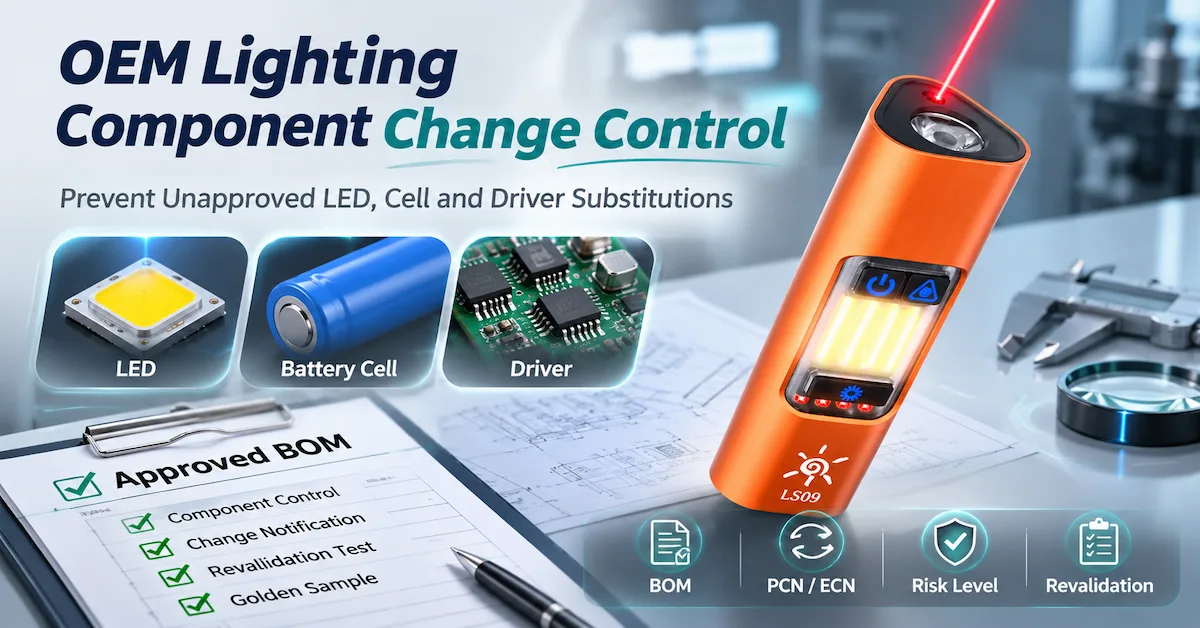
1. How Should Buyers Establish an Approved Lighting BOM?
A bill of materials, commonly called a BOM, identifies the components and materials required to manufacture a particular product.
For OEM lighting programs, an approved BOM establishes the authorized production configuration against which future component changes can be evaluated.
A generic description such as "high-power LED with rechargeable lithium battery" is insufficient for controlling performance-critical components.
Buyers should define which characteristics must remain fixed and which alternatives may be used under approved conditions.
LED Light Approved BOM: Recommended Control Fields
| Component Category | Required BOM Information | Potential Change Risk |
|---|---|---|
| Main LED | Manufacturer, part number, approved bin or specification | Brightness, beam color, thermal performance |
| Auxiliary LED | Approved type, color and electrical characteristics | Lighting modes and visual consistency |
| Rechargeable cell | Manufacturer, model, capacity and protection configuration | Runtime, charging and safety |
| Battery pack | Cell configuration, assembly and protection system | Electrical compatibility and transport requirements |
| LED driver | PCB revision, approved components and electrical requirements | Output regulation, efficiency and temperature |
| Charging circuit | Approved hardware revision and input specification | Charging behavior and battery compatibility |
| Firmware | Approved version and configuration identifier | Mode sequence and protection logic |
| Lens or reflector | Drawing, material and optical specification | Beam pattern and light transmission |
| Sealing components | Material, dimensions and approved specification | Ingress protection |
| Switch | Approved model and functional requirements | Operating reliability |
| Housing | Material grade, drawing and finish | Mechanical and thermal performance |
| Charging cable | Approved electrical and physical specification | Charging compatibility |
The exact level of component identification should reflect the product's technical requirements, purchasing risk, and agreed disclosure arrangements.
Distinguish Fixed Components From Approved Alternatives
Not every component needs to be restricted to one manufacturer.
A practical purchasing specification can divide components into three control categories.
| Control Category | Purchasing Rule |
|---|---|
| Locked component | Only the specifically approved part may be used |
| Approved alternative | Only alternatives already evaluated and listed may be used under their approved conditions |
| Specification-controlled component | Parts may be sourced within defined technical limits and agreed change-notification rules |
For example, a buyer may lock the rechargeable cell and driver revision while permitting several approved suppliers for noncritical fasteners.
Where multiple alternatives are authorized, the approved BOM should identify any permitted combinations and applicable performance limitations.
This prevents production teams from assuming that every individually approved component can be combined with every other approved component.
Maintain a Controlled BOM Revision
Each production order should reference the applicable product and BOM revision.
If the approved specification is Revision B, the purchasing team, production department, quality inspectors, and packaging team should all work from the corresponding released documents.
Conflicting revisions should be resolved before production begins.
2. What Should Trigger a Flashlight Component Change Notification?
A flashlight component change notification allows the buyer to evaluate a proposed modification before it affects the commercial product.
Legitimate changes may arise from component discontinuation, supply shortages, cost reduction, manufacturing improvements, or quality problems.
The objective is not to prohibit every change. It is to prevent unauthorized changes from entering production.
Component Change Notification Triggers
| Proposed Change | Recommended Notification Requirement |
|---|---|
| Different LED manufacturer or model | Prior notification and approval |
| LED bin outside approved range | Prior notification and technical review |
| Different rechargeable cell supplier | Prior notification and approval |
| Battery capacity or protection change | Prior notification and revalidation |
| Driver PCB revision | Prior notification and engineering review |
| Charging IC replacement | Prior notification and electrical assessment |
| Firmware modification | Prior notification and functional review |
| Lens or reflector modification | Prior notification and optical assessment |
| Seal material or geometry change | Prior notification and ingress-protection review |
| New housing material or tooling | Prior notification and mechanical assessment |
| Critical manufacturing process change | Prior notification and process review |
| Production site or critical subcontractor change | Prior notification and qualification review |
Normal component lot-number changes within an already approved specification do not necessarily require a new engineering change approval. However, the applicable traceability and incoming inspection requirements still need to be maintained.
What Is a PCN?
PCN stands for Product Change Notification and may also refer to product or process change notifications.
In the electronics industry, manufacturers such as Texas Instruments use structured notifications to communicate significant changes affecting component characteristics, performance, quality, or reliability.
OEM lighting buyers can adapt this approach to finished-product purchasing programs.
A component manufacturer's PCN does not automatically authorize the flashlight manufacturer to introduce that change into a buyer-controlled product.
The lighting manufacturer must still evaluate the impact on the finished assembly and follow the agreed customer approval procedure.
Recommended Change Notification Template
| PCN Field | Required Information |
|---|---|
| Notification number | Unique change reference |
| Affected products | Buyer SKU and factory model |
| Current configuration | Approved part number and revision |
| Proposed configuration | Replacement part number and revision |
| Reason for change | Availability, improvement, discontinuation or other reason |
| Affected purchase orders | Open and planned orders |
| Risk assessment | Performance, safety and compliance impact |
| Validation plan | Proposed tests and acceptance criteria |
| Sample availability | Expected qualification sample date |
| Implementation plan | Proposed effective production lot |
| Existing inventory | Old components, work-in-progress and finished products |
| Commercial impact | Price, development cost and delivery implications |
| Approval status | Pending, approved or rejected |
An effective notification should provide sufficient information for an engineering decision rather than simply describe the replacement as equivalent.
3. How Should OEM Lighting Component Changes Be Classified by Risk?
An effective OEM lighting change control plan should classify proposed changes according to their potential effect on the finished product.
The following three-level system is a suggested procurement framework rather than a mandatory industry standard.
Engineering Change Risk Classification
| Risk Level | Definition | Illustrative Changes | Required Action |
|---|---|---|---|
| Level 1 — Low | Administrative or minor changes with no identified impact on approved requirements | Internal document reference update | Document review |
| Level 2 — Medium | Changes that may affect appearance, fit, operation or commercial acceptance | Cosmetic finish adjustment, noncritical mechanical component | Targeted verification and approval |
| Level 3 — High | Changes that may affect safety, charging, optical performance, reliability or regulatory evidence | Cell, LED, driver, charging circuit, protection firmware | Formal engineering assessment and risk-based revalidation |
A nominally cosmetic change may become high risk if it affects heat dissipation, material safety, electrical insulation, or environmental protection.
Risk classification should therefore be based on the actual engineering impact rather than the component's name alone.
Questions to Assess Change Risk
Before assigning a risk level, determine:
- Does the change affect an approved electrical specification?
- Could it alter light output, beam distribution, color or runtime?
- Could it influence battery charging or protection behavior?
- Does it affect accessible temperatures or environmental protection?
- Could existing test reports or regulatory documentation become inapplicable?
- Does the packaging or instruction manual require revision?
- Would routine production inspection detect the change?
- Can affected production batches be identified and contained?
A low-cost component can still create significant downstream commercial exposure.
For example, a different sealing material may cost very little but invalidate the assumptions supporting an ingress-protection claim.
4. Which Tests Should Be Repeated After a Lighting Component Change?
Replacing one component does not necessarily require repeating every test performed during initial product development.
However, the manufacturer and buyer should determine which previous qualification results remain valid and which require renewed evaluation.
Component Revalidation Matrix
| Proposed Component Change | Primary Technical Risk | Recommended Revalidation Areas |
|---|---|---|
| Main LED replacement | Output, beam color and thermal characteristics | Light output, beam, current, runtime and temperature |
| LED bin change | Color and brightness variation | CCT, chromaticity and relevant optical limits |
| Rechargeable cell replacement | Usable energy, discharge and charging compatibility | Battery identity, charging, runtime and safety assessment |
| Battery protection circuit change | Protection and electrical behavior | Applicable electrical and protection verification |
| LED driver replacement | Output regulation and efficiency | Mode output, runtime, thermal behavior and applicable EMC review |
| Charging IC replacement | Charging behavior and battery compatibility | Charging profile, indicators and applicable electrical safety checks |
| Firmware update | Mode logic and protection behavior | Functional regression and affected protection requirements |
| Lens or reflector change | Beam distribution and optical efficiency | Beam pattern, intensity and applicable optical safety review |
| Seal replacement | Water or dust ingress | Assembly fit and applicable ingress-protection testing |
| Housing material change | Structural and thermal behavior | Dimensions, mechanical performance and thermal assessment |
| Switch replacement | Operation and durability | Switching sequence, mechanical fit and endurance where applicable |
The matrix should be adapted to the actual product and proposed change.
For significant changes, qualified personnel may require broader product requalification.
Verify Battery Transport Evidence Separately
A replacement rechargeable cell should not automatically inherit the transport documentation of the previously approved battery.
The United Nations Manual of Tests and Criteria, including subsection 38.3 and its applicable amendments, provides a framework for evaluating lithium cell and battery transport testing.
Buyers should request confirmation that the relevant documentation applies to the replacement cell or battery design.
Whether additional testing is necessary depends on the applicable design-type criteria and transport requirements.
A matching battery diameter or advertised capacity alone does not establish that the existing documentation remains applicable.
Use Defined Acceptance Limits
A revalidation report should record the test method, approved limits, sample identity, actual measured results, equipment information, and final decision.
A statement such as "new LED tested successfully" provides insufficient evidence for a meaningful engineering approval.
5. Brightenlux Product Examples: Why Component Identity Matters
Brightenlux publishes several portable LED lighting products with different optical, electrical, and mechanical configurations.
These products demonstrate why change control should operate at individual model and revision level.
Brightenlux Component Configuration Comparison
| Product Model | Published LED Configuration | Published Battery | Maximum Output | Change Control Focus |
|---|---|---|---|---|
| BT-FL8088 | SST40 LED | 21700 4000mAh, included | 1500 lm | LED, cell and driver |
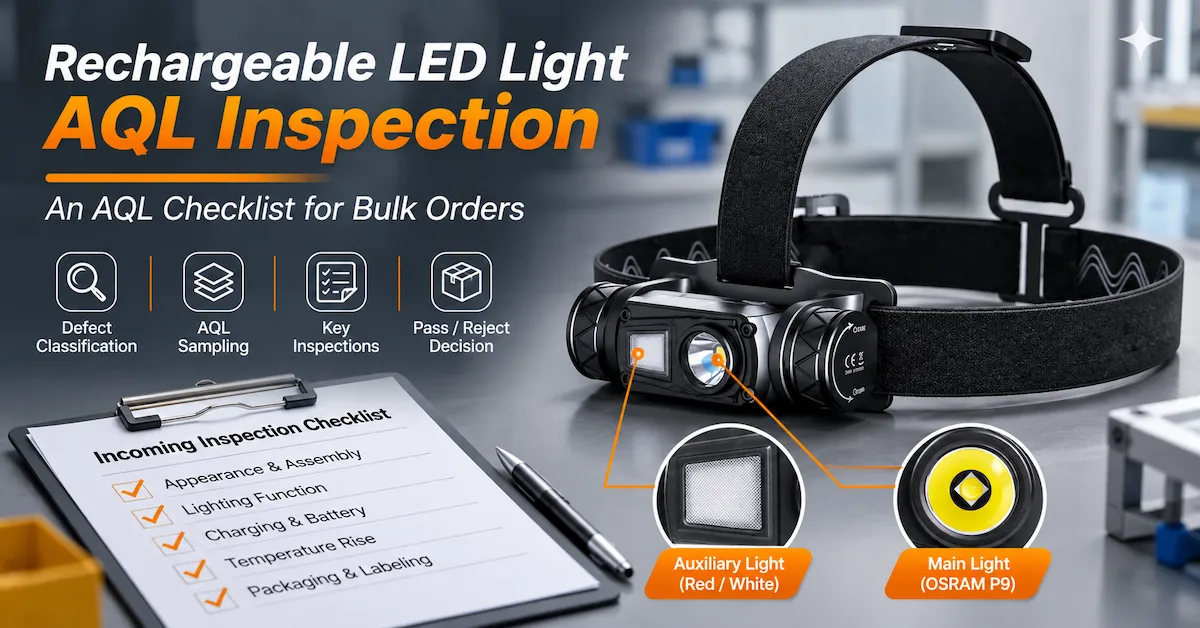
| BT-HL9040 | OSRAM P9 and auxiliary SMD LEDs | 18650 2200mAh, included | 800 lm | Multiple light sources and operating modes |
| BT-PL4031R | High-power COB LED | 3 × 2200mAh lithium batteries, included | 2000 lm | Battery system, COB and dimming electronics |
These are manufacturer-published catalog specifications. They do not establish the complete approved production BOM or authorize component substitutions.
BT-FL8088: Rechargeable LED Flashlight
The Brightenlux BT-FL8088 1500LM Rechargeable Flashlight features an SST40 LED, a 21700 4000mAh battery, Type-C charging, multiple lighting modes, and a magnetic tail.
For an OEM program using this platform, proposed LED or battery substitutions should be evaluated against the agreed output, runtime, charging, and thermal requirements.
The exact cell manufacturer, cell model, driver revision, and permitted alternatives should be established through the project approval documents.
BT-HL9040: Rechargeable LED Headlamp
The Brightenlux BT-HL9040 800LM Rechargeable Headlamp combines an OSRAM P9 main LED with white and red auxiliary SMD lighting.
Changes to the LED configuration, driver, or control firmware could affect both lighting performance and operating sequence.
Buyers should therefore confirm the approved main and auxiliary light sources together with the complete functional configuration.
BT-PL4031R: Rechargeable Camping Lantern
The Brightenlux BT-PL4031R 2000LM Rechargeable Camping Lantern offers COB lighting, multiple light colors, dimming, rechargeable lithium batteries, and a power bank function.
A modification to the battery system or control board may affect multiple operating functions.
Revalidation should address the interactions between the changed component and the lantern's approved lighting, charging, and power-output requirements.
6. How Should Golden Samples Be Retained and Controlled?
A golden sample is a reference product representing an approved configuration.
It can help buyers and manufacturers evaluate product appearance, assembly, operating behavior, accessories, and workmanship.
However, an externally identical product may contain different internal components.
For this reason, the golden sample must be supported by controlled technical records.
Golden Sample Retention Checklist
| Record Field | Required Information |
|---|---|
| Product identity | Buyer SKU and manufacturer model |
| Sample identification | Unique sample number |
| Product revision | Approved engineering version |
| GOOD review | Applicable controlled component list |
| Battery configuration | Approved cell or pack identification |
| Driver configuration | Relevant PCB and firmware revision |
| Approval evidence | Signed inspection and test records |
| Internal photographs | Approved assembly and component references |
| Approval date | Date and authorized personnel |
| Storage location | Controlled sample location |
| Retention period | Agreed project-specific duration |
| Replacement policy | Procedure for superseded or damaged samples |
Retain Technical Evidence Alongside the Sample
Depending on the purchasing agreement, the approval package may also include:
- Controlled BOM and approved alternative component list.
- Relevant drawings and electrical specifications.
- Approved component identification photographs.
- Firmware identification records.
- Product qualification reports.
- Approved packaging and instruction manual.
- Signed sample approval documentation.
Where internal inspection or teardown is necessary, use designated samples and qualified personnel rather than damaging the only retained reference unit.
Rechargeable products should be stored according to applicable battery safety requirements and approved storage instructions. A retained battery's condition may change over time, so an aged golden sample should not automatically serve as the sole electrical performance reference.
Do Not Replace Golden Samples Informally
When a product revision changes, retain the previous reference as required and establish a newly approved sample.
The new sample should not overwrite the historical approval record.
This allows both sides to distinguish products manufactured before and after an authorized change.

7. What Is the Correct OEM Lighting Engineering Change Approval Workflow?
Component change control should connect notification, technical evaluation, approval, and manufacturing implementation.
Three useful document types are:
| Document | Main Purpose |
|---|---|
| PCN — Product Change Notification | Communicates the proposed product or process change |
| ECR — Engineering Change Request | Initiates formal review of the proposed modification |
| ECN — Engineering Change Notice | Communicates the authorized change and its implementation details |
Terminology may vary between organizations. What matters is that the process separates a proposed change from an approved production release.
Eight-Stage Engineering Change Approval Process
- Identify the component availability problem or proposed improvement.
- Issue a documented change notification identifying affected products and orders.
- Compare current and proposed configurations and classify the risks.
- Establish the necessary revalidation plan and acceptance requirements.
- Evaluate qualification samples and review supporting evidence.
- Obtain written approval from the authorized parties.
- Update controlled BOMs, drawings, firmware records and production instructions.
- Implement the change from the approved effective lot and verify the first production run.
Qualification samples may be produced under an agreed engineering authorization, but they must remain distinguishable from ordinary production inventory.
Engineering Change Decision Matrix
| Review Status | Production Decision |
|---|---|
| Notification received | Hold proposed substitution pending assessment |
| Technical assessment incomplete | Continue using previously approved components only |
| Required validation incomplete | Do not release changed products commercially |
| Qualification results fail | Reject proposal or require corrective action |
| Limited deviation approved | Use only within authorized quantity, lot and time limits |
| Permanent change approved | Implement from the authorized revision and effective lot |
| Unauthorized substitution discovered | Contain affected inventory and initiate investigation |
A supplier's notification, a preliminary quotation, or an acknowledgement email should not automatically be interpreted as technical approval.
Silence should not be treated as consent unless an explicit and appropriate contractual mechanism establishes otherwise.
8. What Change Control Requirements Belong in an OEM Purchasing Agreement?
Written purchasing requirements provide a clear basis for preventing unauthorized substitutions.
These requirements should be incorporated into the relevant quality agreement, purchase specification, or purchase order documentation.
OEM Lighting Purchasing Agreement Fields
| Agreement Field | Recommended Requirement |
|---|---|
| Approved configuration | Identify the applicable product and BOM revision |
| Controlled components | List components subject to prior approval |
| Approved alternatives | Define permitted alternatives and conditions |
| Notification period | Establish an agreed advance notice requirement |
| Emergency changes | Require expedited review without automatic authorization |
| Approval authority | Name responsible technical and commercial approvers |
| Revalidation scope | Define how necessary testing will be determined |
| Qualification expenses | Allocate applicable sample and testing costs |
| Effective lot | Identify the first authorized production batch |
| Inventory transition | Define treatment of old components and finished goods |
| Traceability | Link component lots to affected production batches |
| Temporary deviations | Specify quantity limits and expiry |
| Sub-supplier controls | Extend notification obligations to relevant suppliers |
| Unauthorized substitutions | Define containment, investigation and disposition |
| Record retention | Establish agreed documentation retention requirements |
Illustrative Purchasing Clause
The supplier shall not introduce changes to designated critical components, approved manufacturing processes, or controlled product configurations without prior written approval from the buyer. Proposed changes shall be supported by a documented technical impact assessment, applicable validation evidence, and an agreed implementation plan. Any temporary deviation shall identify the affected quantity, production lots, authorized conditions, and expiration date.
This is an illustrative commercial clause and should be reviewed for the actual purchasing relationship and applicable contract law.
Define Notification Timing Before Production
For example, a buyer and manufacturer may agree on 60 calendar days of advance notification for planned critical changes.
This is a negotiable purchasing requirement, not a universal statutory or industry-mandated notification period.
Unexpected discontinuation or supply interruption may require a shorter review period, alternative sourcing, or revised delivery arrangements. It should not automatically permit unapproved substitution.
9. Case Study: What Happens When an Unapproved Battery Is Found?
Consider a hypothetical private-label order of 3,000 rechargeable flashlights.
The approved configuration specifies a particular 21700 rechargeable cell with a rated capacity of 4000mAh.
During production, the approved cell becomes unavailable. An alternative cell is purchased with the same physical format and advertised capacity, but it is not listed as an approved alternative.
Illustrative Production Findings
| Order Information | Hypothetical Result |
|---|---|
| Total order | 3,000 units |
| Units assembled using replacement cell | 1,200 units |
| Remaining units not assembled | 1,800 units |
| Replacement cell approval | Not available |
| Runtime revalidation | Not completed |
| Charging assessment | Not completed |
| Transport documentation applicability | Not confirmed |
| Change status | Unauthorized substitution |
These figures are hypothetical and do not describe an actual Brightenlux order.
Required Containment Actions
The affected production order should remain on hold until the configuration deviation has been evaluated.
The manufacturer should identify the replacement component batches, isolate affected materials and assemblies, and prevent further use of the unauthorized cell.
The buyer and qualified engineering personnel should then evaluate whether the replacement is suitable and whether additional testing is required.
The existing battery test evidence must not be assumed to apply to the alternative cell.
Possible Disposition Decisions
| Decision | Applicable Condition |
|---|---|
| Restore approved configuration | Original approved component becomes available and controlled rework is feasible |
| Approve replacement | Required validation and documentation are accepted |
| Temporary deviation | A limited, documented commercial authorization is technically and legally appropriate |
| Reject affected goods | Requirements cannot be satisfied |
| Stop or revise the remaining order | Approved production cannot continue as originally planned |
The supplier should investigate why purchasing or production was able to introduce the component without authorization.
Corrective action may include updating purchasing controls, restricting unapproved material codes, improving incoming identification, or strengthening production release checks.
A basic functional inspection alone cannot resolve the unauthorized configuration.
10. What Should Buyers Include in an OEM Lighting Change Control RFQ?
Change-control expectations should be discussed before the first purchase order rather than introduced only when a component shortage occurs.
Supplier Change Control RFQ Checklist
| RFQ Field | Required Buyer Information |
|---|---|
| Buyer and sales channel | Importer, distributor, retailer or private-label brand |
| Destination market | Country or region |
| Product application | Outdoor, maintenance, camping or emergency lighting |
| Reference model | Existing Brightenlux platform or buyer specification |
| Critical components | LEDs, cells, drivers and other controlled parts |
| BOM disclosure | Required component information and revision records |
| Approved alternatives | Permitted parts and qualification conditions |
| Notification rules | Changes requiring prior written approval |
| Validation requirements | Optical, electrical, thermal and functional evidence |
| Golden samples | Approval, retention and replacement requirements |
| Traceability | Component identification and production lot records |
| Quality agreement | Approval responsibilities and deviation procedures |
| Order quantity | Initial volume and reorder forecast |
| Commercial terms | Testing fees, component costs and delivery implications |
Questions to Ask Before Supplier Approval
A buyer should understand how the proposed manufacturer identifies critical components, controls approved suppliers, manages component discontinuation, communicates engineering changes, and verifies the first production lot after an authorized change.
Where complete proprietary design information cannot be disclosed, discuss a controlled critical-component register, restricted technical documents, or appropriate confidentiality arrangements.
The objective is to obtain sufficient evidence for the buyer's technical, commercial, and compliance responsibilities.
For broader OEM project development, review the Brightenlux OEM Flashlight Manufacturer Guide.
Detailed purchasing requirements can also be prepared using the Flashlight OEM Specification Template.
For factory-level quality evaluation, see the LED Flashlight Supplier Audit and Traceability Guide.
Discuss Your OEM Lighting Component Requirements With Brightenlux
11. Frequently Asked Questions
1. What is OEM lighting change control?
It is a documented process for reviewing, approving, implementing, and tracing modifications to an authorized lighting product configuration. It helps prevent unauthorized component and process changes from entering bulk production.
2. What is an approved BOM for LED lighting?
An approved BOM identifies the authorized components, materials, specifications, revisions, and permitted alternatives used to manufacture a particular lighting product.
3. Can a manufacturer replace an LED with another model of the same wattage?
Not automatically. Equivalent nominal wattage does not establish equivalent brightness, optical characteristics, electrical behavior, or thermal performance. The replacement should follow the agreed approval process.
4. Can two rechargeable cells with the same capacity be used interchangeably?
Not necessarily. Cells with the same advertised capacity may have different electrical, mechanical, protection, and discharge characteristics. Compatibility and applicable documentation must be evaluated.
5. Does every component change require complete product requalification?
No. The appropriate validation scope depends on the actual change, associated risks, product requirements, and applicability of existing evidence. Significant changes may require broader requalification.
6. What is the difference between a PCN and an ECN?
A PCN communicates a proposed product or process change. An ECN typically communicates an authorized engineering change and its implementation requirements. Exact terminology varies between organizations.
7. Can a golden sample replace a controlled BOM?
No. A golden sample supports physical and functional comparison but cannot independently establish every internal component, material grade, firmware revision, or technical specification.
8. What should happen when a supplier discovers an unapproved substitution?
The affected materials and products should be contained, identified, and investigated. Further production or shipment should follow an authorized disposition and any required validation.
9. How should component discontinuation be handled?
The supplier should notify affected buyers, identify available inventory and potential replacement options, assess the technical impact, and obtain the necessary approvals before implementing a substitute.
10. How can buyers discuss change control requirements with Brightenlux?
Provide the intended product, destination market, critical component requirements, approved alternative policy, notification expectations, validation scope, order quantities, and traceability requirements when requesting an OEM quotation.
Conclusion
Effective OEM lighting change control protects the relationship between an approved product design and the finished products delivered to customers.
For importers, distributors, private-label brands, and lighting procurement teams, repeat-order consistency depends on more than appearance inspection or an approved sample.
A controlled BOM, clear component change notifications, risk-based revalidation, retained golden samples, and written purchasing agreements help buyers identify and manage substitutions before they affect commercial shipments.
Brightenlux offers LED flashlights, rechargeable headlamps, camping lights, and OEM/ODM development support for international portable lighting programs.
Whether developing a new lighting product or placing a repeat order, establish the approved configuration, component substitution rules, and required approval evidence before confirming bulk production.
Approve the components. Control the changes. Verify the production revision before shipment.
Browse Brightenlux LED Lighting Products
Explore OEM/ODM Outdoor Lighting Solutions
Contact Brightenlux for an OEM Lighting Quotation and Component Control Discussion