

LED Flashlight Supplier Audit Guide: Traceability, Test Records, and CAPA
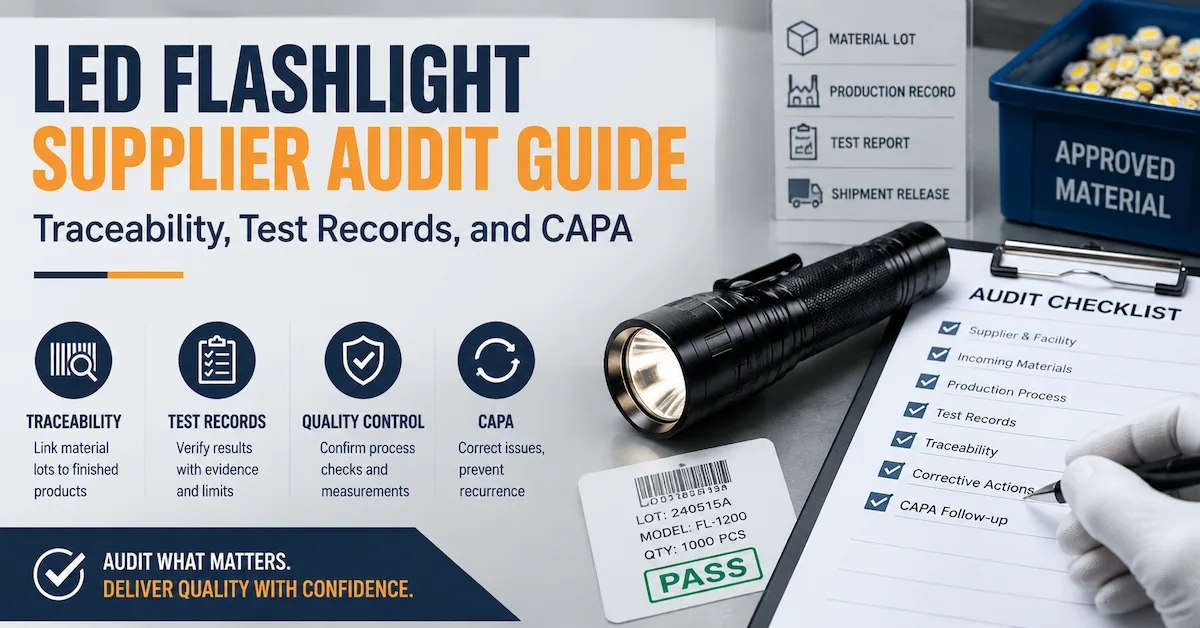
An LED flashlight supplier audit should prove four things: the factory knows exactly which product it is building, critical materials can be traced to a production lot, test results can be linked to the same lot, and problems trigger documented containment and corrective action. A clean workshop or a certificate on the wall is not enough. Buyers need records that connect the approved specification to the goods that will actually ship.
This guide is for importers, distributors, private-label brands, industrial buyers, and quality teams preparing a first order or reviewing an existing flashlight program. It does not repeat a general quotation scorecard or a supply-continuity plan. Its purpose is narrower: to help a buyer conduct a desk, remote, or on-site audit that tests whether product identity, process control, measurement evidence, traceability, and corrective action work as one system.
The audit question that matters
The useful question is not, "Does the supplier have a quality system?" It is, "Can the supplier show how this exact flashlight moves from an approved definition to a traceable shipment?" A credible answer should be demonstrated with a real or redacted example, not a generic policy document.
Start with one finished unit or one recent work order. Ask the supplier to trace backward to the bill of materials, component lots, incoming checks, assembly record, in-process inspections, final tests, packing release, and shipment identifier. Then trace forward from one critical component lot to every finished-goods lot in which it was used. If the links stop at a spreadsheet that no longer matches the shop floor, the audit has found a control gap.
A capable system normally lets the buyer answer these practical questions:
- Which approved revision did the factory build?
- Which LED, driver, battery, switch, seal, optic, and housing lots were used?
- Which process or test records belong to the finished lot?
- Who released the lot, against which limits, and with which instruments?
- What changed since the approved sample or previous order?
- If a defect is reported, how quickly can affected inventory and customers be identified?
The audit does not need to reveal unrelated customer information or proprietary supplier data. Redacted records can still show dates, revision logic, lot links, test fields, approvals, and change history. The objective is evidence of control, not unrestricted access to every commercial document.
Choose the right audit scope before scheduling it
Not every sourcing decision needs a multi-day on-site audit. The scope should follow product risk, order value, customization level, failure consequence, and the amount of evidence already available. A standard promotional light with no battery may justify a different review from a rechargeable private-label product carrying performance claims and lithium-battery transport obligations.
| Audit layer | What it can establish | What it cannot establish alone | Useful evidence |
|---|---|---|---|
| Document review | Revision control, stated procedures, sample records, report identity, and open actions | Whether daily practice matches the documents | Controlled BOM, drawings, test plans, lot records, calibration list, CAPA examples |
| Live remote audit | Current site, process sequence, selected records, line identification, and staff responses | Full independence of the camera view or complete physical access | Live route through receiving, storage, assembly, test, quarantine, and packing |
| On-site system audit | How controls interact across departments and whether records match physical material | Guaranteed conformity of every future shipment | Random record sampling, operator interviews, material trace, instrument checks |
| Product or shipment audit | Conformity of a defined sample or lot at a point in time | Long-term process capability or management-system maturity | Approved specification, sampling plan, measured results, defect photos, release decision |
These layers complement one another. A document review can expose missing revision logic before travel. A remote audit can confirm that the site and line exist. An on-site audit can test whether material status, records, and physical flow agree. A shipment inspection can confirm the specific lot, but it should not be mistaken for a complete supplier audit.
Prepare an evidence request that is product-specific
A broad questionnaire often produces polished but unhelpful answers. Send a short request tied to the product under review and explain that confidential customer names may be removed. Give the LED flashlight supplier time to prepare controlled examples, but reserve the right to select additional records during the audit.
The pre-audit pack can include:
- Site and responsibility map. Legal entity, manufacturing address, relevant departments, key quality responsibilities, and any processes performed outside the site.
- Current product definition. Approved BOM, drawing list, specification revision, packaging artwork revision, firmware or mode reference when applicable, and critical-to-quality characteristics.
- Process flow. Receiving, storage, subassembly, assembly, test, inspection, packing, quarantine, rework, and release steps for the proposed flashlight.
- Control plan or inspection plan. Characteristic, method, frequency, sample size, acceptance limit, instrument, record, and reaction when a result fails.
- Traceability example. One finished lot traced to critical component lots and one component lot traced forward to finished goods.
- Measurement list. Instruments used for dimensional, electrical, photometric, charging, runtime, ingress, or other claimed tests, including identification and calibration or verification status.
- Nonconformity example. A redacted internal defect record or customer complaint showing containment, cause analysis, corrective action, effectiveness review, and closure.
- External evidence. Test reports, declarations, certificates, battery transport documents, or laboratory reports relevant to the exact offered configuration.
Do not ask for every possible certificate by default. First define the target market, channel, product configuration, battery, charger, claims, and intended use. Then ask a qualified compliance professional or test laboratory which evidence is applicable. A large folder of unrelated reports creates noise and can hide a model mismatch.
Build a traceability chain that survives a complaint
Traceability is useful only when it supports a decision. A serial number printed on a flashlight has little value if the supplier cannot connect it to the configuration, work order, component lots, tests, and shipment. Conversely, unit-level serialization is not always necessary. Many programs can use batch-level control when the lot size and risk make affected goods identifiable.
Define the traceability unit
Agree what the code represents: a day, shift, work order, assembly lot, battery lot, carton, pallet, or individual unit. The definition should match how material is issued and how defects could spread. If two LED bins or battery models can be used under one work order, the finished-lot code must preserve that difference or the change must be prohibited.
Link incoming material to approved identity
Receiving records should show supplier identity, part number, purchase order, quantity, received date, supplier lot, internal lot, inspection status, and disposition. For critical components, the inspector should be able to compare the received item with an approved drawing, datasheet, approved sample, or other controlled reference.
Look for relabeling risks. A handwritten internal code may be practical, but the original supplier lot should remain recoverable. Mixed containers, open trays, and partially used reels need status and lot identification. Material returned from the line should not lose its identity when it goes back into storage.
Keep lots separate during production
Line clearance matters when similar housings, reflectors, drivers, lenses, seals, switches, labels, or cartons are produced for different customers. Ask how the line confirms the previous job has been removed before the next job starts. Check whether work instructions display the current revision and whether operators can distinguish approved variants without relying on memory.
When a component lot changes during a work order, the record should mark the point of change. Otherwise, a later investigation may force the buyer to treat the entire production run as affected. This is especially important when the change involves a battery, charging circuit, LED variant, optical part, seal, adhesive, or firmware setting.
Connect packing to product identity
Packing records should link unit or batch codes to carton labels, quantities, artwork versions, included accessories, manuals, battery state or isolation requirements when applicable, and final release. Retail barcodes, date codes, warning labels, and destination-specific marks should be treated as controlled product features, not decoration added after inspection.
Walk the process in the order material actually moves
A conference-room presentation can explain policy, but the process walk tests reality. Follow the product route from receiving to shipping. Compare what you see with the submitted flowchart and select records at the point where work happens.
1. Receiving and quarantine
Check how new material is distinguished from accepted, rejected, or conditionally approved material. A red tag is useful only if staff understand it and the stock system prevents accidental issue. Sample a critical part and ask for its incoming record, specification, status, and intended work order.
2. Storage and environmental control
Observe segregation, shelf identification, first-in-first-out or expiry controls where relevant, and protection against damage, contamination, electrostatic discharge, moisture, or short circuit. The exact controls depend on the part. The audit should test whether the supplier has made that risk decision consciously.
3. Kitting and line issue
Verify that kits or material issues reference the current work order and BOM. Ask what happens when the required quantity is short. An undocumented substitute, borrowed part, or mixed remainder can enter the product at this stage before final inspection has any chance to detect it.
4. Mechanical and surface-finished parts
For machined, die-cast, molded, stamped, coated, plated, painted, or anodized parts, determine which operations occur in-house and which are outsourced. Review the incoming or subcontract acceptance method for dimensions, thread fit, surface appearance, color reference, coating damage, and features that influence sealing or thermal contact. Do not assume an outsourced process is uncontrolled; verify how its output is specified and accepted.
5. Electronic assembly and programming
Trace driver boards, switches, charging components, wiring, soldering, and any firmware or mode programming. Check polarity controls, connector seating, solder acceptance criteria, electrostatic precautions where applicable, and the method used to confirm the correct program or mode set. A functional light-up check may not detect a wrong current setting or a mode sequence that differs from the approved product.
6. Final assembly
Review seal placement, lubrication rules, adhesive or thread-lock use, torque-sensitive fasteners, optical alignment, thermal-interface placement, lens cleanliness, and battery installation. The control method may be visual, fixture-based, torque-controlled, or error-proofed. What matters is that the method addresses the actual failure mode and leaves evidence when the characteristic is critical.
7. Functional test and inspection
Observe what every unit receives and what only a sample receives. A complete plan may combine 100 percent checks, such as basic operation and charging indication, with sampled tests that take longer or consume the product. Ask what the operator does after a failure. Repeated retesting until a unit passes is not the same as controlled disposition.
8. Packing and release
Compare the physical pack with approved artwork and the destination requirement. Verify quantity, accessories, cable or charger variant, warnings, barcode, carton marks, and protection against switch activation or battery short circuit where relevant. Then select the release record and confirm that unresolved defects or deviations cannot be bypassed by production staff.
Test whether the evidence supports the product claims
Test equipment does not create trustworthy data by itself. The audit should connect each product claim or acceptance limit to a method, defined condition, representative sample, identified instrument, result, decision rule, and retained record. Ask the LED flashlight supplier to demonstrate one complete result from sample selection to approval.
| Claim or characteristic | Questions for the audit | Evidence to retain | Common weak signal |
|---|---|---|---|
| Light output and beam | Which method, warm-up state, battery condition, mode, sample, and instrument are used? | Method reference, raw result, sample ID, date, operator, instrument ID | A single lumen number with no condition or product revision |
| Runtime | What defines the starting condition, endpoint, mode, environment, and recorded interval? | Time-series data or report linked to sample and battery lot | Runtime copied from a cell rating or an unrelated model |
| Charging and electrical behavior | Which input source, cable, battery state, current, voltage, temperature, and fault conditions are checked? | Electrical test record, setup, limits, sample ID, disposition | Only the charge indicator is observed |
| Ingress protection | Which edition and test condition apply, who performed the test, and does the tested construction match production? | Report, construction identity, seal details, photos, acceptance result | An IP statement based only on appearance or an unrelated enclosure |
| Impact or drop resistance | What height, surface, orientation, number of drops, sample count, and post-test criteria are used? | Protocol, sample IDs, pre/post condition, photos, failure record | "Drop tested" without a defined method |
| Dimensions and fit | Which dimensions affect assembly, sealing, optics, battery fit, accessories, or packaging? | Drawing revision, measured values, instrument ID, lot, decision | Pass/fail ticks with no measured values for critical dimensions |
ANSI/PLATO FL 1 provides standardized performance definitions and test approaches for portable lighting products. IEC 60529 defines ingress-protection classification for enclosures. These references can improve consistency, but citing a standard is not proof that the tested sample, method, report, and production configuration match. The buyer should inspect that chain.
Give battery and charging records extra attention
Rechargeable flashlights combine a cell or pack, protection components, contacts, wiring, charging circuit, connector, cable, enclosure, thermal environment, and user instructions. A test report for one cell does not automatically cover a different pack or finished product. The audit should identify the exact battery manufacturer, model, electrical rating, protection arrangement, lot code, and approved alternatives.
For transport, lithium batteries are subject to specific rules and documentation. The UNECE lithium-battery resources explain the test framework associated with the UN Manual of Tests and Criteria. The applicable shipping mode, battery configuration, packing instruction, state of charge, marking, documents, and carrier acceptance should be confirmed with qualified dangerous-goods and logistics professionals. Do not accept a generic "UN38.3" label without checking that the test summary identifies the battery actually supplied.
During the audit, sample the battery record from three directions:
- From the approved BOM to the current battery specification and evidence.
- From a battery in storage to its receiving lot, inspection status, and intended product.
- From a finished flashlight to the battery lot and charging-test record used for that production lot.
If the supplier uses more than one approved battery, each alternative needs documented approval conditions and a clear way to identify where it was used. Equivalent capacity on a label does not prove equivalent dimensions, internal resistance, protection behavior, thermal performance, cycle behavior, transport status, or compatibility with the charger.
Check whether measurements are trustworthy
Calibration labels are only the beginning. A useful measurement system has an appropriate range and resolution, a known verification or calibration status, controlled handling, a reaction to overdue or damaged equipment, and a method that operators can repeat. For important measurements, the buyer should understand how much variation comes from the product and how much comes from the method.
Select several instruments from the process, including at least one used to release product. Record the instrument ID and ask for its status. Confirm that the ID on the record matches the physical instrument. Review what happens when an instrument is found out of tolerance: the supplier should evaluate whether previous results and released lots may have been affected, not merely recalibrate the device and continue.
ISO/IEC 17025 describes competence requirements for testing and calibration laboratories. A factory does not need to claim laboratory accreditation for every internal check, but external reports and calibrations should be reviewed for scope, method, laboratory identity, dates, and connection to the product or instrument. Accreditation marks should never be treated as a substitute for reading the scope.
Connect the approved sample to mass production
An approved sample is a physical reference, not a complete production definition. It cannot reveal internal part identity, firmware revision, adhesive, torque, inspection frequency, or permitted alternatives unless those details are also documented. The buyer and supplier should convert sample approval into a controlled package.
That package can include:
- Product specification and drawing revisions.
- Approved BOM with manufacturer and part identity for critical items.
- Color, finish, logo, label, artwork, and packaging references.
- Operating modes, firmware or programming reference when applicable.
- Critical test methods, limits, sample sizes, and reaction plans.
- Approved deviations or alternatives with scope and expiry.
- Signed approval record identifying the exact sample set.
During the audit, compare the controlled package with the line document and one current unit. If the approved sample says one thing, the drawing another, and the operator follows a photo in a messaging app, mass-production identity is not controlled. Resolve the hierarchy before releasing an order.
Audit change control before a change is needed
Many product failures begin with a change that seemed small: a cell source, LED bin, driver component, seal material, adhesive, lens texture, surface finish, cable, carton, test fixture, firmware setting, or subcontractor. The buyer should define which changes require notification and approval, the evidence needed, and whether old and new stock may be mixed.
A practical change request identifies the reason, affected part and process, old and new definitions, risk assessment, validation plan, compliance impact, sample requirement, implementation lot, remaining old stock, labeling impact, and rollback plan. Approval should come from named roles rather than an informal message.
Ask for one historical example, even if it concerns another redacted product. Check whether the LED flashlight supplier documented the change before implementation, tested the relevant risks, updated the BOM and work instructions, and preserved the effective lot. A procedure that has never produced a complete record may exist only on paper.
Use CAPA to test whether the system learns
Corrective and preventive action is often reduced to a form with "operator retrained" in the last box. That response may be appropriate when the cause is truly a knowledge gap, but repeated retraining usually indicates that the process, fixture, material control, instruction, or detection method has not been fixed.
Review a closed issue from detection to effectiveness:
- Problem definition. The record states what failed, where, when, how many, and against which requirement.
- Immediate containment. Suspect material, work in process, finished goods, warehouse stock, and shipments are identified and controlled.
- Extent check. The team determines whether other lots, products, lines, or customers share the same cause.
- Cause analysis. Evidence supports the identified occurrence cause and the reason the defect escaped detection.
- Corrective action. The action changes the system, process, design, material control, fixture, or detection method as needed.
- Implementation evidence. Owners, dates, updated documents, training, tooling, or verification records show the action happened.
- Effectiveness review. Later data demonstrate that the action reduced or removed recurrence without creating a new problem.
CAPA quality matters to a buyer because it predicts how a supplier will respond after a complaint. Fast containment protects the market; accurate traceability limits the affected population; good root-cause work prevents repetition; and clear communication lets the buyer make commercial and regulatory decisions with evidence.
Make a remote audit difficult to stage
A remote audit can be useful when travel is impractical, especially as a screening or follow-up tool. It becomes weak when the entire session follows a supplier-controlled presentation and prerecorded tour. Build live sampling into the agenda.
Ask the host to begin at the site entrance or a verifiable internal location, then move through receiving, storage, production, test, quarantine, rework, and packing in process order. Select a visible lot code and request its record. Select a record and ask to see the physical material. Ask an operator, not only a sales representative, to explain the current work instruction and response to a failure.
Use time carefully. Video quality may be insufficient for fine workmanship decisions, so combine the session with high-resolution, time-stamped evidence and later physical sample inspection. Record agreed evidence gaps and close them with specific documents or an on-site follow-up. A remote result should state its limitations rather than pretending to provide full physical assurance.
Classify findings by risk, not by embarrassment
An audit is not a contest to collect the most findings. The buyer needs a consistent way to decide which gaps block approval, which require action before production, and which can be monitored. Define the classification before the audit and connect it to product risk.
| Finding class | Buyer meaning | Example | Typical decision |
|---|---|---|---|
| Critical | Immediate safety, legal, authenticity, or uncontrolled-release risk | Unapproved battery substitution with no traceability; falsified evidence; rejected stock available for shipment | Stop approval or shipment until containment and independent verification are complete |
| Major | A system failure that can affect product conformity or prevent reliable investigation | Current work instruction unavailable; critical test instrument overdue; component lots cannot be linked to finished goods | Correct before production or release, with evidence and follow-up |
| Minor | Isolated lapse with limited immediate product impact but a need for correction | One incomplete noncritical field where other evidence preserves the decision | Correct by an agreed date and verify in routine follow-up |
| Observation | Improvement opportunity or emerging risk, not a confirmed requirement failure | Manual lot lookup is slow and may become unreliable as volume grows | Monitor or include in improvement planning |
The examples above are a buyer framework, not a universal standard. Classification should consider intended use, market, customer requirement, contractual specification, regulatory duty, detection point, affected quantity, and the supplier's ability to contain the issue.
Turn the audit into an order-control plan
A report that stays in a folder does not protect a purchase order. Convert accepted audit evidence and open findings into order documents. The specification, quality agreement, change-notification rule, inspection plan, approved sample record, packaging approval, and release evidence should use the same product identity and revision.
For the first production lot after approval, consider a focused control plan:
- Confirm the BOM and critical component lots before assembly.
- Review first-off units before full production.
- Verify that agreed audit actions are implemented on the line.
- Collect actual measured data for selected critical characteristics.
- Link functional, charging, runtime, ingress, or other applicable tests to sample IDs and lot codes.
- Review deviations and rework before shipment inspection.
- Receive a lot-release pack before final payment or dispatch when contractually agreed.
The release pack should be proportionate. More pages do not automatically mean more control. A short record with traceable sample IDs, measured results, limits, instrument IDs, approvals, and linked exceptions is more useful than hundreds of unlabeled photos.
A 30-day audit-to-order workflow
Buyers can adapt the following sequence to the commercial schedule. The days are planning placeholders, not promised supplier lead times.
- Days 1-3: define scope. Freeze the proposed configuration, intended market, claims, battery, accessories, packaging, and buyer-specific requirements. Identify critical unknowns.
- Days 4-7: review evidence. Check the product definition, process flow, control plan, traceability example, measurement list, external reports, and one corrective-action record.
- Days 8-10: build the audit trail. Select products, component lots, records, instruments, and departments to sample. Prepare questions that require evidence rather than yes/no answers.
- Days 11-12: conduct the audit. Follow physical material flow, perform backward and forward traces, interview responsible staff, and record exact evidence for each finding.
- Days 13-16: agree containment. Separate immediate product risk from longer-term system improvement. Set owners, evidence, and due dates.
- Days 17-22: verify corrections. Review updated documents, photos, records, test results, or a focused follow-up visit. Do not close findings from promises alone.
- Days 23-26: align order controls. Update the purchase specification, quality agreement, revision list, test plan, approved sample record, and change-notification clauses.
- Days 27-30: release the next gate. Authorize samples, a pilot lot, or production only when blocking evidence is complete. Keep unresolved risks visible to the commercial decision-maker.
How Brightenlux can support an audit discussion
Brightenlux publicly describes itself as a Zhejiang lighting manufacturer established in 2014, with more than 10,000 square metres, more than 150 employees, a broad portable-lighting range, and buyers in more than 50 countries. Those company-profile statements should be reconfirmed by a representative before publication or contractual use.
For a buyer evaluating Brightenlux as an LED flashlight supplier, the useful next step is a product-specific evidence discussion. Send the target model or performance brief, intended market, branding files, battery and charging expectations, packaging requirements, inspection priorities, and requested traceability level. Then ask which processes are performed in-house, which are subcontracted, which records can be shared, and which tests apply to the exact proposed configuration.
Browse the portable-lighting product range, review the public company profile, or contact Brightenlux with a controlled audit and sample checklist. The aim is not to collect generic assurances. It is to agree what evidence will connect the approved product to the production lot and shipment.
Buyer audit checklist for an LED flashlight supplier
- Confirm the legal manufacturing entity and actual production address.
- List in-house and outsourced processes for the proposed product.
- Freeze the current specification, BOM, drawing, mode, artwork, and packaging revisions.
- Define critical components and critical-to-quality characteristics.
- Trace one finished lot backward to material, process, test, and release records.
- Trace one critical component lot forward to affected finished goods.
- Check status control for incoming, accepted, rejected, reworked, and conditionally released material.
- Compare shop-floor instructions with the controlled revision list.
- Verify line clearance and variant-segregation methods.
- Review battery identity, protection arrangement, evidence, and lot control.
- Link each important product claim to a defined test method and result.
- Match sample IDs, instruments, dates, limits, and approvals on test records.
- Sample instrument status and the response to out-of-tolerance equipment.
- Compare the approved sample with documented production requirements.
- Review one implemented product or process change from request to effective lot.
- Review one closed defect or complaint from containment to effectiveness.
- Classify findings by safety, compliance, conformity, traceability, and escape risk.
- Verify corrective-action evidence before closing blocking findings.
- Translate the result into the PO, quality agreement, control plan, and release pack.
- Schedule follow-up according to risk and actual performance, not the age of the audit report.
Frequently asked questions
How often should an LED flashlight supplier be audited?
Audit frequency should follow risk and performance, not a fixed calendar alone. Review the supplier when introducing a new rechargeable platform, changing critical components or processes, entering a new regulated market, seeing repeated defects, losing traceability, or finding that corrective actions do not remain effective. Stable performance may support a lighter surveillance plan, while material change or serious failure may require immediate reassessment.
Is an ISO 9001 certificate enough to approve a supplier?
No. A valid ISO 9001 certificate can be relevant evidence of a quality-management system, but it does not approve a specific flashlight, battery, claim, or shipment. Confirm the certificate's entity, address, scope, issuer, status, and applicability, then audit the product-specific controls and records needed for the order.
Does every flashlight need an individual serial number?
No. The traceability level should match risk, lot size, distribution, service needs, and the ability to isolate affected goods. Batch, work-order, carton, or date-code traceability may be sufficient for some products. The key is that the code reliably connects to the approved configuration, critical material lots, tests, release, and shipment.
What if the supplier refuses to share production records?
First separate legitimate confidentiality from inability to demonstrate control. The supplier can redact customer names, prices, and unrelated specifications while preserving revision, lot, test, approval, and corrective-action logic. If no workable evidence can be provided for critical controls, treat the uncertainty as a sourcing risk rather than assuming the system works.
Can a remote audit replace an on-site factory audit?
Sometimes, but only within a defined scope. A live remote audit can confirm selected processes, staff knowledge, records, and physical lot links. It provides less control over viewing conditions and physical sampling. Use it for screening, follow-up, or lower-risk programs, and record which conclusions still require product testing, shipment inspection, or an on-site visit.
What should a buyer receive after a serious defect?
The buyer should receive prompt containment information, affected-lot identification, stock and shipment status, an interim risk assessment, cause analysis supported by evidence, corrective actions with owners and dates, updated documents when applicable, and an effectiveness review. Commercial credit alone does not prevent recurrence.
Should the buyer audit the factory or the trading company?
Audit the organization and site that control the relevant risk. A trading or sourcing company may control specifications, communication, inspection, and change approval, while a factory controls material and production. If responsibilities are split, examine both interfaces and confirm who owns product definition, supplier approval, traceability, nonconformity decisions, and customer communication.
Final takeaway
The strongest supplier audit follows evidence through the product. It starts with an approved definition, traces critical material into a work order, links production and test records to a finished lot, and confirms that changes and defects receive controlled decisions. This approach gives a buyer more useful assurance than a generic questionnaire, staged factory tour, or folder of certificates.
Choose an LED flashlight supplier that can explain this chain clearly and demonstrate it with current records. Where evidence is incomplete, define the gap, product risk, containment, owner, due date, and verification method before the next commercial gate. An audit should end with a decision and a control plan, not just a score.
References and verification resources
- ISO: ISO 9001 quality management
- ISO 19011: Guidelines for auditing management systems
- ISO/IEC 17025: Testing and calibration laboratories
- ANSI/PLATO FL 1 portable-lighting standard information
- IEC 60529: Degrees of protection provided by enclosures
- UNECE lithium-battery transport resources
Standards, regulations, laboratory scopes, transport rules, and product evidence can change. Verify the current requirements for the exact flashlight, battery, charger, intended use, destination market, sales channel, and shipping method with qualified professionals before placing or releasing an order.