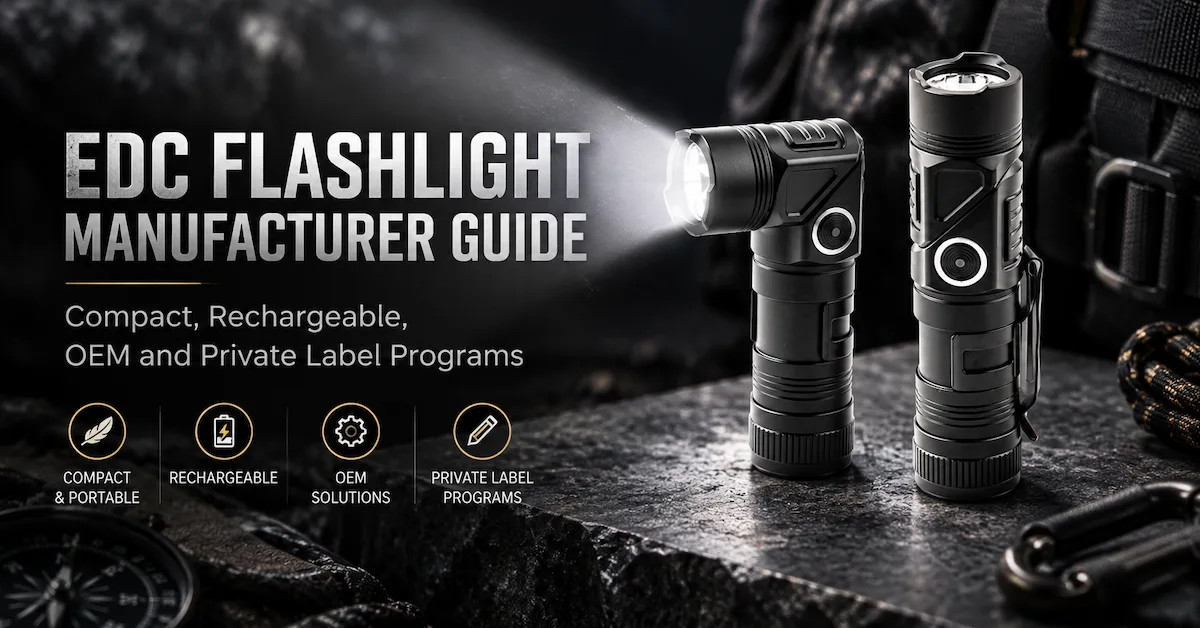


Quick answer: Choose a high lumen flashlight manufacturer by comparing measured output over time, useful beam distance, battery and charging performance, heat management, and repeatable production quality—not a peak-lumen claim alone. A 1,500-lumen magnetic work light may be the better product for a maintenance buyer, while a 2,000-lumen focused model or a 3,000-lumen zoom flashlight may suit distance-oriented outdoor channels. Brightenlux has published examples across these categories; use their catalog ratings to shortlist, then request matching sample data before approving branding or bulk production.
1. What Does a High Lumen Flashlight Manufacturer Actually Need to Control?
A high lumen flashlight manufacturer designs or assembles portable lights intended to deliver substantial luminous output, but that definition is incomplete for an importer buying under its own brand. A flashlight can advertise 3,000 lumens and still be inappropriate for a warehouse aisle, roadside inspection or overnight field kit. Customers experience the complete optical and electrical system: they see its beam pattern, feel its surface temperature, carry its weight, and discover how quickly output changes when the battery drains.
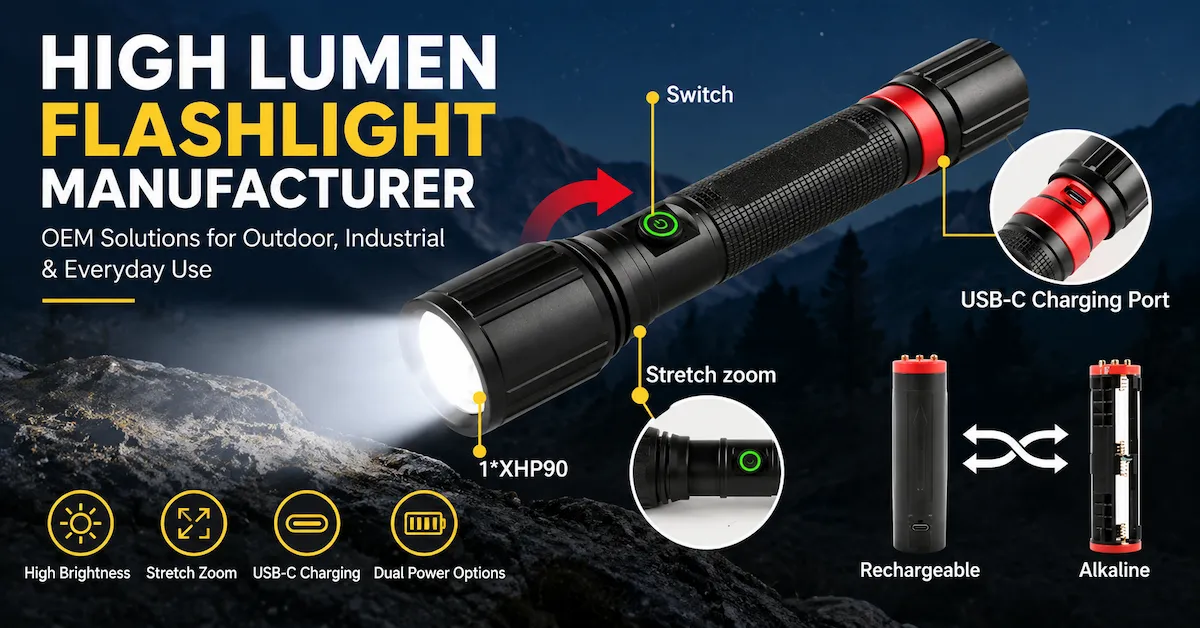
For the overseas purchasing team, manufacturing competence means managing the relationship between the LED emitter, reflector or lens, driver, thermal path, battery, charging board, switching interface, housing and seals. High-output designs amplify the consequences of weak choices. Pushing more current through an LED can create a brighter initial reading and additional heat; choosing a larger battery can increase the body diameter, freight mass and packaging dimensions. A product must remain commercially sensible after those trade-offs are considered.
Brightenlux is operated by Ningbo Brightenlux Electric Appliance Co., Ltd. Its official company introduction identifies the business as a lighting manufacturer established in 2014, with a factory in Zhejiang, a floor area above 10,000 square meters, and more than 150 workers. These are company-level statements, not proof of any particular flashlight's tested output or of available capacity for a new order. Treat them as a starting point for supplier qualification and ask for current evidence linked to the actual production line and SKU.
Readers looking for broader manufacturer-selection principles can consult Brightenlux's LED flashlight manufacturer checklist. This article takes a narrower path: comparing genuine 1,500–3,000-lumen catalog platforms and converting performance requirements into samples, acceptance limits and a quotation that a B2B sourcing team can act on.
2. Brightenlux 1,500–3,000 Lumen Flashlight Models Compared
The following products appear on Brightenlux's current website. Every lumen value, battery description and environmental rating in the comparison is a published catalog statement; it is not an independently verified measurement. Different models prioritize compact magnetic work, wide-to-narrow zoom, spare-cell flexibility or a long-distance concentrated beam. A buyer should not rank them only from brightest to dimmest.
| Brightenlux Reference | Published Output and Optics | Power and Features | Published Protection | Primary Evaluation Fit |
|---|---|---|---|---|
| BT-FL8088 1500 lm SST40 |
1500 lm max; up to 150 m | Included 21700 4000mAh; USB-C; magnetic tail; headstrap/clip | IPX4 | Compact inspection and maintenance |
| 1500 lm dual-power zoom model | 1500 lm max; up to 300 m; twist zoom | Included 18650 2600mAh or 4 AAA; USB-C; power-bank function | IP67 listed | Outdoor wholesale and emergency kits |
| 2000 lm XHP50 zoom model | 2000 lm max; adjustable spot/flood | Type-C twist-out port; 5000mAh battery in description; exact cell format to reconfirm | IP44 | Higher-output adjustable-focus assortment |
| BT-FL8114 2000 lm focused beam |
2000 lm max; up to 600 m claimed; white-laser-LED wording | Included 26650 5000mAh; USB-C; five modes | IP44 | Long-distance spotting; verify beam and safety |
| BT-FL8101 3000 lm zoom / power bank |
3000 lm max; up to 300 m; twist zoom | Included 26650 4000mAh or 6 AA; USB-C C-to-C; power bank | IP67 listed | Feature-led outdoor or emergency product line |
Why the table matters: the 1,500-lumen SST40 model publishes a magnetic tail and headstrap; the 3,000-lumen BT-FL8101 publishes dual-power options and a power-bank function. Those are different retail propositions, not merely different brightness tiers. The two 2,000-lumen designs illustrate the importance of optics: a zoomable XHP50 model and a concentrated-beam model can carry the same lumen headline while behaving differently at useful distances.
One detail deserves special attention: the 2,000-lumen XHP50 product description references a 5,000mAh 26650 battery, while its presentation elsewhere on the site references a 21700 format. This is precisely the kind of product-version detail an OEM buyer should settle on a revision-controlled specification before artwork, battery documentation and quotations are approved. Do not guess which description represents the shipped configuration.
1,500 lm SST40 — BT-FL8088
Magnetic tail, 21700 battery, USB-C charging and head-mounted accessory option. A logical sample for industrial repair and hands-free utility channels.
View Official 1500-Lumen Product →1,500 lm Rechargeable Zoom Model
18650 or AAA power options, adjustable beam and power-bank listing. Test alternate-power operation and confirm which battery and accessories ship.
View Official Dual-Power Product →2,000 lm XHP50 LED Flashlight
Twist-out USB-C port, zoom optics and a published 5,000mAh cell description. Confirm the production battery format before approval.
View Official 2000-Lumen Product →2,000 lm White-Laser-LED Model — BT-FL8114
Focused beam with up-to-600m catalog reach and 26650 battery. Evaluate peak intensity, hotspot, spill and applicable optical safety requirements.
View Official Long-Range Product →3,000 lm Zoom & Power Bank — BT-FL8101
26650 or AA power options, C-to-C charging, power-bank functionality and a published 300m range. Compare battery configurations and thermal step-down.
View Official 3000-Lumen Product →3. Peak Lumens vs Sustained Brightness: What Buyers Should Ask
When a buyer searches for a high lumen LED flashlight manufacturer, the temptation is to build a product tier around a single number: 1,500, 2,000 or 3,000 lumens. That number describes luminous flux, not necessarily the amount of usable light a customer will receive throughout a task. The key distinction is between short-duration maximum output and sustained output once the LED, driver and housing have warmed up.
A high-power mode can begin brightly and step down as the electronics manage heat or battery voltage. Such behavior is not automatically a defect. Controlled reduction may protect the LED and electronics, and it may be the correct compromise for a compact body. The sourcing problem arises when catalog or retail packaging implies continuous maximum brightness without the supporting test result. If your distributor promises a maintenance team "3,000 lumens for six hours," then a multi-hour runtime published for a lower mode cannot support that statement.
Use a time-versus-output graph to compare samples. At minimum, record initial stabilized output, the first meaningful step-down, output after 10 and 30 minutes, output after one hour, and the end condition of the selected test. Ask the manufacturer to identify the mode, cell capacity, state of charge, ambient temperature, instrument, sample revision and measurement method. A buyer can then compare models on the same basis rather than mixing peak readings from one model with eco-mode runtimes from another.
The portable-lighting industry has a relevant measurement reference: ANSI/PLATO FL 1-2025, Flashlight Basic Performance Standard, published by the American National Standards Institute and the Portable Lights American Trade Organization. The 2025 revision includes treatment of short-duration elevated-brightness or turbo modes alongside conventional output, beam distance, intensity, runtime and protection reporting. It is valuable for defining a test request, but this article does not claim that Brightenlux models have passed that standard unless the factory provides model-specific evidence.
Procurement rule: Ask suppliers for both maximum output and an output-versus-time record under a named method. Do not assume that a published four-hour, eight-hour or ten-hour runtime occurs continuously at the advertised maximum lumen setting.
4. Beam Distance, Candela and Adjustable Focus: Why More Lumens May Not Mean More Reach
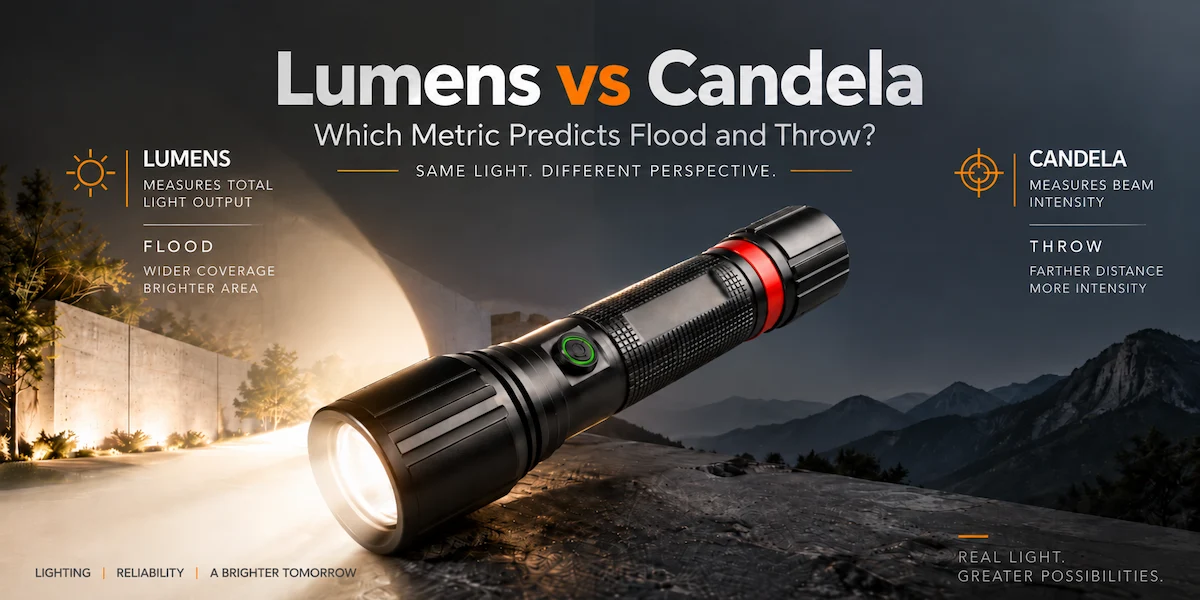
Many industrial and outdoor buyers really need beam reach rather than raw flux. Lumens measure the total visible output, while candela describes luminous intensity in a particular direction. A focused beam can achieve significant distance with fewer total lumens; a wider beam may produce more nearby illumination but lower peak intensity. Neither format is universally better. The appropriate beam depends on the task and the amount of surrounding spill that the user needs.
Consider the published comparison between a 2,000-lumen focused Brightenlux model with up to 600 meters of stated reach and the 3,000-lumen BT-FL8101 with up to 300 meters of stated reach. The larger lumen number does not automatically produce the longer beam. The product pages describe different optical arrangements and use cases. These are catalog claims to verify, not independently demonstrated distances, but they show why a distributor should compare beam geometry.
For a field search or perimeter observation product, ask for peak-beam candela, a defined beam-distance calculation, photographs at multiple known distances, and information about spill around the hotspot. For a maintenance flashlight, evaluate the width and uniformity of the usable illuminated area at one to three meters. Excessively narrow hotspots can make reading components and identifying cable colors inconvenient. Very broad beams can cause glare on polished surfaces or waste light beyond the task.
Adjustable focus adds useful flexibility, yet it also creates mechanical considerations. Test whether the zoom mechanism moves smoothly, holds position, resists wobble, and retains sealing after repeated use. Confirm whether the stated ingress protection applies with the zoom or charging assembly in every operating position. If a customer intends to use the product regularly in rain or dusty conditions, those details can matter more than an impressive distance printed on the carton.
When comparing optical platforms, keep photographic conditions consistent. Phone cameras change exposure automatically, making one beam look superior simply because the camera compensated differently. Use fixed camera settings where possible, label the distance and target, and avoid presenting marketing photographs as a substitute for a measured test.
5. Thermal Management and LED Driver Design for High-Output Flashlights
Heat is the least visible feature on a product listing and one of the most important during real operation. An LED converts electrical power into light and heat; the heat must move through the emitter mounting, circuit board, housing and surrounding air. The driver determines the current delivered under changing battery voltage and temperature. A poor interface or uncontrolled driver can produce inconsistent light output, uncomfortable surfaces and premature component stress.
Buyers do not need to demand a proprietary engineering drawing to assess this issue. Ask what thermal-protection strategy the platform uses, whether there is electronic step-down, what the output trace looks like, and whether the tested sample reaches an acceptable surface temperature for its intended handling position. If the flashlight has a removable zoom assembly, inspect the mechanical path between the LED board and body. Thermal contact that changes with assembly quality can create unit-to-unit variation.
High lumens are especially sensitive to the difference between laboratory conditions and real use. A light tested in free air on a workbench can behave differently inside a warm vehicle, held in a gloved hand, or used in a pouch. For a professional range, trial samples at representative temperatures and document both performance and user comfort. Never advertise a particular temperature limit without a defined test and matching evidence.
The material claims on a flashlight housing are relevant but incomplete. Brightenlux lists hard-anodized aluminum and ABS on several models. These materials can support a durable construction, but finish thickness, component interfaces, sealing design and heat transfer determine the actual result. Specify what must be inspected rather than treating "aluminum body" as a quality guarantee.
6. Selecting 18650, 21700 or 26650 Batteries for Wholesale Programs
Battery architecture is both an engineering and merchandising decision. A compact 18650-based light may appeal to everyday carry and general retail. A 21700 platform can support a larger-capacity product direction, while a 26650 body may suit a broader flashlight and feature-rich design. Cell diameter and length affect the grip, internal space, packaging and accessories. Capacity is meaningful only when the voltage, cell quality, discharge behavior and protective electronics are also known.
The Brightenlux examples make the choice tangible. The 1,500-lumen SST40 BT-FL8088 lists an included 4,000mAh 21700 cell. The dual-power 1,500-lumen model lists an included 2,600mAh 18650 or four AAA cells. BT-FL8101 lists an included 4,000mAh 26650 or six AA cells. These alternatives can be useful for remote environments or emergency channels, but they also raise questions about how the electrical system handles different input voltages, whether adapters are supplied, and whether the output and runtime claims change by battery type.
A 4,000mAh figure by itself is not a guarantee of a fixed number of watt-hours across every possible chemistry or configuration. Ask for nominal voltage, measured capacity, permitted charge and discharge limits, cell manufacturer, protection arrangement and approved alternates. For repeat orders, agree on whether a substituted battery needs prior approval. An apparently identical flashlight can perform differently after a change to its cell or charging board.
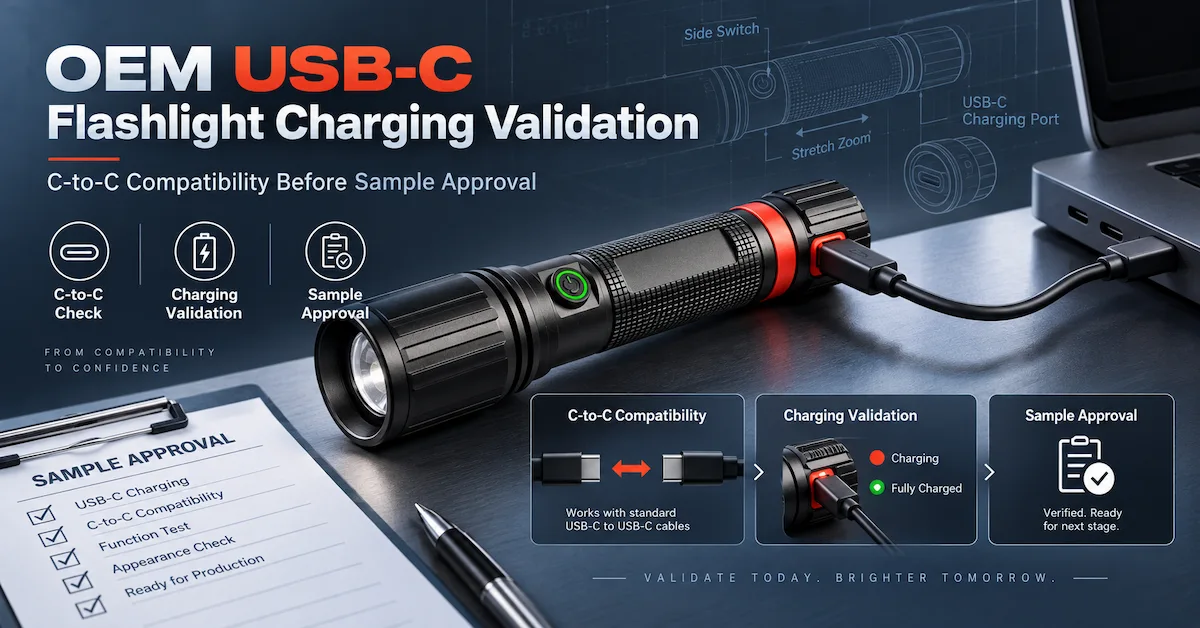
USB-C deserves separate verification. A connector shape does not guarantee compatibility with every USB-C power supply, cable or power-delivery mode.Ask for charging input requirements and test USB-A-to-C and USB-C-to-C connections where they are part of your market expectation. For a flashlight with a power-bank function, test outbound power delivery and the battery reserve left for lighting; do not assume any published flashlight runtime also applies when the user charges a phone.
Lithium batteries also influence shipping paperwork. The UN Manual of Tests and Criteria, subsection 38.3, is relevant to transport testing, while current IATA guidance addresses documentation and carriage requirements for batteries shipped alone, with equipment or inside equipment. For an OEM project, obtain matching battery test-summary information and consult your freight forwarder before selecting packaging and shipping terms. A generic safety data sheet is not a substitute for all transport documents.
7. Which High-Lumen Flashlight Is Best for Each Buyer Segment?
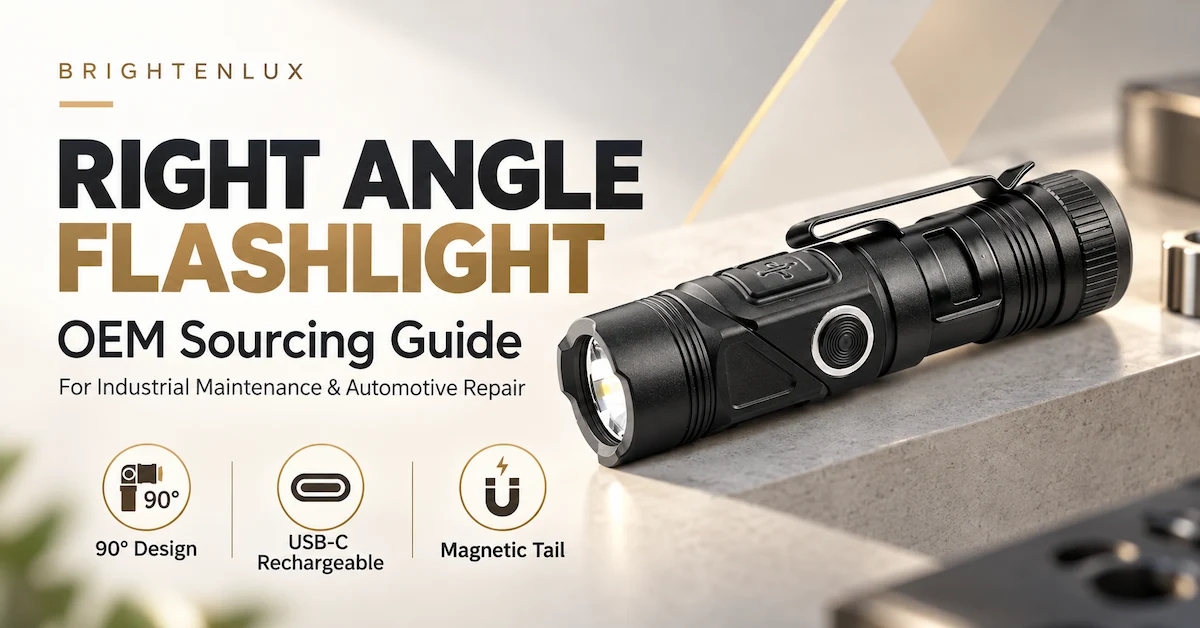
Industrial MRO and equipment distributors: prioritize controlled light at a useful work distance, glove-friendly controls, mounting features, and a repeatable battery strategy. A 1,500-lumen magnetic-tail model may deliver a stronger commercial story than a heavier 3,000-lumen flashlight without hands-free mounting. Evaluate the BT-FL8088 in actual maintenance positions, then decide whether the customer's task requires a larger or more focused alternative.
Outdoor retailers and camping brands: shoppers may compare brightness, zoom flexibility, water resistance, rechargeable convenience and portable-device charging. A 1,500-lumen dual-power model or a 3,000-lumen power-bank model can present a clear range step-up. However, retail packaging must state which batteries are included, whether backup cells require an adapter, and what the water-protection claim actually covers.
Security, patrol and long-distance observation channels: controlled throw, switch access and repeatability across units may matter more than a broad beam. The 2,000-lumen focused model provides a relevant catalog reference because Brightenlux advertises a long-range beam. Before entering a professional channel, obtain candela and beam measurements, optical-safety information where applicable, and an honest description of what can be identified at practical distances.
Emergency-preparedness kit assemblers: storage readiness, simple instructions, battery replacement plans and shipping compliance are often decisive. Dual-power claims require hands-on verification. If the flashlight will remain in storage for months, establish a customer charging or inspection schedule and avoid unsupported promises that a battery will remain ready indefinitely.
Private-label e-commerce and wholesale brands: focus on a coherent range rather than five nearly identical black flashlights. One SKU can anchor practical work lighting, another can emphasize adjustable distance, and a premium SKU can add power-bank features. Clear differentiation improves merchandising, avoids direct internal price competition and gives a distributor a more credible reason to carry multiple versions.
None of these examples should be interpreted as a claim that a listed flashlight is certified for firefighting, explosive atmospheres, rescue service or another regulated professional use. Those environments require separate suitability and compliance evaluation. For portable area lighting rather than a handheld beam, compare the wider Brightenlux outdoor lighting product families.
8. A Practical Sample-Test Protocol for High-Lumen OEM Buyers
A robust sampling plan uses the same conditions for every candidate. It does not need a huge laboratory budget for initial product screening, but final product claims should be supported by competent testing under the appropriate procedures. Agree on the methods before asking a supplier to optimize a sample, then retain the records with the approved version.
| Test | Suggested Buyer Procedure | Required Result or Record |
|---|---|---|
| Output over time | Record the full brightness curve on each important mode from a known battery state | Measured lumens, step-down times, test temperature, instrument and sample revision |
| Beam comparison | Test at the same marked distances and camera settings, with spot and flood positions documented | Beam photographs, peak intensity and defined distance method when claimed |
| Surface temperature | Run at the agreed ambient temperature and intended handling configuration | Temperature-versus-time trace and acceptable user-contact criteria |
| Battery and charging | Cycle with the approved cell and representative power supplies and cables | Charging behavior, protection, charge time and cell identification |
| Mechanical use | Operate switches, focus mechanisms, clips and battery closures repeatedly | Failure criteria, cycle counts and retained function |
| Ingress protection | Use a method matching the product's declared IP rating and assembled state | Test report identifying model, revision and conditions |
| Pack-out check | Check every promised cell, cable, adapter, lanyard, manual, mark and barcode | Golden-sample photos and inspection checklist |
A useful initial screening sequence is to test three samples from each proposed version, though sample quantity and acceptance rules should ultimately reflect the buyer's risk assessment and agreed inspection plan. Fully charge the approved battery, allow the unit to reach ambient temperature, run the chosen mode, and record output at repeated intervals. Use the same test fixture for each flashlight and record any unexpected switching or shutdown. Three units are not enough to prove batch capability; they are a disciplined way to identify obvious design differences before investing in a full qualification program.
For commercial comparison, define one useful-light threshold for your own task, separate from the official runtime definition. For example, a distributor could ask how long an inspection light remains above a task-specific measured output. That threshold is a buyer-defined engineering criterion, not an ANSI/PLATO value. It can help prevent a misleading comparison between a flashlight that runs dimly for many hours and another that maintains higher output for a shorter but more useful period.
Take notes about ergonomics while wearing the gloves and clothing used by the target customer. Test the light when held for ten minutes, carried on a belt and packed with common tools. Many return reasons are not discovered by photometric measurements: slippery grip texture, inconvenient mode memory, poor battery indication and an awkward charging cover can all reduce repeat purchases.
9. Factory Quality Control, Certifications and Repeat-Order Protection
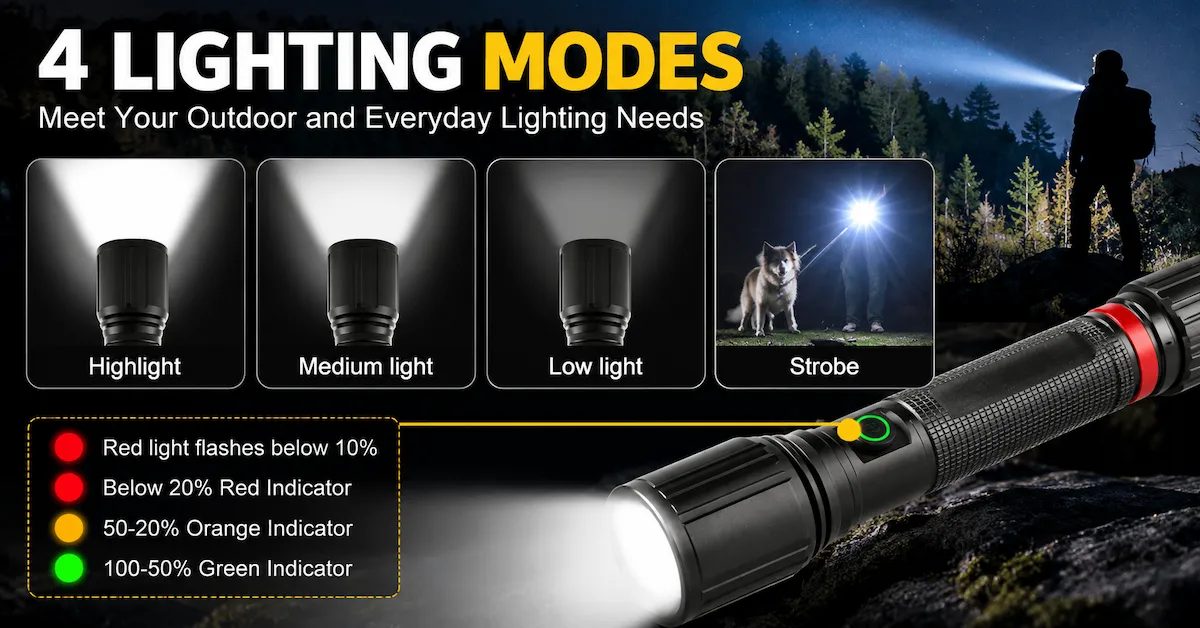
A high-output flashlight combines mechanical, electrical and optical assembly. The approved first article must represent the same product that will reach the retail shelf. Ask the manufacturer how incoming components are identified, how LEDs and batteries are checked, which functional checks are applied to every unit, and which performance or environmental tests are sample-based. A generic claim that a factory performs "100% inspection" should be expanded into a written list of actual checks.
At the incoming stage, important components may include approved LED type and bin, optical parts, driver boards, battery cells, protection boards, switch assemblies, O-rings, seals, charging ports and housing components. During assembly, verify LED alignment, solder and connector workmanship, thermal interfaces, thread engagement, seal placement and firmware or switching configuration. Finished-unit checks should include basic illumination, modes, charging indicators, mechanical feel, visible defects and pack-out completeness.
Brightenlux's public company material describes OEM/ODM work and references CE, RoHS, REACH and FCC-related compliance activities. Those company-level statements are not proof that each high-lumen SKU holds every approval for every country. Request model-specific declarations and test reports matching the exact assembly, battery and market. IEC 60529 is relevant to IP classifications; a published IP44, IPX4 or IP67 claim is not evidence of compliance with unrelated safety requirements. IP67 indicates a defined dust- and temporary-immersion protection classification only when substantiated by the specified test.
For a model described by the website as using a "white laser LED," ask for clarification of the light-source technology and applicable eye-safety or photobiological assessment. Do not assume all long-range products have the same safety obligations. Match the report scope to the actual output configuration and destination-market requirements.
Repeat production also needs a change-control rule. Agree which parts cannot be replaced without notification and renewed approval. A different driver, LED bin, battery, lens or seal can change the product while the exterior looks unchanged. Save the approved sample number, bill of materials, measurement records, artwork revision and inspection limits together. A second order should be checked against that controlled record rather than relying on memory or a previous sales conversation.
10. OEM/ODM Customization: From Catalog Platform to Private-Label Product
Brightenlux advertises OEM/ODM services, including logo-printing options, on its website. The practical customization path depends on what the customer wants to change. An importer entering a market quickly may need only a proven platform, brand mark, box, instruction sheet and local-language safety information. A professional tool label may need a specific beam pattern, operating sequence, clip, battery configuration, charging behavior or finish. The latter changes demand more engineering and a stronger test plan.
Stage one: define the brief. Specify the target user, working distance, useful-light time, size or weight limit, expected exposure, retailer price band, annual demand and destination country. State which performance claims must appear on the package. If a customer asks for 3,000 lumens, ask how long the elevated mode must remain useful and whether zoom or wide illumination is more valuable.
Stage two: shortlist platforms. Use the Brightenlux 1,500–3,000-lumen products to compare architecture rather than beginning with expensive tooling. Ask which features are standard and which are feasible as modifications. If a project needs magnet mounting, the compact SST40 design is a more logical benchmark than a long-range spotlight. If it needs emergency charging, a power-bank model is a more relevant starting point.
Stage three: approve engineering and appearance samples. Freeze the LED, optical assembly, driver, cell, USB-C board, housing, seals, color, logo and accessories. Test the exact combination. Even cosmetic changes can affect tolerances or sealing if they require replacement parts or new finishes. Confirm that packaging artwork reflects verified performance rather than the initial marketing brief.
Stage four: pilot and mass-production controls. Request a pre-production sample or pilot where the level of modification justifies it, then agree on inspections and shipment release. Record how deviations are communicated and who pays for rework if products do not meet the approved specification. A clear escalation route can protect an importer from the much larger cost of shipping a faulty seasonal order.
For additional context on this process, Brightenlux's OEM flashlight manufacturing guide discusses the route from product concepts to production. Use the guide as background, but ask for a model-specific feasibility response and quotation instead of treating every possible customization as an existing production option.
11. Wholesale Price, MOQ and the Hidden Cost of High Lumens
Buyers often ask for the unit price of a 2,000-lumen or 3,000-lumen rechargeable flashlight before specifying the rest of the product. That creates quotations which are difficult to compare. One supplier may include a named battery, retail box and USB-C cable, while another quotes the housing without the cell or with a simpler accessory set. The correct comparison begins with one written specification and the same quantity, packaging and delivery terms.
The main recurring cost drivers usually include LED and driver selection, battery format and cell sourcing, optical components, aluminum and molded parts, finish, seals, charging electronics, accessories, assembly, testing and packaging. A high-power platform may need additional thermal engineering; a power-bank or dual-power feature adds parts and functional checks. Freight cost also changes with finished weight, carton volume and battery classification.
MOQ is rarely one universal number. A standard catalog product can have a different minimum from a logo-printed version, custom body color, modified PCB or new housing. Ask for price breaks at the quantities your sales forecast can support and separately identify tooling, artwork, sample, testing and inspection costs. Do not accept an attractive large-volume price unless you can justify the inventory and cash-flow risk.
Lead time should cover sample revision, documentation, battery and LED procurement, packaging artwork approval, production, inspection and transport booking. For products intended for a particular launch season, build a buffer for test failures and artwork corrections. A claimed fast manufacturing time is not the same as a confirmed ready-to-ship date.
A simple purchasing comparison can include landed cost per saleable unit: accepted goods cost plus tooling allocation, inspection, freight, duty and foreseeable return or warranty allowance. A flashlight that is marginally cheaper at the factory may be a poor decision if it produces a high level of returns due to inconsistent brightness, unexpected thermal step-down, switch problems or misleading runtime claims. The most useful price is the price of the verified, repeatable configuration.
12. Ready-to-Send RFQ Checklist for a High Lumen Flashlight Manufacturer
The checklist below can be attached to your first inquiry. Ask Brightenlux to mark every line as available on a current model, available subject to development or testing, or not currently supported. This converts a broad keyword inquiry into a useful supplier conversation.
- Company and channel: Buyer name, target region, brand, wholesale or retail channel, first-order forecast and annual target.
- Application: Long-distance observation, maintenance, outdoor exploration, emergency backup or another defined use.
- Reference model: BT-FL8088, the 1,500-lumen dual-power model, a 2,000-lumen variant or BT-FL8101.
- Optical requirements: Maximum output claim, useful sustained output, hotspot/spill, peak candela, beam distance and zoom expectations.
- Electrical specification: LED and driver, cell format, included battery, measured capacity, runtime by mode, USB-C inputs and power-bank output if needed.
- Mechanical requirements: Body dimensions, weight, grip, switches, magnet or clip, finish, sealing, drop and temperature performance.
- Customization: Logo treatment, body color, accessories, packaging, manual languages, artwork, barcode and carton requirements.
- Compliance: Target-market regulations, matching product reports, ingress data, battery transport summary and optical-safety evidence where applicable.
- Quality approval: Sample test protocol, golden sample, BOM control, inspection plan, acceptance criteria and change notification.
- Commercial offer: MOQ for standard and customized versions, unit-price tiers, sample fees, tooling, lead-time stages, Incoterms and payment terms.
For an apples-to-apples comparison, send the identical brief to every supplier and request explicit answers rather than a generic catalog. Where a quoted item depends on optional accessories or third-party testing, request a separate line item. After evaluating samples, revise the request into a final purchase specification so that the commercial document and the product approval describe the same thing.
Discuss a 1,500–3,000 Lumen OEM Flashlight Program
Brightenlux can review your target use case, reference product, expected order volume, branding plan and destination market. Request available configurations, current model-specific test evidence and a quotation for an approved sample before planning a bulk purchase.
Contact Brightenlux for OEM / Wholesale Sourcing →13. Frequently Asked Questions About High-Lumen Flashlight Manufacturing
1. What is a high lumen flashlight manufacturer?
It is a business that manufactures portable lighting products designed for comparatively high luminous output. For B2B procurement, the important capabilities include optical design, electrical integration, battery and thermal control, assembly, inspection and repeatable production. A credible supplier should connect lumen claims to a test method and finished-product configuration.
2. Is a 3,000-lumen flashlight always brighter in real work than a 1,500-lumen model?
Not throughout every task. Maximum published lumens are not the same as sustained output after heat and battery effects. The beam pattern also changes perceived usefulness. Compare independent measurements, output curves, distance and the working mode that customers will actually use before deciding.
3. How do OEM buyers compare 1,500-, 2,000- and 3,000-lumen flashlights?
Begin with the application and compare useful illumination, runtime, beam characteristics, weight, battery, mounting, environmental protection, ease of charging and total landed cost. Then use representative samples and common test methods. A compact 1,500-lumen magnetic light can suit maintenance while a concentrated 2,000-lumen model may suit distance-oriented observation.
4. What is the difference between lumens, lux and candela?
Lumens measure total luminous flux. Lux measures illuminance on a surface, while candela describes luminous intensity in a direction. A higher-candela focused beam may reach farther with fewer lumens than a broad, higher-lumen beam. Buyers should compare the combination that reflects the user's real visual task.
5. What is ANSI/PLATO FL 1-2025, and why does it matter?
It is an industry standard establishing uniform approaches to reporting portable-light output, beam distance, intensity, runtime and other performance characteristics. Its 2025 revision addresses short-duration elevated-brightness modes. Use its concepts when requesting comparable test evidence, without assuming that every catalog product has been tested or certified to the standard.
6. Can Brightenlux provide OEM or private-label high-output flashlights?
Brightenlux publicly describes OEM/ODM and logo-printing support. The exact scope for a given model—including housing color, driver changes, battery choices, modes or printed cartons—must be agreed in a current project quotation. Ask which variations can use an existing platform and which require development, tooling or new testing.
7. What battery type is best for a rechargeable high-lumen flashlight?
There is no universal winner. The 18650, 21700 and 26650 formats offer different size and capacity trade-offs. Cell quality, electronics, heat, grip size and shipping documents must be considered. Approve the exact cell and configuration used for performance tests; do not substitute an unspecified battery just to meet a price target.
8. Does an IP67 rating mean a high-power flashlight can be used underwater?
No.IP67 describes a defined level of dust protection and temporary immersion resistance under specified test conditions, when supported by appropriate test evidence. It is not a claim of indefinite underwater operation or resistance to all liquids. Request a report covering the complete approved model and relevant seals or charging-port positions.
9. What MOQ and lead time should I expect from a China flashlight factory?
Both depend on the selected model, battery and accessory availability, branding, packaging, tooling and testing scope. Brightenlux's general OEM statements do not establish one MOQ or lead time for every product. Request quantity-based quotes and a timeline that separates sampling, approvals, component purchasing, assembly and shipment.
10. What should be approved before a bulk high-lumen flashlight order?
Approve a representative sample, frozen BOM or critical-component list, defined output and runtime tests, mechanical and electrical requirements, model-specific compliance and battery records, packaging artwork, inspection criteria, price, delivery terms and a written change-control process. These are the protections that make repeat orders more predictable.
Conclusion
Choosing a high lumen flashlight manufacturer is not a contest to identify the largest number on a product page. For distributors, OEM brands and industrial importers, the better decision is the product that delivers the right beam, maintains useful output through the task, charges reliably, survives the intended environment and can be manufactured consistently. A 1,500-lumen magnetic flashlight, a 2,000-lumen focused model and a 3,000-lumen zoom/power-bank design address different needs, even when their marketing categories overlap.
Brightenlux's published 1,500–3,000-lumen range provides practical platforms for comparing these choices. Use the technical table, sample-test method and RFQ checklist in this guide to move from a catalog shortlist to a verified purchasing specification. If you are planning a private-label range or upgrading an existing wholesale line, contact Brightenlux to discuss high-lumen flashlight OEM sourcing with your application, branding requirements, target order quantity and destination market. Request configuration-specific evidence and an approved sample before committing to mass production.