

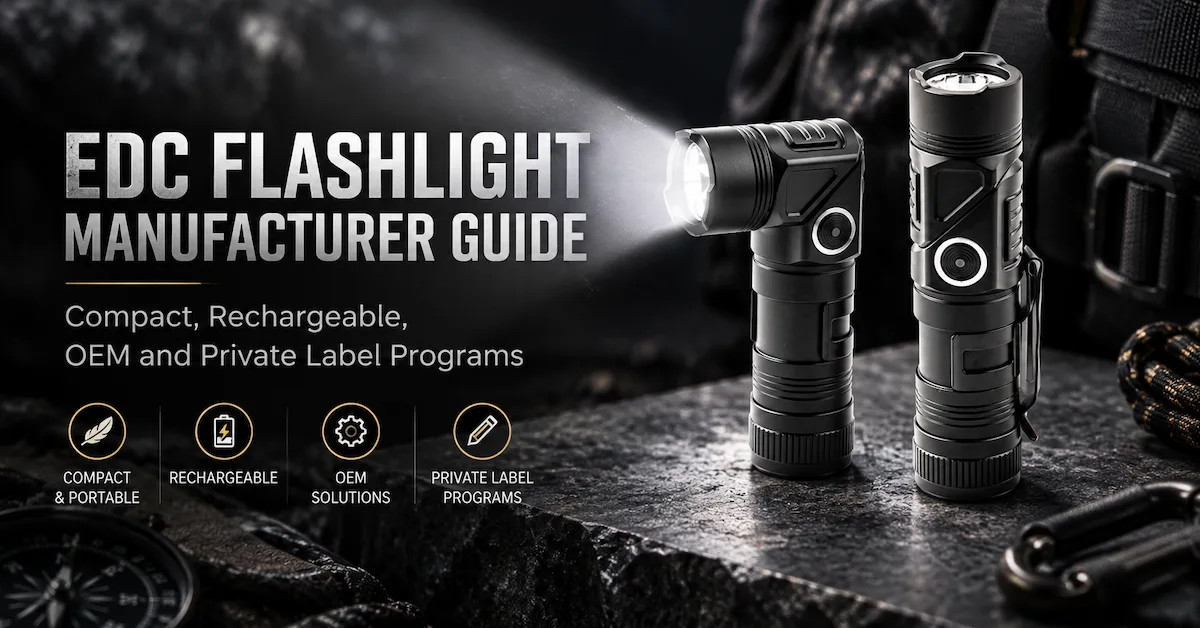
An EDC light is judged in the few seconds before a customer decides to carry it. It has to disappear in a pocket, start with a confident click, throw useful light without becoming uncomfortably hot, and survive the unglamorous jobs that happen after dark. For a brand, that combination makes supplier choice more important than a single lumen number. A capable EDC flashlight manufacturer helps turn a carry idea into a repeatable product program: a defined body, a known cell, a clear interface, tested accessories, approved packaging, and a sample that production can actually match.
This guide is for outdoor brands, hardware distributors, promotional teams, tool companies, and online retailers comparing compact lighting programs. It uses Brightenlux product platforms as practical reference points, not as a substitute for an order-specific specification. Product pages help a buyer make a shortlist. The final decision still belongs in the brief, bill of materials, approval sample, inspection plan, and reorder file.
The useful question is not simply, “How bright can this flashlight be?” Ask instead: what will make a customer keep this light in a pocket, bag, vehicle, or tool pouch? The answer may be a slim dual-power body, a rechargeable Type-C port, a strong clip, a magnet that holds on steel, a red mode, an adjustable head, or a switch that works with gloves. Move one of those levers and several other numbers on the quote will move with it.
Put a real carry job on the first page of the RFQ
Everyday carry sounds precise until two buyers use it to mean completely different things. The commuter's version might be no thicker than a marker and live beside house keys. A mechanic may need a right-angle body that clips to a shirt or sticks to a service panel. A trail user may prefer a larger cell and a deeper reflector. A retailer may need a giftable box and a simple control sequence that can be explained at a counter. A supplier cannot design the right item until the intended carry habit is specific.
Write a one-sentence use case before sending an RFQ: “A [user] carries this light in [place], uses it for [task], and expects [runtime or handling result].” Add the channel, target retail position, destination market, and opening quantity. This small exercise exposes contradictions early. A pocket light that must be extremely thin cannot also accept every large battery. A high-output model that runs for long periods needs a thermal path and grip area. A keychain item cannot promise the same beam reach as a 21700 tool light.
Notes worth putting beside the first sketch
- Name where the light lives most days: front pocket, belt, bag, glove box, tool pouch, or emergency kit.
- Write down the job in the customer's words, whether that is checking a fuse, walking home, finding a dropped fastener, or coping with a power cut.
- Desired beam: flood, balanced beam, throw, adjustable focus, or a right-angle task beam.
- Controls: tail switch, side switch, momentary action, lockout, memory, and mode order.
- Decide whether the promise depends on store-bought cells, a replaceable rechargeable cell, an internal battery, or two power routes.
- Only specify a clip, cord, magnet, headband, or holster when the accessory solves a real carrying or working problem.
- Put the commercial limits on the same page: shelf space, barcode, language, market documents, first-order quantity, launch month, and margin.
What a strong EDC flashlight manufacturer controls
EDC quality is a chain of small decisions. The emitter and driver determine how the light starts and regulates. Look forward and the reflector, optic, lens, and LED position explain the beam. Move back along the tube and the housing has to shed heat while shielding the board. At the joints, threads and seals decide whether battery changes remain pleasant after months of use. The switch and firmware decide whether the light feels calm or frustrating. A reliable factory should be able to explain who owns each decision and how the approved version is carried into production.
Ask for a simple process map for the selected platform. Where are LEDs and cells approved? Who verifies driver components? Have the team sketch the route from a raw aluminum tube to a sealed retail carton and mark every point where the product leaves its building. Outsourcing is not automatically a problem. The risk appears when nobody owns incoming acceptance, change control, or the corrective action after a defect.
During sampling, notice how the team answers ordinary questions. A useful EDC flashlight supplier will restate the requested build, identify what is standard, and flag the parts that need engineering review. A weak answer will quote a familiar model without confirming the cell, mode program, clip, port cover, or package. Clear communication is evidence of production control, not just good manners.
Compare the main EDC sourcing routes
Brands often use supplier labels interchangeably. The scope of work matters more than the label. A standard item can be the right answer for a test launch. A private-label program can add identity without changing the platform. OEM work can control electronics, accessories, and user interface. New tooling is justified only when the commercial or technical result is worth the extra approvals.
| Program route | What is usually controlled | Best fit | Approval focus |
|---|---|---|---|
| EDC flashlight supplier | Existing body, standard electronics and pack | Fast assortment testing or replenishment | Exact model, accessories and current availability |
| Private label EDC flashlight | Logo, finish, color, carton, manual and barcode | Brands entering everyday carry quickly | Logo durability, artwork, pack contents and claims |
| OEM EDC flashlight | Defined platform, battery, UI, accessories and pack | Differentiated but manufacturable programs | Build sheet, sample code, firmware and change control |
| Custom EDC flashlight | New housing, optics, electronics, controls or tooling | A clear application or brand advantage | Engineering samples, tooling cost, validation and timing |
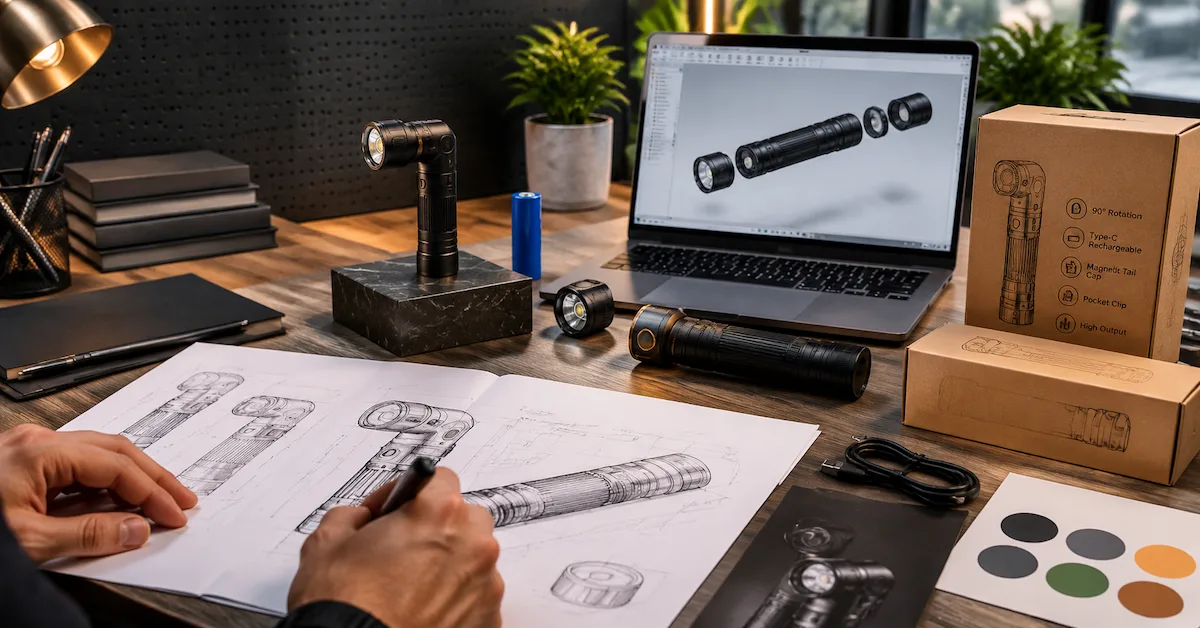
A useful brief separates “must be different” from “nice to have.” For example, a brand may require a custom clip geometry and a memorable side-switch sequence, while accepting an existing 18650 body and reflector. This gives the factory a realistic path to a differentiated product. It also keeps MOQ, sample time, and spare-part planning visible.
Choose the carry format and power platform together
Dimensions, cell choice, and runtime are linked. A compact body around a smaller cell can feel perfect in a jeans pocket but may need conservative output steps. An 18650 platform offers a familiar balance of capacity and size. A 21700 cell supports a premium, longer-use position, although the body and retail pack become larger. A dual-power light gives customers a backup option when disposable cells are easier to find than a charger.
When you compare a compact flashlight manufacturer platform, request the complete carry dimensions rather than the bare tube. Include clip, tail cap, port cover, battery, lanyard, and retail package. A product that fits a pocket may still fail a planogram if its box is oversized. Weight the complete carry configuration; a 21700 light can feel premium in a hand and heavy on a thin pocket clip.
Power questions to settle before sampling
- Is the cell included, user-replaceable, protected, and available in the destination market?
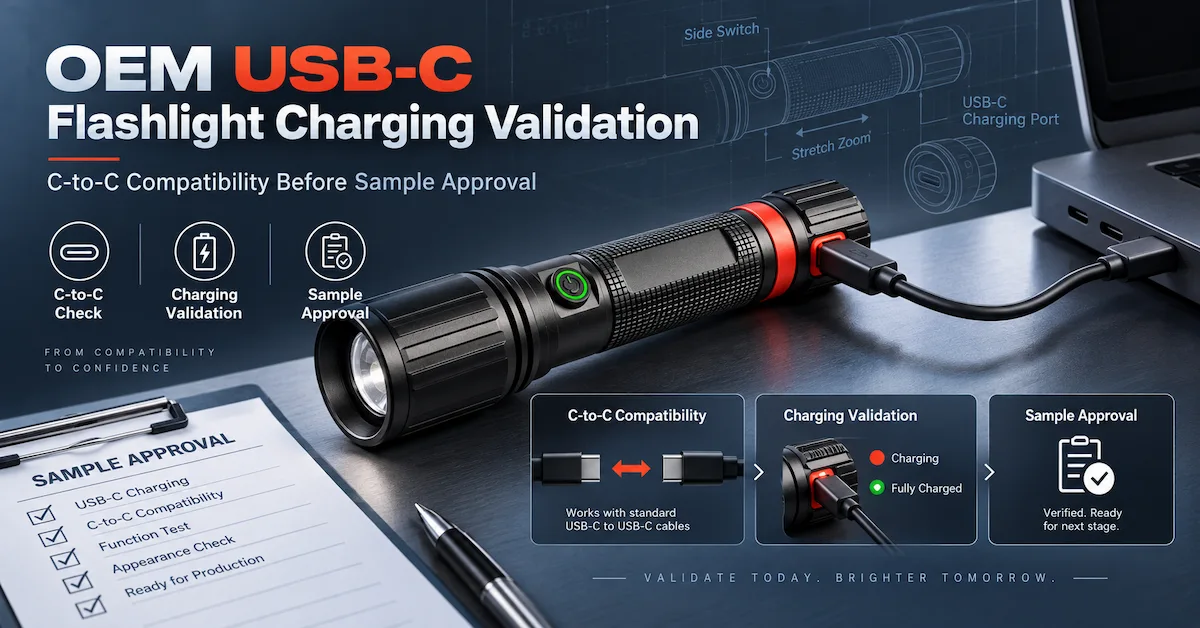
- Try the Type-C socket with the cables customers already own, then carry the sample for a week and inspect the port for lint.
- Watch the indicator through an entire charge; note what it does at the start, at full charge, with a low cell, and after a fault.
- Are runtime claims measured on the exact LED, driver, cell and firmware being quoted?
- What happens when the battery is low: gradual regulation, an abrupt step-down, or shutdown?
- Can the brand buy replacement cells, clips, port covers, O-rings, and tail caps as service parts?
A strong rechargeable EDC flashlight program keeps an approved electrical record. The cell model or approved equivalent, capacity, protection, charging board, connector, cable, indicator behavior, and runtime test method should be listed in one controlled file. Reconstructing these details from old emails is how “the same model” slowly changes.
Design the interface for real pockets and real hands
An EDC flashlight is often operated without looking at it. The tail switch should be easy to find but hard to trigger accidentally. A side switch should have a clear tactile response and enough separation from the charging indicator. If the brand wants a lockout, define whether it uses a long press, a mechanical twist, or a physical cover. Each choice changes the user experience and the instructions printed on the box.
Mode order deserves the same attention as output. A simple low-medium-high sequence can work for general retail. A service light may need instant high, momentary action, or a red mode that avoids ruining night vision. Strobe should never appear unexpectedly during normal cycling. Ask the supplier to provide a short mode map and a numbered firmware version with the sample.
We have learned more from a five-minute glove test than from several tidy specification sheets. Clip the sample to denim, press it with damp fingers, stand it on its tail, and set it on a sloping bench to see where it rolls. Test the magnet in the orientation customers will actually use. These are modest checks, but they create the difference between an item that is carried and an item that is left in a drawer.
Optics and output: specify what customers can see
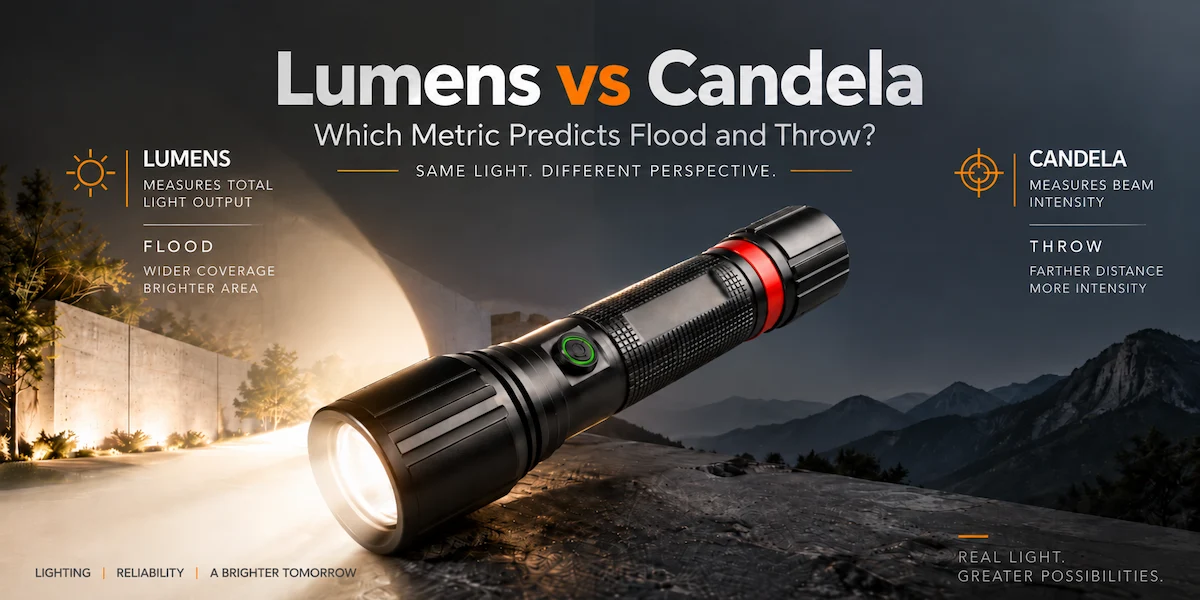
“High lumen” is not a complete buying story. A narrow beam may look impressive across a parking lot and be awkward for close work. A broad beam can illuminate a panel or trail while appearing less dramatic in a showroom. The optic, reflector depth, front lens, LED position, and driver current all influence the result.
Ask for an output description that a sales team can repeat accurately: beam character, useful range, step-down behavior, and the intended task. Request a marked wall test at a stated distance and a runtime trace for the exact sample. If a supplier changes the LED bin, reflector, cell, or firmware, the earlier image and runtime claim may no longer be valid.
For a custom EDC flashlight with an adjustable head, inspect the mechanism as part of the optical system. The head should hold its position, move without grinding, and return to the intended beam relationship after repeated cycles. A clever feature that loosens after a month becomes a return reason, not a differentiator.
Thermal comfort is part of the carry promise
Higher output turns electrical energy into heat. That heat needs a path through the LED board, shelf, body, fins, and the user's hand. A small pocket product cannot dissipate heat in the same way as a large search light. A supplier should explain the regulated output steps and the conditions that trigger a reduction. The goal is not to keep every mode at maximum; it is to keep the light useful and comfortable.
During sample review, run the light in its normal modes, measure the body at repeatable points, and note the time to step down. Repeat the test with the clip attached and with the light tail-standing. A case that becomes hot only when blocked by a pouch may need a warning or a different mode program. Record the ambient temperature and cell state so the result can be repeated.
Thermal comfort also affects packaging claims. Avoid printing “maximum output” as if it were a continuous setting unless the evidence supports it. A professional EDC flashlight manufacturer China sourcing program distinguishes a short peak, a regulated level, a step-down profile, and a measured runtime. That language protects both the brand and the user.
Build a product platform instead of a one-off SKU
Many successful EDC ranges share a family language: knurling, tail geometry, clip style, button feel, box structure, and naming. A platform approach makes the next product easier to develop. The factory can reuse proven machining, seals, drivers, cells, or accessories while giving each SKU a different job. The buyer can also explain the range to retailers without teaching a new vocabulary every season.
| Platform role | Example architecture | Customer reason to choose it | Program watch-out |
|---|---|---|---|
| Pocket core | Slim body, Type-C, moderate output, simple clip | Easy to carry every day | Port protection and accidental activation |
| Capacity step-up | 18650 or 21700, deeper reflector, stronger regulation | Longer useful work time | Weight, heat, and shipping documentation |
| Hands-free specialist | Right-angle head, clip, magnet, optional strap | A light that stays where work happens | Joint strength and accessory consistency |
| Brand hero | Premium finish, distinctive UI, giftable pack | Visible identity and higher perceived value | Tooling, artwork, MOQ, and claim evidence |
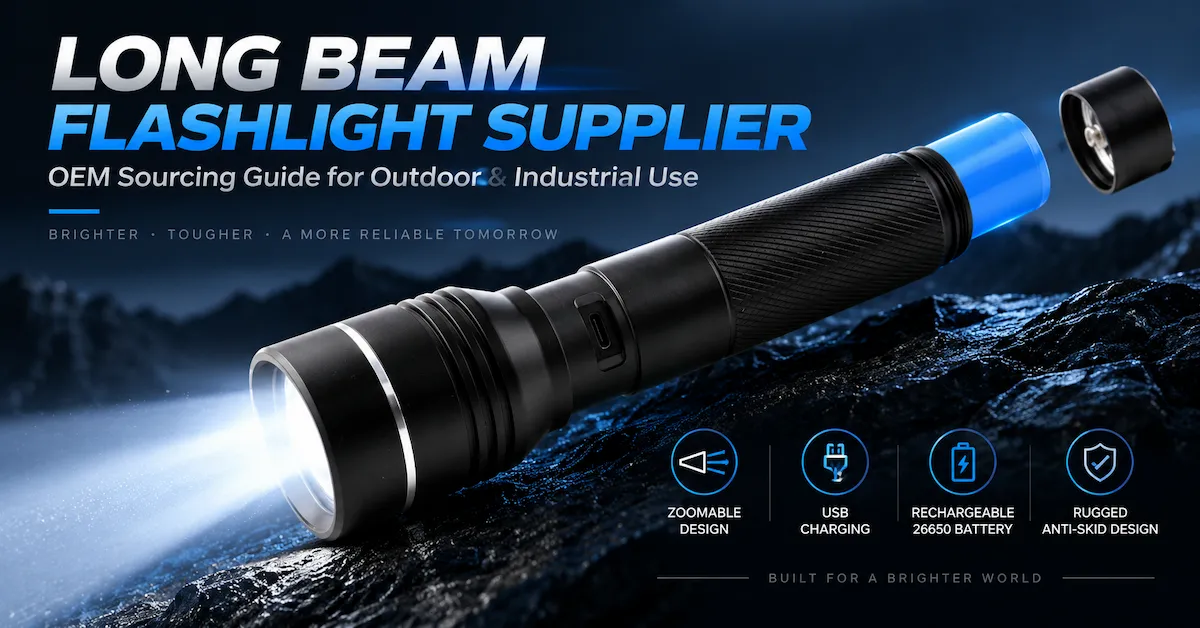
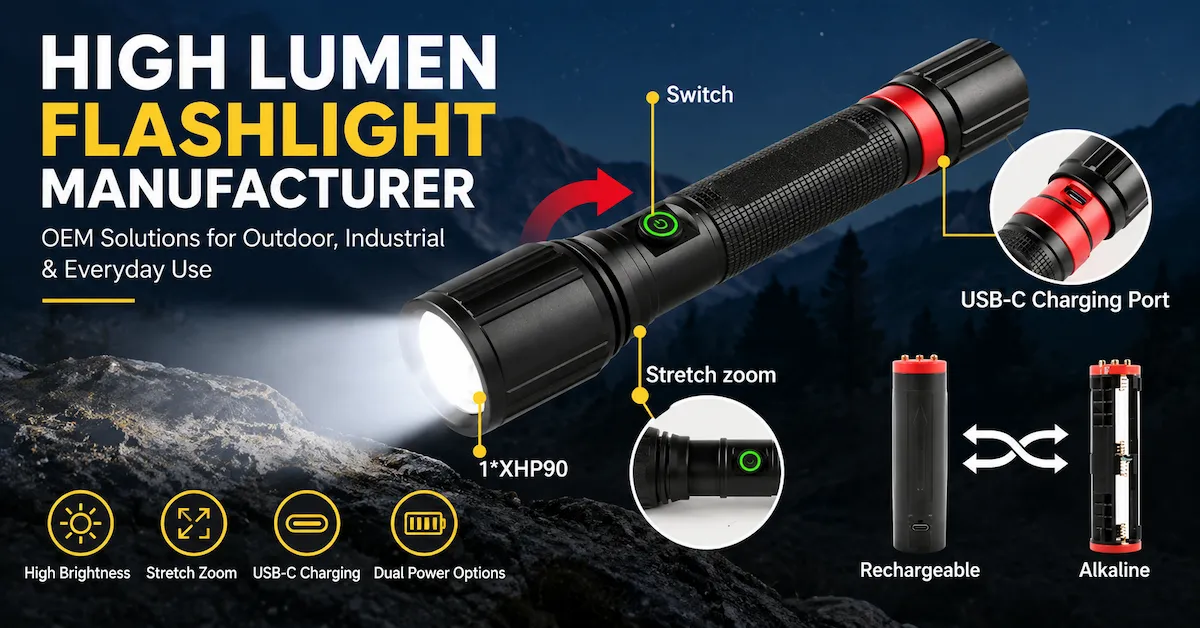
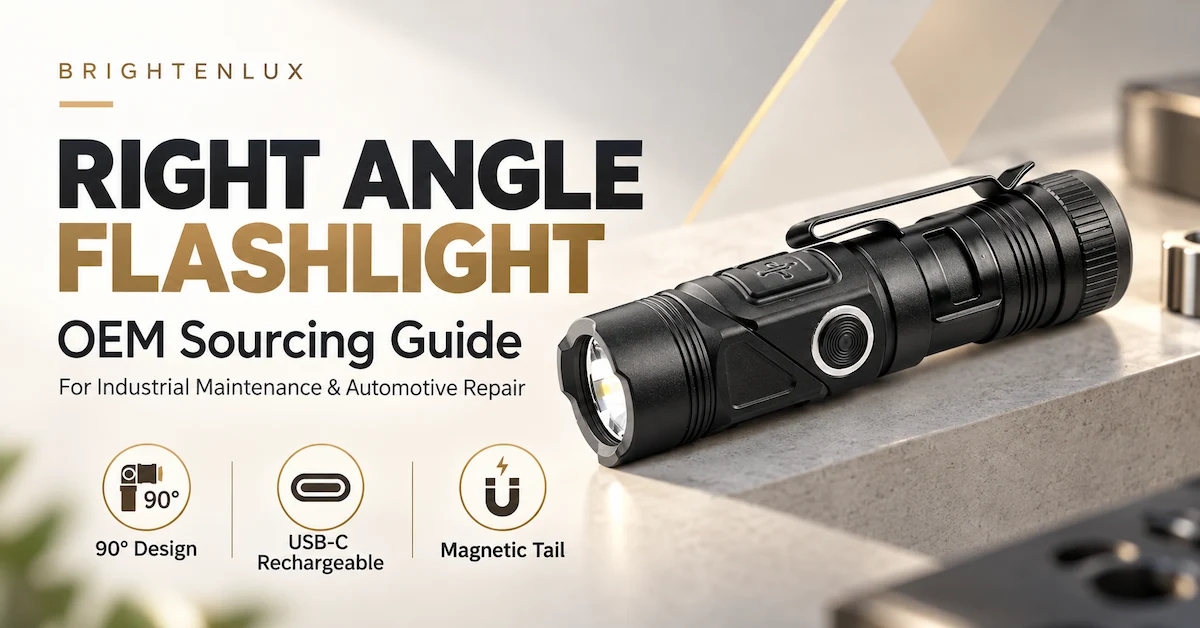
Brightenlux's public platforms illustrate how a range can be built without making every product identical. A dual-power adjustable-focus light can serve general retail or emergency use. An 18650 adjustable-head model can support workshop tasks. A red-mode light can speak to outdoor and service users. A 21700 model can become the premium capacity-led item. A right-angle body can earn a place in maintenance and inspection kits. The supplier should confirm the current configuration and available options for the order.
Make private label visible without making the product fragile
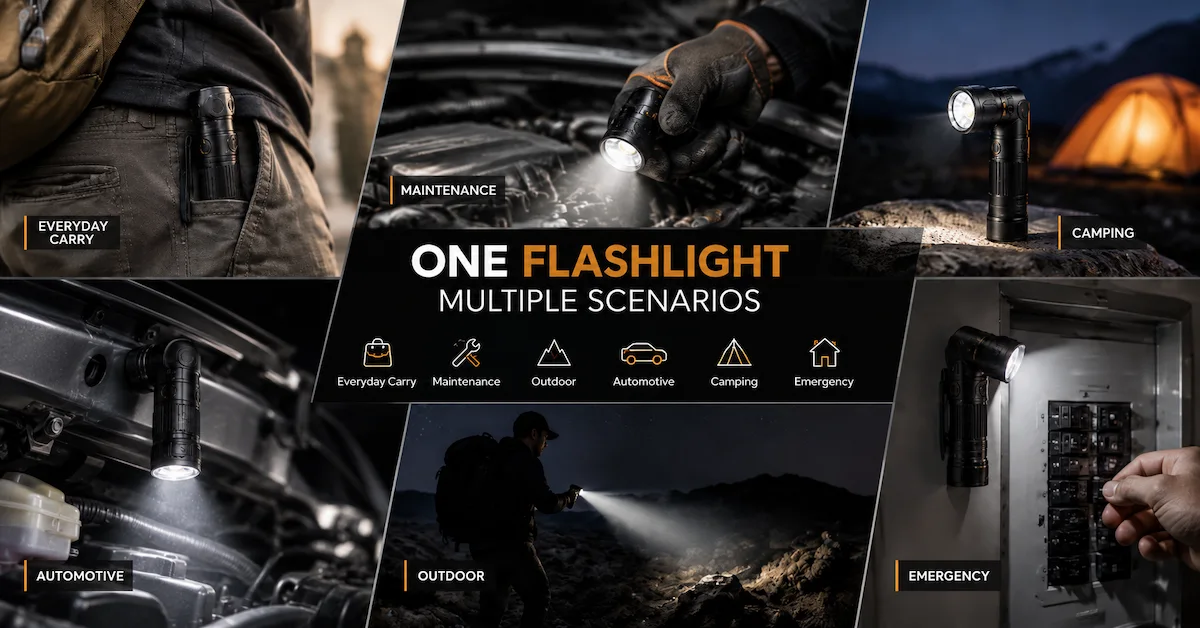
Branding is more than a logo on the tube. It includes anodized color, laser mark or pad print, clip finish, button color, carton, insert, barcode, manual, and the photographs used online. Each choice adds a check. A mark placed on a textured grip may look fine on a proof and become unreadable after handling. A bright body color may change the perceived value while adding a coating or anodizing constraint.
Ask the supplier to recommend the branding process for the actual housing and order size. Request a physical mark sample, not only a digital rendering. Check alignment, contrast, rub resistance, and whether the mark remains legible after charging and clipping. Keep the approved artwork, color reference, and sample code together. A private label EDC flashlight should look consistent across the product, box, listing images, and reorder.
Set MOQ and lead time around the changes that matter
MOQ rarely belongs to the flashlight alone. Standard body, custom color, logo, battery, clip, box, language, and accessory can each create a different minimum. Ask for three quote tiers against one frozen specification: a realistic pilot, a likely reorder, and a volume tier where component purchasing or packaging efficiency changes. This gives the buyer a view of inventory risk rather than a single attractive unit price.
Lead time should be separated into sample, artwork, tooling, component preparation, production, inspection, and shipping. A brand that needs a new clip or firmware should not be given the same timeline as a standard body with a logo. Request the factory calendar and identify the longest-lead component. If the product uses a special cell or custom package, place the reorder discussion earlier than the sales team may expect.
For a wholesale EDC flashlight program, record carton quantity, packed dimensions, gross weight, battery documentation, and replacement-part multiples. These details affect freight, warehouse space, and the cost of a small replenishment. A low factory price can disappear inside a large presentation box or a difficult carton configuration.
Inspect the details customers touch first
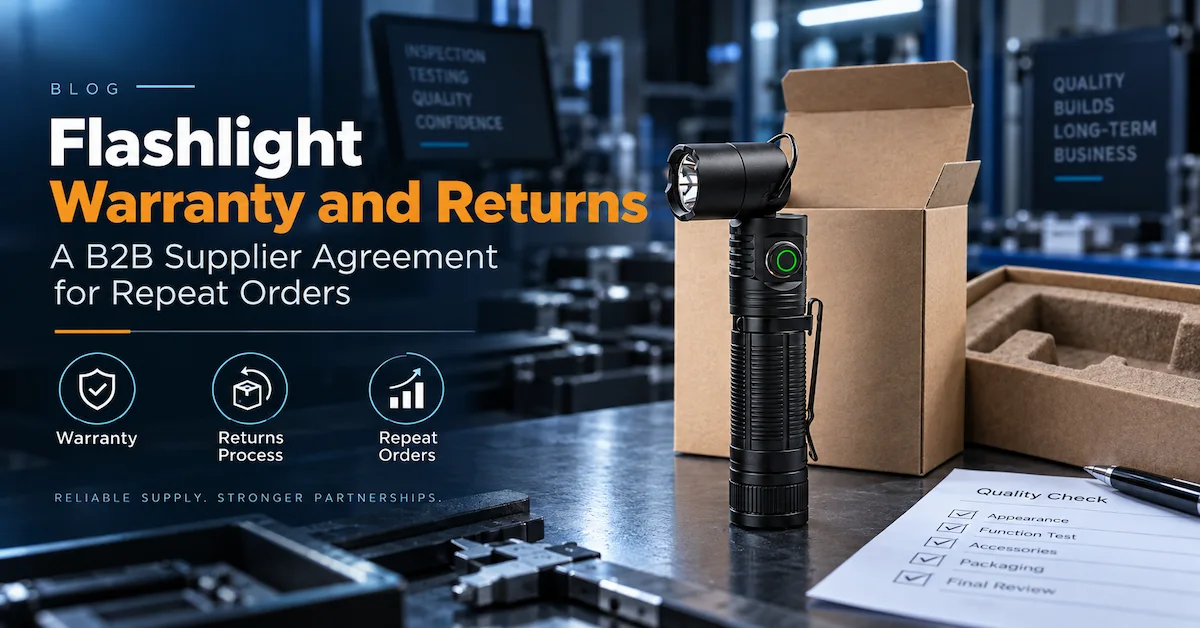
Inspection should begin with return risks, not with a generic checklist. Open the carton and confirm the model code, body, cell, cable, clip, lanyard, strap, manual, and barcode. Charge the light, cycle the modes, check the indicator, test momentary action, and run the output under a stated method. Move the head, operate the clip, attach the magnet, and inspect threads and seals. Look for scratches, burrs, uneven anodizing, loose buttons, port-cover gaps, and logo drift.
Define critical, major, and minor defects before the factory inspection. A missing cell or failed charge function may be critical. A loose clip or incorrect mode label may be major. A small cosmetic mark may be minor, depending on the agreed standard. The report should identify the lot, sample size, model, firmware or build reference, tests performed, failures, photographs, and disposition.
Seven practical EDC checks
- Identity: body, LED, cell, driver, firmware, accessories, and pack match the approved reference.
- Carry: clip tension, lanyard eye, tail-stand stability, magnet holding force, and pocket clearance.
- Controls: switch feel, lockout, momentary action, mode order, memory behavior, and glove operation.
- Charging: connector fit, indicator behavior, port cover, charge completion, and low-battery response.
- Output: beam shape, visible flicker, output steps, thermal behavior, and stated runtime method.
- Durability: threads, head movement, clip cycles, seals, finish, and repeated switch operation.
- Presentation: logo, color, manual language, barcode, warning text, inner protection, and carton marks.
A good EDC flashlight manufacturer should be willing to show how a failed check is contained. Is the affected lot isolated? Is the cause traced to a component, process, or instruction? Is the corrected sample re-tested? The answer is more valuable than a generic statement that every unit is inspected.
Use samples to test the whole carry story
Review each sample in three settings: pocket, work surface, and retail pack. In a pocket, check thickness, clip bite, activation risk, and whether the light snags fabric. On a work surface, check beam, magnet, head movement, heat, switch access, and tail-stand stability. In the pack, check whether the model, battery, charging method, warranty route, and use case are obvious without a salesperson.
Number every sample and keep a short decision sheet. Write observations in plain language: “clip held on denim,” “button too easy to press,” “red mode should be first after lockout,” “box hides the included cell,” or “head joint loosened after 40 cycles.” Take close photographs of the port, cell compartment, clip, switch, logo, and accessories. Once approved, put that sample code into the PO and inspection report.
Evidence, compliance, and claims
Portable lights combine electronics, batteries, charging, and metal parts. The documents a market requires depend on the exact configuration and destination. Ask which reports apply to the ordered model and check the model identity, applicant, test scope, issue date, and referenced standard. Battery transport documents should match the cell or pack actually shipped. A report for another LED, driver, or battery is not automatic evidence for the new version.
Performance claims need the same discipline. Ask how lumens, runtime, beam distance, impact, water exposure, and charge time were measured. Confirm the LED bin, cell, driver, firmware, optic, and test conditions. A marketing page can be concise, but the underlying file should show what the approved product can support. That protects a private-label brand when a retailer, platform, or end customer asks for proof.
Prepare a quote-ready EDC RFQ
Send the same structured request to every shortlisted factory. Include the user job, carry location, channel, destination, preferred Brightenlux platform, required changes, cell and charging method, controls, output expectations, accessories, logo, finish, packaging, barcode, quote tiers, sample stages, inspection plan, documents, delivery term, and target dates.
| RFQ line | Buyer should provide | Supplier should return |
|---|---|---|
| User and channel | Carry location, task, market, retail position | Recommended platform and assumptions |
| Product build | Cell, LED, optic, UI, clip, magnet, port, accessories | Offered specification, deviations, and options |
| Commercial tiers | Pilot, forecast reorder, target launch | Unit tiers, MOQ drivers, one-time costs, validity |
| Validation | Sample stages, runtime method, inspection limits | Sample timing, test evidence, corrective-action route |
| Pack and shipping | Language, barcode, box, carton, destination | Packed size, weight, carton multiple, documents, lead time |
Ask the supplier to mark each requested item as standard, modified, or new. This simple classification prevents a standard product photo from being mistaken for a finished custom design. It also makes it easier to compare two quotations that use different language for the same work.
Common EDC development mistakes
Chasing maximum output before defining the carry task
A bright number cannot fix a light that is too thick, too hot, or awkward to control. Start with the user job, then select output and battery together.
Changing the cell after the sample is approved
A different cell changes runtime, charge behavior, thermal output, shipping documents, and sometimes the balance in hand. Treat the approved cell as part of the product identity.
Approving a digital logo proof without touching a marked sample
Texture, curvature, anodizing, and handling can make a perfect screen mockup fail in the hand. Approve a physical mark where the customer will see and touch it.
Adding accessories that create a second quality problem
A clip, magnet, strap, or holster is part of the EDC promise. Test it, list it in the BOM, and inspect it with the light instead of treating it as a free extra.
Printing runtime or water claims before the final build is frozen
Claims belong to a tested configuration. Finish the cell, driver, firmware, optic, seal, and test method before final artwork.
Questions buyers ask about EDC programs
What makes an EDC flashlight different from a general flashlight?
EDC products are designed around repeated carry and quick access. Thickness, weight, clip behavior, switch feel, lockout, port protection, heat, and pocket durability matter as much as beam output. A general flashlight can be powerful and still be a poor everyday carry item.
Can a supplier provide a custom EDC flashlight with a low-risk pilot?
Often the safest route is to start with a proven platform and customize the parts customers can see or feel: branding, color, clip, accessory kit, package, or a controlled interface change. Ask which requirement creates the MOQ and which changes need engineering samples before approving the pilot.
Should an EDC brand choose an 18650, 21700, or dual-power model?
Choose based on carry habit and channel position. An 18650 body balances capacity and size. A 21700 platform supports a longer-use premium position but adds bulk. Dual power helps when disposable-cell backup is part of the emergency story. Compare complete carry weight, runtime, charge time, package size, and replacement policy.
What should a private label EDC flashlight package explain?
Show the model identity, intended use, battery included or not, charging method, key controls, accessories, basic safety information, warranty route, barcode, and claims supported by the approved build. A small pack has limited space, so use the side or back panel for the details a customer needs before opening it.
How do I evaluate an EDC flashlight manufacturer China sourcing team?
Look beyond location. Confirm legal business details, engineering ownership, component approval, in-house and outsourced steps, battery handling, change control, inspection records, export experience, and the person responsible for corrective action. Ask for a process map and a sample reference tied to the quotation.
What does a wholesale EDC flashlight quote need to include?
It should identify the exact model, cell, LED, driver, firmware, charging method, accessories, branding, package, carton, MOQ, price tiers, one-time costs, sample time, production time, inspection scope, shipping term, and applicable documents. Without those lines, unit-price comparison is unreliable.
Turn a carry idea into a repeatable Brightenlux program
Start with the user and the carry location, then choose a compact platform whose battery, controls, beam, and thermal behavior fit that job. Decide whether the launch needs standard wholesale, private label, OEM control, or genuine new tooling. Freeze the cell and UI early. Approve a physical sample with its clip, magnet, port, pack, and claims. Finally, place the approved sample code, BOM, artwork, inspection limits, and change rules in the reorder file.
Brightenlux's current range gives buyers several useful starting points: dual-power adjustable focus, 18650 rechargeable bodies, red-mode and magnetic-tail lights, 21700 capacity-led models, and right-angle formats for hands-free work. The right choice depends on what your customer carries and why they reach for it. A focused brief lets the engineering and sales teams discuss the same product.
Build Your EDC Flashlight Range
For a brand comparing an EDC flashlight manufacturer, the best proposal is more than a catalogue page. It explains how the light will be carried, what the customer will feel, how the exact build will be tested, and how the same product will be ordered again. Share the task, market, quantity, and must-have details with Brightenlux, and the conversation can move from a promising pocket concept to a controlled, sellable program.