

A qualified manufacturer should demonstrate reliable hands-free mounting, suitable beam performance, safe rechargeable power, documented durability, and repeatable quality control. Compare approved samples against actual maintenance tasks—not just maximum lumen ratings.
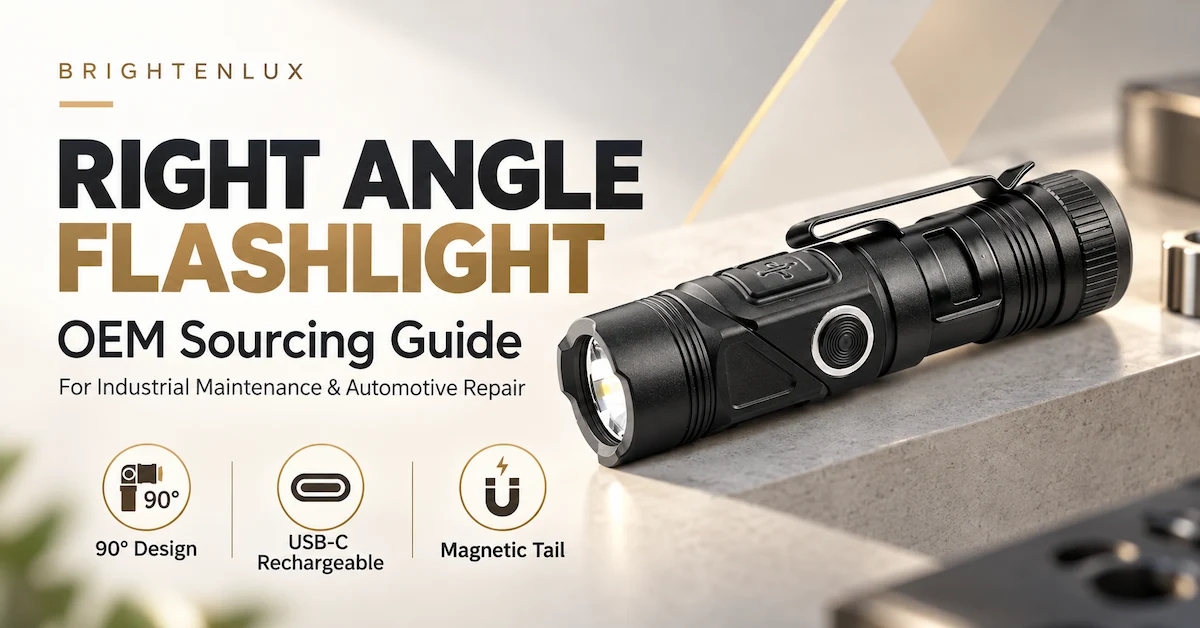
A right angle flashlight manufacturer should do more than supply a compact light with a 90-degree head. For an industrial tool brand, maintenance distributor, or automotive equipment importer, the supplier must help establish how the light will be mounted, where its beam will fall, how long it can work at a useful brightness, and whether the approved design can be reproduced across future shipments.
Short answer: Choose a right angle flashlight manufacturer by evaluating five connected requirements: practical hands-free mounting, task-appropriate beam performance, battery and USB-C charging reliability, verified mechanical and environmental durability, and documented OEM production control. Approve a representative sample against a written checklist before negotiating a bulk order. A high lumen figure, on its own, does not establish suitability for professional work.
Brightenlux offers two relevant 90-degree lighting platforms: a 1000-lumen SST25 model with a magnetic tail and a compact 700-lumen SST20 model with red-light functions. These are useful starting points for a private-label range, but they serve different buying priorities. This guide compares their published features and explains the evidence an importer should request before approving samples, packaging, and production. Buyers can first review the Brightenlux LED flashlight range to understand the wider product family.
What Does a Right Angle Flashlight Manufacturer Actually Produce?
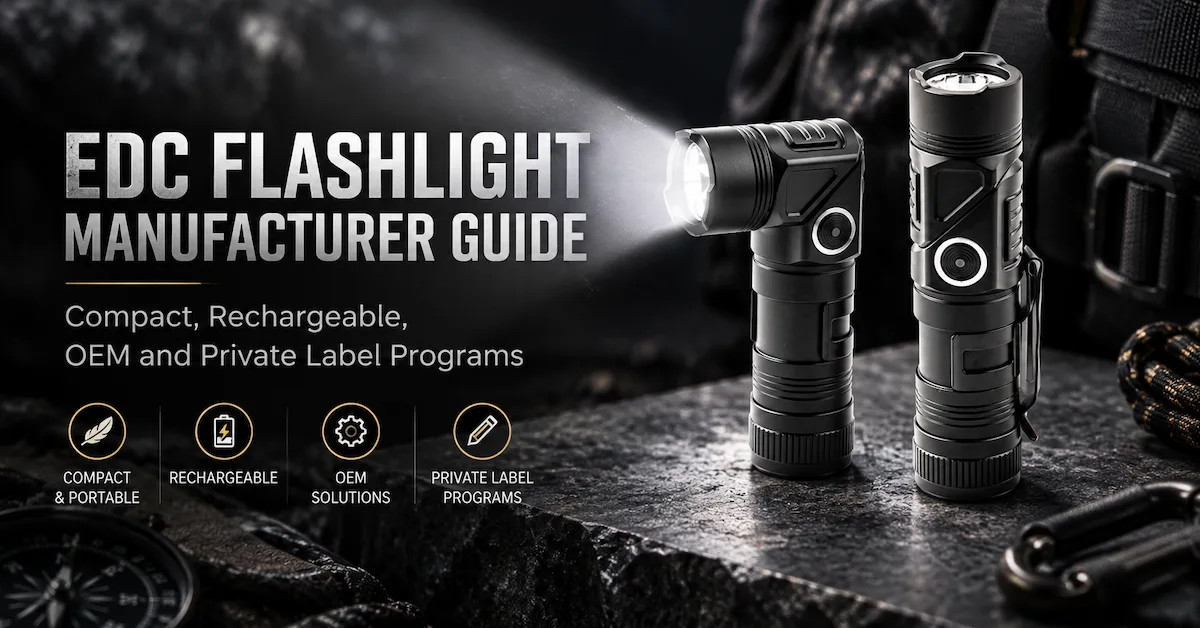
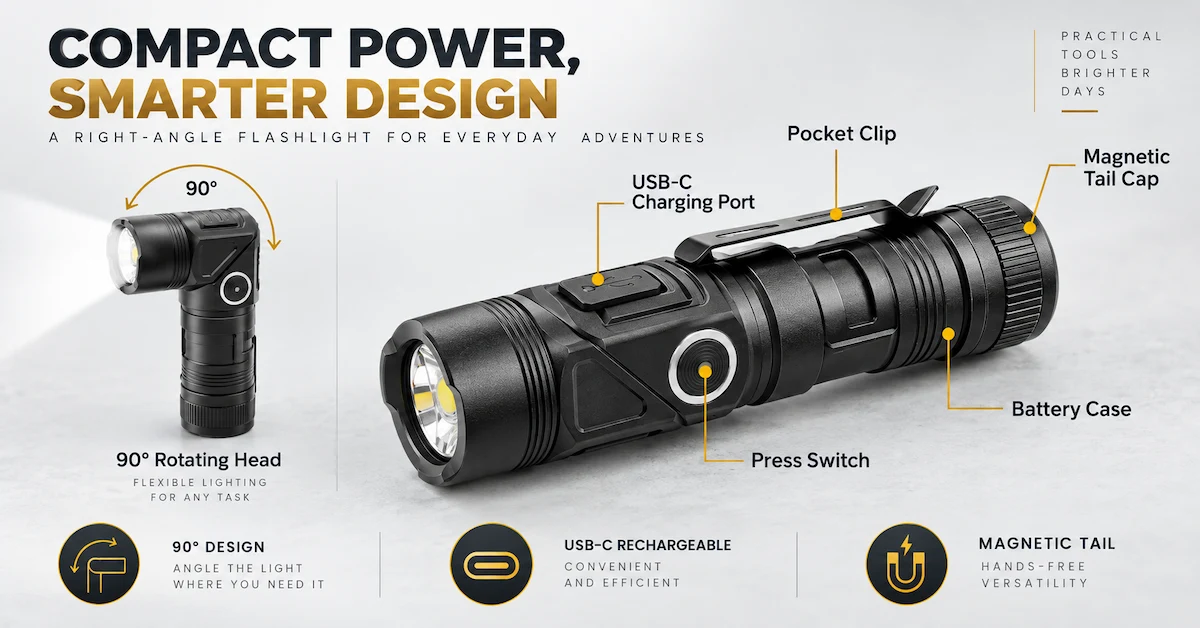
A right-angle flashlight directs light approximately 90 degrees away from the body rather than straight along its length. When the body is clipped vertically to a chest pocket, work vest, backpack strap, or head-mounted holder, the LED can illuminate the area in front of the user. On a suitable steel surface, a magnetic tail may also hold the flashlight while both hands are occupied with a repair.
That geometry makes the product different from an ordinary straight-body torch. A conventional handheld flashlight works well when the user intends to point it with one hand. A 90-degree utility light becomes especially valuable when the user needs to hold a tool, inspect a component, or maintain visibility without continuously gripping the light. The key advantage is not merely the bent head; it is the combination of beam direction, carry position, mounting strength, and controls.
For OEM sourcing, a manufacturer must coordinate the LED and lens, electronic driver, battery, charging system, housing, switches, magnet, clip, seals, and accessories into a repeatable product. Small substitutions can change the result. A slightly weaker clip may let the lamp fall from workwear. A different optical component may move the hotspot away from the task. An altered battery can change runtime, charging behavior, documentation, and freight arrangements.
Where the format is not ideal: A right-angle light is not automatically a substitute for a long-range search flashlight, a wide-area work floodlight, or a certified hazardous-location lamp. If a team needs extensive area illumination, a larger work light may be more suitable. If it needs illumination that follows every head movement, a dedicated headlamp may be more comfortable. If explosive gases or combustible dust may be present, ordinary IP-rated flashlights must not be presented as intrinsically safe equipment without the appropriate separate approval.
Brightenlux 90-Degree Flashlight Models: A Buyer-Focused Comparison
Two published Brightenlux products illustrate how the same right-angle format can address different customer needs. The table deliberately separates stated catalog information from specifications that a purchaser should still confirm. This prevents a common sourcing error: treating a feature found on one model as if it applies to every similar-looking flashlight.
| Purchasing factor | 1000-lumen SST25 right-angle flashlight | 700-lumen SST20 compact magnetic flashlight |
|---|---|---|
| Published light output | Up to 1000 lumens | Up to 700 lumens |
| LED | 1 × SST25 | SST20 |
| Head arrangement | 90-degree head | Compact 90-degree head |
| Hands-free mounting | Magnetic tail; headstrap and plastic mount listed | Magnetic tail; headstrap and plastic mount described |
| Charging | USB Type-C with red/green indication | USB Type-C with red/green indication |
| Battery information | 16340 lithium battery, 800mAh, included | Request current battery specification |
| Modes | High, medium, low, strobe, SOS | White lighting plus red steady, red strobe, red SOS |
| Published water rating | IPX4 | Confirm tested IP rating for the exact version |
| Published weight | 55g | 55g |
| Recommended initial evaluation | General-purpose inspection and magnetic maintenance lighting | Compact utility lighting where red modes add value |
The Brightenlux 1000-lumen 90-degree flashlight (BT-FL8078) also lists an aluminum-and-ABS construction, PMMA lens, approximately 25 × 103 mm dimensions, and a beam distance of up to 100 meters. Its product listing gives approximately two to three hours of working time and two to three hours of charging time, but does not establish that maximum brightness is sustained for the entire stated runtime. Buyers should request mode-specific measurements.
The Brightenlux 700-lumen compact magnetic flashlight is particularly interesting for customers who want white task lighting and dedicated red signaling functions in a small body. Its current published description does not provide the same complete battery, runtime, and IP-rating details as the 1000-lumen listing. Those missing fields belong on the pre-sample question list, not in invented marketing claims.
Purchasing implication: Do not label the 1000-lumen version "better" solely because its maximum figure is larger. A technician using low or medium mode may prefer the 700-lumen platform's controls or red-light functions. The correct selection depends on beam quality, mounting, runtime, protection level, selling channel, and cost after customization.
BT-FL8078 | 1000-Lumen SST25 Right-Angle Flashlight
90-degree head, magnetic tail, USB-C rechargeable, 800mAh 16340 lithium battery and headstrap. Use this as the initial benchmark for compact industrial maintenance lighting.
View 1000-Lumen Product Details →700-Lumen SST20 Magnetic Right-Angle Flashlight
Compact 90-degree design, magnetic tail, USB-C charging and red-light modes. Compare this option for utility kits, outdoor retail and private-label tool ranges.
View 700-Lumen Product Details →Which Industries and Users Need Magnetic Right-Angle Lighting?
Automotive repair and vehicle servicing
An automotive mechanic may need to inspect a hose connection under the hood while holding a wrench, place a light near a wheel well, or see a fastener inside a cramped engine bay. A magnetic flashlight can reduce the need for a second person to hold the light. Yet a magnet is only useful if it can attach to a suitable ferrous surface at a workable angle; many vehicle panels and components are aluminum, plastic, or covered by trim.
For automotive tool distributors, sample testing should include attachment to vertical and horizontal steel panels, greasy-glove switch operation, and beam placement around reflective metal. Check whether the body slides when the panel vibrates or when the user brushes against it. Also test whether the magnetic base attracts metal filings that could scratch painted surfaces. A carefully positioned magnet can help, but it does not make a light universally safe to attach anywhere in a vehicle.
Industrial maintenance, MRO, and facility operations
Maintenance, repair, and operations teams may inspect conveyors, mechanical housings, utility spaces, storage racks, and equipment rooms. A clip-mounted 90-degree work light can be convenient when the technician is walking between tasks. When stationary, the magnet may provide another mounting option. The strongest value proposition is versatility across real work positions, not simply the presence of a magnetic tail.
Industrial buyers should specify how long a normal service task lasts and whether their workers wear thick gloves. A switch that is easy to operate in a showroom can be frustrating inside a dim maintenance space. Purchase trials should include repeated switching, rotation of the body while clipped, and the practical distance from light to target.
Field technicians and utility service teams
Field service work adds another constraint: equipment may need to be carried all day, recharged in a vehicle, and used in light rain. Low weight and compact dimensions matter because an uncomfortable lamp tends to remain in the tool bag. A rechargeable right angle flashlight manufacturer should help buyers clarify charging-port protection, battery status visibility, and realistic operating time at the chosen brightness level.
The user should never be encouraged to clip an ordinary light to unsafe electrical equipment or assume a magnet is suitable for energized cabinets. Worksite procedures, clearance requirements, and equipment-specific restrictions take priority over a flashlight accessory.
Emergency preparedness and professional equipment kits
Emergency-kit assemblers often care about easy operation, dependable storage, clear instructions, and a battery strategy that fits the kit's inspection schedule. A compact magnetic lamp can be useful for everyday outages, vehicle breakdowns, or general utility tasks. However, distributors should distinguish general-purpose emergency lighting from devices that carry specific workplace, fire-service, or intrinsically safe certifications.
For inventory held in storage, request information on self-discharge, recommended recharge intervals, battery protection, and periodic readiness checks. A long theoretical runtime is not useful if a product is stored without charge maintenance and fails when needed.
Outdoor retail, camping, and everyday carry
Outdoor buyers may use the same compact 90-degree format on a backpack strap, near a campsite, or with a compatible headband. For this channel, the ability to switch between handheld, clipped, and worn configurations is a clear merchandising advantage. The package should show exactly which mounts are included and should avoid implying that every version comes with the same accessories.
A distributor can also pair right-angle utility lights with other formats rather than forcing one design to cover every task. Brightenlux's outdoor lighting overview provides a broader product-family context for such assortment planning.
Technical Specifications That Matter Before Bulk Approval
1. Light output, beam shape, and sustained brightness
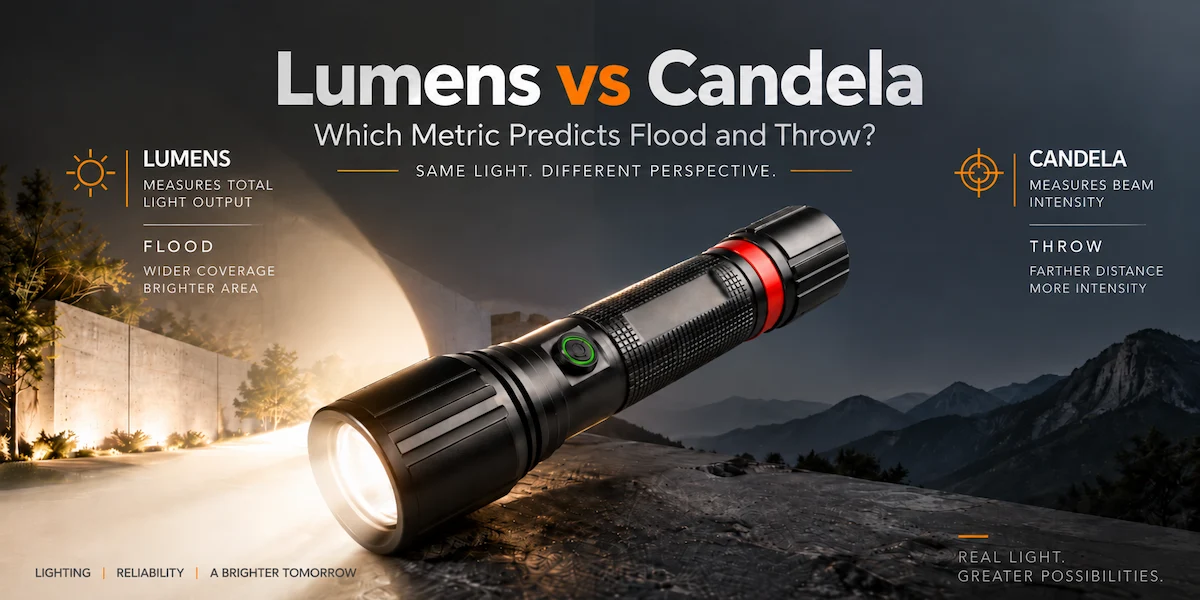
Many flashlight quotations lead with maximum lumens. Luminous flux describes total visible light output, but it does not tell the complete story of a close-range inspection beam. A concentrated hotspot can look impressive in a distant demonstration while creating uncomfortable glare when reflected from shiny machinery. A wide beam may make a repair area easier to see even when its peak intensity is lower.
Ask for beam photographs taken at the same distance and exposure settings. Compare the usable illuminated area at approximately one arm's length and at several meters. Record whether the beam has dark rings, distracting color separation, harsh edges, or an overly narrow hotspot. If the work requires color recognition, ask about color rendering and correlated color temperature rather than assuming all white LEDs behave alike.
Output should also be measured over time. Higher drive current generates more heat, and a small aluminum body has limited space for heat dissipation. The advertised peak may therefore be brief. Ask for a time-versus-output curve, surface temperature under sustained use, and the conditions in which the data was collected. ANSI/PLATO FL 1-2025 is a relevant industry framework for discussing portable-light performance measurements, including how short-duration elevated-brightness modes are reported. Do not describe any specific Brightenlux model as FL 1 certified unless supporting evidence is supplied.
2. Battery architecture and realistic runtime
Battery capacity expressed in mAh is not a runtime guarantee. Actual operating time depends on cell voltage, driver efficiency, LED power, mode selection, temperature, and the point at which the light is considered too dim for its task. Two brands can each advertise a "three-hour flashlight" while delivering very different useful light throughout those three hours.
The published BT-FL8078 configuration uses one 800mAh 16340 lithium battery.This compact format helps keep the product small, but buyers should verify capacity testing, protection circuitry, cell traceability, and replacement availability for their market. If a project proposes another cell type, the manufacturer must reassess enclosure space, thermal conditions, charging electronics, weight, transport documents, and cost.
Request runtime records for every commercially important mode, especially the mode buyers will actually use. State the starting battery condition, ambient temperature, light-output measurement interval, and end-of-test definition. A useful comparison is the brightness available after thirty minutes, one hour, and the expected service interval—not just the light's first few seconds.
3. USB-C charging and electrical reliability
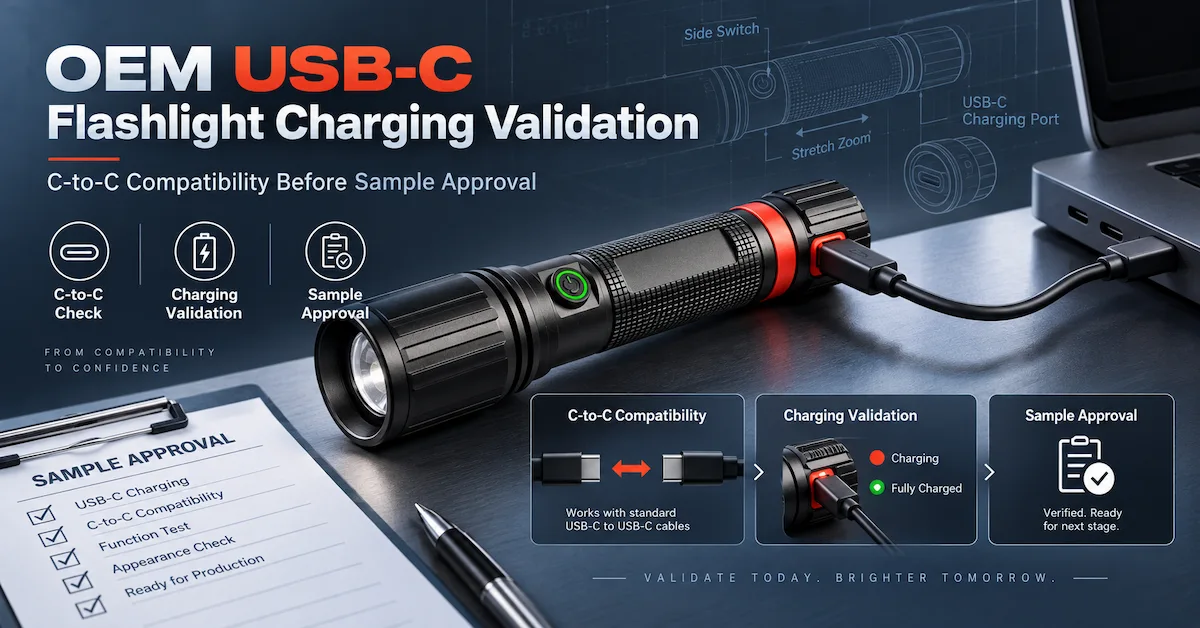
USB Type-C is attractive in a private-label flashlight because users may already own compatible cables. Nevertheless, a USB-C connector alone does not prove compatibility with every USB-C charger or cable. Some products behave differently when connected to a USB-A-to-C lead rather than a USB-C-to-C lead. A sourcing engineer should test the actual approved charging circuit with the adapters and cables common in the destination market.
Check indicator behavior at the beginning of charging, at full charge, during a charging interruption, and when the battery is too depleted to operate the LED. Determine whether the product can operate while charging and, if so, under what thermal and safety limits. Establish whether the port cover or twist-out mechanism must be closed for the published water-resistance claim to apply.
Where the packaging states a charging time, specify the charger output, cable, ambient conditions, starting state of charge, and end point. These details help customer-support teams explain the product accurately and reduce unnecessary returns.
4. Magnetic tail, clip, headstrap, and ergonomics
Magnetic mounting is often the reason a professional customer chooses a 90-degree flashlight. However, "strong magnet" is not a measurable purchase specification. Request a retention test using a defined steel plate, plate thickness, surface finish, orientation, and product position. Vertical mounting and overhead mounting can expose different failure modes. If the lamp may be exposed to vibration, add a vibration or disturbance check based on the expected use.
For clipped use, test how firmly the clip holds to common workwear and straps, whether it can be attached with gloves, whether its edges snag fabric, and whether repeated opening causes permanent deformation. For headstrap applications, verify the mounting bracket's retention and the comfort of the complete assembly, not only the flashlight's weight.
Human factors matter at the same level as electronics. A practical trial should include a user wearing the expected gloves, carrying the light for a normal work period, and changing modes without looking at a printed instruction sheet. If the product has many modes, ask whether the switching sequence supports the intended work rather than forcing the user through SOS or flashing modes during every routine operation.
5. Housing, ingress protection, and environmental suitability
Aluminum bodies can provide useful strength and thermal conduction, while ABS components can support grip or structural functions. Their performance depends on grade, shape, finishing, wall thickness, fastening, and assembly. Hard anodizing may improve wear resistance, but the finish should be evaluated against the expected handling conditions rather than described as indestructible.
IPX4, as published for the 1000-lumen Brightenlux model, concerns protection against splashing water under a defined test. It does not mean the product is submersible, completely dustproof, or resistant to every chemical found in a garage. An IP rating must be associated with the exact assembled design and relevant test conditions. For a different housing, port cover, battery access method, or seal, ask whether the existing evidence remains applicable.
Before the final purchase order, define the expected exposure to rain, washdown, dust, oil mist, vibration, storage temperature, and accidental drops. Not every requirement calls for the highest possible protection grade; it calls for the appropriate verified grade. Over-specification can raise cost and weight without improving the buyer's actual application.
How an OEM Right-Angle Flashlight Project Should Move from Brief to Shipment
An established product platform can shorten the path to market, but an efficient project still requires explicit decisions. Buyers evaluating a right angle flashlight manufacturer should ask for a staged development and approval process, with each stage producing something that can be inspected. This is a recommended procurement workflow rather than a claim that every factory uses identical procedures.
Stage 1: Define the user and commercial brief
Describe the actual task before selecting a product picture. For example: "An automotive mechanic needs a pocket-sized rechargeable lamp that can attach to steel panels, run through a routine inspection on medium mode, and be operated with gloves." Add the desired sales channel, target market, estimated first order, expected annual volume, retail positioning, and any mandatory customer specifications.
Ask Brightenlux which published 90-degree model is closest to that requirement, which attributes are standard, and which would require a new sample, component, or tooling change. Begin with the Brightenlux company and manufacturing overview for background on its design and production scope.
Stage 2: Freeze a preliminary specification
Create a single revision-controlled document containing the target LED, output modes, beam type, battery configuration, charging method, dimensions, weight, housing and finish, magnet and clip requirements, sealing expectations, accessories, packaging, labeling, and test methods. Record any permitted alternatives. "Equivalent LED" or "similar battery" is not an adequate substitution rule without agreed performance and safety criteria.
Stage 3: Evaluate functional samples in realistic conditions
Request representative samples and compare them against the specification. Do not approve only on photographs, showroom brightness, or exterior appearance. Use the same work tasks that future customers will perform: attach the magnet, clip the light to clothing, operate it with gloves, run the preferred mode, recharge it, and inspect the seals and controls after normal handling.
A useful trial is to give each tester the same short scenario: attach the lamp to a vertical steel panel, illuminate a recessed fastener, remove the lamp, clip it to workwear, and complete a small repair task. Record unexpected sliding, awkward switch operation, glare, and any need to reposition the beam. This kind of simple task test often reveals more than comparing headline lumen numbers.
Stage 4: Approve the golden sample and production documents
Once the required function is achieved, approve a physical reference sample and record its revision, bill of materials, drawings, package artwork, labeling text, and test criteria. Both customer and manufacturer should know which features cannot change without written approval. For private-label programs, retain signed-off artwork and packaging photographs, not just an email saying "logo approved."
Stage 5: Verify a pilot or pre-production build
Where project size and risk justify it, assess a small controlled build before full production. Look for assembly repeatability, charging consistency, switch operation, magnet retention, sealing workmanship, cosmetic defects, and correct accessory counts. Confirm that the tested unit represents the same configuration that will ship to customers. Resolve failures while changes are still manageable.
Stage 6: Inspect bulk production and prepare shipment
Agree on incoming component checks, in-process controls, functional inspection, final sampling or full-inspection scope, packaging verification, and shipment documents. The Brightenlux homepage describes a 100% inspection practice, but buyers should ask exactly what each finished-unit inspection covers and which tests are sample-based or externally performed. For a rechargeable product, the shipment release package should also address lithium-battery transport requirements.
Right-Angle Flashlight Quality-Control Checklist for OEM Buyers
The following matrix can be attached to a request for quotation or pre-shipment inspection plan. Acceptance limits should be negotiated for the selected model and application; the table does not imply that an unverified specification is already met by any product.
| Quality area | Practical verification | Evidence to request |
|---|---|---|
| LED and beam | Compare output, distribution, color and beam alignment under defined conditions | Sample measurements and consistent-condition beam images |
| Runtime | Measure output over time in the modes customers use | Mode-specific runtime and step-down records |
| Charging | Check USB-A-to-C and USB-C-to-C operation, indicators and charge termination | Charging compatibility matrix and test record |
| Battery | Check approved cell identity, polarity, protection and traceability | Cell specification, safety evidence and transport summary where applicable |
| Magnet and clip | Check retention in the intended positions and after handling cycles | Defined test method, sample result and accessory drawing |
| Water resistance | Test the complete enclosure in its specified closed condition | Report identifying model, revision and test method |
| Switch and finish | Check mode sequence, intermittent contacts, scratches and fit | Functional checklist and appearance acceptance standard |
| Packaging | Check printed claims, manual, labels, cable, mounts and quantity | Approved artwork, packing list and final inspection results |
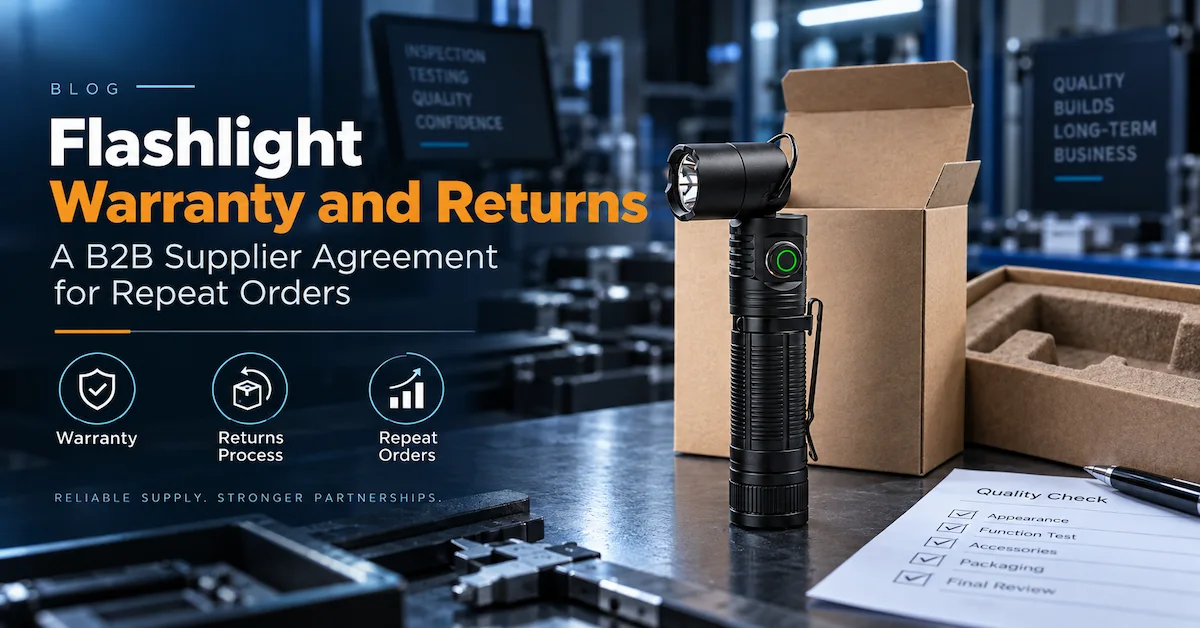
For a buyer planning repeated shipments, this checklist should be tied to the approved sample revision and purchase-order documents. If components change after approval, revisit any test result affected by the change. A right angle flashlight manufacturer that can explain change control clearly is usually easier to work with than a supplier offering only a broad assurance that quality will be "the same."
Certifications, Test Reports, and Lithium-Battery Shipping: What to Verify
Compliance statements should be treated as document requests, not as decorative website badges. Brightenlux mentions CE, RoHS, REACH, FCC-related testing and factory social or supply-chain audits in its public company information. That is relevant background for initial supplier qualification, but it does not establish that every SKU, accessory combination, or modified OEM version has every report required in a particular destination market.
For a European product launch, ask which legislation applies to the finished configuration, which technical documentation supports the claims, and who is responsible for the required declaration and labeling. For a US launch, determine which electrical, radio-frequency, battery, labeling, or retailer-specific obligations actually apply. A rechargeable flashlight with no intentional transmitter does not automatically need the same FCC documentation as a connected electronic device.
For technical reference, ANSI/PLATO FL 1-2025 addresses portable-light performance measurement and reporting; IEC 60529 addresses ingress-protection classifications; IEC 62133-2 addresses safety requirements and tests for portable lithium cells and batteries; and UN Manual of Tests and Criteria subsection 38.3 concerns lithium-cell and battery transport testing. Which documents a buyer needs depends on the product, market, battery configuration, and shipment method. Naming a standard is not a substitute for a matching report.
Document-matching rule: Confirm the legal manufacturer or applicant name, model number, battery model, tested configuration, report date, laboratory identity, and scope. If the OEM project changes the battery, housing, seal, electronics, or charger, ask whether the original evidence remains valid. Keep the latest reports with the purchase order and shipping paperwork instead of collecting unrelated certificates after the goods are packed.
OEM, ODM, and Private-Label Options for 90-Degree Flashlights
Different degrees of customization affect cost, development time, and risk. A buyer should not request a completely new housing when its commercial goal could be achieved with an existing platform and careful branding. Conversely, a professional equipment brand should not assume a logo-only change will solve a genuine technical mismatch.
| Cooperation type | Typical changes | Best fit | Main approval question |
|---|---|---|---|
| Standard wholesale | Existing product and standard pack | Distributors testing demand | Is the current specification and stock plan suitable? |
| Private label | Logo, color where offered, carton, insert, barcode, manual | Retail and e-commerce brands | Are the print methods and package claims approved? |
| OEM platform modification | Selected LED, modes, battery, clip, magnet or accessories when feasible | Industrial tools and differentiated product lines | Which changes require engineering validation? |
| ODM or custom development | New housing, optics, electronics or product architecture | Brands with a distinctive technical requirement | Who owns tooling, drawings, and design rights? |
Brightenlux publicly offers OEM/ODM and low-MOQ logo printing as service directions. However, exact minimum order quantities, tooling fees, development fees, and available changes should be confirmed for the chosen model. A magnetic-tail 90-degree flashlight has interconnected structural and electrical parts; even a small change in battery dimensions or port location can affect sealing, heat transfer, and accessory fit.
For a simple branded launch, ask whether the existing 1000-lumen or 700-lumen product can retain its validated components while receiving new exterior artwork and retail packaging. For a deeper OEM project, submit the revised functional requirements before requesting price. Buyers can also review Brightenlux's OEM flashlight manufacturer checklist for broader supplier-qualification considerations.
What Determines Wholesale Price, MOQ, and Lead Time?
There is no responsible universal unit price for a custom 90-degree work light. The price depends on the approved configuration, order volume, branded packaging, accessories, test requirements, battery sourcing, tooling needs, and trading terms. A low factory quotation can become expensive if it excludes a battery, cable, mounting hardware, labeling, or testing that the retailer expects to receive.
When comparing two right angle flashlight manufacturer quotations, normalize their scope. Ask suppliers to quote the same LED version, battery-included status, accessory set, packaging specification, inspection requirement, currency, quantity tier, and Incoterms. Request separate lines for one-time tooling or design work and recurring per-unit costs. This helps buyers identify a true unit-cost difference instead of a quotation-completeness difference.
MOQ may also vary by customization type. Printing a logo on an existing housing generally has different setup economics from manufacturing a new injection-molded component or configuring a custom electronic assembly. Ask for MOQ at the standard, private-label, and modified-platform levels instead of assuming one website-wide minimum applies to every project.
Lead time should be broken down into specification confirmation, sample preparation, test and revision work, packaging artwork approval, material procurement, assembly, inspection, and freight booking. The longest stage is not always assembly; specialized cells, components, or printed cartons can affect the critical path. Ask for a target timeline with dependencies, not an unconditional delivery promise.
Total cost of ownership matters. If a cheap lamp has recurring clip failures, missing charging cables, inconsistent output, or unsupported water-resistance claims, the importer can lose margin through refunds, replacements, poor reviews, and inventory write-offs. Technical agreement before production is therefore part of cost control, not an optional engineering exercise.
How to Compare a Manufacturer with a Trading-Only Supplier
The answer is not to reject every trading company. A well-organized trading supplier may provide useful assortment management and purchasing flexibility. The important distinction is the level of transparency and control the buyer requires for the project.
For a new industrial or private-label design, ask who owns the drawings, selects critical parts, approves substitutions, executes tests, handles nonconforming production, and signs off corrective actions. If the company claims to manufacture the product, ask to see relevant equipment, current assembly processes, and product-specific inspection records. If work is subcontracted, require a clear account of which organization is responsible for each stage.
Brightenlux's published company material identifies Ningbo Brightenlux Electric Appliance Co., Ltd. as a manufacturer established in 2014, with a factory in Zhejiang and a range that includes flashlights and headlamps. Such information supports an initial shortlist; final qualification still depends on current capacity, technical communication, and evidence for the exact order. A useful supplier should be comfortable documenting both its capabilities and its limits.
Copy-Ready RFQ Checklist for a Custom Right-Angle Flashlight
A detailed request for quotation saves time because suppliers can respond to one defined problem. Use the following fields when contacting a right angle flashlight manufacturer, then ask it to mark each requirement as standard, available by modification, or not currently supported.
- Buyer profile: company, country, sales channel, target customer, and expected first order and annual volume.
- Application: automotive repair, facility maintenance, field inspection, emergency kits, outdoor carry, or another defined task.
- Reference product: Brightenlux BT-FL8078 1000-lumen SST25 or the 700-lumen SST20 magnetic 90-degree model.
- Light performance: required useful beam, mode sequence, brightness, distance, runtime, and output test method.
- Mechanical details: weight, dimensions, housing, surface finish, clip, magnetic tail, headstrap, mounting position, and protection level.
- Power and charging: approved cell type, capacity, included battery, USB-C behavior, charge time, indicator, and user instructions.
- Customization: logo location, print method, body color, accessories, retail box, barcode, languages, and artwork files.
- Quality and compliance: required test reports, market documentation, sample acceptance, inspection method, and battery shipping records.
- Commercial terms: sample price, MOQ by configuration, unit-price tiers, tooling costs, Incoterms, lead time, and payment terms.
- Repeat orders: approved component list, change-notification process, spare-accessory options, and defect-resolution workflow.
Send the completed brief through the Brightenlux contact and quotation page. For the fastest technical response, attach any target-market specifications and explain which features are mandatory versus optional. A supplier can propose a more relevant platform when it understands the real application and acceptable trade-offs.
Frequently Asked Questions About Right-Angle Flashlight Manufacturing
1. What is a right angle flashlight manufacturer?
A right angle flashlight manufacturer develops or produces portable LED lights whose beams are directed approximately 90 degrees from the body. For OEM customers, the manufacturing scope may include optical integration, electronics, battery systems, housing, magnetic or clip mounting, assembly, inspection, branding, and packaging. Buyers should verify which operations are controlled directly and which are outsourced.
2. Are 90-degree flashlights better than straight flashlights for mechanics?
They are often more convenient for tasks where both hands must remain available. A clipped or magnet-mounted right-angle light can hold its beam on a work area without continuous hand positioning. However, the best format depends on the mounting surface, beam spread, workplace safety rules, and whether the user needs a fixed or constantly moving light source.
3. What is the difference between a magnetic work flashlight and a headlamp?
A magnetic work flashlight can be positioned independently on a suitable metal surface, giving the user a stationary light source. A headlamp moves with the wearer's head and can be more useful while walking or looking between many targets. Some Brightenlux right-angle models also support headstrap accessories, providing an additional way to wear the light.
4. Which Brightenlux right-angle model is suitable for OEM sourcing?
The 1000-lumen SST25 BT-FL8078 is a practical reference when buyers want a published IPX4 rating, included 16340 battery, magnetic tail, and five white-light and signaling modes. The compact 700-lumen SST20 version adds published red-light functions. Select by the final application and sample results; neither model should be chosen on maximum lumens alone.
5. Can I order a private-label right-angle LED flashlight?
Brightenlux states that it provides OEM/ODM services and low-MOQ logo printing. Private-label projects commonly cover logo treatment, retail packaging, labels, instructions, and sometimes appearance or accessory changes. Ask for a model-specific customization list, artwork requirements, quotation tiers, and a signed-off sample before assuming every modification is available.
6. How many lumens should an inspection flashlight have?
There is no single ideal number. Close-range maintenance often benefits from a comfortable, well-distributed beam at a sustainable output rather than maximum intensity. Evaluate beam shape, reflected glare, available medium and low modes, thermal behavior, and runtime during the actual task. Compare measured samples at the same distance instead of relying only on catalog lumens.
7. Is an IPX4 right-angle flashlight waterproof?
IPX4 indicates resistance to splashing water under the applicable ingress test; it does not indicate immersion protection or establish dust resistance. The test applies to a defined assembled configuration. For outdoor or industrial programs, ask for an appropriate report identifying the product revision and the required condition of the charging cover, seals, and any other openings.
8. What does a buyer need to verify about USB-C charging?
Confirm the battery and charging circuit, supplied cable, input compatibility, indicator behavior, charging time, low-voltage protection, and whether the product is intended to operate while charging. Check both USB-A-to-C and USB-C-to-C connections where relevant. If the enclosure must be closed for water resistance, the manual should state the limitation clearly.
9. What is the usual MOQ for wholesale 90-degree flashlights?
MOQ depends on the model and the type of customization. A standard catalog item, logo-printed version, modified electronics platform, and newly tooled design may have different minimum quantities and setup charges. Brightenlux does not provide one verified MOQ that can responsibly be applied to every right-angle order in this guide. Request a quantity-specific quotation.
10. What should I request before placing a bulk OEM flashlight order?
Request approved samples, a revision-controlled specification, clear BOM or critical-component controls, mode-specific performance evidence, mechanical and ingress test records where relevant, battery documentation, signed-off packaging, inspection criteria, and a written production and delivery plan. These items help the buyer compare suppliers and protect the repeatability of later orders.
Conclusion
The right angle flashlight manufacturer you choose will influence far more than the appearance of a 90-degree lamp. For industrial maintenance, vehicle repair, outdoor equipment, and private-label retail, the real purchasing decision concerns how securely the light mounts, how useful its beam remains over time, how safely it charges, and how consistently its approved components and features can be reproduced.
Brightenlux provides two relevant starting points: the 1000-lumen SST25 BT-FL8078 with magnetic-tail mounting, and the compact 700-lumen SST20 platform with red-light functions. Begin with the model closest to your user's task, identify any missing evidence, and request a representative sample and a clear OEM/ODM quotation before committing to volume. If you are planning a new range or replacing an inconsistent supplier, contact Brightenlux for a right-angle flashlight sourcing discussion with your application, branding requirements, target quantity, and preferred delivery market.