

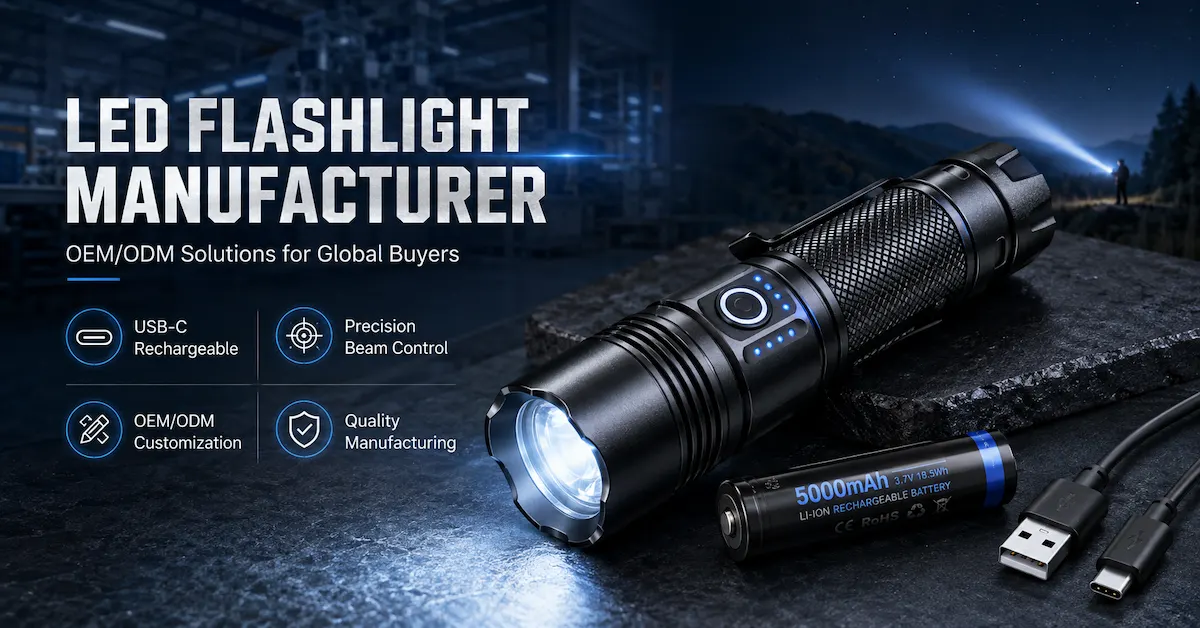
What Should OEM Buyers Verify in an LED Flashlight Manufacturer?
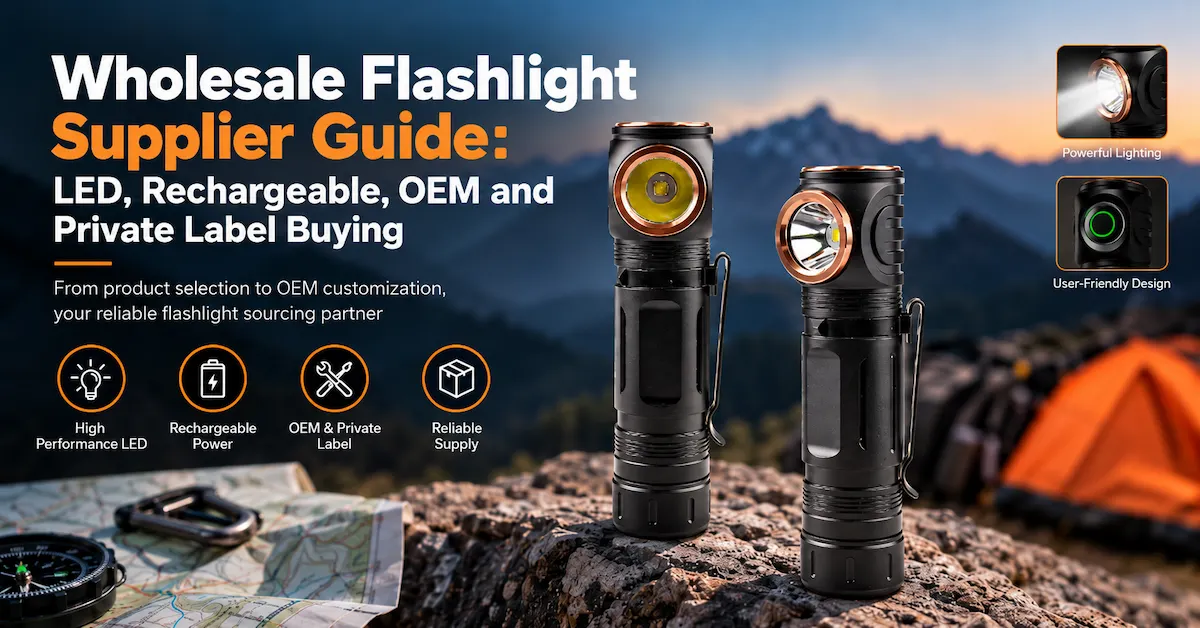
An LED flashlight manufacturer should be able to control more than the visible flashlight body. For an OEM or private-label buyer, the real product includes the LED emitter, optical system, thermal path, driver electronics, battery, charging circuit, housing, seals, switches, accessories, packaging, and the production controls that keep these elements consistent from one order to the next.
This is why comparing suppliers only by lumen claims or unit price creates unnecessary sourcing risk. A flashlight may look nearly identical to another model but behave very differently because of changes in the LED, reflector, battery, driver, thermal design, or assembly.
For buyers preparing an OEM program, the most useful question is therefore not:
“What is your brightest flashlight?”
It is:
“Can this manufacturer define, sample, document, and reproduce the complete product specification we need?”
Brightenlux manufactures portable lighting products including LED flashlights, headlamps, camping lights, bicycle lights, working lights, and other outdoor lighting products. Its About page states that the company was established in 2014, operates a factory of more than 10,000 square meters in Zhejiang, and has more than 150 workers.
Buyers can review the Brightenlux LED flashlight range before building a detailed OEM requirement.
Quick Answer: What Makes a Good LED Flashlight Manufacturer?
For B2B sourcing, a capable LED flashlight manufacturer should be able to provide clear answers in five areas:
- Optical performance: LED, reflector or lens, beam pattern, brightness, beam distance, and operating modes.
- Electrical architecture: battery type, driver, USB-C charging, indicators, protection, and runtime.
- Mechanical construction: housing, surface treatment, threads, switches, clips, magnets, sealing, and heat transfer.
- Production control: approved sample, BOM control, incoming components, assembly inspection, functional testing, and packaging verification.
- OEM/ODM support: logo, color, packaging, accessories, configuration changes, and deeper product development where required.
An OEM buyer should therefore evaluate the flashlight as a system, not as a collection of individual marketing specifications.
Why LED Choice Alone Does Not Determine Flashlight Quality
LED technology is central to a flashlight, but the emitter is only one part of the lighting system.
Brightenlux's existing LED flashlight category includes models identified with SST20, SST25 and SST40 emitters, along with white-laser configurations and different optical architectures. The same category includes adjustable-focus, magnetic-tail, right-angle and rechargeable models.
The sourcing lesson is important:
Two flashlights using similar LED families can still deliver different usable performance.
LED Emitter
The emitter influences factors such as potential output, electrical demand, heat generation and beam characteristics.
Reflector or Lens
The optical system determines how the emitted light is distributed.
A product may prioritize:
- focused throw,
- broad flood,
- adjustable focus,
- balanced hotspot and spill,
- or specialized long-distance illumination.
Driver
The electronic driver controls how the LED receives power.
It can affect:
- operating modes,
- output stability,
- low-voltage behavior,
- thermal step-down,
- battery use,
- and user-interface logic.
Thermal Path
LEDs generate heat during operation. The U.S. Department of Energy notes that thermal management is important to LED performance because heat must be moved away from the LED system.
For flashlight sourcing, this means a high-output specification should be considered together with body construction and sustained operation rather than judged only by peak brightness.
Check 1: Define the Beam Before Defining the Lumen Target
Many OEM projects begin with a number:
“1000 lumens.”
That number does not explain how the flashlight should illuminate the environment.
A more useful specification begins with the application.
| Application | Beam Priority | Other Buyer Priorities |
|---|---|---|
| Camping | Balanced flood and reach | Runtime, charging, portability |
| Hiking | Forward visibility plus spill | Weight, grip, weather protection |
| Patrol | Focused medium/long-range beam | One-handed control, durability |
| Search | Long throw | Battery capacity, sustained output |
| Maintenance | Close-range usable beam | Magnet, right-angle design |
| Automotive repair | Flood/task lighting | Hands-free mounting |
| Emergency kits | Simple general-purpose beam | Power reliability |
| Retail/EDC | Balanced everyday beam | Size, finish, USB-C |
An experienced LED flashlight supplier should ask how the flashlight will be used before recommending optics.
Spot Beam
Useful when the buyer prioritizes distance and concentrated illumination.
Flood Beam
Useful for close-range work or seeing a wider area.
Adjustable Focus
Useful when one product needs to cover both near and longer-distance tasks, although buyers should also inspect the mechanical reliability of the zoom or focus mechanism.
Brightenlux currently lists both adjustable-focus models and fixed-beam configurations, allowing buyers to compare different product architectures rather than forcing one design into every application.
Check 2: Compare Measurable Performance, Not Marketing Language
Terms such as:
- super bright,
- ultra powerful,
- long range,
- heavy duty,
- professional grade
are not enough to approve a B2B specification.
Portable lighting is commonly evaluated using measurable attributes including:
- light output,
- beam distance,
- peak beam intensity,
- runtime,
- impact resistance,
- and water/dust protection.
ANSI records describe the ANSI/PLATO FL 1 standard as covering basic performance for hand-held portable flashlights, spotlights, headlamps and area lights.
For procurement teams, that leads to a simple rule:
Separate Peak Output From Practical Output
A flashlight can have an impressive maximum mode while spending most of its real operating time at a lower output.
Ask:
- How long does maximum output last?
- Is there thermal step-down?
- What is runtime by mode?
- Which battery was used for the test?
- Is beam distance measured or estimated?
- Are test conditions documented?
This creates a much better comparison between factories.
Check 3: Choose the Battery Architecture Around the Market
Battery selection directly affects flashlight size, runtime, cost and positioning.
Brightenlux's LED flashlight range currently includes products using different rechargeable formats, including 18650 and 21700 platforms, as well as other power configurations.
18650 Platforms
Often suitable when the design needs a balance between:
- manageable diameter,
- rechargeable power,
- established battery format,
- and moderate-to-high output.
21700 Platforms
Often considered when buyers want more battery capacity potential or need a platform designed for higher-output or longer-runtime applications.
Brightenlux currently lists a 1500-lumen SST40 flashlight using a 21700 battery, Type-C charging, magnetic tail and strobe functionality.
Dual-Power Designs
A product that supports rechargeable and replaceable battery options can be useful for:
- emergency kits,
- remote areas,
- preparedness products,
- and users who cannot always recharge.
But additional power options also create more specifications to control.
Questions OEM Buyers Should Ask
- What battery format is used?
- What stated capacity applies to the approved model?
- Is the battery removable?
- Is the battery included?
- Can the approved cell specification change during repeat orders?
- What charging input does the product require?
- What runtime applies to each mode?
Battery information should be part of the approved specification, not an informal conversation.
Check 4: Verify USB-C and Charging Requirements
A USB-C connector is increasingly common in rechargeable flashlights, but buyers should not assume that every Type-C product supports the same charging behavior.
An OEM specification should define:
- connector type,
- input voltage/current,
- cable configuration,
- charging indicator,
- approximate charging time,
- battery-protection architecture,
- port-cover design,
- C-to-C compatibility if required,
- and power-bank functionality if required.
Brightenlux's LED flashlight category includes multiple Type-C rechargeable products, including SST25, SST40 and other configurations.
For private-label programs, charging architecture matters because it affects both user convenience and support questions after the product reaches market.
Check 5: Match Housing Design to Heat, Grip, and Durability
An LED flashlight body is more than cosmetic packaging.
For many handheld models, the housing contributes to:
- mechanical protection,
- grip,
- heat transfer,
- sealing,
- battery retention,
- switch positioning,
- and product identity.
Aluminum Housing
Commonly used when buyers value:
- durable feel,
- machining precision,
- heat transfer,
- and a more technical product appearance.
Polymer Housing
Can be appropriate when the project prioritizes:
- lower weight,
- specific form factors,
- molded structures,
- or cost targets.
Neither material is automatically superior for every use case.
The correct question is:
Does this construction support the product's actual operating environment?
For an industrial inspection light, grip, magnet position and switch usability may matter more than decorative machining.
For a compact EDC flashlight, weight and pocketability may matter more.
For a long-range outdoor light, thermal mass and battery capacity may become more important.
Check 6: Verify IP Protection for the Exact Model
“Waterproof flashlight” is too broad for a purchasing specification.
IEC 60529 defines the classification system for degrees of enclosure protection, commonly expressed through IP codes.
This matters because different flashlight applications face different exposure conditions.
A product for occasional household use does not necessarily need the same protection as one intended for:
- heavy rain,
- outdoor patrol,
- wet industrial maintenance,
- emergency response,
- or prolonged outdoor use.
Brightenlux's current LED flashlight catalog itself shows why buyers should check model-specific ratings: listed models include different protection levels rather than one universal IP specification across the whole range.
Therefore, never assume:
“This factory makes an IP67 flashlight, so all its flashlights are IP67.”
Confirm the rating for the exact SKU under consideration.
Check 7: Evaluate Functional Details That Affect Daily Use
Some of the most commercially important flashlight features are relatively small.
Magnetic Tail
A magnetic flashlight can be useful in:
- vehicle repair,
- equipment maintenance,
- electrical cabinets,
- workshop environments,
- and other hands-free situations.
90-Degree Body
A right-angle flashlight can support:
- chest or pocket clipping,
- hands-free task lighting,
- inspection work,
- and restricted spaces.
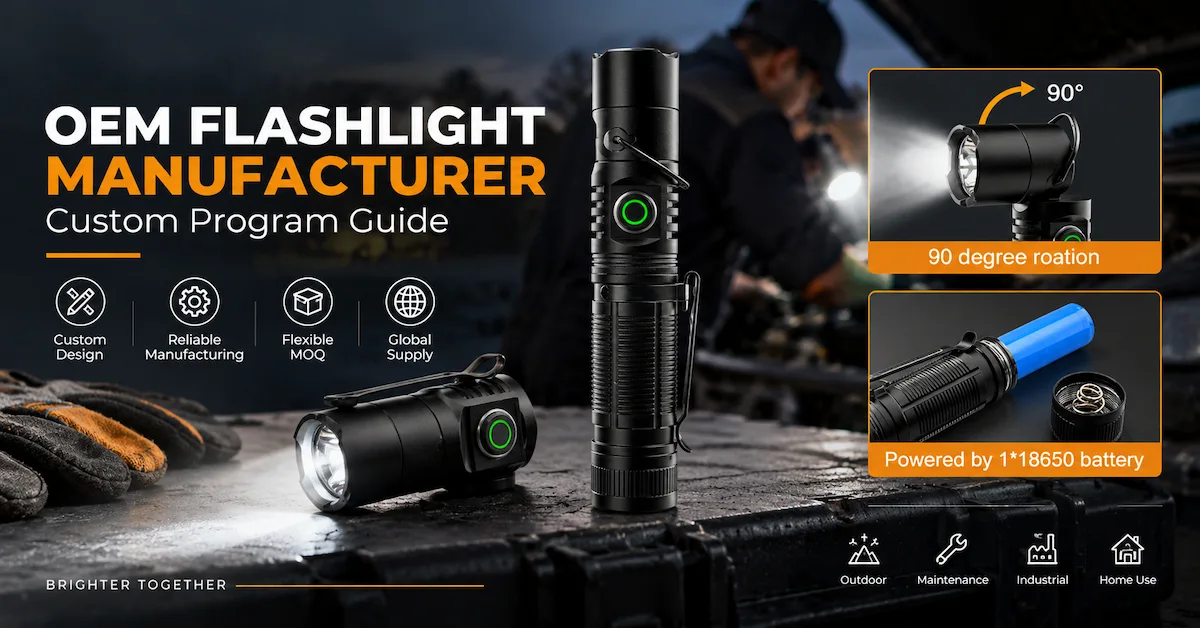
Brightenlux's current catalog includes a 1000-lumen SST25 90-degree Type-C rechargeable flashlight with magnetic tail, as well as a 700-lumen SST20 magnetic 90-degree model.
Switch Layout
Check whether the user can operate the flashlight:
- with gloves,
- one-handed,
- in darkness,
- without cycling unnecessarily through too many modes.
Clip
The clip is inexpensive compared with the complete product, but poor retention or sharp edges can quickly create user complaints.
Small parts can create large return rates if they are ignored during sampling.
Check 8: Build QC Around the Approved Specification
“100% quality” or “strict QC” is not a purchasing specification.
A useful OEM quality plan identifies exactly what should be verified.
Appearance Inspection
Check:
- finish,
- scratches,
- machining,
- color consistency,
- logo position,
- printing.
Functional Inspection
Check:
- switch operation,
- all lighting modes,
- charging,
- indicator,
- zoom or focus,
- magnet,
- power-bank function where applicable.
Assembly Inspection
Check:
- threads,
- lens seating,
- battery compartment,
- clips,
- O-rings,
- end caps,
- fasteners.
Packaging Inspection
Check:
- correct product,
- cable,
- battery where included,
- accessories,
- labels,
- manual,
- barcode,
- retail box,
- carton quantity.
Performance Verification
Where relevant to the purchasing specification, confirm:
- output,
- runtime,
- beam,
- IP requirement,
- charging behavior,
- and other agreed performance criteria.
The key is that inspection standards should be connected to the approved sample and written specification.
Check 9: Control the BOM From Sample to Bulk Production
One of the most important questions in OEM flashlight sourcing is:
Will the bulk order contain the same critical components as the approved sample?
The BOM, or bill of materials, may include:
- LED,
- driver,
- battery,
- PCB,
- lens,
- reflector,
- switch,
- charging port,
- cable,
- housing components,
- sealing parts.
Not every component needs to be locked by brand name, but critical performance items should have clearly agreed specifications.
This is especially important when the visual exterior stays identical while internal components can change.
A flashlight may look exactly the same and still deliver different:
- runtime,
- brightness,
- beam color,
- charging behavior,
- or reliability
if critical components are substituted.
For repeat orders, buyers should therefore establish a change-control rule for important components.
Check 10: Decide How Much OEM or ODM You Really Need
An OEM LED flashlight manufacturer can usually support several levels of customization.
Level 1: Branding
Typical changes:
- logo,
- laser marking,
- printed branding,
- labels.
Level 2: Packaging
Possible requirements:
- retail box,
- color box,
- user manual,
- barcode,
- inserts,
- master carton.
Level 3: Configuration
Depending on the product platform:
- accessories,
- battery options,
- cable,
- mode configuration,
- color,
- selected functional changes.
Level 4: ODM Development
Deeper changes can involve:
- housing,
- optics,
- electronics,
- PCB,
- switch design,
- tooling,
- new functional architecture.
The more customization required, the more important development controls become.
Brightenlux currently presents OEM/ODM capability and low-MOQ customization as part of its B2B offering. Its recent low-MOQ factory guide specifically discusses logo, packaging and small-volume sourcing for private-label and product teams.
Buyers planning a lower-risk first launch can also read the Brightenlux low-MOQ LED flashlight factory guide.
Which LED Flashlight Platform Fits Different Buyer Types?
Different buyers should not automatically source the same flashlight.
| Buyer | Main Need | Suitable Direction |
| Importer | Stable range and repeat orders | Established product platforms |
| Distributor | Several price/performance tiers | Multi-model LED flashlight range |
| Outdoor brand | Runtime, beam, portability | Rechargeable outdoor flashlight |
| Industrial/MRO buyer | Hands-free utility | Magnetic/right-angle flashlight |
| Automotive supplier | Repair and inspection | Magnetic task flashlight |
| Emergency-kit company | Reliability and power flexibility | Rechargeable or dual-power model |
| Private-label brand | Differentiation and branding | OEM flashlight platform |
| E-commerce seller | Market testing and features | Low-MOQ customizable model |
This is why buyers should select the product platform before negotiating cosmetic branding.
A Practical Sample-Test Process for B2B Buyers
A sample should be treated as a technical approval stage, not simply a photo opportunity.
Step 1: Verify Specification
Compare the sample with the supplier's written sheet.
Step 2: Test the Beam in the Real Use Case
Do not evaluate the flashlight only in an illuminated office.
Take it into:
- a dark room,
- workshop,
- outdoor path,
- vehicle,
- inspection area,
depending on the intended customer.
Step 3: Check Runtime and Charging
Run the modes relevant to real usage.
Step 4: Test Controls Repeatedly
Operate:
- switch,
- focus,
- tail cap,
- charging cover,
- clip,
- magnet.
Step 5: Review Packaging
Make sure the end user can clearly understand:
- charging,
- battery,
- modes,
- warnings,
- product features.
Step 6: Freeze the Approved Version
Create a final approval record before mass production.
This process is more valuable than repeatedly asking a supplier whether the quality is “good.”
What Drives OEM LED Flashlight Pricing?
Unit cost depends on the complete specification.
| Cost Factor | Why It Affects Price |
| LED | Emitter specification and output target |
| Battery | Format, capacity, inclusion |
| Driver | Modes and electrical architecture |
| Optics | Reflector, lens, zoom mechanism |
| Housing | Material, machining and finish |
| IP construction | Seals and enclosure complexity |
| Charging | USB-C circuitry and functions |
| Magnet/clip | Extra mechanical components |
| Packaging | Basic export vs retail package |
| Accessories | Battery, cable, strap, case |
| Customization | Logo, color, printing, tooling |
| Testing | Product/market-specific requirements |
| Quantity | Material and production efficiency |
A lower-cost flashlight is not automatically a better purchasing decision if it reaches the price target by reducing the specifications your customer actually values.
Common Mistakes When Choosing an LED Flashlight Manufacturer
Comparing Factories Before Standardizing the RFQ
If suppliers quote different LEDs, batteries, packaging and IP ratings, the prices are not directly comparable.
Choosing the Highest Lumen Claim
The real decision should include beam, runtime, thermal behavior and application.
Assuming the LED Brand Defines the Whole Product
Optics, electronics and housing significantly affect final performance.
Treating USB-C as a Complete Charging Specification
Define actual charging behavior.
Approving the Product Without Checking Packaging
Packaging errors become customer-service problems later.
Assuming Every Factory Certificate Applies to Every Product
Ask for documentation relevant to the selected model and destination market.
Changing Specifications After Sample Approval
Late changes increase the risk of inconsistency and production errors.
Buying a Complex Product When a Simpler Product Fits Better
Additional modes, electronics and mechanical features can add cost without creating meaningful buyer value.
LED Flashlight Manufacturer RFQ Checklist
Before contacting a factory, prepare:
- Target market
- Buyer type
- Application
- Lumen range
- Beam requirement
- Beam distance target if relevant
- Battery format
- Runtime expectation
- Charging requirement
- IP requirement
- Housing material
- Dimensions or weight limits
- Required operating modes
- Magnet/clip/zoom requirements
- Logo
- Product color
- Packaging
- Accessories
- Compliance requirements
- Initial order estimate
- Repeat-order forecast
A detailed RFQ helps the manufacturer recommend an appropriate existing platform or determine whether ODM development is actually necessary.
Brightenlux buyers can start with the full product catalog, then narrow the project to the LED flashlight category.
Why Factory Evidence Matters More Than Generic Claims
A manufacturer page should give buyers evidence they can investigate.
Brightenlux's About page states that Ningbo Brightenlux Electric Appliance Co., Ltd. has focused on lighting products for more than ten years, was established in 2014, has a factory exceeding 10,000 square meters, more than 150 workers, and exports products to more than 50 countries.
Those facts help establish company context, but buyers should still verify the requirements relevant to their individual project.
That is consistent with good supplier qualification:
company capability establishes the shortlist; product-level evidence approves the order.
More background is available on the Brightenlux About Us page.
Frequently Asked Questions About LED Flashlight Manufacturers
What is an LED flashlight manufacturer?
An LED flashlight manufacturer produces portable lighting products by integrating the LED emitter, optics, driver electronics, power source, housing, controls and other components into a repeatable product. OEM/ODM manufacturers may also support branding, packaging, configuration changes or product development.
How should I compare two LED flashlight manufacturers?
Give both factories the same RFQ and compare the same LED, battery, beam, housing, IP requirement, charging method, packaging and order quantity. Then compare samples and documented specifications instead of comparing catalog prices alone.
Which LED is best for a flashlight?
There is no single best LED for every flashlight. The correct choice depends on desired output, beam pattern, thermal design, battery system, runtime, body size and target application. Optics and electronics are just as important as the emitter name.
Is a higher-lumen LED flashlight always better?
No. More maximum output can increase heat and power demand. Buyers should evaluate useful beam, runtime, sustained performance, size, weight and battery capacity together.
Should an OEM flashlight use 18650 or 21700 batteries?
Both can be appropriate. An 18650 platform may support a more compact body, while a 21700 platform can be useful where a larger energy reserve is desired. Compare the complete product, not only the battery format.
How important is IP rating for LED flashlights?
It depends on the use environment. IEC 60529 provides the IP classification framework, but the required protection level should be selected based on actual water and dust exposure rather than automatically choosing the highest number.
Can an LED flashlight factory customize the logo and packaging?
Many OEM manufacturers can support logo and packaging changes. The exact options and commercial requirements vary by model and project, so they should be confirmed before sampling.
What should be checked on an LED flashlight sample?
Check the beam, modes, battery, charging, housing, finish, switches, clip, magnet or zoom where applicable, runtime, packaging, branding and any project-specific technical requirements.
How do I reduce quality risk before mass production?
Use a written specification, approve a representative sample, define the critical BOM requirements, establish inspection points and require approval before significant component changes.
When should I use ODM instead of OEM?
ODM is more appropriate when an existing flashlight platform cannot meet the required mechanical, optical, electronic or functional specification. If only logo, packaging or minor configuration changes are needed, an OEM approach is usually simpler.
Conclusion
Choosing an LED flashlight manufacturer for an OEM or private-label program is ultimately about controlling the complete product rather than buying the most impressive specification sheet.
A disciplined sourcing process should define the application first, then verify the LED and optical system, battery architecture, charging, housing, IP protection, user interface, QC method, BOM stability and customization requirements. The approved sample should become a documented reference for mass production, not merely a visual example.
This approach is especially important for importers, distributors and private-label brands because the real cost of an LED flashlight is not only the factory quotation. Inconsistent performance, packaging errors, specification drift and repeat-order differences can all create additional costs after shipment.
Brightenlux currently offers a range of LED flashlight platforms including Type-C rechargeable, magnetic-tail, right-angle, adjustable-focus and long-range configurations. Buyers can explore Brightenlux LED flashlights, review the company's manufacturing background, or contact Brightenlux with your application, battery, beam, IP, branding, packaging and order requirements to discuss a suitable OEM/ODM platform.