

What Is an OEM Flashlight Manufacturer?
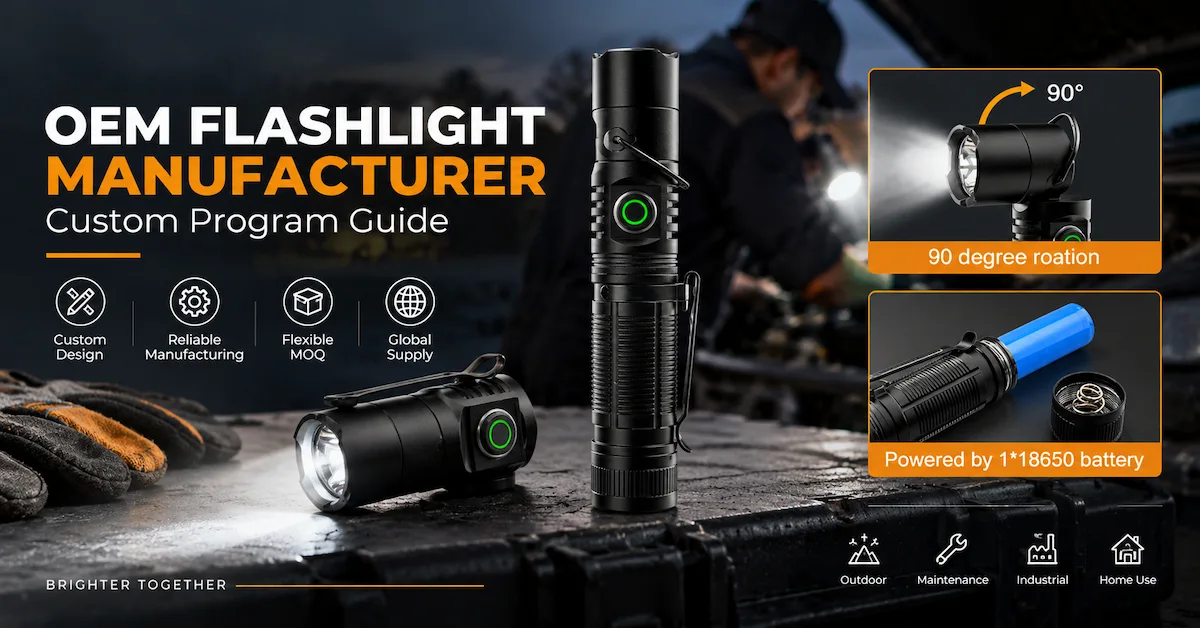
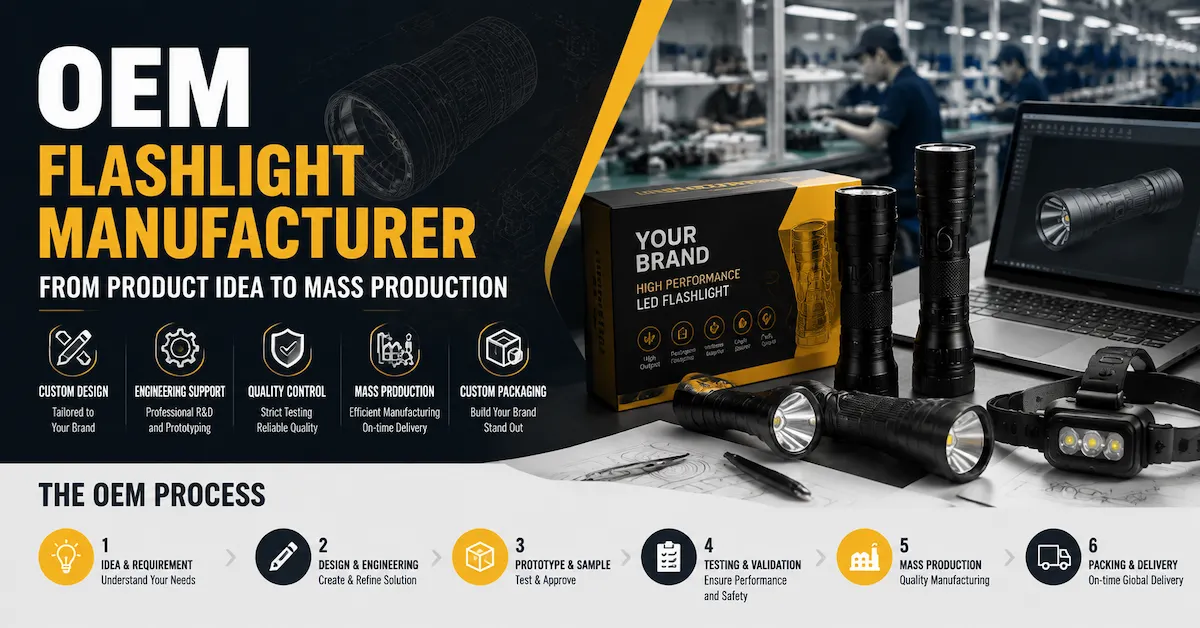
An OEM flashlight manufacturer is a manufacturing partner that helps brands, distributors, and product companies develop flashlight products under their own brand identity.
Unlike purchasing standard catalog products, OEM cooperation allows buyers to define product requirements and customize different parts of the flashlight according to their target market.
An OEM flashlight project may include:
- Product appearance customization
- Brand logo application
- LED and optical configuration
- Battery selection
- Charging system adjustment
- Function customization
- Packaging development
- Product documentation
For global buyers, working with an OEM manufacturer means gaining more control over product positioning, quality standards, and market differentiation.
A professional OEM partner does not only manufacture the final product. It supports the complete process from product concept to commercial production.
Brightenlux provides portable lighting solutions including LED flashlights, rechargeable flashlights, headlamps, working lights, camping lights, and customized lighting products for global customers.
Buyers can explore the Brightenlux product portfolio to understand available flashlight platforms before starting customization discussions.
OEM Flashlight Manufacturer vs Standard Flashlight Supplier
Many buyers confuse OEM manufacturing with simply purchasing existing products.
The difference is mainly the level of control and customization.
| Comparison | Standard Flashlight Supplier | OEM Flashlight Manufacturer |
|---|---|---|
| Product source | Existing catalog models | Customized or modified products |
| Branding | Limited options | Full brand integration |
| Packaging | Standard packaging | Custom packaging development |
| Product specifications | Fixed | Adjustable based on requirements |
| Engineering support | Limited | Available for product development |
| Market differentiation | Lower | Higher |
| Long-term cooperation | Transaction-based | Partnership-based |
A standard supplier may be suitable for buyers who need quick product availability.
However, brands that want unique products, stronger market positioning, or private-label solutions usually require an OEM flashlight manufacturer.
Why Brands Work With an OEM Flashlight Manufacturer
The flashlight market includes many similar products. Without differentiation, brands often compete mainly on price.
OEM manufacturing allows companies to create products with unique value.
Product Differentiation
A customized flashlight can be designed around specific customer needs.
Examples include:
- Outdoor adventure lighting
- Professional inspection lights
- Automotive repair flashlights
- Emergency lighting products
- Industrial maintenance tools
- Promotional lighting products
Different applications require different combinations of:
- Beam pattern
- Battery capacity
- Size
- Weight
- Mounting options
- Charging methods
An OEM partner helps translate market requirements into practical product solutions.
Brand Control
For private-label brands, the product itself becomes part of the brand experience.
OEM customization can include:
- Logo engraving
- Customized colors
- Brand packaging
- User manuals
- Product labels
- Accessories
This allows companies to build recognizable product lines instead of selling identical factory models.
Cost and Supply Stability
Long-term OEM cooperation can improve:
- Production planning
- Component management
- Quality consistency
- Product updates
- Repeat ordering efficiency
Instead of constantly searching for new suppliers, brands can build a stable manufacturing relationship.
OEM Flashlight Development Process From Concept to Production
A professional OEM flashlight project usually follows several stages.
Step 1: Define Product Requirements
The first stage is converting market needs into technical requirements.
Buyers should define:
- Target users
- Application environment
- Brightness requirement
- Beam type
- Battery system
- Charging method
- Product size
- Material preference
- Required functions
- Packaging requirements
For example:
A camping flashlight may prioritize:
- Lightweight design
- Long runtime
- Weather resistance
- Portable charging
A professional work flashlight may prioritize:
- Magnetic mounting
- Durability
- One-hand operation
- High reliability
Clear requirements help the factory recommend suitable solutions.
Step 2: Engineering Review and Product Design
After requirements are confirmed, the factory evaluates product feasibility.
Engineering considerations include:
LED Selection
The LED affects:
- Output performance
- Energy efficiency
- Heat generation
- Beam characteristics
Optical Design
The optical system determines:
- Flood lighting
- Focus distance
- Beam concentration
- Light distribution
Battery Design
Battery selection affects:
- Runtime
- Product size
- Charging requirements
- Weight
Common options include:
- 18650 batteries
- 21700 batteries
- Built-in rechargeable batteries
Housing Structure
The housing influences:
- Durability
- Heat dissipation
- Waterproof performance
- User experience
Step 3: Prototype Development and Sample Approval
Before mass production, OEM projects normally require sample evaluation.
The sample stage verifies:
- Product appearance
- Functional performance
- Assembly quality
- Packaging design
- User experience
Buyers should review:
- Brightness
- Beam pattern
- Runtime
- Charging
- Switch operation
- Accessories
- Overall appearance
A sample should become the reference standard for future production.
The approved version should include:
- Product specification
- Component details
- Packaging files
- Testing requirements
Step 4: Testing and Production Validation
Before mass production, the product should be validated.
Typical checks include:
| Test Area | Evaluation |
|---|---|
| Lighting performance | Output, modes, beam |
| Battery system | Charging and runtime |
| Mechanical structure | Housing and assembly |
| Switch durability | Operating reliability |
| Waterproof protection | Environmental resistance |
| Packaging | Product protection |
The goal is not only creating a working prototype, but ensuring the product can be manufactured consistently.
Step 5: Mass Production and Delivery
After sample approval, production begins.
A reliable OEM flashlight manufacturer should control:
- Material preparation
- Production scheduling
- Assembly process
- Quality inspection
- Packaging
- Shipment preparation
Mass production should follow the approved sample rather than introducing uncontrolled changes.
What Can You Customize With an OEM Flashlight Manufacturer?
OEM customization depends on the factory's engineering capability and project requirements.
Appearance Customization
Common options include:
- Housing color
- Surface finish
- Texture design
- Logo engraving
- Product appearance changes
For private-label brands, appearance customization helps create product recognition.
Branding Customization
Branding options may include:
- Laser logo
- Printing
- Labels
- Customized instructions
- Product cards
These details help transform a standard flashlight into a branded product.
Battery and Charging Customization
OEM projects may customize:
- Battery type
- Battery capacity
- Charging interface
- Charging indicator
- Charging accessories
For rechargeable flashlight projects, battery selection should consider:
- Runtime
- Product size
- Safety
- Transportation requirements
Function Customization
Depending on the product platform, buyers may request:
- Multiple lighting modes
- Adjustable focus
- Magnetic tail
- Side lighting
- Power indicator
- Emergency functions
However, every added function may affect:
- Cost
- Reliability
- Testing
- Production complexity
Packaging Customization
Packaging is an important part of an OEM project.
Options include:
- Retail boxes
- Color packaging
- Custom manuals
- Barcode labels
- Display packaging
A complete OEM solution should manage both product customization and market presentation.
How to Evaluate an OEM Flashlight Manufacturer
Selecting an OEM partner requires evaluating more than product samples.
Engineering Capability
A capable manufacturer should understand:
- Product structure
- Electrical systems
- LED selection
- Battery solutions
- Production feasibility
Strong engineering support reduces development risks.
Manufacturing Capability
Evaluate:
- Production lines
- Assembly process
- Capacity
- Material management
- Production control
A factory should be able to support both sample development and repeat production.
Quality Management
Important questions include:
- How are materials inspected?
- How are production defects handled?
- What testing is performed?
- How are approved samples controlled?
Quality should be built into the process, not checked only after production.
Communication Ability
OEM projects involve many technical decisions.
A good supplier should communicate clearly about:
- Design limitations
- Cost changes
- Production risks
- Improvement suggestions
Good communication reduces unnecessary delays.
MOQ and Cost Factors for OEM Flashlight Projects
OEM buyers often ask about MOQ, but MOQ depends on project complexity.
Factors affecting MOQ include:
| Factor | Impact |
|---|---|
| Product design | New designs may require higher investment |
| Components | Special parts may require larger orders |
| Packaging | Custom printing usually requires quantity |
| Decoration | Logo methods affect minimum quantities |
| Tooling | New structures require development cost |
| Production setup | Changeover affects efficiency |
Cost is also influenced by:
- LED type
- Battery
- Housing material
- Electronics
- Functions
- Testing requirements
- Packaging
OEM Flashlight Manufacturer Quality Control Process
A reliable OEM factory should control quality throughout production.
Incoming Material Inspection
Check:
- LED components
- Battery specifications
- PCB boards
- Housing parts
- Accessories
Production Inspection
Monitor:
- Assembly accuracy
- Component installation
- Electrical connection
- Waterproof sealing
Functional Testing
Verify:
- Lighting modes
- Charging
- Runtime
- Switch operation
- Beam performance
Final Inspection
Before shipment, confirm:
- Product appearance
- Quantity
- Packaging
- Accessories
- Labels
This ensures the delivered products match the approved sample.
Common Mistakes When Choosing an OEM Flashlight Manufacturer
Choosing Only Based on Price
Low prices may result from:
- Lower-quality components
- Limited testing
- Reduced customization
- Poor production control
Starting Customization Without Clear Requirements
Unclear requirements often cause:
- Repeated modifications
- Higher development costs
- Longer lead times
Ignoring Production Consistency
A good sample does not automatically guarantee good mass production.
Buyers should confirm:
- Production control
- Inspection methods
- Change management
Adding Too Many Features
More functions do not always create more value.
Additional features may increase:
- Cost
- Failure risk
- User complexity
The best product is the one that solves the customer's actual problem.
Frequently Asked Questions About OEM Flashlight Manufacturers
What does an OEM flashlight manufacturer do?
An OEM flashlight manufacturer develops and produces customized flashlight products according to buyer requirements, including branding, specifications, packaging, and production support.
What is the difference between OEM and ODM flashlight manufacturing?
OEM usually focuses on customizing existing product platforms, while ODM involves deeper product development such as new structures, electronics, or product designs.
Can I create my own flashlight brand with an OEM manufacturer?
Yes. Many OEM manufacturers support private-label projects including logo customization, packaging, product specifications, and branded documentation.
How long does OEM flashlight development take?
The timeline depends on product complexity, customization level, sample requirements, component availability, and production schedule.
What information should I provide to an OEM flashlight factory?
Buyers should provide:
- Application
- Target market
- Product requirements
- Battery preference
- Functions
- Packaging needs
- Order quantity
What is the MOQ for OEM flashlights?
MOQ depends on customization level, components, packaging requirements, and production setup. Standard models usually require lower quantities than fully customized products.
Can OEM flashlight manufacturers customize rechargeable models?
Yes. Rechargeable flashlight OEM projects can include battery selection, charging systems, indicators, accessories, and packaging customization.
How do I choose a reliable OEM flashlight manufacturer?
Evaluate manufacturing capability, engineering support, quality control, customization experience, communication ability, and long-term cooperation potential.
Conclusion
Choosing the right OEM flashlight manufacturer allows brands to move beyond standard products and create lighting solutions designed for specific markets.
A successful OEM project requires:
- Clear product requirements
- Strong engineering support
- Reliable manufacturing capability
- Controlled quality management
- Effective communication
- Stable long-term cooperation
The best OEM partner is not simply a factory that can produce flashlights.
It is a manufacturing partner that can help transform an idea into a reliable commercial product.
Brightenlux supports global customers with LED flashlights, rechargeable flashlights, headlamps, camping lights, and OEM/ODM lighting solutions.
Explore the Brightenlux products, learn more about the company's manufacturing capabilities, or contact the team through the Brightenlux contact page to discuss customized flashlight projects.