

Why warranty belongs in the sourcing decision
The buyer who looks only at the first shipment's unit price may miss the cost of the second year of ownership. A rechargeable light can fail because of a cell, charging board, switch, seal, contact, optic, cable, or misuse. A retailer may see only “does not charge,” while a factory needs to know whether the cell was absent, reversed, depleted, damaged or replaced with an incompatible part. If every return arrives without a lot code or product configuration, neither side can distinguish a one-off incident from a recurring production fault.
The purpose of a warranty program is not to make every failed unit free. It is to give both parties an agreed path for protecting the end user, finding the cause, allocating cost and preventing the next batch from repeating it. That requires product identity, a clear warranty statement, serviceable or replaceable components where appropriate, records, response times and a change-control mechanism. A buyer can ask for these elements during commercial investigation without pretending that one policy fits every destination market.
This article addresses a supplier-comparison and RFQ-intent question: what should a distributor require from a manufacturer before committing to a branded rechargeable flashlight range? The answer is a written quality and after-sales schedule that sits beside the price and specification, not a generic promise of “excellent service.” An enforceable agreement names evidence and decisions, not adjectives.
Start with the product and its actual pack-out
Consider the Brightenlux XHP50 zoom flashlight listing. It describes a 2,000-lumen maximum, a 4,000 mAh 21700 rechargeable lithium cell included, up to five hours of use, a Type-C charging port under a twist-out head, five lighting modes and an IP44 rating. Its public product image shows the broad head, orange accent ring, side switch and blue cell. Those details suggest specific service questions: Does the claimed battery ship inside the product? How does the charging head close? How is the switch diagnosed? Can a customer obtain a compatible replacement cell? Which parts are field-serviceable, and which require whole-unit replacement?
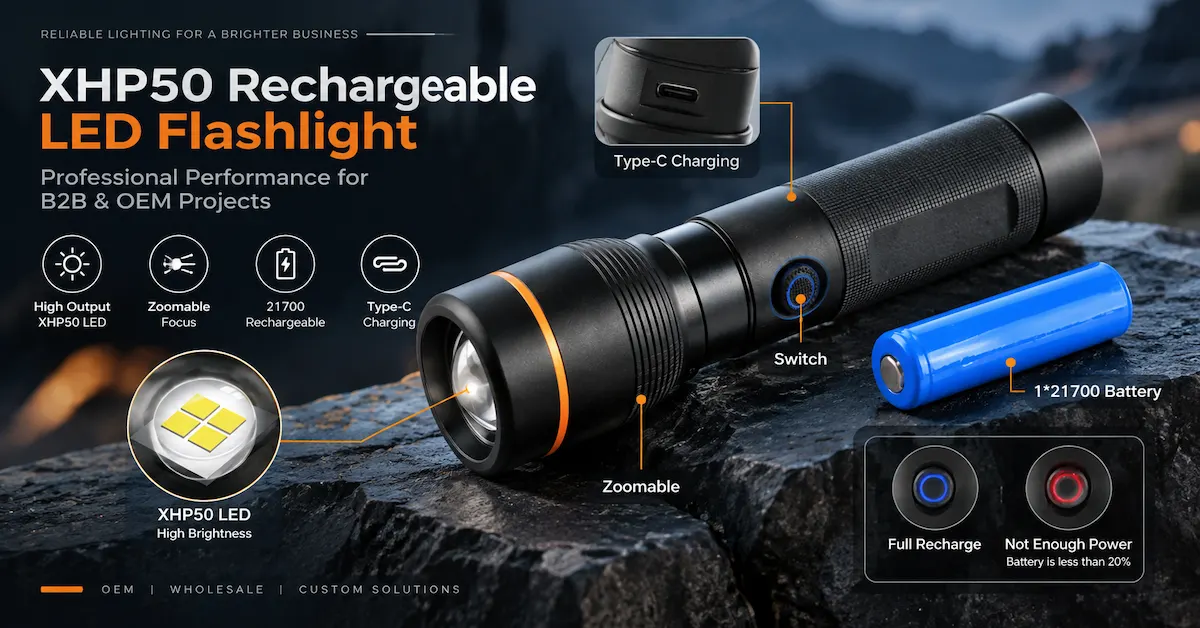
Do not write a policy around the catalog title alone. The buyer's approved SKU sheet should identify the light revision, included cell and cable, packaging, instructions, date-code location and destination market. If a battery-included pack and a battery-excluded pack share a body, they need distinguishable reorder codes and return instructions. The commercial schedule should point to the approved bill of materials, sample and artwork. A “same model” return from a later batch may be technically different if the cell, charging board or seal was substituted without approval.
The public listing also calls the product IP44 and uses “waterproof” in its title. A warranty clause must be precise about exposure conditions rather than promising unlimited water damage coverage. The IEC 60529 IP Code framework is the appropriate reference for understanding an ingress rating; an IP44 claim is not an immersion rating. Whether a particular returned unit failed because of a manufacturing seal defect, an improperly closed charging head or use outside the rated conditions requires an examination, not a photograph and a guess.
Define coverage in a one-page matrix
Set a project-specific warranty period and trigger. Is it measured from factory shipment, distributor receipt, consumer sale or activation? What proof is accepted if a buyer does not retain a receipt? Is the end customer dealing with the retailer, the importer, or directly with the manufacturer? Local consumer law and marketplace policies may impose requirements beyond the supplier's commercial warranty; the importer should obtain market-specific advice. The buyer-supplier agreement should make cost allocation clear without trying to rewrite the end user's legal rights.
List the components separately: body and switch, LED/driver, charging circuit, included battery, cable, accessories, seals and cosmetic finish. A rechargeable cell is a wear item, but a cell that arrives defective is not the same as gradual capacity loss after normal use. Define what evidence separates those situations. Avoid blanket exclusions such as “all battery issues are misuse.” Equally, do not promise indefinite free replacement for damage caused by incompatible charging equipment, unauthorized modification or operation outside stated conditions without agreeing how those cases are evaluated.
| Return symptom | Initial evidence | Provisional route | Decision owner |
|---|---|---|---|
| No light output | Mode, cell identity/charge, switch response, lot code | Safe functional check; isolate cell versus electronics | Agreed buyer/supplier triage team |
| Will not charge | Port/head state, cable, indicator, approved cell | Stop if heat or damage is present; otherwise controlled check | Qualified service technician |
| Short runtime | Mode, starting charge, cell age, output curve | Compare with approved claim method | Technical reviewer |
| Water ingress | Exposure, cap/port position, seal condition, photos | Quarantine if electrical hazard; review IP evidence | Quality and safety leads |
| Broken clip or head | Use context, impact marks, photos, date code | Compare with drawing and handling criteria | Quality team under agreed rules |
| Cosmetic damage | Arrival photos, packaging condition, finish zone | Separate transit damage from production finish | Commercial/quality owners |
This matrix is a proposed diagnostic workflow, not a statement of Brightenlux's present warranty policy. For each route, write a response window, escalation owner and interim remedy. A case can be marked “cause pending” without blocking immediate customer care. Do not force a warehouse employee to open a suspect lithium cell or perform unsafe charging. The first task is to protect people and preserve evidence.
Make the return record useful to engineering
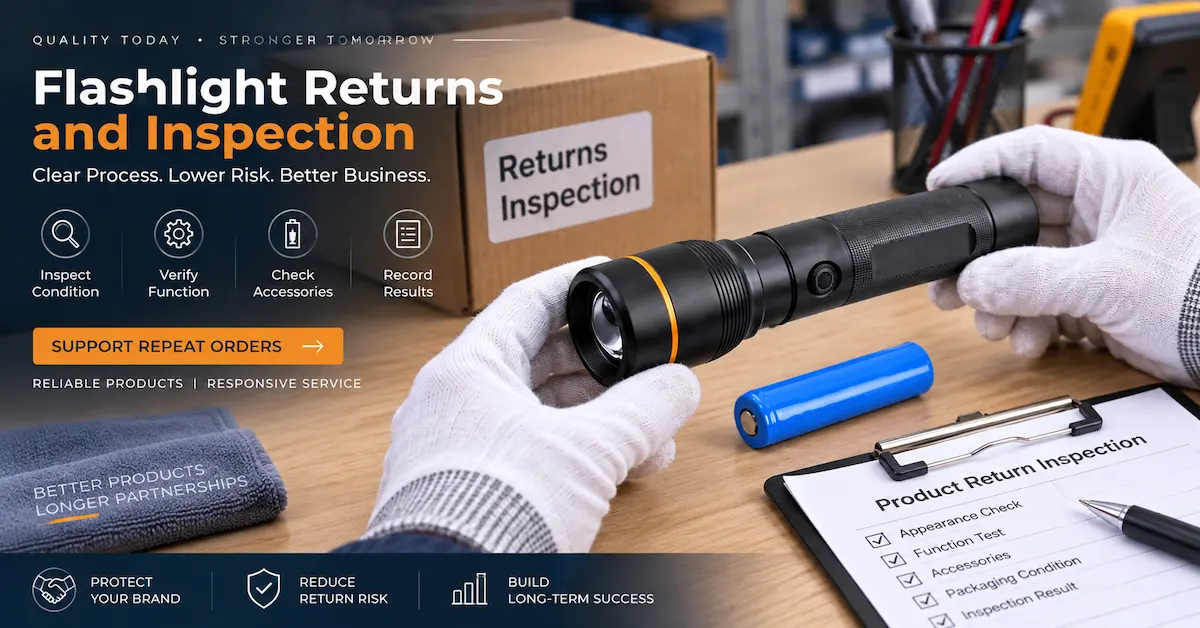
Many RMA forms collect a name, order number and a broad reason such as “defective.” That is enough to issue a label but not enough to improve a product. Add fields for SKU and revision, lot or date code, serial number if available, battery included or replaced, purchase and first-use dates, use environment, observed symptom, photos, charger/cable used, and whether the product was opened or modified. Include a free-text field for the customer's own words. A structured symptom code should be added by the triage team after reading the account, not substituted for it.
Separate symptom, failed component and root cause. “No light” is a symptom. “Open circuit at the switch contact” is a component-level finding. “Contact plating change in lot B caused intermittent connection after vibration” is a possible root cause only when supported by investigation. Do not label every unexplained return as misuse or every intermittent fault as a manufacturing defect. This distinction matters when negotiating a replacement allowance and when deciding whether a production change is needed.
Use a small code set that warehouse and customer-service staff can apply consistently. For instance, start with no output, charging fault, runtime complaint, control/mode fault, water ingress, mechanical damage, appearance, missing accessory and no fault found. Then add a separate cause code after technical review. Keep a link to the original photographs and communications. If a unit is replaced before diagnosis, retain or sample enough returns for later analysis. The data should preserve uncertainty rather than creating false precision.
Protect customer information. Product engineering usually needs the build, symptom and circumstances, not a full consumer profile. Share personal details only as required for service and follow applicable privacy rules. Agree on who stores the records, how long they are kept and who can access them. A complaint system is an operational asset only if the entries can be trusted and legally handled.
Safety escalation comes before ordinary RMA economics
A report of heat, smoke, swelling, electrolyte leakage, burns or a charging event is not a routine exchange request. Stop charging and handling according to qualified safety guidance, segregate the affected product, preserve relevant evidence and escalate to the responsible safety and regulatory personnel. Do not mail a visibly damaged lithium cell using the normal return label. Transport rules vary with the cell and package condition; the IATA lithium-battery resources are an authoritative starting point for air-cargo requirements, but the shipper and qualified carrier must make the actual classification and booking decision.
Define an internal safety trigger and a named owner before launch. The distributor may need to stop sale or quarantine inventory while facts are gathered; the manufacturer may need to trace the cell and charging-board lots. Neither side should wait for a statistically significant return percentage if the reported failure presents a plausible hazard. The article does not determine whether any specific incident is reportable under a jurisdiction's law. That decision belongs to competent legal and product-safety teams with the actual facts.
For non-safety complaints, choose a proportionate route. A missing cable can be resolved differently from a failed driver. An obvious transit-damaged carton may belong in a carrier claim rather than a factory defect count. A reversible user error may warrant clearer instructions rather than a hardware change. The RMA workflow should make it possible to recognize these distinctions without making the end user repeat the same story to multiple organizations.
Diagnose the likely failure path without assuming the cause
Battery and charging
A no-charge complaint can originate in the cell, USB cable, connector, port contamination, charge controller, indicator or user sequence. The authorized technician should first check for visible damage or heat and follow safe procedures. For an undamaged sample, record the approved cell identity and the test setup before substituting a known-good component. A problem that disappears with a different cable should not automatically be charged to the flashlight factory; a recurring port alignment fault on the approved product should not be dismissed as “bad cables.”
Battery capacity and runtime complaints need context. Ask the customer which mode was used, whether the unit stepped down, when and how it was charged, and whether the cell was replaced. Compare a returned unit with an approved control under the same conditions. The product page's “up to five hours” wording does not establish five hours at maximum output. The ANSI/PLATO FL 1-2025 standard provides a common performance vocabulary, but the actual method and contract endpoint must be agreed. A field complaint can still be commercially important even when a narrow standardized test passes.
Switch, LED and optical assembly
Record whether a switch fails always or intermittently, whether the failure follows a particular mode sequence, and whether the unit responds to a known-good approved cell. A scratched lens is visually different from an optic that moved during assembly. A dim light might be a discharged cell, thermal step-down, driver fault or LED change. Preserve evidence before swapping multiple parts at once; otherwise the true cause may be lost. When a supplier claims a component substitution is equivalent, ask how equivalence was tested on the complete light.
Head, seals and construction
The XHP50 example's twist-out charging arrangement invites questions about closure, seal wear and the customer's instructions. A return showing moisture should be photographed before disassembly, then compared with the rated condition and the actual exposure account. A broken zoom mechanism should be classified by physical damage, assembly issue or design weakness only after examination. Not every defect can be resolved remotely; define when the supplier will inspect a sample and how the parties handle units that are uneconomic to ship back.
Even a “no fault found” result needs a record. Perhaps the customer used a different mode, the cell was not included in a particular pack, or the retailer's instructions were incomplete. Repeated no-fault-found returns can be a product-interface or content problem. Feed those patterns into manuals, product pages and carton copy. The absence of a bench failure does not mean the customer experienced no problem.
Write a supplier agreement that can be operated
A quality agreement should specify how the buyer and manufacturer exchange claims, not simply state that the factory “guarantees quality.” Include product scope and revision, start and end of the commercial warranty, covered and excluded conditions, evidence required, immediate-safety escalation, response times, sample-return route, cost allocation, remedies and closure criteria. Attach an escalation contact on each side and a cadence for reviewing trends. Keep the agreement aligned with the consumer-facing policy; the latter may be governed by local law and retailer commitments that differ from the factory's contract.
Define what happens before fault attribution is complete. A distributor may need to replace a consumer's light quickly. The factory may reasonably require a representative failed unit before accepting responsibility for a systematic issue. An interim reserve, credit process or sample-return procedure can bridge that gap. Do not force the customer to wait for a transnational root-cause report, and do not make a supplier accept an unlimited unidentified return population. Write down which party takes the initial action and how costs are reconciled after diagnosis.
Use a defect-severity ladder. Safety concerns should trigger immediate containment and qualified review. Functional failures that make the light unusable require a defined response and investigation. Minor cosmetic variation can follow the agreed visual standard. The thresholds and sample plans should be negotiated with the SKU's use case and volume in mind. Do not copy a generic AQL number into this article or the purchase order and assume it answers every failure mode. Inspection acceptance at shipment and warranty performance in the field are related but different obligations.
Set the evidence handoff. The buyer sends an RMA export with product and lot identity, symptom codes, photographs, failure dates and return volume. The manufacturer acknowledges cases, requests representative samples, reports findings with uncertainty, and proposes corrective action with an owner and target date. Both parties review whether the action worked on a later lot. The record should distinguish “suspected cause,” “confirmed cause” and “closed.” This prevents an attractive but untested explanation from becoming a permanent label in the database.
For repeat issues, agree on a trigger for broader investigation rather than waiting for an annual negotiation. The trigger might involve a cluster of the same symptom within a lot, a significant increase against the agreed baseline, or a single credible safety report. The actual numerical threshold should be set from the program's volume and risk. Record how inventory is identified and quarantined, who informs channel partners, and how corrected units are verified. A factory that offers a replacement without root-cause control may solve one complaint while preserving the next shipment's defect.
Calculate the cost of a return before negotiating a unit allowance
The commercial cost of a failed light is not just its ex-factory price. A distributor may pay for customer support, reverse logistics, inspection, replacement freight, tax adjustments, retailer chargebacks and lost shelf time. Some units are not economical to return to China; others are worth retrieving because the failure could indicate a safety or production problem. Put these costs into a transparent model and then decide which events each party controls. Avoid turning a complex quality problem into a flat percentage without a data collection path.
| Cost line | Buyer question | Evidence to retain | Possible agreement treatment |
|---|---|---|---|
| Customer replacement | Is advance replacement needed? | RMA and replacement SKU | Interim stock or credit, reconciled later |
| Return freight | Does diagnosis need a physical unit? | Carrier record and sample selection | Pre-agreed sample route, not every unit |
| Inspection labor | Who performs first-level triage? | Time and procedure | Rate or service allowance by contract |
| Parts | Can a safe, approved part be replaced locally? | Part code, lot and instruction | Spare-parts supply and qualification |
| Inventory containment | Which lots or channels are affected? | Lot traceability and count | Responsibility after investigation |
| Artwork/manual correction | Was the claim or instruction unclear? | Approved copy and revision history | Allocate by change owner and cause |
Do not treat the table as a quote or a promised Brightenlux service schedule. It is a structure for comparing supplier proposals. When seeking a wholesale price, ask for the base product, battery, cable, packaging, optional spares, warranty reserve and proposed service responsibilities as separate lines. A cheap quote with no support provisions may be expensive after the first peak season. A higher quote with a defined parts and credit process can be easier to manage, but only if the promised process is written and feasible.
Prepare a sensitivity calculation using your own expected annual units and observed channel return history. Run more than one plausible scenario rather than presenting a fabricated industry-average defect percentage as fact. A small program may decide to hold a few replacement units locally. A large chain may require automated lot-level RMA reporting and a supplier reserve. The cost model should show the break-even point for local repair versus whole-unit replacement, including technician skill and safety controls. If there are no reliable baseline data, begin with a pilot and update the allowance after real returns are classified.
Design spare parts and repair boundaries before launch
Ask which parts are replaceable by the end user, retailer, trained service partner or factory only. A removable 21700 cell does not mean every internal part is serviceable. The approved cell format, dimensions and protection arrangement must be specified; casually recommending an arbitrary replacement battery can create compatibility and safety problems. The supplier should provide parts codes and instructions for any authorized service. If a seal is disturbed during repair, decide whether the repaired assembly retains its ingress rating and what requalification is required.
A practical spare-parts list can include approved cells, cables, tail caps, clips, O-rings, lens assemblies or switches where the design and service method support them. Do not promise those parts for the XHP50 model merely because they appear physically separable in a photograph. Ask the manufacturer which are actually available, how long they will remain available, minimum quantities, lead times and revision compatibility. Some low-cost items are best held locally; some should be shipped with the next replenishment; some should not be field-repaired at all.
Document the boundary with a simple decision tree. If the complaint is a missing accessory, ship the approved accessory. If the unit has heat or cell damage, stop routine service and escalate. If a normal charging fault can be safely diagnosed by an authorized technician, test with approved components. If opening the enclosure voids the seal or creates electrical risk, replace the complete unit and return a sample for analysis. A policy that says “repair where possible” without naming competence and tools is not a service plan.
Use returns to protect the next purchase order
At each reorder, compare a new sample with the approved reference and the field-return trends. Has the LED, driver, switch, battery supplier, port, seal, coating or packaging changed? Is a recurring complaint concentrated in one lot or across the range? Did revised instructions reduce no-fault-found returns? Ask the manufacturer to disclose changes affecting performance, service or claims before production. A substitution can be beneficial, but an undocumented substitution breaks the connection between the original tests and the product being shipped.
Build a corrective-action record with the problem statement, containment, investigation, confirmed or unconfirmed cause, proposed change, validation result and effectiveness review. For a charging issue, validation might include repeated connector use and compatibility with the approved cell and cable. For an ingress issue, use the appropriate enclosure test on the changed assembly. For a cosmetic complaint, use agreed visual examples under consistent light. These are examples of a buyer's requested validation; this article reports no actual factory test data.
Keep the next order's specification aligned with customer support. If a replacement cell becomes a new approved source, update the service instructions and spare inventory. If a mode sequence changes, update the manual, retailer FAQ and customer-service script. If a packaging insert changes, photograph the final pack-out. The best return reduction often comes from synchronizing a technically correct product with correct expectations, not from demanding a generic “zero defects” promise.
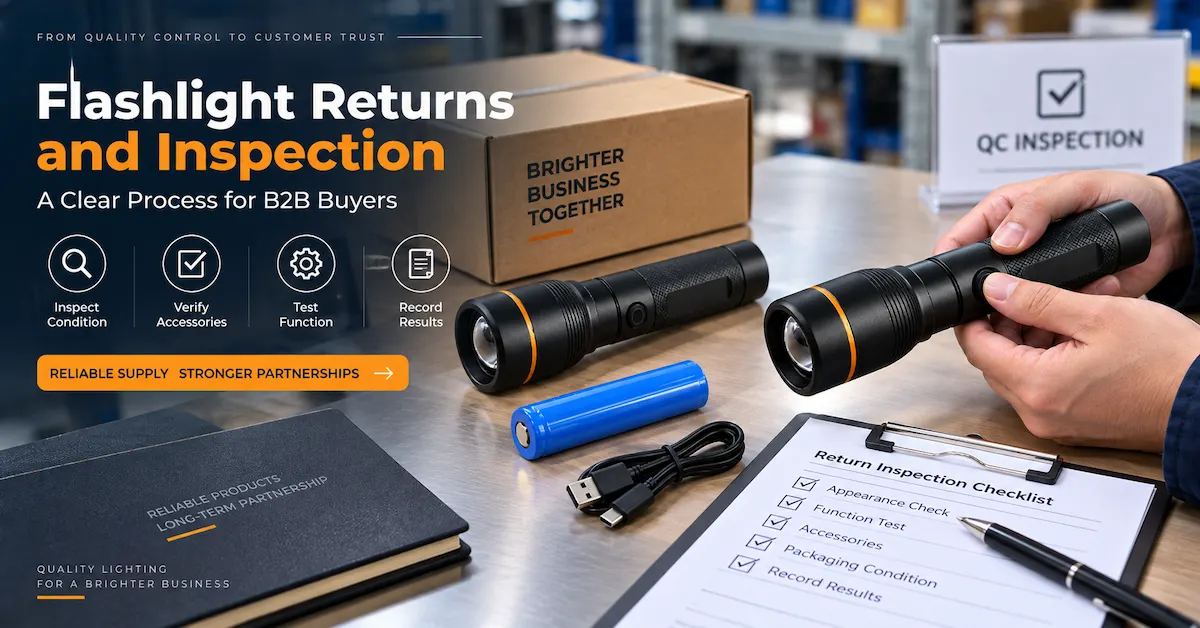
A pilot order can establish the evidence baseline. Approve one configuration, collect a representative pre-production sample, agree on the first shipment inspection, retain a reference, then collect structured feedback from the launch channels. Review the first return cohort together before scaling the program. The pilot should have a commercial plan, not be a vague request for free samples. State the intended forecast, destination market and decision gate so the supplier can quote an appropriate build and service scope.
Different buyer searches imply different after-sales questions
A buyer searching for a flashlight manufacturer may primarily want production capacity, but the meaningful comparison is whether the supplier can identify and support the exact shipped build. Ask who maintains the specification, how date codes map to components and how a failed unit reaches an engineer. An impressive catalog without a usable RMA route is a weak foundation for a distributor warranty.
For an LED flashlight manufacturer, ask how optical and switch failures are coded and how an LED or driver revision is validated. The linked adjustable-head model is a distinct reference with a magnetic tail and 18650 cell; its service pattern should not be pooled blindly with the 21700 XHP50 zoom model. A shared brand does not make the internal designs interchangeable.
For a rechargeable flashlight manufacturer, the battery and charging system deserve their own warranty schedule. Ask about cell inclusion, replacement guidance, charging-board diagnosis, power-bank function where offered, and transport handling for returns. A power-bank feature adds an output path that a simple light does not have. Do not assume identical failure categories across both products.
An OEM flashlight manufacturer should explain which party validates a changed component and pays for a change-related service issue. The buyer may approve an upgraded cell or new switch for commercial reasons, but the new build needs a revision and updated service records. An OEM label should not erase responsibility for engineering changes.
With a private label flashlight manufacturer, align the consumer-facing brand's warranty copy with the factory's remedy process. Logo, packaging and contact channels may belong to the buyer, while the factory supplies investigation and replacement units. Ask who answers technical complaints and who may issue a public product statement. A branded carton should not direct customers to an unreachable generic inbox.
A custom flashlight manufacturer project may require bespoke spares or tooling retention. Define the planned service life and change notification before the last compatible component disappears. If the head, magnet or enclosure is newly engineered, validate any repair procedure and keep the part drawing under revision control.
A flashlight supplier China comparison should include the practical return route between the destination market and the factory. Who pays for a sample shipment, who classifies the battery, and when can a photo or local inspection substitute for physical return? The linked dual-power listing has a different battery arrangement, so the return instructions should identify which configuration is in the carton.
A wholesale flashlight supplier relationship often spans many SKUs and channels. Require a common RMA data structure but preserve model-level diagnosis. Otherwise a high-volume entry light can hide a low-volume but serious defect in a premium model. Compare warranty terms alongside assortment roles and reorder availability.
A portable flashlight manufacturer inquiry should address clip, switch and pocket-carry complaints, including accidental activation and finish wear. A small light that is carried daily experiences a different handling pattern from a stored emergency light. Define normal use and the cosmetic acceptance standard with real sample photos before launch.
RFQ appendix: ask for a warranty proposal, not a slogan
Send the supplier a concise schedule alongside the product brief. Identify intended markets and channels, forecast and launch order, the proposed consumer warranty and any retailer service-level requirements. Ask the supplier to mark each item as accepted, proposed alternative or not available. Request a named owner and sample of the RMA report format. This is more productive than asking “Do you offer a warranty?” and receiving a one-word yes.
- Confirm the exact quoted SKU, revision, battery and accessory pack-out, plus where a lot/date code appears on unit and carton.
- State the proposed coverage period and start date; distinguish consumer policy from the supplier's business-to-business remedy.
- List covered components and conditions, exclusions that need evidence, and a process for disputed cases.
- Define safety escalation, inventory containment and the route for a damaged or suspect lithium battery.
- Agree on first response, sample request, investigation update and final disposition milestones.
- Price replacement units, approved spares, local-service training, sample freight and any initial reserve separately.
- Set a common RMA data format, review cadence, repeated-failure trigger and corrective-action closeout method.
- Document change notification, approved reference retention and validation required before a new component enters a reorder.
Ask for a project-specific MOQ and lead-time breakdown for the selected service strategy. A supplier may have one minimum for stock goods, another for branded cartons, and another for custom spare parts. The answer depends on the actual configuration, production schedule and commercial relationship; the public catalog does not supply a reliable universal number. Similarly, do not publish a promised response time unless the responsible team accepts it in writing and has a channel for receiving cases.
FAQ: flashlight warranty and return planning
Should the battery have the same warranty as the light?
Not automatically. A rechargeable cell changes with use and storage, but an included cell can also be defective on arrival. State the coverage conditions and evidence needed for each case. Identify the approved cell and safe replacement route. Avoid a broad clause that labels every weak-runtime report “battery wear” without checking mode, charging history and the product's own electrical behavior.
Can we promise a lifetime warranty in our private-label listing?
Only if the business has defined what “lifetime” means for its market, can fund the remedy and has a supplier agreement that supports the actual obligation. Consumer-law rules vary. The factory's one-year or project-specific commercial support, if any, does not automatically fund a brand's broader promise. Obtain legal and commercial review before putting an open-ended statement on packaging or a marketplace page.
What if a customer returns a flashlight with another brand's 21700 cell?
Record the cell identity and condition without assuming it caused the fault. An authorized technician may test the light with the approved cell if it is safe to do so. The contract should explain compatibility and exclusions, while the customer-facing instructions should make the approved replacement type clear. An unrelated cell could be relevant evidence, but it is not by itself a full root-cause analysis.
Do we need every failed unit shipped back to the factory?
Usually the economically sensible route depends on volume, failure severity and diagnostic value. A representative sample may be enough for a recurring non-safety problem, while a safety concern may require controlled evidence preservation and qualified transport handling. Agree on sampling and cost allocation before cases accumulate. Do not use normal parcel labels for a damaged or suspect lithium cell.
How do we know whether water ingress is a warranty defect?
Review the rated condition, the product revision, cap and port position, seal state, exposure account and available test evidence. IP44 is not an immersion promise. A manufacturing seal defect under rated use and damage after out-of-scope exposure require different decisions, but photographs alone may not settle either. Preserve the unit and document the technical review rather than defaulting to a blanket “water damage excluded” response.
What is a reasonable spare-parts promise?
One that identifies actual serviceable parts, compatibility by revision, minimum order, price, availability period and lead time. A list copied from an exploded diagram may include parts that are unsafe or uneconomic to replace in the field. Ask for approved procedures and consider whether opening the light changes ingress protection. The parties can choose whole-unit replacement where a safe local repair route does not exist.
Should a new cell supplier trigger a full product requalification?
It should trigger an impact assessment and the tests affected by the change. Cell dimensions, protection behavior, capacity, charging and runtime may matter. The exact validation scope belongs in the approved specification and change-control agreement. Treat “equivalent” as a conclusion supported by evidence, not merely a supplier's purchasing label. Update RMA and service records so older and newer lots remain distinguishable.
How can a small distributor start without historical return data?
Define a modest pilot with clear product identity, a local replacement plan and a simple but complete RMA form. Review the first cohort after a meaningful number of units have been used, while escalating any safety signal immediately. Use the observed mix of symptoms to adjust packaging, instructions, spare stock and the commercial allowance. Do not import a generic industry return percentage and present it as this product's history.