

A flashlight is not automatically an easy parcel just because its battery is small. Imagine three orders for the same approved body: one puts the cell inside the tube, the next places it in a retail tray, and the third leaves battery sourcing to the importer. Those three cartons can call for different transport descriptions, packing instructions, marks and booking decisions. The problem usually starts when a sales page says “rechargeable” while the purchase order never says what is physically inside the shipping package.
This lithium battery shipping flashlight guide is for importers, private-label buyers and distributors selecting Brightenlux models for international orders. It addresses a practical question: what must a buyer establish before asking a forwarder for an air or sea quote? It is a preparation framework, not a dangerous-goods declaration or a substitute for the current regulations, trained shipper, carrier requirements and route-specific professional review. The exact cell, pack, quantity, packaging and route control the answer. Regulatory points below were checked against the IATA 2026 guidance, UNECE battery-test resources, IMO's current IMDG Code information and PHMSA's shipper resources as of 14 September 2026.
Quick answer: what changes when a flashlight contains a lithium battery?
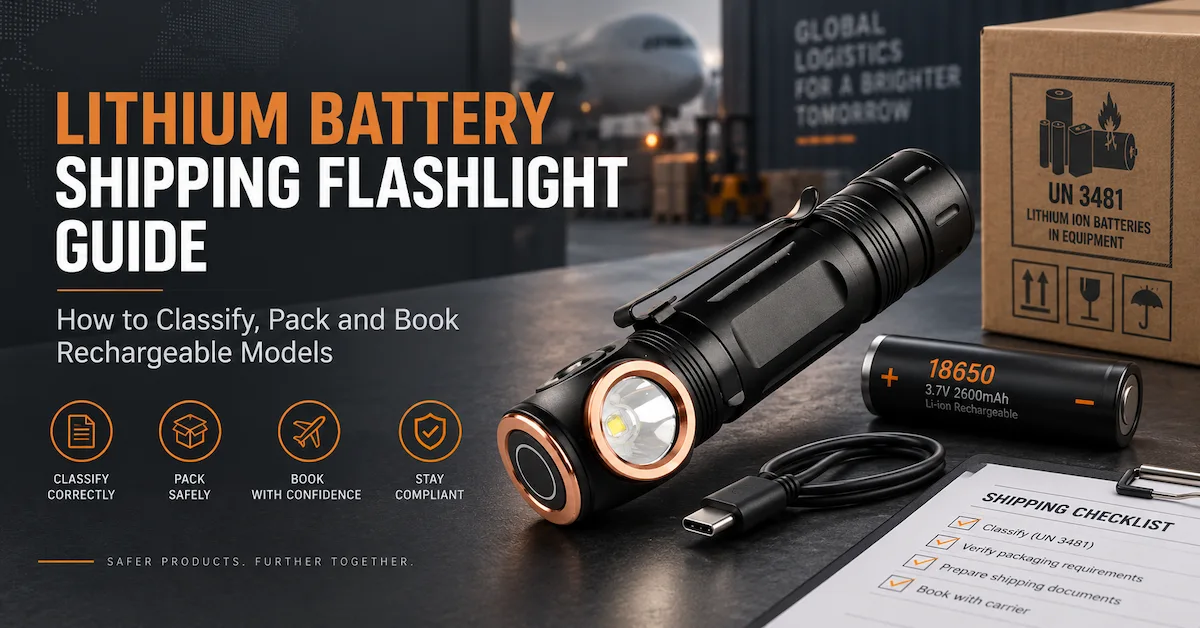
First identify the chemistry and the physical relationship between the cell and the flashlight. A lithium-ion cell installed in a rechargeable flashlight and a lithium-ion cell packed separately with the flashlight can both fall under UN 3481, but the air packing instructions differ: PI 967 for contained in equipment and PI 966 for packed with equipment. If a carton contains replacement lithium-ion cells but no flashlights, a flashlight name on the invoice cannot turn its contents into “equipment”; UN 3480 and PI 965 are the air starting point. A non-rechargeable lithium-metal chemistry sends the review down the UN 3090/3091 branch instead. Give a qualified dangerous-goods specialist the pack photo and route for sign-off, not just the web listing. The IATA battery guidance gives the current air-transport decision framework.
Second, match the cell identity and watt-hour rating to its UN 38.3 test summary. Third, decide the transport mode and route. Fourth, approve an outer package that prevents damage, short circuits and accidental activation, with the marks, labels and documents required for that exact case. Finally, send the forwarder a truthful packing list: model, cell type, battery location, units per carton, net battery weight where required, carton count and dimensions. No sticker can fix a wrong battery description.
One 2026 detail deserves special attention. For air transport, IATA's 2026 guidance says lithium-ion batteries packed with equipment under PI 966 are subject to a state-of-charge limit, with specific Section I and Section II conditions. For batteries contained in equipment under PI 967, reduced charge is strongly recommended but not generally mandatory under that guidance. These are different cases; do not copy a 30% claim from one into the other. Carrier or State variations may be stricter.
Start with the retail box and the master carton
Good flashlight lithium battery shipping starts at the packing bench, not the airport. Ask for photographs of one open retail box and one open master carton from the proposed order, then point to each cell. Is it inside the light? In a plastic sleeve beside the light? A second spare cell in an accessory compartment? Did a sales sample include a battery that the bulk order omits? A single extra cell can change the transport story while leaving the product page and carton artwork apparently unchanged.
Some flashlight platforms also accept AA or AAA dry cells. “Dual power” does not tell a forwarder what was actually supplied. For example, Brightenlux lists a 600-lumen dual-power flashlight with a rechargeable battery included and AA cells not included on its current page. A buyer could choose a different commercial configuration only after getting written confirmation; the transport file must describe the delivered configuration, not a possible use case. On the 1000-lumen Type-C page, the 18650 is “not included by default,” a small commercial line with a large pack-out consequence. That distinction is commercially useful and transport-relevant.
| What is in the shipping package? | Likely lithium-ion air starting point | Buyer should verify |
|---|---|---|
| Cell or battery installed in each flashlight | UN 3481, contained in equipment, PI 967 | Installed position, switch protection, Wh, unit count and package marks |
| Cell or battery beside the flashlight, intended to power it | UN 3481, packed with equipment, PI 966 | Individual terminal protection, quantity, 2026 SoC rule and packing section |
| A carton of replacement cells, no lights | UN 3480, PI 965 | The separate-battery booking, charge and cargo-aircraft conditions |
| A flashlight supplied without any lithium cell | No lithium entry solely on account of that light | Look inside accessories and mixed cartons for a hidden spare or backup cell |
Use the rows to frame a precise question to the trained shipper, not as a ready-made declaration. Chemistry, energy rating, configuration, section, number of packages and carrier acceptance still need checking. A package mixing equipment and separate spare batteries is especially easy to describe incorrectly. Ask the forwarder to review a pack-out photograph and detailed bill of materials before quantities are finalized.
Request a Battery-Configuration Review
UN3481 flashlight shipping: the label is not the whole answer
Buyers often ask for a “UN3481 label” as if that completes the shipment. The UN3481 flashlight shipping decision begins earlier: is this lithium-ion cell installed in the device, or packed separately with the device it powers? IATA gives both descriptions under UN 3481, but PI 967 and PI 966 have different packing conditions. Section I and Section II also affect marks, labels, paperwork and limits. The carton may need a lithium battery mark, but the IATA guidance includes exceptions for certain small consignments of cells or batteries installed in equipment. The mark is not universally required, and it must not be applied merely for visual reassurance.
Do not confuse a lithium battery mark with the Class 9 lithium battery hazard label. They are distinct transport elements. The required combination depends on the packing instruction and section. An installed-cell product is not automatically exempt from all documentation or outer-packaging requirements. Nor is “less than 100 Wh” a free pass. It identifies one threshold in the air guidance for a lithium-ion battery; the remaining conditions still matter.
When a sales team says “we have shipped this model before,” ask what shipped before: same cell maker and part number, same number of cells, same physical location, same master carton, same mode, same route and same operator? A previous successful shipment can be a useful record, but it does not approve a changed pack-out. The objective is a repeatable classification tied to a frozen configuration rather than a label template attached to whichever carton happens to be ready.
What changed for lithium-ion air freight in 2026?
The most easily missed point in lithium ion battery flashlight air freight is the state-of-charge treatment. IATA's 2026 Battery Guidance Document says that from 1 January 2026, lithium-ion cells and batteries packed with equipment under PI 966 Section I must be offered at no more than 30% of rated capacity unless the specified State approvals are obtained. Under Section II, the 30% requirement applies to cells or batteries above 2.7 Wh; shipping above that charge level leads into Section I and its approval conditions. For PI 967 batteries installed in equipment, 30% SoC or an indicated battery capacity not exceeding 25% is strongly recommended as a safety measure, but the guidance says reduced charge is not mandatory for that case.
Those words matter at the factory. An installed 21700 cell may be treated differently from a spare 21700 cell placed beside the flashlight. Moving a cell from the body to the retail tray to simplify inspection is not a neutral packing change. Likewise, a spare-cell promotion can change both the pack-out and transport eligibility. Ask the packing team how it brings a packed-with cell into the approved charge range, where it records the measurement, and whether that work happens before retail boxes are sealed.
IATA's passenger-aircraft prohibition applies to loose UN 3480 lithium-ion battery cargo under normal provisions. It does not automatically bar an installed-cell flashlight; the assigned packing instruction and carrier still decide. Conversely, a courier website accepting a tracking number is not proof the declared configuration was correct. An airline, forwarder or postal operator may impose additional restrictions and may decline a shipment even where a regulatory path exists.
A sensible quote request has two prices if the product has two legitimate configurations: with the approved cell installed, and without a lithium cell. Compare the complete landed proposition, including the battery, source control, packing, documentation, freight, destination handling and customer experience. Do not remove the cell from a retail promise without revising the product page, carton copy, manual and customer-service expectations.
The battery identity sheet that prevents a booking surprise
For shipping flashlights with lithium batteries, “one 18650 included” is only the start of a useful description. The number 18650 describes cylindrical dimensions; it does not tell a shipper which maker's tested design is in the tube. Give each approved cell a one-line identity record: maker and part, chemistry, nominal voltage, Ah and Wh, protection arrangement, cell-versus-pack status, and permitted alternate. Identify the flashlight model, product revision and quantity of that cell in each device and shipping package.
Watt-hours for a lithium-ion cell are calculated from nominal voltage multiplied by ampere-hour capacity. A hypothetical 3.7 V, 2.6 Ah cell is 9.62 Wh. That is an arithmetic illustration, not a claim about any Brightenlux product or a substitute for the battery maker's rated Wh. Keep the documented value and manufacturer part number together. If a factory changes to a same-size cell of a different brand, “same mAh” does not prove that its UN 38.3 test evidence, protection behavior, electrical fit or traceability is equivalent.
The UNECE Manual of Tests and Criteria, Rev. 8 and Amendment 1 provides the official subsection 38.3 framework. IATA's 2026 guidance says manufacturers and subsequent distributors must make the specified lithium battery test summary available for relevant post-June-2003 designs. Compare its named manufacturer, model, mass, watt-hour rating, report reference, laboratory and test results with the actual supplied cell or battery. A PDF with “UN 38.3” in its filename but a different cell part number is a question, not a completed check.
| Evidence item | What to compare | Common mismatch |
|---|---|---|
| Battery identity sheet | Maker, model, chemistry, Wh, quantity, location in device or pack | Only “18650 lithium battery” appears on the invoice |
| UN 38.3 test summary | Tested design, model and rating match the supplied lot | Report belongs to a former or alternate cell |
| Bill of materials and purchase order | Approved cell and substitution rules match commercial pack-out | Factory substitutes at incoming inspection without buyer approval |
| Pack-out and carton record | Installed versus packed-with, units per carton, net battery weight | Sales sample and production carton contain different extras |
| Forwarder approval | Mode, route, carrier, marks, labels and documents for final package | Approval was for sea freight but order is changed to air |
Ask for the evidence before artwork and shipment dates are locked. A test summary is not itself a certification that the flashlight, charger, retail carton or destination-market sale meets every requirement. It answers a specific battery transport-design question. A model-change control procedure must keep that answer connected to the cell that production actually installs.
Ask About the Exact Cell and Pack-Out
Make the outer package protect the light and the people handling it
flashlight battery transport packaging is more than a retail box with a battery symbol. The package needs to keep batteries from damage and short circuits and, for installed batteries, keep the flashlight from accidental activation. A raised tail switch can press against a tight insert. A side switch may be accessible through an open display window. A magnetic-tail model may shift inside a thin tray. Test the proposed insert and outer carton in the orientation and density used for transport.
For a cell packed separately with a flashlight, prevent terminal contact with metal accessories, other batteries or loose components. Do not assume a thin plastic sleeve is adequate without reviewing the packing instruction and actual handling. If a retail pack holds a battery beside the flashlight, the designed cavity should constrain movement after the pack is dropped or shaken. The outer master carton must also retain strength when stacked. IATA notes additional packaging performance requirements introduced for relevant non-UN-specification air packagings; the trained shipper should verify the applicable test and evidence rather than improvising a carton test at dispatch.
For installed cells, lockout and activation prevention are practical checks. Does the switch require a long press? Can a mechanical tail cap be backed off safely without changing the customer-ready condition? Does a protective tab belong in the retail experience, and is it removed by the user? Decide these as part of the approved product and pack, then inspect samples from packed cartons. An accidental beam inside a closed package may mean heat and an unacceptable transport risk, not merely drained batteries.
The shipper should determine the correct lithium battery mark, hazard label, cargo-aircraft-only label, wording and documents for the exact route and section. IATA's guidance explicitly describes circumstances where a battery mark is not required for a small number of installed cells or batteries, and circumstances where it must not be applied to a Section I package. Blindly ordering 10,000 printed UN3481 cartons before classification can create waste. Approve the mark and its placement on an actual shipping package, not only on an attractive retail carton.
Air versus sea: do not reuse one booking checklist
The lithium battery flashlight shipping regulations differ by transport mode. Air cargo is governed through ICAO Technical Instructions and the operator's implementation, with IATA's current Dangerous Goods Regulations and battery guidance widely used in preparation. Sea shipments use the International Maritime Dangerous Goods Code. The IMO states that the 2024 IMDG Code including Amendment 42-24 became mandatory on 1 January 2026. Road and rail legs and the destination country's rules may add another layer. A valid sea-freight pack-out is not automatically an air-freight pack-out.
Sea is often commercially practical for planned bulk orders, but it is not “unregulated shipping.” Ask the forwarder which IMDG classification, special provisions, packing, marks, documents, segregation and local port rules apply to the final cargo. For a time-sensitive sample shipment by air, the small parcel can be more complicated than a pallet because the carrier's service and account acceptance rules matter. Plan sample logistics before promising a customer a delivery date.
| Question | Air booking | Sea booking |
|---|---|---|
| Which current rule set? | ICAO/IATA packing instruction, section and carrier variation | Current IMDG Code and carrier/port conditions |
| Where is the battery? | Installed, packed with or separate drives PI and acceptance | Same physical distinction must be honestly declared |
| Charge-state plan? | Check 2026 PI 966 and PI 967 treatment | Check actual IMDG and carrier requirements; do not import an air rule uncritically |
| What evidence goes to the forwarder? | Cell identity, UN 38.3 summary, pack-out, counts, proposed marks and documents | The same identity chain plus sea-specific declaration and packing review |
Ask a forwarder for a written answer to the actual configuration, not a generic “battery freight surcharge.” Specify the origin, destination, mode, expected transit plan, number of retail units per master carton, cell count and Wh, net battery weight, packaging photographs and required delivery window. If the route changes after quotation, reopen the battery review. A buyer who keeps that gate in the project calendar has more freedom to choose cost-effective transport than one who discovers the issue after goods are packed.
Brightenlux product examples: three quotes, three different questions
A lithium battery flashlight manufacturer should be asked for order-specific data, not an unsupported promise that every model is “ready for worldwide shipping.” Brightenlux's public pages show useful product configurations for building the conversation, but the buyer and trained shipping parties must confirm the actual cell and pack-out for the purchase order. The examples below are illustrations drawn from public product descriptions, not transport classifications issued for Brightenlux shipments.
Example A: 1000-lumen SST25, red modes and 18650 included
The SST25 rechargeable flashlight page states that an 18650 battery is included, with magnetic tail and headstrap accessories. Ask whether the cell is installed in each flashlight for the bulk order or packed separately in the retail box. Request the exact cell maker and model, Wh, UN 38.3 summary and a photo of the opened retail pack. The accessory bundle needs space without creating switch pressure or loose metal contact. If the package is redesigned for a private-label promotion, reopen the transport review.
Example B: 1500-lumen SST40 with 21700 included
The 21700 rechargeable flashlight page identifies a 4000 mAh battery as included. Capacity in mAh alone does not establish Wh or the precise cell design. Ask for nominal voltage, cell model, location, approved shipping charge-state plan and packaging drawing. A buyer ordering this as a premium retail model may want the battery installed for immediate use; a separate-cell bundle is a different pack-out and may trigger the PI 966 air SoC conditions. Agree on that choice before buying printed cartons.
Example C: 1000-lumen Type-C model without a cell by default
The 1000-lumen Type-C page says its 18650 battery is not included by default. If an order really contains no lithium cell in the flashlight, accessory pack or master carton, it presents a different battery-transport question from Examples A and B. But the buyer must not market it as battery-included by mistake. Confirm the final pack list and customer-facing copy together. “No cell” can simplify one aspect of transport while adding a customer-experience and sourcing decision at destination.
Compare Battery-Included and Battery-Free Options
Write rechargeable flashlight shipping requirements into the RFQ
Vague rechargeable flashlight shipping requirements create two kinds of quotation: one supplier includes a cell and proper transport preparation, another quotes a bare light and leaves the buyer to discover the difference. Use a single RFQ worksheet across suppliers. Separate the product price from any incremental cell, pack, test-document, marked-carton or specialist freight charge. Ask which party is the shipper of record and who will approve the dangerous-goods description.
Send the RFQ with product URL or model, target market, quantity, battery-included choice, cell type, desired installed/packed-with position, spare-cell policy, retail pack, master-carton target, transport mode and proposed handover place. Request a reply that identifies the cell maker and exact part, Wh, evidence available, pack-out drawing, inspection points, lead time and any unresolved transport questions. It is acceptable for the supplier to answer “forwarder confirmation required.” It is not useful for a quote to hide that uncertainty under “shipping included.”
Put a change trigger in the purchase order: no cell manufacturer, cell model, capacity, protection design, quantity or packed position may change without documented buyer review and any necessary retesting, repacking or reclassification. The same applies when marketing adds a second battery to a promotion. Keep transport and customer-facing records in the same revision cycle; otherwise the web listing, invoice and actual carton can diverge.
A five-stage release gate for the first shipment and every reorder
- Freeze the physical configuration. Open a representative retail pack and master carton. Count cells, photograph their location, verify the flashlight model and record whether any extra cell is present. Connect the result to the bill of materials and sales description.
- Match the battery evidence. Compare maker, model, Wh and design with the UN 38.3 summary. Check whether an approved alternate is actually in use. Hold a substitution until a competent reviewer decides if more evidence or testing is needed.
- Get mode-specific classification and acceptance. Give the trained shipper and forwarder the exact pack-out, quantity, route and requested service. Ask for the applicable UN entry, packing instruction or IMDG provision, marks, labels, documents and carrier acceptance in writing.
- Inspect the real outer package. Check switch activation, terminal protection where cells are packed separately, unit restraint, outer-carton strength, battery mark or other labels when required, and consistency with the packing list. Do not approve a computer mock-up as evidence of package performance.
- Release documents against final cartons. Reconcile final cell count, carton count, weights and dimensions with the booking. Retain the approved photo, evidence references and shipping decision for the reorder file. If the pack changes, repeat the affected gates.
This sequence is not busywork. It turns a vague “battery problem” into identifiable decisions. If the cell is wrong, purchasing can hold it. If the pack-out differs, production can correct it. If the carrier rejects the route, logistics can propose another service before a truck collects the goods. A record of the decision also helps the second order ship with the same controlled configuration.
Common questions about shipping rechargeable flashlights
Can a flashlight with an installed 18650 cell be sent by air?
Potentially, yes, under the applicable provisions for a lithium-ion battery contained in equipment, subject to its cell design, Wh, package, marks, documents and carrier acceptance. It is not the same as shipping a loose 18650 cell. A trained shipper must review the exact order and route; a product page alone is insufficient.
Is UN 3481 the same whether the battery is installed or beside the light?
The UN number can be the same, but the proper description and IATA packing instruction distinguish contained in equipment (PI 967) from packed with equipment (PI 966). The 2026 air state-of-charge treatment is an important reason not to collapse those cases into one line on an RFQ.
Does every UN 3481 flashlight carton need a lithium battery mark?
No universal answer follows from the UN number alone. IATA lists exceptions for certain small consignments of installed cells or batteries and distinguishes Section I and Section II marking. The trained shipper should review the exact number of cells or batteries, packages, section and outer-pack size before artwork is printed.
Is a safety data sheet enough instead of a UN 38.3 test summary?
No. An SDS can convey useful hazard information, but it does not by itself demonstrate that the specific cell or battery design passed subsection 38.3 testing or supply the specified test-summary details. Request the summary for the exact design and ask a qualified reviewer to compare it with the delivered cell.
Does a battery-free flashlight eliminate all shipping checks?
It removes the lithium-cell issue only if there truly is no lithium cell or battery in the device, accessories or package. The shipment still needs ordinary product, packing, customs and destination review. Customer-facing material must accurately state that no battery is supplied.
Who should decide the label and declaration?
The party offering the goods for transport carries defined responsibilities under the applicable rules. The buyer, supplier, trained dangerous-goods shipper and freight provider should agree who classifies, prepares, verifies and signs the shipment documents. Do not assume a courier's booking form transfers those responsibilities.
What should change when a 18650 cell is replaced by another brand?
Pause the release and compare battery identity, Wh, UN 38.3 summary, protection, electrical compatibility, packing and documents. A same-size replacement may require an updated evidence chain and approval. Retain the lot-level record of which cell went into which product order.
Turn a flashlight choice into a transport-ready order
The best shipping conversation starts while the buyer can still choose the product and pack-out. Compare Brightenlux's battery-included 18650 and 21700 examples with a model listed without a battery by default. Ask what is physically included, where the cell sits, which tested design is supplied and which route the forwarder can accept. Then authorize the retail box and master carton against that answer. That is far more dependable than trying to solve a battery discrepancy at the freight terminal.
For a lithium battery shipping flashlight project, send Brightenlux the intended model links, destination, order quantity, desired battery inclusion, retail presentation and preferred air or sea route. Ask for an order-specific cell and pack-out proposal, then have your trained shipping partner verify the applicable current rules. A useful inquiry is one that lets product, purchasing and logistics discuss the same physical carton.