

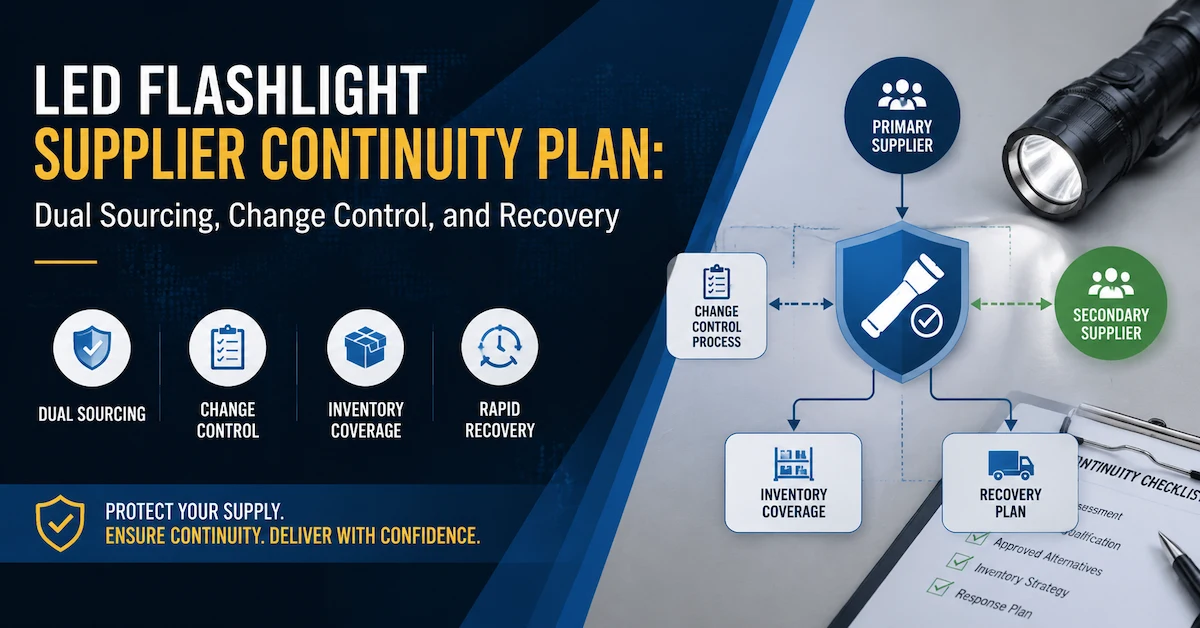
LED Flashlight Supplier Continuity Plan: Dual Sourcing, Change Control, and Recovery
An LED flashlight supplier continuity plan protects an established product when a battery, LED, driver, housing, package, factory, or transport route becomes unavailable. The plan should identify critical parts, approved alternatives, ownership of tools and files, minimum evidence for a second source, inventory coverage, change authority, and recovery tests. Dual sourcing can reduce dependency, but only when both sources are qualified against one controlled product definition.
This guide is written for importers, distributors, private-label brands, retail programs, industrial buyers, and product teams that already have a flashlight product or are preparing one for repeat orders. It is not another general supplier-selection article. The focus is what happens after approval: how to keep the product available without allowing emergency substitutions, rushed transfers, or undocumented changes to create a different and potentially non-compliant product.
The short answer: what keeps a flashlight program supplied?
Continuity comes from visibility and controlled options. Map every part and process that can stop supply, identify which failures would affect safety, performance, compliance, appearance, or delivery, and decide how the business will respond before the disruption. Maintain a current product package, monitor early-warning signals, hold inventory according to exposure, pre-approve alternatives where practical, and qualify a backup source before the primary source fails.
- Know the dependency. A second assembler does not solve a shortage when both suppliers depend on the same battery pack, LED, charging IC, tool, or packaging converter.
- Protect the product definition. Drawings, critical parts, firmware, test limits, artwork, and change history must remain available outside informal messages.
- Separate emergency action from permanent approval. A temporary concession should identify affected lots, limits, duration, and exit condition.
- Qualify recovery. The first lot from a backup source needs technical, quality, document, and packaging verification before it replaces normal supply.
- Measure time to detect and recover. A disruption discovered before production offers more options than one found during final inspection or customs clearance.
Why flashlight supply chains fail in different ways
A flashlight may look like a simple finished product, but its supply chain combines electronics, optics, batteries, metal or plastic parts, seals, switches, surface finishing, software or mode programming, printed materials, and logistics. These elements fail on different timelines. A mould can be damaged suddenly. A battery cell can become unavailable after a supplier change. An LED bin or driver component can drift quietly. A package can miss a retailer deadline even when the flashlight is complete.
The buyer should distinguish five disruption types:
- Demand disruption. A promotion, tender, seasonal event, or unexpected channel order exceeds the approved plan.
- Material disruption. A critical component is delayed, discontinued, restricted, changed, or rejected.
- Process disruption. Tooling, equipment, labour, surface finishing, programming, assembly, or testing capacity is unavailable.
- Quality or compliance disruption. A failure, report mismatch, regulatory change, or undocumented substitution blocks production or sale.
- Logistics disruption. Space, route, dangerous-goods acceptance, customs documents, weather, or port conditions delay movement.
Each type needs a different response. Extra finished-goods inventory may cover a short transport delay but will not fix a compliance stop. A second factory may protect assembly capacity but not a single-source battery. Faster freight cannot recover time lost because artwork was not approved. Continuity planning should therefore start at the dependency level, not with a generic request for a backup supplier.
Map the real dependency behind every critical feature
Create a product-and-process map with the LED flashlight supplier. Start with features the customer can see, then trace the parts and operations that create them. A lumen or runtime claim depends on more than the LED name. It may depend on the LED variant, driver, cell, optics, thermal path, firmware, and test method. An ingress-protection claim may depend on housings, dimensions, seals, grease, fastener control, assembly sequence, and test conditions.
| Product outcome | Typical dependencies to map | Continuity question | Evidence affected by a change |
|---|---|---|---|
| Beam and output | LED variant, optics, reflector, lens, driver, current, firmware, and thermal path | Which alternatives preserve the approved beam and output behaviour? | Performance tests, drawings, component list, and marketing claims |
| Runtime and charging | Cell or pack, protection, driver efficiency, USB input, charging IC, cable, and indicators | Is the backup battery truly interchangeable in performance, safety, fit, and transport status? | Runtime, charging, battery, transport, and product-safety records |
| Water and dust resistance | Housing dimensions, seals, ports, covers, adhesives, fasteners, and assembly process | Can another tool or factory reproduce sealing interfaces and process controls? | Ingress tests, drawings, work instructions, and inspection limits |
| Durability and finish | Material grade, wall thickness, tool condition, machining, coating, texture, and assembly | Which process is the bottleneck and where can it be transferred? | Material records, dimensional checks, appearance limits, and durability tests |
| Retail readiness | Artwork, labels, barcode, manual, package, master carton, pallet, and market documents | Are editable files, approved proofs, converters, and document owners available? | Artwork approval, package tests, label review, and retailer acceptance |
Record the legal supplier, actual manufacturer, production address, critical sub-supplier, tool location, material lead time, approved alternative, required test, and recovery owner for each high-impact dependency. Review the map when the product, forecast, regulation, or supply base changes. A document that is never updated creates false confidence.
Classify parts by recovery difficulty, not only unit cost
A low-cost seal or charging component can stop a high-value shipment. Part criticality should consider the effect of failure and the difficulty of replacement. The purchase price is only one input.
For each component or process, ask:
- Does it affect electrical, battery, thermal, optical, mechanical, chemical, or fire safety?
- Does it influence a declared performance claim, retailer requirement, or regulatory document?
- Is it made with product-specific tooling, firmware, artwork, colour, or test equipment?
- Is there one real source even when several distributors sell it?
- How long would qualification, material purchase, tooling, and production take?
- Can the existing product use an alternative without changing fit, function, appearance, packaging, or user instructions?
- Would a change create new battery transport, compliance, or customer-approval work?
Use those answers to create practical tiers. A Tier 1 item might stop sale, affect safety, or require extensive requalification. Tier 2 may affect performance, appearance, or delivery and require controlled validation. Tier 3 may have several approved options and a short recovery path. The names do not matter; the response attached to each tier does.
Do not label an item "dual sourced" merely because two part numbers exist in a spreadsheet. Confirm that both are technically approved, commercially available, documented, and connected to a production process that can actually use them. Verify whether both sources rely on the same upstream factory or raw material.
Single sourcing, dual sourcing, and dormant backup capacity
Dual sourcing is useful, but it is not free. Splitting volume can raise price, reduce purchasing leverage, complicate forecasting, create cosmetic variation, duplicate testing, and increase document work. In some products, two sources may create more inconsistency than resilience. The decision should reflect recovery risk and the buyer's ability to manage two controlled configurations.
| Supply model | Main advantage | Main limitation | Control needed |
|---|---|---|---|
| Single qualified source | Concentrated volume, simpler control, and one production history | High dependency if the source, tool, material, or route fails | Inventory, transparent sub-supply map, recovery plan, and transferable records |
| Active dual source | Both sources produce and remain current | More variation, administration, qualification, and forecast allocation | One product definition, source-specific controls, regular comparison, and lot identity |
| Primary source plus dormant backup | Lower routine duplication while preserving a recovery route | Backup capability may decay if tools, people, parts, or documents are not maintained | Scheduled revalidation, tool care, file control, sample refresh, and restart lead time |
| Shared platform with approved alternatives | Common housing or architecture with flexible components | Alternatives may not be equal in every market or performance claim | Configuration matrix, validation by option, and clear customer-facing identity |
For stable, low-risk products with short replenishment time, a controlled single source plus inventory may be reasonable. For long-life products, critical programs, seasonal launches, custom tooling, difficult batteries, or expensive outages, an active or maintained backup may justify its cost. The buyer should compare the cost of resilience with the financial and customer impact of a realistic interruption.
When volume is divided, each LED flashlight supplier should receive the same approved product baseline while retaining source-specific records. The allocation rule should consider current qualification, delivery performance, capacity, cost, and risk instead of moving volume informally whenever one quotation changes.
Build a continuity package before a disruption
A backup supplier cannot reproduce a product from a photograph and one physical sample. A transfer package should contain enough controlled information to quote, sample, validate, and produce the intended configuration. Its scope depends on who owns the design and which rights the buyer is authorised to transfer.
The continuity package may include:
- Current product specification, drawings, dimensions, tolerances, materials, finish, markings, and approved sample reference.
- Critical bill-of-material controls, approved sources, approved alternatives, and prohibited substitutions.
- LED, optics, driver, battery, charging, firmware, switch, seal, adhesive, and safety-relevant definitions.
- Performance claims with test methods, conditions, equipment, limits, and sample rules.
- Assembly instructions, special process controls, inspection points, fixtures, and functional-test requirements.
- Artwork, editable packaging files where contractually owned, label text, manuals, barcode records, and carton specifications.
- Compliance and transport document matrix showing the exact tested configuration and responsible party.
- Known failure modes, complaint history, corrective actions, approved concessions, and open risks.
- Tool register showing owner, location, identification, condition, maintenance, cavity status, and transfer terms.
- Revision history, approval authority, effective lots, and contact list for technical, quality, commercial, and logistics escalation.
Store buyer-owned records where the buyer can retrieve them. Respect supplier intellectual property, confidentiality, and licence limits. A continuity plan does not authorise copying another company's protected design, firmware, tooling, or process. Tooling ownership, design rights, file access, and transfer assistance should be clarified before deposits and development work begin.
Qualify a second LED flashlight supplier without changing the product
Second-source approval is a product-development project, even when the target is "the same." Different tools, equipment, operators, materials, assembly methods, test fixtures, and sub-suppliers can create different results. Treat differences as visible engineering decisions rather than asking the backup factory to make a close copy.
1. Confirm legal and commercial readiness
Verify the contracting entity, manufacturing location, invoice identity, payment beneficiary, confidentiality terms, ownership boundaries, and right to use transferred information. Confirm that the candidate accepts the required change-control, inspection, traceability, and corrective-action process.
2. Run a technical gap review
Compare the transfer package with the backup source's proposed materials, components, tooling, processes, fixtures, software, tests, and sub-suppliers. Create a gap list. Each difference should have an owner and disposition: match the original, accept as a controlled source-specific difference, test further, or reject.
3. Protect configuration identity
Use a source or configuration code when parts, tools, or processes differ. Lot identity lets the buyer connect complaints, inspections, and documents to the correct build. Two products can share a commercial model only when the buyer has confirmed that the differences do not undermine required performance, compliance, labelling, or customer approvals.
4. Test representative samples
Evaluate several units against the controlled requirements. Compare dimensions, materials, finish, beam, output behaviour, modes, runtime, charging, temperature, indicators, seals, mechanical interfaces, markings, accessories, package, and any market-specific requirements. Portable-lighting claims should use defined conditions; ANSI/PLATO FL 1 information from PLATO provides context for common performance claims.
5. Review compliance impact
Determine whether the second source changes the tested model, manufacturer, battery, charger, critical component, material, production site, label, or technical file. Do not assume that evidence for one factory or configuration automatically covers another. Obtain qualified advice for the destination markets and customer program.
6. Run a pilot build
The pilot should use intended production materials, people, tools, work instructions, tests, packaging, and records. Inspect first-off units, monitor yield and rework, and review failures by root cause. Close issues before authorising normal volume.
7. Approve ramp-up and allocation
Define the first commercial quantity, inspection level, shipment release, warranty monitoring, and volume-allocation rule. A backup source remains unproven until it can reproduce the approved result on a production lot and support the required documents and delivery process.
Approved alternatives are more useful than emergency substitutions
Pre-approved alternatives can shorten recovery when a component becomes unavailable. The original and alternative do not need to be identical in name, but they must satisfy the product's requirements and evidence boundary. Approval should state where the alternative may be used, which markets and customer programs it covers, and which tests support the decision.
A battery alternative deserves particular scrutiny. Match dimensions, connection, polarity, chemistry, capacity basis, internal resistance, protection, charge limits, discharge behaviour, temperature behaviour, supplier, traceability, and transport evidence. A physically compatible cell is not automatically a safe or equivalent replacement. The UNECE lithium-battery transport resources provide official information related to lithium-battery transport, including UN 38.3.
LED and driver changes can alter output, tint, beam appearance, runtime, temperature, low-voltage behaviour, electromagnetic characteristics, and marketing claims. Seal and housing changes can affect ingress protection. If an IP code is claimed, understand the relevant conditions in IEC 60529 and review whether the changed product still matches the evidence.
Maintain an alternative-parts matrix with the original part, approved option, supplier, qualification report, affected markets, effective date, expiry or review date, and change authority. Remove obsolete approvals instead of allowing the matrix to become a historical list of parts no longer available.
Inventory should cover a defined exposure
Safety stock is not a substitute for root-cause control, but it can buy decision time. Set coverage according to demand variability, replenishment lead time, source concentration, component shelf life, forecast reliability, seasonality, transport options, recovery time, and cost of shortage.
Track usable inventory, not only system quantity. Separate approved finished goods, work in process, critical components, material on hold, rejected stock, goods committed to customers, and stock in transit. Battery-bearing products may require attention to storage conditions, ageing, state of charge, package integrity, and transport acceptance. Long storage can create a quality risk while solving a supply risk.
A simple coverage view is:
Usable coverage days = usable available units divided by expected daily demand.
The result is only as reliable as the demand and usable-stock definitions. Compare coverage with the time needed to detect the problem, decide on a response, procure material, qualify changes, produce, inspect, and transport the replacement. Review the assumptions rather than treating one fixed number as permanent.
Where critical components have a long recovery path, component inventory may offer more flexibility than finished goods. However, ownership, storage, shelf life, compatibility, traceability, and disposition must be clear. Buyer-owned stock held at a supplier should be identified and reconciled, especially when the relationship ends.
Use early-warning signals before an order is late
A capable LED flashlight supplier should communicate risks while options remain. Buyers can make this easier by defining signals that require escalation. Examples include:
- A critical component quotation or lead time changes outside the agreed review process.
- A sub-supplier, production site, tool, battery, LED, driver, material, or package converter may change.
- Material is not ordered or received by the planned milestone.
- Incoming yield, first-pass yield, rework, or final-test failure moves outside the established pattern.
- A planned pilot, inspection, document, booking, or approval date slips.
- The supplier requests urgent specification relief to protect the ship date.
- Financial, legal, labour, utility, environmental, or facility conditions affect production access.
- Dangerous-goods acceptance, route capacity, customs documentation, or retailer booking becomes uncertain.
Define who receives the alert, what information is required, and when management review begins. Avoid punishing early risk disclosure. If the supplier believes that bad news will automatically cost the order, problems may stay hidden until recovery choices are limited.
Control changes during shortages
Shortage pressure is when change control matters most. An urgent substitute may be reasonable, but urgency does not make it equivalent. Require a written request that identifies the affected part or process, reason, proposed replacement, available inventory, affected orders, technical differences, risk assessment, validation evidence, document impact, cost, schedule, and effective lot.
Choose one of three dispositions:
- Permanent approval. The alternative completes the required qualification and becomes part of the controlled product.
- Temporary deviation. The change is limited to named lots, quantity, customer, market, and period, with defined tests and an exit condition.
- Rejection. The evidence, risk, schedule, or commercial case does not support the change.
A temporary deviation should not become an undocumented permanent design. Review remaining stock, labels, reports, manuals, spares, warranty support, and future orders when the deviation ends. Record what customers or authorities must be notified where applicable.
What to do when supply stops
A disruption plan should be specific enough to act on but flexible enough for different causes. The sequence below is a decision framework, not a promise that every interruption can be solved on the same timetable.
| Response stage | Immediate questions | Evidence to secure | Decision output |
|---|---|---|---|
| Contain | What stopped, which lots and customers are affected, and is any product unsafe or non-compliant? | Lot records, inventory status, open orders, test results, documents, and physical samples | Stop, hold, segregate, or continue unaffected scope |
| Quantify | How much usable stock exists and when will each customer run out? | Usable inventory, demand, commitments, work in process, and shipment status | Exposure by date, market, and customer |
| Create options | Can supply be recovered, reallocated, repaired, substituted, transferred, or redesigned? | Supplier recovery plan, alternatives, backup capacity, tooling, test needs, and logistics options | Ranked scenarios with cost, time, and risk |
| Approve | Who may accept the technical, compliance, commercial, and customer impact? | Validation, deviation, legal review, customer approval, and updated records | Authorised response and communication plan |
| Recover | Does the new supply meet the controlled release criteria? | Pilot data, inspection, tests, documents, package, shipment, and traceability | Release, restricted release, further correction, or rejection |
| Prevent recurrence | Why was the disruption possible and why was it detected at that point? | Root cause, response timeline, control gaps, supplier actions, and monitoring changes | Updated product, sourcing, inventory, contract, and review plan |
Keep customer communication factual. Separate confirmed facts from estimates, state the affected products and dates, explain available options, and update the plan when evidence changes. Do not use an unverified recovery date to postpone a difficult conversation.
Transferring tools, files, and production responsibility
A supplier transition can fail because the commercial agreement ends before the technical transfer is complete. Review tooling ownership, payment status, maintenance, physical location, identification, condition, cavities, spare inserts, fixtures, gauges, software, source files, raw materials, work in process, finished goods, buyer-owned stock, and outstanding quality issues.
Inspect buyer-owned tools before movement. Record photographs, dimensions or condition checks where relevant, maintenance history, open repairs, packing method, destination, carrier, insurance responsibility, and receipt verification. A tool that arrives damaged or without process history may not create an immediate backup.
Transfer knowledge as well as hardware. Critical settings, assembly sequence, seal installation, adhesive cure, programming, test fixtures, cosmetic limits, rework rules, package setup, and known failure modes may not be obvious from drawings. The receiving source should conduct a gap review and prove the process through samples and a pilot.
Do not mix transition inventory without traceability. Identify old-source finished goods, new-source finished goods, reworked stock, shared components, and transitional packaging. This protects complaint investigation and prevents the wrong documents from following the wrong configuration.
Contracts can support continuity, but they cannot create capacity
Commercial terms should support the operating plan. Depending on the relationship and applicable law, agreements may address forecast sharing, order acceptance, material authorisation, long-lead purchases, price-review triggers, discontinuation notice, change notice, inspection rights, records, tooling ownership, inventory, confidentiality, intellectual property, transition assistance, warranty, corrective action, and termination responsibilities.
Write the Incoterm and named place into quotations and purchase orders using the current ICC Incoterms rules. The Incoterm helps allocate defined delivery obligations, costs, and risks, but it does not replace specifications, title terms, payment, product responsibility, inspection, or continuity planning.
A contract cannot force unavailable material to appear or instantly recreate a damaged tool. It can make responsibilities visible, preserve information, define notice, and reduce disputes during recovery. Match contractual remedies to practical alternatives; the business still needs qualified sources, inventory, tools, files, and decision owners.
An LED flashlight supplier agreement should also state how active orders, buyer-owned material, finished goods, tools, technical records, open corrective actions, and transition support will be handled if the relationship ends. Legal wording should be reviewed for the relevant transaction and jurisdiction.
Compliance must survive the continuity plan
Emergency supply is not exempt from destination-market requirements. When the supplier, manufacturer, site, battery, charger, LED, driver, material, label, or package changes, review the effect on reports, declarations, technical files, registrations, retailer approvals, transport records, and product traceability.
For products placed on the EU market, the General Product Safety Regulation may be part of the applicable framework, alongside other product, battery, chemical, waste, and market requirements. Responsibilities depend on the product and economic-operator role. Obtain qualified advice instead of assuming that a supplier's generic certificate list covers a transferred configuration.
Keep the evidence connected to the actual lot. If two sources use different approved configurations, their supporting files may also differ. Traceability should let the buyer identify which factory, tool, battery, component set, label, and report basis applies to a complaint or shipment.
How Brightenlux can fit a continuity-minded sourcing program
Ningbo Brightenlux Electric Appliance Co., Ltd. presents itself as a Zhejiang-based lighting manufacturer established in 2014. Its public company profile states that the operation covers more than 10,000 square metres, employs more than 150 people, and serves buyers in more than 50 countries. Its published range includes LED flashlights, headlamps, bicycle lights, work lights, camping lights, night lights, and other outdoor lighting products.
For a continuity discussion, buyers should move beyond a general catalogue request. Ask Brightenlux to identify the proposed product platform, critical components, available alternatives, custom-tool requirements, production milestones, change-notification method, traceability, document support, and recovery assumptions for the exact program. Those details must be verified at product level rather than inferred from company scale.
A useful enquiry includes the application, destination market, current or target specification, forecast, peak demand, required launch or replenishment window, battery and charging architecture, branding, packaging, buyer-owned tools or files, evidence requirements, and known supply risks. Use the Brightenlux contact page to start that structured conversation.
A 16-point continuity checklist
- List the finished products, markets, customers, forecasts, and shortage impact in scope.
- Map the actual manufacturer, sub-suppliers, tools, materials, processes, documents, and routes.
- Identify single points of failure hidden behind multiple commercial suppliers.
- Classify components and processes by safety, compliance, performance, delivery, and recovery impact.
- Define which risks use inventory, approved alternatives, backup tools, a second source, or redesign.
- Maintain a controlled product package outside informal communication channels.
- Clarify design rights, confidentiality, tooling ownership, file access, and transfer assistance.
- Create and maintain an approved-alternatives matrix with evidence and market scope.
- Qualify the second source through gap review, representative samples, compliance review, and pilot production.
- Keep source and configuration traceability through production, inspection, shipment, and complaints.
- Set usable-inventory coverage according to replenishment and recovery exposure.
- Define early-warning signals, escalation owners, and the information required with each alert.
- Use written permanent approvals, temporary deviations, and rejection decisions during shortages.
- Prepare a containment, exposure, option, approval, recovery, and prevention response sequence.
- Verify the first recovered lot against technical, quality, document, packaging, and release criteria.
- Review the disruption and update sourcing, inventory, product, contract, and monitoring controls.
Frequently asked questions
Should every flashlight program have two suppliers?
No. Dual sourcing adds cost, control work, and potential variation. The decision should reflect outage impact, recovery time, product life, tooling, component concentration, order volume, and the buyer's ability to maintain two qualified sources. A controlled single source with inventory and a tested recovery route may be suitable for some programs.
Can two LED flashlight suppliers use the same approved sample?
They can use one product target, but each source still needs source-specific qualification. Different tools, components, processes, fixtures, and sub-suppliers can affect the result. Keep a common specification plus identified samples, evidence, deviations, and traceability for each approved source.
Which flashlight components are the biggest continuity risks?
The answer depends on the design and supply chain. Batteries, LEDs, drivers, charging components, custom housings, seals, firmware, surface finishing, tooling, and printed packaging can all stop supply. Map real source concentration, lead time, qualification difficulty, and compliance impact instead of relying on component price.
How much safety stock should an importer hold?
There is no universal quantity. Base coverage on demand variability, replenishment time, recovery time, source concentration, shelf life, transport options, forecast confidence, seasonality, and shortage cost. Count usable stock and review assumptions regularly. Battery-bearing finished goods also need appropriate storage and ageing controls.
Can a supplier change the battery during a shortage?
Only through the agreed change process. The replacement must be reviewed for chemistry, fit, polarity, electrical behaviour, protection, charging, runtime, temperature, safety, traceability, transport evidence, compliance, labels, and customer requirements. Physical interchangeability alone is not approval.
What documents are needed to move flashlight production?
The package normally includes controlled drawings, specifications, critical parts, approved alternatives, firmware, test methods and limits, process and inspection requirements, artwork, packaging, compliance records, change history, known failures, and tool information. Transfer only information the buyer is authorised to use.
How do I know the backup source is ready?
The backup source should close the technical gap review, produce representative samples, satisfy applicable evidence requirements, complete a production-representative pilot, pass the agreed inspection and tests, provide correct packaging and documents, and demonstrate traceability. A quotation or one handmade sample does not prove recovery readiness.
What should an LED flashlight supplier report before a delay?
The supplier should report the affected part, process, lot, quantity, milestone, cause, available stock, likely customer impact, recovery options, decisions needed, and next evidence date. The buyer should define escalation thresholds in advance and support early disclosure while options are still available.
Final takeaway
Supply continuity is not achieved by adding a second company name to a vendor list. It comes from understanding the product's real dependencies, protecting the approved definition, maintaining usable options, and proving that recovery supply is fit for release. An LED flashlight supplier should participate in that system by disclosing risk, controlling changes, preserving traceability, and validating alternatives before urgency removes good choices.
Start with the current product, not a generic disaster list. Map the parts and processes that create its claims, safety, appearance, documents, and delivery. Decide where inventory is enough, where an alternative part must be pre-approved, where a tool or file needs protection, and where a second source must stay active. Then test the plan through a sample refresh, pilot, inventory review, or recovery exercise before the first real interruption.
To discuss an OEM, ODM, wholesale, private-label, or continuity-sensitive flashlight program, send Brightenlux a structured project brief covering the product, market, forecast, critical components, packaging, evidence needs, buyer-owned assets, risk concerns, and replenishment expectations.
References and verification resources
- ISO 22301: Security and resilience - Business continuity management systems.
- PLATO: ANSI/PLATO FL 1 portable-lighting standard information.
- IEC 60529: Degrees of protection provided by enclosures (IP Code).
- UNECE lithium-battery transport resources.
- International Chamber of Commerce: Incoterms rules.
- EUR-Lex: Regulation (EU) 2023/988 on general product safety.
- Brightenlux company profile.