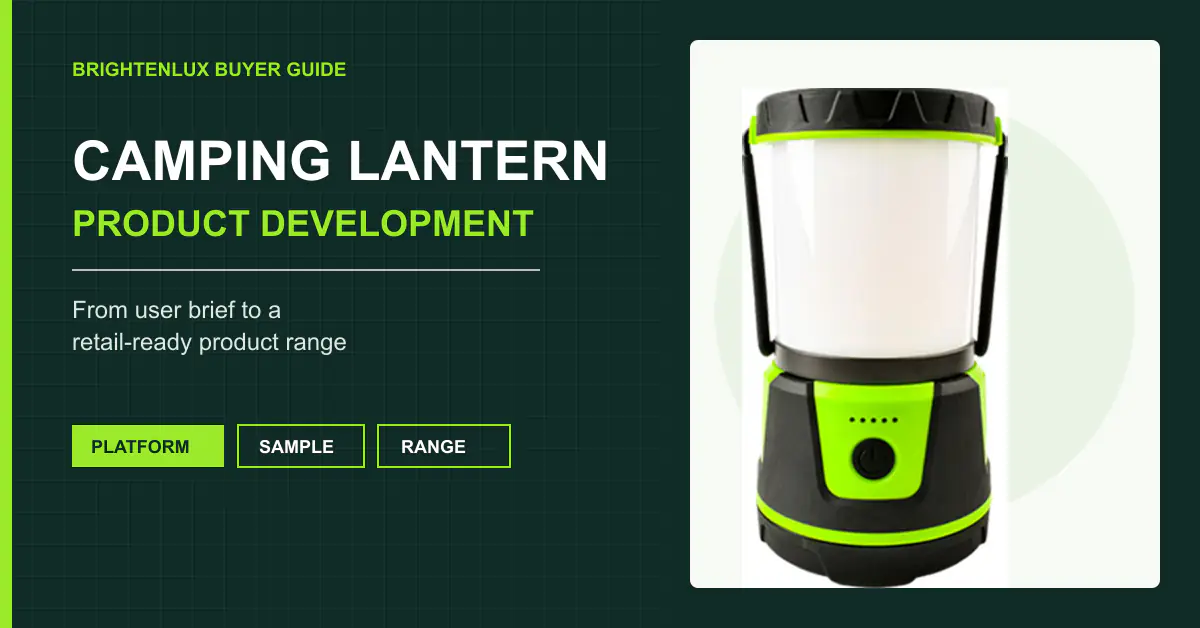


Short answer: the right LED flashlight manufacturer is not simply the factory offering the highest lumen figure or the lowest quotation. A dependable manufacturing partner should be able to translate a use case into a stable optical, electrical, mechanical, and packaging specification; build representative samples; explain how performance will be verified; control approved components during mass production; and provide the documents required for the target market and shipping method.
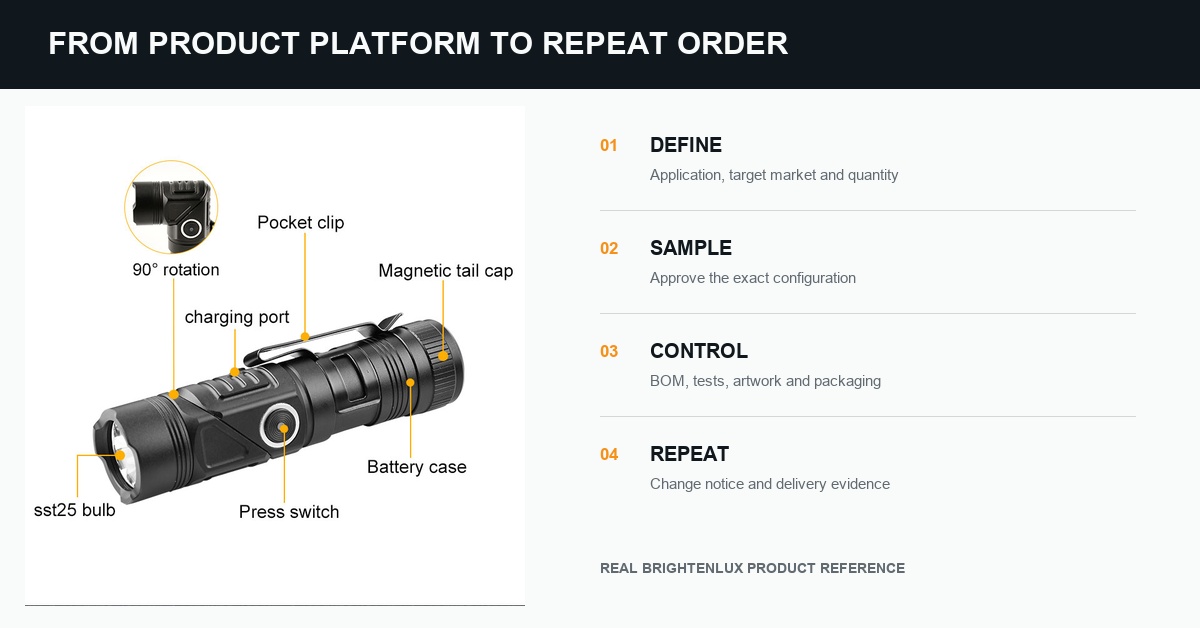
That distinction matters because a flashlight is a system, not a collection of impressive numbers. The LED, driver, battery, reflector or lens, housing, seals, switch, charging circuit, and firmware all affect one another. A brighter drive current may also create more heat. A larger battery may extend runtime but add weight and charging time. A waterproof claim is only useful when it refers to a defined test and the production seals remain consistent. Buyers therefore need to compare manufacturers by evidence, process, and product fit rather than by one headline specification.
Ningbo Brightenlux Electric Appliance Co., Ltd. has focused on lighting products since 2014. Its Zhejiang factory covers more than 10,000 square metres, employs more than 150 people, and supports a range that includes LED flashlights, headlamps, bicycle lights, work lights, camping lights, and other outdoor lighting products. Brightenlux products have reached buyers in more than 50 countries. This guide draws on that category experience to give importers, distributors, retailers, promotional-product companies, and private-label brands a clearer way to qualify an LED flashlight factory.
What does an LED flashlight manufacturer actually do?
An LED flashlight manufacturer develops, sources, assembles, tests, and packs portable lighting products. Depending on the project, the work may include industrial design, mechanical engineering, optical selection, printed circuit board and driver development, battery integration, firmware configuration, tooling, surface finishing, logo application, packaging, inspection, and shipping support.
Not every supplier controls every stage in-house, and that is not automatically a problem. A capable factory may use qualified partners for LEDs, cells, PCBs, anodising, injection moulding, or printed packaging. What matters is whether the manufacturer owns the specification and supplier-control process. It should know which component is approved, what substitutions are allowed, how incoming parts are inspected, and how a change is communicated to the buyer.
The words manufacturer, factory, supplier, and trading company are often used interchangeably online. Buyers should look beyond the label. Ask who owns the production line, who employs the engineers and quality team, where final assembly occurs, and which operations are outsourced. The answer should be clear enough to map the real supply chain.
Quick comparison: the evidence a buyer should request
| Area | Weak evidence | Useful evidence | Why it matters |
|---|---|---|---|
| Brightness | A lumen claim in a catalogue | Defined test method, sample report, output curve, and measurement conditions | Peak output alone does not show sustained performance |
| Runtime | One large hourly figure | Runtime by mode, battery type and capacity, and end-point definition | Different batteries and step-down behaviour change the result |
| Water resistance | “Waterproof” without a rating | Target IP level, test conditions, report availability, and seal-control plan | Rain resistance and immersion resistance are different requirements |
| Battery safety | Cell capacity printed on a wrapper | Cell identity, protection design, charger specification, and transport documents where applicable | Battery quality affects safety, runtime, logistics, and returns |
| Quality control | “100% QC” as a slogan | Inspection checkpoints, test limits, sampling plan, records, and defect handling | A repeatable process protects mass-production consistency |
| OEM work | A logo mock-up | Artwork approval, colour standard, golden sample, packaging proof, and change history | Brand details fail when approvals are informal |
| Delivery | A date promised before the specification is frozen | Milestones for samples, tooling, materials, pilot build, inspection, and shipment | Lead time depends on decisions as well as assembly capacity |
Start with the use case, not the catalogue
Experienced buyers begin by describing the job the light must perform. A security patrol flashlight, a compact retail torch, a roadside emergency light, and a long-range search light may all use LEDs, yet their best specifications are different. Without a clear use case, suppliers tend to quote whatever model is closest to the keyword in the enquiry.
A useful request for quotation should state the user, environment, typical operating time, required beam character, power source, charging preference, size or weight limits, target market, expected annual volume, branding scope, packaging format, and target launch date. It should also separate mandatory requirements from preferences. That gives the manufacturer room to propose a proven platform when a custom feature would add cost without adding customer value.
For example, a maintenance team working inside equipment cabinets may value a broad close-range beam, magnetic tail, pocket clip, simple mode sequence, and high colour rendering more than extreme throw. A hiking brand may prioritise low weight, weather resistance, usable medium-mode runtime, a lockout function, and easy USB-C charging. A law-enforcement distributor may focus on switch access, impact resistance, grip, holster compatibility, and repeatable high-output behaviour. “Best flashlight” is not a specification; “best for this task” can become one.
1. Evaluate light output as a curve, not a single number
Lumens describe total light output. Candela describes peak beam intensity, and beam distance is derived from intensity under defined conditions. These values answer different questions. A flood-oriented work light can produce high lumens without throwing far, while a tightly focused light can reach farther with lower total output. Buyers should determine whether the product needs flood, throw, or a balanced beam before choosing the LED and optics.
The portable-lighting industry commonly uses the ANSI/PLATO FL 1 standard to communicate metrics such as light output, peak beam intensity, beam distance, runtime, impact resistance, and water resistance. Referencing a standard does not make every published number correct, but it creates a common language for the test. Ask the factory which version or method it uses, whether testing is performed internally or externally, and whether a report for the quoted configuration can be reviewed.
Pay particular attention to sustained output. Many compact flashlights begin at a high level and reduce output as the driver responds to temperature or battery voltage. This step-down can protect the LED, electronics, cell, and user. It is not necessarily a defect. The problem occurs when a buyer compares one product's initial output with another product's stable output as though they were equivalent.
Request an output-versus-time curve for the main operating modes. Note the ambient temperature, cooling conditions, battery, starting state of charge, and measurement interval. If the product uses thermal regulation, ask how its threshold and recovery behaviour work. A well-chosen 1,000-lumen product that sustains useful light can serve customers better than a small enclosure briefly driven to a much larger marketing number.
2. Match the LED, optics, and beam to the application
The LED package is only one part of beam quality. Reflector geometry, total internal reflection optics, lens transmission, LED centring, bezel design, and focus mechanism shape what the user sees. Two flashlights using the same emitter can have visibly different beams.
For a fixed-focus design, inspect the hotspot, spill, rings, artefacts, and colour consistency across the beam. For an adjustable-focus or zoom flashlight, evaluate the beam at both ends of travel, the smoothness of the mechanism, looseness after cycling, and sealing implications. A zoom system is flexible, but its moving interfaces require careful mechanical tolerances and may not be the right choice when compactness or high ingress protection is the first priority.
Colour temperature also affects product positioning. Cooler white light can appear crisp and supports high efficacy in many configurations. Neutral or warmer light may render natural surfaces more comfortably in rain, fog, camping, inspection, or general work. Colour rendering index can matter when users identify wire colours, inspect finishes, read maps, or perform medical and technical tasks. A buyer should not pay for a specialised emitter without a use case, but neither should it treat every white LED as interchangeable.
During sample approval, project the beam onto a neutral wall at a fixed distance and also test it outdoors. Photographing the result with locked camera settings helps compare revisions. The approved LED bin, optic, lens, and centring method should be recorded in the product specification or bill of materials.
3. Treat thermal design as a core performance feature
LEDs are efficient, but high-output systems still generate heat. That heat must travel from the LED board through its interface and supporting structure into the housing, where it can dissipate. Poor thermal paths can reduce output, shorten component life, discolour materials, or create uncomfortable surface temperatures.
Ask how the LED board contacts the heat-spreading structure, which materials are used, how thermal interface material is controlled, and how the driver manages temperature. Examine whether decorative body features actually contribute to heat transfer or merely create an aggressive appearance. In small products, firmware and current regulation are often just as important as aluminium mass.
A practical sample test is to run the light on its highest mode in the specified ambient conditions while logging light output and accessible surface temperature. Then repeat the test after the product has experienced charging cycles, drops, or environmental conditioning when those stresses are relevant. The goal is not to eliminate step-down; it is to verify predictable behaviour and a useful stable level.
4. Specify the battery and charging system precisely
Rechargeable LED flashlights may use replaceable cylindrical cells such as 18650 or 21700 formats, larger cells such as 26650, built-in lithium packs, or hybrid arrangements that also accept primary batteries. The choice influences energy, diameter, weight, sourcing, serviceability, and shipping.
Do not approve a battery solely by the capacity printed on its wrapper. Record the cell manufacturer or approved cell specification, nominal capacity, voltage, discharge capability, protection configuration, and any allowed alternate. Ask how incoming cells are checked and matched, how storage state of charge is managed, and how pack or cell traceability is retained. Unrealistic capacity claims should be challenged before the sample stage.
For a USB-C rechargeable flashlight, clarify the supported input voltage and current, connector type, cable included, charging time, indicator logic, behaviour while charging, overcharge and over-discharge protection, short-circuit response, and reverse-polarity protection where relevant. A USB-C socket does not by itself guarantee every USB-C-to-USB-C charger will work. If C-to-C compatibility matters, put it in the specification and test it with a defined charger matrix.
Lithium batteries also affect transport. The United Nations Manual of Tests and Criteria, Part III, subsection 38.3 addresses lithium battery testing used in transport requirements. The exact documents, packaging, labels, and carrier rules depend on the cell, product configuration, destination, and transport mode. Ask the manufacturer or logistics provider to confirm what applies to the shipment; do not assume that a generic file from a different battery covers the ordered product.
5. Define runtime in a way customers can understand
Runtime is easy to misread because the result depends on the selected mode, battery energy, regulation strategy, temperature, and test end point. A product that slowly dims may technically remain on for a long time while no longer providing useful task light. Another light may hold a stable level and then shut down more quickly.
For each important mode, ask for the starting output, output curve, approximate regulated period, and the definition used to stop the test. For real purchasing decisions, medium mode often matters more than turbo. It may deliver the best balance between visibility, heat, and battery life.
Buyers should also check low-voltage warnings. A stepped indicator, illuminated switch, or flashing alert can help users plan around remaining energy. The interface must be easy to explain in packaging and instructions. An indicator that changes meaning between charging and operation can generate customer-service questions even if it functions correctly.
6. Verify ingress protection and impact claims
Ingress Protection codes are defined by IEC 60529. The two characteristic numerals address protection against solid objects and water under specified conditions. They should not be treated as a vague scale in which every higher-looking number makes a product universally tougher. IPX4 water-splash resistance, IPX7 temporary immersion, and IPX8 conditions describe different tests and product expectations.
If water resistance matters, identify the target rating and obtain the associated test conditions. Review how the factory controls O-rings, charging-port covers, switch boots, lens seals, threads, lubricant, compression, and assembly torque. A laboratory sample can pass while mass production drifts if seal dimensions or assembly methods are uncontrolled.
Impact resistance also requires context. Ask about drop height, surface, sample count, orientation, and acceptance criteria. A flashlight can remain illuminated after a drop yet suffer a cracked lens, damaged charging cover, or intermittent switch. The pass criteria should reflect what the brand is prepared to sell.
Run an abuse sequence on representative samples rather than treating every test as isolated. Drops can affect sealing; repeated charging-port use can wear a cover; temperature cycling can change compression. For a professional or outdoor product, combined-condition testing often reveals more than a pristine sample test.
7. Examine the driver, switch, and user interface
The electronic driver regulates power and shapes the user experience. Ask whether the product uses constant-current regulation, pulse-width modulation at lower modes, thermal control, low-voltage protection, electronic lockout, and mode memory. The correct design depends on cost and use case, but its behaviour should be intentional.
Mode order deserves more attention than it usually receives. A consumer utility flashlight may work well with high, medium, low, and off. A tactical user may need immediate access to high output. A camping product may benefit from low-first activation. Strobe can be useful in some markets and unwanted in others. Hidden special modes can keep normal operation simple.
Physically cycle the switch, charging port, zoom head, tailcap, clip, and battery door. Check activation force with bare and gloved hands. Look for flicker when the light is tapped or shaken. Verify electronic lockout and mechanical lockout if the product could activate in a bag. Small interface decisions often determine whether reviews describe the product as intuitive or frustrating.
8. Assess mechanical construction and finish
Aluminium-alloy housings are common in higher-output flashlights because they combine strength, machinability, and useful heat transfer. Plastic housings can reduce weight, cost, and electrical conductivity while supporting shapes that are efficient to mould. Neither material is automatically superior. The correct choice follows the product's environment, price point, and desired feel.
For machined bodies, inspect thread engagement, burrs, wall thickness around openings, anodised finish, colour consistency, electrical contact surfaces, and tailcap feel. For moulded bodies, inspect parting lines, gate marks, sink, warpage, texture, screw bosses, inserts, and ultrasonic welds where used. Across both types, check the lens retention, battery fit, spring compression, clip attachment, lanyard point, and resistance to rattling.
Cosmetic standards should be documented with limit samples or clear photographs. Words such as “minor scratch” invite disagreement. Define which surfaces are critical, the viewing distance and light, and what size or frequency of mark is acceptable. Packaging must also prevent products from rubbing against accessories during shipment.
9. Build a quality-control plan before mass production
A reliable LED flashlight manufacturer should be able to explain the controls used from incoming material through final packing. “We inspect everything” is not enough. Buyers need to know what is inspected, how it is measured, which limits apply, who records the result, and what happens when a failure is found.
A practical control plan may include:
- incoming checks for LEDs, cells, electronic components, housings, seals, switches, lenses, cables, and packaging;
- first-article approval at the beginning of an assembly run;
- polarity, current, charging, indicator, mode, and basic output checks during assembly;
- controlled seal installation, fastening torque, and functional cycling;
- appearance and workmanship inspection against approved samples;
- final functional testing and any specified ageing or burn-in process;
- sampling inspection of dimensions, water resistance, drop performance, charging, and packaging;
- carton marking, quantity, accessory, barcode, and drop checks before shipment;
- lot identification and retention of inspection records.
The buyer and factory should agree on critical, major, and minor defects. A missing protection component, charging hazard, or incorrect battery is not equivalent to a small cosmetic mark. If an acceptance sampling plan is used, specify the inspection level and acceptance quality limits rather than referring to “standard AQL” without numbers.
Quality also includes change control. The golden sample and signed specification should identify the approved configuration. If an LED, driver IC, cell, seal material, adhesive, surface process, or packaging component becomes unavailable, the factory should request approval before substitution. Many field failures begin with an unreviewed “equivalent” part.
10. Choose the right level of OEM or ODM customization
OEM flashlight projects can range from applying a logo to an existing model to developing a new platform. The least expensive route is usually a proven product with custom branding and packaging. Colour changes, accessory bundles, firmware revisions, emitters, optics, or battery choices add moderate complexity. New housings, tooling, electronics, or optical systems require greater volume, budget, engineering time, and validation.
Customization should support a commercial reason. A distinctive colour can improve shelf recognition. A simplified mode sequence can reduce returns. A magnetic tail can open a work-light use case. Custom tooling may be justified when a brand needs proprietary ergonomics, accessory compatibility, or defensible design ownership. Adding features only to make a specification longer tends to increase failure points.
Before paying for tooling or artwork, confirm ownership, maintenance, expected life, modification rules, storage, and what happens if the programme ends. Keep signed versions of drawings, colour references, logo placement, packaging dielines, manuals, labels, barcode data, and the golden sample. A revision number on the specification and purchase order prevents old files from returning later.
11. Review compliance for the product and target market
There is no single universal “flashlight certificate.” Requirements depend on the product architecture, battery, charger or adapter, radio functions if any, target country, sales channel, and claims made. The manufacturer should help assemble evidence, but the importer or brand must understand its own legal responsibilities.
Depending on the configuration and market, the review may involve electromagnetic compatibility, restriction of hazardous substances, battery transport, product safety, labelling, waste or battery obligations, packaging rules, and retailer-specific protocols. A declaration or report should identify the relevant model and configuration. Check the issuing laboratory, test date, standard, applicant, product photos, and whether the report really covers the ordered battery and electronics.
A responsible factory will not claim that one logo makes a product legal everywhere. Share the destination markets at the RFQ stage so the product and documentation plan can be priced correctly. If third-party testing is needed, agree on the sample source, laboratory, payment, failure handling, and ownership of the report.
12. Understand MOQ, price, and lead time as a connected system
Minimum order quantity is influenced by material purchases, production setup, colour processes, printed packaging, battery sourcing, and the degree of customization. A low MOQ can be valuable for a trial launch, regional distributor, or new private-label programme, but it may limit custom colours, component choices, or packaging economics.
Compare quotations only after the specification is aligned. Confirm whether the price includes the battery, charging cable, holster, clip, lanyard, spare seals, manual, inner box, master carton, testing, and any tooling or artwork charges. Record the trade term, currency, quotation validity, and tax assumptions. A low unit price can become expensive after omitted items and rework are added.
Lead time should be expressed as a sequence: specification confirmation, sample preparation, sample approval, artwork approval, material procurement, pilot or first production, mass assembly, inspection, and shipment booking. The starting point matters. “Thirty days” after deposit is different from thirty days after the buyer approves packaging two weeks late.
A disciplined sample-to-production process
- Send a structured RFQ. Describe the application, mandatory performance, preferred design, estimated quantity, destination, branding, packaging, documents, and schedule.
- Review the proposal. Ask the supplier to identify assumptions and alternatives. Resolve contradictions between brightness, runtime, dimensions, battery, and price.
- Order representative samples. Use the intended LED, driver, battery, optics, seals, finish, firmware, and accessories whenever possible. A showroom sample with different internal parts is not a production sample.
- Test against written criteria. Evaluate beam, output curve, runtime, charging, temperature, switch logic, drops, water resistance, mechanical cycling, cosmetics, and packaging as applicable.
- Close the issues. Record defects and questions with photos, measurements, and version numbers. Retest changes rather than accepting them by email.
- Approve a golden sample and specification. Both should match. Include the bill-of-material controls, artwork, packaging, inspection criteria, and authorised alternatives.
- Run a pilot when risk justifies it. New tooling, electronics, batteries, firmware, or sealing designs benefit from a smaller controlled build before full volume.
- Inspect mass production. Verify that the shipment matches the approved standard. Use a qualified third party if the buyer cannot inspect directly.
- Track field performance. Capture return reasons by model and lot. Share evidence with the manufacturer so corrective action targets the real failure mode.
Questions to ask an LED flashlight manufacturer
A focused factory conversation is more revealing than a long generic questionnaire. Ask:
- Which model in your existing range is closest to our use case, and what are its trade-offs?
- Which operations are performed in your facility and which are outsourced?
- What LED, driver, cell, optic, and seal specifications will be fixed for our order?
- Can you provide output and runtime curves for the proposed configuration?
- Which test method supports the lumen, beam-distance, impact, and water-resistance claims?
- How do you test USB-C charging, protection behaviour, and charger compatibility?
- Which battery transport and market documents are available for this exact model?
- What inspections occur during assembly and before packing?
- How are defects classified, recorded, contained, and corrected?
- What is your engineering-change approval process?
- Which OEM changes can be made without new tooling?
- What drives the MOQ and lead time for our branding and packaging?
- Can you build a pilot batch and retain a signed golden sample?
- How are production lots traced if customers report a problem?
Common sourcing mistakes and how to avoid them
Choosing by maximum lumens
A large initial number can hide rapid thermal step-down, a narrow use case, or an oversized battery requirement. Compare beam pattern, sustained output, runtime, temperature, and dimensions together.
Using a sample as the whole specification
A sample shows one unit, not the rules for reproducing it. Pair the golden sample with drawings, component controls, performance limits, cosmetics, firmware, artwork, packaging, and inspection criteria.
Leaving the battery undefined
The same flashlight body fitted with a different cell can change runtime, charging time, safety evidence, cost, and transport paperwork. Approve the battery as part of the product.
Assuming “waterproof” is self-explanatory
State the target IP level and conditions. Confirm whether testing applies to the charging cover closed, which accessories are installed, and whether the sampled construction matches production.
Requesting custom tooling too early
Validate the market with a proven platform when possible. Invest in a new housing or electronics only after the commercial advantage and volume justify the engineering and validation burden.
Comparing incomplete quotations
Normalise batteries, accessories, packaging, tests, trade terms, and tooling before comparing unit prices. A quotation is meaningful only against a controlled specification.
Ignoring duplicate online content
For brands selling through search, dozens of near-identical articles aimed at the same term can compete with one another instead of building authority. A stronger approach is one comprehensive manufacturer guide supported by narrower articles about batteries, optics, testing, OEM packaging, and specific applications. Internal links should make that topic structure clear to readers and search engines.
Why buyers consider Brightenlux
Brightenlux is a China-based LED flashlight manufacturer serving portable and outdoor lighting programmes. The company has worked in lighting products for more than a decade, with a 10,000-plus-square-metre facility in Zhejiang, more than 150 employees, and design and sales teams supporting international buyers. Its wider category experience spans LED flashlights, LED headlamps, bicycle lights, work lights, camping lights, and related outdoor lighting.
The product range includes dry-battery and rechargeable formats, multiple cylindrical battery platforms, fixed and adjustable beams, USB-C charging, magnetic tails, power-bank functions, and different water-resistance targets depending on the model. That breadth gives a buyer a practical starting point: select a proven platform, define the application, and then decide whether branding, packaging, accessories, mode logic, optics, or a deeper ODM change is justified.
Buyers should still qualify every proposed model against their own requirements. Ask for samples and the evidence relevant to the exact configuration and destination market. To start that discussion, review the Brightenlux product range, read the factory profile, or send the team your RFQ.
Frequently asked questions
What is an LED flashlight manufacturer?
An LED flashlight manufacturer is a company that develops or produces portable lighting products using LEDs. Its responsibilities may include product design, component sourcing, driver and battery integration, housing production, assembly, testing, branding, packaging, quality control, and export support. Buyers should confirm which stages are performed directly and which are managed through partners.
How do I choose a reliable LED flashlight manufacturer in China?
Begin with a written use case and specification. Then evaluate whether the factory can explain its components, provide representative samples, support output and runtime claims with defined tests, control batteries and charging, document quality checkpoints, manage approved changes, and supply relevant market and transport documents. Factory scale can help, but transparent process and product fit are more important than size alone.
What is the difference between an OEM and ODM flashlight?
In a typical OEM project, the buyer selects an existing product platform and customises elements such as logo, colour, packaging, accessories, or certain specifications. In an ODM project, the manufacturer contributes more design and engineering, which may involve a new housing, electronics, optics, tooling, or user interface. In practice the terms overlap, so the contract and approved specification should define the actual scope.
What MOQ should I expect for custom LED flashlights?
There is no universal MOQ. It depends on the existing model, battery, body colour or finish, logo method, packaging print run, component purchases, testing, and whether new tooling is required. A stock platform with a simple logo generally supports a lower quantity than a fully custom design. Ask the supplier to break down which choice creates each minimum.
How should flashlight brightness be verified?
Ask for the test method, equipment, conditions, and output-versus-time curve for the exact sample configuration. ANSI/PLATO FL 1 provides commonly used definitions for portable-lighting performance. Evaluate initial lumens together with sustained output, peak beam intensity, beam distance, runtime, and thermal behaviour.
Does a USB-C port mean any USB-C charger will work?
No. The connector shape alone does not prove compatibility with every charger or cable. Specify input voltage and current, USB-A-to-C and C-to-C requirements, charging time, indication, protection functions, and any use-while-charging behaviour. Test the sample with a defined group of chargers and cables sold in the target market.
What documents are needed for a rechargeable flashlight?
The answer depends on the battery, charger, product functions, destination, shipping method, and retailer. Lithium battery transport evidence such as the applicable UN 38.3 test summary may be relevant, along with market-specific electrical, electromagnetic compatibility, hazardous-substance, labelling, battery, and waste requirements. Obtain advice for the actual product and market rather than relying on a generic checklist.
How long does a custom flashlight project take?
A logo and packaging change on an established model can move relatively quickly after sample and artwork approval. A new colour, battery system, optics, firmware, housing, or tooling adds sourcing, engineering, and validation time. Ask for a milestone schedule that starts only after each required buyer approval is defined.
What should be included in a flashlight golden sample?
The golden sample should represent the approved housing, finish, LED and beam, electronics, firmware, battery, charging behaviour, seals, logo, accessories, and packaging. It should carry a revision or approval record and be paired with a written specification. Both buyer and factory should retain a controlled reference.
Can one manufacturer supply flashlights, headlamps, and camping lights?
Yes. A broader outdoor-lighting manufacturer may support several categories and simplify sourcing for a distributor. Buyers should still qualify each product platform separately because the optics, thermal design, batteries, construction, tests, and typical failure modes differ across handheld, hands-free, and area lighting.
Final buyer takeaway
The best LED flashlight manufacturer for a project is the one that can make the required product repeatedly and prove it. Start with the user's task. Translate that task into measurable optical, electrical, mechanical, environmental, cosmetic, packaging, and compliance requirements. Approve a representative sample and controlled specification. Then verify that production follows them.
Price still matters, but it should be the price of the correct, repeatable configuration. When buyers compare evidence instead of adjectives, they reduce returns, avoid late compliance surprises, and build a product range that customers can trust. For an OEM or wholesale discussion, contact Brightenlux with your application, quantity, target market, preferred battery, performance goals, branding needs, and launch schedule.