

For most distributors, the hard part of flashlight buying arrives after the price sheet. Can a counter assistant explain the difference between two models? Will the item still be available when a seasonal order sells through? Will the second shipment feel like the first? A capable wholesale flashlight supplier helps answer those awkward, practical questions. Price tiers matter, of course, but so do the mix of models, sensible order quantities, packaging, inspection, and the record kept for reorders.
An importer will read this differently from an outdoor shop, a hardware distributor, or a promotional-products team. That is intentional. The examples come from Brightenlux's current range: dual-power bodies, 18650 and 21700 formats, moving heads, magnetic tails, red modes, and right-angle lights. Website specifications get a buyer to a shortlist. The purchase order still has to name what is actually being bought, down to the battery, accessories, pack, test references, and market-specific details.
The central buying question is simple: which group of products gives customers a clear reason to buy, while giving the distributor a realistic path to reorder? The answer depends on the sales channel. A hardware wholesaler may value familiar controls and dependable availability. An outdoor brand may need a stronger performance story. An industrial catalogue may prioritize hands-free features and clear technical records. The product range should follow those jobs instead of copying a competitor's assortment.
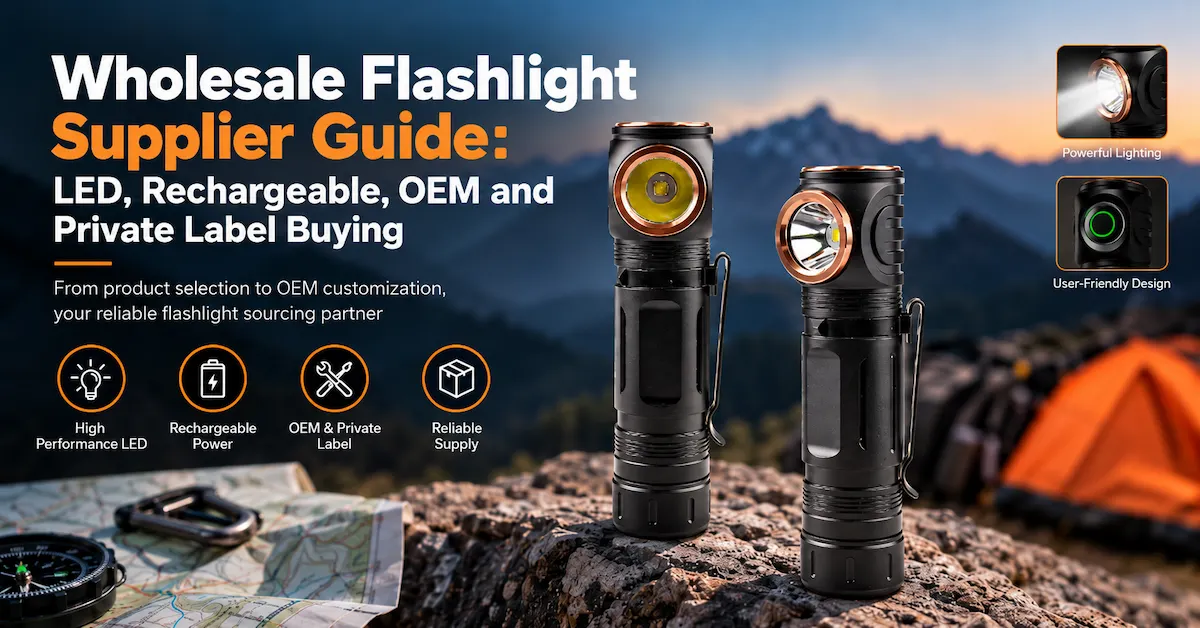
Start with a sellable range, not a long supplier catalogue
A catalogue can contain dozens of similar black flashlights. That variety looks useful until four of them need stock, photography, packaging, training, and advertising. Give each SKU a job before it earns a place. Perhaps a small light opens the price ladder, a rechargeable model does the daily work, a larger battery justifies the step-up, and a right-angle body serves technicians. Put two near-identical items beside each other and customers will hesitate; one of them will usually become dead stock.
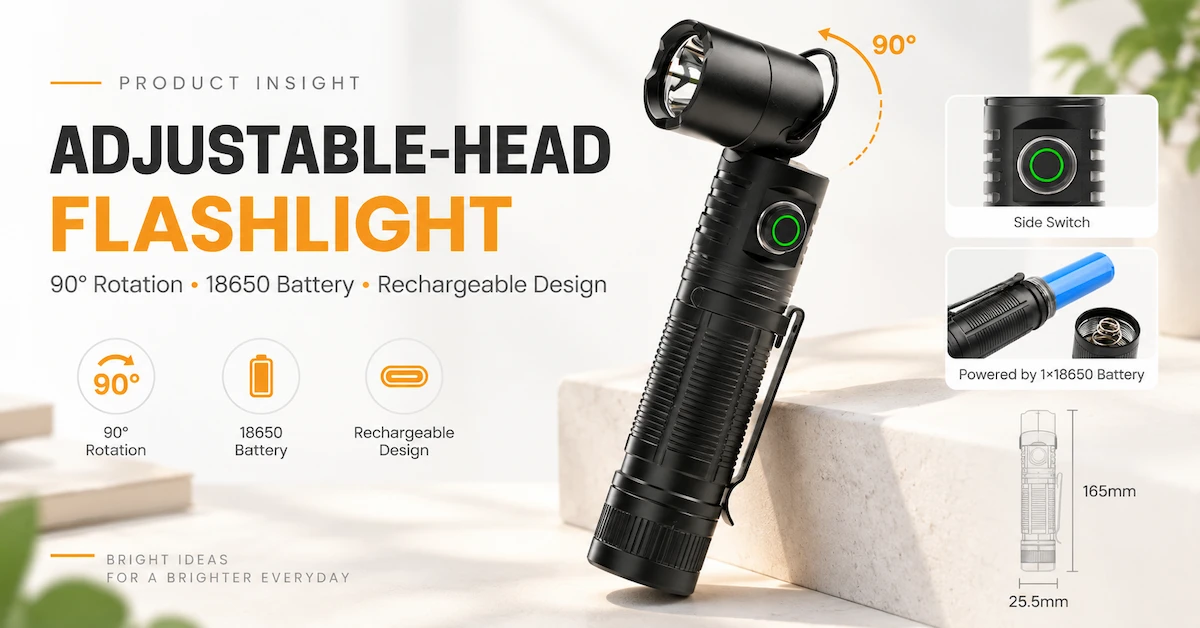
For a first order, a four-SKU structure is usually easier to manage than an ambitious wall of products. An entry light can be compact and simple. The core model should be the easiest product to explain and reorder. A step-up model can offer more battery capacity, output, or handling features. A specialist model might use an adjustable head, red modes, a magnet, or a right-angle format. This structure gives the sales team a short answer when a customer asks, "What changes if I spend more?"
A useful flashlight wholesale supplier will not simply send a price list. It will help identify where two proposed products overlap, which models share batteries or accessories, and which configurations are already stable in production. Shared components can make training and replenishment easier, but every model should still have a distinct reason to exist.
A practical four-level assortment
| Range role | What the customer notices | Typical channel | Buying discipline |
|---|---|---|---|
| Entry | Compact size, simple operation, accessible price | Counter display, promotion, general retail | Keep packaging and accessories economical |
| Core | Rechargeable power and a familiar handheld format | Outdoor, hardware, ecommerce | Protect availability and repeat-order consistency |
| Step-up | Higher capacity, stronger output, useful accessories | Professional and enthusiast buyers | Verify claims and runtime conditions |
| Specialist | Right-angle, red light, magnet, adjustable head | Inspection, maintenance, emergency, outdoor | Test the feature in the intended task |
Match the buying model to the commercial goal
Wholesale, private label, and OEM sit beside one another, though the work is not the same. Standard wholesale buying usually keeps the existing build and gains speed. Private label brings in the visible identity: logo, colour, carton, barcode, and instructions. OEM can reach into components, controls, accessories, or output. Every step away from the established model adds something to approve and may alter quantity or timing.
A buyer testing a new category may be better served by an established rechargeable model and a simple branded sleeve than by redesigning the entire flashlight. A mature brand with a proven customer segment may have a sound reason to change the mode sequence, battery capacity, finish, or accessory kit. The supplier should price these routes separately so the buyer can see what differentiation actually costs.
This is where a private label flashlight supplier and an OEM flashlight manufacturer may give different answers to the same inquiry. The private-label proposal may reach the market faster. The OEM proposal may create a more distinctive product, but it needs a stronger technical file and a longer approval path. Neither is automatically better; the right route matches the evidence behind the sales forecast.
Use Brightenlux products as range-building examples
Brightenlux currently shows several rechargeable platforms that can occupy different positions in a wholesale assortment. Buyers should treat the public pages as a comparison starting point, then request current quotations, sample availability, packaging details, and order-specific confirmation. The purpose of the table below is not to declare a universal winner. It is to show how product architecture can support a clear range.
| Brightenlux platform | Power format | Visible buying story | Possible range role |
|---|---|---|---|
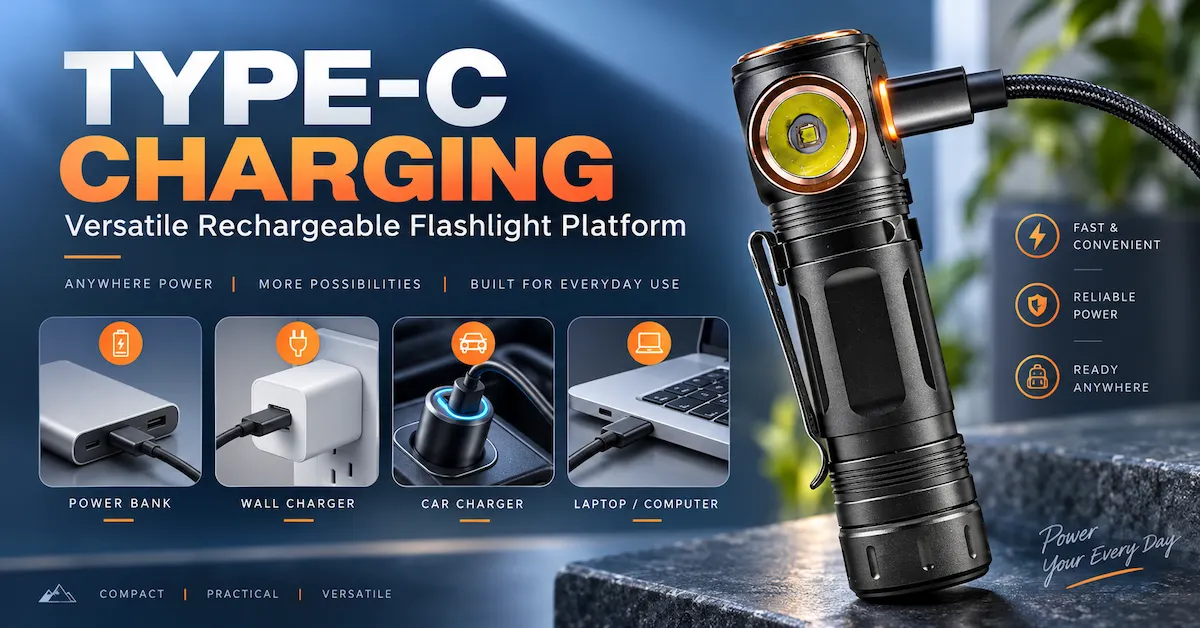
| 600-lumen dual-power adjustable-focus flashlight | Rechargeable battery or 2 AA cells; Type-C | Charging convenience plus disposable-battery backup | Core emergency, travel, or general retail |
| 1000-lumen adjustable-head SST40 flashlight | 18650 platform; Type-C | Adjustable head and magnetic tail for task lighting | Maintenance or workshop specialist |
| 1000-lumen SST25 flashlight with red modes | 18650 battery; Type-C indicator | White and red modes, magnet, headstrap option | Outdoor or service-kit step-up |
| 1500-lumen SST40 21700 flashlight | 4000mAh 21700 platform; Type-C | Higher-capacity positioning, magnetic tail, strobe | Premium outdoor or professional hero SKU |
| 1000-lumen right-angle SST25 flashlight | Built-in rechargeable platform; Type-C | Directional task light, clip, magnet, headstrap use | Inspection and hands-free specialist |
The public specifications should be repeated on packaging only after they are confirmed for the ordered version. Battery cell, LED bin, driver, mode program, included accessories, and test conditions can affect the final claim. A buyer should request a marked sample and a one-page specification before approving photography or printed cartons.
Plan MOQ around the reason each product is in the range
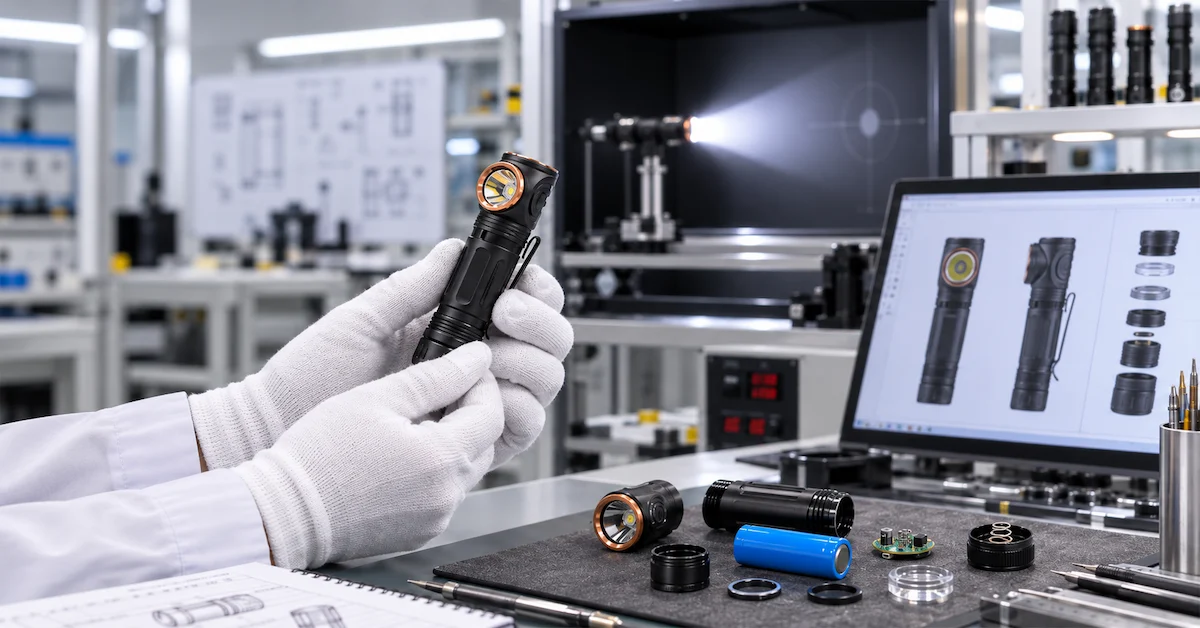
Minimum order quantity is often discussed as if it were one fixed number. In practice, the MOQ may differ for the flashlight body, custom color, logo process, battery, printed package, accessory, and master carton. A standard model in a neutral box may support a smaller trial than the same model with a custom anodized finish and a full-color gift box. The buyer needs to know which requirement creates the quantity threshold.
Ask for at least three quote tiers using one frozen specification. A first tier can show the realistic test order. A second can reflect the expected reorder. A third can show the volume at which packaging, component purchasing, or production efficiency materially changes. This makes it possible to compare inventory risk against unit-price savings instead of treating the cheapest tier as an automatic target.
A bulk flashlight supplier should also explain carton quantity and order multiples. A quote for 1,000 units may sound tidy, but the production and packing plan might work in cartons of 48, batteries in trays of another quantity, and retail displays in sets of 12. Understanding those multiples before the PO avoids partial cartons, unexpected overproduction, or a last-minute quantity revision.
Ask Brightenlux for a tiered wholesale quotation
Send the destination market, chosen product links, opening quantity, packaging plan, and target delivery window.
Request Wholesale PricingCompare landed cost, not only the factory unit price
The cheapest line on a factory quote does not always produce the cheapest item on the shelf. One buyer may discover that the cell was excluded; another may lose the apparent saving to a bulky box. Put the battery, cable, insert, retail pack, protective material, testing, inspection, freight, and likely replacement cost on the page. Until both quotations describe the same delivered item, their unit prices are just different numbers.
We find a plain landed-cost sheet more revealing than a polished quotation. Use identical rows for each offer, then move tooling and artwork setup away from costs that recur on every order. Note the trade term, destination, quotation date, and exchange-rate assumption in the margin. If those details are missing, the total is not ready for approval.
For LED flashlight wholesale programs, packaging volume can be surprisingly important. A large presentation box may improve shelf impact but reduce the number of units per carton and container. A compact recyclable carton may lower freight and storage cost while still explaining the product well. Ask for packed dimensions and gross weight before approving the final dieline.
Forecast reorders before placing the opening order
A wholesale program succeeds when the second order is easier than the first. Before buying, estimate weekly sales by channel, stock cover, production lead time, inspection time, and shipping time. Add a buffer for peak season or promotions. The purpose is not to predict perfectly. It is to identify when the reorder conversation must begin so the product does not disappear just as customers discover it.
Ask the supplier which components have the longest lead time and whether the exact battery, LED, driver, or housing finish can be reserved. If a product shares components with other active models, that may improve continuity. If it relies on a special cell, custom color, or unique package, the buyer may need to forecast earlier. Put substitution rules in writing: no change affecting form, fit, function, safety, appearance, claims, or packaging without approval.
A dependable rechargeable flashlight supplier should maintain a record of the approved electrical configuration. The cell model or approved equivalent, capacity, protection, charging board, connector, indicator behavior, cable, and runtime test conditions should not be reconstructed from old emails each time. These details affect customer experience and transport documentation as well as performance.
Build channel-specific packs instead of one universal box
The same flashlight may need a different commercial presentation for hardware distribution, outdoor retail, ecommerce, industrial supply, or promotional sales. A hardware package should make practical controls and battery information easy to scan. An outdoor package may lead with the use case and show beam behavior. Ecommerce requires clear image assets and compact claims that survive a small screen. Industrial buyers may want model codes, replacement information, and a straightforward specification table.
Do not create packaging before the product and accessory set are stable. Confirm whether the order includes a battery, cable, headstrap, clip, lanyard, spare seal, or instruction sheet. Then make the front, back, side panels, barcode, warnings, model identity, and carton marks agree. Request a digital proof and a physical production proof when color, fit, or print position matters.
A private label flashlight supplier should be able to state which branding processes suit the housing and order size. Laser engraving, pad printing, body color, package printing, and manual localization each have different setup needs. The cheapest logo method is not always the best if it rubs off, lands on a textured surface, or becomes unreadable at the required size.
Inspect wholesale orders using customer-visible risks
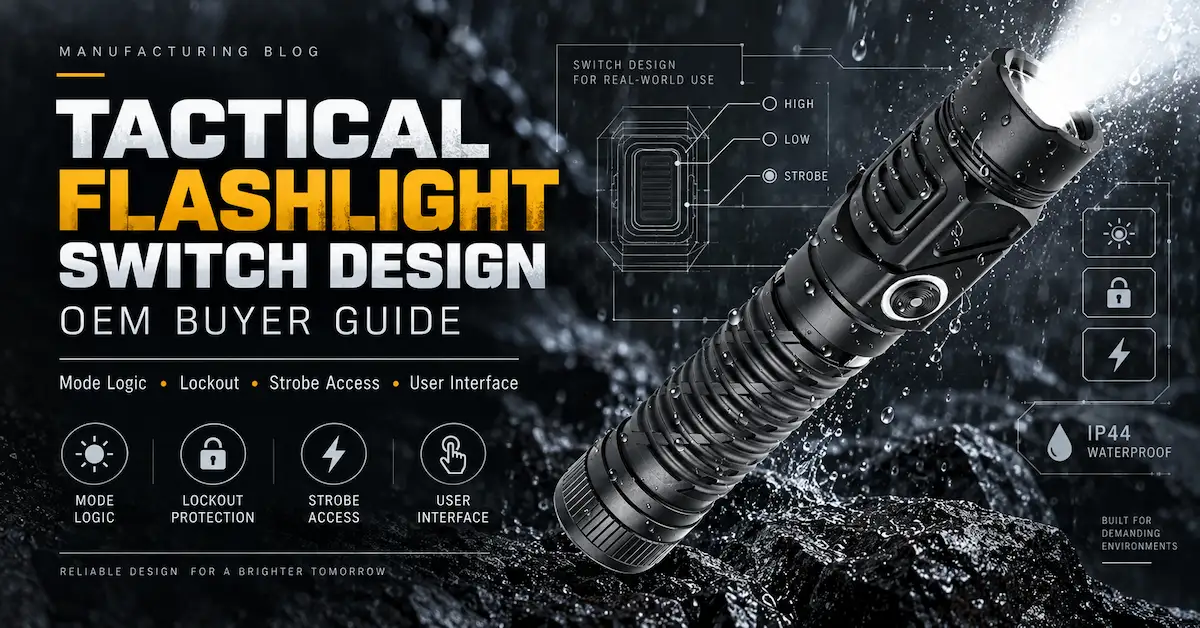
Inspection should begin with the problems that would create returns. For a rechargeable light, check charging, indicator behavior, mode sequence, switch response, heat, and useful runtime. For an adjustable-head or right-angle model, check movement, alignment, and holding force. For a magnetic product, test whether the magnet supports the light in the intended orientation. Appearance, scratches, logo position, package contents, and barcode readability also affect a wholesale shipment.
Agree on the inspection method while there is still time to act on it. Define the lot and sample size, then write a few examples of critical, major, and minor defects. The report should leave no mystery about which model and order were inspected, how many units were opened, what was tested, and what the photographs show. A failed check is the start of the useful conversation: isolate the affected pieces, trace the cause, correct the line, and show the buyer what changed before release.
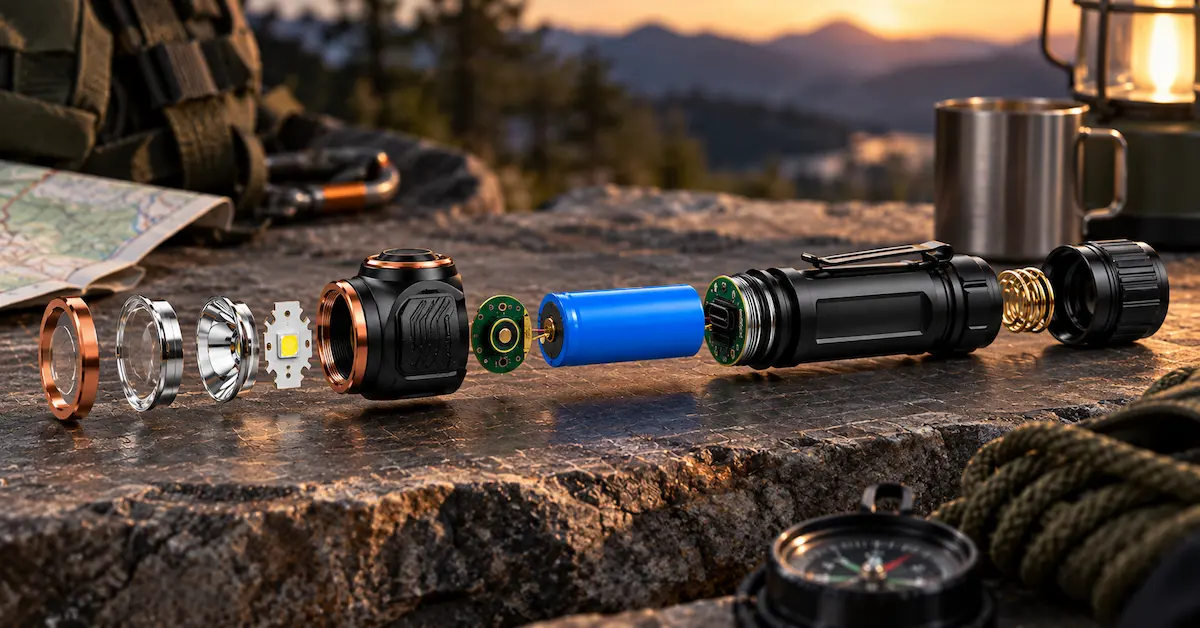
Seven checks for the cartons waiting at the factory
- Model code, body, LED, battery, modes, and accessories match the approved reference.
- Charging starts normally, the connector fits, and indicators follow the agreed behavior.
- Switches, focus, adjustable heads, clips, magnets, threads, and seals work consistently.
- Beam appearance and output behavior are checked under a stated method.
- Logo, finish, labels, manual, barcode, and package claims match the approved artwork.
- Inner protection, carton quantity, carton marks, and gross weight match the shipping plan.
- Any deviation is identified, contained, and approved in writing before shipment.
Sample the product as a buyer, user, and warehouse team
A sample review is more useful when three perspectives are represented. The buyer checks commercial fit: price position, packaging, and differentiation. The user checks grip, controls, beam, charging, and handling during a real task. The warehouse or operations team checks package size, labels, carton handling, and whether different SKUs can be identified quickly. A product can perform well in hand and still create fulfilment problems if boxes look identical or barcodes are poorly positioned.
Number each sample and keep a short decision sheet. A few blunt notes are enough: arrived on Tuesday; clip scratched; charging passed; beam too narrow; revised box still needed. Take close photographs of the port and battery compartment, then add the switch, logo, pack, and loose accessories. Once everybody signs off, put that sample code into the purchase file so there is no debate about which unit became the reference.
For a wholesale LED flashlight assortment, compare products side by side rather than on different days. Charge batteries under the same conditions, use one marked wall and distance for beam checks, and weigh the complete retail pack. This reduces subjective decisions and makes the range hierarchy easier to defend.
Evaluate a flashlight manufacturer in China beyond geography
China has a broad portable-lighting supply chain, but location alone does not establish capability. When evaluating a flashlight manufacturer China sourcing teams should confirm the legal business, production scope, engineering ownership, quality process, export experience, communication route, and responsibility for purchased components. The objective is to understand who controls the finished product and how problems are handled.
Ask for a simple process map for the shortlisted model. Who approves LEDs and batteries? Where are boards assembled? How are housings finished? Which steps are outsourced? Who performs charging, mode, appearance, and packing checks? Outsourcing is common, but the supplier should still control incoming acceptance, approved specifications, and corrective action.
Communication quality is practical evidence. A useful answer identifies assumptions, confirms the model, flags unavailable requirements, and states what must be tested. A weak answer repeats "no problem" without showing how the request will reach engineering, purchasing, production, and inspection. During sampling, observe whether the team maintains one version of the specification or creates a new interpretation in every message.
Ask for evidence that matches the exact order
Certificates and reports are not interchangeable marketing badges. Their relevance depends on the model, components, destination, and claim. Ask which documents apply to the ordered configuration, then check the model identity, applicant or manufacturer, test scope, issue date, and referenced standards. Battery transport documents should match the cell or battery pack actually supplied.
Performance claims need the same discipline. Ask a very ordinary question whenever a number appears: how was it measured, and on which build? That applies to lumens and runtime as much as beam distance, water exposure, impact, or charge time. Change the cell or driver and the earlier runtime curve may be useless; change the lens or housing and the beam or thermal result may move. Finish the evidence first. Marketing can then say exactly what the approved light can support.
A professional wholesale flashlight supplier will distinguish between a public product-page statement, an internal test, a third-party report, and an order-specific guarantee. That distinction helps the buyer write accurate packaging and product pages while avoiding claims that cannot be defended.
Need samples for a wholesale range review?
Choose two or three Brightenlux models and send your channel, market, quantity, and required features.
Discuss Samples and MOQMake every quotation comparable
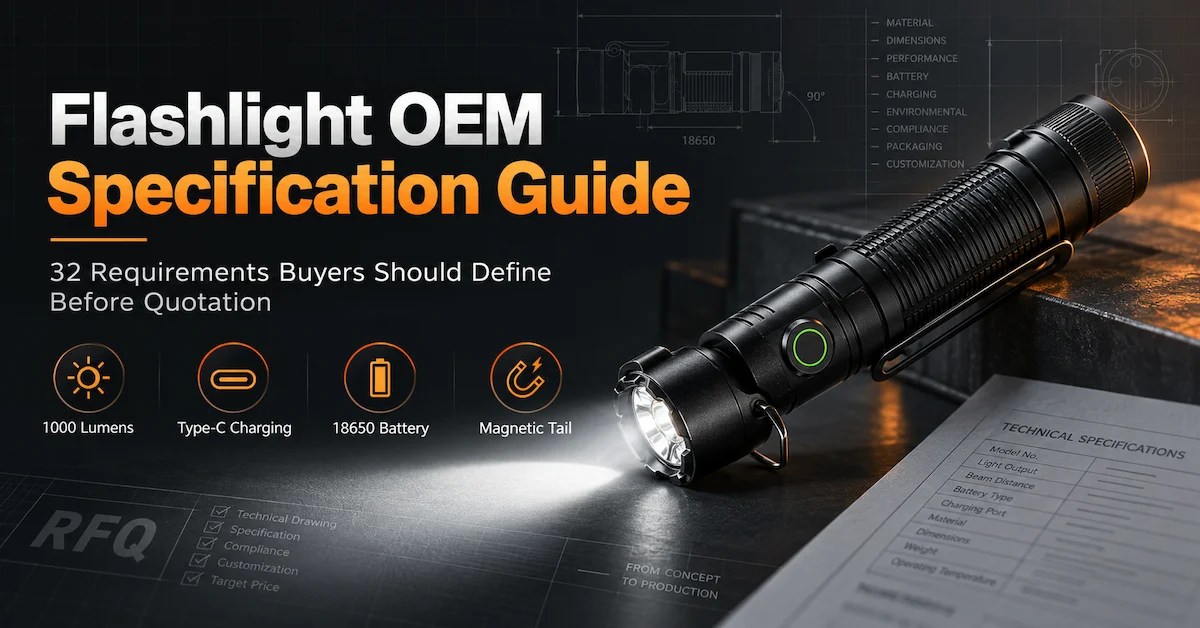
Send each shortlisted supplier the same request. Include the intended user, destination market, channel, product link, required changes, battery, charging method, accessories, package, order tiers, target schedule, delivery term, inspection plan, and documents. Ask the supplier to identify every deviation instead of silently quoting a near match.
Use a response table with columns for requirement, offered specification, deviation, evidence, unit cost, one-time cost, sample time, and production time. This format exposes assumptions early. It also prevents a low quote from winning simply because several required items were omitted.
During a LED flashlight wholesale comparison, normalize the battery and accessory set first. A light without a cell, cable, headstrap, or printed package may appear cheaper than a complete retail product. Then normalize the trade term, carton volume, inspection, and payment structure. Only after those adjustments does the unit price become meaningful.
Information to include in the first RFQ
- Buyer type, sales channel, destination country, and target customer.
- Preferred Brightenlux product links and the role of each SKU in the assortment.
- Opening quantity, expected reorder quantity, and launch date.
- Battery, charging, modes, beam, runtime, handling, and accessories.
- Logo process, body color, packaging, language, barcode, and carton requirements.
- Sample stages, inspection method, required reports, and claim evidence.
- Delivery term, destination, quote validity, and requested response date.
Protect margin by reducing avoidable complexity
Margin is influenced by more than purchase price. Too many similar SKUs increase photography, listings, package inventory, warehouse errors, and slow-moving stock. Too many custom components increase approval work and make reorders less flexible. A disciplined range keeps meaningful customer choice while reducing operational noise.
Spend development money where the customer can feel the result: the right battery format, a magnet that holds, a head that stays at its chosen angle, a sensible accessory kit, or a box that answers the obvious questions. An internal alteration needs a business reason, such as a measured performance or reliability problem. When the existing platform already does the job well, keeping it unchanged can be the smarter product decision.
Review sell-through by SKU after launch. Track returns, customer questions, warranty reasons, channel margin, and reorder speed. Send structured feedback to the supplier. A model that sells slowly may need different positioning rather than immediate replacement; a model that sells well but creates charging questions may need clearer instructions or images. The best wholesale program improves through evidence instead of adding products reactively.
Common wholesale flashlight purchasing mistakes
Buying five products that solve the same job
Visual differences can hide commercial overlap. Give every SKU a range role and customer sentence before ordering. Remove products that cannot explain why they deserve separate inventory.
Accepting a quotation without a complete configuration
A model name and lumen figure do not define the product. Record battery, LED, modes, charging, accessories, logo, package, and inspection scope before comparing prices.
Using the largest discount tier as the opening order
A lower unit cost does not compensate for unsold stock. Use a realistic test quantity, collect channel evidence, and expand the reorder when sell-through supports it.
Approving printed claims before evidence
Packaging is expensive to correct. Confirm the ordered configuration and supporting evidence before printing lumen, runtime, distance, water-resistance, or certification statements.
Failing to define the reorder reference
Keep the approved sample code, specification, artwork, inspection criteria, test evidence, and deviations together. Require written approval for component or process changes.
Questions buyers tend to ask before the first carton is ordered
Is the company supplying a standard light or building my version?
That question is more useful than arguing about labels. Wholesale orders commonly use an existing product and move quickly, while factory work can reach into components, functions, structure, or packaging. One company may offer both. Ask it to mark every requested feature as standard, modified, or newly developed; the scope will be clearer than the company description.
How many flashlight models should a first wholesale order include?
There is no magic number. In practice, three to five products give a new distributor enough choice without turning the launch into an inventory exercise. Each needs a different price role, user job, or handling advantage. The sixth model should wait until sales calls, search data, or lost orders reveal a customer need the first five cannot cover.
Should the core model use 18650, 21700, or dual power?
Look at the shopper and the shelf position before choosing. An 18650 body is familiar and can stay fairly compact. A 21700 cell supports a capacity-led step-up, although the grip and packed weight grow. Dual power makes sense when disposable-cell backup is part of the buying story. Put the samples in hand, then compare runtime, charge time, box size, transport paperwork, and the replacement policy.
Can Brightenlux provide private-label packaging?
Brightenlux presents OEM and private-label capabilities in its public materials. The buyer should send the product, quantity, logo method, packaging format, language, barcode, and destination requirements for a current feasibility review and quotation.
How should buyers compare MOQ?
Ask which element creates the minimum: standard product, special color, logo, battery, accessory, or printed package. Request several quantity tiers against the same specification and compare the inventory risk, landed cost, and reorder timing.
What should be checked before a bulk flashlight shipment?
Verify identity, appearance, function, charging, mode sequence, battery, accessories, logo, package, barcode, carton quantity, and agreed performance checks. Define the sampling plan and response to failures before the inspection begins.
How can a distributor keep repeat orders consistent?
Maintain one approved product file and a physical or numbered reference sample. Record the configuration, artwork, inspection criteria, reports, approved deviations, and revision history. Require notice and approval before substitutions that affect the product or its claims.
Turn the next supplier inquiry into a range proposal
Begin with the channel and customer, then choose a small number of products with different commercial roles. Use Brightenlux's current flashlight catalogue to identify possible entry, core, step-up, and specialist models. Add the opening quantity, packaging plan, destination, launch timing, and the evidence needed for your market.
Ask for a response that includes the offered configuration, deviations, price tiers, sample route, production timing, carton information, and applicable documents. That information gives the buyer a working decision rather than another catalogue. It also gives the supplier enough context to recommend an existing platform when it fits and identify genuine development work when it does not.
Build your Brightenlux wholesale flashlight range
Share your market, channel, quantity tiers, preferred products, packaging needs, and target delivery date.
Start a Wholesale Flashlight RFQFor buyers comparing a wholesale flashlight supplier, a long product list is not much of a proposal. A good one explains which lights belong on the shelf, what each delivered unit costs, what the inspector will open, and how the same build can be ordered again. Brightenlux currently offers useful starting points rather than one answer: dual-power, 18650, 21700, moving-head, red-mode, magnetic, and right-angle designs. Tell the team what your customer is trying to do, and those choices become much easier to narrow down.