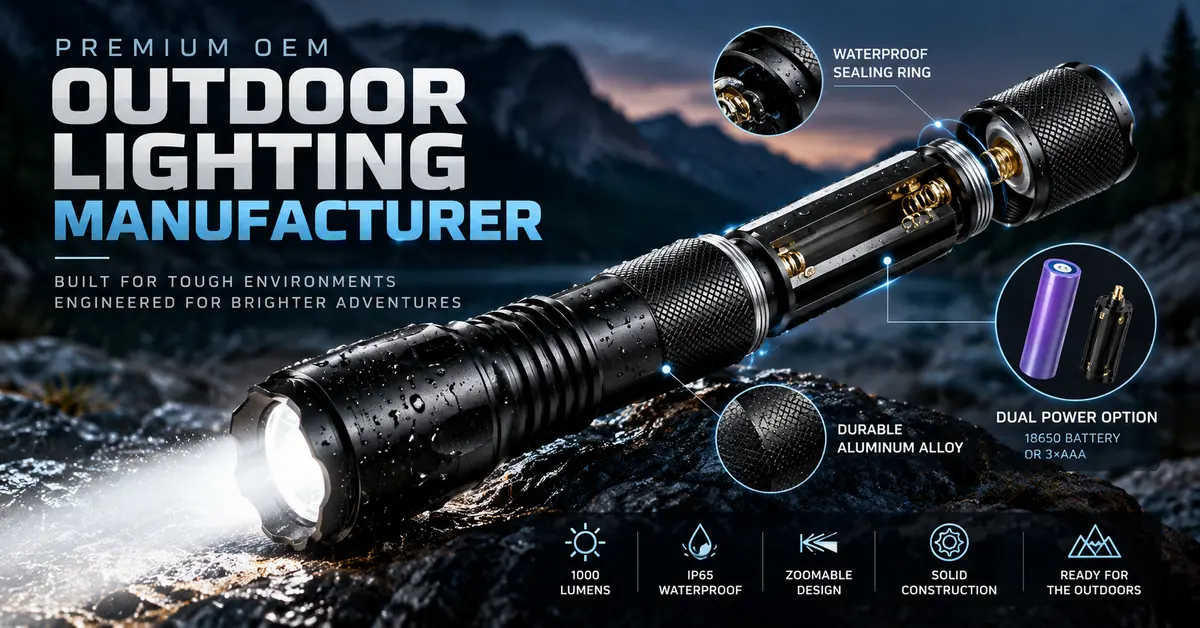


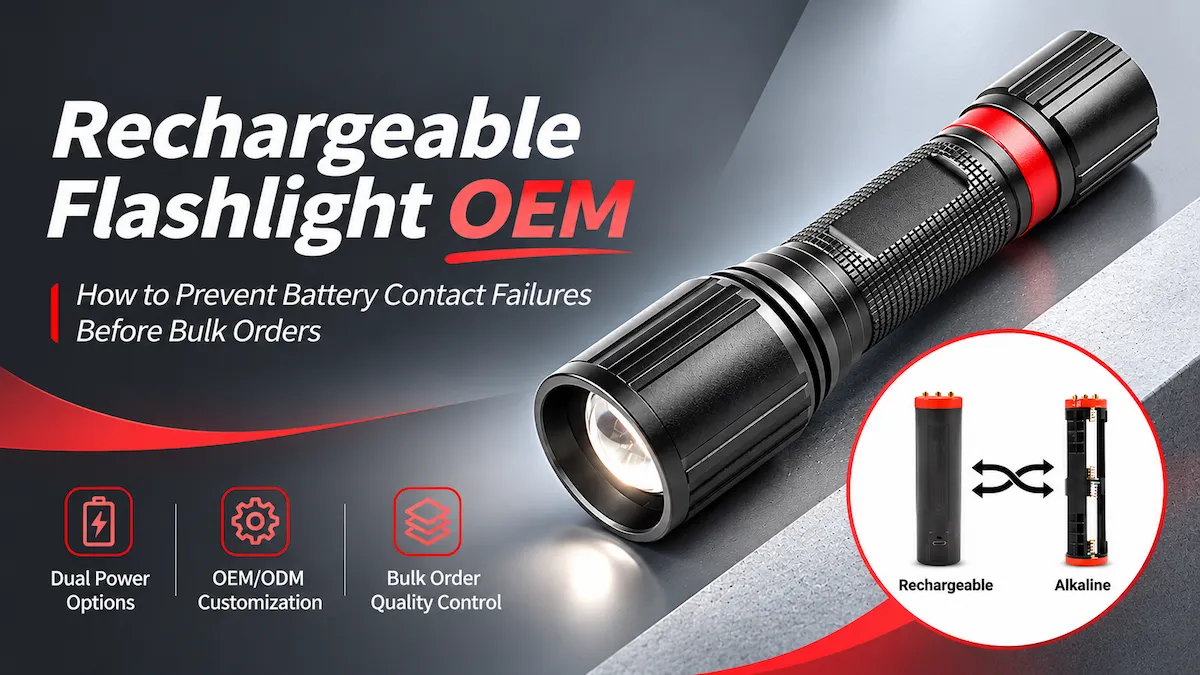
A successful rechargeable flashlight OEM project requires more than selecting a high-capacity lithium battery and approving a USB-C charging interface. This B2B guide helps flashlight brands, importers, and wholesale distributors evaluate battery compartment tolerances, contact reliability, power interruptions, and production consistency before bulk manufacturing. Learn how to compare existing rechargeable flashlight platforms, develop practical sample tests, manage component substitutions, and establish acceptance criteria that support dependable repeat orders.
Request an OEM QuoteExplore ProductsWhy Does Battery Contact Reliability Matter in Rechargeable Flashlight OEM Projects?
A rechargeable flashlight depends on the complete electrical path: battery, contacts, driver, LED, switches, charging electronics, and housing. When a removable cylindrical battery is used, retention and contact engagement are also essential. A fully charged product can still flicker, reset, or switch off if a connection becomes intermittent. Similar symptoms may originate from the switch, driver, protection circuit, or PCB; buyers should require diagnosis rather than assume a weak spring is always responsible.
Which buyers should prioritize these checks?
| Buyer | Program | Main concern |
|---|---|---|
| Outdoor flashlight brand | Rechargeable hiking and camping lights | Reliable operation during handling |
| Industrial tool distributor | Maintenance flashlights | Contact stability and repeated use |
| Private-label importer | Branded flashlight ranges | Consistent batches and fewer returns |
| Emergency equipment supplier | Backup portable lighting | Readiness after storage and movement |
| OEM product developer | Customized battery systems | Electrical and mechanical compatibility |
A successful program should evaluate the battery interface as part of a controlled assembly, not as an isolated component.
What Causes Battery Contact Problems in Rechargeable Flashlights?
Several interacting conditions can cause unreliable power delivery.
Contact engagement and spring travel
Insufficient engagement may permit interruptions when the light is moved. Excessive compression can also introduce mechanical stress or assembly problems. The correct design depends on the approved battery, contact geometry, and operating conditions.
Battery size and terminal variation
Nominal cell-format labels do not guarantee identical assembled length, terminal shape, insulation, or protection construction. Buyers must approve exact cells or packs.
Contamination and assembly variation
Contact corrosion, foreign material, unsuitable finishes, incorrect tailcap engagement, or misplaced retaining parts can affect continuity.
| Potential problem | Possible symptom | Engineering review |
|---|---|---|
| Poor terminal engagement | Intermittent lighting | Contact geometry and fit |
| Incorrect spring compression | Flicker during movement | Spring travel and assembly |
| Battery movement | Power interruption | Retention design |
| Contaminated contact | Higher resistance | Surface condition and material |
| Incorrect tailcap assembly | Unstable connection | Thread and fit checks |
| Switch or PCB fault | Similar intermittent symptoms | Electrical fault isolation |
The investigation should identify the actual failure mechanism before a design change is approved.
How Do 18650, 21700 and 26650 Battery Platforms Affect OEM Design?
The 18650, 21700 and 26650 designations refer to different nominal cylindrical-cell size families. They are not automatically interchangeable, and a protected cell or assembled pack may differ from a bare cell in important dimensions.
An 18650 platform can suit compact rechargeable flashlights. A 21700 platform changes the available housing envelope and weight balance. A 26650 configuration generally requires a larger compartment. A dual-power arrangement adds carrier, polarity, and charging considerations.
| Battery platform | Design consideration | OEM verification |
|---|---|---|
| 18650 | Compact cylindrical architecture | Approved cell length and contact fit |
| 21700 | Different size and energy configuration | Housing, weight and retention |
| 26650 | Larger cylindrical form factor | Compartment and tailcap design |
| Integrated pack | Controlled assembly | Pack mounting and wiring |
| Dual power | Alternative approved power sources | Carrier, isolation and polarity |
Only batteries specifically approved for the exact flashlight should be installed. Physical fit alone does not establish electrical or charging safety.
Which Brightenlux Products Can Be Evaluated for Rechargeable Flashlight OEM Projects?
Ningbo Brightenlux Electric Appliance Co., Ltd. publishes rechargeable flashlight models with several battery configurations. These are useful reference platforms, not evidence that all battery substitutions or OEM changes are available.
| Model | Published LED/output | Published power configuration | Evaluation focus |
|---|---|---|---|
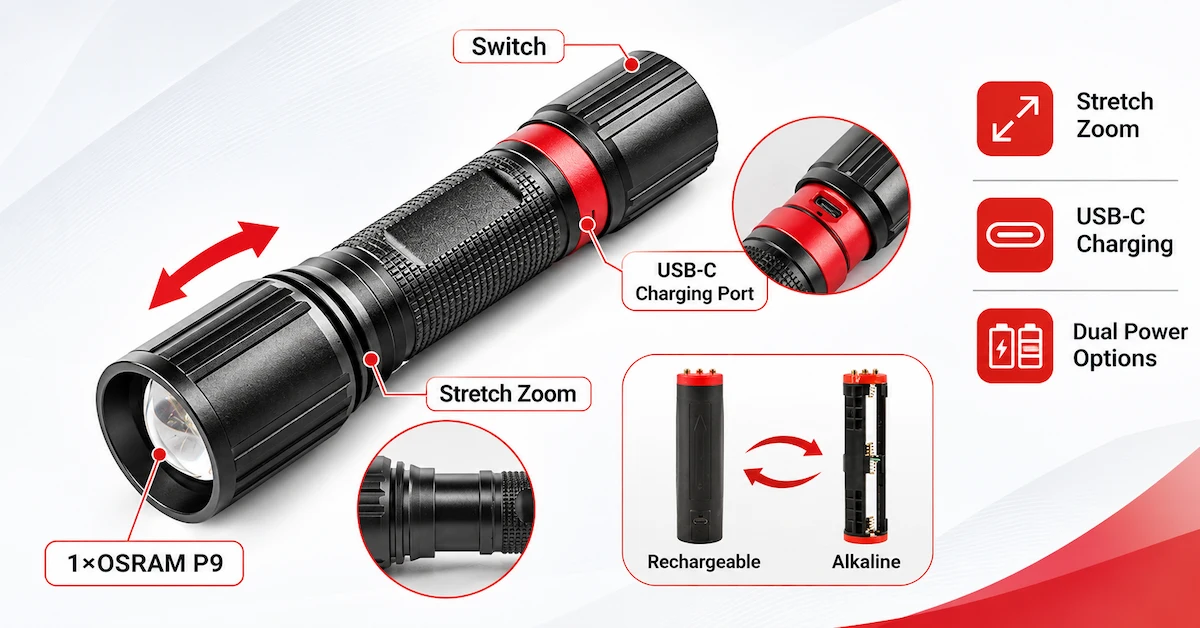
| BT-FL8034 | OSRAM P9, up to 1000 lm | 18650 rechargeable battery, not included by default | Approved cell and compartment fit |
| BT-FL8088 | SST40, up to 1500 lm | Included 21700 4000 mAh | Retention and continuity |
| BT-FL8032 | XHP50, up to 2000 lm | Included 26650 5000 mAh | Larger-cell assembly |
| BT-FL8104 | Up to 1000 lm | Included 18650 2200 mAh or 3 AAA option | Alternative power configuration |
BT-FL8034: 18650 platform
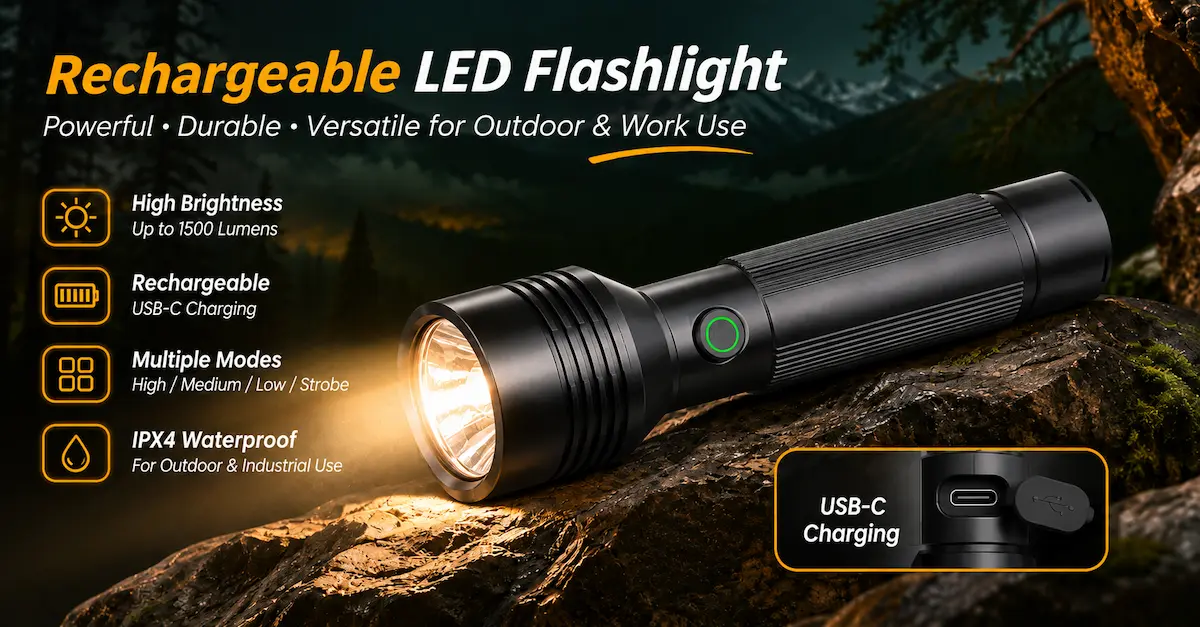
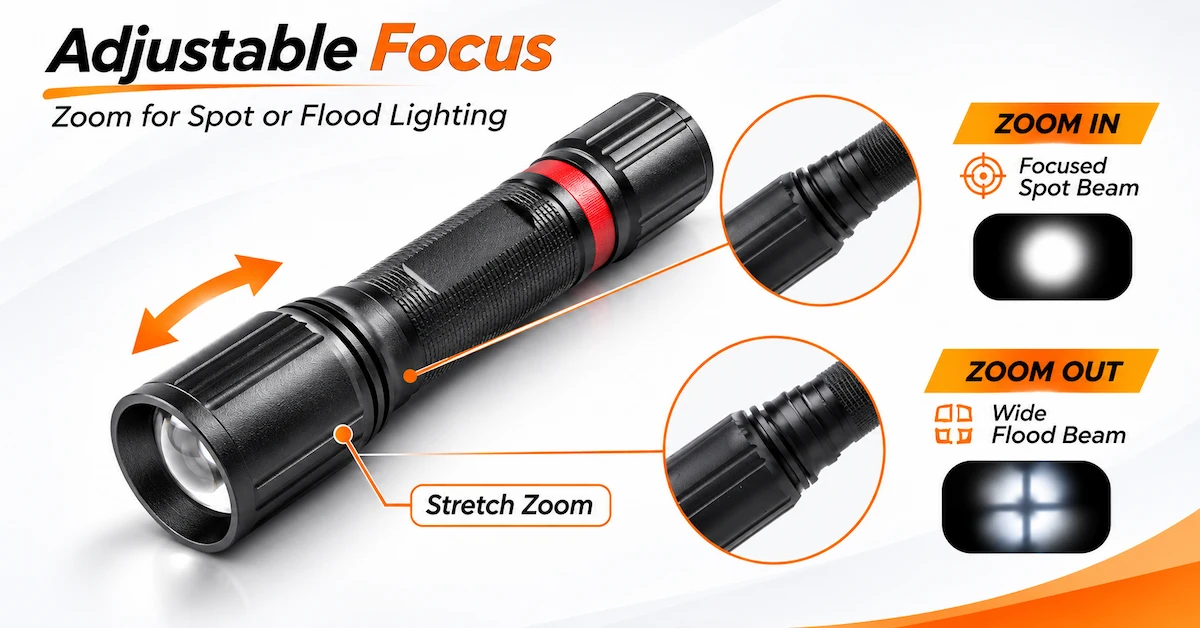
The BT-FL8034 rechargeable flashlight is described with an OSRAM P9 LED, adjustable beam, aluminum housing, and Type-C charging. Because its 18650 battery is not included by default, buyers should explicitly confirm which approved cell, terminal arrangement, and accessory configuration are included in a quotation.
BT-FL8088: 21700 platform
The BT-FL8088 magnetic rechargeable flashlight is published with an SST40 LED, magnetic tail, Type-C charging, and included 21700 4000 mAh battery. Evaluate the approved cell's retention alongside product weight and normal handling.
BT-FL8032: 26650 platform
The BT-FL8032 rechargeable flashlight is published with an XHP50 LED and included 26650 5000 mAh battery. Relevant checks include physical installation, tailcap fit, and operation after agreed handling conditions.
BT-FL8104: dual-power arrangement
The BT-FL8104 twist-focus flashlight is listed with an 18650 rechargeable option or three AAA cells. Buyers must verify any required carrier and ensure that the charging circuit is not represented as suitable for disposable primary batteries.
Explore Brightenlux products or request model-specific information.
Send your battery configuration, inspection criteria, target market and order volume to Brightenlux for review.
Discuss Your OEM ProjectView Flashlight ProductsWhat Battery Compartment Specifications Should OEM Buyers Approve?
A written battery-compartment specification should identify the approved cell or pack, physical envelope, terminal geometry, contact construction, insulation, polarity, retention, and charging arrangement.
Battery identity and dimensional control
Record manufacturer, exact model, chemistry, nominal voltage, capacity, protection arrangement, terminal design, and approved dimensional tolerances. Engineering drawings should define compartment geometry and contact positions.
Contact construction and retention
Identify the approved contact material, finish, spring or plate geometry, and retaining components. Battery retention must be evaluated under the intended use conditions. Any changes to springs, spacers, tailcaps, or internal housing dimensions may require renewed review.
| Item | Required information | Evidence |
|---|---|---|
| Battery | Exact approved model | Component specification |
| Terminals | Approved geometry | Drawing and sample |
| Dimensions | Cell and compartment tolerances | Dimensional report |
| Contacts | Material and finish | Controlled BOM |
| Retention | Mechanical engagement | Inspection record |
| Insulation | Polarity and isolation | Engineering review |
| Charging | Approved battery compatibility | Electrical test |
| Revision | Housing and tailcap identity | Change-controlled record |
The exterior size of a flashlight is not sufficient to define its internal battery compatibility.
How Can Buyers Test Battery Contact Continuity Before Mass Production?
Contact-continuity evaluation should use representative production-intent samples and appropriate instrumentation, under competent engineering supervision.
Step 1: Identify the sample
Record the flashlight revision, exact battery, driver, switch, charging system, and contact components.
Step 2: Establish baseline operation
Prepare the battery according to its approved procedure. Verify normal lighting behavior and document the operating mode and conditions.
Step 3: Test permitted orientations
Place the product in representative approved handheld or mounting positions. Observe normal function and investigate any suspected interruptions.
Step 4: Apply controlled handling conditions
Use an agreed, safe handling method relevant to the intended application. A casual shake test is not equivalent to a standardized durability procedure.
Step 5: Monitor continuity
Suitable electrical measurement equipment can detect brief events that visual observation misses. Test instrumentation must not introduce unsafe conditions or alter the system in a way that invalidates results.
Step 6: Inspect and record
Examine battery retention, contacts, tailcap, housing, and functional behavior. Record the test method, observations, deviations, and engineering disposition.
| Test condition | Evaluation | Acceptance basis |
|---|---|---|
| Normal position | Stable operation | Approved specification |
| Alternate permitted position | Electrical continuity | Defined criteria |
| Controlled handling | Response to movement | Agreed procedure |
| Post-handling | Function and mechanical condition | No unexplained failure |
| Battery installation | Correct engagement | Approved assembly |
| Tailcap operation | Fit and continuity | Defined inspection |
| Multiple samples | Repeatability | Buyer-approved plan |
These are recommended evaluation categories, not claimed Brightenlux laboratory results.
Which Engineering Tests Are Relevant to Battery Contact Reliability?
For handling durability, the official IEC 60068-2-31:2008 rough-handling test standard describes methods involving specified shocks such as drops and toppling for relevant equipment. The actual test severity and acceptance criteria must be chosen for the intended flashlight; citing the standard does not prove a model has passed it.
After a relevant handling test, evaluate contact continuity, switch behavior, charging function, battery retention, tailcap engagement, and housing integrity. A product that works intermittently after impact should be investigated even when the exterior appears intact.
For battery safety context, IEC 62133-2:2017+A1:2021 addresses safety requirements and testing for portable sealed secondary lithium cells and batteries. Cell-level safety documentation is not a substitute for finished-flashlight electrical compatibility or mechanical-contact testing.
Ask the supplier to identify the tested revision, procedure, scope, results, and available reports. Never treat a reference to a standard as evidence of a product certification.
Why Can a Flashlight Pass Charging Tests but Still Have Contact Problems?
Charging tests often occur with the product stationary, while normal use involves movement, repositioning, and repeated opening of a removable-battery compartment. Electrical loads and control behavior may also differ between charging and illumination.
A green charging indicator does not prove contact reliability in every operating condition. A power interruption can also originate in the switch, driver, battery protection circuit, or control electronics.
| Suspected area | Potential issue | Review |
|---|---|---|
| Battery contacts | Intermittent connection | Retention and contact tests |
| Switch | Unintended interruption | Switch continuity |
| Driver | Unstable behavior | Driver diagnosis |
| Battery protection | Protection activation | Approved system review |
| Charging circuit | Incorrect charging response | Charging validation |
| Controls | Reset or mode change | Control-system review |
For a separate discussion of USB-A/C-to-C charging compatibility, refer to the Brightenlux OEM USB-C charging validation guide.
How Should Battery Contacts Be Controlled During OEM Manufacturing?
Prototype approval does not guarantee repeatable production. Critical incoming parts may include batteries, springs, contact plates, tailcaps, retainers, insulators, and electronic assemblies. The supplier should identify inspection requirements for each.
Relevant dimensions should be compared with approved drawings. Assembly processes should control contact placement and any specified torque or fit requirements. First-article inspection should confirm the production-intent assembly before routine output proceeds.
For appropriate attribute-based lot inspection, ISO 2859-1:2026 provides AQL-indexed sampling schemes. Sampling can support agreed finished-goods inspection, but it cannot replace engineering qualification or guarantee that every unit is free of defects.
| Stage | Main control | Evidence |
|---|---|---|
| Incoming battery | Approved cell and condition | Identity record |
| Incoming contacts | Correct material and finish | Component inspection |
| Housing | Compartment dimensions | Dimensional report |
| Assembly | Correct contacts and tailcap | Assembly checks |
| First article | Approved reference match | First-article report |
| Function | Stable normal operation | Test record |
| Finished goods | Agreed lot inspection | Inspection report |
| Repeat order | Change control | Revision history |
A simple visual inspection is insufficient when the purchasing requirement concerns transient electrical interruptions.
Send your battery configuration, inspection criteria, target market and order volume to Brightenlux for review.
Discuss Your OEM ProjectView Flashlight ProductsHow Can OEM Battery Substitutions Affect Repeat-Order Quality?
Two cells with the same nominal format can differ in terminal arrangement, protection assembly, physical dimensions, and electrical characteristics. A proposed substitute should undergo engineering assessment before acceptance.
The same applies to contact springs, coatings, retaining parts, tailcaps, driver boards, and charging circuits. Even a visually identical exterior can conceal a materially different internal assembly.
| Proposed change | Required review |
|---|---|
| Battery manufacturer or model | Electrical and dimensional compatibility |
| Contact spring | Engagement and continuity |
| Contact material or finish | Electrical and environmental suitability |
| Tailcap | Fit and mechanical engagement |
| Battery retainer | Cell positioning |
| Housing geometry | Compartment tolerance |
| Driver or PCB | Electrical operation |
| Charging circuit | Battery and charging compatibility |
Establish which changes require written buyer approval and whether additional sample testing is necessary.
How Do Battery Contact Requirements Affect OEM Flashlight Costs?
A reliable contact system has engineering, manufacturing, inspection, and commercial implications. Relevant costs may include battery selection, contact materials, tighter dimensional control, retention components, engineering tests, and traceability.
| Cost area | Potential impact |
|---|---|
| Battery | Approved sourcing and cell price |
| Contacts | Material and processing |
| Housing tolerance | Machining or molding |
| Retention | Components and assembly |
| Validation | Samples and laboratory work |
| Inspection | Measurement and documentation |
| After-sales | Investigation and replacements |
For illustration only, if 2% of a hypothetical 5,000-unit order generated $15 in handling and replacement costs per affected unit, the expense would be 5,000 × 0.02 × $15 = $1,500. This is not a Brightenlux defect rate or customer case.
Compare quotations using the same approved battery, contact arrangement, accessories, tests, packaging, and inspection scope. The lowest quoted unit price does not necessarily describe an equivalent product.
What OEM/ODM Customization Can Buyers Discuss With Brightenlux?
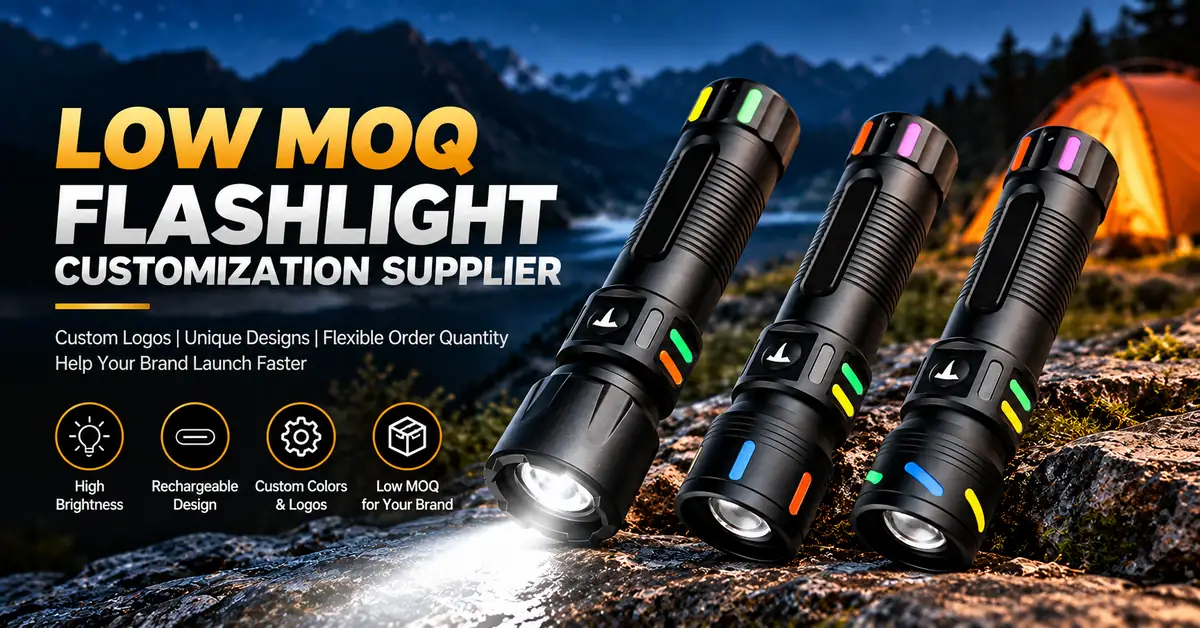
Brightenlux describes OEM/ODM portable lighting support. Possible project discussions include logo marking, housing finish, retail packaging, product identification, manuals, and accessories. Availability must be confirmed for the selected model.
Changing the battery, tailcap, contact assembly, housing, or charging electronics is an engineering change rather than a cosmetic adjustment. It may require new drawings, tooling, safety assessment, and sample validation.
A recommended buyer-controlled workflow is: Application brief → Existing platform → Approved battery → Mechanical/electrical review → Engineering sample → Contact-continuity evaluation → Design approval → Pilot production → Inspection → Shipment.
MOQ, tooling costs, sample timing, and production lead time vary by model and customization. Obtain written, project-specific quotations instead of assuming universal factory figures.
What Should Buyers Include in a Rechargeable Flashlight OEM RFQ?
A useful RFQ identifies the end use, reference model, lighting performance, battery configuration, mechanical fit, contact reliability, charging, expected handling, OEM customization, validation, quality control, quantity, and commercial terms.
| RFQ field | Information to provide |
|---|---|
| Buyer | Company, market and channel |
| Application | Outdoor, industrial, emergency or general use |
| Reference | Brightenlux model or drawing |
| Lighting | Output, beam, modes and runtime |
| Battery | Exact approved cell or pack |
| Compartment | Geometry, contact and retention |
| Charging | Input and battery compatibility |
| Handling | Intended conditions and tests |
| OEM | Branding, housing and packaging |
| Validation | Sample and acceptance criteria |
| QC | BOM, inspection and change control |
| Commercial | Quantity, MOQ, tooling and timeline |
Before approval, ask which batteries are approved, how contacts are controlled, what continuity tests are available, how substitutions are handled, and which evidence accompanies the production-intent sample.
Explore Rechargeable Flashlight Products · Review OEM/ODM Lighting Solutions · Request a Rechargeable Flashlight OEM Quote
Send your battery configuration, inspection criteria, target market and order volume to Brightenlux for review.
Discuss Your OEM ProjectView Flashlight ProductsFrequently Asked Questions About Rechargeable Flashlight OEM Manufacturing
What should buyers look for in a rechargeable flashlight OEM manufacturer?
Choose a manufacturer that identifies the approved battery and electrical architecture, provides model-specific specifications, supports representative sample testing, and controls components across production and repeat orders.
Why can a rechargeable flashlight flicker when its battery is charged?
Possible causes include unstable battery contact, switch faults, driver behavior, or protection-circuit events. Competent engineering diagnosis is needed to identify the actual cause.
Can a protected 18650 battery replace an unprotected 18650 battery?
Not automatically. Protection assemblies and terminal configurations can change dimensions and compatibility. Only specifically approved cells should be used.
Are 18650, 21700 and 26650 batteries interchangeable?
No. They are different cell-format families. A flashlight must be designed and approved for its specific battery configuration.
How can buyers evaluate battery contact reliability?
Test production-intent samples with the approved battery, defined orientations and safe handling procedures, appropriate continuity measurement, and documented acceptance criteria.
Does USB-C charging prove reliable battery contacts?
No. Charging functionality and contact stability during handling are different evaluation areas and should be verified separately.
Which OEM changes require additional testing?
Changes to the battery, contact parts, tailcap, retention, housing geometry, driver, PCB, or charging system may require engineering review and renewed validation.
Can Brightenlux supply 18650, 21700 and 26650 rechargeable flashlights?
Brightenlux publishes models using these formats, including BT-FL8034, BT-FL8088, and BT-FL8032. Availability and configuration should be confirmed for the specific order.
How should suppliers control components between repeat orders?
Use a controlled BOM, relevant traceability, agreed inspection records, and written approval for substitutions affecting performance or safety.
How can I request a rechargeable flashlight OEM quotation?
Provide application, reference model, battery and charging requirements, lighting performance, branding, quantity, destination market, and testing expectations. Contact Brightenlux for a model-specific proposal.
Conclusion
Choosing a rechargeable flashlight OEM partner requires more than comparing lumen ratings, lithium battery capacities, USB-C connectors, and exterior appearance. The battery, contacts, housing, driver, charging system, and retention design must operate as an approved assembly.
For outdoor brands, industrial distributors, and private-label importers, the most effective approach is to select an appropriate existing platform, define the exact approved battery, test contact continuity under representative conditions, and control critical components through production and repeat orders.
Brightenlux publishes rechargeable flashlight platforms using 18650, 21700, and 26650 configurations and discusses OEM/ODM development with international buyers. Product-specific engineering feasibility, testing evidence, MOQ, and timelines require confirmation.
Explore Brightenlux Products · Review OEM/ODM Solutions · Request an OEM Quote