

Quick Answer: A flashlight OEM ODM factory can support different levels of product customization, from branding an existing flashlight to developing a new housing, optical system, or electronic design. New tooling becomes commercially attractive when the additional margin, confirmed customer demand, or operating benefits justify its development cost. Before investing, B2B buyers should compare total launch costs, calculate break-even volume, validate technical requirements, and agree on ownership, testing, and production controls.
For overseas flashlight brands, distributors, and importers, one of the most expensive purchasing mistakes is investing in a fully customized product before establishing whether the market actually needs it.
A new aluminum housing may create stronger brand recognition. A redesigned optical system may improve illumination for a specific application. A modified battery arrangement may support a different runtime target.
However, each change can introduce engineering expenses, tooling requirements, additional testing, and new supply-chain risks.
The real question is not whether a factory offers OEM or ODM services.
It is whether the expected commercial value of customization exceeds its full development and production cost.
This guide introduces a practical decision model for working with a flashlight OEM ODM factory, using published Brightenlux flashlight products as reference platforms.
1. What Is the Difference Between OEM, ODM, and Private Label Flashlight Manufacturing?
The terms OEM, ODM, and private label are frequently used interchangeably in lighting procurement.
However, they can represent different engineering responsibilities and investment requirements.
Private label: branding an existing product
Private-label manufacturing commonly involves selecting an existing flashlight and adding approved brand elements.
Typical requests include:
-
Product logo and identification markings.
-
Retail packaging and printed inserts.
-
User manuals in the destination-market language.
-
Barcode labels and product assortment packaging.
-
Selected colors or accessories where supported.
This route is often appropriate for distributors testing a new category, outdoor retailers launching an entry-level product, or brands expanding an existing flashlight assortment.
Because the core design remains unchanged, it may avoid some development and tooling costs.
However, the buyer must still verify the product's performance, packaging accuracy, and relevant market requirements.
OEM: manufacturing to an agreed specification
An OEM project uses a defined product specification agreed between the buyer and manufacturer.
It may retain an existing platform while introducing modifications to:
-
LED and optical configurations.
-
Battery format or approved battery model.
-
Switch and lighting-mode behavior.
-
Charging interface.
-
Housing appearance and accessories.
-
Product branding and packaging.
The extent of these changes determines the engineering work required.
A new logo is very different from modifying the charging electronics or thermal design.
ODM: developing or adapting a product design
ODM cooperation typically involves the manufacturer contributing product design or engineering resources.
An ODM flashlight project may involve modifying an existing supplier-developed platform or developing a substantially new product.
Possible development areas include housing geometry, electronic controls, optical systems, mechanical interfaces, and battery integration.
However, the term ODM does not automatically determine who owns the resulting design.
Design ownership, tooling rights, exclusivity, documentation access, and future production permissions must be agreed in writing.
OEM vs ODM vs Private Label: Procurement Comparison
| Manufacturing Route | Typical Scope | Main Cost Drivers | Suitable Buyers |
|---|---|---|---|
| Private Label | Logo, labels, packaging, approved accessories | Decoration, printing, packaging setup | New brands, distributors |
| Platform-Based OEM | Existing design with selected functional changes | Engineering, components, testing | Established outdoor brands |
| Modified ODM | Supplier platform with more substantial redesign | Prototypes, partial tooling, validation | Brands requiring differentiation |
| New-Tooling ODM | New housing or major product architecture | Design, tooling, electronics, qualification | Buyers with validated demand |
Procurement takeaway: Choose the least complex development route that meets the actual user requirements and commercial objectives.
2. Which Buyers Should Consider Custom Tooling?
Not every B2B flashlight program benefits from a completely original product.
The decision depends on purchase volume, product positioning, customer requirements, and the potential value of differentiation.
Established outdoor equipment brands
An established brand may need a flashlight with distinctive ergonomics, accessory compatibility, or optical performance.
Custom tooling may be justified when those differences create measurable product value.
For example, a proprietary body design could accommodate a particular mounting accessory or a more comfortable grip.
However, aesthetic differentiation alone may not recover the investment.
Industrial equipment distributors
Industrial customers may require flashlights adapted for inspection, repair, or field maintenance.
Their purchasing priorities can include:
-
Consistent beam positioning.
-
Easy switch operation.
-
Reliable magnetic or mechanical mounting.
-
Defined operating time.
-
Compatible replacement accessories.
A modified existing platform may meet these requirements without a fully new product.
Private-label importers and retail chains
Retail buyers often need consistent product appearance, packaging, documentation, and repeat-order availability.
For an established retail program, a dedicated design can potentially create a recognizable product family.
However, new brands with uncertain sales volume generally have stronger reasons to begin with an existing, verified flashlight platform.
When custom tooling may be unnecessary
A new-tooling program may not be appropriate when:
-
Demand is not validated.
-
The main requirement is logo or packaging customization.
-
Existing flashlights already meet the intended application.
-
The purchase volume cannot support development costs.
-
The launch schedule leaves insufficient time for engineering and validation.
-
The buyer has not defined meaningful product differences.
In these situations, platform-based OEM customization can provide a more practical starting point.
3. Can Existing Brightenlux Flashlights Reduce Development Costs?
Before commissioning new tooling, buyers should review whether a manufacturer's existing product architecture meets their functional requirements.
Ningbo Brightenlux Electric Appliance Co., Ltd. provides portable lighting products and publicly describes OEM/ODM outdoor lighting support, including product development discussions, branding, and manufacturing coordination.
The current catalogue includes several rechargeable flashlight platforms with different battery formats and mechanical structures.
Representative Brightenlux Flashlight Platforms
| Product Platform | Published Technical Features | Potential OEM Application |
|---|---|---|
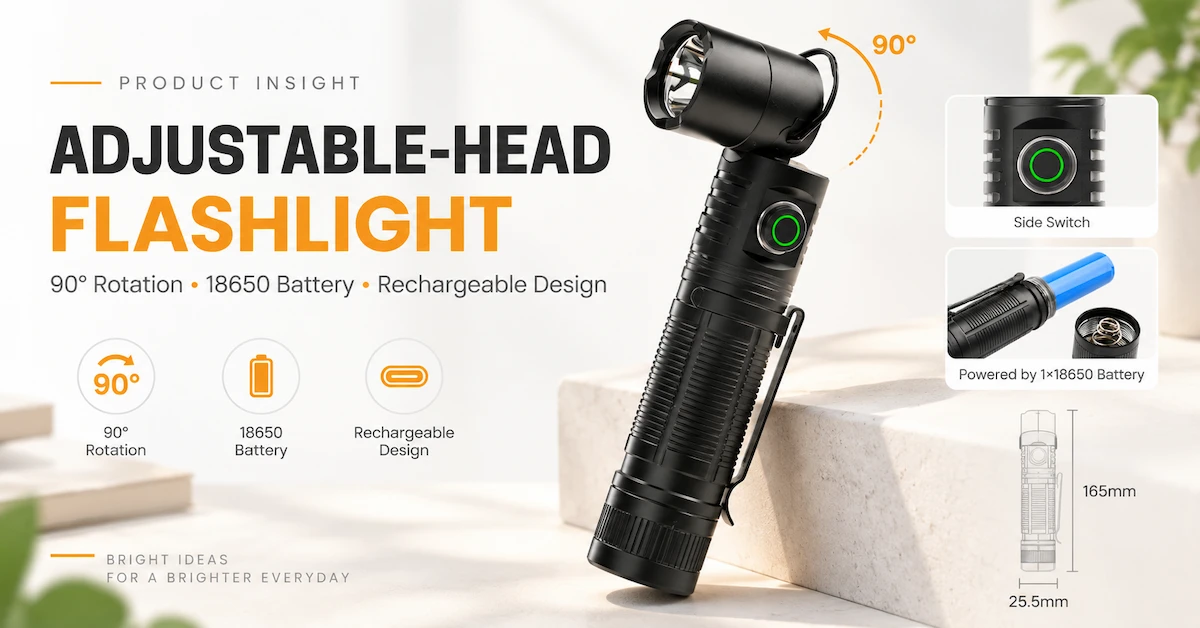
| 1000-Lumen Adjustable-Head SST40 Flashlight | SST40 LED, 18650 battery, Type-C charging, adjustable head, magnetic tail | Maintenance and industrial inspection |
| 1500-Lumen SST40 Magnetic Flashlight | SST40 LED, 21700 4000mAh battery, Type-C charging, magnetic tail | Higher-capacity outdoor and professional lighting |
| 1000-Lumen Right-Angle SST25 Flashlight | SST25 LED, 16340 800mAh battery, Type-C charging, magnetic tail, headstrap option | Compact hands-free inspection |
These specifications are based on Brightenlux's published product descriptions. They are not independently verified test results or confirmation that every modification is available.
Platform A: Adjustable-head inspection flashlight
Explore the Brightenlux 1000-Lumen SST40 Adjustable-Head Flashlight
This platform combines an adjustable lighting head with a magnetic tail.
Its published configuration includes an 18650 rechargeable battery and Type-C charging.
For a tool distributor, the existing geometry may already support important maintenance tasks.
Instead of immediately requesting a redesigned housing, the buyer could evaluate whether branding, packaging, or selected accessory changes would meet the intended market need.
Platform B: 21700 rechargeable flashlight
Explore the Brightenlux 1500-Lumen SST40 Rechargeable Flashlight
This product uses a published 21700 battery configuration and magnetic tail.
Its platform may interest buyers looking for a rechargeable flashlight with a different capacity and size positioning from smaller-cell models.
However, a larger battery does not automatically guarantee a particular runtime or sustained brightness.
Buyers should request mode-specific measurements under defined testing conditions before approving product claims.
Platform C: Compact right-angle flashlight
Explore the Brightenlux 1000-Lumen Right-Angle SST25 Flashlight
This product combines a 90-degree lighting structure, magnetic tail, rechargeable battery, and wearable mounting option.
It provides a different physical design suitable for evaluation in compact inspection tasks.
The buyer should first test whether the existing geometry already solves the intended application.
The commercial advantage of starting with an existing platform is the opportunity to avoid unnecessary redesign—not a guarantee of lower cost, shorter lead time, or customization availability.
For model-specific customization, request engineering confirmation from Brightenlux.
4. How Do You Calculate Whether Custom Flashlight Tooling Will Pay Off?
Custom tooling decisions should be based on expected contribution and realistic sales volume, not simply the difference between two factory unit prices.
Step 1: Identify one-time development costs
A new flashlight program may involve:
| One-Time Cost | What It May Include |
|---|---|
| Industrial design | Product appearance, ergonomics, mechanical design |
| Engineering development | Electronics, optics, battery integration |
| Tooling | Molds, fixtures, custom manufacturing tools |
| Prototype development | Engineering and corrected samples |
| Product validation | Lighting, mechanical, electrical, and environmental testing |
| Documentation | Drawings, manuals, packaging and approval files |
| Pilot production | Setup, inspection, initial production validation |
The actual cost depends on the proposed design and which resources are already available.
Step 2: Calculate contribution per unit
For a fair comparison, account for both the expected selling revenue and the variable costs associated with each product.
A simplified calculation is:
Contribution per unit = Net selling revenue − Total variable cost per unit
Variable costs may include the purchased product, packaging, freight, applicable duties, sales-channel fees, and expected variable service costs.
Step 3: Calculate incremental contribution
Compare the contribution of a custom product with the contribution of an existing-platform product.
Incremental contribution = Custom-product contribution − Standard-platform contribution
A new design only generates a positive financial improvement if customers pay enough for the difference, or the design reduces relevant costs.
Step 4: Calculate tooling break-even volume
Break-even units = Additional fixed development investment ÷ Incremental contribution per unit
This model works when incremental contribution is positive.
If customization reduces contribution and offers no measurable other benefit, additional sales volume alone cannot recover the investment through this calculation.
Hypothetical Flashlight OEM/ODM Investment Example
Consider a private-label outdoor lighting brand comparing an existing rechargeable flashlight with a customized ODM version.
| Financial Metric | Existing OEM Platform | Custom ODM Product |
|---|---|---|
| Net selling revenue per unit | $18.00 | $22.00 |
| Total variable cost per unit | $11.00 | $13.00 |
| Contribution per unit | $7.00 | $9.00 |
| Incremental contribution | — | $2.00 |
| Additional fixed development investment | — | $16,000 |
The projected additional contribution from the customized design is $2.00 per unit.
Therefore:
Break-even volume = $16,000 ÷ $2.00 = 8,000 units
The buyer must sell approximately 8,000 units of the customized product to recover the additional fixed development investment under these assumptions.
How Sales Volume Changes the Investment Result
| Cumulative Custom-Product Sales | Extra Contribution | Balance After $16,000 Investment |
|---|---|---|
| 2,000 units | $4,000 | −$12,000 |
| 4,000 units | $8,000 | −$8,000 |
| 8,000 units | $16,000 | $0 |
| 12,000 units | $24,000 | +$8,000 |
All amounts are hypothetical examples, not Brightenlux quotations, manufacturing costs, customer data, or market-price forecasts.
If the brand expects to sell only 3,000 units annually, reaching 8,000 cumulative sales would take approximately 2.7 years at that rate.
This simplified calculation does not include the time value of money, uncertain demand, additional fixed costs, delayed launch revenue, or possible changes in return rates.
A product that looks profitable in a spreadsheet may still be commercially unattractive if sales are uncertain or development requires substantial additional cash.
What if custom tooling reduces unit cost instead?
Sometimes a new design is intended to simplify assembly or reduce material cost rather than command a higher retail price.
In that situation:
Break-even volume = Additional tooling investment ÷ Verified unit-cost savings
The savings should be confirmed through comparable factory quotations and manufacturing evidence.
This distinction is important because not all custom flashlight programs rely on a higher selling price.
5. Which Flashlight Design Changes Create the Greatest Engineering Risk?
Different changes have different consequences for product development, cost, and validation.
LED and optical system changes
Changing the LED emitter, reflector, or lens can affect:
-
Beam pattern and distance.
-
Luminous output.
-
Color temperature.
-
Electrical current.
-
Heat generation.
-
Battery runtime.
A higher-power LED does not automatically create a better product.
The driver, housing, optical system, and thermal path must support the revised configuration.
Battery and charging modifications
Battery selection can influence product dimensions, operating time, charging behavior, transport arrangements, and replacement policies.
For example, changing from an 18650-based configuration to a 21700 platform may affect the housing diameter, contacts, internal space, weight, and electronic design.
Buyers should verify:
-
Approved battery manufacturer and model.
-
Cell capacity and nominal voltage.
-
Protection and charging arrangements.
-
Compatibility with the product's electrical system.
-
Physical fit and retention.
-
Runtime under defined operating modes.
-
Applicable battery documentation.
Housing and mechanical design
A new flashlight housing may involve aluminum machining, molded components, surface finishing, sealing interfaces, and mechanical assembly.
The exact process depends on the design.
Important engineering considerations include thread fit, switch alignment, heat dissipation, battery access, lens retention, charging-port construction, and sealing surfaces.
Changing a housing dimension can affect several connected parts.
User-interface changes
A revised switch sequence or lighting mode program may appear simple to customers, but it can require driver or control changes.
For some markets, a simplified interface offers more practical value than adding several additional lighting modes.
The important question is whether the change solves a documented customer problem.
Flashlight Design Change Risk Matrix
| Proposed Change | Main Technical Risk | Required Buyer Review |
|---|---|---|
| Logo or printed packaging | Incorrect artwork or marking | Approved visual proof |
| Housing color | Appearance variation | Color reference and finish inspection |
| LED replacement | Output, heat, runtime | Optical and electrical validation |
| Battery substitution | Charging, runtime, compatibility | Electrical and battery review |
| Lens or reflector modification | Beam distribution | Photometric comparison |
| New switch program | Incorrect operation | Full mode-sequence validation |
| New housing/tooling | Fit, heat, sealing, durability | Drawing review and prototype testing |
Procurement takeaway: Request a written engineering impact assessment for every change affecting the approved design.
6. What Manufacturing Process Should an OEM/ODM Factory Follow Before Bulk Production?
A successful custom flashlight project needs clearly defined approval stages.
The following is a recommended buyer-controlled workflow, not a claim that every Brightenlux project follows the same fixed procedure or schedule.
Stage 1: Define the product requirements
The buyer should provide:
-
Intended users and applications.
-
Destination markets.
-
Product category and form factor.
-
Target light output and beam behavior.
-
Battery and charging preferences.
-
Material and mechanical requirements.
-
Branding and packaging requirements.
-
Expected order quantities.
-
Product launch objectives.
A clear specification prevents buyers and manufacturers from interpreting the same request differently.
Stage 2: Evaluate the existing platform
Ask the factory to identify whether an existing product already meets the requirements.
If modifications are necessary, separate them into standard options, engineering changes, and new tooling.
Stage 3: Review design feasibility and costs
Before approving a new design, request a feasibility review that addresses:
-
Component availability.
-
Mechanical manufacturing methods.
-
Optical and electrical performance.
-
Thermal behavior.
-
Tooling requirements.
-
Development expenses.
-
Validation needs.
-
Estimated manufacturing costs.
At this stage, the factory should also identify unresolved risks.
Stage 4: Approve the engineering sample
The engineering sample should demonstrate the proposed product's main functions and construction.
The buyer should inspect operation, finish, assembly, beam behavior, charging, accessories, and relevant environmental performance.
Any unresolved issues should be documented before the next revision.
Stage 5: Freeze the approved design
A production-ready technical file should contain:
-
Product specification and revision.
-
Controlled bill of materials.
-
Mechanical drawings.
-
Approved LED, driver, and battery configurations.
-
Switch and lighting-mode requirements.
-
Appearance and color references.
-
Packaging artwork.
-
Inspection requirements.
-
Approved sample identification.
This prevents an attractive prototype from becoming an ambiguous production order.
Stage 6: Validate the first production configuration
A pilot or first-production review should compare actual manufactured units with the approved reference.
The factory and buyer should agree on the required inspection evidence and how nonconforming units will be handled.
Stage 7: Approve bulk shipment
Shipment approval should depend on the agreed product specification, inspection results, packaging, documentation, and outstanding issues.
The objective is not to create unnecessary paperwork. It is to make the approved flashlight reproducible.
7. What Quality Control and Technical Evidence Should Buyers Require?
A flashlight OEM ODM factory should be evaluated by the evidence it can provide for the proposed product—not simply by its catalogue size or claims of manufacturing experience.
Lighting performance
For applicable portable lighting products, the ANSI/PLATO FL 1-2025 Flashlight Basic Performance Standard establishes standardized approaches to performance testing and reporting.
Relevant characteristics include luminous output, beam distance, runtime, and certain durability-related claims.
The revised standard also addresses short-duration elevated-brightness modes.
This distinction matters because a brief peak-output figure does not necessarily represent the light's normal sustained operation.
Buyers should request test conditions and results for the actual product revision.
Sampling inspection
The official ISO 2859-1:2026 sampling standard provides a framework for acceptance sampling by attributes.
A buyer can use an appropriately selected sampling plan as part of incoming or finished-goods inspection.
However, sampling inspection alone does not establish complete product quality.
Critical safety-related and functional requirements may require different controls based on the product's risk.
Battery transport and documentation
Rechargeable flashlights may contain lithium-ion batteries, which introduce transportation and documentation considerations.
The IATA lithium battery fact sheet explains important transport distinctions and UN 38.3-related test-summary requirements.
The requirements depend on the battery type, configuration, transport mode, and shipment conditions.
Buyers should confirm the applicable rules and documentation with qualified logistics professionals.
References to these standards do not mean Brightenlux or any particular flashlight has been certified, tested, or approved under them. Model-specific evidence must be requested and reviewed.
Recommended OEM/ODM Quality Acceptance Matrix
| Inspection Area | What to Verify | Supporting Evidence |
|---|---|---|
| Product identity | Approved model and revision | Specification and sample record |
| Optical performance | Light output and beam requirements | Defined test method and results |
| Battery system | Correct cell and electrical configuration | BOM and battery documents |
| Charging | Approved input and charging behavior | Functional test records |
| Housing | Dimensions, finish, fit | Drawings and inspection records |
| Switch functions | Correct operating sequence | Function checklist |
| Environmental claims | Applicable protection claims | Matching test evidence |
| Packaging | Logo, labels, manuals, accessories | Approved packaging sample |
| Production consistency | Approved components and configuration | Lot and inspection records |
The exact acceptance limits should be agreed before production.
8. How Should Buyers Compare OEM and ODM Factory Quotations?
Two suppliers may offer similar prices while proposing very different product configurations.
A quotation should therefore identify the complete manufacturing scope.
Compare total project cost
The total project cost can be expressed as:
Total project cost = Fixed development costs + Unit purchasing costs + Packaging and accessories + Testing and inspection + Logistics + Expected support costs
Avoid comparing a standard flashlight quotation with a fully customized ODM proposal as if both included identical services.
Confirm what is included
Ask the factory to clarify:
| Quotation Item | Buyer Question |
|---|---|
| Base product | Which model and revision are quoted? |
| Battery | Is the approved battery included? |
| Charging accessories | Which cable or charger is supplied? |
| Logo | Which marking method and setup cost apply? |
| Packaging | Is the retail box standard or custom? |
| Engineering | Which modifications are included? |
| Tooling | Is the tooling charge separate? |
| Tool ownership | Who owns and controls the finished tools? |
| Testing | Which tests and reports are included? |
| MOQ | What minimum applies to each configuration? |
| Lead time | Which milestones affect delivery? |
| Freight | What Incoterm and shipment basis apply? |
Why MOQ varies between projects
There is no universal MOQ that applies to every flashlight OEM/ODM program.
A standard model with a custom logo can have different purchasing constraints from a product requiring new molding tools or electrical components.
The minimum quantity may be influenced by component purchasing, assembly setup, finishing processes, packaging production, and the proposed development scope.
How should lead time be discussed?
Instead of asking only for one total lead time, request separate milestones covering:
Specification approval → Engineering review → Prototype development → Testing → Component procurement → Production → Inspection → Shipment preparation
This makes the project easier to evaluate and helps identify activities that could delay the launch.
Brightenlux buyers can use the outdoor lighting OEM/ODM service page as a starting point for discussing the appropriate customization route.
9. What Should Buyers Confirm About Tooling Ownership and Repeat Orders?
When a brand funds new tooling, commercial protection becomes particularly important.
The purchase agreement should clarify who owns the mold, fixture, technical drawings, and any other project-specific assets.
Important questions include:
-
Who legally owns the tooling after payment?
-
Where will the tooling be stored and maintained?
-
Can the design or tooling be used for other customers?
-
Which engineering drawings and files will the buyer receive?
-
Who pays for maintenance, modification, or replacement?
-
What happens if the buyer changes suppliers?
-
Can the product be manufactured again using the same approved design?
-
Who must approve component substitutions during repeat orders?
An ODM relationship does not automatically give a buyer exclusive rights to the manufacturer's existing technology.
A proprietary design, a modified shared platform, and custom artwork may require different contractual arrangements.
Relevant intellectual-property provisions should be reviewed with qualified legal advisers.
Protecting repeat-order consistency
Repeat orders must reference the approved product revision.
Changes to LEDs, batteries, drivers, housing materials, firmware, optics, or packaging may affect product performance and customer experience.
Ask the manufacturer to provide written notification of relevant changes and identify which tests must be repeated.
This helps prevent a later shipment from being technically different from the originally approved product without the buyer's knowledge.
10. How to Request an OEM/ODM Flashlight Development Proposal From Brightenlux
Brightenlux is a China-based portable lighting manufacturer offering discussions about product selection, customization, and outdoor lighting development.
For an importer or private-label brand, the most productive starting point is a clear application brief.
Information to include in your RFQ
| RFQ Field | Information to Provide |
|---|---|
| Buyer profile | Company, country, distribution channel |
| Product application | Camping, inspection, emergency, everyday carry |
| Starting platform | Existing Brightenlux product or new design concept |
| Customization level | Branding, platform modification, or new tooling |
| Technical requirements | Light output, beam, battery, charging, modes |
| Materials and design | Housing, finish, size, mounting |
| Order plan | Initial quantity and realistic forecast |
| Commercial targets | Target price range and launch budget |
| Tooling expectations | Ownership, development scope, exclusivity |
| Validation requirements | Sample testing, documents, QC criteria |
| Packaging | Logo, retail box, instructions, accessories |
| Timing | Target sample approval and launch schedule |
Buyers should also identify which requirements are essential and which can be modified if engineering or commercial constraints arise.
Recommended development approach
For a new brand, begin by comparing appropriate existing flashlight platforms.
For an established brand, identify which features generate real customer value and consider targeted OEM changes.
For a larger differentiated product program, request a detailed ODM feasibility assessment and investment calculation before approving new tooling.
Explore available platforms: Brightenlux LED Flashlight Products
Discuss customization: Brightenlux OEM/ODM Outdoor Lighting Solutions
Request a quotation: Contact Brightenlux
When contacting the factory, ask for a model-specific proposal identifying the quoted configuration, available customization options, additional engineering requirements, applicable MOQ, and development milestones.
11. Frequently Asked Questions About Flashlight OEM ODM Factories
1. What does a flashlight OEM ODM factory do?
A flashlight OEM ODM factory manufactures flashlights according to agreed product requirements and may support branding, product modifications, or design development. OEM and ODM services can differ in engineering scope, design responsibility, tooling requirements, and ownership arrangements. Buyers should define the actual project deliverables rather than rely only on the service label.
2. Is OEM flashlight manufacturing cheaper than ODM development?
It can involve less initial investment when an existing platform requires only limited customization. ODM development may introduce engineering, tooling, prototype, and validation expenses. However, a well-designed custom product might offer commercial advantages over time. The correct comparison is the complete project cost and expected contribution, not only the quoted factory unit price.
3. Do I need custom tooling to add my logo to a flashlight?
Not necessarily. Logo marking and packaging changes may be possible on an existing product without creating new housing tools. Availability depends on the selected product, marking process, material, artwork, and order quantity. Request confirmation of the supported method and sample approval requirements.
4. How can I estimate custom flashlight tooling payback?
Calculate the additional fixed investment, then divide it by the incremental contribution per unit generated by the customized product. The result indicates the sales volume needed to recover the additional investment under the model assumptions. Buyers should also test lower-demand scenarios and account for development delays and commercial uncertainty.
5. Can Brightenlux modify an existing rechargeable flashlight?
Brightenlux publicly offers OEM/ODM discussions and product development support. Whether a specific flashlight can be modified depends on its current construction and the proposed changes. Buyers should identify the exact product and request engineering confirmation before assuming that an LED, battery, charging system, or housing modification is available.
6. What determines MOQ for an OEM or ODM flashlight project?
MOQ depends on the existing product, customization level, component availability, production requirements, packaging, and tooling or engineering scope. Logo-only projects and new-platform development may have different minimum quantities. Buyers should request a breakdown of the MOQ drivers for the specific configuration.
7. How can buyers verify flashlight brightness and runtime claims?
Request a defined testing method, sample identification, operating mode, battery configuration, measurement conditions, and recorded results. ANSI/PLATO FL 1-2025 provides a relevant portable lighting performance framework. A manufacturer's published lumen number should not be treated as evidence of sustained output under all conditions.
8. Does a custom flashlight require new certification or testing?
A design change can affect the applicability of previous tests and documentation. Changes involving batteries, charging circuits, optics, enclosures, or other critical components should trigger a technical impact assessment. Applicable testing and compliance requirements depend on the product configuration and destination market. Existing reports should not automatically be applied to a substantially changed design.
9. Who owns the tooling in an ODM flashlight project?
Ownership depends on the contract. A buyer-funded tool is not automatically exclusive to the buyer unless the agreement establishes the relevant rights. The contract should address tooling ownership, usage, storage, maintenance, transfer rights, and any intellectual-property restrictions.
10. What information should I send to receive a flashlight OEM/ODM quotation?
Provide the application, target market, preferred product platform, customization requirements, battery and lighting targets, packaging needs, intended order quantity, development budget, and launch objectives. If new tooling is required, ask for separate engineering and tooling costs, a validation plan, proposed ownership terms, and a realistic project schedule.
Conclusion
Choosing a flashlight OEM ODM factory should begin with understanding what the product must achieve and whether custom development offers measurable commercial value.
For many distributors and emerging brands, an existing rechargeable flashlight platform with suitable branding and packaging can provide a practical starting point.
For established brands seeking meaningful product differentiation, selected OEM modifications may offer a better balance between development investment and market value.
For projects requiring unique mechanical structures, optics, or electronics, ODM development and custom tooling may be justified—but only when expected sales, contribution margins, technical feasibility, and ownership arrangements support the investment.
The most effective purchasing decision combines five elements: a clearly defined application, an appropriate product platform, realistic tooling economics, documented product validation, and controlled bulk manufacturing.
Brightenlux offers a selection of rechargeable LED flashlight platforms and OEM/ODM development discussions for overseas buyers.
Whether your project involves a branded existing model or a more specialized flashlight concept, the next step is to compare feasible product configurations and request an itemized development and manufacturing proposal.
Explore Brightenlux Flashlight Products
Request an OEM/ODM Flashlight Development & Bulk Order Quote