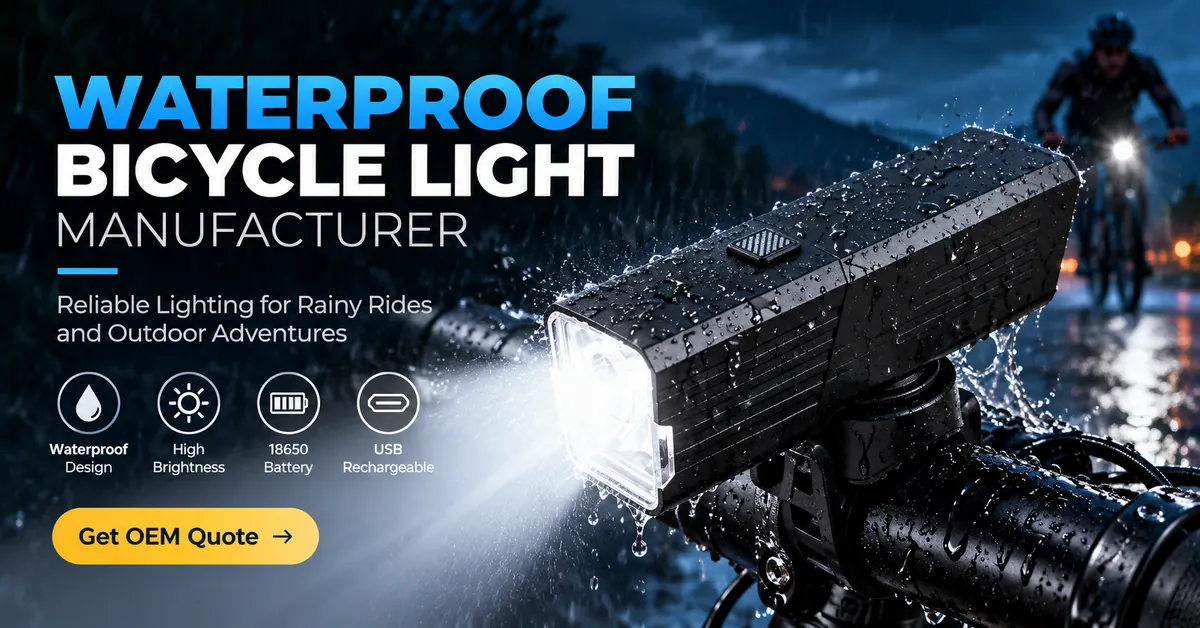


A reliable rechargeable bike light supplier should help a bicycle accessories buyer define a complete, usable front-and-rear lighting system: a front beam appropriate to the rider's route, a visible rear signal, secure mounting, dependable charging, and repeatable quality for every shipment. The best starting question is not “How many lumens?” but “What riding environment, regulations, installation method, and customer expectations must this product serve?”
For importers, cycling brands, OEM product managers, online sellers, and wholesale distributors, the commercial challenge is to turn those questions into an approved specification and a profitable range. A product that photographs well may create costly returns if its beam dazzles road users, its bracket slips on a handlebar, its battery runs out earlier than advertised, or its packaging makes claims unsupported by testing.
Brightenlux identifies bicycle lights among its portable-lighting product directions and offers manufacturing and customization discussions for international buyers. However, its public Bike Light category currently displays no individual products. No rechargeable bicycle-light SKU, lumen rating, battery capacity, road approval, MOQ, or shipping date is therefore attributed to Brightenlux in this guide. The technical configurations below are proposed buyer specifications for evaluation, not confirmed stock items. To obtain a current catalogue or explore a custom project, contact Brightenlux with the brief described below.
Request a Current Bike-Light Catalogue · View the Bike Light Category
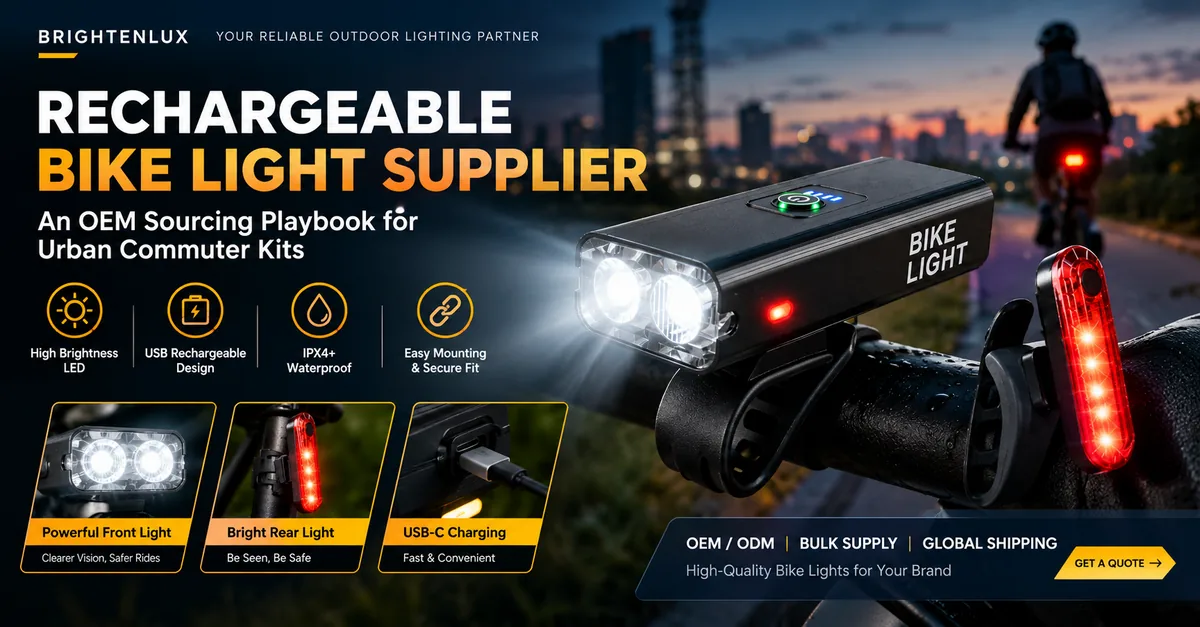
1. Who Should Use This Bicycle-Light Sourcing Guide?
The strongest audience for this article is a buyer whose business depends on repeatable specification, margin, and low returns rather than a consumer choosing one lamp for tomorrow's ride. Typical buyers include bicycle accessory importers building a private-label range, cycling retailers adding front-and-rear sets, commuting-equipment distributors, urban mobility brands preparing seasonal kits, and procurement teams buying lights for rental or service fleets.
Each buyer brings a different success measure. A retail brand values straightforward mounting, attractive packaging, clear feature differentiation, and customer reviews. An importer must manage destination-market documents, master cartons, and product traceability. A fleet buyer may prefer controlled charging, identifiable components, robust brackets, and efficient replacement procedures. An OEM brand may prioritize a design that can be repeated without changes to the approved optic, cell, connector, or housing.
The proposed product must also have a clear not-for statement. A general-purpose bicycle flashlight should not automatically be described as a road-approved German front lamp, a certified bicycle safety system, or a substitute for required reflectors. An auxiliary visibility lamp and a road-legal primary lamp may be two different purchasing categories. High-output off-road lights require their own beam and mounting assessment. Treat e-bike system integration as a distinct electrical project rather than assuming an independent USB-rechargeable bicycle lamp can connect directly to a motor battery.
Before asking suppliers for quotations, write one sentence that describes the target rider: for example, “An urban commuter using mixed illuminated streets and dark connecting cycle paths, charging the front and rear lamps twice weekly.” That sentence is a planning assumption, not a claim about any existing model. It is nevertheless more actionable than requesting the “best LED bike light.”
2. Front and Rear Lights Perform Different Jobs
A rechargeable bike light supplier should be able to explain why a front bicycle lamp and rear bicycle lamp have different requirements. A front bicycle lamp helps the rider detect the route, obstacles, edges, and hazards. A rear lamp communicates the rider's presence to approaching traffic. Some riders also use lights in daylight to improve conspicuity, but the permitted modes and requirements vary by market. These functions should be specified separately before packaging the products together.
Front light: seeing the road without unnecessary glare
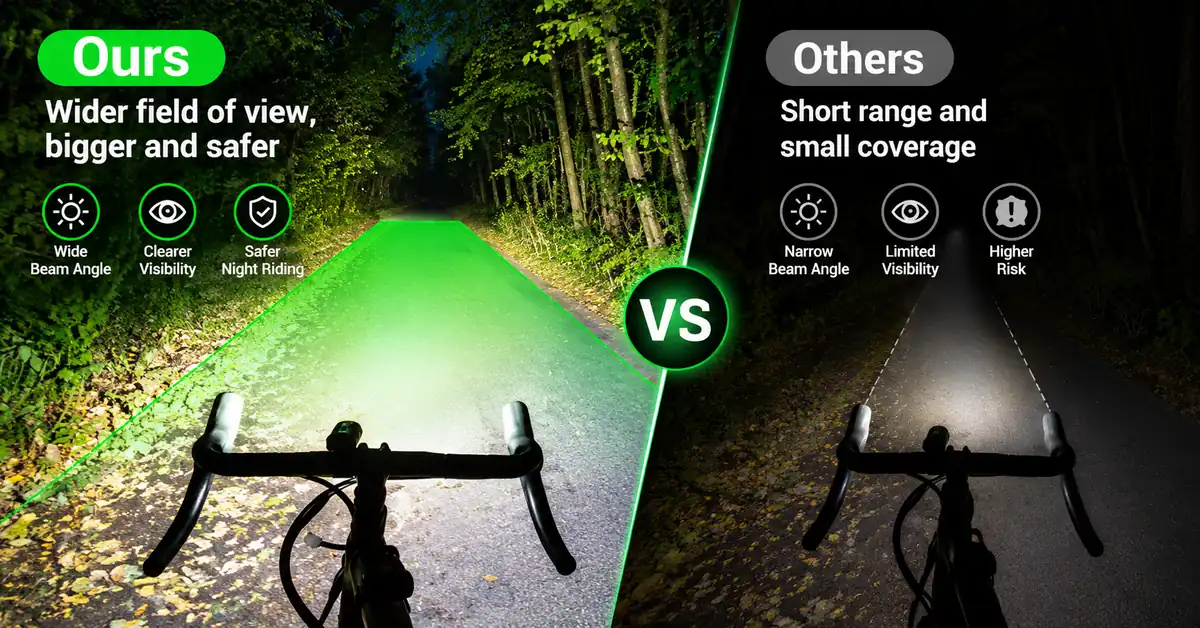
A commuter front light needs usable illumination on the riding surface. Its optical design determines how far ahead a rider can see, how evenly the nearer route is lit, and whether the beam creates glare for others. Beam shape and aiming stability matter as much as total light output. Buyers should request photographs and, where necessary, photometric plots at a defined mounting height and angle.
A lens or reflector producing a controlled cut-off pattern may suit particular on-road requirements better than a round, highly concentrated flashlight beam. Do not assume that a claimed “anti-glare” label proves any specific standard or type approval; assess the actual beam distribution and target jurisdiction.
Rear light: a conspicuous signal, not a miniature headlight
Rear lamps are evaluated differently. Viewability from relevant approach angles, red light distribution, stable positioning, clearly identified operating modes, and the ease of charging are important. A bright pinpoint emitter may be uncomfortable to follow without providing useful off-axis visibility. The fitting must remain visible rather than being hidden by a saddlebag, jacket, basket, or rack.
If the product offers steady, flash, pulse, or brake-style functions, request exact mode definitions and determine whether each is permissible in the market where it will be sold. A feature desirable in one region is not automatically legal in another.
Pairing the front and rear as one retail system
A kit should feel unified. That means consistent instructions, sensible charging accessories, compatible installation procedures, packaging that correctly describes both lights, and no unexplained difference in the quality of switches or seals. It does not mean identical batteries, lumen ratings, or power consumption. Front and rear lamps have different jobs and may require different electrical architectures.
3. Build a Product Matrix Around Actual Riding Environments
One SKU cannot comfortably cover every type of cyclist. Wholesale buyers can start by selecting a limited number of environments and defining the minimum acceptable outcomes for each. This creates more useful differentiation than offering several products whose only visible distinction is an advertised lumen number.
| Buyer-Defined Use Case | Front-Light Priority | Rear-Light Priority | What to Validate |
|---|---|---|---|
| City commuting on illuminated streets | Controlled near/mid-range visibility and simple operation | Clear rear conspicuity and reliable mount | Glare, user interface, quick removal, charging |
| Mixed urban and unlit cycle paths | Wider usable road coverage and sustained output | Broad viewing angles and usable runtime | Beam uniformity, low-battery behavior, rain exposure |
| Recreation on unlit trails | Route-specific beam reach and sturdy mounting | Visibility to accompanying riders or traffic where relevant | Thermal behavior, vibration, terrain conditions |
| Retail front-and-rear gift kit | Easy setup, coordinated styling, clear instructions | Simple charge/status indication | Complete pack-out, returns, packaging accuracy |
| Fleet or service bicycles | Standardized fitting and service procedure | Identifiable, replaceable component configuration | Retention, asset management, repeat-order consistency |
The table describes evaluation priorities, not a Brightenlux catalogue. Final product selection also depends on local road rules, bicycle geometry, rider speed, and customer expectations. The same city-commuter label can mean a short, brightly lit journey or a long ride that includes unlit paths.
For a private-label launch, an efficient starting range may be one economical commuter kit, one extended-runtime commuter kit, and one separately qualified specialist option. These are assortment concepts, not known available products or guaranteed bundles. A manufacturer should confirm the current platform options before an importer publishes specifications or presells inventory.
4. Read Optical Specifications Like a Technical Buyer
One of the first mistakes when evaluating a rechargeable bike light supplier is treating lumens as a complete description of visibility. Lumens measure total luminous flux. They do not tell the buyer where the light goes. For a road-facing lamp, the beam distribution, peak intensity, cut-off characteristics where required, and aiming position determine how much usable light reaches the road and how much reaches other people's eyes.
Candela describes luminous intensity in a specified direction. Lux describes illuminance on a surface. These concepts help an engineer interpret beam tests, but only when the measurement conditions are defined. Request a consistent mounting distance and height, horizontal and vertical beam information where relevant, and photographs taken using fixed exposure settings. A night-time promotional image with automatic camera exposure is not a test report.
Useful front-light data to request
Ask whether the manufacturer can provide output by mode, intensity distribution or a comparable beam diagram, usable beam width, thermal-regulation behavior, and runtime at each specified mode. Test the beam at a position representing the actual bicycle, rather than holding the lamp in a hand at an arbitrary angle.
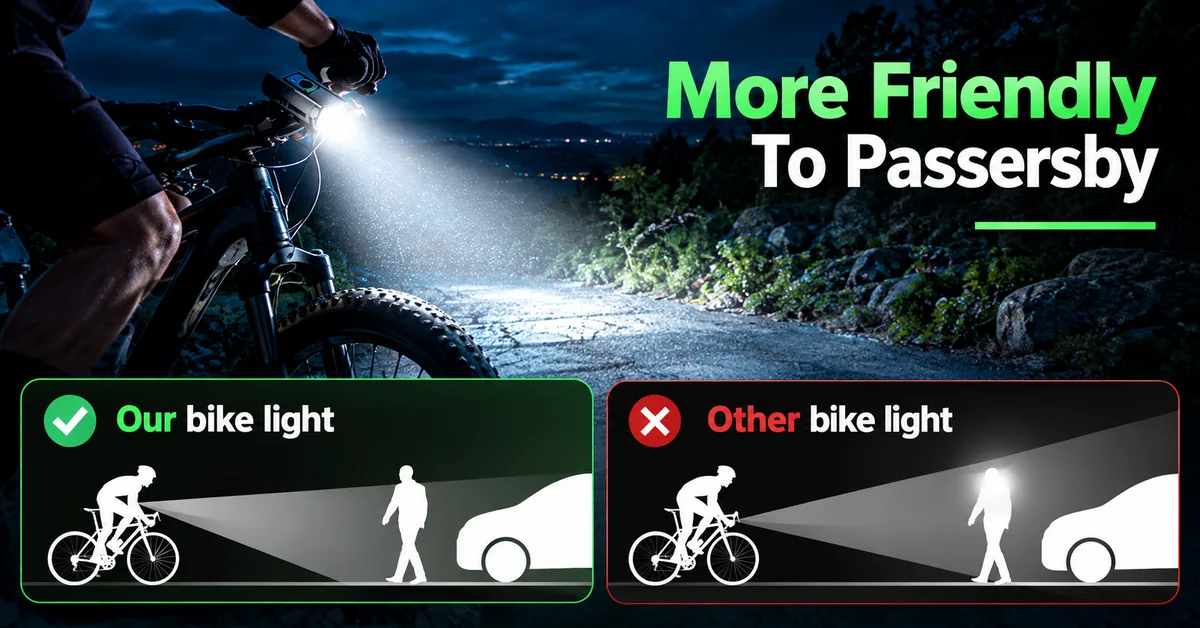
Glare is also an optical and mounting question. Even a carefully designed beam can dazzle if aimed incorrectly or if a weak mount drifts upward after a pothole. Packaging instructions should make correct aiming understandable to the user. Buyers selling into jurisdictions with defined lamp approvals should obtain the actual model-specific approval evidence before stating the lamp is compliant.
Useful rear-light data to request
For the rear unit, define the modes, luminous intensity or relevant photometric requirements, viewing angles, charge indication, mounting orientation, and the effect of bags and accessories on visibility. Where a steady and a flashing mode both exist, establish which mode is used for published runtime and which may be used in the intended market. Statements such as “visible from several kilometres” require substantiation with a defined test and should not be written into a new product page on assumption.
A measurable specification is better than a marketing adjective
Replace “super bright, all-weather and long lasting” with fields that can actually be checked: agreed beam distribution, output and test condition, battery and charger details, operating-mode sequence, mount retention, and an applicable ingress test. An honest incomplete field marked “supplier to confirm” is more useful to a procurement manager than a fabricated number.
5. Battery Capacity, Charging and Runtime Need a Common Test Method
When assessing a rechargeable bike light supplier, pay particular attention to the energy system because rechargeable bicycle lights often compete on convenience. But “USB-C rechargeable” is a connector description, not a guarantee of fast charging, USB Power Delivery, universal cable compatibility, or a particular operating time. Buyers should examine the complete energy system: cell or battery pack, charging circuit, input limits, protective features, indicators, thermal response, and user instructions.
Capacity in milliamp-hours alone can be misleading when compared across different battery voltages. If the exact electrical design is known, watt-hours are useful for describing stored energy. In every case, the actual runtime depends on load and control logic. A nominally larger cell may not produce a proportionally longer ride if the lamp draws more power or changes brightness dynamically.
Define runtime as more than “time before it turns off.” Specify the light mode, initial charge state, ambient conditions, and an agreed endpoint for usable performance. Ask whether the lamp dims gradually, steps down as it heats, flashes a warning, or turns off when the battery reaches a protection threshold. Test both lights independently; their batteries and circuits need not behave in the same way.
Charging questions that affect customer satisfaction
Confirm whether both lamps charge with USB-C or use different interfaces. Ask whether the cable is included and what charging input is supported. Check whether the charging-port cover can be closed reliably after repeated use, whether indicators are understandable in daylight, and whether a cyclist can accidentally switch the lamp on while it is in a pocket or bag.
For a brand selling a matched kit, simplicity can be a more valuable benefit than another decorative lighting mode. A customer who must carry two unusual cables may consider the product poorly designed even if both lights are bright. Conversely, a very compact rear light may require a different connector or battery arrangement for valid engineering reasons. Verify feasibility rather than demanding visual uniformity at any cost.
Battery transport documentation and end-of-life obligations also matter. Request the lithium-cell or battery test-summary documentation appropriate to the exact shipped assembly, including UN Manual of Tests and Criteria subsection 38.3 evidence where applicable. The rules for shipment depend on whether batteries are contained in equipment, packed with it, or shipped separately, and on the transport mode and destination. Work with a qualified shipper for the actual consignment.
For EU-bound products, review the obligations and applicable dates under Regulation (EU) 2023/1542, including portable-battery removability and replaceability provisions. Their application and any exceptions depend on the design and legal classification; do not claim that a sealed lamp is compliant merely because it uses a known cell brand. Regulatory reviews should be repeated before launch and when the product design changes.
6. Mounting Hardware Is Part of the Safety and Quality Specification
An experienced rechargeable bike light supplier should discuss mounting tests alongside photometric claims. Mount design is a frequent cause of returns that do not appear in laboratory lumen tests. The light must remain aimed correctly despite rough pavement, bicycle vibration, rain, repeated removal, and the user's tendency to tighten parts by feel rather than with a controlled torque tool.
For front lamps, record compatible handlebar diameters, any adaptors, installation position, retention method, rotation resistance, and clearance from brake cables, displays, bags, bells, and other equipment. A solution suitable for a round conventional bar may not fit an aero-profile bar or an integrated cockpit. Avoid publishing compatibility claims unless the sample has been assessed with the stated geometry.
For rear lamps, identify whether they are mounted to a seatpost, saddle rail, rack, or another approved position. Test common seatpost profiles, available vertical space, saddlebag interference, and how much side visibility remains when the rider is seated. A simple attachment may be more valuable than a sophisticated optical function if the user can install it correctly the first time.
A basic retention test for sourcing teams
Install the lamp using the supplied instructions. Mark its initial aim. Subject it to an agreed representative riding or vibration condition, then inspect for displacement, loosening, cracks, and damaged straps. Repeat installation and removal to reveal wear in clips and elastomeric parts. This is a buyer-proposed validation method, not an assertion that Brightenlux uses a particular test cycle count.
Also consider theft prevention versus convenient charging. A quick-release design suits commuters who remove lights daily, but the release action must resist accidental disengagement. Make the trade-off explicit in the product brief so the supplier can propose the right mechanism.
7. Materials, Construction and Weather Exposure
Every rechargeable bike light supplier should be evaluated on its ability to control an integrated electrical, optical, and mechanical system. LED bicycle lamps combine all three. Their performance depends on how consistently those systems are manufactured and assembled. Ask for the proposed housing materials, lens material, light guide or reflector arrangement, heat management, seals, switch design, bracket components, and surface finish.
Aluminium can support heat transfer in appropriate designs, while molded polymer housings can provide useful geometry and low mass. Neither material is automatically superior for every cycling light. The completed structure, mass, sealing strategy, thermal path, and manufacturing controls determine fitness for purpose. Avoid assuming that a generic flashlight's component list confirms the materials of an unlisted bicycle-light model.
Ingress claims such as IPX4, IP44, or IP67 should be associated with a precise model, test method, and report. A water-related rating is not a universal guarantee against pressure washing, salt spray, chemical exposure, charging with an open cover, or damage from repeated impacts. Ask for the actual tested configuration and any limitations on normal use.
Manufacturing documentation should also identify critical features and the accepted appearance standard: lens clarity, gasket installation, connector alignment, button travel, labeling, and the precision of the optical assembly. An apparently minor variation in the lens position can alter the beam. A small change in the mounting bracket can create an entirely different customer experience.
8. Regional Road Rules: Design the Market First, Then Make the Claim
A rechargeable bike light supplier that serves several countries must understand that bicycle lighting rules are not universal. A compliant retail launch begins by defining the country of sale, whether the lamp is intended as the mandatory primary road light or an optional accessory, and which product approvals or markings apply.
The International Organization for Standardization's ISO 6742-1:2023, Cycles—Lighting and retro-reflective devices—Part 1: Lighting and light signalling devices, addresses functions, safety requirements, photometric performance, and test methods for cycle lighting. It is a relevant technical reference, but naming the standard does not prove compliance for an individual product.
In Great Britain, Highway Code Rule 60 calls for a white front and red rear light at night, together with specified reflectors. UK government guidance explains the rules affecting steady and flashing cycle lamps. Importers should assess the current legal text and the actual lamp configuration rather than rely on a general claim that flashing modes are always permitted everywhere.
In Germany, StVZO §67 establishes specific requirements for bicycle lighting used on public roads, including approved lighting equipment and restrictions on flashing headlamps and rear lamps. Buyers targeting Germany should request appropriate evidence of the model's approval and verify the allowed light functions. A broad “CE approved” slogan is not a substitute for the relevant cycle-light approval.
For the United States and other markets, national, state, and local rules may differ. A buyer should check applicable bicycle equipment requirements, distribution obligations, electrical-product rules, and battery/transport requirements for each country or state served. Do not reuse a German or UK compliance claim to market the same lamp in a different jurisdiction without review.
| Target Market or Framework | Buyer Must Clarify | Evidence to Request |
|---|---|---|
| Great Britain | Front/rear colours, reflectors, allowed modes, product classification | Market-specific assessment and applicable test/marking documents |
| Germany (StVZO §67) | Road use, approval, beam and mode requirements | Relevant model-specific approval documentation |
| ISO 6742-1:2023 framework | Applicable optical functions and test methods | Test scope and results for the actual configuration |
| EU battery obligations | Battery category, removability, safety information, timing | Design review and applicable conformity documentation |
| Other markets | Local road, consumer-product and transport requirements | Destination-specific documentation and importer review |
This table is a review checklist, not legal advice or proof that Brightenlux products meet any named requirement. If the supplier cannot document a claimed approval, the buyer should not present the product as an approved primary road light.
9. Define the RFQ Specifications Before Asking for a Bike-Light Price
The most efficient way to work with a rechargeable bike light supplier is to give every shortlisted factory the same structured quotation brief. This avoids comparing an unspecified low-cost light with a complete approved commuter kit.
| RFQ Field | Information to Supply or Request | Commercial Reason |
|---|---|---|
| Buyer market and use | Country, commuter or trail use, primary/auxiliary role | Determines optical and legal requirements |
| Front optical performance | Beam goal, agreed test method, modes, glare/cut-off needs | Prevents misleading lumen-only comparisons |
| Rear light performance | Red-light distribution, mode policy, off-axis visibility | Supports appropriate product selection |
| Runtime and charging | Mode conditions, battery details, connector, cable inclusion | Prevents battery-life disputes |
| Mechanical interface | Handlebar/seatpost geometries and mounting retention | Reduces returns from poor fit |
| Environmental protection | Desired exposure and verifiable test method | Aligns IP claims with real use |
| Packaging and brand | Logo, language, manual, barcodes, colours, kit contents | Makes quotation retail-ready |
| Documentation | Testing, approvals, battery and shipping records | Reduces launch and customs risk |
| Order scope | Sample quantity, forecast, initial order, Incoterm | Produces comparable commercial offers |
| Revision control | Approved BOM, golden sample and change approval | Supports repeat-order consistency |
The buyer should mark each field as required, preferred, or open for supplier recommendation. This lets a product-development team explain what is feasible on an existing platform, what requires tooling or redesign, and which requested features conflict with market regulations.
A good supplier response includes a numbered proposal, drawings or clear photographs, known performance figures with test conditions, exclusions, sample plan, MOQ by customization level, production milestones, and a transparent quote basis. A one-line price without a bill of supplied parts is not enough for private-label purchasing.
Send a Front-and-Rear Bike-Light RFQ · Review Brightenlux Manufacturing Background
10. Compare Four Proposed Product Configurations Without Inventing Models
The following is an illustrative assortment-planning table for sourcing discussions. A, B, C and D are buyer-defined concepts, not Brightenlux product codes, confirmed inventory, or performance claims. The purpose is to show how a wholesale brand can create a meaningful range without confusing “more functions” with “better value.”
| Proposed Configuration | Product Positioning | Principal Specification Priorities | Suitable Buyer Channel | Main Trade-off |
|---|---|---|---|---|
| A — Essential Commuter Pair | Entry-level front + rear kit | Easy mounting, straightforward charging, verified road-use suitability | General cycling retail and entry-level private label | Price versus accessory/optical quality |
| B — Extended-Runtime Pair | Everyday commuter upgrade | Longer usable runtime, readable battery status, secure brackets | Specialist urban retailers and repeat commuters | Mass and component cost |
| C — Route-Specific Front Light | Unlit routes or controlled off-road use | Suitable beam distribution, thermal regulation, sustained output | Outdoor and specialist cycling channels | Weight, glare control and legal positioning |
| D — Replacement Rear Unit | Separately sold rear accessory | Visibility angles, matching mount, correct local mode support | Parts/replenishment and fleet programs | Compatibility across installations |
It is more credible to sell three accurately specified products than six nearly identical boxes with incompatible accessory sets. Start with a narrow range that your customers can understand and your factory can reproduce. Broader diversification can follow once return reasons and reorder rates are known.
Where required, arrange the front-and-rear kit so both components appear clearly in the pack and neither is obscured by decorative cardboard. Show mounting examples, charging instructions, and a QR code to a genuine manual if that is part of the final program. Never put symbols, test marks, or performance badges on packaging before supporting documents and permitted use have been confirmed.
11. Sample Qualification: An Eight-Step Test Plan for Wholesale Buyers
Ask any rechargeable bike light supplier for a sample representing the proposed production build. If the supplier changes the battery, lens, LED board, bracket, firmware, or charging circuit after approval, the performance and documents may change too. Keep one controlled sample and revision record for every proposed product.
Step 1 — Check pack-out. Confirm front/rear units, chargers or cables, straps, mounts, instructions, labels, and the exact quoted battery arrangement. Photograph all parts and record initial defects.
Step 2 — Review the beam. On a safely controlled test route or optical bench, compare front illumination and glare at defined mounting heights. For rear units, review off-axis visibility and whether bags or racks obstruct the light. Use appropriate measured methods for any performance claims.
Step 3 — Record mode behavior. Check power-on defaults, short and long presses, memory function if proposed, accidental activation, charge-state indicators, and any flashing behavior. Confirm that the sequence is compatible with the intended market.
Step 4 — Measure practical runtime. Start from a defined charge condition, select an agreed mode, and document the output or usability endpoint and environmental conditions. Repeat enough to determine whether results are reasonably consistent.
Step 5 — Test mounting. Install and remove the units repeatedly, then subject them to representative vibration or riding conditions. Record bracket movement, rubber wear, loosened fasteners, and whether the beam stays aimed.
Step 6 — Examine environmental resilience. Review ingress evidence, closures, joints, and charging-port protection. If the product is claimed to suit exposure to heavy rain or frequent cleaning, agree the appropriate additional validation rather than extrapolating from a generic rating.
Step 7 — Check electrical and documentation controls. Confirm the battery identity, charge input, safety-related labels, manuals, and target-market documents. If approval marks are present, cross-check the exact model and version to the relevant records.
Step 8 — Release the golden sample. Approve a final configuration, bill of materials, packaging artwork, test plan, and permitted claims. Note any limitations. The release should state who is authorized to approve later substitutions.
This buyer-side test sequence can become a repeatable quality gate for future orders. It is a recommended workflow, not a claim that Brightenlux has already carried out these tests on an undisclosed bicycle-light model.
12. Factory Capability, Workmanship and Quality Control
Brightenlux identifies itself as Ningbo Brightenlux Electric Appliance Co., Ltd., a Zhejiang-based portable-lighting manufacturer established in 2014. Its About Us page reports a factory exceeding 10,000 square metres and over 150 workers, with design and sales personnel. These are company-published profile statements, not an independent factory audit or proof of current bicycle-light production capacity.
For a rechargeable bike light supplier evaluation, the useful question is whether the supplier can make and verify the exact approved design repeatedly. Ask what manufacturing operations are carried out in-house and which components or processes are sourced externally. Review engineering drawings, tooling and mold-control processes where relevant, incoming-component inspection, assembly controls, charging tests, and packaging checks. A factory photograph does not establish a particular product's performance.
Optical alignment should be treated as a critical parameter where the road beam or approval depends on it. Battery and charging circuits should be identified by controlled part numbers. Seal placement, switch function, bracket retention, and marking should have clear acceptance criteria. Customer-facing instructions should correspond to the mode sequence and charging behavior of the actual production revision.
When a buyer requests a quality-system certificate, social audit, laboratory report, or approval record, confirm the name on the document, issuing body, covered site or model, scope and date. General certificates are not substitutes for product-specific evidence. For a product intended to be road legal, document review is part of specification approval, not merely a marketing task performed after the order ships.
A useful first factory assessment also asks how complaints are recorded and how corrections are handled. Can an importer identify which batch used a particular battery or optical component? Is there a process for isolating affected goods, investigating a failure, and approving corrective action? Those answers matter much more over a two-year supply relationship than a large list of unverified claims.
13. OEM/ODM Design Options and Private-Label Differentiation
A rechargeable bike light supplier may propose OEM customization beginning with packaging, logo placement, instructions, or colour treatment. More substantial changes—lens geometry, LED selection, battery arrangement, control firmware, new mounting hardware, or housing design—can affect product performance and trigger new validation needs. The exact scope must be agreed with the factory; not every requested feature is available on an existing platform.
For private-label bicycle lights, a sensible order of decisions is use case → target market → optical design → power system → mount → testing → packaging. Branding should come after the safety- and performance-related choices. A distinctive package cannot rescue a lamp that dazzles oncoming riders or falls off after two weeks of commuting.
Differentiation that buyers can actually demonstrate
A premium story might focus on controlled beam placement, simple day-to-day charging, secure quick-release brackets, clear low-battery indicators, or a coordinated front-and-rear kit. Each selling point should be observable or measurable. Avoid unsupported phrases such as “completely waterproof,” “unbreakable,” “universally road legal,” or “guaranteed all-night power.”
Where a new bracket or lens requires tooling, agree who pays, who owns the tooling, how revisions are authorized, and what happens to samples and documents when the design is updated. Request the development milestones: design review, first sample, engineering correction, pilot build, verification, packaging approval, and mass-production release.
Brightenlux presents broader OEM/ODM manufacturing support through its outdoor lighting business information. Buyers should use that as a discussion starting point and request project-specific confirmation for bicycle lighting. No custom feature, road approval, quantity discount, tooling condition, or delivery date is promised by this article.
14. MOQ, Lead Time and Total Landed Cost
When comparing a rechargeable bike light supplier quotation, first normalize what is included. One quote may cover a front lamp only, while another may cover a front-and-rear set with batteries, charging cable, installation hardware, retail packaging, and translated instructions. Comparing headline unit prices without a common bill of materials is unreliable.
A useful landed-cost model adds the quoted lighting units, supplied accessories, branding, packaging, documentation or testing allocations, tooling where applicable, freight, insurance, duties, handling, and an appropriate warranty provision. Where the quantity and costs are not yet known, show them as open fields rather than inventing a saving or expected margin.
MOQ may differ by standard catalogue item, custom colour, printed logo, new mold, or market-specific variant. Separate these clearly. The same principle applies to timing: request sample availability, sample delivery, technical approval, material procurement, pilot build if needed, mass-production time, final inspection, and dispatch separately.
A first order of a new bicycle-light configuration may have a different schedule from a repeat order of an already approved product. Battery availability, optical components, injection-mold tooling, target-market testing, packaging artwork, and transit restrictions can affect delivery. No universal number of days can be inferred from a factory's general experience.
For repeat orders, ask whether the supplier will preserve the approved bill of materials and notify the buyer before changing the LED, battery, charger, optical components, bracket materials or firmware. A subtle substitution can invalidate a photometric comparison or approval file, even if the product photograph looks identical.
15. An RFQ That Makes It Easy for Brightenlux to Respond
Because the public Bike Light category does not currently list individual SKUs, the fastest credible next step is to request the current bicycle-light line sheet or a feasibility assessment, not demand a price for an invented model. Buyers can ask which platforms, prototypes, or development services are actually available and what evidence accompanies them.
Include the following in your inquiry: company name and country; target sales market; front-only, rear-only, or pair requirement; intended rider and route; required road-use status; beam pattern and light modes; desired runtime and charging method; compatible mounts and dimensions; basic weather-exposure conditions; packaging and language; estimated sample and bulk quantities; forecast of repeat demand; target launch date; and any approvals the importer has identified.
Ask the supplier to mark each item available / customizable / requires development / unavailable. This simple response format protects both buyer and factory against misunderstandings. If only general-purpose flashlight platforms are available, request a separate development proposal for a cycling-specific optical and mounting solution rather than listing a standard flashlight as a compliant primary bicycle lamp.
A competent quotation should return with a proposed configuration, photographs or drawings, known data and test methods, market-document status, sample plan, MOQ by option, commercial terms, and next approval step. Where information is missing, a transparent “to be tested” or “to be confirmed” is a more reliable answer than an unsupported sales promise.
Request OEM/ODM Bicycle Lighting Details · Explore Brightenlux's Product Categories
16. Frequently Asked Questions for Bicycle-Light Buyers
1. How do I choose a rechargeable bike light supplier for a private-label brand?
Start with the destination market, rider scenario, and whether the lamp is a mandatory road light or an optional accessory. Then review real models, optical data, mounts, batteries, sample quality, testing records, customization scope, and the factory's ability to reproduce an approved configuration. Do not choose solely on an advertised lumen figure or unverified certificates.
2. Does Brightenlux have rechargeable bicycle lights available for immediate wholesale orders?
Brightenlux identifies bicycle lighting as a product direction, but its public Bike Light category currently shows no individual product listings. Current models, inventory, prototypes, MOQ, prices, and lead times must be requested directly from the company. This guide does not establish that a particular bike-light SKU is currently in stock.
3. What is the difference between a front bicycle light and a rear bike light?
The front lamp helps illuminate the route and must manage where the beam falls. The rear lamp functions primarily as a visible signal to traffic. Their optical, electrical, mounting, and regulatory requirements may differ, even if they are sold as one matched kit.
4. Is a higher-lumen bike light always better for commuting?
No. Beam distribution, glare control, aiming stability, sustained output, and rider environment are decisive. A high-lumen round beam may be poorly suited to a road-use case that requires controlled illumination. Compare measured conditions and intended use, not just a headline brightness number.
5. Can a USB-C rechargeable bike light use any USB-C charger?
Not necessarily. The connector alone does not verify USB PD support, all C-to-C cable arrangements, or a particular input power. Request the exact supported voltage/current, cable configuration, charging instructions, and test evidence for the final product.
6. Do I need front and rear lighting for UK commuters?
UK Highway Code Rule 60 requires white front and red rear lights at night, as well as relevant reflectors. The specific product, operating modes, and markings must be assessed under applicable UK requirements. Importers should review current rules for the actual model and proposed selling claims.
7. Can the same bike light be sold as road-legal in Germany and Britain?
Not without separate market assessment. Germany's StVZO §67 has specific approval and light-function requirements, while UK rules differ. Verify model-specific evidence in each target jurisdiction. A general CE statement is not proof of either approval.
8. Which quality-control tests should be included before a bulk order?
Agree checks for beam performance, rear visibility, runtime by mode, charging, battery identity, mechanical retention, water-ingress claims, switch and mode operation, labeling, packaging, and lot traceability. Use an approved sample and control any later component changes.
9. What OEM/ODM features can be customized for bike lights?
Depending on feasibility, customization may include logo, packaging, colour, accessories, mounting design, optical components, battery architecture, or control modes. Deeper changes may require tooling and new testing. Ask the manufacturer to confirm available options, cost, MOQ, development milestones, and approval implications for each project.
10. What should I include when requesting a bike-light wholesale quote?
Provide the target country, application, required front/rear combination, road-use requirements, beam and runtime goals, charging and mounting preferences, packaging, estimated quantities, certification documents needed, and launch schedule. Contact Brightenlux to request a current catalogue or a development feasibility review.
Conclusion
Choosing a rechargeable bike light supplier is ultimately an exercise in matching the rider's real environment to a measurable, repeatable product and a credible sourcing process. For commuter brands, the priorities extend beyond lumen ratings: appropriate front and rear functions, controlled beam distribution, usable runtime, charging convenience, reliable mounting, destination-market documentation, and repeat-order consistency all affect customer trust and margin.
Brightenlux is a China-based portable-lighting manufacturer that publicly includes bicycle lights within its business scope. Its Bike Light category does not presently identify individual products, so responsible buyers should first confirm which models or development options are available rather than assume a specification or approval. Use the Brightenlux company profile to review its manufacturing background, then send a bicycle-light RFQ covering your market, front/rear kit requirements, testing, volume, and OEM objectives.
Request a Bicycle-Light Catalogue & Quote · Review Brightenlux Product Categories