

OEM USB-C flashlight charging validation: two platforms, two offers
OEM USB-C flashlight charging validation can begin with a specific quotation question: what charging configuration is being offered for this light? Brightenlux has two zoom-flashlight pages with explicit C-to-C wording. They are useful candidates for a buyer who requires that connection, but they describe different rechargeable configurations. Asking for “the C-to-C model” would leave the supplier to choose between them.
Begin with the 1500-lumen zoom platform. Its page lists C-to-C charging, a power-bank function and an included 2600mAh 18650 rechargeable battery. The 3000-lumen 26650 platform separately lists C-to-C support and power-bank functionality, with an included 4000mAh 26650 rechargeable battery. A purchasing inquiry can name both candidates and request separate offers.
The first useful answer is not a statement about adapter wattage. It is the rechargeable configuration, cable and supported source arrangement offered for each platform. The capacity difference does not establish input power, charge-controller settings or elapsed charging time. Those remain technical questions for the particular build. A result obtained on one platform cannot simply be filed under the other.
Everything that follows is a proposed buyer workflow. The product statements are manufacturer-published information; the worksheets are unfilled tools. This article contains no Brightenlux charging measurements, customer test history or completed USB-IF certification. The project needs controlled input information, approved battery preparation and engineering acceptance criteria before electrical evaluation.
Ask three questions before choosing the sample
Which rechargeable configuration is in each offer?
The two C-to-C pages also describe dry-cell alternatives. The 1500-lumen page lists a separate four-AAA option, while the 3000-lumen page lists six AA cells as an alternative to the included rechargeable battery. That flexibility may be relevant to the application, but it does not make every power arrangement chargeable. The charging inquiry should identify the approved rechargeable cell or pack; it must not authorize charging unspecified dry cells.
An RFQ can therefore ask: “For each candidate, identify the rechargeable battery and the charging configuration included in the offer. State the supported input and the source/cable combinations proposed for sample evaluation.” The supplier can then distinguish a current offered configuration from an alternative or development proposal. The question does not prescribe an unknown input voltage or component value.
The two offers also need separate answers about their displays. The 1500-lumen zoom page lists red/green charging indication; the 3000-lumen page describes energy-level indications. Ask for the charging-state map for each offered build. A battery-level display and a charging-completion indication answer different user questions, even if both use colors.
Is power-bank output actually part of this order?
A buyer may want only to recharge the flashlight. Another application may require it to supply power to a separate device. The two functions can be priced and specified in the same inquiry, but they should have separate acceptance questions. The public power-bank descriptions do not identify output profiles, port roles, simultaneous operation or whether input and output share a physical port.
For an output requirement, ask the supplier to label the relevant interfaces and describe supported output and operating conditions. For an input-only project, keep the charging worksheet focused on input. This avoids using a catalog feature to infer an electrical arrangement that neither the buyer nor supplier has defined.
What cable will ship, and what cable will users employ?
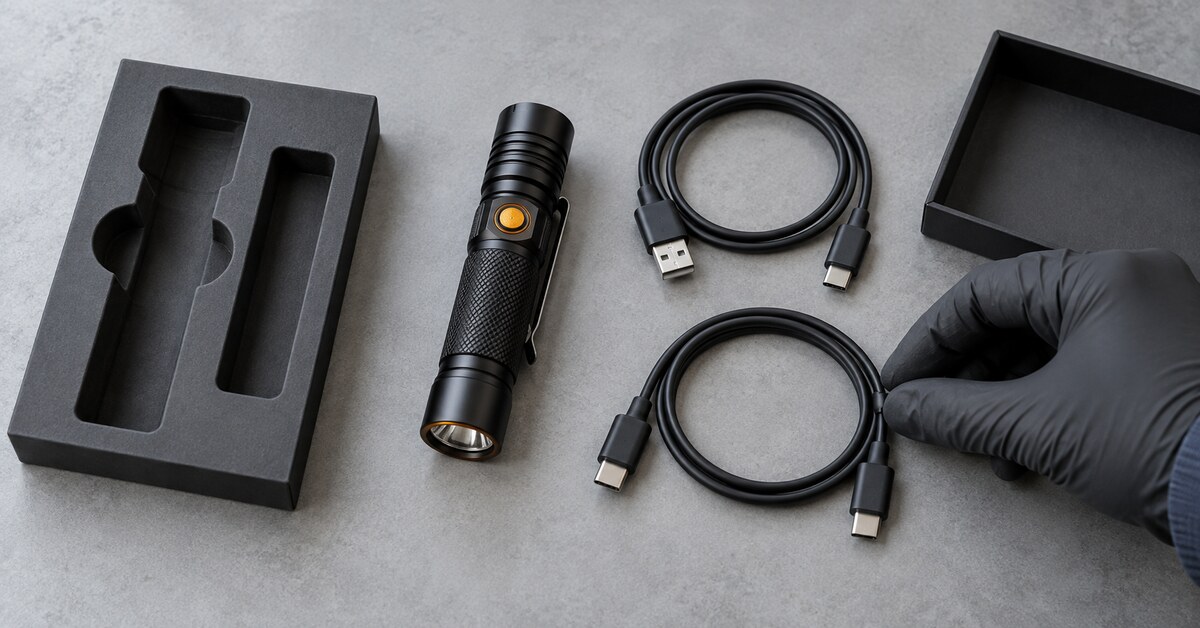
Those can be different answers. If a proposed kit includes A-to-C but the intended users need C-to-C, evaluate both paths within their stated roles. The supplied cable is a pack-list item. The user's C-to-C connection is a functional requirement. A working supplied cable cannot answer the other question on its own.
The cable format in that example is hypothetical; the two C-to-C product descriptions do not establish the pack cable for a particular order. Obtain the offered accessory identity rather than assuming it from the connector on the light. This is the point at which an inquiry about one product becomes a specification for the complete kit.
Keep application needs in the platform comparison
Explicit C-to-C wording is useful, but it should not displace another essential requirement. A buyer may need the adjustable head of the 1000-lumen SST40 platform, for example. That page lists Type-C charging and an included USB cable. The 1500-lumen SST40 21700 platform likewise describes Type-C charging with red/green charging indication.
Neither description explicitly identifies a C-to-C path in the text checked here. The unanswered path should go into the inquiry. It is not evidence of incompatibility. If the platform fits the application, the buyer can continue with it while asking for confirmation of the required connection, an alternative configuration or a defined development proposal.
The table covers these two Type-C-listed platforms and the 1500-lumen zoom example. The 3000-lumen 26650 example above remains a separate candidate; it is not an assumed equivalent hidden inside the third row.
| Official platform reference | Charging information actually listed | Listed rechargeable configuration | What the approval file still needs |
|---|---|---|---|
| 1000-lumen SST40 adjustable-head flashlight | Type-C charging; USB cable included | Included 2200mAh 18650 battery | Input specification, included cable identity and requested C-to-C evidence |
| 1500-lumen SST40 21700 flashlight | Type-C charging with red/green charging indicator | Included 4000mAh rechargeable battery | Supported sources, cable scope and a defined indicator-state map |
| 1500-lumen zoom flashlight with power-bank function | Explicit C-to-C charging statement; red/green charging indication | Included 2600mAh 18650 battery; page also lists an alternative dry-cell arrangement | Input limits, approved charging configuration, source/cable records and separate output-function scope |
An illustrative service-kit brief might therefore have two routes. One supplies an identified USB-A adapter with A-to-C; the other requires the named USB-C equipment used in the application. The same flashlight candidate might be discussed for either route, but the required source evidence differs. The buyer chooses the route from the intended use, and the supplier answers against that route.
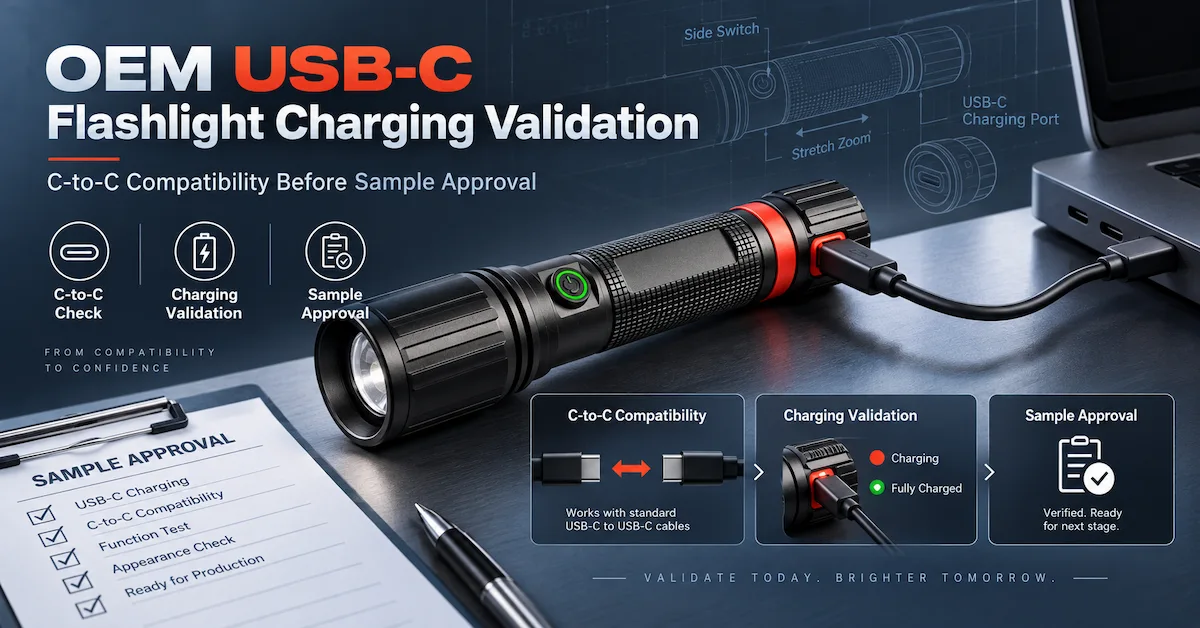
The manufacturer's graphic depicts source categories, not trials with the buyer's equipment. It can accompany a product discussion, but it cannot identify the laptop adapter, vehicle adapter, cable or battery preparation used in sample work. Those identities belong in the project file. No compatibility result is being inferred from the pictured sources.
Put the charging answer beside the quotation
At the quotation stage, the charging requirement has to be small enough to answer. “C-to-C from adapter S1 through cable C1, in the specified rechargeable configuration” creates a bounded question. “Works with any USB-C charger” would reach far beyond a finite sample plan. State the intended equipment and scope before comparing price or sample dates.
For a USB-C flashlight OEM project, the reply can separate the buyer's requested configuration, the supplier's offer and any deviation. A supplier proposing another platform should name the change and the supporting work. An offer using a different cable should identify it. This gives purchasing a decision to make while the program is still at quotation stage.
| Requirement field | Answer to obtain | How it affects sample approval |
|---|---|---|
| Finished build | Model, hardware revision, charge-control implementation and relevant firmware revision | Defines the sample and the evidence that apply to it |
| Rechargeable battery | Approved cell or pack, protection arrangement and preparation instructions | Prevents different power options from sharing an undefined charging trial |
| Input specification | Supported input conditions and limits, with the relevant product documentation | Sets the allowable setup and acceptance basis; values remain pending until supplied |
| Source scope | Intended source types and the models or capabilities included in validation | Bounds the compatibility claim |
| Cable scope | Included cable, approved alternatives, connector arrangement and relevant ratings | Defines which connection paths belong to the kit |
| Protocol claim | Declared Type-C behavior and any specifically supported USB Power Delivery function | Keeps connector naming separate from protocol evidence |
| Charging and lamp states | Allowed initial battery states and whether operation during charging is supported | Determines which test rows are permitted |
| Indicators and completion | State map, timing definitions and engineering completion criteria | Prevents a visible color from becoming an undefined pass criterion |
| Exceptions and changes | Unsupported combinations, stop conditions and approval of substitutions | Creates a clear route for a deviation or a revised build |
The form allows an unresolved input answer to stay visible. Public battery capacity and lumen information do not supply a maximum cell voltage, input-current limit or charge-IC setting for these builds. Purchasing can describe the use and ask for the documents. Engineering determines the allowable setup and evaluation method from the controlled information.
A useful supplier reply also identifies the sample that represents the offer. Model name alone may leave hardware, firmware, rechargeable battery or accessories unspecified. The team needs a reference that will connect the sample to the subsequent order. That reference can be concise, provided it actually distinguishes the configuration being accepted.
Consider a conditional quotation disagreement: the buyer asks for the user C-to-C path, but the offer confirms only A-to-C with the proposed pack cable. The accessory answer has arrived; the functional answer has not. Purchasing can request confirmation, consider a different offered configuration or accept a revised requirement if it serves the application. Until that decision is made, the required C-to-C portion of approval remains open.
Not every optional connection needs to delay an order. A connection outside the chosen scope can remain excluded, with the user claim limited accordingly. A required connection is different. Distinguishing those cases helps the team direct the next sample work toward an actual purchasing decision rather than collecting unrelated charger demonstrations.
Use USB terminology to define the promised function
A USB-C receptacle, a C-to-C charging path and USB Power Delivery support are distinct items in the brief. The USB-IF language guidelines dated March 2023 distinguish the connector from additional USB capabilities. A reply naming Type-C therefore does not, by itself, establish a PD capability.
The same applies to charging speed. A time claim needs a defined start state, source, cable, ambient conditions, lamp state and endpoint. The adapter's overall wattage is not the flashlight's supported input or actual draw. Have the supplier explain the offered charging basis before deciding which timing language the package can carry.
The USB Type-C Cable and Connector Specification, Release 2.5, March 2026 describes the Configuration Channel, or CC, in source-to-sink attachment, orientation and power configuration, including source and sink terminations. Mechanical fit alone cannot describe that electrical behavior.
This is context for a C-to-C evaluation, not a way to diagnose a circuit from outside. A-to-C success followed by C-to-C failure does not identify a missing resistor, a charge-controller fault or the guilty item in the chain. The source, cable and assembled flashlight all remain relevant to the engineering comparison.
Certification also has a separate basis. The USB-IF testing index currently lists Functional Test Specification revision 0.91 alongside other compliance resources. The buyer worksheets here are not formal certification procedures or permission to use a logo. Successful buyer trials and component documentation do not establish certification of the finished light.
Build OEM USB-C flashlight charging validation around the chosen kit
The first matrix rows should represent the connections in the commercial brief. A supplied adapter is an identified piece of equipment, not merely a charger category. Where the user path relies on named existing equipment, that source and port belong in the plan. Extra sources can broaden coverage when they answer a relevant use question.
Multiport equipment needs its agreed loading condition stated. A trial with only the flashlight attached describes that setup. If the application also requires another device on the source, include that arrangement explicitly. The plan should show why a condition was chosen, as well as which equipment will create it.
Keep cable identities separate too: pack cable, requested C-to-C cable and engineering reference cable.Connector arrangement, length and relevant specification or rating help distinguish them. A successful reference-cable comparison can assist an investigation while leaving the retail cable unresolved. The latter still needs a decision before it is packed.
| Proposed trial group | Setup to identify | Conditions to record | Decision it supports | Record / disposition |
|---|---|---|---|---|
| Included A-to-C path | Approved A-port source and the actual pack cable | Sample, battery state, lamp state and plug orientation at the light | Whether the supplied charging arrangement meets the brief | _____ |
| Requested C-to-C path | Approved C-port source and the specified C-to-C cable | Both plug orientations, battery state and any relevant source loading | Whether the stated C-to-C requirement is supported | _____ |
| Alternative approved source | Additional named source model and port | The same cable and controlled sample conditions | Whether the declared source scope extends to that equipment | _____ |
| Alternative approved cable | Additional identified cable within the defined scope | The same source and controlled sample conditions | Whether the accessory alternative is acceptable | _____ |
| Recovery after disconnect | A previously defined source/cable combination | Disconnect, reconnect and the agreed observation interval | Whether charging restarts as specified | _____ |
| Approved lower battery state | Supplier-defined rechargeable configuration and preparation | Initial state, source/cable and subsequent charging behavior | Whether the declared start condition is supported | _____ |
| Near completion | The same approved charging configuration | Indicator transition and engineering completion evidence | Whether the user indication corresponds to the defined endpoint | _____ |
| Lamp operating during charging | Only a condition expressly supported by the supplier | Mode, setup, electrical/thermal observations and completion behavior | Whether the additional use claim can be accepted | _____ |
The blank final column is intended for the trial reference and disposition. It is unfilled because this is a proposed tool. When used, a row excluded from the accepted scope should be distinguishable from an unrun required row or an unresolved exception. Those states lead to different actions at the sample meeting.
Orientation and case counts
Assign cable end A to the source and end B to the flashlight for the orientation exercise. Each plug has two positions at its assigned receptacle, giving four combinations while that end assignment stays fixed. Exchanging the cable ends is an additional factor, so a plan that includes it should name it rather than burying it among retries.
The labels belong on the setup record or photograph. Do not modify the connector. The responsible team selects suitable fixtures and instruments for the electrical observations. A setup photograph can clarify source port, plug position and end assignment without turning the reviewer into a detective.
For illustrative planning, three identified USB-C sources × two C-to-C cables × four orientation combinations × two approved initial battery states = 48 cases per sample. Two samples under the same plan produce 96 cases. These counts describe proposed coverage; they are neither executed trials nor a recommended statistical sample quantity.
The example fixes cable-end assignment and uses one approved lamp state. Adding exchanged ends or another supported lamp state changes the coverage. Excluding a combination calls for a reason and an updated count. The point of the arithmetic is to expose the plan's assumptions, not to present a large number as proof of quality.
Coverage and repetition should have their own rationale. Repeating a connection on one source can explore whether behavior recurs. It does not cover a second source that was never used. Choose sample quantity and repetition for the application and development stage rather than copying the illustrative count into a factory sampling requirement.
Discuss Your OEM Charging Validation Brief ↗ Include the application, market, model/configuration, quantity, power sources and cables, customization, packaging, required documents and timeline. Identify C-to-C compatibility and any operating-during-charge requirement explicitly.
Establish the start, endpoint and interruption behavior
Elapsed charging time begins with an identified battery condition. A sample removed from its shipping box has an uncontrolled initial state. Use the supplier-defined preparation for the approved rechargeable cell or pack, within its limits. The lower starting condition in the matrix does not authorize improvised deep discharge or reproduce a formal dead-battery compliance test.
The endpoint needs a definition before a stopwatch result becomes a customer promise. A display transition, a charge-control endpoint and a later usable-energy observation are different observations. Engineering selects the criterion and evidence appropriate to the requirement. The indicator can be useful once its meaning has been connected to that basis.
Before connection, identify the assembled sample, configuration, battery preparation, source, cable, orientation and permitted lamp state. The agreed method supplies the relevant environment, observation intervals, equipment and limits. Nothing in the public pages reviewed here provides a numerical electrical test recipe.
An illustrative trial identifier such as CV-01 can link source S1, cable C1 and the stated conditions to photographs and data. Those labels are proposed placeholders. The file should let a second team reconstruct the setup without assuming that a filename saying “works” describes the charging process.
Describe the measurement location
An input-path reading is a reading at the input. It does not directly reveal current entering the cell or the cell's endpoint. Other loads and control behavior can exist within the assembled flashlight. Naming the quantity and its location avoids using “charging current” for different observations in purchasing and engineering discussions.
An inline instrument becomes another item in the connection chain. Its connector arrangement and supported behavior matter. The responsible team chooses equipment appropriate to the function and determines whether comparison with the intended uninstrumented connection is needed. When equipment changes during investigation, the setup description should show the change.
Keep instrument and fixture identity, relevant settings and the calibration or verification basis where applicable. That context is useful when another laboratory reads the evidence later. A different measurement setup can create apparent disagreement that the original file is otherwise unable to explain.
PD evidence requires the relevant implementation information and protocol method. An ordinary power reading or a charging color cannot establish every negotiated capability. The responsible laboratory determines the applicable procedure; purchasing supplies the actual claim that needs an answer.
Translate the display into user instructions
The offered build needs a charging-state map, even when its product page already describes indication. Ask what appears on attachment, during charging, at completion and after an interruption. The map belongs with the manual because users and sample reviewers need the same meaning for the same signal.
| State to define | Information requested from the supplier | Proposed observation |
|---|---|---|
| Disconnected | Expected indicator behavior and any permitted residual indication | Record what remains visible after removal of the source |
| Connection/start | Expected start indication and timing basis | Record the transition alongside the defined input observation |
| Charging in progress | Indicator meaning and its relationship to the approved charging process | Retain a timed state record rather than a single photograph |
| Completion | Completion indication and the engineering endpoint it represents | Compare the visible transition with the agreed endpoint evidence |
| Interrupted/reconnected | Expected restart sequence and any user action required | Record recovery using the same identified source and cable |
| Unsupported or abnormal condition | Defined response and stop/escalation criteria | Record the event; stop according to the approved plan, without inventing a reset procedure |
If a sample shows the proposed completion color immediately upon connection, compare the initial preparation with the state definition and endpoint evidence. The starting state might explain it, but the photograph cannot establish that explanation alone. This is a specific question for the agreed process, rather than a reason to accept or reject the color in isolation.
Disconnect/reconnect behavior is another event. Use the identified source and cable for the agreed sequence and observation interval. A button press or cable swap may restore operation while leaving the original recovery requirement unanswered. Any response needed from the user should be part of the supported instruction, not an undocumented action added during the trial.
Lamp operation during charging belongs in the plan only when expressly supported by the supplier and required by the application. Define the mode and the electrical, thermal and endpoint observations first. Illumination while connected, by itself, establishes none of those acceptance details.
Decide what a failed combination changes
The first question after a failure is what was connected and what happened, not which item to blame. Preserve the starting conditions, sequence and observations. “Does not charge” can begin an investigation, but it cannot identify the circuit cause or decide the commercial outcome.
| Hypothetical observation | Next controlled comparison | Record or answer needed |
|---|---|---|
| A-to-C works; requested C-to-C does not | Keep the sample fixed; verify the identified C-source/cable chain with appropriate reference equipment | Supported input behavior and engineering review of the failing combination |
| One plug orientation behaves differently | Repeat the recorded orientations with source/cable identities preserved | Orientation-specific evidence, finished-port review and any corrective action |
| Only the retail cable fails | Compare that cable with an identified approved reference cable | Accessory identity, specification and the scope of the comparison |
| Indicator appears normal but charging evidence is absent | Review the state definition and the agreed electrical observation | Relationship between the indication and the actual charging process |
| Charging starts but later stops | Preserve source loading, battery state, lamp state and timed observations | Cause investigation against the supported operating conditions |
| Reconnect does not reproduce the expected start | Repeat the agreed disconnect/reconnect sequence without undocumented actions | Recovery specification and a traceable event record |
| The board works; the assembled sample differs | Compare controlled board and finished-unit setups | Assembly, port-access, thermal or other configuration differences to investigate |
| A revised build behaves differently | Compare the approved and proposed revisions under the same defined setup | Change record, affected evidence and approval decision |
The table offers hypothetical comparisons, not findings about the Brightenlux platforms. Appropriate reference equipment may help investigate a source-and-cable chain. A reference device's successful response does not by itself prove a flashlight defect or explain the cause. Engineering still needs the product's supported behavior and the controlled observations.
An orientation-dependent outcome remains an exception even when one position works. Repeat the defined positions with the equipment identities preserved and send the difference for review against the C-to-C requirement. Turning the plug until it works provides a workaround; it does not close the other position's exception.
For a controlled comparison, changing one identified item at a time retains more information than simultaneously changing source, cable and starting battery state. The latter may obtain a working setup without explaining the difference. The original event and the relevant comparison need to remain available together.
There is a purchasing fork when an alternative works. If the supplier proposes a replacement cable, engineering may first use it to investigate. Packing that replacement is a separate choice that changes the kit. Its identity, fit, relevant charging evidence and commercial inclusion need to be agreed before it becomes the supplied accessory.
The adapter decision is similar. A working wall adapter does not close a required vehicle-adapter path. The buyer can accept a proposed source change when it serves the application, or retain the original requirement. That choice determines what work remains open and what the instructions may promise.
Closure should identify the accepted limitation, corrected configuration, repeated relevant evidence or revised requirement. The actual project names the decision authority. A successful retry stays linked to the earlier exception with the reason it is acceptable, instead of replacing the failed event with an unexplained message that the problem disappeared.
Transfer the sample decision to the finished order
Board-level evidence has a useful development role. The ordered kit has a housing, port access, indication and accessories as well as electronics. The cable plug must reach the receptacle and seat under normal handling. A finished-sample review answers those assembly questions that a board demonstration leaves open.
Consider a hypothetical housing change that recesses the receptacle more deeply. The charging implementation could be unchanged while a molded plug no longer seats as intended. The drawing and actual pack cable need to meet in the finished-unit check. Approval should not rely on altering the plug or housing in a way the customer is never instructed to use.
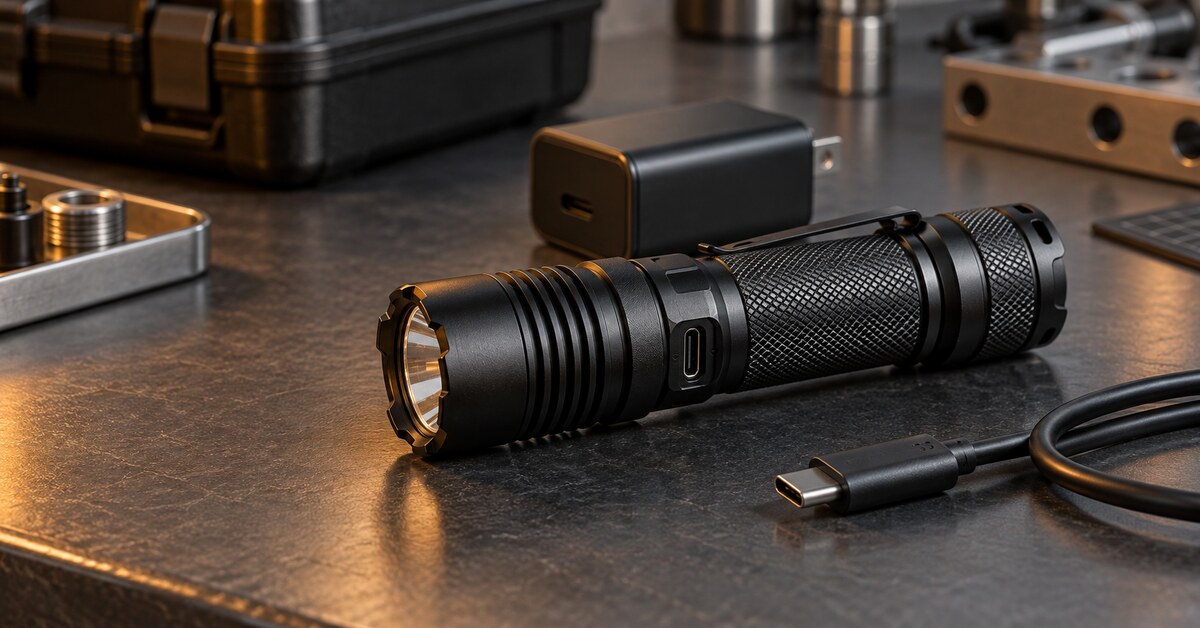
Brightenlux's About page identifies Ningbo Brightenlux Electric Appliance Co., Ltd. and publishes the workshop image below. It shows visible workbench activity. It does not identify the ordered model's charge-test instruction, board revision, equipment or qualification result; those are order-specific answers to obtain.
At packing review, match the accessory identity in the kit list to the relevant sample evidence. A development C-to-C reference cable and a supplied A-to-C cable can have different roles in the same program. The file needs to make those roles plain. If the buyer supplies the adapter separately, the quotation and carton should reflect that division.
The operation sheet has to describe the accepted rechargeable configuration, source/cable scope, indications and permitted conditions. A generic instruction can expand the charging promise beyond the sample decision. Review it with the finished kit and artwork, using the same configuration reference.
Link development evidence to production checks
Engineering validation explores agreed behavior across selected conditions. Production checks verify designated characteristics of the released units or lots. Ask the supplier how the proposed check, fixture or method, recorded result and exception handling connect to the validated build for this order.
A short functional start check may answer a defined release question while leaving charging time and wider source coverage to appropriate development evidence. Keep that scope explicit. It should not acquire a broader meaning simply because it appears on a factory release record.
For rechargeable flashlight factory charging tests, the useful answer is the model-specific plan and its configuration reference. Workshop photographs and general QC wording cannot connect an unidentified test to an approved sample. The actual order discussion should establish what is proposed to be checked and how exceptions will be handled.
Review changes against the accepted charging configuration
The catalog name can stay unchanged while the battery, receptacle, firmware, charging implementation or included cable changes. Arrange notification before revised goods are treated as the sample already approved. A change request is easier to resolve before packing than after purchasing discovers that the accessory or build differs.
| Proposed change | Charging questions to revisit | Evidence to retain for approval |
|---|---|---|
| Charging implementation or control component | Input behavior, supported source/protocol scope, endpoint and recovery | Revised specification, affected trial rows and engineering disposition |
| Receptacle or connection path | Attachment, orientation behavior and mechanical seating | Part/drawing revision and relevant finished-unit checks |
| Rechargeable cell or pack | Approved preparation, charging limits and completion basis | Cell/pack identity, compatibility review and affected charging evidence |
| Firmware or indicator behavior | Start, charging, completion and recovery messages | Revision, state map and repeated relevant observations |
| Included cable | Connector arrangement, fit and behavior in the intended source path | Accessory identity, specification and kit-level comparison |
| Housing or port-cover geometry | Plug seating, user access and finished-assembly conditions | Drawing/sample revision and practical connection check |
| Recommended or supplied power source | Compatibility, source loading and the supported claim | Source identity and the relevant matrix rows |
| Manual or package claim | Whether wording still matches the approved charging scope | Artwork revision linked to the underlying evidence |
This is an engineering impact-review tool, not an automatic instruction to repeat everything or an exemption for a small-looking substitution. The responsible team selects affected evidence and revalidation. Its reasoning should explain why the chosen work is adequate for the changed functions.
A replacement cable calls for its identity, specification, seating and relevant source paths to be compared with the accepted kit. A replacement cell or pack raises the charging basis and preparation instead. The word “equivalent” cannot answer those different questions; the affected configuration needs to be identified.
Keep the earlier approval with the build it covers and give the proposed revision its own identity and disposition. A replenishment order should not inherit an unspecified scope just because the public title is unchanged. The buyer then has a basis for accepting the revision or retaining the earlier configuration.
An artwork revision can expand the requirement without changing hardware. Adding C-to-C wording or a faster charging promise introduces a claim to support. Bring that wording back to the accepted behavior before printing, so commercial copy and technical approval remain tied to the same product offer.
Send a quotation request that includes the charging decision
An OEM USB-C flashlight charging validation inquiry can be focused enough for the supplier to price. Name the application, destination market, preferred candidate, quantity and customization. Add the required source/cable arrangement, packaging, documents and timeline. Separate the offered supported configuration from any work still proposed for approval.
Three suggested attachments provide a readable starting point: the finished configuration and rechargeable battery sheet; the source/cable and operating-state matrix; and the indicator, endpoint and evidence requirements. Give them revisions and connect them to the pack list. These are documents for the buyer to complete, not evidence that the factory has already performed the requested work.
A buyer comparing the two explicit C-to-C candidates could write: “Please quote each attached configuration for the stated market and quantity. Identify its rechargeable battery, supplied cable and supported input. Our required user connection is the named C-to-C source and cable. Confirm the proposed sample evaluation, charging-state map and deviations. State the documents and dependencies before approval.” This is a proposed RFQ text, not an actual customer inquiry.
At the sample meeting, list the configuration reviewed, required rows addressed, exceptions dispositioned, permitted claims and remaining conditions. Assign the actual project's signer and authority. Attach that decision to the commercial reference so a unit price, sample arrival or dispatch date cannot be mistaken for resolution of an open compatibility requirement.
FAQ: decisions before a charging sample is accepted
1. Which C-to-C platform should the supplier quote?
Name each candidate separately. The 1500-lumen zoom and 3000-lumen 26650 pages list different rechargeable configurations. Their public C-to-C statements provide an inquiry starting point, but neither establishes equivalence of the offered input, accessories or charging evidence.
2. Does Type-C wording exclude a platform from a C-to-C order?
The adjustable-head and SST40 21700 descriptions leave that specific connection to confirm. Ask about the offered configuration when the platform fits the application. Missing explicit wording is not a demonstrated failure, and a required connection remains open until answered.
3. How should a separately listed dry-cell option be handled?
Keep it distinct from the approved rechargeable configuration used for charging. Do not charge unspecified dry cells or assume every catalog power option shares the same charging approval. Obtain the instructions for the arrangement selected in the order.
4. What extra evidence does a PD or charging-time claim require?
PD needs the relevant implementation and protocol basis. Charging time needs a defined starting state, source, cable, conditions and endpoint. Neither follows from socket shape or the adapter's printed wattage, and the model-specific input information remains necessary.
5. What if the supplied cable is A-to-C while users need C-to-C?
Treat the pack accessory and required user path as separate entries. A success with one does not answer the other. If an alternative cable is accepted for packing, update its identity and kit evidence rather than treating an investigation substitution as an order change.
6. Why does one working plug orientation leave an exception?
It does not explain or close the other position's outcome. Preserve the identified setup, repeat the defined positions and obtain engineering review against the requirement. The observation does not diagnose a particular circuit component.
7. Can battery-level indication stand in for charging completion?
Ask for the charging-state map and endpoint evidence for the offered build. A battery-level display answers another question. A charging color can become useful evidence when its defined meaning is connected to the agreed process and starting state.
8. How are lower starting states and lamp operation selected?
Use supplier-defined battery preparation within approved limits. Include lamp operation during charging only when expressly supported and required, with a defined mode and method. Do not improvise deep discharge or infer support merely from illumination while connected.
9. What happens when the cable or cell is substituted?
Engineering reviews the affected functions and selects relevant revalidation. Retain the earlier approval with its configuration; identify the proposed item and new disposition. Different changes need different questions, rather than a universal all-or-none rule.
10. What do the example 48 and 96 counts establish?
They illustrate coverage arithmetic for fixed assumptions, including cable-end assignment and lamp state. They are not executed trials, certification results or a statistical sampling prescription. The actual project supplies its sample and repetition rationale.
Conclusion
OEM USB-C flashlight charging validation starts with the offered configuration and the intended user connection. Ask separately about each platform's rechargeable arrangement, supplied cable and supported input. Resolve indication, endpoint, recovery and exceptions against agreed criteria, then connect the accepted kit to the order and its change process. The buyer can compare offers and review substitutions with a clear reference instead of relying on a connector label alone.
Discuss Your OEM USB-C Flashlight Project ↗ Share the application, market, model/configuration, quantity, power setup, customization, packaging, required documents and timeline to prepare a charging-specific sample and quotation discussion.