

A low MOQ flashlight customization supplier should help a buyer launch a controlled, branded first order without making unsupported promises about quantity, price, engineering changes, or delivery. The goal is not simply to buy fewer flashlights. It is to test a commercially useful product with approved specifications, a realistic landed cost, consistent packaging, and a documented path from pilot batch to repeat order. An appropriate supplier explains which customization minimums apply to the flashlight, marking, packaging, accessories, and any technical modification separately.
For private-label outdoor brands, industrial-tool distributors, online retailers, and corporate-kit buyers, small opening volumes are often an opportunity to learn before committing substantial inventory capital. They are also a test of the supply relationship. Does the sample match the quote? Does the final shipment contain the agreed battery and cable? Can the same configuration be reproduced after the first sales cycle? These questions matter more than an attractive but unexplained “low MOQ” badge.
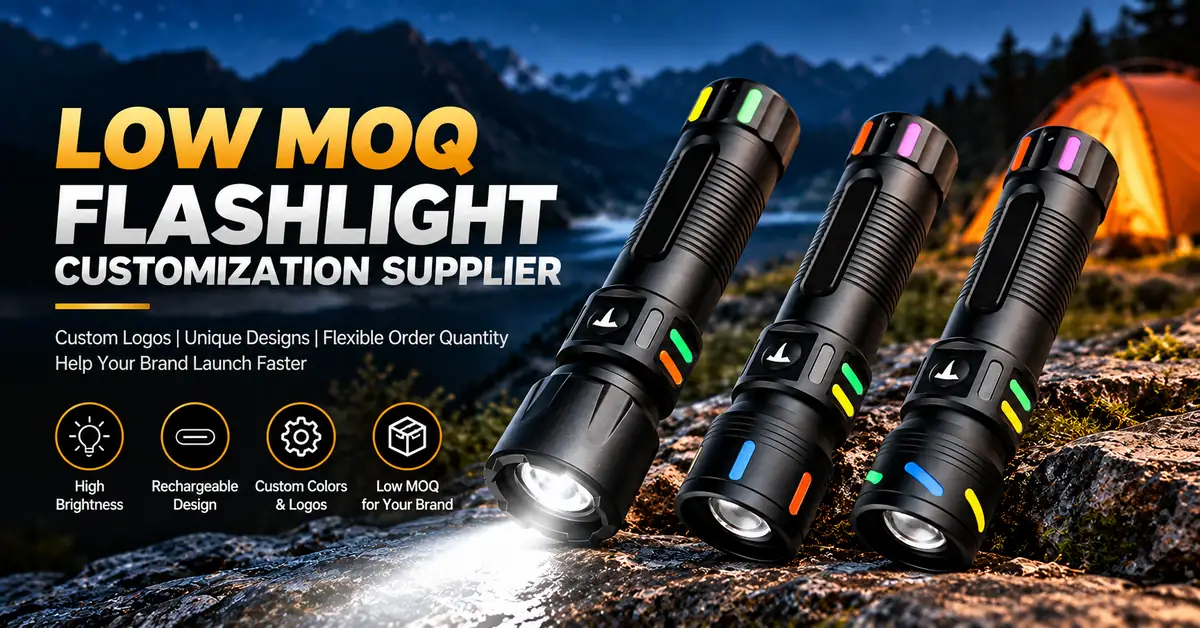
Brightenlux, operated by Ningbo Brightenlux Electric Appliance Co., Ltd., publicly offers OEM/ODM services and low-MOQ logo-printing discussions for portable lighting products. Its flashlight catalogue includes genuine rechargeable and dual-power platforms. No universal minimum order quantity, custom-logo unit price, or lead time is published for every model, so all commercial terms in this guide must be confirmed against the proposed build.
Explore Brightenlux Flashlights Request a Pilot-Order MOQ Quote
1. Why a Low-MOQ Pilot Is a Commercial Experiment, Not Just a Small Purchase
A pilot order tests a specific business hypothesis: “Will customers in this channel buy this defined flashlight, at this landed cost and presentation, with an acceptable experience?” A supplier quote and a sample can answer whether a product is obtainable; they do not prove that the market wants it. Sales evidence, field feedback, return reasons, and the cost of keeping inventory are needed before the buyer raises the order quantity.
Different buyer groups use a pilot for different reasons. A new outdoor label may test a compact torch with a logo and retail sleeve. A tool distributor may supply a magnetic light to a small group of mechanics and observe use and replacement requests. An e-commerce seller may compare two product-page propositions while keeping the actual physical specification constant. A promotional-products business may validate a logo application and presentation pack for a customer's seasonal campaign.
A low starting quantity is not automatically suitable for every use. New moulds, custom drivers, unusual battery packs, regulated safety applications, or proprietary optical designs can carry engineering and component costs that are difficult to distribute across a tiny run. A factory should identify that limitation early. The realistic starting point for many small-brand projects is an existing, documented flashlight platform with only approved presentation changes.
A useful pilot decision record names its target buyer, intended application, market, sales channel, proposed SKU, known commercial risks, and the reason a second order would be justified. If these details are missing, even an inexpensive pilot can become unsold inventory.
2. Understand the Five Different Minimums Hidden Inside One “MOQ”
There is rarely one magic minimum that applies to the complete product. A low MOQ flashlight customization supplier may have separate economic thresholds for the standard flashlight, the logo process, the packaging printer, a selected accessory, and a newly specified component. The final saleable unit is constrained by the requirements of whichever element cannot be economically procured or processed at the target quantity.
| MOQ Driver | What Creates the Constraint? | A Lower-Risk Pilot Approach | Question for the Supplier |
|---|---|---|---|
| Existing flashlight platform | Stock, assembly scheduling or component availability | Select an active, unchanged model | What is the minimum for this exact configuration? |
| Logo application | Artwork setup, marking fixtures or printing batches | Use an approved mark on the standard body | What setup cost and mark area apply? |
| Retail packaging | Printed carton or insert production minimums | Consider an approved label or sleeve where feasible | Can unused printed components be held for a reorder? |
| Accessories and batteries | Supplier pack quantities or special sourcing | Retain the standard included battery and cable | Which accessories are standard versus optional? |
| Engineering changes | Tooling, development, validation and dedicated components | Defer technical changes until demand is proven | What costs and tests are triggered by this change? |
This table describes common sourcing economics, not confirmed minimum quantities at Brightenlux. The commercial discussion should be model-by-model and option-by-option. A supplier may quote a quantity for one logo method but require a different quantity for a new housing finish. A buyer should ask for both quantities instead of assuming “low MOQ” covers everything.
The most useful response is a quotation that identifies each minimum driver alongside its one-time cost and recurring cost. If a factory says that a particular carton cannot be ordered in the requested quantity, the buyer can decide whether to simplify the package, store excess printed material, combine artwork across variants, or delay the launch. Each option changes the economics in a different way.
3. Build a Three-Stage Launch Plan: Validate, Repeat, Then Expand
A staged approach makes the trial commercially meaningful. It also prevents a premature promise to a supplier about annual volumes that have not been supported by actual orders. The three stages below are a buyer-side operating framework, not an advertised Brightenlux production program or guaranteed quantity schedule.
| Stage | Main Decision | Buyer Evidence | Supplier Deliverable | Stop or Advance Gate |
|---|---|---|---|---|
| Stage A — Sample and pilot | Does this exact product suit the channel? | User test, approved branding, first sales and issue log | Identified sample, priced pack-out and pilot quotation | Approve only if specification and product claims are supportable |
| Stage B — Controlled reorder | Can we sell and receive the same product again? | Orders, returns, sell-through, support enquiries | Revision-matched replenishment proposal and inspection record | Reorder when demand and quality justify the cash exposure |
| Stage C — Range expansion | Which change creates proven customer value? | Repeat demand and specific unmet user need | Feasibility for colour, accessory, optics or electronics changes | Develop new variants only after engineering and economics are reviewed |
The critical insight is that each stage should answer a different question. A sample checks design and functionality. A small saleable batch checks the practical operation of packaging, shipment, retail listing, and customer response. A reorder tests supply consistency. A new or modified model then becomes a strategic investment rather than a guess.
Before each stage, set a date for review and agree which records the buying team will use. “Sales are going well” is not a sufficiently precise purchasing criterion. The team should at least know quantities sold, quantities still held, refund or replacement reasons, customer comments relevant to product function, and any unplanned logistics or packaging expense. For business-to-business tool sales, feedback from a small group of real operators can be especially useful.
4. Start With Real Brightenlux Flashlight Platforms, Not an Imaginary Custom Model
Brightenlux displays existing handheld and right-angle products suitable for a platform-first quotation discussion. Each model offers a different combination of beam control, power source, mounting, and user job. These are published product claims; they are not independently tested results, and they do not establish that logo, colour, packaging or electronics changes are available at any particular volume.
| Published Brightenlux Product | Manufacturer-Listed Configuration | Potential Pilot Channel | Important Confirmation |
|---|---|---|---|
| 600 lm dual-power adjustable-focus flashlight | SST20, included 1400mAh rechargeable battery or 2 AA cells, Type-C, High/Low/Strobe, twist focus, anodized aluminium | Entry retail, travel or emergency accessory | Battery arrangement, charging behaviour and pack contents |
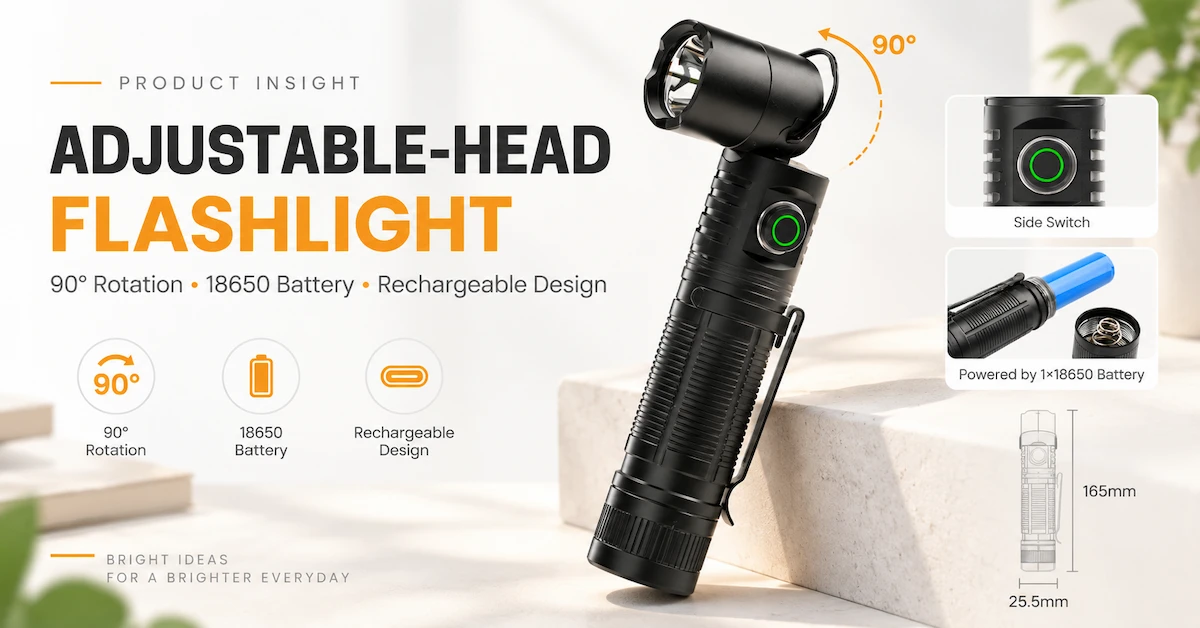
| 1000 lm adjustable-head SST40 flashlight | 18650 2200mAh included, Type-C, magnetic tail, adjustable head, IP44 listed | Workshop or utility private label | Mode-specific runtime, magnet and head retention, IP evidence |
| 1000 lm SST25 red/white flashlight | White and red modes, magnetic tail, Type-C, listed headstrap and plastic mount, 18650 format | Outdoor, inspection or kit seller | Included accessories, red-mode sequence, battery specification |
| BT-FL8088 1500 lm SST40 flashlight | 21700 4000mAh included, Type-C, magnetic tail, 150m catalogue beam, IPX4 listed | Premium utility or outdoor range | Performance reporting, cell source, exact pack-out and target market documents |
Select the product to match the user job. A tool-channel customer may value magnetic mounting more than an additional decorative light mode. A low-cost retail accessory may benefit from a simple control scheme and a clear battery-inclusion statement. A premium outdoor SKU may justify a different cell format, provided the resulting size, mass, charging requirements, and price are appropriate for its buyer.
The first sourcing request should name the exact product page and the functions you intend to keep unchanged. This makes the quote significantly more reliable than requesting “your cheapest customizable 1000-lumen flashlight.” A model-specific enquiry also helps the supplier identify where an apparent visual similarity hides a different charging board, driver or battery.
Compare Flashlight Models Ask Brightenlux Which Models Support Your Pilot
5. Match the Pilot to the Sales Channel Before Specifying the Logo
A brand trial should begin with a customer problem, not simply the desire to print a name on a flashlight. The channel determines the acceptable appearance, required information, accessories, and likely complaint patterns.
Outdoor and camping brands may prioritise carry size, a practical medium or low mode, splash exposure, and battery availability. A model chosen for short hikes may not be the same as one intended for a vehicle emergency box. Confirm whether the end user expects a cable, spare cells, a lanyard or a pocket clip in the retail pack.
Industrial and automotive distributors often value beam placement, magnetic attachment, grip, charging convenience and consistent replenishment. A right-angle or adjustable-head model may serve them better than a more powerful straight torch. The purchase trial should include actual workbench or equipment-inspection tasks conducted under appropriate workplace safety rules.
Online retail brands need an accurately photographed product, an understandable mode sequence, reliable unit dimensions and a clear package contents list. The biggest preventable commercial problems may be mismatched product photos, undocumented battery exclusions, or a feature claimed by the listing but absent from the shipped batch.
Corporate and promotional buyers usually need a controlled mark area, appearance sample, gift packaging and delivery plan. A promotional flashlight still needs accurate electrical and performance statements. Its use as a giveaway does not exempt it from applicable product or battery requirements.
For every channel, write a short “not-for” statement. General-purpose flashlights should not be described as explosion-protected mine lights, approved medical inspection instruments, or certified emergency safety equipment without the correct product-level evidence. Clear limits improve purchase decisions and protect the brand from unsuitable applications.
6. Control the Customization Boundary: Brand Changes vs Engineering Changes
When buyers search for a low MOQ flashlight customization supplier, they often combine changes that look similar in a catalogue but require very different approval processes. A name printed on an unchanged housing is not equivalent to a new charging board, even though both may be called “customization.” Separate the scope before asking for pricing.
Presentation-only changes can include a logo, product label, barcode, manual layout, colour sleeve, or retail insert. They still need an approved design proof, the final model reference, artwork ownership, and acceptable print/mark quality. The feasibility and minimum depend on the process and chosen product.
Assortment and cosmetic changes may include a new body finish, optional accessories or an alternate package structure. They can introduce supplier batch constraints, appearance standards and new inventory components. A custom anodized colour should be reviewed against a real physical reference and a realistic tolerance, not only a screen image.
Functional and component changes involve optics, LED, cell, driver, charge circuit, control sequence, switch, magnet, seal or enclosure. These changes can affect lumens, beam profile, heat, endurance, battery documents and water-resistance claims. The buyer should expect engineering review, an updated bill of materials and revalidation of affected claims.
New ODM designs can involve tooling, original enclosures, circuit layouts and new qualification plans. A small saleable order will not necessarily justify that investment, even if the final product is intended for a premium brand.
One practical way to reduce launch risk is to retain the existing optical and electrical design for Stage A, add only a clearly described branding package, and collect customer feedback before seeking a distinctive mechanical variant. This is a procurement strategy, not a promise that every Brightenlux model can be branded without engineering work.
7. Freeze a Single Production Build Before Artwork Approval
A small order can still suffer from costly discrepancies if the product specification is defined only by a photograph. Create a one-page approved build sheet. It should identify the model and revision, LED and optic, cell, charging arrangement, modes, enclosure, finish, accessories, packaging, and the source of each advertised claim.
| Critical Field | What to Record | Why a Buyer Needs It |
|---|---|---|
| Model and revision | Official reference, sample ID and date | Stops visually similar models from being substituted |
| LED, optic and driver | Specific approved configuration | Protects beam and output consistency |
| Battery and charging | Cell format, included quantity, USB input and cable | Prevents runtime, charging and pack-out confusion |
| User interface | Switch sequence and displayed indicators | Keeps instructions and product experience aligned |
| Mechanical parts | Magnet, clip, head pivot, lanyard and seals | Controls the features customers handle every day |
| Performance claims | Output, beam distance, runtime and test method | Allows substantiated listing and carton text |
| Brand presentation | Mark artwork, approved location and packaging revision | Controls the saleable unit the customer receives |
| Quality and change control | Golden sample, inspection criteria, substitution rules | Makes repeat orders comparable to the first batch |
The build sheet should state which characteristics are fixed and which are optional. If an accessory is shown in an image but is not included in the quoted kit, record the exclusion. If an IP rating is presented on the public product page, request supporting evidence for the exact offered configuration before placing it on the branded carton.
This approval work need not be administratively heavy. A well-maintained versioned file and an identified golden sample can prevent many ordinary misunderstandings. The important point is that the brand, sales team, production team and supplier must all be discussing the same physical item.
8. Packaging Strategies That Preserve a Small Pilot Budget
Packaging is often a hidden minimum-order driver. A factory may be able to assemble a small number of standard lights while a carton supplier requires a different print quantity. The buyer should compare several approaches without assuming that one is universally cheapest or available.
A standard carton with a compliant branded label may work for some trial channels, but only if the required product details and markings remain legible. A printed sleeve can create a consistent retail appearance while keeping the original protective box. A fully printed custom carton may be appropriate when shelf presentation is central to the sales strategy or forecast volume supports the print run. Each option needs a real quotation and packing sample.
Packaging decisions also affect product safety and returns. The chosen insert must protect the lens, switch, charging socket, cell and any included accessories. A box that looks premium but causes the power switch to be pressed during transport is not a successful design. Check packed dimensions and master-carton quantities before calculating freight cost.
For e-commerce, plan the listing and physical pack together. The images must show the actual model, battery and accessories. Do not describe the cable as included unless it appears on the pack-out sheet. If a two-power-source model is used, clarify which cell is shipped and how the alternate battery option works.
An intelligent small-batch packaging plan also considers repeat orders. If the buyer pays for more custom sleeves than the first run uses, ownership, storage conditions, remaining quantity, and future usage rights should be documented. Otherwise the apparent lower unit printing price can become stranded packaging inventory.
9. Make the Pilot Sample Test the Real Buyer Experience
A product that works on a sales representative's desk may behave differently in its intended use. A pilot-stage quality plan should connect function, presentation, accessories and customer expectations rather than treating every sample as a generic on/off check.
First, verify identity and pack-out. Photograph the unit, label, mark, included cell, cable, clip, strap and manual. Confirm that each item matches the approved build sheet. Record the exact sample ID so later test results cannot become detached from the product version.
Second, evaluate the intended job. For workshop use, test angle adjustment and magnetic retention on representative surfaces without attaching equipment to unsafe or energized locations. For camping, assess carry comfort, useful lower modes and user controls. For retail, ask an unfamiliar user to operate and charge the light using only the included instructions.
Third, review the claims. Measure or request evidence for output, beam and runtime using defined methods when these are printed selling points. The ANSI/PLATO FL 1-2025 Flashlight Basic Performance Standard provides an established portable-light testing and reporting framework. It does not certify a specific Brightenlux product simply because a buyer references it. Distinguish short-duration peak brightness from sustained usable output.
Fourth, test charging and handling. Verify the specified cell, cable, input, indicator behaviour, port cover, button action and expected operation through a practical work cycle. USB Type-C does not itself prove support for every Type-C charger or a particular fast-charging protocol.
Fifth, approve the branding. Inspect the mark for placement, alignment, contrast, durability appropriate to the application, and consistency on the chosen finish. Make sure the label and retail description correspond to the correct model and operating modes.
Finally, document deviations. If the sample fails an agreed criterion, identify the reason, proposed remedy, and whether a revised sample is needed. Do not silently change the battery, driver or optic to make the next sample pass. Small batches deserve the same clarity about defects as large orders.
10. Compare Pilot Economics: Cash at Risk Matters More Than Unit Price
A low MOQ flashlight customization supplier can help reduce initial inventory exposure, but a smaller order may carry a higher per-unit manufacturing and packaging cost. The buyer should compare a realistic small batch with a larger order using the same approved product and included contents. A bargain based on a different cell, accessory bundle or carton is not an equivalent comparison.
Consider a hypothetical illustration, not a Brightenlux quotation: a brand considers 120 units at an illustrative landed cost of USD 9.00 each, versus 500 units at USD 7.20 each. The smaller plan commits USD 1,080 to units; the larger commits USD 3,600. The large order costs USD 1.80 less per unit but requires USD 2,520 more initial cash before adding sales, storage, financing or returns. Whether it is better depends on the likelihood and speed of selling the extra stock.
A useful planning formula is:
Initial cash exposure = Ordered units × fully loaded unit cost + non-recurring setup, samples and development charges.
Then calculate a scenario for inventory remaining after the intended sales window. If only a portion of units sell, account for the cost of unsold stock, fulfillment, platform fees, damages, refunds and future price reductions. No responsible supplier can promise your sell-through rate or net margin.
A second formula supports repeat-order decisions:
Reorder trigger = Forecast demand during confirmed replenishment time + appropriate safety stock − usable available inventory − confirmed incoming supply.
The variables belong to the buyer and must be updated with actual data. A practical review may include customer feedback, channel reorder requests and the cost of stockouts as well as the simple quantity calculation.
11. Negotiate Three Quote Tiers Against One Frozen Specification
The highest-value pricing discussion is not “Please lower your MOQ” but “Please quote the same approved build under three realistic order scenarios, identifying exactly what changes at each tier.” This makes it possible to see whether the economic threshold comes from assembly, printing, batteries, logistics or development.
Ask for a pilot tier matching the volume you can realistically validate, a first reorder tier based on expected channel demand, and a volume tier that might change unit economics. These quantities are buyer-requested scenarios, not confirmed factory minimums.
Require the quotation to separate: flashlight, included cell, charging cable, accessories, body marking, packaging, printing or setup charges, sample expenses, relevant test allocations, master carton, inspection, delivery terms and applicable one-time tooling costs. State the currency, quote validity and Incoterm. A unit price without those inclusions may be misleading.
Also ask whether mixed models can share a packaging format or whether they trigger separate minimums. This is particularly relevant to distributors testing a compact flashlight and a magnetic model in the same channel. It may or may not be practical for the supplier, but the answer affects the launch architecture.
When a supplier proposes an alternative cell or body to hit a price, request the trade-off in writing. Lower cost is useful only if the product still meets the user job, claim requirements and approved packaging. A transparent “not feasible at this quantity” is more valuable than a promise that fails during production.
Request Three-Tier Pricing Review Brightenlux OEM Product Options
12. Plan Sample, Artwork, Production and Shipment Dates Separately
Lead time should be expressed as a sequence, not an unexplained number. Even a small branded batch can wait on artwork approval, material procurement, finished-body availability or packaging production. Changing a logo late in the process is not equivalent to changing an electronic component after production has started.
A quote-ready timeline identifies: commercial scope approval; sample identification or preparation; sample acceptance; artwork proof; packaging confirmation; materials and production readiness; assembly and marking; inspection; dispatch preparation; and shipping. Each stage should have an owner and a trigger that starts its clock.
If a custom colour or accessory requires a supplier batch, the lead time may differ from a standard-body pilot. If market-specific testing is needed, confirm whether it occurs before or after a prototype update. If a battery is included, verify that transport arrangements and documents are consistent with the shipped configuration.
Ask what can be reserved in advance and what cannot be guaranteed before approval. A supplier should not be pressured to promise “fast delivery” before the product, artwork, order quantity and destination are defined.
Replenishment planning begins with the pilot, too. When early demand arrives, the buyer will need to know whether a repeat order can use the same cells, parts and carton artwork, how much notice is required, and whether a lower-cost volume tier introduces any new component sourcing risk. Document these questions before the first shipment.
13. Quality Control and Market Documents Must Be Model-Specific
Brightenlux describes manufacturing experience and a factory presence in Ningbo on its company page. That information establishes the supplier's stated background, but it does not prove that any newly customized flashlight has passed a particular independent test or that a selected configuration can ship to every destination market without further review.
A useful pilot quality agreement covers incoming critical components, functional assembly, charging, housing finish, marking placement, relevant water-ingress evidence, pack-out checks, lot identity, and nonconforming-product handling. The buyer and supplier should agree which tests apply to the exact flashlight and which controls are necessary for the target channel.
For portable-light performance reporting, reference relevant methods in ANSI/PLATO FL 1-2025 where appropriate. For a claimed ingress rating, request a report using a suitable method such as the framework in IEC 60529. These are independent technical references, not a claim that the entire Brightenlux range is certified to those standards.
Lithium-cell transport obligations are separate again. The UN Manual of Tests and Criteria, Part III, subsection 38.3, provides a relevant lithium-cell and battery testing framework. Request the required test summary and other shipping documentation for the actual cell or pack and route, working with qualified transport specialists. Product-page marketing copy is not the shipment compliance file.
Do not print unverified marks, laboratory names or universal compliance statements on packaging. The importer has its own responsibilities for the markets in which it sells. When a product changes materially, review whether its earlier evidence still applies.
14. Reorder Control: Keep the Second Shipment as Good as the Approved First
A successful pilot is not complete when the first customers buy. It becomes a supply program only if the next order can reproduce the same expected product. For this reason, define a reorder identity that links the approved physical sample, build revision, battery, accessories, carton artwork, inspection criteria and supporting records.
The buyer should keep an issue log covering runtime complaints, charging problems, switch behaviour, mark durability, packaging defects, missing accessories, and returns. Not every complaint proves a manufacturing defect, but recurring issues can reveal an inaccurate claim, weak instructions or a part variation. Distinguish user experience problems from confirmed quality failures.
Before a second order, ask the supplier to declare any proposed changes to the LED, optic, cell, charging board, firmware, switch, seal, finish, battery supplier, packaging or accessories. Decide whether a new sample or claim test is required. Minor paper-copy changes may need only artwork approval; a different cell or driver can affect advertised runtime and transport documentation.
A buyer may choose to expand quantity only after seeing acceptable pilot sell-through and quality performance. That is a commercial decision, not a factory-guaranteed growth curve. A disciplined process protects both the brand and the supplier from avoidable last-minute disputes.
15. A Quote-Ready RFQ Template for a Small Custom Flashlight Order
A complete first enquiry lets a low MOQ flashlight customization supplier respond with realistic options rather than guesses. It is especially useful when the buyer has not sourced lighting products before. Use the following checklist to turn a general interest into a reviewable quotation:
- Buyer and market: company, destination countries, selling channel and intended end user.
- Exact platform reference: link to a Brightenlux product or attach a clearly identified sample reference.
- User job: camping, everyday carry, inspection, tool kit, home backup or promotional gift; include situations the product is not designed for.
- Required unchanged features: LED, lens, battery, charging, modes, controls, enclosure and accessories you want to preserve.
- Requested changes: logo position, method, packaging, instruction language, barcode, appearance, accessories or any functional adjustment.
- Commercial scenarios: sample quantity, pilot quantity, anticipated reorder tier and longer-term forecast, stated as estimates rather than commitments where appropriate.
- Quality evidence: golden sample, output claims, battery documents, ingress requirements, pack-out and inspection plan.
- Artwork and packaging: source files, required copy, logos, carton style and approval contact.
- Logistics: destination, Incoterm, delivery window, carton details and shipping-document expectations.
- Quotation structure: request unit price by tier, MOQ driver, setup charges, inclusions, exclusions, sample timing and key milestones.
Ask the supplier to classify each requested modification as standard, available with a documented option, requires engineering development, or not currently available. This is far more informative than a one-line answer saying that OEM customization is possible.
If you already have a preferred model, send the product link and RFQ to Brightenlux. If you need to compare models first, explore the flashlight product category and the company's outdoor-lighting service information.
16. Frequently Asked Questions About Low-MOQ Flashlight Customization
1. What qualifies as a low MOQ for a custom flashlight?
There is no universal quantity. The minimum depends on the specific flashlight, material availability, marking process, packaging, battery, and requested engineering changes. A buyer should ask for a model-specific and option-specific quotation rather than assume every supplier or product supports the same number.
2. Does Brightenlux offer low-MOQ logo customization?
Brightenlux's official website advertises OEM/ODM services and low-MOQ logo printing. That supports a customization enquiry, but it does not establish a fixed minimum, pricing, marking method, or approval for a particular model. Contact the team with your selected product and intended quantity.
3. Can a brand order a small pilot without changing the electronics?
That can be a lower-risk approach when an existing platform meets the intended use and target market. The buyer can discuss an approved mark, insert, sleeve or retail carton while keeping the cell, driver, optics and controls unchanged. Actual availability and MOQ must still be confirmed.
4. Which customization request usually increases complexity the most?
A change affecting the optical, electrical or mechanical design—such as a new driver, battery pack, switch or enclosure—can require engineering, dedicated components and additional validation. Packaging and logo changes are often simpler, but they may still create setup costs or print minimums.
5. Is a 21700 flashlight automatically better than an 18650 model?
No. Cell format alone does not determine the suitability of the flashlight. Size, mass, actual cell capacity, drive settings, sustained output, charging and intended user task all matter. Compare the complete models under the same defined test conditions rather than choosing by cell designation alone.
6. Can a small custom flashlight order include batteries and charging cables?
It depends on the exact product and quotation. Several Brightenlux listings specify included rechargeable cells and accessories, but pack-out can differ by configuration. Ask for a written itemized contents list and review the received sample before approving retail photography or packaging.
7. How do I compare a low-MOQ quotation with a larger wholesale order?
Use one frozen product specification and compare total initial cash exposure, one-time costs, fully loaded per-unit cost, unsold-stock risk and replenishment timing. A larger order may reduce unit cost while increasing inventory exposure. The better choice depends on your actual demand and financial constraints.
8. What tests are important before printing a branded flashlight box?
Confirm the intended use, modes, battery, charging, physical assembly, accessories, relevant performance claims and any claimed IP rating. Apply appropriate methods and obtain model-specific evidence where needed. The printed product claims must match the approved build and its supporting records.
9. What should happen if the supplier changes the battery or LED before a reorder?
The supplier should notify the buyer and document the change. The buyer should assess its effect on performance, safety-related evidence, labeling and transport documents, and approve any required new sample or test before the revised product ships. An external resemblance does not prove technical equivalence.
10. What information should I send to get a realistic MOQ and OEM quotation?
Provide the exact flashlight reference, end-use, target market, customization list, intended pilot quantity, forecast reorder, packaging requirements, included accessories, evidence expectations and target milestone dates. Contact Brightenlux to request a proposal identifying the actual minimums and commercial assumptions.
Conclusion
The value of a low MOQ flashlight customization supplier is not merely the ability to accept a small purchase order. It is the ability to help a brand select an appropriate existing platform, identify the true quantity constraints, keep custom work within a realistic budget, verify a saleable sample, and reproduce the approved product when customer demand justifies a reorder. A disciplined pilot protects capital while generating the evidence needed for the next purchasing decision.
Brightenlux provides published rechargeable and dual-power flashlight options alongside OEM/ODM and low-MOQ logo-printing discussions. Use its flashlight product portfolio to identify a reference platform, review the company's customization background, and request a model-specific pilot quotation with your product choice, desired mark, packaging, market, quantities and approval requirements. The best first order is one your brand can learn from—and confidently repeat.
Explore Flashlight Platforms Get a Customized Pilot MOQ Quote