

Does the quoted weight include the battery? Will the light charge from the cable your customer already owns? Is the retail box printed or plain? A product photo answers none of these. Even a small note saying “battery not included” can change the purchase price and the pack you need.
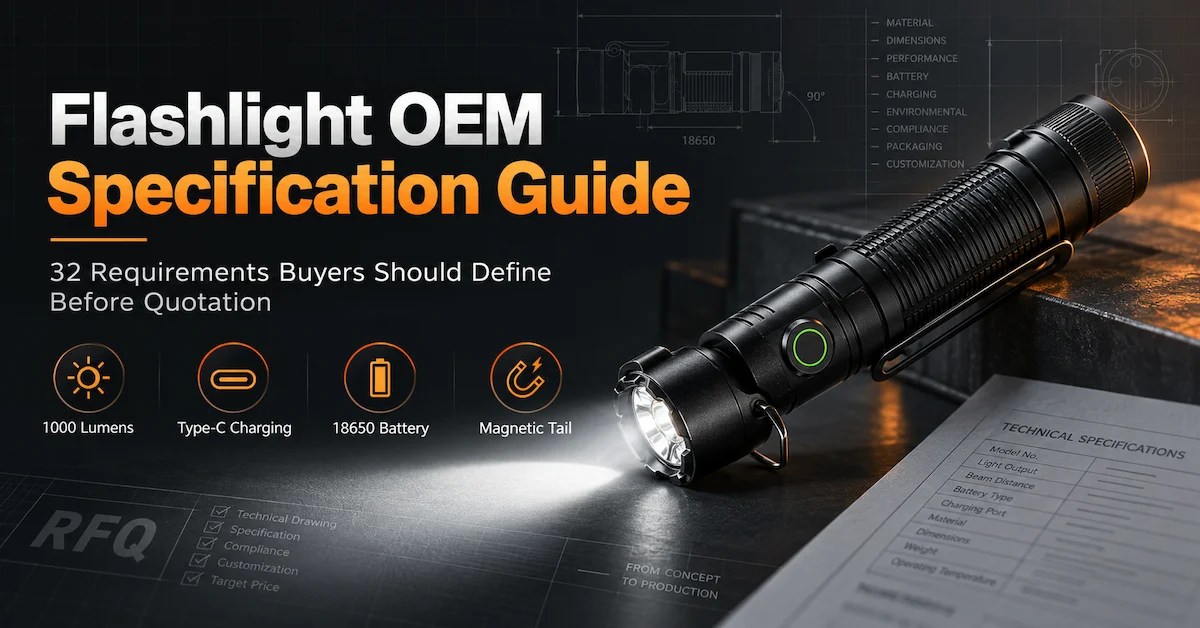
The flashlight OEM specification template below follows those questions through quotation and sampling. Buyers fill column three; suppliers answer in column four. Replies should identify the build being priced.
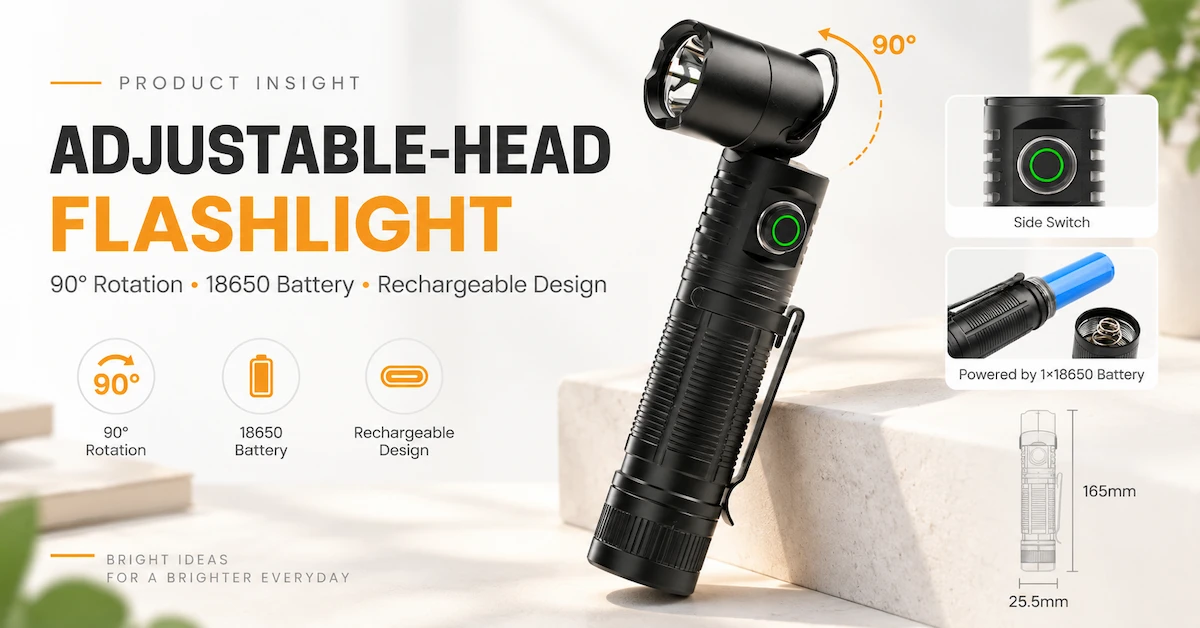
How to use the flashlight OEM specification template
Field 3 can say, for example, “inspect under a vehicle hood while attached to steel.” Now the mounting and beam choices have a reason. For a pocket model, the brief can give the available space and say whether pressure on the switch is a concern.
Beside each entry, use required, target, open or approved. A requirement is a boundary the quote must meet. A target leaves room for an engineering proposal. An open item needs a decision, sometimes with two prices. Approval means there is a dated drawing, sample or other accepted reference behind the answer.
The revision number matters when replies arrive. If one supplier prices your first battery choice and another prices an alternative, the prices are not yet comparable. An OEM flashlight requirements sheet should show that difference. Purchasing can then spot the change without reconstructing an email thread.
The flashlight OEM specification template: 32 fields
The blanks below belong to the buyer. They are not preset Brightenlux specifications. Where an answer needs more space, enter a file name and revision: a control diagram, artwork proof or packing drawing is more useful than squeezing the decision into a few words.
| No. | Field | Buyer entry | Supplier confirmation |
|---|---|---|---|
| 1 | Project and revision | Project ___; revision ___; date ___; approval owner ___. | Quote and sample references use this revision. |
| 2 | Market and channel | Destination countries ___; retail / online / industrial / other ___. | Documents, labels and language proposed for that scope. |
| 3 | Task and environment | Main task ___; indoor / outdoor; temperature range ___. | Use limits and unsuitable conditions stated. |
| 4 | Quantity and variants | First order ___; repeat estimate ___; units per color or version ___. | Price breaks, minimums and mixed-order rules. |
| 5 | Product platform | Existing model / modified platform / new design; reference ___. | Exact model, build and design scope. |
| 6 | Output by mode | Required modes ___; output targets ___; tolerances ___. | Test method, timing and sample build. |
| 7 | Beam pattern | Wide / focused / mixed / adjustable; working distance ___. | Beam evidence and any intensity or distance claims. |
| 8 | Runtime by mode | Mode ___; minimum useful output ___; desired duration ___. | Runtime endpoint, conditions and output curve. |
| 9 | Light appearance | Describe preferred light color: CCT ___, CRI ___, acceptable variation ___. | Options offered, their tolerances and supporting data. |
| 10 | Thermal behavior | Continuous-use task ___; acceptable control behavior ___. | Step-down behavior, temperature limits and test conditions. |
| 11 | LED, optic and driver | Named components / supplier proposal; substitution approval owner ___. | Component identities and proposed equivalents. |
| 12 | Battery configuration | Choose disposable / rechargeable ___; chemistry ___, cell size ___, count ___. | Cell identity, arrangement in the pack and supply scope. |
| 13 | Battery rating | Enter nominal voltage ___, capacity ___ and energy ___; rating basis ___. | Cell or pack data, including rating tolerances. |
| 14 | Battery access and protection | Sealed / removable; access method ___; protection needs ___. | Protection functions, compatible cells and replacement guide. |
| 15 | Charging input | Port ___; supply needs ___; required cable and charger pairs ___. | Supported inputs and compatibility checks. |
| 16 | Charging accessories | In the box: cable yes / no ___, length ___; wall charger yes / no ___. | Exact accessories included, with costs for omitted options. |
| 17 | Charging behavior | Desired charge time ___; indicator sequence ___; use while charging ___. | Conditions behind the timing, signals and any use limits. |
| 18 | Power output function | Not required / required; connector ___; supported output ___. | Function limits, protection and supporting evidence. |
| 19 | Switch and startup | Side / tail / both; first mode ___; glove-use needs ___. | Switch layout and startup behavior. |
| 20 | Mode sequence | Mode order ___; click, double-click and hold actions ___. | Complete control diagram, including timing. |
| 21 | Memory and lockout | Remember last mode? ___; lockout method ___; emergency access ___. | Memory and lockout behavior after power-off, charging and cell removal. |
| 22 | Housing and finish | Specify material ___, finish ___ and color reference or sample ___. | Material grade and finishing process; approval sample ID. |
| 23 | Size and weight | Critical dimensions ___; weight ceiling ___; include battery? ___. | Drawing, dimension tolerances and weighing basis. |
| 24 | Mounts and accessories | Clip / magnet / strap / holster / other ___; mounting task ___. | Included items, attachment method and agreed load checks. |
| 25 | Water and dust exposure | Required rating or exposure ___; port-cover position ___. | Test scope, build, evidence and use limits. |
| 26 | Impact and environment checks | Drop scenario ___; surface ___; other environmental needs ___. | Procedure, orientation, sample count and pass criteria. |
| 27 | Branding and artwork | Logo file ___; location ___; print / engraving; color reference ___. | Proof, process, setup cost and approval reference. |
| 28 | Retail pack and instructions | Pack type ___; contents ___; languages ___; required markings ___. | Artwork, packing list and instruction proof. |
| 29 | Shipping pack and codes | Units per carton ___; route ___; barcode and carton marks ___. | Carton specification, dimensions and transport-test proposal. |
| 30 | Market evidence | Applicable rules ___; report or document review owner ___. | Documents linked to the quoted model and build. |
| 31 | Inspection and acceptance | Define defects ___; nominate inspection plan ___ and acceptance owner ___. | Methods, sampling and accept/reject rules; handling of failures. |
| 32 | Sample and change control | Retained sample IDs ___; approved files ___; change approval owner ___. | Release revision, change notice process and reorder reference. |
At the first RFQ, “open” can be the right answer. A new design may need feasibility work, or a buyer may want prices for two battery options. Those are useful discussions when the quote names its assumptions. A later change to the build should lead to a matching revision and price.
Resolve the choices that change the product
Output, runtime and heat belong together
“Bright enough for a full shift” sounds clear until the sample arrives. Which mode was meant? How much light is still useful near the end? The relevant record is output over time, using the proposed battery and thermal controls. A brief burst at maximum output and sustained working light answer different needs.
Beam shape adds another decision. Imagine a mechanic looking across a small engine bay: a tight bright spot may leave nearby parts harder to see. A task at a distance calls for a different discussion. Beam photos help explain a preference, but camera exposure changes the result. The acceptance sheet still needs a measurement basis.
What will the customer plug into the charging port?
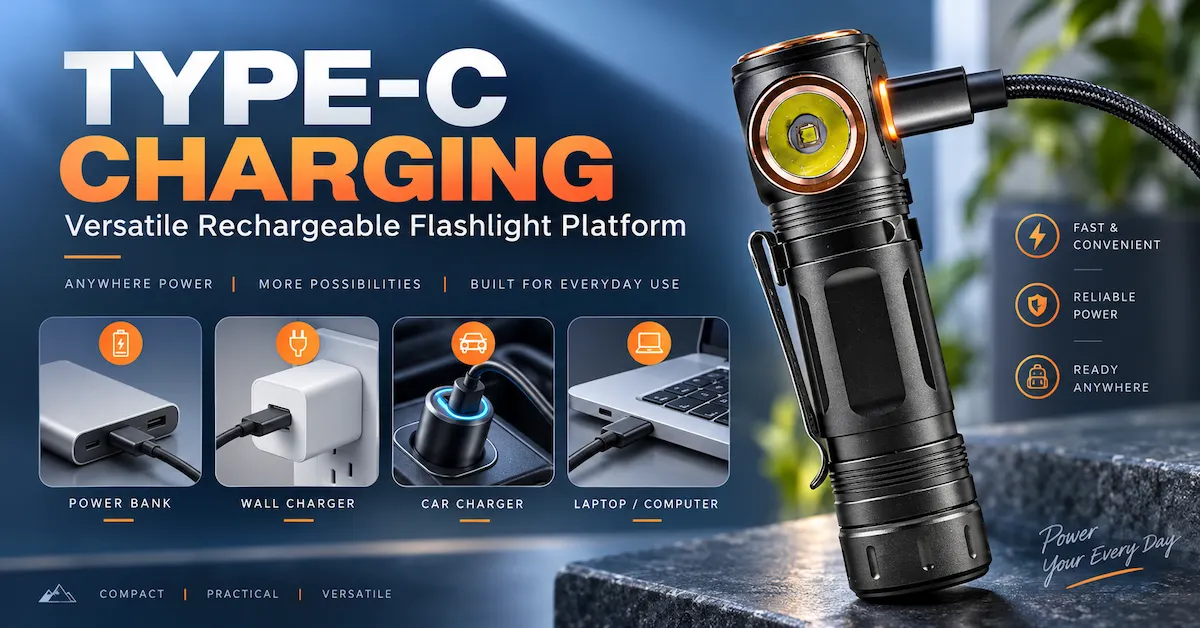
An omitted wall charger shifts a decision back to the buyer: what equipment will customers use? For field 15, list the required combinations of cable and supply. If that includes USB-C-to-USB-C, name it explicitly. For charge time, the useful details are the starting battery state, supply and end signal. Use while charging remains a separate choice.
Controls and mounting deserve a practical trial
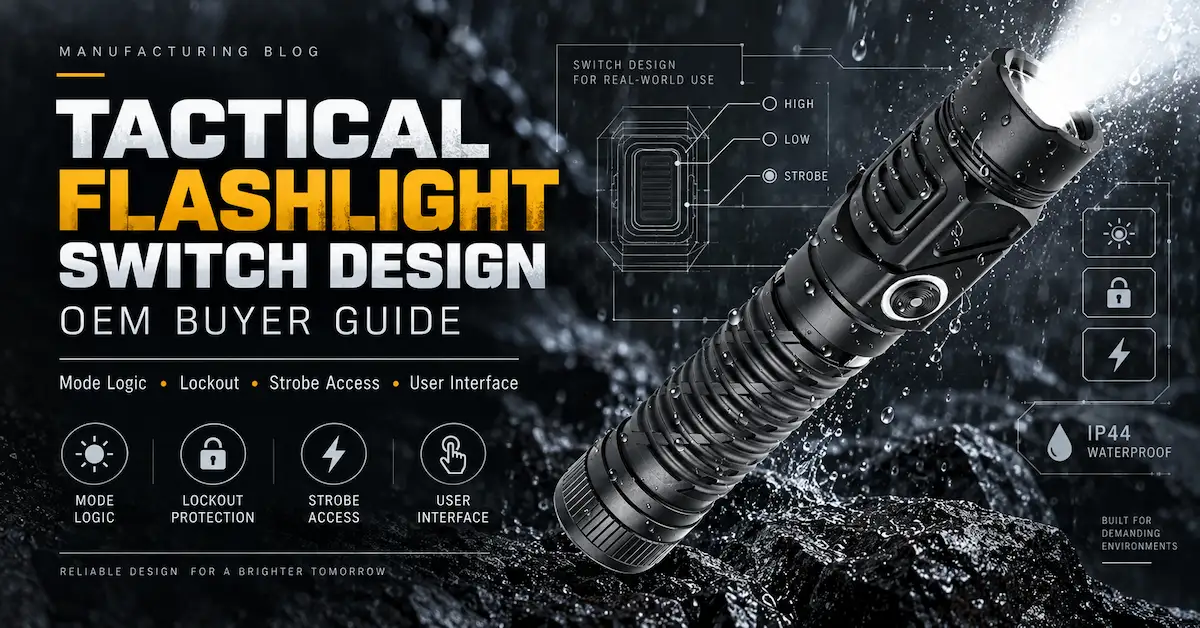
A control diagram can expose a problem before tooling is discussed. Perhaps a buyer wants the light to start on low, yet the reference sample remembers its last mode. Or a strobe command shares a button used with gloves. These are choices to settle in the sequence, then try on the sample. Mounting needs the same practical attention: surface, angle, attachment and load all belong in the agreed check.
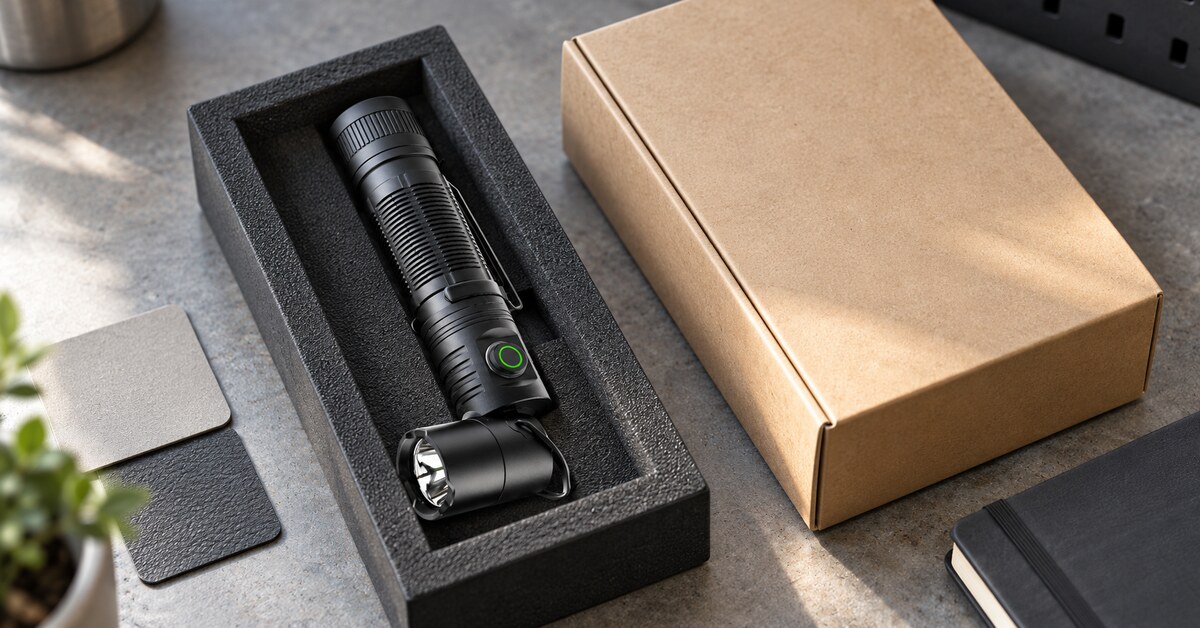
Read the inclusions before comparing prices
Suppose two suppliers return a price for the same custom flashlight spec sheet. One includes the battery, printed pack and sample checks; the other includes only the light. In this hypothetical comparison, those inclusions matter before either unit price does. The return format below records them and the one-time work.
| Quote item | Ask the supplier to state | Check before comparing |
|---|---|---|
| Finished unit | Model, approved configuration, quantity, currency and price basis. | Same battery, modes, finish and accessories. |
| Branding and packaging | Included artwork work, processes, pack contents and setup charges. | One version or several; proofs and language scope. |
| Development and tooling | One-time charges, ownership terms and changes covered. | Existing platform modification versus new tooling. |
| Samples and validation | Sample costs, test scope, report access and approval stages. | Prototype evidence versus production-build evidence. |
| Schedule and delivery | Milestones, start trigger, delivery terms and freight exclusions. | Does the quoted clock start at deposit or sample approval? |
| After-sales terms | Coverage, claim documents, remedy and who pays associated costs. | The route from a reported failure to a decision. |
A proposed cell change is worth more than a note saying “equivalent.” It may touch size, charging and documents as well as price. The buyer needs those linked effects in the reply. Once accepted, the alternative becomes part of the sheet, not an exception buried in correspondence.
Build an approval trail from your flashlight OEM specification template
A report is most useful when its identifiers lead back to the light being ordered. Model, revision, sample details, method and date are the starting points. A battery or enclosure mismatch is a question for the responsible reviewer, who needs to determine whether that evidence supports the order.
A scratched finish and a light that will not charge need separate defect definitions. The inspector also needs a decision rule for the lot. ISO 2859-1:2026 provides the reference for attribute sampling plans indexed by an acceptance quality limit. The quality team selects the defect classes, inspection level and plan. Using such a plan does not establish that every unit is defect-free.
A transport test starts with the package and route. A retail box inside a master carton and an individual parcel are different test configurations. ISTA's procedure guidance separates screening from simulation tests; its 3A overview describes individual packaged products for parcel delivery within its stated weight scope. The selected procedure needs to fit the intended shipment.
These are method references, not Brightenlux certificates or proof of a product passing a test. Any claim for a listing, label or instruction needs evidence for the relevant build.
By production release, the approved sample should have a trail to the bill of materials, drawings, controls, artwork and packing files. Retained sample IDs support later comparisons. A repeat order can cite the accepted flashlight OEM specification template revision. A proposed substitution goes back through approval instead of silently becoming the new reference.
FAQ: filling out your RFQ
1. Which blanks can remain open at the first RFQ?
Items awaiting advice can stay open, provided the price states an assumption. Two battery options, for instance, can have separate prices. Selection comes before production release, when the build and acceptance checks need an approved reference.
2. Is a logo-only order covered by this worksheet?
The worksheet can be limited to the changes being ordered. With a logo-only project, the existing model or sample stays as the base reference. Field 27 carries the mark, process and artwork proof; field 28 covers any pack changes.
3. Who signs off a flashlight OEM specification template?
Purchasing checks scope, engineering checks the build, and quality checks acceptance. One named owner collects those approvals and resolves open points.
4. Two suppliers quote the same lumens. What is missing?
The number may describe only a maximum. For sustained use, the buyer needs the output curve and beam, not just that peak. Mode, battery and test conditions belong beside it; included accessories belong in the price comparison.
5. Where do mAh and Wh belong on the sheet?
As a hypothetical calculation, 3,000 mAh is 3 Ah, and 3 Ah × 3.6 V gives 10.8 Wh of nominal energy. The numbers illustrate the units; they are not a Brightenlux rating. Field 13 needs the actual voltage, capacity, energy and rating basis from the supplier.
6. What if we will not include a wall charger?
Then field 16 should say so, while field 15 names the cable-and-supply combinations you require. The customer-supplied equipment question is still part of charging compatibility. Those combinations can be checked during sample review.
7. Can I leave the request at “waterproof”?
In field 25, decide on a required exposure or rating, then describe the configuration and use limits. Whether the charging-port cover is closed, for instance, should be recorded. The supplier's evidence needs to identify the build it supports.
8. Where should the supplier put its MOQ?
Beside field 4's quantities and variants, including separate conditions for special finishes or printed packs. The entry records the supplier's proposed terms, not a universal Brightenlux minimum.
9. Which report details connect it to my variant?
Model identifiers and the tested configuration are the first link. Differences in battery, electronics or enclosure need assessment against the report's scope. The responsible reviewer decides whether that evidence can cover the variant being ordered.
10. Should artwork go into the first inquiry?
Available artwork and pack files help define the work being priced. Attach them with the sheet, quantities by variant, target markets and reference product. If the files are unfinished, label their status and name the sample stage needed.
Conclusion
Before sending the sheet, read across the open rows. Can a supplier tell whether you want advice, an alternative price or a firm requirement met? The flashlight OEM specification template can then go to Brightenlux with your product reference, quantities, target market and customization files. Ask that the reply cite the sheet's revision and identify any deviations.