

A custom outdoor lighting supplier for brands should do more than print a logo on a catalogue product. The commercially useful role is to help a brand specify a coherent family of portable lights, decide which functions customers will actually value, compare achievable product platforms, approve samples and documentation, and reproduce the same agreed configuration at reorder. That process connects product strategy, engineering evidence, packaging, manufacturing quality control, and wholesale economics before the first shipment.
For an outdoor retail brand, the challenge is rarely the absence of another flashlight. It is the difficulty of making a flashlight, hands-free headlamp, and area-lighting lantern feel like parts of one reliable product range while keeping batteries, charging instructions, technical claims, accessories, and after-sales processes manageable. This guide presents a practical development framework for importers, private-label companies, tool and camping distributors, and brand product managers. It uses publicly documented Brightenlux portable-lighting products as starting references, not as evidence that every custom feature or combination is already available.
Explore Brightenlux Outdoor Lighting Discuss an OEM/ODM Brand Program
1. What Should a Custom Outdoor Lighting Supplier Actually Deliver to a Brand?
The first deliverable is a decision-ready product brief, not a quotation. A useful supplier can turn buyer requirements into a documented discussion about available platforms, engineering changes, costs, sample approval, quality evidence, and shipment preparation. The buyer still owns its market positioning, customer research, final claims, and commercial decisions; the supplier contributes product and manufacturing information that makes those decisions feasible.
There are three distinct sourcing paths. A private-label program applies approved branding, packaging, and presentation to an existing configuration. An OEM configuration program modifies agreed details—perhaps accessories, modes, or battery arrangements—subject to feasibility and testing. A new ODM development may require a housing, optical arrangement, control scheme, tooling, or other engineering changes. Calling all three “custom lighting” can hide important price, timing, and approval differences.
The distinction matters when launching multiple product families. A brand may be able to start with a verified hand flashlight, add a rechargeable headlamp for hands-free use, and complement both with a campsite lantern. It should not imply that the same LED, driver, battery, ingress rating, or test document applies to all three. A common brand language can coexist with different physical architectures.
Brightenlux's Outdoor Lighting service page describes product selection, development discussions, brand customization, quality-minded production, and delivery coordination. That supports a genuine OEM/ODM conversation. The feasibility of a particular new feature, MOQ, production volume, lead time, or certification remains specific to the proposed product and must be confirmed before the brand publishes a promise.
2. Which Buyers Benefit—and Which Projects Need a Different Specialist?
The strongest fit is a company with a known sales channel and a definable end user. Outdoor retail and camping brands need clear product roles, consistent packaging, and products that match common activities. Industrial or tool distributors may want magnetic mounting, focused task lighting, gloves-friendly switches, and practical spare accessories. Private-label e-commerce brands need differentiating photographs, accurate product specifications, consolidated inventory, and fewer avoidable returns. Importers and regional wholesalers prioritize repeat-order consistency, controlled cartons, documentation, and predictable quotations.
A fleet, emergency-kit, or corporate procurement program may also need a controlled bill of materials and a replenishment plan. For these buyers, the lamp can be only one element of a larger kit, so item identification and accessory inclusion may matter as much as peak brightness.
Some projects are not appropriate to approve from a general portable-light catalogue alone. Intrinsically safe or explosion-protected equipment, certified fire-service or mining lamps, regulated road-bicycle headlamps, medical devices, and precision machine-vision lighting require their own specialised engineering and proof. A normal rechargeable flashlight should not be marketed for those functions without model-specific evidence.
A useful first enquiry states three things: the real user, the working environment, and the role of the light. “A compact magnetic lamp for routine equipment checks in a service van” is actionable. “A premium flashlight for everyone” is not.
3. Start With a Brand Promise, Not a Collection of Similar SKUs
A brand portfolio developed with a custom outdoor lighting supplier for brands needs a consistent reason to exist. That reason might be lightweight convenience, dependable backup power, hands-free service work, or comfortable campsite illumination. Once the promise is clear, technical features can be chosen to support it. Without this order, an importer may end up with six products whose specifications overlap but whose packaging and batteries are inconsistent.
Consider three illustrative brand strategies. These are market-planning examples, not claims about Brightenlux customers:
- Trail & Camp: compact carry light + wearable headlamp + lantern with comfortable area illumination; priority on weight, useful low modes, hanging convenience, and accessible charging.
- Workshop & Utility: adjustable-head or magnetic flashlight + hands-free headlamp; priority on attachment stability, beam placement, rugged controls, and straightforward tool-kit packaging.
- Preparedness & Home Backup: dual-power flashlight + battery-operated or rechargeable lantern; priority on user instructions, long storage routines, battery replacement options, and easy identification of included parts.
Each range gives every product a specific user job and price position. A premium SKU should offer a meaningful improvement—such as a different power architecture or mounting solution—not merely a larger number printed in gold on a box. An accessory model should not repeat the flagship's job unless there is a valid channel or size difference.
For SEO and product taxonomy, this also produces more understandable pages: LED flashlights for directional tasks, headlamps for wearable lighting, and camping lights for general area illumination. These categories should connect through buyer use cases rather than competing for one generic phrase.
4. Translate Customer Scenarios Into a Brand-to-SKU Architecture
Instead of selecting the cheapest model in each category, build a matrix connecting activity, light format, functional differentiator, price tier, and evidence requirement. This one-page decision tool helps sourcing, marketing, and quality teams make the same trade-offs.
| Brand Range / Customer Job | Useful Product Format | Differentiator Worth Testing | Buying Decision to Resolve |
|---|---|---|---|
| Short hikes and travel kits | Compact rechargeable flashlight | Carry size, low-mode usefulness, USB charging | Battery inclusion, weight, runtime evidence |
| Campsite setup after dark | Rechargeable headlamp | Headstrap fit, beam spread, controls with gloves | Comfort, switching logic, moisture evidence |
| Equipment inspection and repair | Adjustable or right-angle magnetic flashlight | Hands-free positioning and fixed beam angle | Magnet/clip retention, work-surface compatibility |
| Family camping and picnic | Area-lighting lantern | Warm/cool white modes and stable placement | Diffuser uniformity, battery approach, accessories |
| Home preparedness | Dual-power portable light or lantern | Backup-battery availability and instructions | Storage procedure, included cells, shelf strategy |
| Premium outdoor bundle | Coordinated flashlight + headlamp + lantern | Clear roles and consistent ownership experience | Packaging, claims, charging differences, reorder tracking |
This matrix is intentionally application-led. It should not be read as a guarantee that one factory already produces every configuration listed. The buyer must obtain an actual quotation and sample for each candidate.
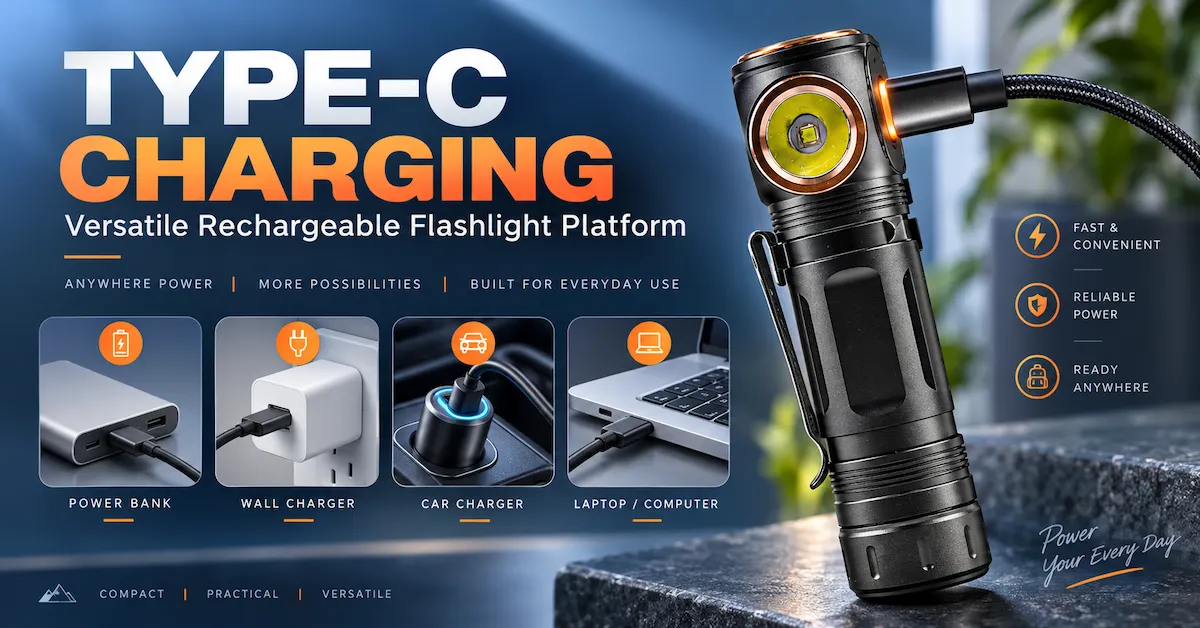
For example, a brand that wants a “one-cable” story should verify the charging input and C-to-C behaviour of each chosen product. A Type-C socket by itself does not establish USB Power Delivery, universal fast charging, or identical charging times. If one item runs on replaceable D batteries, the brand should explain that difference openly rather than make a misleading uniform-charging claim.
5. Verified Brightenlux Platforms That Can Anchor a Custom Range
A credible product-development article needs concrete references. The following are manufacturer-published specifications for specific products, not independently measured performance results and not promises that every modification is possible. The relevant detail is how each platform could play a different role in a proposed assortment.
| Official Brightenlux Product | Published Product Configuration | Potential Role in a Brand Program | What the Buyer Must Verify |
|---|---|---|---|
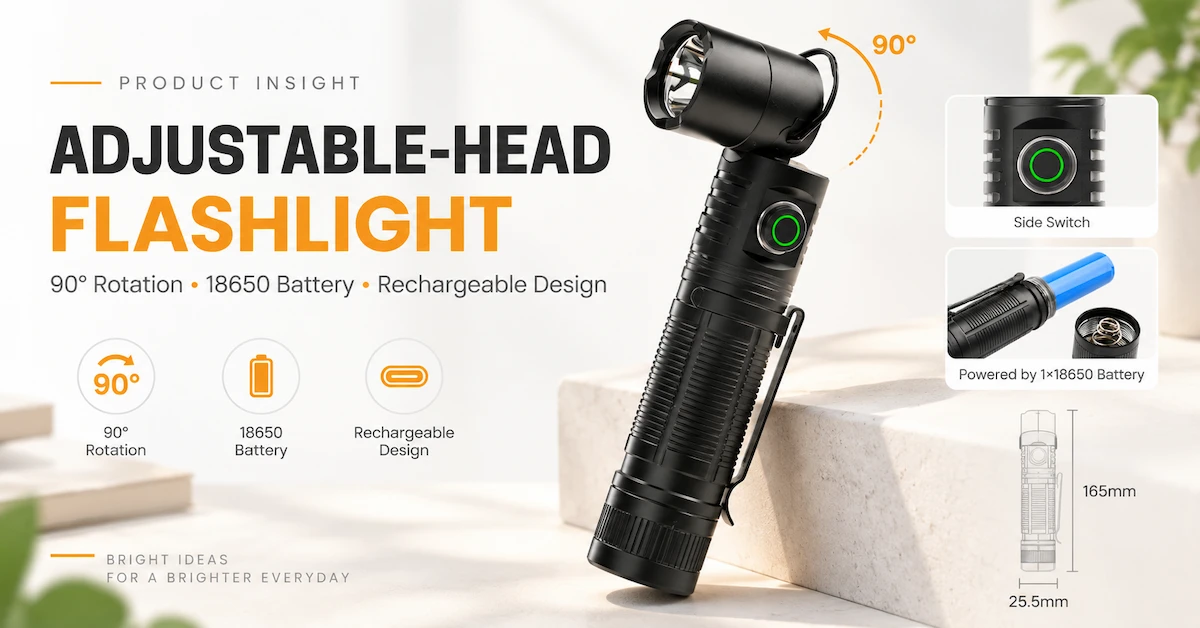
| 1000 lm SST40 adjustable-head flashlight | SST40, Type-C recharge, magnetic tail, adjustable head; 18650 battery platform described on website | Workshop/utility task light | Pivot durability, working modes, battery and accessories in the quoted version |
| BT-FL8088 1500 lm flashlight | SST40, included 21700 4000mAh, Type-C, magnetic tail, IPX4 listing | Feature-led outdoor or repair flashlight | Output by mode, IP report, magnet hold, charging and thermal behaviour |
| BT-HL9040 800 lm LED headlamp | OSRAM P9, 18650 2200mAh included, Type-C, white/red side modes, IP44 listing | Focused hands-free headlamp | Strap comfort, battery pack-out, beam fit and rating evidence |
| BT-HL9105C COB sensor headlamp | XTE + warm/cool COB, sensor, included rechargeable 1100mAh or 3 AAA, Type-C, IP67 listing | Multi-mode / hybrid-power headlamp | Actual sample weight, mode logic, alternate-power operation, IP documents |
| BT-PL4030 1000 lm camping lantern | 3 × D cells not included, warm/cool/natural white, dimming, IP44 listing | Replaceable-battery family camping lantern | Runtime by mode, D-cell pack-out, diffuser and hanging stability |
| BT-PL4031R 2000 lm camping lantern | COB, 3 × 2200mAh cells, five listed light modes, dimming, power-bank function, IP44 listing | Premium rechargeable campsite lantern | Sustained output, real power-bank behaviour, complete pack-out and IP evidence |
Two cautions are particularly important. First, the BT-HL9105C page contains inconsistent weight statements, so its weight should be resolved from a measured production-intent sample before use on retail packaging. Second, maximum output and runtime on a product page must not be treated as a promise of sustained maximum brightness; a buyer needs the test method and selected operating mode.
This is where a custom outdoor lighting supplier for brands adds value: not by saying every model is “top quality,” but by helping the buyer compare actual formats, distinguish verified claims from marketing descriptions, and select platforms for sampling.
Compare Brightenlux Products Request Brand-Specific Model Recommendations
6. Build a Technical Specification That Can Survive the Packaging Stage
When briefing a custom outdoor lighting supplier for brands, a marketing team may want simple benefit statements, but the underlying engineering requirements must be precise enough for a sample, a test report, and a repeat order to describe the same product. Avoid accepting an RFQ that says only “high lumen, waterproof, long battery life.” Each adjective needs a measurement or use-case definition.
Light output, intensity and beam shape
Lumens measure emitted luminous flux; they do not describe how far a beam reaches or how evenly it lights a campsite. Candela and beam distribution help explain focused directional light. A lantern should also be evaluated for diffuser glare and useful area illumination. A headlamp requires comfort and controllable near-field light. Comparing a 2000-lumen lantern directly with a 1500-lumen flashlight as though they perform the same task is misleading.
For portable-light performance claims, the ANSI/PLATO FL 1-2025 Flashlight Basic Performance Standard describes uniform reporting methods for light output, beam distance, peak beam intensity, runtime, impact resistance, and water/dust protection. It is a credible technical reference for writing a test request. It does not mean Brightenlux's published products are certified under that standard merely because they are mentioned beside it.
Power configuration and controls
State the exact battery format, nominal capacity, whether it is included, charging connector, proposed cable, mode sequence, low-battery indication, and nominal operating conditions. If a product is offered with rechargeable and disposable-cell options, describe the method of switching power sources and exactly what ships in the retail pack.
Mechanical and environment requirements
Define dimensions, mass with the included battery, material and finish, strap or magnet requirement, enclosure exposure, and any necessary test evidence. An IP44 or IPX4 listing cannot be presented as universal submersion protection. Always link the claim to a specific model and configuration.
| RFQ Specification Field | Buyer Should Specify | Supplier Should Return |
|---|---|---|
| Target job and user | Handheld inspection, camping area light, hiking headlamp | Proposed platform and intended limitations |
| Optical performance | Usable beam shape, modes, and test priority | Model-specific output/beam data and test method |
| Energy system | Rechargeable, replaceable, or hybrid; runtime target | Exact battery, cable, charger requirements, mode runtime |
| Controls | Simple switch, sensor, red mode, memory | Verified mode sequence and user instructions |
| Enclosure and mounting | Splash exposure, magnet, clip, strap, hanger | Drawings and relevant mechanical/IP evidence |
| Pack-out | Logo, carton, cable, cells, inserts | Itemised kit manifest and packaging sample |
| Market documents | Selling countries and applicable product claims | Relevant scope, report, issue date, and any limitations |
| Production control | Target order, variation allowance, golden sample | Revision-controlled specification and QC plan |
The buyer should distinguish must-have requirements from desirable upgrades. A higher-priced optical component is not automatically worthwhile if the customer primarily needs a comfortable low mode. Conversely, a cheap charging circuit is no bargain if it increases returns and reputation risk.
7. Decide on Battery Families Before Advertising a Unified Brand Experience
Cross-category lighting brands often want their products to look and feel related. That ambition can become expensive if it leads to a claim that every lamp has identical batteries, charging speed, or runtime. Brightenlux's public platforms already show meaningful differences: 18650- and 21700-based flashlights, rechargeable/AAA hybrid headlamps, a D-cell camping lantern, and a multi-cell rechargeable lantern.
A useful architecture is to standardise the customer-facing process where technically practical, while accurately describing product differences. For example, the brand might make battery inclusion obvious on every package, use consistent charging warnings, supply a complete accessory list, and place operating modes in the same section of each manual. Those are scalable rules even when batteries are different.
The buyer should answer: Do customers charge at home, in a vehicle, or at a campsite? Are spare cells available in the target market? Does the product need to remain usable after months of storage? Is a power-bank feature genuinely valuable for the intended user? Who replaces a damaged cable or worn headstrap?
Do not infer runtime from milliamp-hours alone. The LED, driver efficiency, selected mode, output regulation, temperature, and cell condition all affect useful operating time. For a practical range, ask for testing at at least one realistic medium or low mode, not only the brightest setting. Where a device advertises power-bank output, verify how that changes the lighting reserve and what cable/interface the output actually supports.
Lithium transport is a separate workstream. The UN Manual of Tests and Criteria, Part III, subsection 38.3 provides a relevant testing framework for lithium cells and batteries transported under applicable dangerous-goods provisions. Request the evidence relevant to the shipped battery, assembly, route, and current transport rules. A factory statement of “rechargeable” is not sufficient shipping documentation.
8. Materials, Optics, and Workmanship: What a Brand Can Sensibly Customize
Customization should begin with customer value, not decoration. A black anodized housing, a distinctive accent color, or a premium package may help recognition, but the product must still work, charge, attach, and withstand its intended environment. Some changes are relatively straightforward presentation decisions; others can alter safety, thermal performance, optical output, or the validity of a previous test.
A flashlight's reflector, lens, LED, driver, housing, and switch form one functional system. Changing the LED designation without checking the optic and thermal path may alter beam quality. A headlamp adds a headband, mounting angle, weight balance, and skin-contact considerations. A lantern adds diffuser geometry, standing or hanging stability, broad light distribution, and sometimes multiple color temperatures.
The official Brightenlux product pages describe materials such as aluminium, ABS, PC/PMMA, and TPR on selected models. Those are model-level construction details, not proof that every product uses the same grade or passes the same impact, chemical, or water-resistance test. Ask for the exact production bill of materials where the material affects performance or marketing claims.
A new logo panel or texture may be cosmetic; a new switch boot or charging-port cover may change sealing. A new strap supplier may affect comfort and retention. New packaging dimensions may affect shipping damage. For every customization request, record whether it requires just artwork approval, sample rechecking, or a full engineering validation. This simple classification prevents the artwork team from inadvertently authorizing an untested design change.
9. Three Customization Levels—and Why They Need Different Quotes
A buyer should request a quotation by development level so that “OEM service” does not become an unbounded promise.
| Program Level | Typical Requested Work | Approval Needed | Typical Commercial Question |
|---|---|---|---|
| Level A: Private label | Logo placement, printed instructions, retail carton, barcode, accessory presentation | Artwork and pack-out proof on an approved existing build | MOQ for logo and print version? |
| Level B: Configuration adaptation | Agreed light modes, cell/charging choice, strap or clip, optics or accessory changes | Revised engineering sample, affected tests and specifications | Which changes are feasible without new tooling? |
| Level C: New ODM platform | New enclosure, new optical or control design, tooling, specialized mount | Design reviews, prototypes, test plan, pilot build and release | Who owns tooling and how are development milestones billed? |
A quotation should identify what is included, what is optional, what requires tooling or test expense, and what is not currently feasible. Nothing in a general product-family page guarantees a specific MOQ, a fixed sample charge, or immediate availability of a proposed new design.
For most brands entering a new category, a realistic starting approach is to approve one or two existing platforms first, then reserve engineering changes for the functions customers can clearly recognise and value. This is a commercial recommendation, not an assertion that existing platforms always cost less over the full lifecycle.
10. Make Packaging a Product-Specification Control, Not a Last-Minute Graphic Task
For a custom outdoor lighting supplier for brands, the retail carton is where a technical claim becomes a promise to customers. It must agree with the purchased configuration, the manual, the product label, and the supporting evidence. A logo approval does not verify lumen output, water resistance, charging compatibility, or included accessories.
Create a claims-to-evidence matrix before artwork design. Each statement—“1500 lumens,” “IPX4,” “USB-C rechargeable,” “battery included,” “warm and cool light,” or “power-bank output”—should point to the exact approved product revision and proof or supplier record. If evidence is pending, the wording should not go to print.
An effective brand system may use the same tone of voice, product photography conventions, icon style, technical table layout, and colour hierarchy across flashlight, headlamp, and lantern boxes. Yet it must present the different user jobs clearly: focused beam versus hands-free light versus campsite area illumination.
Retailers also need a stable barcode and SKU structure; e-commerce teams need accurate dimensions, product weights, compatible accessories, and realistic lifestyle photographs. Use photograph captions that describe the exact device rather than an imagined model. Never add a certification mark merely because the template already includes a blank space for it.
For a coordinated outdoor kit, a useful pack-out record might include one specified flashlight, one headlamp, the agreed cable or cables, the correct number of cells, relevant straps or hanging attachments, separate instructions, and the retail carton revision. Every item should be checked against the quote. Do not assume a battery or strap shown on a product page is included in every custom pack unless the contract confirms it.
11. Use a Seven-Gate Approval Process From Brief to Repeat Order
A custom outdoor lighting supplier for brands is most valuable when the project has clear decision gates. These gates tell the buyer when a design is ready to advance and what happens when a requirement changes. The following sequence is a proposed collaborative workflow, not a claim that Brightenlux publishes this exact internal procedure.
Gate 1 — Brand brief approved. Define the customer, markets, channel, target price position, acceptable feature trade-offs, approximate quantities, and intended launch period. Assign an owner for engineering decisions and an owner for marketing claims.
Gate 2 — Platform feasibility confirmed. Compare actual existing models, identify gaps, and obtain supplier feedback on any proposed adaptations. Record unavailable requirements. Do not proceed with a product that meets only the photograph but not the actual use case.
Gate 3 — Engineering sample accepted. Test beam, controls, charging, runtime, fit, materials, and relevant environmental conditions on the intended configuration. Record findings and agreed corrections. Approval includes limitations, not only strengths.
Gate 4 — Claims and artwork frozen. Match the sample, product specification, packaging text, battery inclusion, labels, manual, and target-market documents. Store the approved files under a controlled revision.
Gate 5 — Pilot or pre-production verification. Where appropriate to risk and order size, inspect an initial production build for repeatability and pack-out consistency. Do not substitute a pilot photograph for a documented sample review.
Gate 6 — Bulk release and shipment. Agree sampling inspection, critical defects, functional checks, final packing, lot identifiers, and shipment documents. Resolve deviations before release rather than after container loading.
Gate 7 — Reorder and field-feedback review. Capture returns, user complaints, mounting wear, battery issues, packaging confusion, and component changes. Review whether the next shipment matches the retained golden sample and whether the product needs an approved revision.
The advantage is not bureaucratic complexity. It is that every stakeholder—design, marketing, sourcing, quality, and supplier—can see what is being approved and when. A premium product becomes commercially repeatable only when those approvals are connected.
12. Sample Testing and QC: Turn Brand Claims Into Checkable Criteria
In a custom outdoor lighting supplier for brands program, catalogue specifications can shortlist candidates, but a golden sample and agreed acceptance method determine whether a shipment is fit for the program. The buyer should define verification using actual applications. A flashlight used inside machinery should be evaluated for beam placement and magnet retention. A headlamp should be assessed for headband comfort and control logic. A lantern should be checked for diffuser quality and stable placement or hanging.
Suggested tests include function and mode checks, charging verification, output/runtimes at defined settings, switch durability, mounting retention, fit and finish, battery identification, and carton/accessory reconciliation. Environmental testing should be specified only to the extent relevant to the application and the claims made. A splash-resistant consumer light does not become a certified industrial hazard lamp through a general drop test.
IEC 60529, Degrees of protection provided by enclosures (IP Code), is a relevant framework for checking model-specific solid and water ingress claims. An IP value on a website is not independent evidence until the corresponding test scope and configuration are established. Similarly, the revised ANSI/PLATO FL 1-2025 framework can guide performance measurements for appropriate portable lighting but must not be misrepresented as an approval already held by every Brightenlux model.
A practical QC discussion should also cover incoming LEDs, batteries, lens assemblies, switches, charging boards, seals, straps, and packaging. Ask how critical components are identified, what substitutions require buyer approval, and how production defects are recorded. For finished goods, establish the inspection sample plan and who decides whether a failure is critical, major, or minor.
One significant rule: a change to the battery, driver, optic, LED bin, sealing component, or other performance-critical part may require retesting even if the external product appearance remains unchanged. The final approval should attach to a controlled revision, not simply a marketing product name.
13. Certifications, Market Documents and Claims: Separate the Evidence
Outdoor lighting exporters and their customers often confuse four different questions: Does the product function? Has it been tested for a named attribute? Does it meet the applicable market obligations? And may the buyer make a particular advertising claim? The answers are related but not identical.
For example, an ingress-protection test under an appropriate IEC 60529 method concerns a defined enclosure property. It does not automatically establish every electrical, battery, road-use, transport, or chemical requirement. A factory audit concerns the site and a defined audit scope. It does not certify every SKU. A CE-related claim must be tied to the actual applicable EU legislation, responsible economic operators, and supporting assessment—not applied indiscriminately to the entire catalogue.
Identify the destination market before selecting packaging marks. Ask which declarations, laboratory reports, battery documents, manuals, labels, and traceability records are needed for the specific product. For lithium products, review current transportation requirements with the responsible shipper and appropriate professionals. The supplier should provide accurate records for its part of the chain; the importer must also perform its own market-entry responsibilities.
For content marketing and AI search, the safest presentation is specific: “This model's published product page lists IPX4; request the applicable test evidence for the quoted production configuration.” Avoid sweeping claims such as “all products are certified to every international standard” or “fully waterproof in all weather.” Technical clarity is a stronger brand asset than inflated adjectives.
14. Calculate Total Landed Brand Cost, Not Just Ex-Factory Price
A custom outdoor lighting supplier for brands should make a product commercially assessable, but no supplier can responsibly promise an identical landed cost across markets without knowing the order, packaging, freight route, and trade terms. Buyers should compare complete programs rather than bare-unit prices.
A useful planning formula is:
Delivered program cost = Lighting products and included batteries + Accessories + Branding and packaging + Sample/tooling/test allocations + Freight, insurance and duties + Inspection and distribution handling.
Then evaluate expected lifecycle costs from your own evidence: returns, replacement cables or straps, warranty processing, parts availability, and customer-service time. Do not invent a failure rate or claim a fixed percentage saving from switching manufacturers.
Ask for a breakdown by standard platform, private-label version, and engineered change. An apparent price premium may reflect an included cell, an extra strap, a better packaging insert, or required documentation. Conversely, a low quote may exclude the very accessories that make a retail SKU usable.
Cross-category programs also carry range-level costs: multiple print versions, additional barcodes, photography, multilingual manuals, sample logistics, and inventory holding. Brands can keep these costs visible through a master assortment sheet linking product revision, packaging revision, target channel, and committed quantity.
For a growing label, simplicity can be more profitable than a catalogue of near-duplicate variants. But that is a hypothesis to check against your actual demand, gross margin, return data, and logistics structure—not a universal economic law.
15. MOQ, Capacity and Lead Time: Get Commitments at Configuration Level
Minimum order quantity can change with branding, packaging, colour, accessory selection, new tooling, and destination-market documentation. Sample lead times can differ from production lead times. A factory's general scale or years of experience does not establish current capacity for a newly designed headlamp or a custom carton.
Separate the timeline into requirements review, platform selection, sample production, sample approval, artwork confirmation, component procurement, production, final inspection, and shipment preparation. Ask which stages can run in parallel and which depend on formal approval. If a brand is ordering three categories, request an individual milestone path for each and then a realistic consolidated dispatch plan.
Brightenlux's company introduction describes a manufacturing business in Ningbo established in 2014 and reports a factory of more than 10,000 square metres with over 150 workers. These are company-published statements, not an independent capacity audit or an order-specific production guarantee. The practical purchasing question remains: can the factory confirm the quoted build, components, inspection, and delivery plan for this purchase?
Before replenishment, require notification of significant component or design changes and agreement on whether retesting is needed. A repeat order should match the approved revision and kit manifest, not merely a similar product photograph.
16. A Buyer Scorecard for Comparing Brand Lighting Partners
Comparing a custom outdoor lighting supplier for brands with other candidates becomes easier when each answers the same questions. The scorecard below is a buyer decision aid, not an independent ranking of Brightenlux or any other supplier. Adjust weights to the risk of your product and target channel.
| Review Area | What Good Evidence Looks Like | Red Flag to Resolve |
|---|---|---|
| Brand-to-range fit | Each product has a customer job and a clear role | Many overlapping models with no positioning |
| Technical transparency | Model-specific specifications and test conditions | Vague superlatives without measurement basis |
| Customization control | Written list of feasible changes and approval stages | Every requested modification described as trivial |
| Battery and charging | Identified cell and accurate pack-out | Unclear charging compatibility or included accessories |
| Quality control | Approved sample, tests, defect rules, lot tracking | No process for component substitutions |
| Artwork and claims | Claims-to-evidence record and controlled files | Unverified marks or unsupported runtime promise |
| Commercial clarity | Itemised quotation, MOQ and milestones | One headline unit price with missing inclusions |
| Reorder support | Revision notice, complaint handling and correction path | Reorder identified only by a broad product name |
A brand should consider the cost of unanswered questions as part of supplier risk. A supplier who states that a proposed feature is not feasible without development may provide a more useful answer than one who says yes before checking the specification.
17. Send a Quote-Ready Outdoor Lighting RFQ
An effective first message gives the supplier enough context to propose real, available platforms or identify development work. It should not force the supplier to guess whether the buyer wants a trial private-label order or a completely new optical and mechanical design.
Send the following information:
- Your brand and route to market: importer, retail chain, outdoor brand, industrial distributor, e-commerce store, or corporate kit buyer; target countries and sales channels.
- End-user scenario: who uses the light, what they need illuminated, and whether they carry, wear, attach, stand, or hang it.
- Preferred product family: flashlight, headlamp, lantern, or a coordinated cross-category kit; include any relevant Brightenlux product-page references.
- Required optical and power outcomes: usable beam, preferred modes, charging method, battery inclusion, expected operation period, and mode-specific evidence.
- Mechanical and environmental needs: mounting, weight, materials, dimensions, cleaning, splash exposure, and applicable test documentation.
- Customization scope: logo, housing appearance, accessory changes, printed manual, product modes, packaging artwork, or a new ODM design.
- Packaging and logistics: retail pack or bulk pack, barcode, market language, carton quantities, shipping destination, and relevant battery transport needs.
- Commercial scope: samples, initial order quantity, expected replenishment, budget range, requested Incoterm, and target milestone dates.
- Quality and approval: sample tests, golden-sample process, required reports, acceptable substitutions, inspection plan, and defect handling.
- Next-step request: ask which requirements are already available, which are customizable, what needs development, and what is not feasible.
The supplier's reply should specify exact model names or development references, assumptions, exclusions, sample cost and schedule where applicable, pricing basis, possible MOQ, and a list of open technical questions. This makes the procurement discussion actionable and helps the brand avoid later disagreements caused by incomplete quotations.
Request a Custom Lighting Quote Review Brightenlux Company and Manufacturing Information
18. Frequently Asked Questions: Custom Outdoor Lighting for Brands
1. What is a custom outdoor lighting supplier for brands?
It is a manufacturing or product-development partner that can discuss outdoor lighting configurations, branding, packaging, engineering feasibility, sample approval, and repeat production. The useful service is not merely attaching a logo; it is helping a buyer define a product that matches a real market and can be documented and reordered consistently.
2. What is the difference between private label, OEM and ODM outdoor lighting?
Private label usually adapts branding and presentation on an existing approved configuration. OEM may involve buyer-defined changes to a production platform. ODM can involve new design work, tooling, and engineering validation. The exact commercial terminology varies, so the quotation should define deliverables rather than rely on labels alone.
3. Can one supplier coordinate flashlights, headlamps and camping lanterns?
A supplier with relevant product families can discuss a coordinated program, but each product still requires its own specifications, samples, accessories, and test evidence. Brightenlux publicly displays flashlights, headlamps and camping lanterns; buyers should confirm availability and customization feasibility for the specific combination they want.
4. Can Brightenlux customize logos, colours and packaging?
Brightenlux states that it offers OEM/ODM and private-label discussions. Specific logo processes, finishes, colour options, printed materials, minimum quantities, tooling needs and pricing must be confirmed for the quoted product version. A general service statement should not be interpreted as approval of every requested change.
5. Do all Brightenlux models use USB-C or the same rechargeable battery?
No. The public portfolio includes Type-C rechargeable flashlights and headlamps, products with different lithium-cell formats, and a D-cell camping lantern. A brand should approve the actual battery and cable included with each SKU and avoid claiming one charging architecture applies to its entire range.
6. How should I compare lumen ratings across different portable lights?
Compare the product's job and beam system, not lumens alone. A focused flashlight, wearable headlamp, and campsite area lantern distribute light differently. Ask for mode-specific output, beam characteristics, runtime method, and application tests. ANSI/PLATO FL 1-2025 provides a useful reporting framework for applicable portable-light products.
7. Can I advertise every custom outdoor light as waterproof?
No. Water-resistance claims need appropriate model-specific evidence. A listing marked IP44 or IPX4 is not a universal immersion or pressure-washing claim. If the enclosure, charging-port cover, switch, or another relevant part changes, review whether the claim and test evidence remain valid.
8. What should a brand approve before mass production?
At minimum, approve the engineering sample, key specifications, battery and accessories, packaging artwork, supported performance claims, applicable documents, inspection method, and product revision. For new ODM work, additional tooling, pilot-build, and verification gates may be appropriate.
9. How can an importer reduce repeat-order differences and returns?
Retain a golden sample, control the bill of materials and packaging revision, require notification of important substitutions, and record real customer feedback. Compare subsequent lots against the agreed product and kit contents rather than relying only on the catalogue product name.
10. What should I include when asking Brightenlux for an OEM/ODM quote?
Provide target market, application, preferred product categories, reference products, lighting and battery requirements, quantities, branding, packaging, required test evidence, and intended timeline. Ask the team to identify standard options, possible customizations, development needs, and order-specific commercial conditions through the Brightenlux contact page.
Conclusion
Choosing a custom outdoor lighting supplier for brands means choosing a way to turn a market idea into a controlled, repeatable product range. The strongest programs start with distinct customer jobs, use real product platforms as references, verify optical and battery claims, separate private-label changes from engineering development, and approve artwork only after the matching product evidence is ready. A flashlight, headlamp, and lantern can share a brand identity without pretending they share identical specifications or approvals.
Brightenlux offers a practical starting point through its publicly listed portable lighting products, outdoor lighting business services, and OEM/ODM project discussions. To explore a coordinated range, contact Brightenlux with your intended users, target markets, reference models, quantities, desired customization, and approval requirements. The goal is not simply a branded sample: it is a clearly specified product program your brand can launch, support, and reorder with confidence.
Explore Outdoor Lighting Platforms Get an OEM/ODM Brand Program Quote