

Camping Light Manufacturer Retail Range Guide: Build an Assortment Buyers Understand
A camping light manufacturer should help a retail buyer build a range that customers can understand, compare and trust. The goal is not to fill a catalog with many similar lanterns. The commercial goal is to give every SKU a clear user, price position and reason to exist. When this work happens before quotation, buyers can compare like with like, protect margin and reduce the risk of slow inventory.
This guide is written for outdoor retailers, importers, hardware distributors, e-commerce brands and private-label teams. It explains a nine-step approach for turning customer situations into a practical product ladder, choosing rechargeable or replaceable-battery formats, and connecting packaging, quality control and launch evidence into one category plan.
Brightenlux states that it has produced portable lighting products since 2014 at a factory in Zhejiang covering more than 10,000 square meters, with more than 150 workers and exports to over 50 countries. Buyers can review current product categories through the Brightenlux products page, discuss requirements through the contact page, or send project details through the inquiry page.
Step 1: Start with the Customer Situation
The first decision is not which model looks attractive. It is who the customer is, what situation the light must solve and how much explanation the sales channel can provide. A family car-camping customer, a home emergency buyer and a promotional seasonal shopper may all buy portable lighting, but they do not value the same features in the same order.
Situation-based planning is more useful than demographic planning alone. Age and income may affect merchandising, but the engineering requirement usually comes from use conditions. Ask where the light will be used, how often it will be used, what power is available and what failure would mean to the customer.
| Customer situation | Primary job | Feature priority | Common buying concern |
|---|---|---|---|
| Family car camping | Comfortable table and tent-area lighting | Broad diffusion, dimming, stable base, easy charging | Glare, confusing modes and insufficient evening runtime |
| Home emergency kit | Reliable light during outages | Stored readiness, intuitive controls, battery availability | Battery self-discharge and unclear operating time |
| Outdoor enthusiast | Versatile light for repeated trips | Durability, hanging options, weather protection, useful low mode | Weight, packing volume and weak mechanical parts |
| Value retail shopper | Affordable general-purpose area light | Simple modes, visible brightness, dependable packaging | Unclear value difference between models |
| Premium preparedness buyer | Lighting plus backup device power | Battery status, Type-C input, output power, documented runtime | Overstated capacity and complicated instructions |
Step 2: Give Every SKU a Clear Role
A strong retail range normally includes fewer, better-separated products. Each proposed SKU should have a one-sentence role. If two role statements sound the same, the items are probably too close. For example, an affordable outage and campsite area light using widely available cells is different from a rechargeable family-camping lantern with adjustable white light and emergency phone power.
Clear SKU roles make supplier communication easier. A camping lighting supplier can propose a relevant platform when the buyer explains the job, target retail price, market and expected annual volume. Without that context, the supplier can only send popular products and hope one fits.
Step 3: Build a Visible Price Ladder
Price tiers work only when the customer can see why the next model costs more. The difference should appear in the product, packaging and claim hierarchy. Adding modes that are difficult to demonstrate rarely supports a sustainable premium.
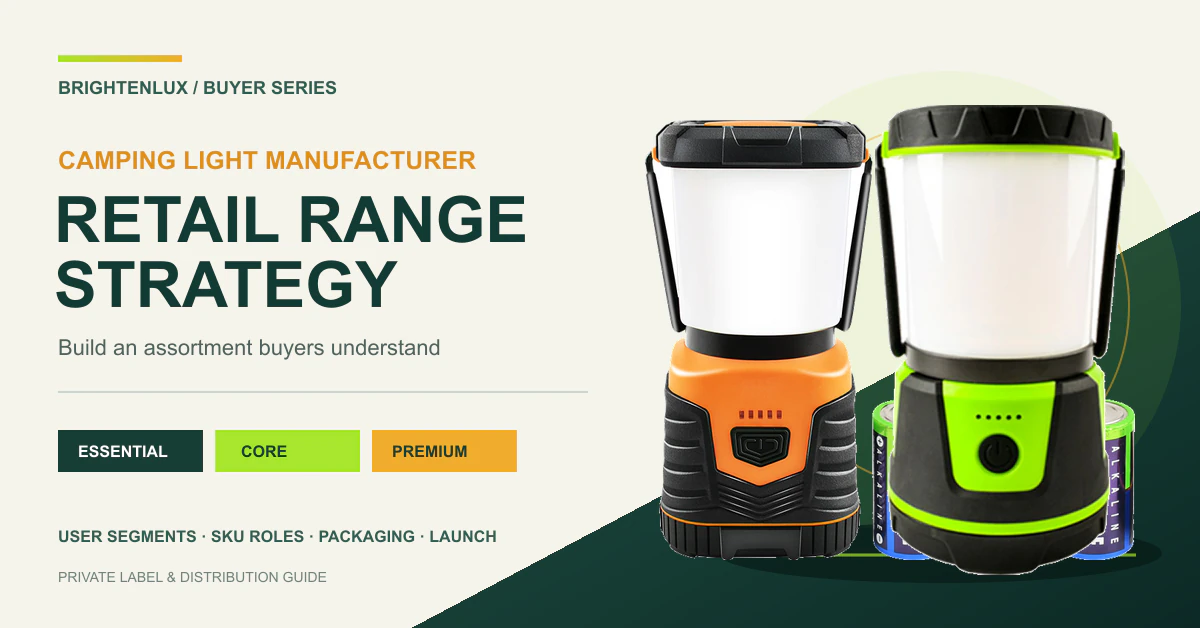
An essential SKU should be easy to understand within seconds. It may use dry batteries, provide useful light settings and emphasize broad area illumination. It should still feel complete, with a stable base, legible battery markings, clear switch feedback and protective packaging.
A core rechargeable SKU should solve the most common job with fewer compromises. Type-C charging, a visible charge indicator, a comfortable low mode and a practical handle or hook can help justify the step up. The buyer should define the included cable, charging behavior and runtime claim conditions instead of leaving those points to generic packaging text.
A premium multifunction lantern needs a complete value story. Higher output alone is not enough if it creates glare or quickly reduces runtime. A larger battery, power-bank output, better mechanical details and stronger presentation may support a premium, but claims should explain the conditions. Customers should understand that charging another device reduces the energy available for lighting.
Step 4: Choose Rechargeable and Dry-Battery Formats Deliberately
Rechargeable and replaceable-battery camping lights are not simply premium and budget versions of the same product. They create different ownership experiences, storage assumptions and logistics responsibilities.
The Brightenlux rechargeable platform is described with a maximum output of 2,000 lumens, multiple white and red modes, dimming, three 2,200 mAh lithium batteries, Type-C charging, power-bank output and IP44 protection. The dry-battery platform is described with a maximum output of 1,000 lumens, three color temperatures, dimming, three D-size cells, ABS and PC construction and IP44 protection. Requirements and claims must be confirmed for the exact order configuration and destination market.
Rechargeable products fit customers who use the light repeatedly and have predictable access to USB power. They can support visible charging features and a higher perceived value. They also require attention to cell identity, protection, transport evidence, cable specification and storage instructions.
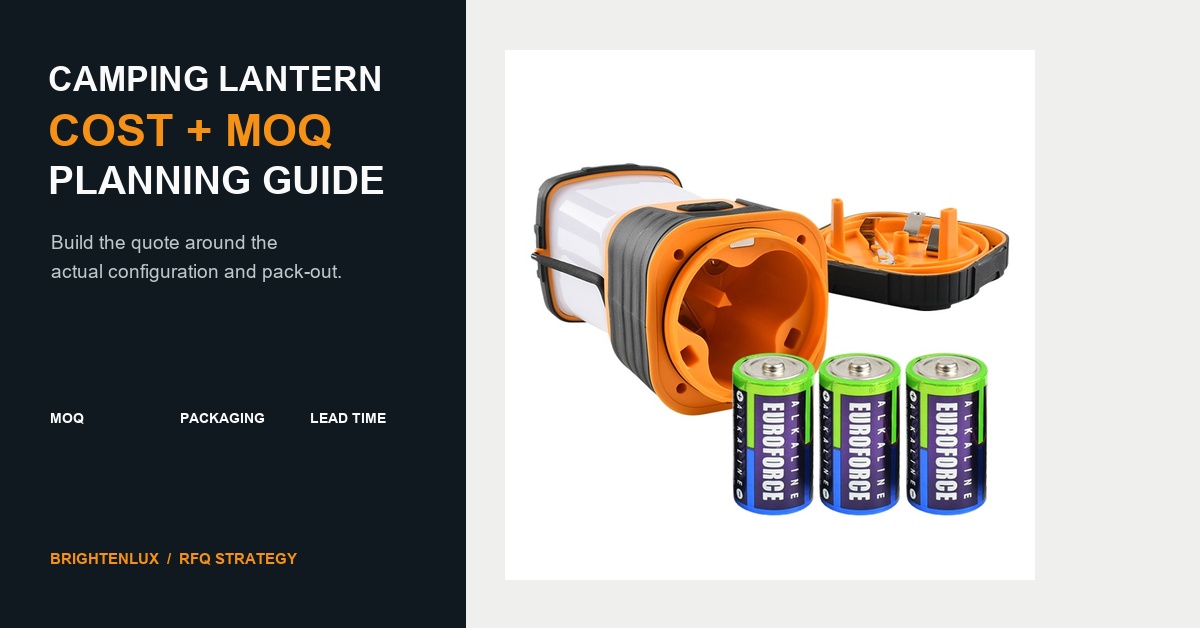
A dry-battery light fits customers who prioritize long storage, field replacement or operation away from charging infrastructure. The product story should explain which batteries are required and whether they are included. The battery door, contacts and polarity markings become critical parts of the user experience.
Step 5: Control the Feature Budget
Every feature consumes more than component cost. It can add assembly time, inspection points, packaging explanation, support questions and failure modes. Treat the target cost as a feature budget and ask the camping light manufacturer to spend it where the customer can notice the benefit.
For a family-camping lantern, a well-diffused low mode may create more value than an extra flashing pattern. For an emergency product, a clear battery indicator may matter more than decorative color options. For a value model, improving the battery door and carton protection may reduce returns more effectively than raising the peak output claim.
Buyers should ask which requested changes affect the bill of materials, tooling, firmware or validation plan. A new logo and color may be straightforward on an established platform. A revised mode sequence, different cell configuration or new charging board can require additional sample and documentation work.
Step 6: Make the Lighting Experience Easy to Demonstrate
Retail products need a demonstration story. Customers can understand broad illumination, warm versus cool light, dimming, hanging and device charging. They struggle with technical claims that lack a visible benefit.
Review the lantern at eye level on a table, above a tent area and during a dark-room demonstration. Look for glare, uneven bands and mode steps that are too close together. A product can produce a high meter reading yet feel uncomfortable if the diffuser exposes bright LED points. The best range combines measurable claims with a pleasant experience.
Mode order also deserves attention. A customer should not have to pass through an emergency strobe every time the light is switched off. Long-press dimming should behave consistently. Indicators should be visible but should not distract from nighttime use. These details influence reviews even though they may not appear in the first quotation.
Step 7: Design Packaging for the Selling Channel
Packaging performs different jobs in a store, marketplace warehouse and direct-to-consumer parcel. A hanging retail box must communicate quickly and survive handling. An e-commerce package must protect the diffuser, switch and accessories through parcel impacts. A promotional pack may prioritize carton efficiency and branding area.
Define the front-panel claim hierarchy before artwork begins. The customer should see the product type, primary use, power system and one or two meaningful benefits. Secondary details can move to the side or back panel. A crowded front panel suggests complexity and makes comparison harder.
- Control the exact product name and model number.
- State included and excluded batteries, cables and accessories.
- Match lighting modes to the final mode sequence.
- Define conditions behind output or runtime claims.
- Include charging input and output information for rechargeable products.
- Confirm barcode, carton marks, quantity and country-of-origin statement.
- Ensure instructions match the final indicators and controls.
Step 8: Protect Margin Through Specification Control
Margin is damaged when the approved product changes quietly, when claims create avoidable returns or when the sales team discounts unclear SKUs. A controlled specification is therefore a commercial document, not only a quality document.
List the model revision, materials, LED and driver information, battery or cell configuration, charging board, mode sequence, accessories, packaging version and approved appearance. Define which characteristics are critical, major and cosmetic. If a component changes, the supplier should identify the old and new part, assess the effect and obtain approval before production.
The specification should also define claim test conditions. A runtime statement is incomplete without the mode, initial battery state, ambient condition and endpoint. Broad terms should be avoided when the verified claim is specific, such as IP44. Precise language protects conversion and customer trust.
Step 9: Plan Sampling, RFQ and Quality as One Process
A range RFQ allows the supplier to see how products relate. Include a category map before individual specifications. For each SKU, provide the role, power format, preferred feature envelope, packaging direction, target market and claims that need evidence.
Sampling should close decisions in stages. A range sample compares size, light distribution, controls and price position. A customized sample confirms color, logo, mode behavior, accessories and electrical configuration. A packaging sample confirms artwork, protection, barcode, instructions and shelf presentation. A pre-production sample represents the authorized mass-production configuration, and a shipment sample can be retained as a traceable reference.
Final inspection should reflect how customers and channels experience the product. Identity, appearance, function, accessories, labels, packaging and carton marks all matter. For incoming and in-process control, focus on parts that affect consistency, including cells or contacts, LEDs, drivers, switches, charging boards, seals, diffusers and printed materials. ISO 2859-1 is an international reference for sampling procedures for inspection by attributes, but the sampling plan and acceptance limits must be agreed for the product and buyer risk.
FAQ: Working with a Camping Light Manufacturer
How many camping light SKUs should a retailer launch?
There is no fixed number. A retail chain may cover most needs with three clearly separated lanterns, while an outdoor specialist may support more because staff can explain technical differences. The key is that every SKU must have a distinct customer situation and price role.
Should a range include both rechargeable and dry-battery lights?
Both can belong when their roles are visibly different. A dry-battery model can support preparedness and value, while a rechargeable model can support convenience and premium outdoor use. The difference should be explained as a power strategy, not only as an output comparison.
What should buyers confirm before quotation?
Buyers should confirm the target channel, customer situation, SKU role, power format, feature priorities, packaging needs, claim conditions and expected order configuration. This lets the camping light manufacturer quote controlled configurations instead of unrelated catalog items.
Why is claim control important?
Unclear claims can create returns, support questions and loss of trust. Output, runtime, charging and protection statements should match the exact configuration and the conditions under which they are verified.