

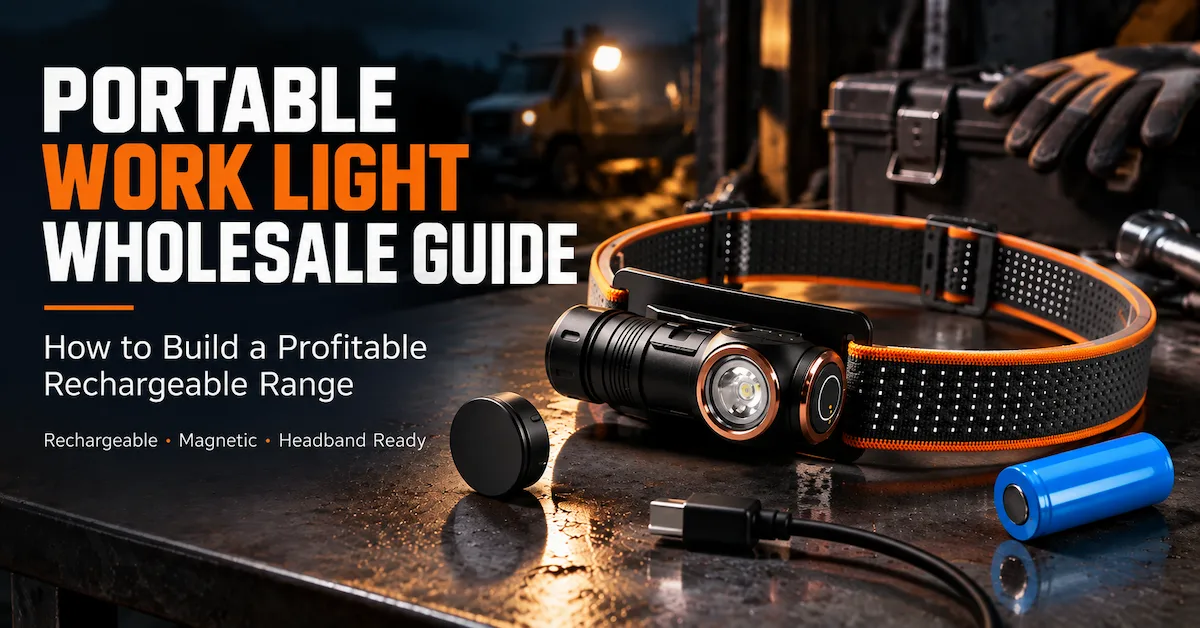
Wholesale buyers rarely lose money because a portable work light is one dollar too expensive. They lose money when the range is hard to explain, the battery configuration changes, the same-looking models overlap, or the second shipment arrives with different accessories. A successful wholesale program therefore starts before the price list. It starts with a product ladder, a channel plan and a supplier that can keep the approved configuration repeatable.
This guide is for importers, hardware distributors, automotive suppliers, tool brands, ecommerce operators and private-label teams comparing portable work light wholesale programs. It explains how to choose a useful assortment, compare rechargeable and replaceable power options, evaluate magnetic and right-angle formats, calculate landed cost, prepare an RFQ and protect replenishment. Brightenlux public product pages are used as reference points; the final model, specification, MOQ, lead time and availability must be confirmed for the actual order.
Quick answer: what makes a portable work light wholesale program healthy?
A healthy program has a small number of clearly different products, a power system customers understand, packaging that protects the light, a price ladder with enough margin, and a reorder process tied to an approved sample. The best portable LED work light supplier will help you decide which model is entry, core, step-up or specialist instead of sending ten similar lights and leaving the buyer to guess.
Wholesale is a system, not a carton count. The product must be easy for a salesperson to demonstrate, easy for a retailer to display, easy for a technician to use and easy for purchasing to reorder. Ask four questions before requesting a final quote:
- What job does each SKU perform that the others do not?
- What will the customer notice when moving up the price ladder?
- Which parts, batteries, cables or accessories can be shared?
- What evidence proves the delivered configuration matches the sample?
If the answers are clear, the range can grow. If the answers are vague, adding more products usually creates more slow stock rather than more revenue.
Build the assortment around customer jobs
A portable work light manufacturer should ask where the light will be used before recommending a body style. A mechanic may need a beam that reaches into an engine bay, a magnet that holds on painted steel and a button that can be found with gloves. A warehouse operator may need a compact light that clips to a vest. A contractor may need a broader beam, a stable base and a battery that lasts through a shift. A homeowner may value simple USB-C charging and a low entry price.
Translate each job into a range role. The role is more useful than a vague description such as “professional light.” For example, an entry model can solve close-range checks. A core model can cover daily rechargeable use. A step-up model can add capacity, stronger output or longer handling options. A specialist model can focus on right-angle mounting, red modes, a magnet or a particular inspection task.
Brightenlux's current public Working Light category shows no goods at the time of review, so buyers should request the latest catalogue and sample status. The wider Outdoor Lighting range and current portable-light platforms can still help define a brief. This distinction matters: a category page is not proof that a particular SKU is available for wholesale shipment.
A four-level wholesale product ladder
| Range role | Customer reason to buy | Useful format | Wholesale discipline |
|---|---|---|---|
| Entry | Accessible price and simple close-range utility | Compact rechargeable light or dual-power body | Keep pack contents and claims economical |
| Core | Reliable daily work and easy charging | Type-C rechargeable LED work light | Protect availability and repeat-order consistency |
| Step-up | More useful runtime, output or mounting flexibility | 21700 or higher-capacity magnetic platform | Verify battery, thermal and runtime conditions |
| Specialist | Hands-free inspection or a specific field task | Right-angle, magnetic, red-mode or clip-mounted light | Test the feature in the real work position |
A four-level ladder is not a rule that every buyer must follow. It is a way to prevent overlap. If two lights have the same body, battery, beam and pack contents, the retailer may not need both. Give each SKU a visible difference and a customer sentence: “This one is the easy daily charger; that one stays on metal; the third one lasts longer; the fourth keeps the beam where your head or clip points.”
Use Brightenlux platforms as wholesale reference points
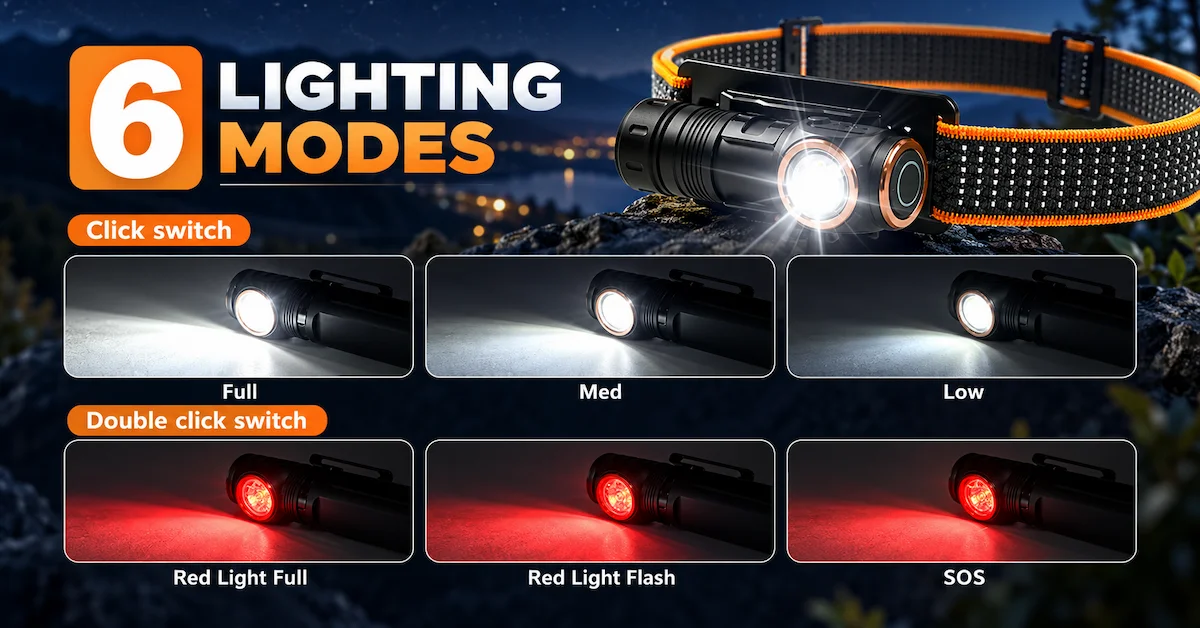
The 700-lumen compact 90-degree magnetic light is a useful reference for a small hands-free role. Its public page describes a Type-C rechargeable design, red steady/strobe/SOS functions, a magnetic tail, a head strap and a lightweight body. A buyer could position a similar platform for close maintenance, emergency kits, outdoor retail or a counter display. The final wholesale pack should still confirm battery, cable, mode sequence and available artwork.
The 1000-lumen right-angle light gives the range a stronger specialist story. The public description identifies an SST25 LED, five modes, a magnetic tail, Type-C charging, a headband and a built-in 800mAh 16340 battery. This is the kind of product that can serve mechanics, inspectors, maintenance teams and customers who need the light to stay attached while their hands work.
For a capacity-led step-up, review the 1500-lumen 21700 magnetic-tail platform. The public page lists a 4000mAh rechargeable battery, Type-C charging, multiple modes, a magnetic tail and a head strap/clip option. Those features can justify a higher range position, but do not copy the page into a quotation without confirming the exact production configuration and current availability.
Request Portable Work Light Wholesale Samples
Rechargeable versus replaceable power for wholesale
Most buyers comparing a rechargeable portable work light start with the convenience of USB-C. That is sensible, but the commercial question is broader. Rechargeable products need a stable battery, a charging board, a cable decision, clear indicators, transport evidence and a plan for warranty or end-of-life service. The retailer also needs a simple answer when a customer asks how long the light works.
Replaceable batteries can suit long-storage kits, remote sites and markets where cells are easy to buy. They can reduce the number of integrated lithium packs in a shipment, but they create their own tasks: cell type, polarity, compartment fit, customer instructions and switch protection during storage. A buyer should not treat replaceable power as automatically cheaper or rechargeable power as automatically premium.
Ask the supplier to separate these fields in the quotation:
- Battery chemistry, model, capacity and whether the cell is included.
- Charging port, cable, charger and indicator behaviour.
- Runtime at high, medium and low modes, including the test end point.
- Operation while charging, low-voltage behaviour and protection features.
- Battery replacement, warranty handling and approved alternatives.
- Shipping and documentation implications for the delivered configuration.
A cordless work light wholesale range should make the power story visible on the shelf. If one model includes a battery and another does not, use different pack language, barcode records and sales training. Confusion at the point of sale becomes returns, negative reviews and margin loss.
Magnetic, right-angle and clip features: sell the job, not the gadget
A magnetic portable work light earns its place when the customer can attach it securely to a useful surface. The specification should identify the test surface, orientation, load, sliding tolerance and whether the magnet is expected to hold through paint, vibration or a cable pull. “Strong magnet” is a marketing phrase until the use condition is written down.
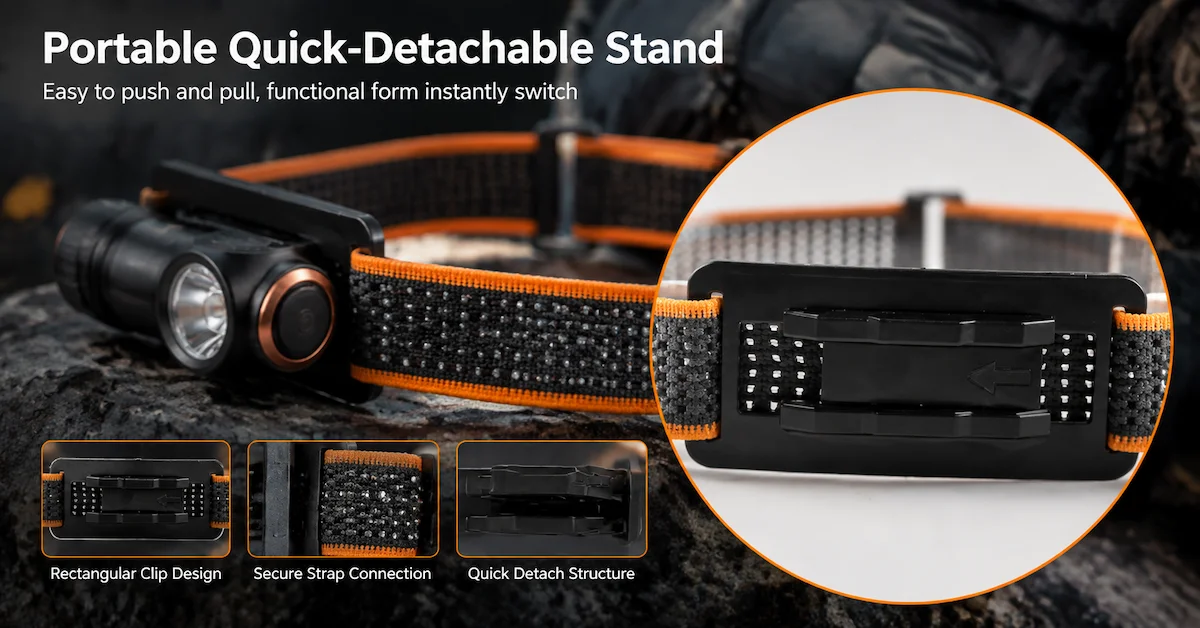
Right-angle bodies are valuable because the light can point forward while the body clips to clothing, a strap or a tool bag. They are not automatically better for every user. The angle, clip strength, headband, switch position and cable cover all affect whether a technician actually keeps the light in place. Ask for a sample trial in the intended work position.
Clip-mounted products also need a simple durability question: what happens when the clip catches on a pocket edge or is opened repeatedly? A small metal part can create a high return rate if it loosens or scratches a customer's equipment. Include clip retention, hinge cycles, magnet hold and accessory count in the inspection checklist.
Calculate landed cost instead of comparing unit price
A wholesale quote becomes useful only after the scope is normalized. Ask whether the price includes battery, cable, charger, head strap, plastic mount, logo, retail box, master carton, inspection, spare parts, tooling and the chosen trade term. Two suppliers can quote the same model name while shipping different pack contents.
Build a simple landed-cost worksheet with these lines:
| Cost line | Question to ask | Why it changes margin |
|---|---|---|
| Product and battery | Is the exact battery included and approved? | Capacity and pack-out can move the base cost |
| Branding and packaging | Is artwork, colour, insert and barcode setup included? | Small setup costs become material at low MOQ |
| Freight and duties | What are carton dimensions, battery terms and delivery basis? | Volume, route and lithium handling affect landed cost |
| Inspection and warranty | Who checks the goods and how are failures handled? | Returns and replacements can erase a low unit price |
| Inventory carrying cost | How long will the stock remain before reorder? | Slow SKUs tie up cash and shelf space |
A low quote may be sensible when the buyer wants a standard product and a simple bulk carton. It may be misleading when the brand expects private-label packaging, individual cables, a battery-included configuration and a special inspection. Write the intended delivery scope beside each quote so purchasing is comparing like with like.
Private label and OEM choices for portable work lights
A private label work light program can move quickly when the product platform already fits the customer job. Logo, colour, carton, manual and accessory presentation may be enough to create a coherent range. The buyer should still approve the actual sample and packaging because a printed logo does not control a hidden battery, driver or diffuser change.
An OEM portable work light supplier becomes more valuable when the buyer needs a distinctive geometry, a new control sequence, a different battery system, a custom bracket or a kit built around a service workflow. Those changes may require engineering, tooling, new tests and a larger commitment. Ask the supplier to split standard, configurable and newly developed items in the quotation.
For a private-label launch, provide logo files, colour references, target channel, package dimensions, language, barcode, warning statements and desired accessories. For an OEM project, add user research, work position, output targets, mounting loads, runtime, charge source, environmental exposure, sample stages and decision dates. The better the brief, the less time is spent re-interpreting screenshots.
How to qualify a portable work light manufacturer China program
Searching for a portable work light manufacturer China option can open a wide supply base, but geography is only the first filter. Confirm who owns the design, where final assembly occurs, which parts are outsourced, how incoming batteries and LEDs are checked, and who approves a substitution. A capable supplier can explain the path from sample to production without hiding behind a catalogue.
Ask for a model-specific process map. It should cover incoming inspection, assembly, charging, mode checks, optical review, mechanical inspection, pack-out and final release. If the company uses qualified partners for machining, injection moulding, batteries or PCB assembly, ask how the approved specification travels to those partners and how deviations are controlled.
Communication is evidence. A strong response identifies assumptions, flags unavailable requirements, proposes a sample stage and names the information still needed. A weak response says “no problem” to every request and leaves the conflict to production. Wholesale buyers need a supplier that can say no early when a feature, price, MOQ or schedule cannot coexist.
Packaging and channel fit
Portable lights are sold through hardware counters, ecommerce listings, tool distributors, outdoor shops, service kits and promotional programs. Each channel needs a different package. A retail box may need a strong front-of-pack benefit and a visible battery statement. A service kit may need fast identification, a protected cable and a replacement position. An ecommerce carton needs restraint and impact protection for parcel handling.
Confirm the included items: light, battery, cable, charger, headband, clip, plastic holder, instruction sheet and any spare part. The product page, carton and packing list should tell the same story. If the public category is temporarily empty, do not copy an old image into new artwork before confirming the current configuration.
Write a sourcing brief that a factory can quote
A well-written brief is one of the fastest ways to improve a wholesale result. It gives the supplier a shared picture of the customer, the package and the order instead of forcing the team to infer requirements from a product photo. Start with the commercial frame: destination market, sales channel, expected first order, annual estimate, target retail price and launch date. Then describe the user task in plain language. “Used by a mechanic during a ten-minute inspection in a dark engine bay” is more useful than “professional, high brightness.”
Next, separate must-have requirements from preferences. Must-haves may include USB-C charging, a tail magnet, a pocket clip, a minimum runtime, a specific carton size or a required language. Preferences may include a red mode, a head strap, a particular surface finish or a gift-ready insert. This distinction lets the portable work light manufacturer protect the commercial purpose when two requests conflict. It also prevents a low-value cosmetic choice from delaying a useful sample.
Give the quote a revision code and ask the supplier to return the same code on the sample label, drawing, artwork and packing list. Include a simple acceptance page with photographs of the switch, charging port, magnet, clip, beam and accessories. If the supplier recommends an alternative LED, cell, cable or driver, require a written comparison before approval. A replacement may be technically sound, but it can change runtime, colour, charging behaviour, price or regulatory documentation.
Finally, ask for a reorder calendar rather than a single promised date. The calendar should show sample approval, artwork lock, component booking, pilot build, inspection, production release and shipment. Add a buffer for battery documentation and peak-season freight. This is especially important when a buyer is comparing an LED work light wholesale supplier with a general flashlight factory: the right partner should understand that the second order is part of the first order’s value.
When a supplier can answer this brief without guessing, the buyer receives a more useful quote and a more honest lead time. When the reply only contains a unit price, the missing information will reappear later as a packaging surcharge, a delayed sample, a changed battery or an expensive correction.
Nine-step wholesale buying method
- Define the channel. Identify hardware, automotive, outdoor, ecommerce, project or promotional sales.
- Describe the user job. State the work area, distance, duration, mounting surface and handling conditions.
- Build the price ladder. Give every SKU an entry, core, step-up or specialist role.
- Choose the power story. Compare battery inclusion, charging, runtime, service and shipping requirements.
- Test the mounting feature. Check magnet, angle, clip, strap, hook, hinge and stability in the real task.
- Normalize the quotation. Align pack contents, branding, packaging, inspection, freight, MOQ and trade terms.
- Approve the range sample. Record model, revision, battery, modes, accessories, photos and open issues.
- Prepare the launch pack. Align claims, images, manuals, barcodes, carton artwork and sales training.
- Protect replenishment. Set a reorder file, change-notice rule, retained sample and inspection reference.
This method is intentionally commercial. It connects the product decision to the shelf, the customer and the second shipment. The output should be a short range plan, a normalized quote and a controlled sample rather than another unfiltered catalogue.
Send Your Portable Work Light Wholesale Brief
Questions wholesale buyers ask
How many portable work light SKUs should a first order include?
There is no universal number, but three to five distinct roles are easier to sell and replenish than a large wall of near-identical lights. Start with one entry, one core, one step-up and one specialist option when the channel supports it. Add a model only when a customer job, price point or feature is genuinely missing.
Should every wholesale model include a rechargeable battery?
No. Rechargeable products suit daily use and USB-C convenience, while replaceable-cell formats can suit long storage or markets with easy battery access. Decide from the customer, route, service plan and shelf message. Make the inclusion or exclusion of cells unmistakable in the packaging and quotation.
What makes a magnetic work light worth a higher price?
The magnet must solve a real positioning problem. A higher price can be justified when the light holds securely on the intended surface, points into the work area, survives repositioning and includes useful charging or hands-free features. Test the magnet with the surface and load that match the actual customer job.
Can a supplier customize an existing portable work light?
Often yes for logo, colour, packaging, instructions and accessories. Changes to optics, battery, controls, housing or mounting geometry require a deeper review. Ask the supplier to separate standard, configurable and newly developed work so the quote and timeline are realistic.
What should I request from a wholesale work light supplier?
Request the exact model, current availability, battery and pack contents, mode table, runtime method, mounting details, dimensions, carton data, MOQ, sample lead time, production lead time, inspection plan, warranty approach and change-control process. This turns a price request into a comparable sourcing brief.
How do I protect the second shipment?
Keep the approved sample, BOM or component description, artwork, accessory count, inspection checklist and model revision together. Require written notice before changing the battery, LED, driver, switch, plastic, cable, charger or packaging. Inspect against the retained reference rather than a new online photo.
Turn wholesale demand into a repeatable portable lighting range
The most profitable portable work light range is usually the one a customer can understand quickly. One product solves close work, another stays attached to metal, another offers greater capacity and another supports hands-free inspection. The quote, package and product page should tell that same story. A supplier earns its place when it can maintain the approved build, answer the awkward battery and accessory questions, and support the next order without starting from zero.
For a Brightenlux inquiry, send the target market, channel, quantity range, user jobs, desired price ladder, battery preference, mounting requirements, packaging, logo and timing. Review the current portable lighting catalogue and confirm which work-light platforms are available now. A precise portable work light wholesale brief gives the team enough context to recommend samples, MOQ and a realistic replenishment plan.