

A magnetic work light succeeds when it stays where the user puts it, points at the task and behaves the same way in the next production run. A strong-looking magnet in a product photograph proves very little. Holding performance changes with the steel surface, paint, orientation, contact area, lamp weight, head angle and vibration. For a buyer, the real job is to convert “magnetic” from a catalogue feature into a repeatable working condition.
This guide is written for importers, tool brands, automotive distributors, hardware chains and private-label teams selecting a magnetic work light manufacturer. It explains how to define the use case, compare magnetic formats, evaluate rechargeable platforms, write a useful RFQ, test samples and control production. Brightenlux public product pages are used as reference points. Model availability, specifications, MOQ, artwork, lead time and compliance documents must be confirmed for the exact order.
Quick answer: how should buyers evaluate a magnetic work light manufacturer?
Evaluate the complete mounting system, not only the magnet. Begin with the work surface and lamp position. Then check whether the magnetic base, housing, rotating joint, beam, battery and controls support that job. A capable magnetic work light supplier should be able to explain the proposed test surface, vertical and overhead behaviour, sliding risk, head-angle stability, battery configuration, sample stages and production inspection.
Before requesting a final quotation, answer five questions:
- Where will the light attach: bare steel, painted steel, a vehicle panel, a machine frame or a tool cabinet?
- Will the load pull straight away from the surface, slide downward, rotate or experience vibration?
- Which beam direction must remain stable after the lamp is mounted?
- How long must the light remain useful, and which battery and mode support that duration?
- Which sample, test record and component description will control the repeat order?
If those points are defined, a supplier can recommend a suitable platform. If the brief only says “strong magnet and high lumens,” two factories can quote entirely different products while appearing to meet the same request.
Use verified product platforms to frame the discussion
Brightenlux currently presents several portable lighting platforms with magnetic tails. They are useful starting points for a magnetic work-light range, although the public Working Light category shows no dedicated goods at the time of review. Buyers should therefore request the current catalogue and confirm whether a reference platform is available for the intended order.
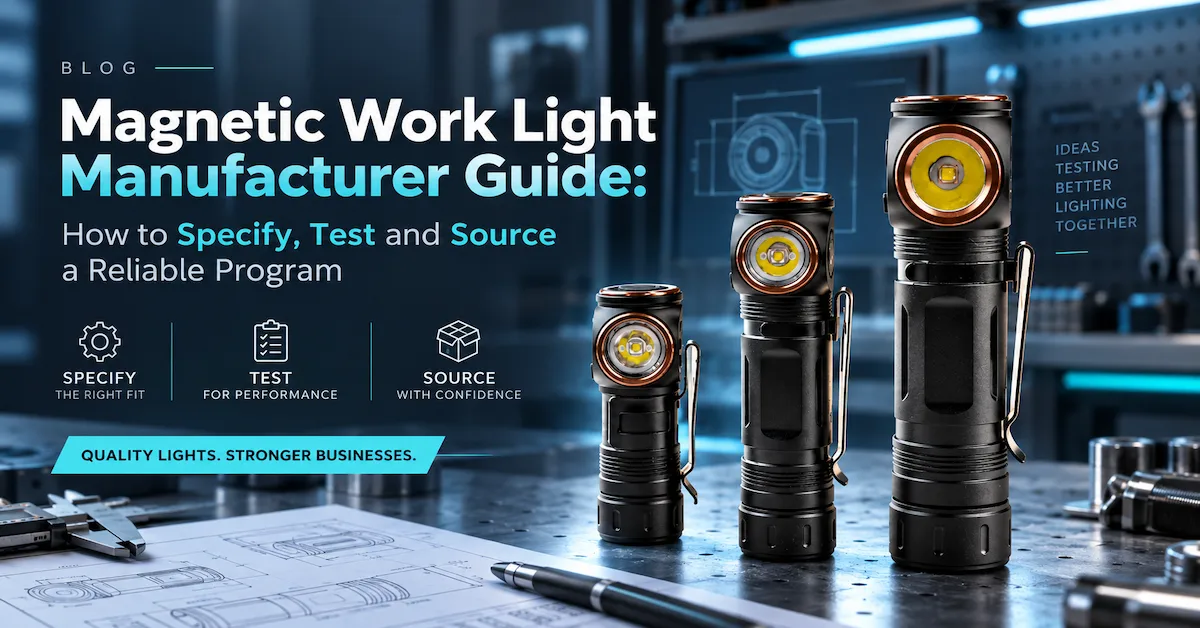
The 1000-lumen 90-degree magnetic-tail light illustrates a compact, directional format. Its public page lists an SST25 LED, five modes, a magnetic tail, Type-C charging, an included 800mAh 16340 battery, a head strap and a 55g product weight. The right-angle body can support clipped, head-mounted or magnet-mounted use, making the head position and magnetic orientation especially important during sample evaluation.
The 700-lumen compact magnetic platform adds red steady, strobe and SOS functions to a 90-degree rechargeable format. It can inform a brief for inspection, emergency-kit or outdoor channels where signal modes and hands-free use matter. Confirm the exact battery, mode sequence, accessories and artwork before using those claims in a retail listing.
For a larger capacity step-up, the 1500-lumen 21700 magnetic-tail light publicly identifies a 4000mAh battery, Type-C charging, multiple modes and a head strap/clip option. Its greater mass and capacity create a different mounting question from a 55g right-angle light. The stronger output figure does not, by itself, prove that it is the better product for a vertical service panel.
Request Magnetic Work Light Samples
A magnetic mounting claim needs a defined surface and direction
Magnetic holding is not a single universal number. A lamp attached to a clean horizontal steel plate may appear secure because gravity pushes it toward the surface. The same lamp on a vertical painted panel must resist sliding. Under a vehicle lift, the lamp may hang overhead and experience a direct pull. A swivel head adds leverage; a charging cable can add another sideways force.
Surface conditions matter just as much. Thin sheet metal, curved body panels, textured paint, oil, dust and gaps reduce useful contact. A thick test plate in a laboratory may create a stronger magnetic path than the surface a mechanic actually uses. The RFQ should therefore name the representative material, approximate thickness, finish, orientation and cleanliness. If several surfaces matter, treat them as separate tests.
The following matrix helps a buyer turn a vague magnetic claim into a sample trial:
| Mounting condition | Primary risk | Sample check | Record to keep |
|---|---|---|---|
| Horizontal, magnet below lamp | Tip or movement when the head is extended | Operate every approved head angle and button action | Photo of plate, angle and final position |
| Vertical painted steel | Slow downward sliding | Timed hold with clean and representative finished surfaces | Surface description and movement limit |
| Overhead steel | Direct separation and drop hazard | Static hold plus controlled repositioning in a safe fixture | Fixture, duration and pass/fail result |
| Curved vehicle panel | Reduced contact area or finish damage | Check stability and inspect the surface after removal | Panel radius, finish and contact photo |
| Vibrating machine frame | Rotation, walking or detachment | Application-specific vibration trial with agreed duration | Setup video and post-test inspection |
Do not perform overhead trials above a person or valuable equipment. Use a secondary restraint and a controlled fixture during development. A magnetic light is a positioning tool, not automatically a certified lifting device or safety attachment.
Pull, shear, peel and rotation are different failure modes
Many supplier demonstrations show a straight pull from a clean steel plate. That can be informative, but it is only one direction. On a wall, the lamp tends to move in shear: gravity encourages it to slide across the surface. If one edge lifts first, the load creates a peel action. A rotating head or long body can generate torque around the contact point.
A buyer does not need to turn the RFQ into a physics textbook. The practical solution is to recreate the working geometry and define acceptable movement. Record the lamp configuration, battery, accessories, head angle, surface and duration. Press the switch and adjust the head during the test because user input can dislodge a marginal mount.
Also inspect the magnetic base. A protective pad can reduce scratches and improve grip on some finishes, but its thickness may increase the air gap and change magnetic holding. A recessed magnet may be better protected from impact while offering less direct contact. An exposed metal surface may collect swarf in a machine shop. These trade-offs should be discussed with the factory rather than hidden behind the phrase “strong magnet.”
Choose the light architecture around the task
A magnetic base works only if the beam can be aimed after attachment. Straight flashlights with tail magnets are compact and easy to carry, but the beam direction depends heavily on the mounting surface. Right-angle lights can send the beam away from a vertical panel. Folding work lights may cover a broader area, while compact inspection lights can fit in confined spaces. Each architecture changes leverage, stability and user access to the switch.
An LED magnetic work light manufacturer should ask for the working distance and illuminated area before recommending a lumen target. Repair work inside an engine bay often benefits from broad, even light with limited glare. A long-distance inspection may need more concentration. A high initial output that quickly steps down may be less useful than a stable medium mode that lasts through the job.
Controls also belong in the mounting discussion. Can the button be reached when the light is attached? Does a long press turn it off from any mode? Does the unit remember its last setting? Can a gloved user adjust the head without breaking magnetic contact? Ask users to perform the actual task with the sample; a tabletop demonstration will not reveal every handling problem.
Rechargeable power is part of the mounting system
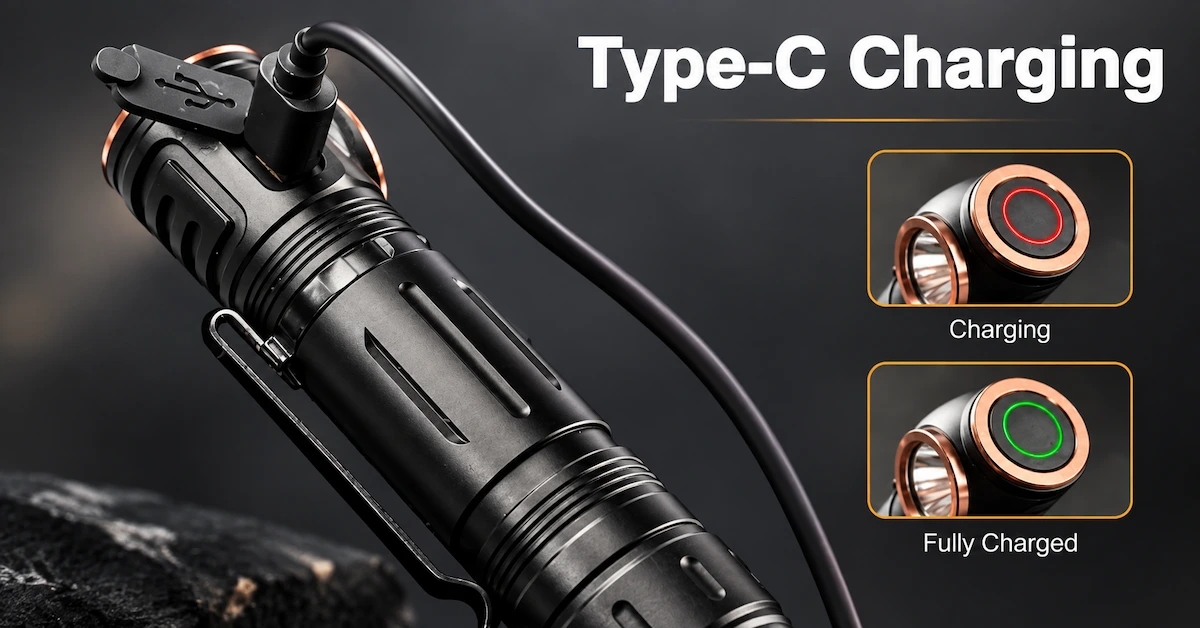
A rechargeable magnetic work light brings battery weight, charging access and cable force into the design. A larger cell may improve runtime but increase the load on the magnetic base. A side-mounted port may be easy to reach on a bench and awkward when the lamp sits against a vehicle frame. Operating while charging may pull the cable across the work area.
Ask the supplier to identify the battery chemistry, model, rated capacity, protection, inclusion status and approved alternatives. For the charging system, record the connector, input, supplied cable, indicator sequence, approximate charging time and behaviour while the light is operating. Runtime must be tied to a named mode, battery condition, ambient temperature and end point.
Transport requirements depend on the delivered battery configuration and route. Confirm current documents for the cell or battery used in the order instead of relying on a report for a similar product. Packaging should prevent accidental activation, protect the charging port and keep metal debris away from the magnetic base.
Design a useful product range instead of repeating one body
Wholesale buyers often receive a line-up of lights that differ mainly in headline lumens. A healthier range gives each model a visible job. One compact light can serve close inspection. A core model can add USB-C charging and easy daily handling. A capacity model can support longer tasks. A specialist option can add red light, a 90-degree body, a head strap or a clip.
For wholesale magnetic work lights, define a customer sentence for every SKU. For example: “the pocket model for quick checks,” “the right-angle model for clipped or vertical mounting,” and “the 21700 model for longer portable use.” If sales staff cannot explain the difference in one sentence, the assortment may be carrying duplicate inventory.
OEM and custom development: decide what really needs to change
An OEM magnetic work light manufacturer can support different levels of work. A standard platform may accept a logo and packaging change. A configurable platform may allow colour, accessories, battery capacity or mode sequence within approved limits. A new magnetic base, hinge, body or optical system becomes an engineering project with tooling, tests and a different schedule.
Do not use “OEM” as a catch-all word. Mark each requested change as standard, configurable or new development. Then ask what it changes: MOQ, tooling, unit price, sample stage, battery documentation, mechanical validation, packaging or lead time. This keeps a small branding request from being quoted like a new product and prevents a structural change from being treated like a print revision.
A custom magnetic work light supplier should also explain the ownership and control of magnets, moulded parts, PCBs, batteries and assembly. If an outside partner supplies a critical component, the main factory still needs an approved requirement and incoming check. The buyer should know how a proposed substitute will be reviewed before it reaches production.
Branding and packaging need magnetic-specific controls
Private-label work extends beyond a logo. Record the body colour, finish limit, printing process, logo location, model marking, rating label, date code, manual, barcode, retail carton and master-carton identification. Approve artwork against the actual product revision so battery and accessory statements match the pack.
Magnets create additional packaging questions. The light should not move inside the carton or attach unpredictably to accessories. The pack should protect finished surfaces and keep the switch from being pressed. If several lights share a master carton, the arrangement should be reviewed for handling and transport. Ask the responsible logistics or compliance team whether the magnetic assembly affects the chosen shipping method; do not make a universal claim from one route.
A portable magnetic work light supplier should provide pack-out photos or a sample that includes the final cable, strap, clip, holder, manual and carton. Accessory changes can alter weight, presentation and customer expectations even when the lamp itself remains unchanged.
A nine-step method for sourcing magnetic work lights
- Describe the user and job. Record the task, work distance, required area, operating time, gloves, dirt and available metal surfaces.
- Define the mounting geometry. Name the material, finish, thickness, orientation, head angle and likely vibration or cable load.
- Choose the product architecture. Compare straight, right-angle, folding, clipped and head-mounted formats against the actual beam direction.
- Set useful lighting targets. Define beam type, working area, modes, glare limit, colour expectation and acceptable output behaviour.
- Lock the power configuration. Identify the battery, charging method, indicators, runtime test, inclusion status and transport evidence.
- Build the sample test. Check vertical, overhead and representative finished surfaces using the intended battery, angle and accessories.
- Normalize the quotation. Align pack contents, branding, packaging, MOQ, tooling, inspection, freight basis and warranty handling.
- Approve one production reference. Retain the sample, photos, component description, artwork, accessory count and acceptance record.
- Protect repeat orders. Require written notice before changes to the magnet, pad, housing, joint, LED, driver, battery, cable or packaging.
This method connects the magnetic claim to a user, a surface and a production record. It also gives marketing a defensible story: the product was selected for a defined job rather than because its catalogue photograph looked powerful.
Send Your Magnetic Work Light RFQ
Build a production acceptance plan
A sample test is useful only when production can be checked against it. Create a short acceptance matrix that names the requirement, approved condition, inspection method and record. Use measurable criteria where the team has evidence, and use an approved reference where appearance or feel cannot be reduced to one number.