

B2B PROCUREMENT GUIDE · UPDATED SEPTEMBER 2026
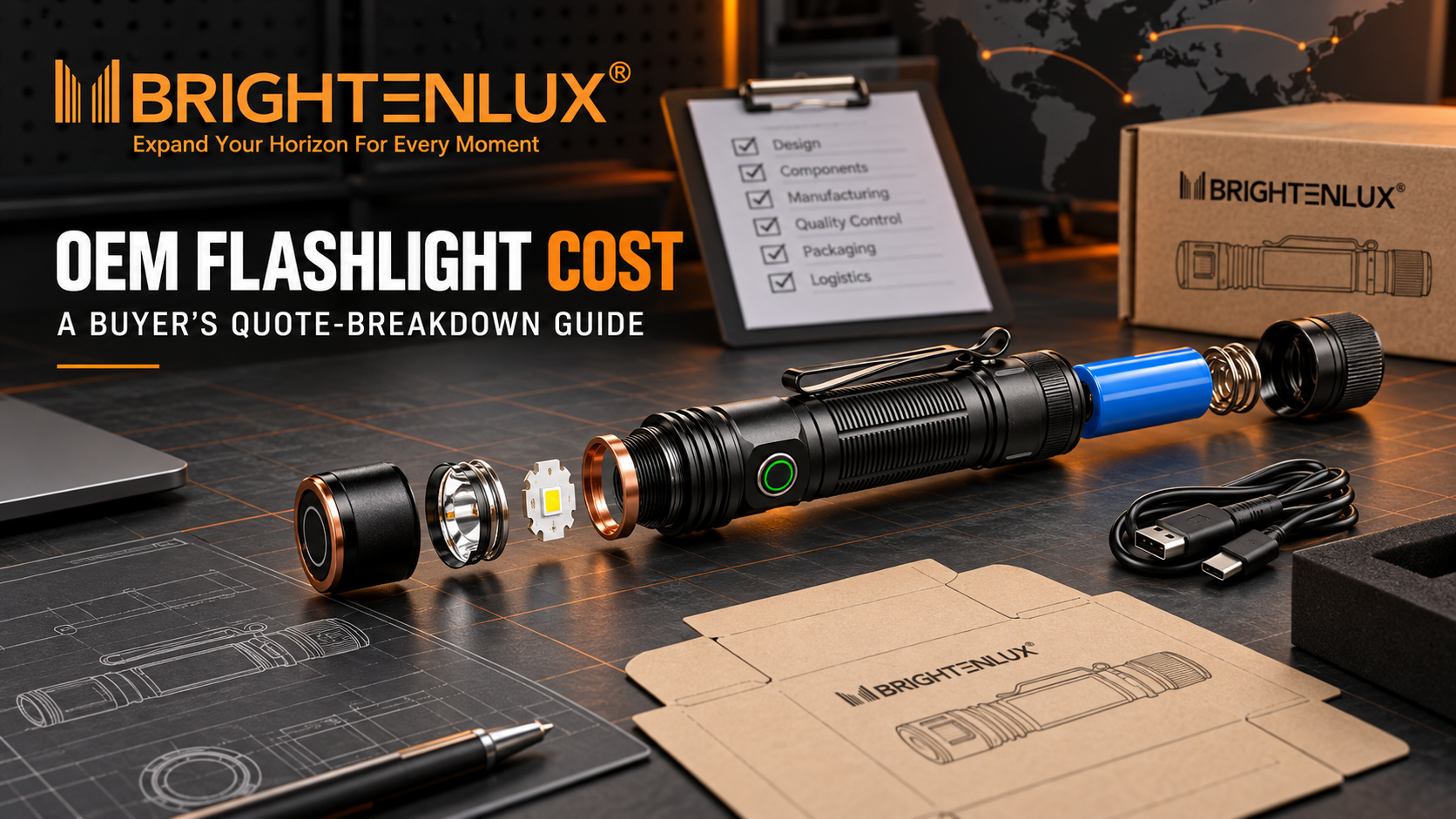
A price request that says only “Please quote a rechargeable flashlight with our logo” sounds efficient, but it leaves most of the commercial decision undefined. One supplier may assume a battery is included and another may not. One may quote a printed color box, another a neutral carton. One may price a tested, approved cell; another may leave the cell brand and capacity open. The spreadsheet shows two prices, yet the products, risks and buyer obligations are different.
This guide is written for importers, brands, distributors, retailers and product managers who need to understand a quotation before they select samples or issue a purchase order.It does not publish a fictional “typical” price. Instead, it gives you a practical cost architecture, a quote-normalization table, a sample and tooling checklist, a landed-cost model and a ready-to-send RFQ brief. Those tools are more useful than a number detached from the model, market and order conditions.
Brightenlux develops and supplies portable lighting products for international buyers. The available scope for branding, packaging or engineering must be confirmed by model. Performance, compliance, MOQ and lead time also require model-specific confirmation. That boundary matters: an honest quotation is a controlled project document, not a promise that every option is available on every flashlight.
| If you need to decide… | Define this first | Ask the quotation to show | Main risk if omitted |
|---|---|---|---|
| Which platform fits the application | Beam task, duty cycle, size, controls and environment | Exact model and revision | Comparing unrelated products |
| Whether the target cost is realistic | Must-have versus negotiable features | Base configuration and priced options | Value engineering removes a critical feature |
| How much cash the launch requires | Quantity, packaging, samples, tooling and testing | Recurring, one-time and order-level charges | Budget surprise after sample approval |
| Whether offers are comparable | One RFQ revision and one Incoterm | Inclusions, exclusions and validity | A low headline price hides buyer-paid items |
| Whether the product can ship | Destination, route, battery configuration and documents | Carton data and shipping-document responsibility | Delay, rework or expensive route changes |
Want an itemized, model-specific quotation?
Send the destination market, application, target performance, estimated quantity, branding and packaging requirements, required documents and requested delivery date. Brightenlux can then discuss suitable product platforms and state the quotation assumptions clearly.
Send Your Flashlight RFQ →Why the cheapest quotation can become the most expensive order
Procurement teams often focus on the line labeled “unit price” because it is easy to rank. The real commercial result is the cost per sellable, compliant unit delivered when needed. That result includes more than the flashlight leaving the assembly bench. It also reflects the cost of unclear requirements, extra sample rounds, packaging corrections, late component changes, inspection failures, air freight caused by delay and returns caused by an unsupported claim.
Suppose Supplier A is cheaper per unit but does not identify the cell, charging behavior or package construction. Supplier B is modestly higher and specifies each of those items, includes an approved packaging proof and defines what test records accompany the lot. Supplier A has not necessarily offered the same product at a lower price. It has offered a less defined scope. Until the assumptions are normalized, the difference is not savings; it is uncertainty.
The same distinction applies when you compare a trading company, a led flashlight manufacturer, a sourcing agent and an assembly factory. The business label alone does not reveal who controls the bill of materials, who approves substitutions, who owns the packaging files, who investigates failures or who remains accountable after shipment. Price needs to be read alongside control.
Use three cost buckets, not one
A clean quotation separates three kinds of spending. Recurring unit cost changes with the product and the production quantity.One-time project cost covers work that may not repeat for every order. Order-level cost applies to a batch or shipment rather than an individual unit. Keeping these buckets separate prevents a buyer from mistaking a waived setup charge for a permanently lower manufacturing cost.
| Cost bucket | Common examples | How to compare it | Useful question |
|---|---|---|---|
| Recurring unit cost | LED, optic, driver, housing, battery, cable, clip, assembly, retail pack | Same specification, quantity tier and currency | What exact components and accessories are included? |
| One-time project cost | Tooling, engineering, artwork setup, test fixtures, certification or third-party testing | Separate ownership, reuse and retest conditions | Will this charge recur after a design or supplier change? |
| Order-level cost | Inspection, special handling, master-carton plates, documentation, freight and insurance | Allocate across expected sellable units | Which party pays, arranges and carries the risk? |
This is a decision formula, not an accounting rule and not a Brightenlux price promise. Your finance and logistics teams should adapt it to the channel, tax treatment and destination. The phrase “expected sellable units” is deliberate.Samples, destructive tests, inspection holds, damage allowance and promotional units may not become revenue inventory. Dividing by the purchase quantity alone can make the business case look better than it is.
Start with a frozen RFQ baseline
The fastest way to improve quotation quality is to give every candidate the same baseline. It can be a product requirement document, a marked reference sample or a model-selection brief. What matters is that the revision is dated, controlled and specific enough to reveal differences. A buyer approaching a flashlight manufacturer china search should resist sending a collage of competitor listings with “same as this, best price.” Images rarely define cell quality, driver behavior, thermal control, sealing, firmware, artwork responsibility or acceptance criteria.
A quote-ready baseline should identify:
- Destination and channel. Country, online or retail channel, intended buyer and planned selling environment.
- User job. Inspection, general household use, outdoor travel, daily carry, tool-bag use, emergency supply or another clearly bounded task.
- Optical outcome. Near-field flood, defined hotspot, adjustable focus, mixed beam or a target expressed through measurable test conditions.
- Duty cycle. Expected minutes or hours of use, target mode and acceptable output behavior as the battery discharges or the product warms.
- Power architecture. Included or buyer-supplied cell, replaceable or built-in battery, charging interface, cable and required protection behavior.
- Mechanical requirements. Envelope, weight, finish, clip, magnet, switch, focus mechanism, impact exposure and ingress target.
- Customization. Logo method, color, packaging, manual, barcode, accessories, electronics or new mechanical work.
- Evidence. Test report, inspection record, traceability data, battery documents and market-specific compliance files.
- Commercial frame. Trial and forecast quantity, variant count, target date, currency, payment basis and named Incoterm place.
- Acceptance. Approved sample, golden sample, appearance standard, performance limits and inspection responsibility.
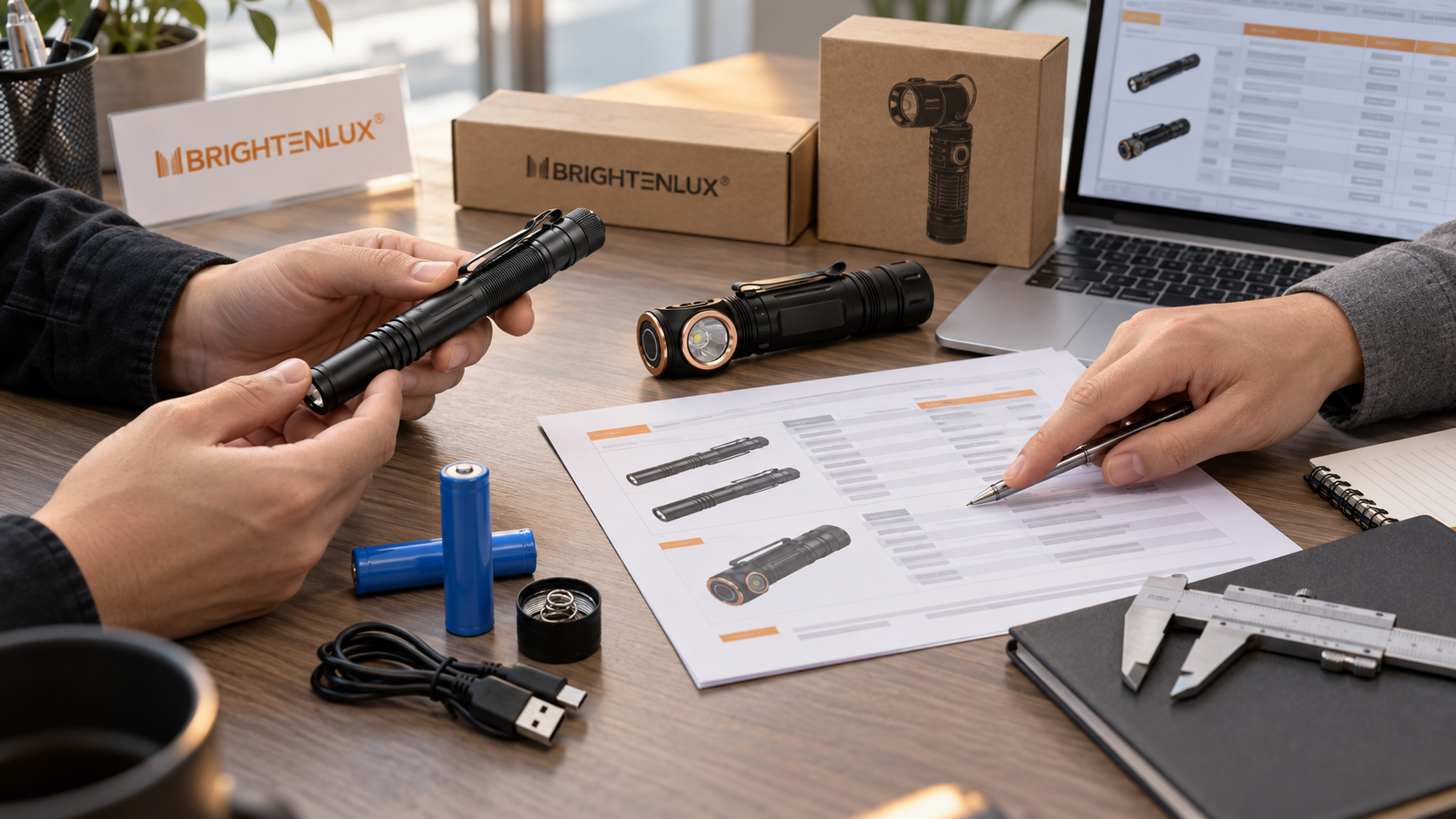
A one-page quotation identity block
Place a compact identity block at the top of your comparison sheet. Record the supplier, quotation date, validity, product model, revision, battery, package, quantity, currency, Incoterm with named place, lead-time basis and attached documents. If any cell is blank, mark it “not stated” instead of filling it from memory. That visual gap is a procurement action.
Use the same discipline when speaking with a rechargeable flashlight manufacturer. “Type-C” describes the connector shape; it does not by itself define input behavior, charge current, charging time, C-to-C compatibility, cell protection, indicator logic or cable inclusion. Those are separate specification and test questions. A quote that names only the connector still has open cost and performance variables.
The twelve parts of an OEM flashlight cost breakdown
The following stack turns one headline price into a reviewable commercial model. Not every project needs every line, but every line should be considered. The purpose is not to make the RFQ longer. It is to stop important decisions from surfacing after the buyer has anchored on a price.
1. Base product platform
An existing platform usually has known tooling, established assembly instructions and some production history. A platform does not mean every component is automatically fixed forever. Ask for the current model code and revision, then record which options are already released. A slim penlight, an adjustable-head work-oriented flashlight and a larger 21700 platform do not share the same housing, cell, driver, thermal path or packaging economics.
For an everyday-carry assortment, a buyer may start with a compact platform from an edc flashlight manufacturer discussion.A distributor serving outdoor or tool channels may evaluate the 1500-lumen rechargeable 21700 platform. The product page is a starting point, not the final quotation: confirm the model, included cell, approved performance claims and package for the destination market.
2. LED, optic and beam system
Emitter specification, bin availability, color temperature, optic, reflector, lens, focus mechanism and driver current all influence cost and buyer value. A request for “high lumens” does not describe where the light must go. A broad beam can be better for close inspection; a higher-intensity hotspot can be better for identifying an object farther away. The sourcing team should write the task first, then decide how lumen output, peak beam intensity and beam distance will be evaluated.
The practical difference behind lumens vs candela flashlight searches is not academic. Lumens describe total emitted light under a stated method; candela describes luminous intensity in a direction. Changing an optic can materially change beam intensity without changing the emitter. A lower-cost quotation that substitutes an optic may still meet a lumen line while failing the user's distance or spill requirement.
3. Driver, modes and user interface
The driver determines how electrical power is managed.Mode sequence, memory, lockout, low-voltage response, battery indication and thermal step-down are user-experience decisions as well as component and firmware decisions. A crowded mode sequence can increase customer complaints even if the BOM is inexpensive. A special interface may require engineering, firmware control, test cases and a longer approval path.
For a tactical flashlight manufacturer brief, define permitted use and channel language before requesting features. Do not rely on unsupported military, police or safety claims. State switch access, mode priority, momentary behavior if required, glove use, lockout and verification method. A “tactical” label is not an acceptance criterion.
4. Battery and power architecture
The cell can change runtime, peak current capability, dimensions, mass, logistics documents, pack-out and replacement policy. Specify chemistry, format, capacity basis, protection, inclusion, replaceability and approved supplier or performance criteria. The battery price line is incomplete without the cell specification and the records that connect the shipped battery to the tested design.
A buyer comparing an 18650 vs 21700 flashlight platform should not assume that the larger format always creates a better product.The 21700 format may support more energy or current depending on the cell, but it can also change tube diameter, weight, thermal behavior, charger assumptions and freight economics. Compare complete, tested platforms against the use case.
5. Charging system and accessories
USB-C can simplify the user experience, yet the connector is only the visible part of the system. The PCB, protection devices, port support, sealing, indicator, cable, power source and thermal behavior must work together. Ask whether the quoted configuration was tested with common chargers and cable types relevant to the market. Ask what happens during charging, after full charge and when the battery is outside its normal operating range.
For usb c rechargeable flashlight design, write “C-to-C compatibility required” only if it is genuinely a market requirement, and define the test. Do not turn “fast charge” into packaging copy until the input profile, cable, temperature, charge time and evidence support it. Cable inclusion, length, connector quality and retail presentation should appear as separate quotation fields.
6. Housing, finish and mechanical hardware
Housing cost is shaped by more than the material name. Aluminum grade, extrusion or stock diameter, machining time, wall thickness, threads, knurling, surface preparation, anodizing, molding, inserts, springs, seals, clips, magnets and moving mechanisms all matter.A minor-looking geometry change may require a new tool or a slower machining operation. A finish change can introduce its own supplier batch, color approval and cosmetic limit sample.
Define what the product must survive and what the customer will notice. A tool-channel buyer may care about glove grip, roll resistance, magnetic holding and impact exposure. A promotional buyer may value printable area and appearance consistency. A private label flashlight manufacturer project using a released body with logo and packaging changes is commercially different from a new housing program. Put them on different timelines and cost models.
7. Thermal design and sustained output
LED output becomes heat in the emitter, driver, cell and charging system. The housing, contact surfaces, board, thermal interface, control logic and ambient conditions influence what the user experiences after the first moments of operation. An impressive initial reading can fall quickly if the compact enclosure cannot sustain it. Conversely, an oversized heat path may add mass and machining without creating value for a brief-use application.
Ask the supplier to define the test conditions behind flashlight thermal management: starting temperature, battery, airflow, mode, sampling interval, surface measurement point and step-down logic. A curve is more informative than a single peak value.If a quotation reduces driver or housing cost, request the updated curve before accepting that the products are equivalent.
8. Sealing and environmental protection
Ingress protection affects seals, grooves, port covers, threads, assembly lubrication, torque, inspection and sometimes tooling. The IP code applies to the enclosure under defined test conditions; it is not a general adjective meaning “outdoor.” The International Electrotechnical Commission publishes IEC 60529, the standard covering degrees of protection provided by enclosures. A supplier should connect any claim to the specific model, revision and report scope.
When specifying a waterproof flashlight IP rating, state which digits are required, how ports and covers are configured during testing and whether the test sample matches production. IPX4, IPX6 and IP67 are not interchangeable marketing phrases. The absence of a dust digit, shown by “X,” also has meaning. Do not upgrade the package claim because a related model passed a different test.
9. Branding and appearance approval
Laser marking, pad printing, screen printing, labels, color fill and molded marks have different setup, durability, contrast and geometry limits. The cost line should identify method, position, size, colors and artwork version. If the logo crosses a curved or textured surface, request a physical marked sample rather than relying only on a digital mockup. Define whether slight position and color variation will be judged against an approved master.
A custom flashlight manufacturer discussion may include new industrial design, optical architecture or electronics. A oem flashlight manufacturer discussion may adapt an established platform or develop a product to an agreed brief. Private label often concentrates on identity and retail readiness. Businesses use these terms differently, so write the requested work instead of assuming the label defines scope.
10. Packaging, manuals, labels and barcodes
Packaging is both a cost and a launch dependency. A plain export box, printed folding carton, color sleeve, clamshell, EVA case and gift set require different materials, tooling, print quantities and packing time. Inserts, cable placement, spare seals, multilingual manuals, labels and barcode control can change the pack-out. Carton dimensions then influence freight and warehouse handling.
Ask for the unit pack, inner pack and master carton as separate lines. Confirm artwork responsibility, dieline version, proof method, color target, finish, insert, quantity per carton, gross and net weight and carton mark. If marketplace labeling is required, identify who supplies and verifies the data. A cheap product packed in avoidable volume can cost more to deliver than a slightly higher-priced unit in a transport-efficient box.
11. Testing, documentation and inspection
Testing is not a decorative certificate line. It may include engineering validation, production checks, third-party market testing, battery transport documents, packaging tests or buyer-specific inspection.State the model, configuration, sample stage, method, laboratory, report language and acceptance limit. Also state who pays if a buyer change requires retesting and what happens when a component changes after approval.
ANSI/PLATO FL 1-2025 establishes uniform methods and reporting requirements for attributes including light output, peak beam intensity, beam distance, runtime, impact resistance, and water or dust penetration protection. Its 2025 revision also addresses short-duration elevated-brightness modes. A buyer requesting ANSI PLATO FL1 testing should identify which attributes will be reported and ensure the test configuration matches the sold product. Purchasing the word “tested” without scope is not useful.
12. Production quantity, schedule and commercial terms
Quantity influences component purchasing, line balance, setup allocation, packaging minimums and inspection economics. Schedule influences material choices, capacity planning, change tolerance and freight risk. Payment terms, currency and price-validity period affect commercial exposure. None of these is a substitute for product definition, but each can move the quotation.
A buyer asking a wholesale flashlight supplier for a broad assortment should separate the per-SKU minimum from the combined order total.Mixing several models may help a distributor build range breadth, but it does not automatically remove the minimum for a custom color, printed box, cell or accessory. Request a constraint map rather than one headline MOQ.
How MOQ actually forms
MOQ is often discussed as if the factory chooses one arbitrary number. In practice, several minimums can overlap. The workable order quantity is usually determined by the most restrictive item after existing stock, shared components and approved alternatives are considered. That constraint may be product assembly, a custom finish, a printed package, an electronic component, an accessory or the economic allocation of setup work.
| Possible MOQ trigger | Why it exists | Ways to reduce launch exposure | What must remain controlled |
|---|---|---|---|
| Finished-product assembly | Line setup and production efficiency | Choose a released platform; combine forecasted demand | One model and revision per lot |
| Custom color or finish | Material or surface-treatment batch | Use a standard finish for the pilot | Appearance master and allowed variation |
| Printed package | Printing and converting setup | Use neutral packaging plus a controlled label or sleeve | Barcode, warnings, language and brand approval |
| Logo process | Fixture, screen, plate or handling setup | Use an existing printable area and one-color artwork | Method, position, durability and proof |
| Battery or electronic component | Supplier pack size, availability and qualification | Select an already approved component when suitable | No substitution without written approval |
| New tooling | Engineering and capital recovery | Validate demand on an existing body first | Tool ownership, maintenance and released drawing |
A competent low moq flashlight manufacturer conversation therefore starts with “Which requested item creates the minimum on this model?” If the barrier is the printed carton, a neutral box with a label may be possible. If the barrier is a custom anodized housing, changing the package does not solve it. If the barrier is a dedicated PCB, logo-only simplification will not remove the engineering work.
Use a trial order to test the commercial hypothesis, not to skip product control. Keep variant count low. Select one primary channel. Freeze the battery, packaging and claims. Define how repeat orders will retain the same approved revision. Small volume does not make an undocumented substitution harmless; it can make the cost per complaint higher because the launch has less inventory over which to absorb rework.
Samples, engineering and tooling: what the quote should clarify
“Sample fee” can refer to very different deliverables. An off-the-shelf model sample confirms general form and function. A logo sample checks marking. A functional engineering sample may use temporary components or unfinished tooling. A pre-production sample should represent the released build and package closely enough to serve as an approval reference. Ask which stage you are buying.
For each sample round, record:
- sample purpose, quantity, model and revision;
- which parts are production-equivalent and which are temporary;
- included battery, cable, accessories and packaging;
- tests completed, conditions and raw records available;
- open deviations and the plan to close them;
- sample fee, tooling or setup charge, courier term and possible credit policy;
- buyer feedback deadline and expected next revision;
- who signs the approved reference and where it will be retained.
Tooling quotes should state the tool or fixture, output, material, cavity or process assumptions, included trials, ownership, storage, maintenance, repair, expected life where supportable and what files are released. Do not assume that paying a fee automatically transfers every intellectual-property right or every production file. Put ownership and permitted use into the commercial agreement, and have qualified counsel review material IP terms.
A useful oem flashlight cost comparison shows non-recurring engineering, tooling and validation outside the recurring unit price. If one supplier amortizes them into the first order and another lists them separately, normalize the cash total before ranking offers. Also model the second order: the launch winner can look different once genuine one-time items are removed.
The manufacturing process is part of the cost answer
A flashlight price is credible when the factory can explain how the released specification becomes a repeatable batch. The flashlight manufacturing process should connect requirements, purchased parts, assembly controls, test records, packaging approval and shipment release. The details vary by model, but a controlled program commonly includes the following gates.
- Requirement review. Sales, product and engineering translate the buyer's application into a written specification and identify open feasibility questions.
- Platform selection or design review. The team selects an existing platform or defines new mechanical, optical and electrical work.
- Quotation and commercial clarification. The offer separates scope, exclusions, quantity tiers, one-time charges, package, test needs and Incoterm.
- Sample planning. The team states what each sample will prove, the build status and the evidence required for approval.
- Design and artwork freeze. Model, BOM, drawing, firmware, color, logo, packaging, manual and labels receive revision-controlled approval.
- Supplier and material release. Components are purchased against approved requirements; substitutions require review rather than silent acceptance.
- Incoming control. Relevant materials are checked for identity, condition and defined critical attributes.
- First-article and process setup. The line confirms build sequence, fixtures, torque or assembly controls and functional checkpoints.
- In-process verification. Assembly, charging, switches, beam, appearance and other critical items are checked at suitable stations.
- Final inspection and reliability sampling. Finished goods are evaluated against the released inspection plan and agreed acceptance criteria.
- Pack-out verification. The team confirms product, accessories, labels, manuals, barcodes, carton quantity and shipping marks.
- Shipment release and traceability. Batch identity, inspection disposition, carton data and required documents are connected to the released order.
Every missing gate can become a hidden cost. Late artwork approval creates reprinting. An unapproved cell substitution creates retesting or claims risk. A packaging dieline changed after production may force manual rework. A quotation should not pretend these risks are free. It should state which inputs the buyer must supply and which approval delays move the schedule.
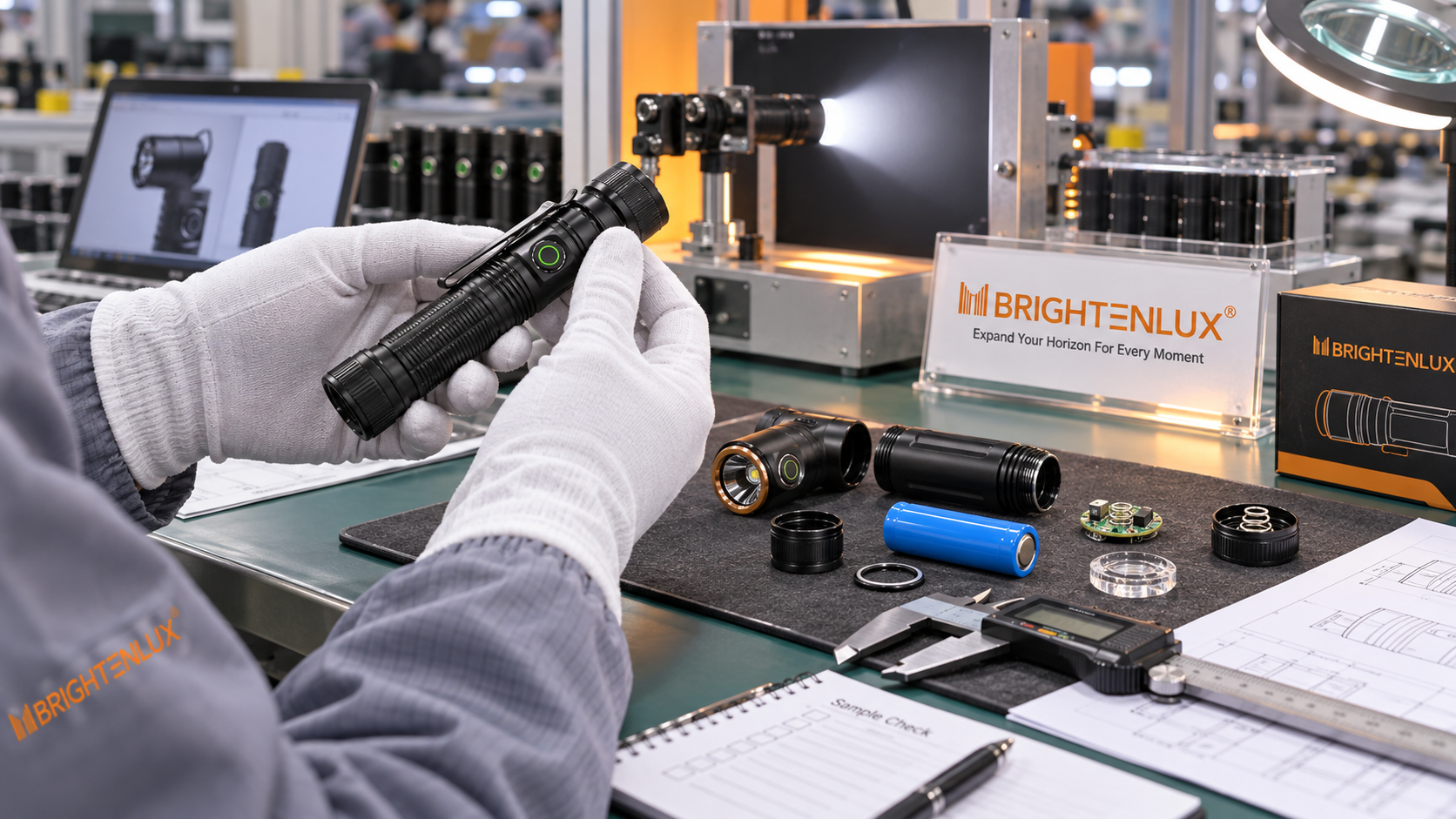
Quality costs less when acceptance criteria are written early
Flashlight quality control should not begin with a third-party inspector opening cartons at the end.Incoming, in-process and final controls should focus on risks that can affect safety, function, customer experience and claims. A pre-shipment inspection is valuable, but it cannot efficiently undo a design ambiguity or a wrong component built across the entire lot.
Create a critical-to-quality list from the use case. For a compact rechargeable model it might cover correct cell and polarity protection, charge and indicator behavior, switch sequence, beam appearance, sustained-output behavior, surface temperature, port-cover fit, dimensions, cosmetic limits, marking, pack-out and traceability. The list must name test conditions and acceptance limits. “Works normally” is too vague for repeatable inspection.
| Control point | Example question | Evidence to request | Commercial effect |
|---|---|---|---|
| Incoming material | Is the cell, LED, driver and seal the approved item? | Identity record, supplier lot and change approval | Reduces substitution and rework risk |
| First article | Does the line build match the released revision? | First-article record and approved sample | Stops a systematic error early |
| Functional check | Are charging, modes and indicators correct? | Work instruction and test result | Reduces obvious customer failures |
| Performance sampling | Are claims supported under stated conditions? | Raw measurement and summary report | Protects product-page and package accuracy |
| Final inspection | Does the lot meet agreed critical, major and minor criteria? | Inspection plan and signed report | Supports shipment disposition |
| CAPA | How will a repeated failure be contained and prevented? | Root-cause and corrective-action record | Protects repeat orders |
A flashlight factory audit should test whether the supplier's records tell one coherent story: the quoted model matches the sample; the sample matches the frozen BOM and artwork; the production batch matches the released revision; and inspection results can be traced to the shipment.A showroom and a certificate wall do not answer those questions on their own.
Quality spending belongs in the business case. Include validation samples, destructive tests, inspection, retained samples, replacement parts and expected warranty handling. Cutting every preventive cost can raise failure cost later. At the same time, do not buy tests without a decision purpose. Prioritize the risks created by the application, destination market, claims and product architecture.
Compliance and battery logistics belong in the RFQ, not after the PO
The destination country and sales channel affect the evidence, markings, language and responsible-party obligations that may apply. Product configuration matters too. A battery-included rechargeable flashlight, a light shipped without a cell and a product containing a power-bank function may not share the same logistics or documentation path. Ask a qualified compliance and logistics professional to confirm the requirements for the actual shipment.
For the current air-transport context, IATA's 2026 Battery Guidance Document points readers to the 2025–2026 ICAO Technical Instructions and the 67th Edition of the IATA Dangerous Goods Regulations. Read the limitation on page one carefully: it is guidance, not the regulation itself. In a buying meeting, translate that limitation into a simple rule. Reopen the shipping review for the actual battery, route and packing configuration; an old document pack from a similar lamp is not enough.
Put document ownership beside each shipping task. Who supplies the cell specification? Who checks the safety data and UN 38.3 test summary? Who confirms any additional carrier paperwork for this configuration? Then compare the model and battery identities across the product, invoice, packing list, report and labels. A cell change sends the file back for review. Saving a little on the cell makes no commercial sense when the change breaks the evidence chain or removes the planned route.
From factory price to landed cost
EXW, FCA, FOB, CIF, DAP and other trade terms allocate different responsibilities, costs and risks. The International Chamber of Commerce publishes Incoterms® 2020 as the official framework; the named place or port is part of the term. Writing only “FOB price” without a named port, or comparing EXW with DDP as if both were product prices, creates a false ranking.
Build the landed-cost bridge line by line. In our worksheet, the buyer does not enter a single freight guess.The rows are grouped so the team can see where each number came from:
- product, battery, standard accessories and spare parts;
- retail package, inner pack, master carton and pallet if used;
- logo, artwork, engineering, tooling and validation;
- testing, reports, inspection and documentation;
- inland transport, export handling and origin charges according to the agreed term;
- international freight, insurance and dangerous-goods or battery-related handling where applicable;
- destination clearance, duty, tax, brokerage, port or terminal fees;
- warehouse receiving, labeling, marketplace preparation and domestic delivery;
- currency movement, financing and payment fees;
- allowance for non-sellable units, returns, claims and urgent replacement freight.
Choose a working currency, write down the exchange-rate date and leave it unchanged while offers are compared. Quantity and expected ship date must also match. Keep ocean and air scenarios in different columns. When a proposed lead time misses the intended ocean sailing, show the possible air-freight exposure beside the quotation. That is often where an apparently small schedule slip becomes a large budget problem.
A quote-normalization worksheet buyers can copy
The table below is an original working template for a sourcing review. Add a column for each supplier. Enter only stated facts, write “not included” where the offer excludes an item and “not stated” where it is silent. Use comments for evidence links and revision notes. Before awarding, resolve every critical blank in writing.
| Comparison field | Required input | Supplier A | Supplier B | Decision note |
|---|---|---|---|---|
| Model identity | Model, drawing/BOM revision, quotation date | ___ | ___ | Must match sample |
| Optical system | LED, optic, modes, measured claims and conditions | ___ | ___ | Compare task performance |
| Power | Cell format, capacity basis, inclusion, protection | ___ | ___ | Check document match |
| Charging | Port, input behavior, cable, indicator, test | ___ | ___ | Connector alone is insufficient |
| Mechanical | Material, finish, dimensions, weight, hardware | ___ | ___ | Record tolerances |
| Protection | IP/impact requirement, method, report scope | ___ | ___ | Model-specific evidence |
| Branding | Method, colors, positions, setup, approval | ___ | ___ | Attach artwork revision |
| Packaging | Structure, printing, manual, label, barcode, carton | ___ | ___ | Confirm pack-out proof |
| Samples | Stage, quantity, fee, courier, credit, timing | ___ | ___ | State production equivalence |
| Tooling/NRE | Deliverable, ownership, trials, maintenance | ___ | ___ | Separate one-time cost |
| Testing | Method, sample, lab, report,retest trigger | ___ | ___ | Avoid generic “certified” |
| Quality | Inspection plan, acceptance, traceability, CAPA | ___ | ___ | Price prevention and failure risk |
| Quantity/MOQ | Per SKU/variant/component and price tiers | ___ | ___ | Name limiting item |
| Lead time | Start trigger, approval assumptions, capacity basis | ___ | ___ | Do not count from inquiry date |
| Trade basis | Currency, payment, Incoterm® 2020 + named place | ___ | ___ | Normalize cost allocation |
| Landed-cost inputs | Carton data, battery route, origin/destination charges | ___ | ___ | Logistics review required |
Score risk separately from price
Do not hide risk inside a single supplier score. Show price, technical fit, evidence, delivery confidence and service separately, then agree the weighting before opening final offers. This prevents the team from changing the scoring logic after seeing a preferred supplier's price.
| Dimension | Example weight | Evidence, not impressions | Red flag |
|---|---|---|---|
| Application and specification fit | 25% | Requirement response, sample results, deviation list | “Yes” to every request without conditions |
| Quality and change control | 20% | Inspection plan, records, traceability, CAPA example | Substitutions allowed without buyer approval |
| Total commercial value | 20% | Normalized cash and landed-cost model | Critical exclusions discovered late |
| Delivery and capacity confidence | 15% | Material plan, approval gates, capacity evidence | Lead time has no defined start trigger |
| Compliance and logistics readiness | 10% | Model-specific document register and route review | Company certificate offered as proof for every SKU |
| Communication and project control | 10% | Revision log, owners, response to open issues | Specifications change across email threads |
The percentages are an example, not a universal rule. A promotional launch may weight schedule and unit economics differently from an industrial program. What should not change is the evidence requirement. A confident sales answer is not equivalent to a dated test record or an approved specification.
A worked sourcing scenario: how a low unit price loses
Imagine a distributor preparing one rechargeable flashlight for an automotive-accessory range. The brief is unusually concrete: compact body, magnetic placement, USB-C charging, a practical medium mode for longer jobs, one-color branding, bilingual instructions and a printed sleeve. The launch quantity is intentionally cautious. If sell-through supports the idea, the same approved build will move into a repeat order.
Supplier A quotes the lower unit price. Its offer says “18650 included, Type-C, waterproof, logo box.” Supplier B is higher and names the cell specification, cable, mode sequence, marking method, sleeve material, IP test basis, inspection plan, carton data and FCA named place. Supplier B also lists the logo fixture and sleeve proof separately.
The buyer normalizes the offers. Supplier A's price excludes the retail sleeve, does not include the cable, assumes EXW pickup and has no stated test or inspection cost. Its cell is not identified, so the logistics provider cannot confirm the planned battery-document package. The apparently lower offer now requires additional packaging, pickup, document clarification and another sample round.
Supplier B's one-time setup charge raises launch cash, but it is visible. The repeat-order model removes that charge, retains the approved revision and uses carton data already reviewed by logistics.The buyer may still negotiate or choose Supplier A after clarification; the point is that the original unit prices were never comparable. The worksheet reveals the decision instead of making it for the team.
Use the product category to choose the right sourcing path
Different flashlight programs carry different value and cost drivers. Link the commercial request to a real product architecture before discussing customization:
- A compact pen-style platform can support pocket carry, inspection or promotional concepts; review a relevant product before asking an edc flashlight manufacturer to price options.
- A higher-output, larger-cell platform may fit a distributor's outdoor range, but its runtime, thermal curve, carton weight and cell documents must be compared—not just the output label.
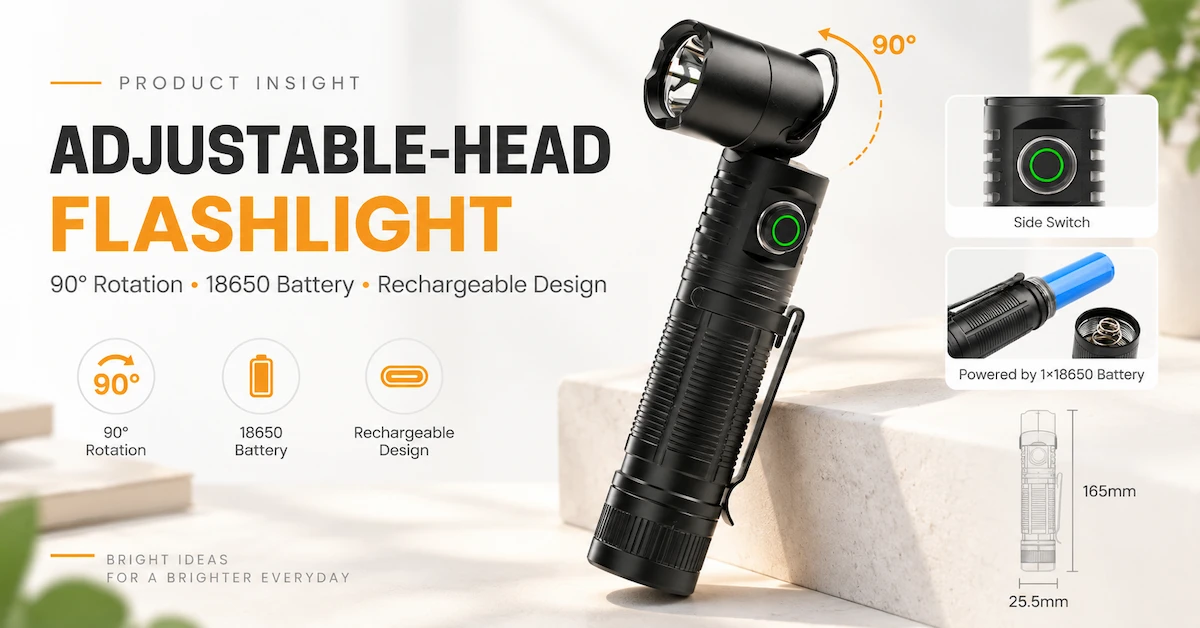
- A right-angle or magnetic product can serve hands-free tasks; specify attachment surface, orientation, holding expectation and user environment.
- A rechargeable retail program should align cell, charging, manual, cable, packaging claim and shipping route as one system.
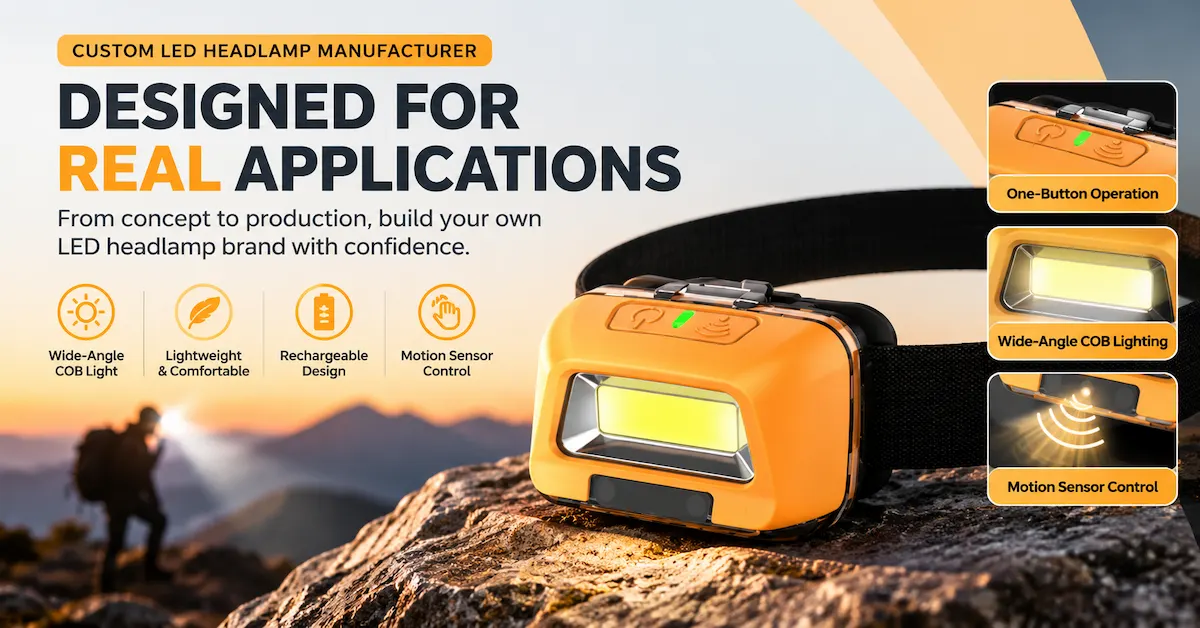
When several product families are sourced together, the same cost discipline still applies. A headlamp manufacturer must account for strap, tilt mechanism, weight distribution and hands-free controls in addition to optical and battery cost. A rechargeable headlamp manufacturer brief should define charge behavior, runtime mode, cable and battery evidence, not just connector type.
For deeper development, an oem headlamp manufacturer quotation should separate platform reuse from new electronics, housing or headband work. A launch using established hardware and new identity may suit a private label headlamp manufacturer path. In either case, an oem headlamp cost comparison needs the same recurring, one-time and order-level split used for flashlights.
Headlamps add wearer-centered controls. Link the inspection plan to headlamp quality testing: strap retention, tilt-cycle behavior, switch access, cable routing, charging, runtime, thermal comfort and ingress protection may all influence returns. Discuss front, rear or hybrid architectures under headlamp battery pack design. For long-wear use, make lightweight headlamp design a balance and stability question, not just a headline gram figure.
Hands-free switching also needs a test plan. A motion sensor headlamp manufacturer should state activation distance or range under defined conditions, false-trigger scenarios, glove use, standby behavior and manual override. When comparing any headlamp supplier, ask whether the quotation, sample, BOM, test evidence and packaging all refer to the same revision.
Questions to send before requesting the final quote
- Which product model and revision are you quoting, and which requested features deviate from the released platform?
- What is included in the unit price: battery, cable, accessories, logo, manual, retail package and master carton?
- Which items are priced separately as samples, setup, engineering, tooling, testing, inspection or documentation?
- Which component, process or package creates each MOQ, and can a released alternative reduce it?
- Which cell, LED, optic, driver and charging configuration will be frozen for the approved sample and production?
- What performance claims will be tested, under what conditions, and which raw records or reports can be supplied?
- What ingress, impact, charging and runtime requirements apply to the exact configuration?
- What artwork, language, labeling and barcode inputs must the buyer approve, and by which date?
- What starts the sample and production lead-time clock: deposit, specification freeze, artwork approval or material release?
- Which changes after approval trigger price, MOQ, schedule or retest review?
- What are the currency, payment terms, quotation validity and Incoterm® 2020 with named place?
- What carton data and battery documents will logistics receive before booking?
- Show the record trail that connects incoming, in-process and final checks with the production batch.
- Describe the containment, warranty-claim review and corrective-action route for nonconforming goods.
Buyer questions, answered without vague price promises
Is a reference photo enough for a firm production quotation?
A photo can help identify the visual category, but it rarely defines the battery, driver, LED, optic, thermal behavior, seals, material, tolerances, accessories, test scope or packaging. Treat the first number as a budget indication with stated assumptions. Approve a written specification before treating it as a production quotation.
What is normally included in a flashlight unit price?
There is no universal inclusion list. Ask whether the price includes the cell, charging cable, clip, magnet, strap, spare seals, manual, individual package, master carton, logo process, standard testing and export handling. The quotation should state inclusions rather than relying on “standard package.”
Why does custom packaging change MOQ?
Printing and converting suppliers have setup and material economics. A custom box, sleeve, insert or manual may have a different minimum from flashlight assembly. Ask which item creates the constraint and whether a neutral pack plus controlled label can support a pilot without compromising required consumer information.
Does moving from 18650 to 21700 automatically raise the complete product price?
Not necessarily in every complete product comparison. Cell specification, included capacity, current capability, housing size, driver, optic, order quantity and supply conditions all matter. Compare tested model configurations. Do not infer price, runtime or quality from cell format alone.
Should tooling be included in the unit price?
Either presentation can be commercially valid if it is transparent. Separate tooling makes cash and ownership easier to review. Amortization may reduce the visible upfront charge but should state quantity, recovery period and what happens if volumes change. Compare total launch cash and repeat-order cost.
How can buyers compare quotations with different Incoterms?
Rebuild the offers to a common delivery point and cost responsibility. Record the precise Incoterm® 2020 rule and named place, then add the missing origin, freight, insurance, destination and clearance costs using qualified logistics estimates. Do not compare an EXW amount directly with a DAP amount.
Does a higher IP rating guarantee a better flashlight?
No. It describes enclosure protection under defined test conditions, not overall optical, electrical, mechanical or user quality. The target should match the application, and the claim should be supported for the sold model. Extra sealing can also affect assembly, charging-port design and serviceability.
How many sample rounds are normal?
The useful answer depends on customization depth and how completely the brief is frozen. A logo proof on a released model may need fewer decisions than new electronics or tooling. Define the purpose and acceptance criteria for every round. Avoid an endless sequence of samples that do not close documented issues.
How should buyers evaluate a very low quotation?
Clarify the exact model, component identities, battery, packaging, accessories, testing, inspection, trade term and validity.Ask for a deviation list against the RFQ. A low offer may reflect genuine efficiency or a suitable standard platform; it may also reflect omissions. Evidence distinguishes the two.
Can the factory guarantee a permanent price?
A supplier can state a validity period and explain adjustment triggers, but components, currency, freight, quantity, specification and schedule can change. For repeat business, agree how changes are communicated and whether alternatives require written approval. A dated quotation is more credible than an indefinite promise.
What should be fixed before the purchase order?
At minimum, freeze model and revision, BOM-critical items, approved sample, performance claims, battery and charging, color and finish, logo artwork, package, labels, manual, accessories, inspection plan, quantity, schedule, price, payment and trade term. Record permitted deviations and the change-approval route.
What information helps Brightenlux prepare a useful quotation?
Provide destination country, sales channel, main application, target beam and runtime, battery and charging preference, size or weight constraints, estimated quantity, customization, required evidence, sample deadline, delivery target, packaging and Incoterm preference. Brightenlux will confirm what can be supported for the selected model rather than treating every request as universally available.
Final buyer checklist
Before selecting a supplier, make sure you can answer yes to these statements:
- Every finalist quoted the same dated requirement revision.
- The model, battery, accessories and package are identified.
- Recurring unit, one-time and order-level costs are separated.
- MOQ constraints are explained by item, not hidden in one number.
- Samples have a stated purpose and production-equivalence status.
- Performance and protection claims have defined methods and applicable evidence.
- Artwork, labels and manuals are revision controlled.
- The inspection plan covers the most important application risks.
- Battery documents and the proposed transport route have been reviewed.
- The Incoterm includes a named place and the landed-cost bridge is complete.
- The lead time has a clear start trigger and buyer approval assumptions.
- Repeat-order change control and claims handling are written down.
The goal is not to force every program into the same product or price. It is to put the tradeoffs in plain view. A clear specification gives engineering something real to protect. Evidence lets procurement compare value rather than adjectives. Finance sees the cash required to launch, while sales knows which statements the approved product can honestly support.
Bring us a real RFQ, not a one-line price request
Where will the product be sold? What job must it do, and for how long? Add the planned quantity, brand and package scope, required documents and the date your channel needs stock. With that context, Brightenlux can discuss suitable flashlight platforms and make the assumptions behind price, MOQ, samples, testing and delivery visible.
Contact Brightenlux for an Itemized Quote →Sources and verification notes
Source pages checked on September 8, 2026:
- ANSI/PLATO FL 1-2025, Flashlight Basic Performance Standard, published through the American National Standards Institute. The standard defines uniform measurement and reporting requirements; use the licensed standard and qualified laboratory procedures for compliance work.
- IEC 60529 consolidated version, Degrees of protection provided by enclosures (IP Code), published by the International Electrotechnical Commission. Apply claims only to the tested model, revision and configuration.
- IATA 2026 Battery Guidance Document. The first page warns that the guide should not be used as the source of regulatory compliance.
- ICC Incoterms® 2020 overview. Use the correct rule and named place in the sales contract.
Editorial note: This article is a procurement framework, not a quotation, certification, legal opinion or guarantee of search ranking. Product availability, specification, performance, MOQ, lead time, compliance scope and commercial terms must be confirmed for the selected model and order.