

How to Evaluate a Professional Outdoor Lighting Manufacturer in China for Handheld LED Products

Choosing a professional outdoor lighting manufacturer China buyers can rely on is not simply a matter of comparing product photos or asking for the lowest unit price. For a handheld LED flashlight intended for hiking, camping, trail navigation, emergency use, or outdoor maintenance, the important questions are more practical: how consistent is the beam, how well is the battery compartment protected, which materials are actually used, and can the supplier document the product’s performance? This guide helps sourcing managers and product teams assess a portable lighting supplier before moving from an attractive image to a production decision.
The sourcing problem: a compact product still carries real risk
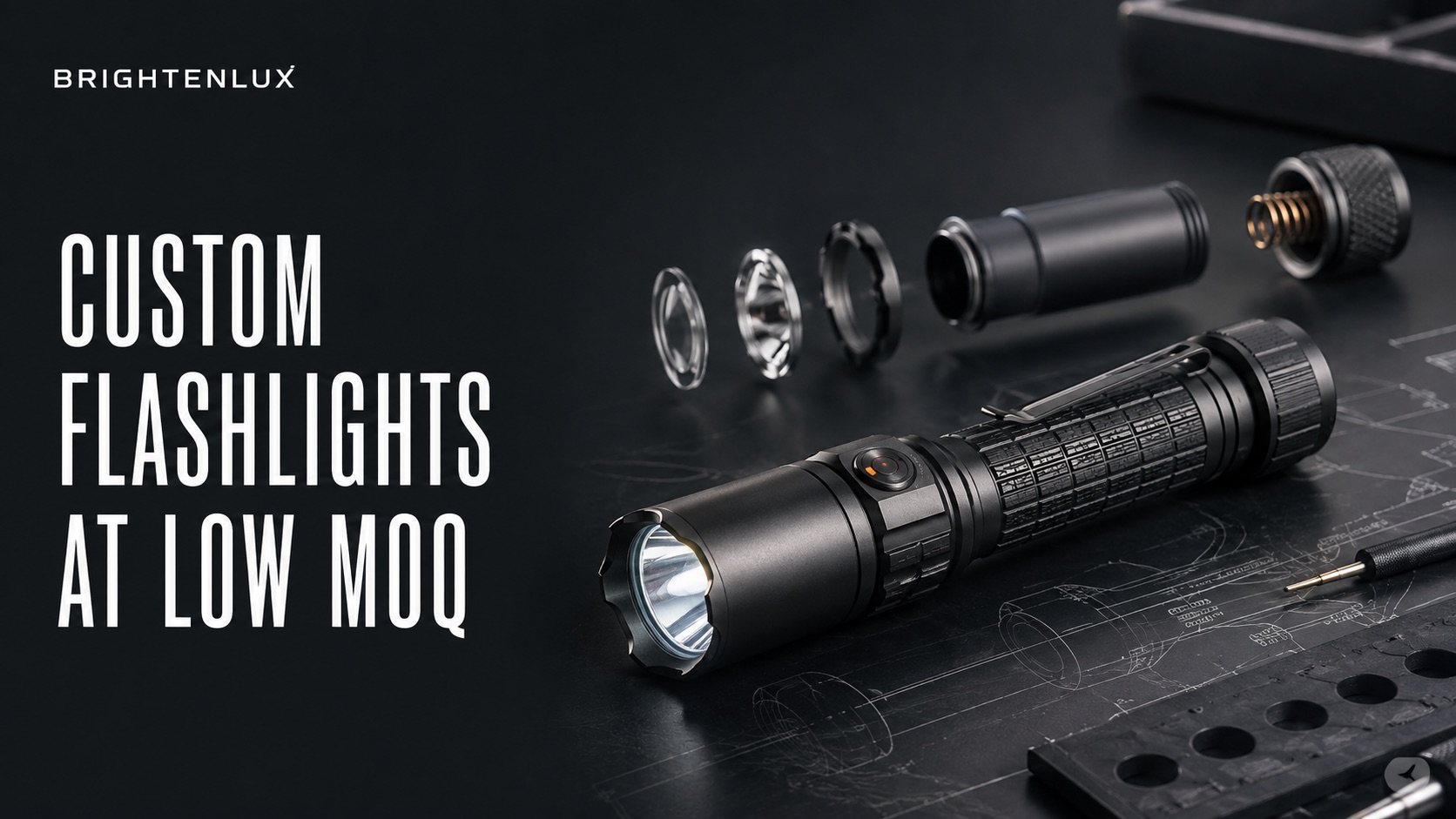
A handheld flashlight looks uncomplicated. It may have only a housing, lens, LED module, reflector or optic, switch, and battery compartment. Yet each part affects the user experience. A loose switch can be frustrating on a trail. An uneven optic can produce a weak or poorly controlled beam. A housing that feels solid in a sample may not remain consistent across a larger production run if the supplier has weak process controls.
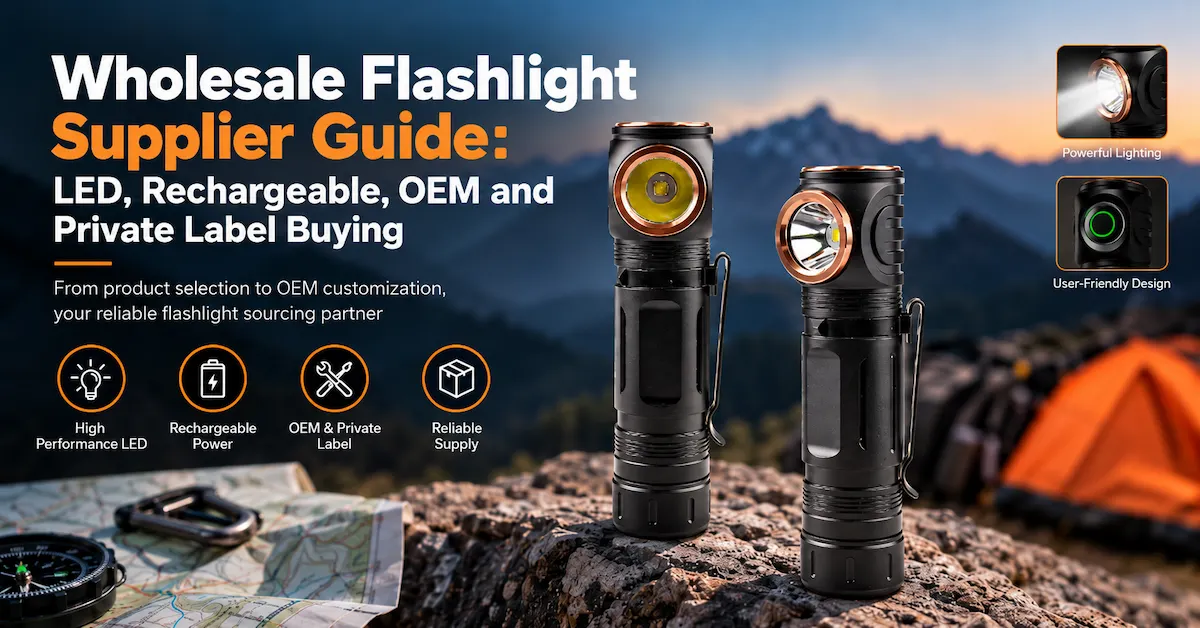
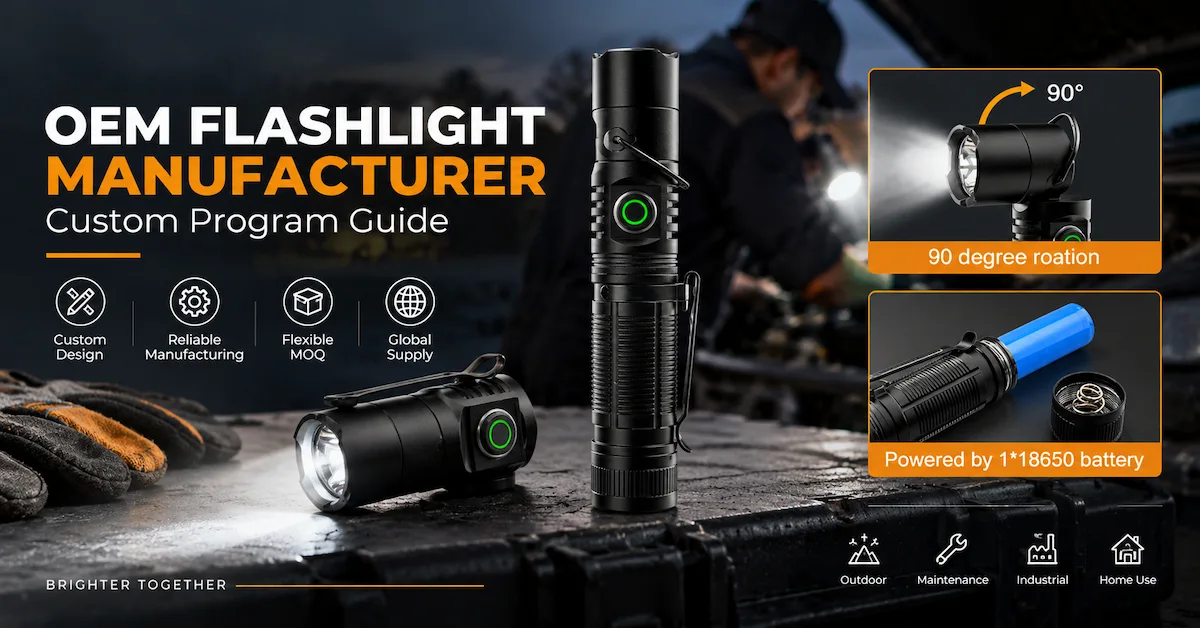
The supplied product information shows a small, dark-colored handheld flashlight producing a focused white beam in a mountain or valley setting. That makes its likely role clear: directional illumination rather than broad-area decorative lighting. It could suit night hiking, trekking, camping, emergency preparedness, outdoor maintenance, and similar tasks. However, the available information does not establish brightness, beam distance, runtime, battery type, charging method, weather resistance, impact rating, dimensions, weight, or certifications. Those gaps should become part of the buyer’s evaluation plan, not assumptions hidden inside a purchase order.
Quick reference: what to verify before selecting a supplier
| Evaluation area | What the buyer should confirm | Why it matters |
|---|---|---|
| Product architecture | LED module, optic or reflector, switch, battery compartment, lens, and housing design | These components determine beam control, usability, serviceability, and product cost |
| Materials and finish | Actual housing material, surface treatment, lens material, and grip details | A product image cannot reliably distinguish polymer from metal or confirm durability |
| Electrical performance | Brightness measurement method, runtime conditions, operating modes, and battery configuration | Nominal claims can be misleading without a defined test method |
| Environmental protection | Water and dust resistance testing, sealing design, and applicable impact testing | Outdoor users may expose the flashlight to rain, dirt, drops, and temperature changes |
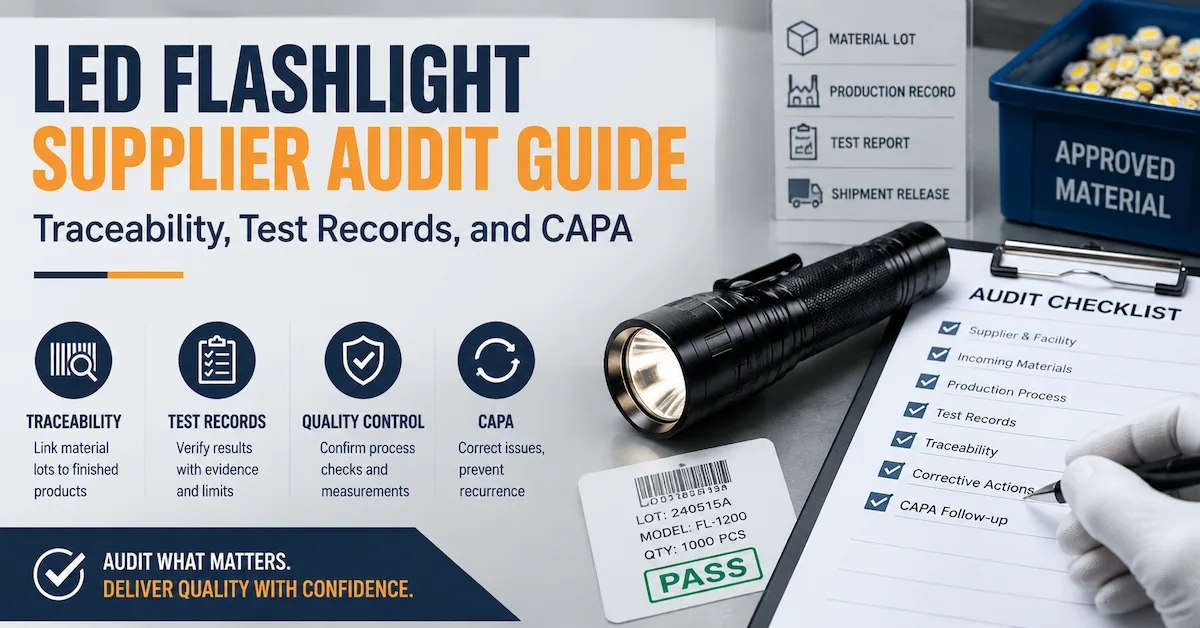
| Production control | Incoming inspection, assembly checks, functional testing, and batch records | Portable products need repeatable assembly, not just a convincing prototype |
Start with the application, not the catalog image
The same flashlight can be acceptable for casual camping and unsuitable for professional field maintenance. Define the use case in operational terms. Will users carry it in a pocket, attach it to equipment, or hold it for extended periods? Is a narrow beam preferred for trail navigation, or is a wider beam more useful for inspecting a work area? Will batteries be replaced in the field, or is a rechargeable design expected?
These decisions influence the housing shape, control layout, optical system, battery access, and grip. They also affect packaging and instructions. For example, an emergency-preparedness product may need simple controls and long storage stability, while a trekking product may place greater emphasis on compactness and one-handed operation. Do not ask the supplier to “make it outdoor” without defining what outdoor means in your application.
Product construction and manufacturing questions
Housing and surface finish
The image suggests a rigid body with a dark matte finish, but the material is not verified. It may be polymer or metal; the distinction should be confirmed through a specification sheet and sample inspection. Ask whether the housing is injection molded, machined, die cast, or made through another process. The correct process depends on volume, tooling investment, dimensional requirements, appearance, and product architecture.
Inspect the grip, switch location, battery cover, threads, and lens retention. A dark finish can hide scratches, sink marks, molding variation, or inconsistent coating. If the product is intended for repeated outdoor use, request samples from more than one production batch when possible. A single development sample says little about long-term consistency.
Optics and beam behavior
The visible beam is narrow and directed, which is appropriate for pointing light along a trail or toward a distant feature. Still, “focused beam” is not a complete performance specification. Ask for the beam profile, center intensity, spill pattern, color consistency, and test distance. Confirm whether performance is measured from a fully charged battery and how output changes as the battery discharges.
Do not accept a lumen figure without understanding the measurement basis. The LED brand, color temperature, optical component, and thermal management are also not supplied here. A supplier should state what is known and identify what remains configurable. This is especially important when a buyer is comparing several apparently similar flashlights.
Power system and controls
The battery type, capacity, charging method, and operating modes are unknown for this product. These are commercial and technical decision points, not minor details. Replaceable batteries may simplify field use, while integrated charging may improve convenience but introduce charging, cable, and battery-life considerations.
Ask the supplier to describe the switch design and control sequence. A product that cycles through several modes every time the button is pressed may be less suitable for emergency use than a simple on-off interface. Confirm whether the product has low-voltage behavior, charging indicators, thermal protection, or other functions relevant to the intended market. If none are included, that should be stated plainly.
How to assess a security lighting manufacturer versus a portable-lighting supplier
Search results often group handheld flashlights with a security lighting manufacturer, floodlights, work lamps, and other outdoor products. That classification can create confusion. Security lighting typically involves fixed installation, mounting hardware, wider coverage, controls, and site-level illumination. A handheld flashlight has different priorities: portability, beam direction, grip, battery access, and user control.
A supplier experienced in fixed luminaires may still be capable of producing a handheld product, but the buyer should verify relevant experience rather than relying on a broad catalog. Ask for evidence of portable product assembly, optical alignment, switch testing, battery-compartment inspection, and final functional checks. Product-category familiarity matters because the quality risks are not identical.
Common mistakes when buying from an outdoor lighting supplier
- Assuming the image proves the specification. The visible product does not establish lumens, runtime, IP rating, impact resistance, or certifications.
- Comparing prices before defining the test method. Two suppliers may quote different performance levels while using the same general product description.
- Approving one sample as representative of mass production. Request information about assembly controls and batch inspection.
- Ignoring the battery supply chain. Battery type, availability, transport requirements, and replacement policy can affect the complete product program.
- Using “waterproof” as a casual term. If water resistance matters, specify the required test or protection level and request supporting documentation.
- Overlooking user handling. Switch pressure, grip diameter, tailcap access, and one-handed operation should be evaluated by real users.
Where decorative outdoor lights fit—and where they do not
Decorative outdoor lights can be relevant to a broader outdoor lighting program, but they should not be used as a proxy for handheld flashlight capability. Decorative products usually prioritize appearance, ambient illumination, landscape integration, or installation method. A trail flashlight prioritizes directional output, portability, control, and energy use. A supplier may offer both categories, but each should receive its own technical review and acceptance criteria.
A practical supplier-qualification process
Begin with a structured request for information. Include the intended application, target form factor, beam preference, battery concept, operating environment, packaging expectations, and required documentation. Ask the supplier to separate standard features from proposed customizations. This avoids paying for assumptions that were never agreed.
Next, review a physical sample. Check the beam visually in a controlled area, operate the switch repeatedly, open and close the battery compartment, inspect the lens and housing, and assess balance in the hand. If the supplier claims outdoor resistance or impact performance, request the applicable test method and report rather than relying on marketing language.
Before approval, define the production specification in measurable terms. It should cover materials, dimensions where important, electrical behavior, battery configuration, appearance, labeling, packaging, inspection points, and acceptable defects. Exact tolerances and test limits should be agreed with the supplier for the specific design; they should not be copied from an unrelated flashlight.
Frequently asked questions
Is this product suitable for hiking and camping?
Its compact handheld format and focused beam appear suitable for those uses. Suitability cannot be confirmed fully until brightness, runtime, battery arrangement, weather resistance, weight, and impact performance are verified.
Can the housing material be identified from the image?
No. The finish appears dark and possibly matte, but the supplied information does not verify whether the housing is polymer, metal, or another material.
Should a buyer request certifications?
Yes, where certifications or regulatory documentation are required for the target market. The specific documents depend on the product configuration, battery system, destination, and sales channel. They should be confirmed with the supplier and applicable compliance specialists.
What is the most important first question for a supplier?
Ask the supplier to provide a complete, testable specification for the intended use rather than a catalog description. That single step exposes many unknowns early, when changes are less expensive.
Next step for buyers
Treat the pictured flashlight as a product concept with a clear use case, not as a finished specification. Shortlist suppliers that can explain the LED and optical assembly, housing process, power system, inspection plan, and documentation. Then compare samples under the same conditions. A capable professional outdoor lighting manufacturer should be willing to distinguish verified data from estimates and standard features from optional design work. That clarity is often a better indicator of sourcing reliability than a polished product page.