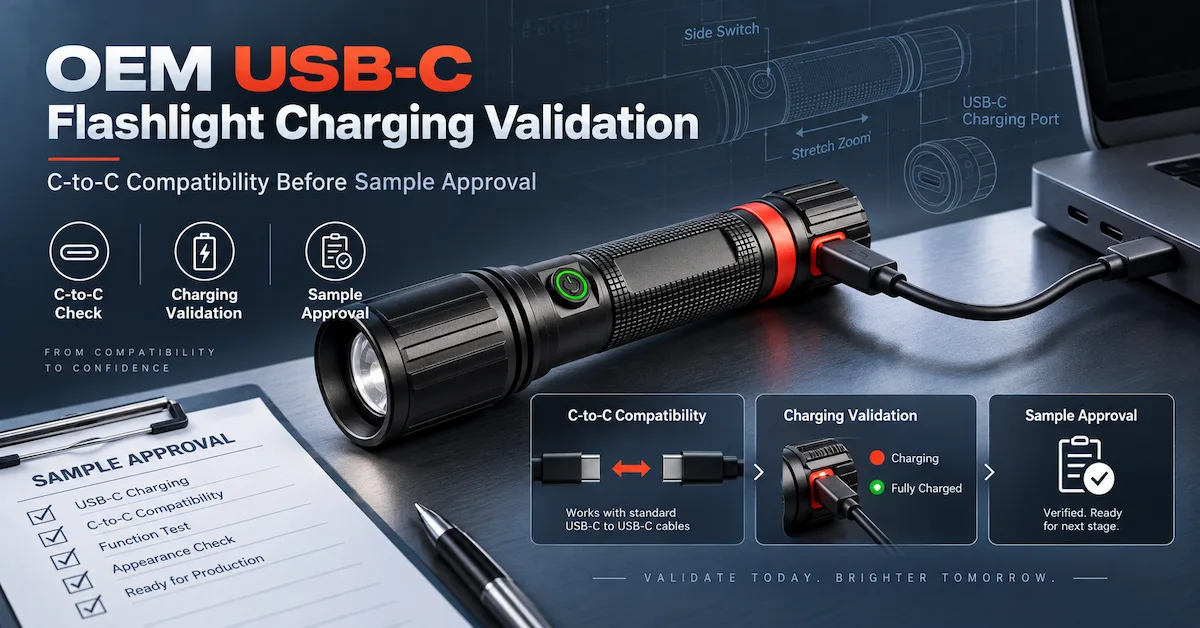


Quick Answer: When comparing a flashlight factory with low MOQ, buyers should calculate the total cost of receiving a saleable flashlight—not simply compare the minimum order quantity or factory unit price. Confirm whether batteries, charging cables, branding, packaging, inspection, and freight are included. Then compare prices using the same product specification, actual carton multiples, and realistic sales demand. A smaller order may cost more per unit but require significantly less initial inventory investment.
For overseas importers, e-commerce brands, industrial distributors, and private-label retailers, minimum order quantity (MOQ) is often one of the first questions asked when sourcing flashlights from China.
A supplier may advertise flexible ordering, while another offers a noticeably lower price at a larger quantity. Both offers can appear attractive. However, the lowest unit price is not always the most economical purchasing decision.
An inexpensive flashlight may become expensive when the quotation excludes its rechargeable battery, cable, inspection, or branded retail packaging. A small order may also become larger than expected when quantities must be rounded to complete cartons or purchased separately for each color and SKU.
These differences affect cash flow, warehouse capacity, product-launch risk, and the ability to replenish successful items.
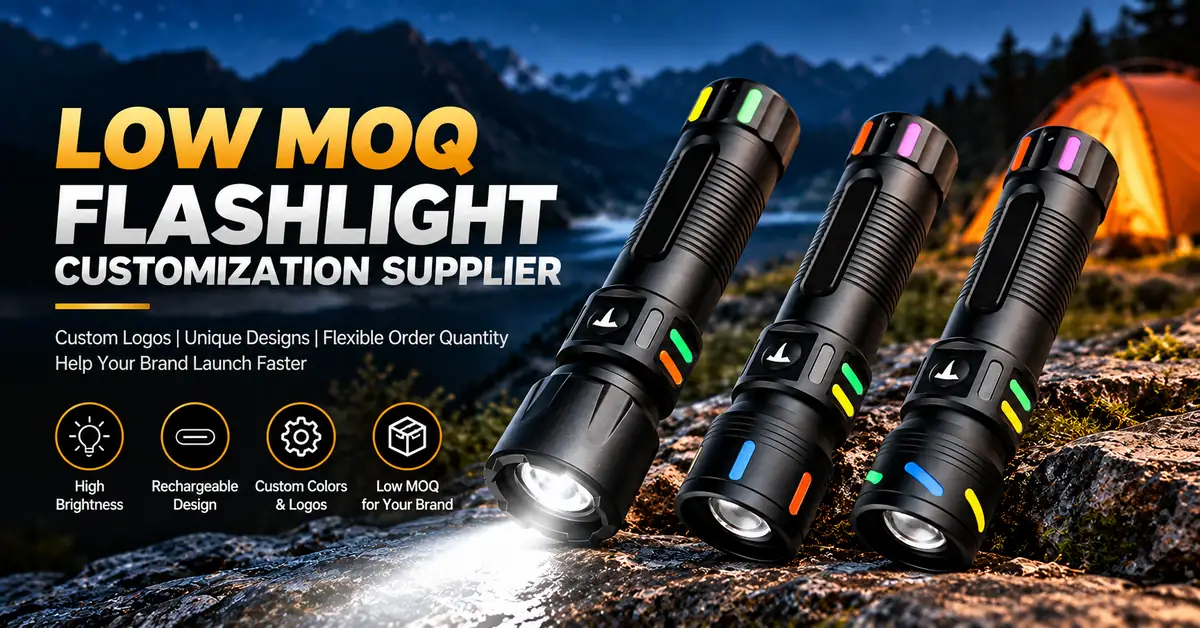
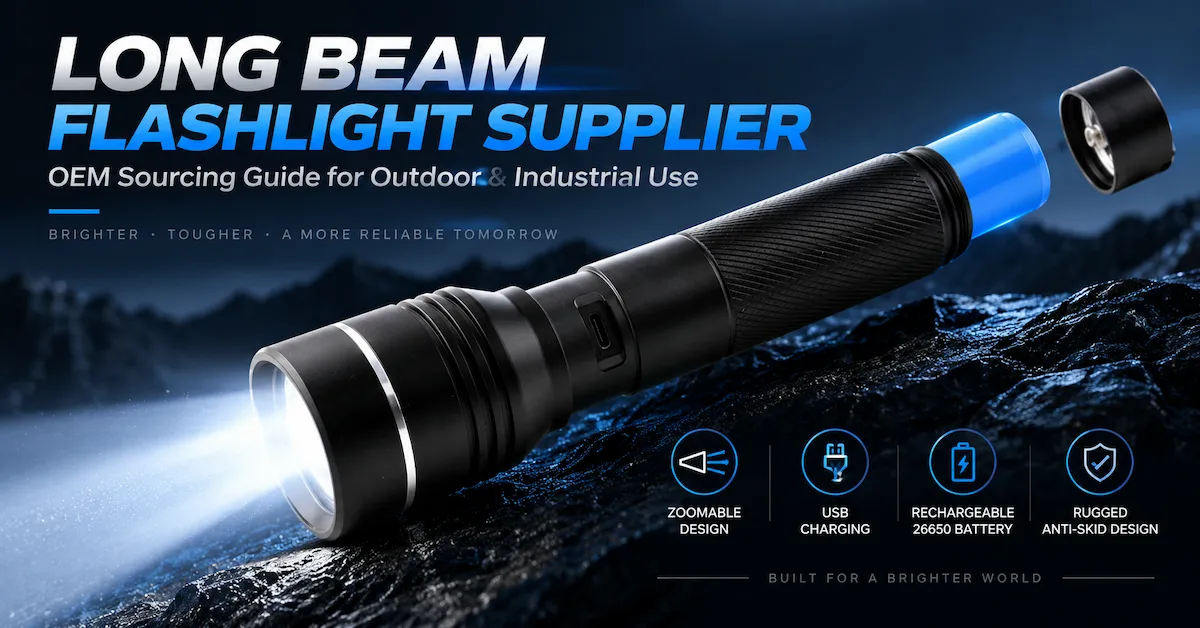
This guide explains how to audit small-batch flashlight quotations using technical specifications, landed-cost calculations, and practical purchasing controls. It also introduces documented flashlight platforms from Brightenlux, a China-based outdoor lighting manufacturer offering OEM/ODM services and low-MOQ logo-printing discussions.
The objective is simple: identify the most commercially workable order—not merely the supplier advertising the smallest minimum.
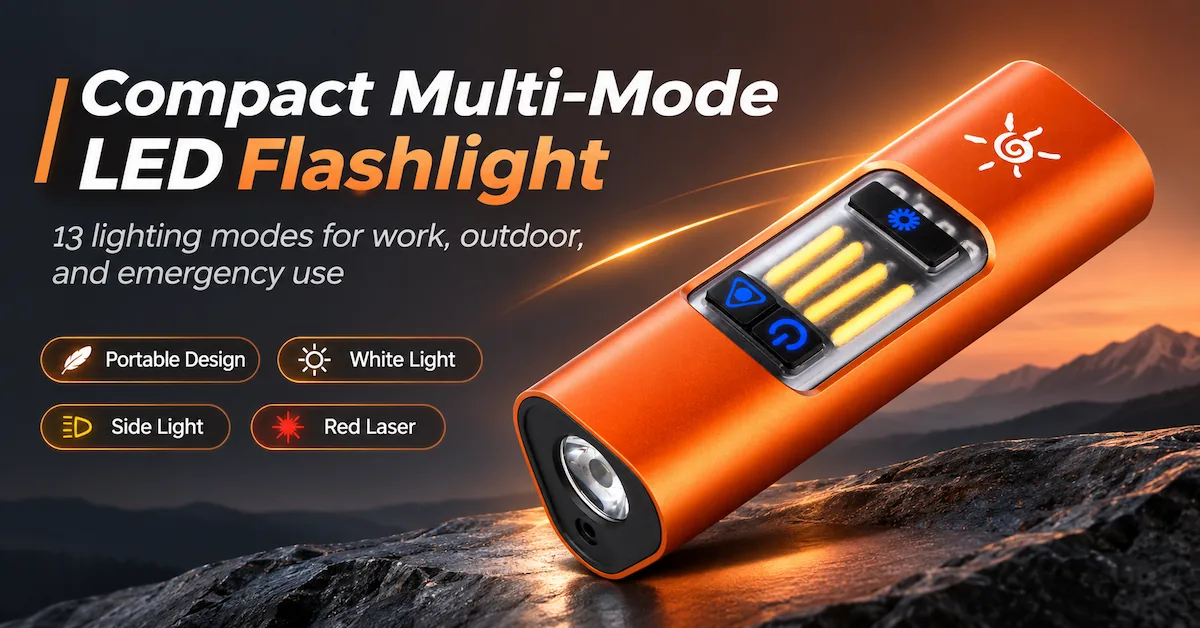
1. Key Takeaways for Low-MOQ Flashlight Buyers
- MOQ and economical order quantity are different. A factory may accept an order that is technically possible but commercially expensive.
- Product specifications must be identical. Price comparisons are unreliable when batteries, LEDs, accessories, or packaging differ.
- The minimum may apply per SKU. A mixed order of several flashlight models may not qualify for one combined MOQ.
- Carton quantities affect actual purchases. Full-carton requirements can increase the quantity beyond the buyer's initial request.
- Fixed costs matter more in small orders. Sampling, printing setup, inspection, and freight are spread across fewer units.
- Inventory exposure must be evaluated. A larger order may reduce the unit price while tying up substantially more working capital.
- Low MOQ does not eliminate quality requirements. Sample approval, battery verification, accurate performance claims, and pack-out inspection remain essential.
The best purchasing approach is to normalize quotations, calculate the complete landed cost, and assess how much unsold inventory the business can reasonably support.
2. What Does Low MOQ Really Mean for a Flashlight Factory?
MOQ refers to the minimum quantity a supplier is prepared to accept under specified conditions. In flashlight manufacturing, that quantity can depend on several different processes.
A standard black flashlight with an existing battery and packaging configuration may have different commercial requirements from the same flashlight with custom anodizing, printed cartons, a special battery, and an exclusive accessory kit.
The different quantities hidden inside one quotation
| MOQ Type | What It Controls | Buyer Question |
|---|---|---|
| Base product MOQ | Minimum quantity of an existing flashlight configuration | What quantity applies to this exact model and revision? |
| Per SKU MOQ | Minimum for each separately identified product variant | Can different models or colors be combined? |
| Branding MOQ | Printing, engraving, or logo setup requirements | Is the minimum calculated per logo design? |
| Packaging MOQ | Carton printing, inserts, sleeves, and manuals | Can standard packaging be used for a smaller order? |
| Component MOQ | Special LEDs, battery cells, drivers, or accessories | Does the requested component create a separate purchasing minimum? |
| Shipping multiple | Full-carton or pallet quantity restrictions | Must the final order be rounded to complete cartons? |
A factory's ability to supply a small number of standard units does not automatically establish that it can provide the same quantity with customized components or packaging.
Is a low-MOQ factory suitable for every buyer?
It can be particularly valuable for new private-label brands, regional distributors, promotional buyers, industrial equipment resellers, and companies evaluating an additional product category.
It may be less economical for buyers requesting dedicated tooling, unusual battery configurations, complex engineering modifications, or exclusive components at very small volumes. For those projects, the fixed development investment may outweigh the benefit of a low initial production quantity.
What does Brightenlux publicly offer?
Brightenlux's official website describes OEM/ODM support and low-MOQ logo printing for outdoor lighting products. However, it does not establish one universal minimum for every model, battery, packaging format, or customization request.
Therefore, buyers should request a model-specific and configuration-specific MOQ quotation.
3. Compare Real Flashlight Platforms Before Comparing Factory Prices
A quotation is only useful when the buyer knows what is being purchased. Different flashlight architectures affect component costs, operating functions, package size, shipping weight, and potential target customers.
Brightenlux offers several documented rechargeable flashlight platforms suitable for evaluation.
Brightenlux Product Comparison
| Product | Manufacturer-Published Configuration | Suitable Sales Direction | Cost and Verification Considerations |
|---|---|---|---|
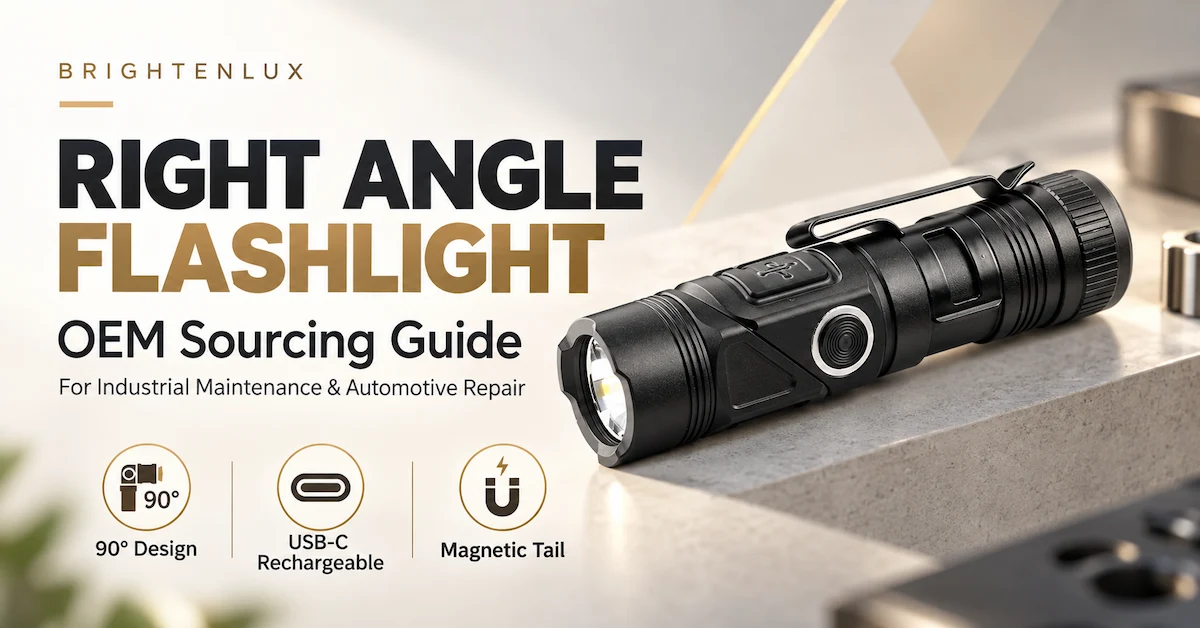
| BT-FL8078 Right-Angle Flashlight | Up to 1000 lm; SST25 LED; 16340 800mAh battery included; Type-C; magnetic tail | Compact inspection and maintenance accessories | Battery inclusion, mounting accessories, packaged size |
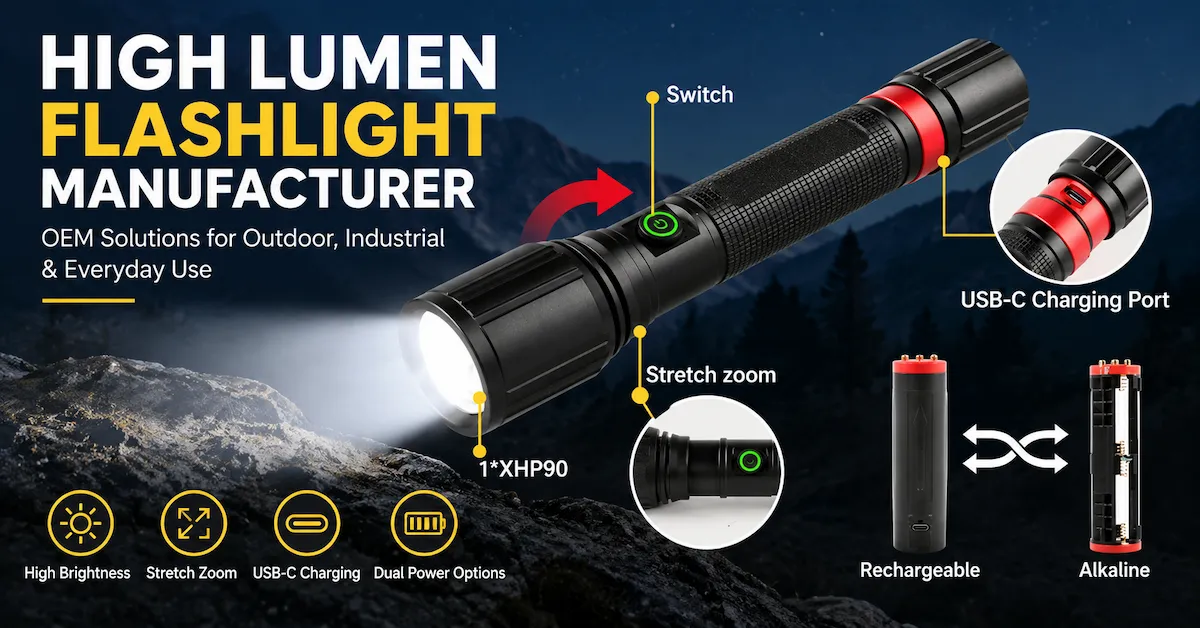
| BT-FL8104 Twist-Focus Flashlight | Up to 1000 lm; 18650 2200mAh included or three AAA cells; adjustable focus; Type-C | General retail, outdoor and preparedness products | Alternative battery arrangement, accessories, charging and packaging |
| BT-FL8088 Magnetic Rechargeable Flashlight | Up to 1500 lm; SST40 LED; 21700 4000mAh battery included; Type-C; magnetic tail | Outdoor and professional utility ranges | Battery identity, unit weight, runtime and mounting function |
The specifications above are manufacturer-published claims. They are not independent test results or confirmations of current MOQ, custom-logo availability, or prices.
Why model selection matters to low-MOQ economics
The BT-FL8078 uses a compact battery format and a right-angle design. The BT-FL8104 provides an adjustable-focus architecture and alternative battery arrangement. The BT-FL8088 uses a larger rechargeable cell and a magnetic attachment feature.
These are different product propositions, even where advertised brightness figures appear similar. A buyer should not compare a quotation for one model against another unless the commercial purpose is to select between those different products.
Recommended selection method
Choose the end-user application first. An industrial distributor may favor magnetic mounting and useful beam placement. An outdoor retailer may prioritize charging convenience, handling, runtime, and portability. A general hardware brand may prefer an established product with straightforward operation and packaging.
Then request quotations for the chosen configuration.
4. How to Audit a Small-Batch Flashlight Quotation
A professional quotation should identify the complete saleable unit. Without that detail, a low price may hide exclusions or differences that become apparent only after samples arrive.
The 12-Point Flashlight Quote Audit
| Quotation Item | What Must Be Confirmed |
|---|---|
| 1. Product | Model, revision, and approved configuration |
| 2. LED and optics | Emitter, focus or beam system, operating modes |
| 3. Battery | Exact supplied cell or pack, quantity, and configuration |
| 4. Charging | Connector, supplied cable, and electrical input |
| 5. Accessories | Clip, strap, holster, holder, or other included items |
| 6. Branding | Logo method, location, setup fee, and approval sample |
| 7. Packaging | Retail box, insert, manual, labels, and master carton |
| 8. MOQ | Total minimum, per-SKU minimum, and variant restrictions |
| 9. Quality | Sample approval, inspection scope, and applicable testing |
| 10. Price | Currency, unit price, fixed charges, and quotation validity |
| 11. Logistics | Incoterm, destination, carton dimensions, and shipping responsibility |
| 12. Timing | Sample preparation, artwork approval, production, and dispatch milestones |
Why identical specifications are essential
Suppose two factories quote a rechargeable flashlight. Factory A includes an approved lithium battery and a USB charging cable. Factory B quotes a visually similar flashlight without the battery. Factory B may appear cheaper, but the offers are not equivalent.
The buyer must add the missing components or request a revised quotation before comparing them.
Separate included and optional items
Require suppliers to mark each feature as included in the base price, available at an additional charge, subject to a separate MOQ, requiring engineering approval, or not included or unavailable.
This prevents an attractive initial quotation from becoming more expensive after order confirmation.
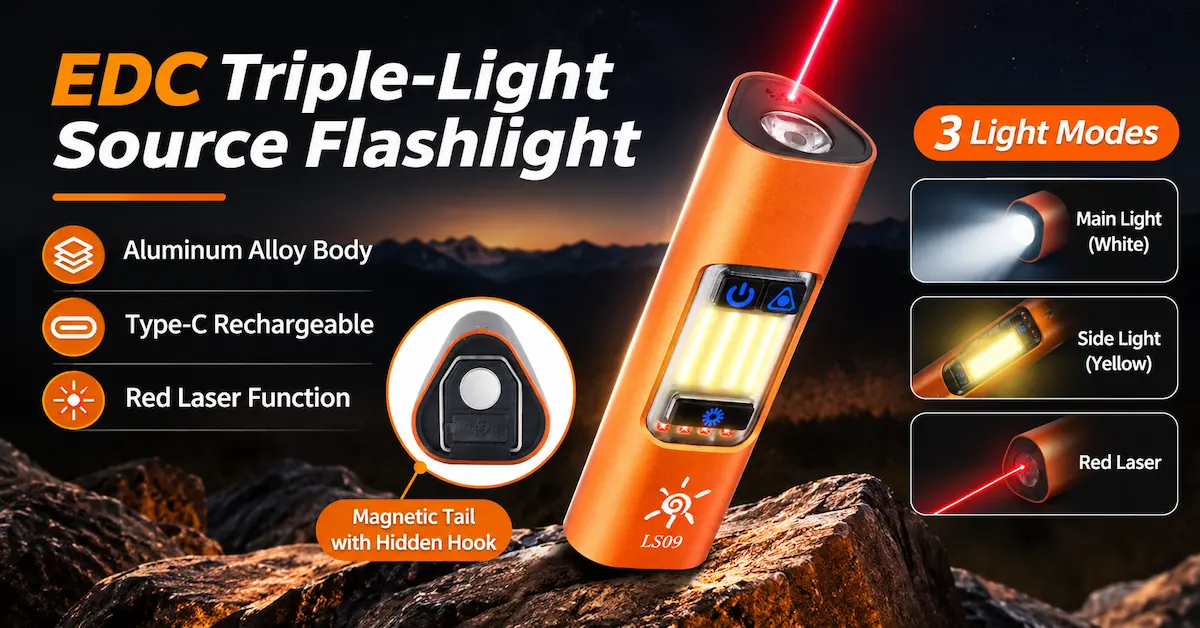
5. The Hidden Cost of Carton Multiples and Mixed-SKU Orders
A flashlight factory with low MOQ may still require complete shipping cartons or separate purchase quantities for individual models. These constraints can change the actual quantity the importer must buy.
Illustrative mixed-SKU calculation
Consider a hypothetical distributor requesting three flashlight types. The company wants 85 compact models, 55 general-purpose models, and 30 higher-output models.
Assume, strictly for this example, that the supplier requires full cartons containing 24 units of each SKU.
| SKU | Buyer Requested | Assumed Units per Carton | Full Cartons Required | Actual Order Quantity |
|---|---|---|---|---|
| Compact flashlight | 85 | 24 | 4 | 96 |
| General-purpose flashlight | 55 | 24 | 3 | 72 |
| Higher-output flashlight | 30 | 24 | 2 | 48 |
| Total | 170 | — | 9 | 216 |
The requested quantity is 170 units. The actual order becomes 216 units. That creates 46 additional units, approximately 27% above the original quantity request.
This is an illustrative planning example. It does not represent the actual carton quantities, MOQ, or packing practices of Brightenlux.
How to calculate the final quantity
When complete cartons are mandatory:
Actual order quantity = Round up (Requested quantity ÷ Units per carton) × Units per carton
Apply this calculation to each SKU separately. If partial cartons are permitted, the result may differ.
Questions to ask the supplier
Can partial cartons be ordered? Can multiple color variants share one master carton? Is MOQ calculated per physical model, packaging design, or purchase order? Can accessories and batteries be packed consistently across variants? Can an order combine models to qualify for a commercial price tier?
These questions should be settled before calculating freight or preparing the purchase order.
6. What Is the True Landed Cost of a Low-MOQ Flashlight Order?
The factory unit price is only one component of the final cost. A buyer importing flashlights may also pay for packaging, samples, branding, testing, inspection, freight, customs duties, and local handling.
A practical comparison should account for these charges under consistent assumptions.
Landed Cost Formula
Total landed cost = Product and included components + Packaging + Setup + Samples and testing + Inspection + Freight + Duties + Local handling
Landed cost per accepted saleable unit = Total landed cost ÷ Number of accepted saleable units
For initial planning, a buyer may assume every ordered unit passes inspection. For actual financial reporting, rejected or unsaleable units should be treated according to their documented disposition and recovery arrangements.
Hypothetical Small-Order versus Larger-Order Comparison
Consider two order scenarios for the same approved rechargeable flashlight configuration. The battery and charging cable are assumed to be included in the base product price in both scenarios.
All values below are invented for illustrating a calculation. They are not Brightenlux prices, current freight quotations, or promised order quantities.
| Cost Item | Small Order | Larger Order |
|---|---|---|
| Quantity | 120 units | 360 units |
| Base product per unit | $8.50 | $7.40 |
| Product subtotal | $1,020 | $2,664 |
| Packaging | $66 | $180 |
| Branding/setup | $110 | $160 |
| Inspection and testing allocation | $160 | $160 |
| Freight and handling | $620 | $980 |
| Total illustrative landed cost | $1,976 | $4,144 |
| Cost per unit | $16.47 | $11.51 |
In this example, the larger order has a substantially lower landed cost per unit. However, it also requires $2,168 more initial cash.
Is the larger order better?
That depends on actual demand. If the buyer expects to sell only 100 flashlights during the initial selling period, the small-order scenario leaves 20 units in inventory. The larger-order scenario leaves 260 units.
Those unsold products are not automatically a financial loss, but they tie up cash and may create storage, financing, markdown, or obsolescence risk.
If demand is stronger, the larger order may offer better economics and reduce the need for another shipment.
Commercial conclusion
Compare both the unit cost and the cash commitment. A low-MOQ purchase can be attractive even with a higher unit cost when it limits exposure to uncertain demand.
Conversely, repeatedly purchasing tiny batches may be inefficient when demand is stable and freight or setup charges remain high.
7. How to Compare Two Factory Quotes Fairly
To compare suppliers, the purchasing team should use one controlled specification and consistent commercial terms.
Normalize the product
Both quotations should include the same approved battery, charging cable, lighting functions, accessories, and packaging. If the proposed models differ, document those differences rather than treating them as equivalent.
Normalize the quantity
Request prices for the same buyer-defined quantities. A quotation for 100 units should not be compared directly with a 1,000-unit price without evaluating the additional inventory and cost assumptions.
Normalize delivery terms
EXW, FOB, CIF, and DAP quotations allocate transport responsibilities and costs differently. Buyers should compare offers at a common destination and cost basis.
A low EXW price may become less competitive when origin handling, export arrangements, freight, and destination charges are added.
Normalize testing and documentation
Confirm whether samples, performance reports, battery documentation, inspection, and destination-market requirements are included.
Do not assume a product's advertised features establish compliance with every market requirement.
Normalize payment and risk
Consider deposit requirements, payment timing, quotation validity, warranty procedures, and remedies for nonconforming goods.
The best offer is not necessarily the cheapest one. It is the offer that provides acceptable product performance and supply reliability at a commercially sustainable total cost.
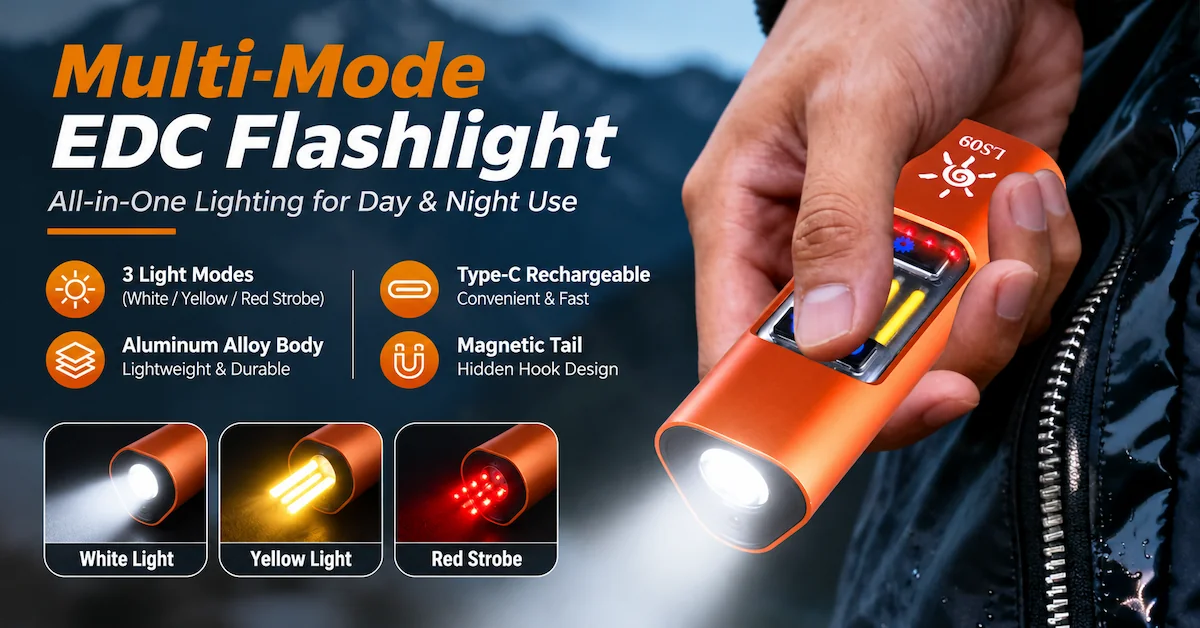
8. How Should Packaging Be Designed for Small-Batch Flashlight Orders?
Retail packaging can become a significant cost driver when orders are small. However, packaging decisions should be based on the intended distribution channel.
Standard packaging
An existing factory carton may be appropriate for certain industrial distribution programs where extensive branding is unnecessary. Confirm that any required labels and instructions are included.
Branded labels or sleeves
A printed label or sleeve may offer branding flexibility while retaining a standard protective package. The supplier should confirm the permitted artwork, material, application process, and minimum quantity.
Fully customized retail cartons
Custom printed cartons can improve shelf presentation and brand consistency. They may also introduce printing minimums, setup costs, additional proofing, and unused packaging inventory.
Packaging evaluation table
| Packaging Approach | Potential Advantage | Main Procurement Concern |
|---|---|---|
| Standard carton | Uses an existing format | May provide limited brand distinction |
| Standard carton with approved label | Can simplify presentation changes | Label durability and correct product information |
| Printed sleeve | Creates visible brand identity | Additional print and packing steps |
| Custom retail box | Greater control over brand presentation | Printing MOQ, setup, and leftover inventory |
| Custom protective insert | Tailored component protection | Tooling, fit testing, and material requirements |
These options are general sourcing approaches, not guaranteed Brightenlux services at a particular quantity.
Important packaging requirement
The package should accurately describe the product it contains. If the rechargeable battery is not included, the retail presentation should not imply otherwise.
Likewise, lumen, runtime, and ingress-protection claims should match the approved product configuration and available evidence.
9. Batteries, Charging, and Shipping: Why Small Orders Need Careful Planning
Rechargeable flashlight orders introduce technical and logistics considerations that do not disappear at low quantities.
Confirm the supplied battery
A flashlight may use an 18650, 21700, 16340, or another battery configuration. The cell format affects physical design, component sourcing, charging, runtime, and transportation arrangements.
For product comparison, record the actual battery supplied—not simply the battery format printed in a headline.
Verify charging functionality
A Type-C charging port should be checked for supported electrical input and the intended charger and cable configuration. Type-C does not automatically establish a particular charging speed or universal compatibility.
Plan lithium-battery shipments correctly
Lithium batteries may be subject to transport requirements depending on whether they are installed in equipment, packed with equipment, or shipped separately.
The UN Manual of Tests and Criteria, subsection 38.3, provides an important framework for lithium-cell and battery transport testing. For air freight, applicable IATA requirements and carrier procedures must also be considered.
The precise documentation, packaging, marking, and charge-state requirements depend on the current rules and shipment configuration. Buyers should obtain model-specific battery information and work with qualified shipping specialists.
Why this affects MOQ economics
Two flashlight quotations may use different battery arrangements. Those differences can influence the delivered cost even if the factory unit prices are similar.
A buyer should avoid committing to a small international shipment before confirming the battery configuration and practical transport options.
10. What Quality Checks Should a Low-MOQ Flashlight Factory Support?
A small production run still needs an approved product specification and an inspection process. Low MOQ should not mean reduced control over essential product functions.
Sample identification
The approved sample should be identified by model and revision. It should match the configuration intended for production.
Functional testing
Check operating modes, switches, charging, battery indicators, and relevant mechanical features. For magnetic or adjustable-angle products, evaluate the intended mounting and handling behavior.
Lighting performance
Where product claims require verification, request a suitable test method and documented conditions. The ANSI/PLATO FL 1-2025 standard provides a recognized framework for reporting applicable portable-lighting performance, including short-duration elevated-brightness modes.
Referencing the standard does not establish that a particular product has been tested or certified to it.
Appearance and branding
Inspect logo position, surface finish, marking durability, and consistency with the approved artwork.
Pack-out inspection
Verify the supplied battery, cable, accessories, manual, labels, and cartons.
Change control
The factory should notify the buyer before substituting critical approved components. A different battery, LED, driver, or charging board may require new approval and testing.
11. What Should Buyers Verify About Factory Capacity and Delivery Time?
A supplier's minimum order quantity does not establish its ability to meet a particular delivery date.
Production scheduling depends on material availability, customization, ongoing workload, inspection, and shipping arrangements.
Separate the project milestones
Ask for separate dates covering:
- Sample selection and approval.
- Logo and packaging artwork.
- Component and packaging procurement.
- Production scheduling.
- Assembly and functional inspection.
- Final pack-out and shipment preparation.
Confirm when the lead time begins
A stated production duration may begin only after deposit, sample confirmation, and final artwork approval. Buyers should clarify the actual trigger before planning launch dates.
Ask about future repeat orders
If a pilot is successful, the buyer may need additional stock. Discuss whether the same model and approved components can be sourced again and what notice is required.
However, avoid treating an estimated future reorder as a guaranteed production allocation unless the supplier has agreed to it.
What is the practical advantage of direct factory communication?
A factory-backed supplier can potentially coordinate product information, customization, sampling, and production planning through one commercial relationship.
Brightenlux publishes manufacturing and OEM/ODM service information, but project-specific capacity and timing should still be confirmed directly.
12. Which Low-MOQ Purchasing Strategy Fits Your Business?
Different buyer groups have different financial and operational priorities. A smaller initial purchase may be useful for some customers but inefficient for others.
Purchasing Decision Matrix
| Buyer Type | Primary Commercial Concern | Recommended Evaluation |
|---|---|---|
| New private-label brand | Avoiding unsold inventory | Compare total cash exposure and realistic demand |
| Regional flashlight distributor | Introducing another SKU | Check mixed-SKU minimums and carton quantities |
| E-commerce retailer | Product returns and listing accuracy | Verify batteries, accessories, dimensions, and claims |
| Promotional merchandise buyer | Branding and deadline control | Separate logo setup, artwork, and shipment milestones |
| Industrial equipment reseller | Product reliability and replenishment | Confirm approved configuration and repeat-order consistency |
| Established outdoor lighting brand | Total annual purchasing cost | Compare volume tiers, freight efficiency, and quality |
How to choose
If demand is uncertain, focus on managing initial capital exposure while keeping the product technically and commercially complete.
If demand is already established, evaluate whether larger orders can reduce freight, packaging, and purchasing costs without creating unreasonable inventory risk.
If the project requires unique electronics or tooling, evaluate total development economics rather than only the proposed first shipment.
13. A Quote-Ready RFQ for a Flashlight Factory With Low MOQ
A detailed RFQ helps the supplier prepare a commercially useful response. Instead of requesting the cheapest flashlight, provide the information needed to price the exact product and delivery arrangement.
Buyer Information
Company and market: Company name, destination countries, target customers, and sales channel.
Product application: Outdoor retail, repair, general use, preparedness, promotional supply, or another defined application.
Product Requirements
Preferred model: Provide a link to a Brightenlux flashlight or a clear product reference.
Technical specification: Required beam, brightness, operating modes, battery, charging, dimensions, and handling features.
Standard versus optional features: State which existing functions must remain unchanged and which features are requested as options.
Commercial Requirements
Quantity scenarios: Request quotations for the actual proposed starting quantity and two realistic alternative quantities.
SKU allocation: Provide the number of products, variants, colors, and desired quantity per SKU.
Packaging: Specify standard cartons, labels, sleeves, printed boxes, inserts, manuals, and barcodes as applicable.
Customization: Provide logo artwork, marking requirements, and any other requested changes.
Cost breakdown: Request unit cost, setup charges, samples, testing, inspection, packaging, and logistics assumptions separately.
Delivery: State the destination, Incoterm preference, and required shipment window.
Quality and Documentation
Sample approval: Request a representative sample of the intended production configuration.
Inspection: Define relevant functional, visual, charging, and pack-out requirements.
Documentation: Identify market-specific technical or transport documentation requirements.
Ask for a structured quotation response
| Supplier Response Field | Information Needed |
|---|---|
| Model and revision | Exact proposed product |
| Minimum quantity | Per product and per variant |
| Quantity tiers | Unit prices at the requested quantities |
| Carton details | Units per carton, dimensions, and weights |
| Included components | Battery, cable, accessories, manuals |
| Customization | Available methods and limitations |
| Fixed charges | Artwork, printing, tooling, samples |
| Testing and inspection | Included services and additional charges |
| Logistics | Incoterm and shipping assumptions |
| Timing | Sample, artwork, production, and dispatch |
| Exceptions | Differences from the requested specification |
| Quote validity | Expiry date and relevant conditions |
A supplier response containing these fields is far more useful than a single price and MOQ number.
14. Frequently Asked Questions About Low-MOQ Flashlight Factories
1. What is a realistic MOQ for an LED flashlight factory?
There is no universal number. MOQ depends on the selected model, current components, customization, packaging, factory scheduling, and commercial terms. Request a written minimum for the exact product configuration rather than relying on a general advertising statement.
2. Does Brightenlux support low-MOQ flashlight orders?
Brightenlux publicly advertises OEM/ODM services and low-MOQ logo printing. However, the exact minimum quantity, available branding methods, product options, and pricing must be confirmed for the selected model and order.
3. Can I combine different flashlight models into one small order?
Possibly, but mixed-model orders may have separate requirements for each SKU, battery configuration, packaging design, or production process. Ask whether the factory permits pooled quantities or applies minimums independently.
4. Why can the landed cost of a small flashlight order be high?
Fixed expenses such as samples, artwork, inspection, and freight are distributed across fewer units. Packaging and transport efficiency may also differ from larger orders. Compare the complete delivered cost rather than the factory unit price alone.
5. Can a low-MOQ order include custom logos and packaging?
Depending on the chosen model and production arrangements, branding may be possible. Logo methods, printing minimums, artwork charges, and custom packaging requirements should be quoted separately and approved through representative samples.
6. Are rechargeable batteries included in wholesale flashlight prices?
Not always. Product listings may describe included batteries, but the exact order configuration must be confirmed. Request a written pack-out list covering the supplied cell, cable, accessories, and any alternative battery options.
7. How can I compare two flashlight factory quotations accurately?
Use one approved specification and normalize product components, quantity, customization, packaging, testing, trade terms, and destination. Record all exclusions and fixed charges before comparing the effective landed cost.
8. Is the lowest MOQ always best for a new brand?
No. A smaller order may limit inventory exposure but increase unit costs. A larger order may improve purchasing efficiency while tying up more cash. The appropriate quantity depends on actual demand, sales-channel requirements, and financial capacity.
9. What quality inspections should be completed before shipment?
Verify the approved product identity, lighting modes, charging function, battery configuration, physical condition, branding, included accessories, packaging, and relevant technical claims. The inspection scope should match the agreed specification.
10. How can I request a low-MOQ OEM flashlight quotation from Brightenlux?
Provide the preferred product model, destination market, proposed quantities, number of SKUs, battery and packaging requirements, logo details, and delivery expectations. Use the Brightenlux contact page to request model-specific MOQ, pricing, samples, and production information.
Conclusion
Choosing a flashlight factory with low MOQ is not simply a matter of identifying the smallest acceptable opening order.
For international importers, private-label retailers, and industrial distributors, the more important question is whether the proposed quantity delivers an acceptable product at a sustainable total cost.
A professional purchasing decision should consider the complete flashlight configuration, battery inclusion, accessories, branding, packaging, carton multiples, inspection, freight, and inventory exposure.
Buyers should also distinguish the factory's minimum production quantity from the quantity their own business can economically support.
A small order can help control risk when demand is uncertain. A larger order can improve cost efficiency when the sales forecast and available working capital justify the commitment.
Brightenlux offers documented rechargeable flashlight platforms, including the BT-FL8078, BT-FL8104, and BT-FL8088, together with OEM/ODM and low-MOQ logo-printing discussions.
These products provide starting points for a model-specific sourcing evaluation, while actual MOQ, customization options, packaging requirements, prices, and delivery schedules must be confirmed for each project.
Before committing to wholesale production, request an itemized quotation, calculate the complete landed cost, check carton and SKU restrictions, approve the supplied product configuration, and assess the cash required for the proposed order.