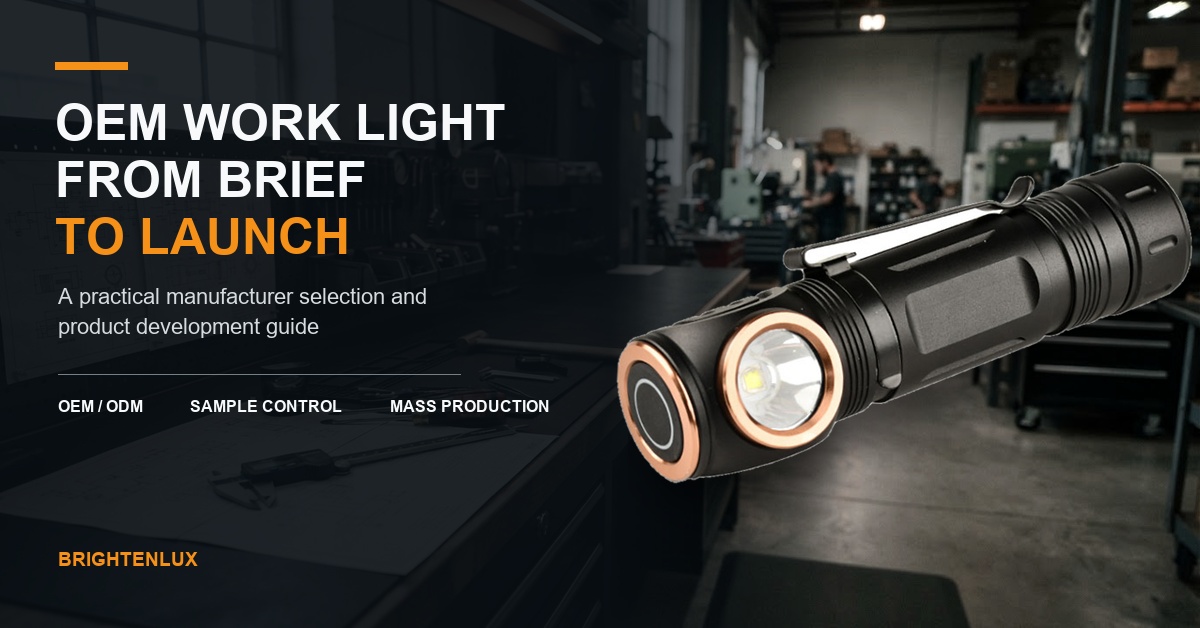


Quick Answer: A custom LED flashlight supplier should explain which changes affect appearance only and which require new engineering or performance validation. Logo printing may need artwork and marking approval; changing the LED, driver, battery, charging circuit, optics, or enclosure can affect lumen output, runtime, thermal behavior, safety, and published claims. Classify every modification, validate representative samples, and obtain a configuration-specific quotation before OEM production.
A custom flashlight project often begins with a simple request: change the logo, improve brightness, increase battery capacity, or add a special feature. However, those changes have very different manufacturing consequences. Changing a carton color is not equivalent to changing a lithium battery. A new LED can require driver and thermal checks, while a redesigned charging-port cover may change water-resistance performance.
For distributors, outdoor brands, industrial equipment suppliers, and private-label retailers, these dependencies affect cost, development time, minimum order quantities, validation, and after-sales exposure. The challenge is not finding a supplier willing to say yes. It is finding one able to explain what changes, what must be tested again, what costs more, and what can remain unchanged. This guide provides a practical framework based on documented portable-lighting platforms from Brightenlux.
Need a customized flashlight configuration? Start with a proven model or request project advice.
Browse LED Flashlight Products ›Request a Custom OEM Quote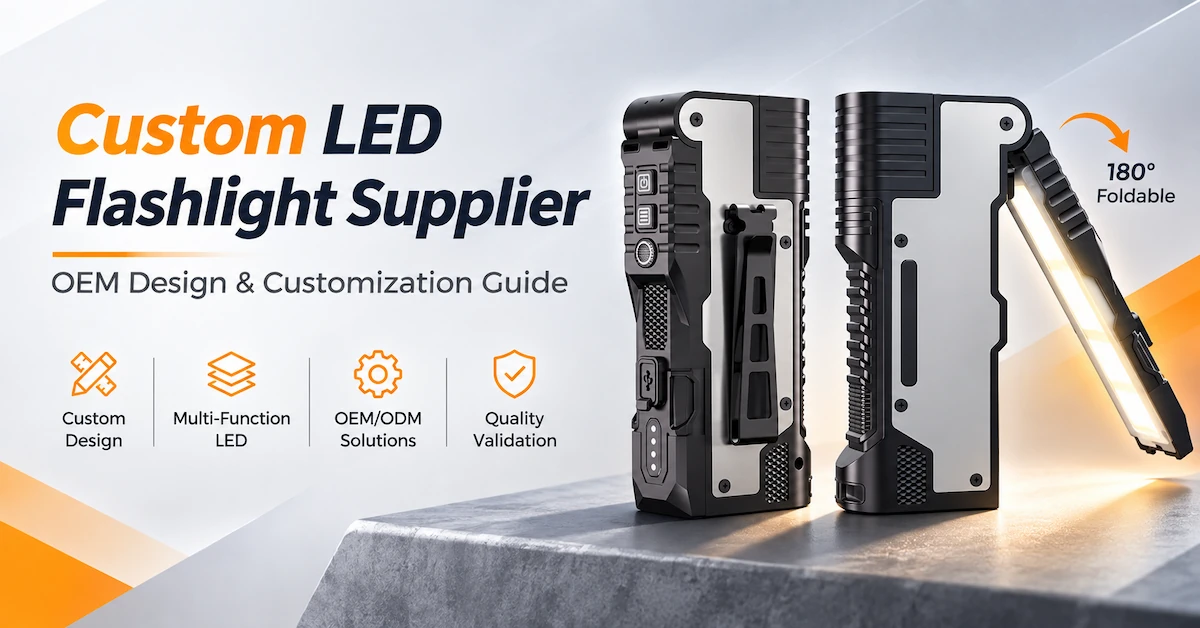
1. Quick Comparison: Four Levels of LED Flashlight Customization
The first decision is to classify the proposed change. Appearance modifications may leave the electrical architecture untouched. Other requests affect several connected subsystems and may require engineering work.
| Customization level | Typical changes | Main approval requirements | Commercial impact |
|---|---|---|---|
| Level 1: Branding | Logo, carton artwork, manual, barcode | Artwork, location, print quality and packaging | Usually limited technical impact |
| Level 2: Mechanics and accessories | Housing finish, clip, strap, magnet, grip | Fit, assembly, retention, durability | Depends on materials and tooling |
| Level 3: Electrical and optical | LED, reflector, driver, battery, charging, modes | Electrical, optical, thermal, charging and function tests | Potentially substantial validation and development |
| Level 4: New product development | New housing, electronics, optics or integrated product | Drawings, prototypes, tooling and comprehensive validation | Highest project complexity |
These four levels are a purchasing framework, not guaranteed Brightenlux service tiers or price brackets. A responsible supplier should identify the actual technical work for each proposal.
Which route usually makes commercial sense?
Many brands should begin with an existing flashlight platform that already serves the intended user. Customize visible and valuable details first; request a new optical, battery or electronic architecture only when the expected improvement can be measured.
2. Key Takeaways for OEM and Private-Label Buyers
- Branding often has fewer technical consequences than changing batteries, LEDs, charging electronics or enclosure joints.
- A change to one component can require new tests of several connected components.
- Maximum advertised lumens should not be confused with useful sustained light output.
- Battery substitutions need more than a comparison of printed mAh ratings.
- An approved physical sample must correspond to a controlled product configuration.
- A custom LED flashlight supplier should quote and validate the exact proposed version, not an approximate catalog product.
Purchasing rule: Do not release a feature change for production until its impact on performance, assembly, documentation and cost has been reviewed.
3. Change-Impact Matrix: Which Modifications Require New Tests?
A change-impact matrix helps a buyer see what may happen downstream when a supplier updates a component or feature. It is particularly valuable for products combining cosmetic, mechanical and functional changes.
| Proposed change | Possible technical impact | Recommended verification |
|---|---|---|
| Printed or laser-engraved logo | Appearance and marking durability | Artwork, location and surface-finish checks |
| New housing color or coating | Finish consistency and part fit | Color reference, adhesion and assembly checks |
| Different belt clip or magnetic tail | Retention and mounting strength | Mechanical fit and use-case tests |
| Alternative LED emitter | Output, current demand, heat and color | Photometric, driver and thermal checks |
| New lens or reflector | Beam spread, intensity and distance | Beam measurement and optical inspection |
| Battery cell or capacity change | Runtime, dimensions, charging and temperature | Cell approval, charging and runtime tests |
| Modified USB-C charging board | Input behavior, protection, charging time | Electrical and charging-system validation |
| Different operating modes | User interface, consumption and runtime | Control, firmware and mode-specific checks |
| Modified seal or port cover | Dust and water ingress performance | Applicable enclosure and ingress tests |
| New retail packaging | Protection, contents and product claims | Artwork, pack-out and transport checks |
Not every modification demands every test. Scope testing according to affected functions, applicable requirements, contractual specifications and credible failure modes.
Example: Requesting a brighter LED
Before choosing a substitute emitter, ask if the driver can operate it correctly, whether heat increases, whether the optics still form the intended beam, whether runtime remains acceptable, and whether carton claims need revision. A seemingly small component change can become an electrical, thermal and marketing change.
Example: Increasing battery capacity
A higher advertised mAh figure is not automatically interchangeable with an approved cell. Confirm dimensions, voltage, discharge characteristics, protection, charging compatibility, approved sourcing and relevant paperwork. A larger cell may also change weight, mechanical retention or the charging process.
Buyer action: Ask for a written change-impact assessment whenever a request touches the electrical, optical, mechanical or environmental characteristics of the product.
4. Which Brightenlux Flashlight Platform Should Buyers Customize?
Brightenlux, officially Ningbo Brightenlux Electric Appliance Co., Ltd., manufactures portable LED lighting products. Its public portfolio includes rechargeable handheld flashlights, adjustable-focus designs, right-angle magnetic lights and higher-output models. It also describes OEM/ODM outdoor lighting services for international buyers.
An existing product architecture is often a practical starting point, provided the buyer confirms the proposed modifications rather than assuming every listed component is interchangeable.
| Product | Manufacturer-published features | Possible positioning | Priority to verify |
|---|---|---|---|
| BT-FL8104 Twist-Focus Flashlight | Up to 1000 lm; 18650 2200mAh or three AAA; Type-C; adjustable focus | General retail, preparedness and outdoor | Dual-power behavior, battery inclusion, zoom mechanism |
| BT-FL8078 Right-Angle Flashlight | Up to 1000 lm; SST25; 16340 cell; magnetic tail; Type-C | Maintenance, inspection and hands-free | Magnet retention, attachment and modes |
| BT-FL8088 Rechargeable Flashlight | Up to 1500 lm; SST40; 21700 4000mAh; Type-C; magnetic tail | Outdoor and professional portable lighting | Thermal behavior, runtime and charging |
| BT-FL8101 High-Power Flashlight | Up to 3000 lm; 26650 4000mAh or six AA; Type-C; power-bank feature | Larger-body, higher-output programs | Sustained output, alternate power, USB and weight |
The features above are descriptions published by the manufacturer, not independently verified results. Confirm present availability, actual supplied configuration, testing evidence and OEM feasibility for every quotation.
BT-FL8104: Adaptable general-purpose design
This adjustable-focus platform may be suitable for retail hardware and outdoor buyers. Its published rechargeable and AAA options create a useful discussion of battery strategy, but both operating configurations, accessories and packaging must be specified for the actual order.
BT-FL8078: Right-angle magnetic design
A right-angle layout and magnetic tail can make this platform relevant to repair and maintenance applications. A requested clip, holder or mounting change should be assessed under a representative work task, not simply approved by appearance.
BT-FL8088: Rechargeable magnetic platform
This 21700-based design is a candidate for brands evaluating a rechargeable flashlight with magnetic attachment. Relevant validation includes charge behavior, sustained output, operating modes and mechanical retention.
BT-FL8101: Larger high-output architecture
This platform may suit buyers seeking a different size and light-output category. Higher maximum lumens can bring thermal, runtime, weight and cost tradeoffs. A replacement LED or battery cannot be approved based only on headline performance.
Selection approach: Choose the closest existing architecture before proposing new electronics or tooling.
Review model features before committing to a custom design.
Compare Rechargeable Flashlights ›Ask for Model Datasheets ›5. Which Custom Features Are Worth Paying For?
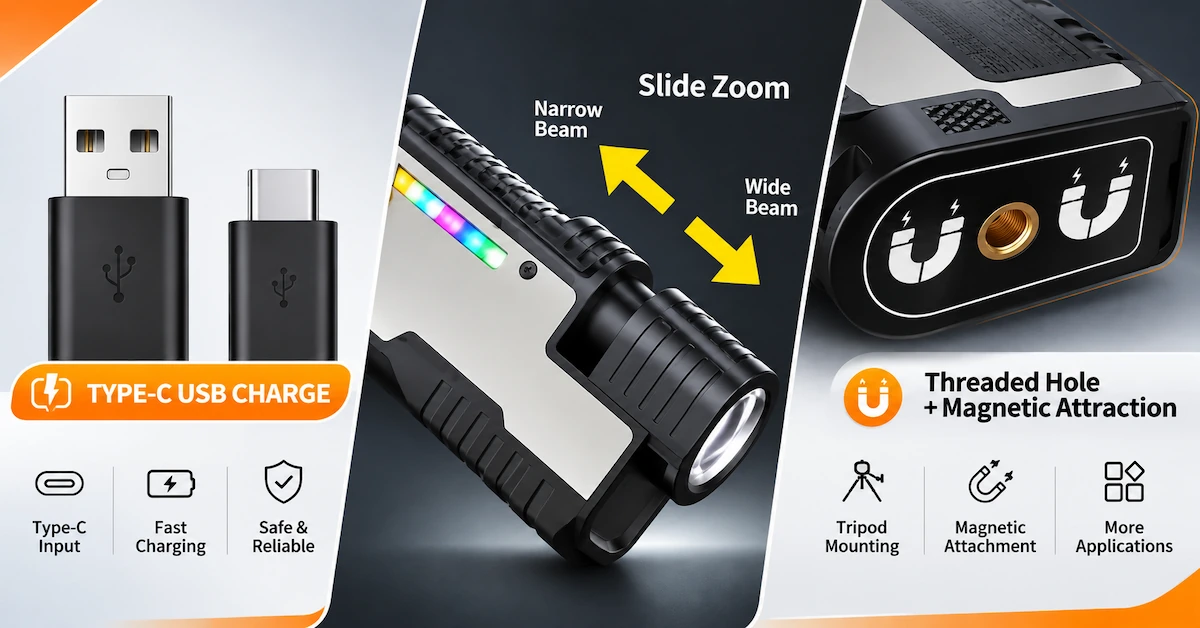
Customization should help a defined customer segment. A visible feature without a practical benefit may introduce additional sourcing, inspection and warranty complexity.
Outdoor retail brands
Buyers may prioritize beam usability, manageable size, straightforward charging, comprehensible controls and appropriate runtime. A new finish or package can differentiate the line without an electrical redesign, provided it is commercially valuable.
Industrial equipment distributors
Relevant benefits might include clip retention, magnetic mounting, switch accessibility and beam direction. Evaluate mounting and handling under permitted field tasks before final approval.
Emergency-preparedness brands
Purchasers may value intuitive controls, storage instructions and compatible power arrangements. Do not describe a general portable flashlight as a certified building emergency luminaire without appropriate evidence.
Promotional and private-label buyers
A standard product with high-quality branding, controlled accessories and accurate packaging can often be more appropriate than a completely new flashlight design. The choice should follow sales-channel requirements and the buyer's volume assumptions.
Decision question: Does the feature improve the user's task, meet a verified market requirement, reduce ownership problems or justify a credible commercial premium?
6. Which Specifications Must Be Frozen Before Sample Approval?
A custom flashlight is not defined completely by a product image. Its approved record should identify the elements that affect operation and commercial presentation.
| Specification group | Required information | Approval evidence |
|---|---|---|
| Product identity | Model, revision and buyer project code | Controlled product specification |
| Optical system | LED, optics, modes and output claims | Representative sample and relevant tests |
| Electronics | Driver, charging board and firmware | Electrical and functional verification |
| Battery | Cell type, voltage, capacity, included configuration | Approved cell and applicable documents |
| Mechanical | Materials, finish, dimensions, switch, clip and seals | Drawings and physical sample |
| Environmental | Intended exposure and claimed protection | Relevant configuration-specific evidence |
| Branding | Logo artwork, method, color and position | Approved appearance reference |
| Packaging | Box, manual, labels and accessories | Artwork and pack-out approval |
| Commercial | MOQ, tooling, price, inspection and delivery | Written proposal and agreement |
Identify standard features, accepted modifications, new development, and excluded requests. This keeps purchasing, engineering, production and marketing aligned, especially when a buyer uses multiple custom options.
7. How Should a Supplier Validate Design Changes?
Validation should be proportionate to the technical effects of the change. A printed logo may need surface-durability approval; a new battery or driver requires more comprehensive work.
Optical and lumen measurements
If an LED, optic, driver or operating mode changes, review output, beam pattern and run-time claims. ANSI/PLATO FL 1-2025 provides recognized performance reporting methods for applicable portable lighting products. A short-duration peak-output figure should not be confused with useful sustained operation. Mentioning this standard does not establish that a particular Brightenlux model has been independently tested against it.
Battery and USB-C behavior
A battery or charging-board change may affect charging time, temperature, protection, usable energy and transport documentation. USB-C identifies a connector; it does not automatically guarantee a specific USB Power Delivery input or charging rate.
Mechanical and thermal behavior
A new clip, magnet, enclosure or optical assembly may change ergonomics, fit or heat transfer. Test the proposed configuration under representative use cases. Even a mechanically sound add-on can be unsuitable if it blocks a switch or slips off the intended mounting surface.
Enclosure protection and claims
If the product advertises an IP classification, reconsider evidence when seals, joints or charging covers change. IEC 60529 describes enclosure ingress-protection ratings. Existing evidence for a different enclosure revision should not automatically be applied to the redesigned product.
For each important claim, identify the tested product revision, method, conditions, results and relationship to the proposed production configuration.
Changes to battery, optics and charging need a clear validation scope.
Explore OEM / ODM Options ›Discuss Required Testing ›8. A Three-Stage Sample Approval Process
Stage 1: Feasibility sample
Confirm basic suitability: physical format, beam, charging architecture, handling, controls and possible branding locations. Record every deviation from the buyer's initial brief.
Stage 2: Engineering or customization sample
Evaluate the requested changes, including functional effects and testing needs. A new operating sequence, accessory, finish, battery or optical element should be identified in a revision log.
Stage 3: Preproduction approval
Approve a sample representing the configuration intended for bulk manufacturing. Link it to the final specification, bill of materials, logo files, packaging, inspection plan and test results. Retain a golden sample with a recorded revision.
If anything changes after approval, request an updated impact review and decide whether supplementary validation or a new sample is required. Not every substitution demands a complete redesign, but it should not be hidden from the buyer.
9. How Much Can Flashlight Customization Add to the Cost?
Complete OEM pricing may include the standard flashlight, batteries, accessories, special materials, packaging, engineering, prototypes, tooling, validation and inspection. Compare the complete program rather than one bare unit price.
Hypothetical cost example — not a supplier quotation
Assume a brand considers two versions for 1,500 units:
| Cost element | Standard-platform branding | Functionally modified product |
|---|---|---|
| Order quantity | 1,500 | 1,500 |
| Assumed unit cost | $8.00 | $8.70 |
| Product subtotal | $12,000 | $13,050 |
| Assumed setup and validation | $300 | $2,100 |
| Illustrative total | $12,300 | $15,150 |
| Effective cost per unit | $8.20 | $10.10 |
In this hypothetical example, the modified project costs $2,850 more, or $1.90 more per unit. Freight, duties, taxes, after-sales support and other project costs are excluded. These numbers are not Brightenlux pricing or a market benchmark.
When is extra customization justified?
A modification can be worthwhile if customer demand, market requirements, or task performance supports the additional expense. A higher advertised specification does not automatically create a higher selling price.
How does MOQ change?
Branding, custom-color parts, a new PCB and new housing tooling may have very different material and process requirements. Obtain separate written MOQ and lead-time conditions for the exact product revision. Do not treat a logo-printing MOQ as a guarantee for new electronic development.
Compare complete delivered configurations, not bare unit prices.
Request Custom Pricing ›View Available Products ›10. Common Custom Flashlight Development Problems
Problem 1: A feature without a measurable requirement
Requesting a brighter LED without specifying operating duration, useful beam or heat limits can produce a less suitable product. Define measurable acceptance criteria first.
Problem 2: Treating similar batteries as interchangeable
Two cells may carry similar nominal capacities yet differ in electrical or physical characteristics. Approve the correct cell, charging behavior and relevant documentation.
Problem 3: Late mechanical changes
Modifying a housing after tooling or sample approval may affect dimensions, seal fit, packaging and cost. Freeze critical interfaces before major commitments.
Problem 4: Unsupported marketing claims
A revised carton may list brightness, runtime or waterproof ratings that no longer match the changed configuration. Approve claims and supporting evidence before printing.
Problem 5: Uncontrolled repeat-order substitutions
A later production batch may include an alternate LED or battery. Use revision control, component approval and an explicit supplier change-notification process.
11. How to Evaluate a Custom LED Flashlight Supplier
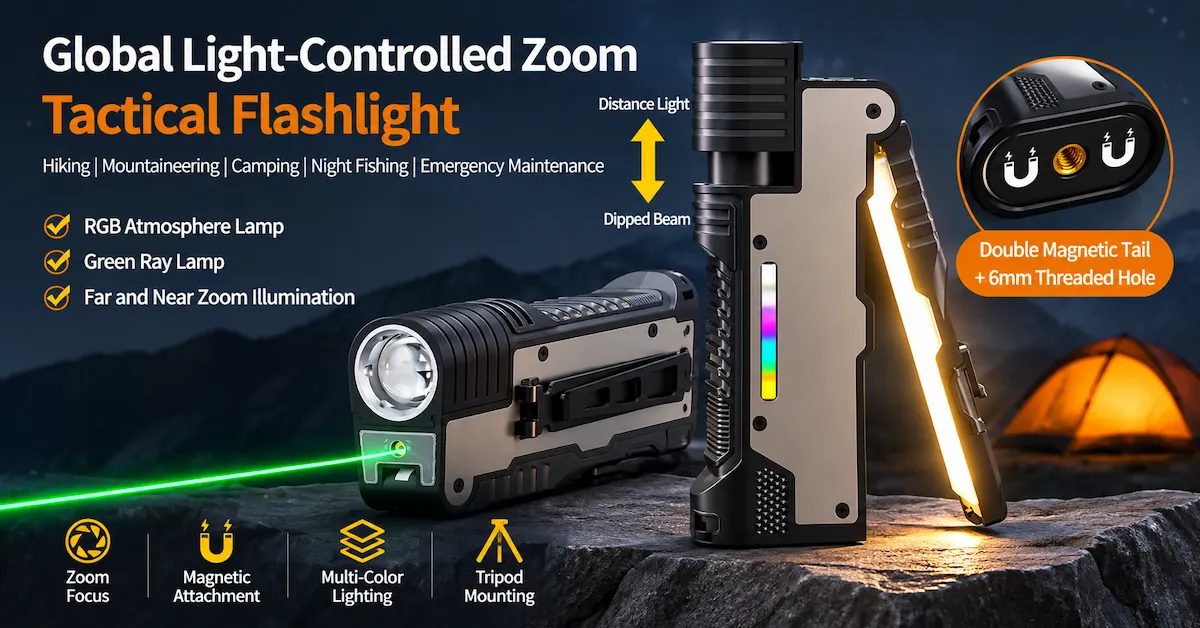
A useful supplier assessment asks for clear technical decisions rather than vague promises of unlimited customization.
Technical interpretation: Can the supplier distinguish standard features, feasible modifications and new development?
Engineering awareness: Can it explain relationships among optics, LED drivers, batteries, charging, mechanics and thermal design?
Platform selection: Does it recommend an existing suitable design when starting from scratch would add no proven value?
Sample control: Are prototypes and preproduction samples tied to identifiable revisions and requirements?
Manufacturing coordination: Are component sourcing, assembly, inspection and packaging responsibilities clear?
Commercial transparency: Are one-time engineering costs, tooling, artwork, validation and recurring unit costs separated?
Repeat-order governance: Is there an approval process for changes to materials, components and configurations?
Brightenlux publishes information about its manufacturing business and rechargeable flashlight range. Its outdoor lighting services describe development, branding and manufacturing coordination. These provide a basis for a custom project discussion, but every proposed modification, document, MOQ and schedule needs project-specific confirmation.
Evaluate manufacturing support and proposed change-control arrangements.
Learn About Brightenlux ›Speak to the OEM Team ›12. What Should a Custom Flashlight RFQ Include?
A structured request for quotation should describe the actual end-user task and make every requested modification explicit.
- Application: User, typical task, environment and intended operating duration.
- Market: Destination countries, distribution channel and product positioning.
- Reference model: Preferred Brightenlux platform or required architecture.
- Requested changes: Logo, finish, LED, optics, battery, controls, accessories or housing.
- Performance: Beam, modes, usable runtime, charging, materials and environment.
- Approval: Sample stages, test requirements and final acceptance criteria.
- Commercial: Pilot quantity, forecast, budget and delivery basis.
- Development: Tooling, drawings, packaging artwork and special parts.
- Documentation: Product claims, shipping evidence and market-specific requirements.
- Schedule: Sample review, approval, pilot production and shipment milestones.
Supplier response matrix
| Requested field | Information the supplier should return |
|---|---|
| Modification | Exact component or function affected |
| Proposed configuration | Standard model and planned changes |
| Engineering impact | Connected systems or possible risks |
| Validation | Tests and evidence required |
| Sampling | Prototype and approval milestones |
| Commercial terms | MOQ, unit pricing and one-time charges |
| Timing | Estimated development and production steps |
| Deviations | Anything different from the buyer's brief |
A configuration-specific response helps purchasing teams compare offers consistently and prevents custom features from being accepted informally.
Share your specifications, samples, target market and planned quantity.
Send a Custom Flashlight RFQ ›See OEM Lighting Services ›13. Frequently Asked Questions About Custom LED Flashlight Suppliers
1. What can a custom LED flashlight supplier customize?
Depending on the model and demonstrated capability, customization may involve logos, packaging, housing finish, clips, optics, batteries, charging electronics, controls and structural designs. Each request must be evaluated for feasibility, cost, MOQ and validation.
2. Is a private-label flashlight a fully custom flashlight?
Not necessarily. Private labeling often changes branding or packaging on an existing product. New electronics, housing or optics usually involve deeper development and associated testing.
3. Which changes are normally easiest?
Logo application and approved packaging changes often have fewer technical consequences than changes to the LED, driver, battery or seals. Actual impacts still depend on the selected product.
4. Can I change the LED to increase brightness?
Possibly, but the supplier must check electrical compatibility, thermal performance, beam optics, runtime and the validity of published claims before approving the design.
5. Can I request a larger rechargeable battery?
A different cell may be feasible if dimensions, electronics, charging, protection and documentation support it. Printed capacity alone is insufficient for engineering approval.
6. Can housing customization affect waterproof claims?
Yes. Revisions to enclosure joints, charging covers, seals and related structures can affect ingress protection. Validate the specific modified configuration when making an IP claim.
7. How long does custom flashlight development take?
Timing varies by the selected platform and whether the work involves branding, new components, tooling or electronics. Request project-specific milestones instead of assuming a universal lead time.
8. What is the MOQ for custom LED flashlights?
There is no universal MOQ. It depends on product model, branding method, purchased components, packaging, tooling and technical development. Ask for the MOQ of the exact proposed configuration.
9. How do buyers keep bulk production aligned with samples?
Use an approved specification, controlled bill of materials, revision-identified golden sample, agreed inspection plan and supplier change-control procedure.
10. How do I get a custom flashlight quote from Brightenlux?
Provide the application, reference model, requested modifications, performance needs, target market, expected quantity and project timeline. Use the Brightenlux contact page to request a configuration-specific OEM proposal.
Conclusion
Selecting a custom LED flashlight supplier is ultimately an exercise in understanding design change and manufacturing risk, not simply finding a factory that offers logos or extra features. Branding may need mainly appearance and packaging approval, while changes to LEDs, drivers, batteries, charging circuits, optics or housings can affect multiple functions and require new validation.
For distributors and private-label brands, the change-impact matrix, model comparison and approval steps in this guide make technical discussions more specific. They support accurate quotations, controlled product claims, realistic schedules, and more consistent repeat orders.
Brightenlux offers documented flashlight platforms including BT-FL8104, BT-FL8078, BT-FL8088 and BT-FL8101, together with international OEM/ODM project discussions. The right next step is to select the closest existing model, identify proposed changes, agree on testing and sample acceptance, and request a complete configuration-specific commercial proposal.