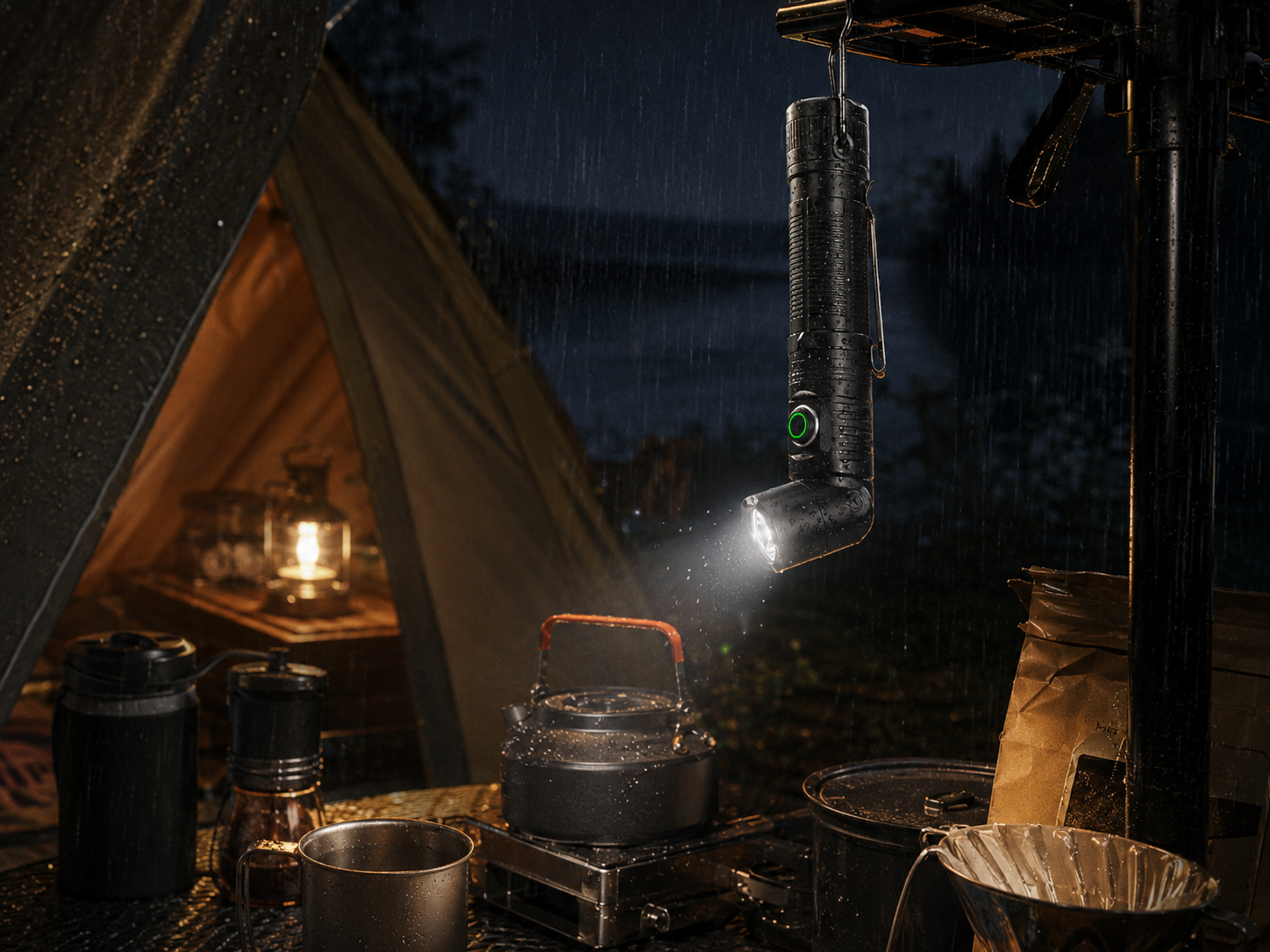


TL;DR: Buying 20W rechargeable emergency light wholesale products requires verification of three things: what the 20W rating actually describes, how much usable light the product produces, and how long the battery can support the required operating mode. If a completed lamp draws 20W continuously from its battery, four hours of operation requires 80Wh of usable energy before additional reserve assumptions. Brightenlux offers portable rechargeable lighting platforms for evaluation, but a specific 20W emergency-light configuration must be confirmed before bulk purchasing.
For importers, outdoor equipment distributors, emergency-preparedness brands, and OEM purchasing managers, the greatest challenge is not finding a product advertised as 20W. It is determining whether the advertised specification translates into reliable performance during a power outage. Two rechargeable lights may carry the same wattage label but deliver different lumen output, battery runtime, thermal behavior, and charging performance.
One product may use an LED module rated at 20W while operating it at a lower electrical load. Another may consume approximately 20W from its battery in high mode. A third may advertise a 20W charging input rather than 20W lighting power. These products should not be compared as technically equivalent.
This guide provides an engineering and purchasing framework for evaluating rechargeable portable emergency lighting, using documented Brightenlux LED lighting products as real product-family references. The emphasis is on verified electrical performance, usable runtime, thermal management, quality control, customization feasibility, and total procurement cost.
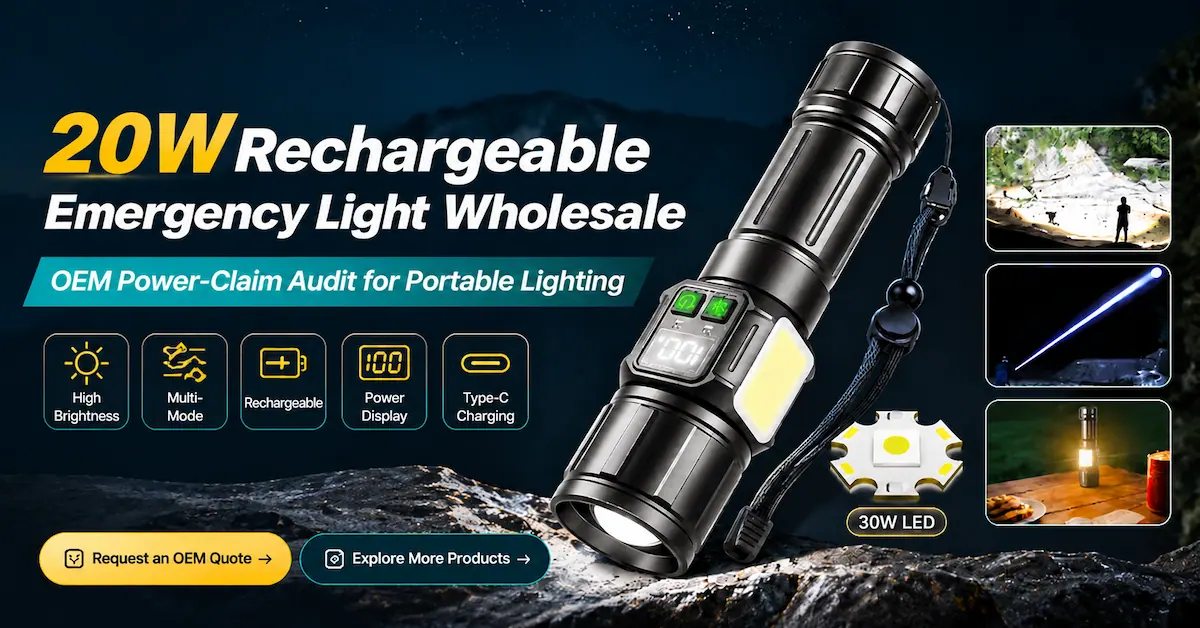
1. How Should Buyers Compare 20W Rechargeable Emergency Lights?
A purchasing decision should begin with a side-by-side evaluation of actual operating characteristics. The most useful comparison is not between two marketing labels. It is between two complete configurations tested under comparable conditions. Before requesting pricing, establish the application's light level, operating duration, charging method, battery type, and approved product scope.
Quick Reference: 20W Emergency Light Engineering Comparison Matrix
| Evaluation Dimension | What a Supplier May Advertise | What Buyers Must Verify | Purchasing Decision |
|---|---|---|---|
| Power rating | 20W high-power LED | LED rating versus actual battery-side power | Do not accept wattage without its definition |
| Brightness | High lumens or super-bright output | Measured lumen output and beam distribution | Select according to the application |
| Battery reserve | Large-capacity lithium battery | Battery watt-hours and usable energy | Match battery capacity to required runtime |
| Operating duration | Long-lasting or all-night lighting | Sustained output at the specified mode | Require an output-versus-time test |
| Charging system | USB-C rechargeable | Supported input, charging time and protection | Verify the actual charging configuration |
| Thermal design | Durable metal construction | Temperature, heat dissipation and output regulation | Confirm sustained performance |
| Environmental protection | Waterproof or weather-resistant | Model-specific IP evidence | Match protection to intended conditions |
| Wholesale supply | OEM/ODM and bulk pricing | Approved BOM, MOQ, QC, lead time and pack-out | Compare complete quotations |
Engineering takeaway: The technically suitable product is the one that meets the user's required illumination and operating duration while remaining commercially reproducible. A higher advertised wattage is not automatically a better purchasing choice.
2. Key Takeaways for Wholesale Buyers
- 20W does not automatically mean 20W continuous consumption. Verify whether the value refers to the LED component, operating circuit, battery input, or charging input.
- Battery energy determines the theoretical operating window. A continuous 20W battery load requires 80Wh of usable energy for four hours.
- Maximum lumens and sustained output are different performance characteristics. Test the complete light over time.
- Thermal management can affect advertised performance. High-output products may reduce brightness to manage temperature or battery demand.
- Portable emergency lanterns and regulated evacuation luminaires are not interchangeable. Confirm intended use and applicable product requirements.
- Wholesale reliability depends on production consistency. Lock down batteries, drivers, LEDs, charging electronics, accessories, and inspection criteria before release.
For OEM and private-label buyers, a practical sourcing strategy is to define the user application, obtain a production-intent sample, verify the relevant technical characteristics, and then compare model-specific commercial proposals.
3. What Is the Technical Basis of This Comparison?
Evidence and methodology
This article uses an engineering selection framework built around electrical power, photometric output, stored battery energy, runtime, temperature, and production control. The information is divided into three categories.
Manufacturer-published product information: Product features and model descriptions on Brightenlux's official website identify candidate lighting platforms. They are supplier statements rather than independent measurement.
Engineering calculations: Battery-energy and runtime examples use explicitly stated assumptions. They demonstrate the evaluation method, not actual measured Brightenlux performance or an existing customer case.
Technical standards and testing frameworks: ANSI/PLATO FL 1-2025 provides selected portable-light performance methods. IEC 60529 defines enclosure ingress classifications. IEC 60598-2-22:2021 addresses emergency luminaires within its specified scope. Naming a standard does not certify a Brightenlux product.
Important product verification boundary
Brightenlux's independent website lists rechargeable flashlights, lanterns, headlamps, and outdoor lighting solutions, but the public Emergency Light category does not currently establish a verified 20W rechargeable emergency-light product with a complete technical specification. The existing products compared below are real portable-lighting references, not confirmed interchangeable 20W emergency-light models. Any 20W model offered for wholesale purchasing requires a current sheet, sample, and quotation.
4. What Does a 20W Rating Actually Mean?
The term 20W rechargeable emergency light can refer to different electrical characteristics. Understanding the distinction prevents buyers from comparing products that do not operate under equivalent conditions.
LED rated power versus actual operating power
An LED may have a nominal or maximum rated electrical power of 20W. However, the finished light may operate below that rating to manage heat, improve efficiency, or extend runtime. This does not necessarily indicate poor manufacturing; it can be a legitimate design choice. Ask for the LED component specification and the actual current and voltage at the selected mode.
Battery-side power versus LED-side power
A driver converts battery input into power appropriate for the LED, with some losses. If the LED receives 20W and the driver efficiency is an illustrative 85%, battery-side power would be 20 ÷ 0.85 ≈ 23.5W. The 85% is a hypothetical example, not measured Brightenlux data. Battery runtime depends on energy drawn from the battery, not simply the LED's rated wattage.
Charging input is a separate specification
A product may support 20W charging input under approved conditions. This does not describe light output and does not establish the LED's operating wattage. For USB rechargeable products, the supplier should identify voltage, current, connector implementation, and charging protocol; a USB-C socket by itself does not guarantee a particular fast-charging capability.
Selection rule: Ask for measured electrical power at the defined operating mode before treating any product as a continuous 20W light.
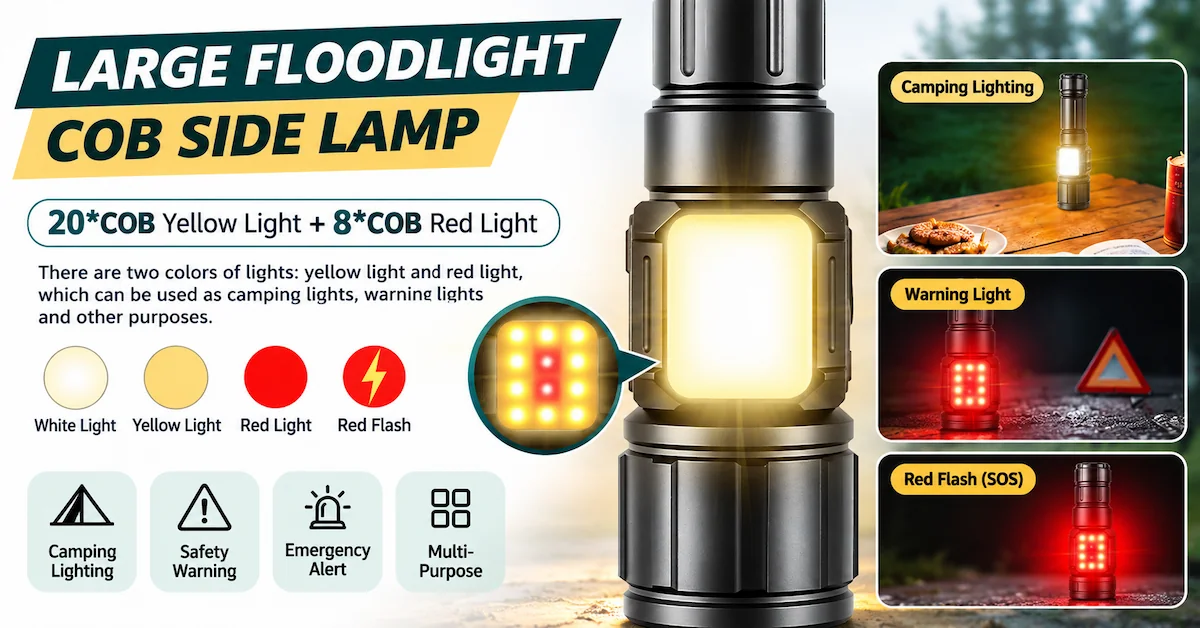
5. How Much Battery Energy Is Required for a 20W Light?
For wholesale buyers, a basic energy calculation can reveal whether a proposed runtime is technically plausible. The relationship is Energy (Wh) = Power (W) × Time (h). Use power measured at the battery if you are estimating energy drawn from the battery.
Scenario A: 20W measured at the battery
Assume the completed light consumes 20W continuously from its battery. Four hours requires 20W × 4h = 80Wh of usable energy. If the buyer's preliminary model assumes 80% of nominal battery energy is usable, the nominal target becomes 80Wh ÷ 0.80 = 100Wh. The 80% figure is an illustration, not a universal discharge limit. Actual usable capacity depends on cell chemistry, temperature, age, discharge behavior, and protection circuitry.
Scenario B: 20W delivered to the LED
If 20W describes LED operating power and driver efficiency is assumed to be 85%, battery input would be approximately 23.5W. Over four hours that is about 94Wh usable, or about 118Wh nominal under the same illustrative 80% factor. The difference shows why the measurement point matters.
Battery Sizing Comparison
| Operating Scenario | Duration | Usable Energy Required | Nominal Battery Energy at Illustrative 80% Usability |
|---|---|---|---|
| 20W battery-side load | 1 hour | 20Wh | 25Wh |
| 20W battery-side load | 2 hours | 40Wh | 50Wh |
| 20W battery-side load | 4 hours | 80Wh | 100Wh |
| 20W battery-side load | 8 hours | 160Wh | 200Wh |
| 20W LED-side load, 85% driver efficiency | 4 hours | Approximately 94Wh | Approximately 118Wh |
All values are hypothetical examples, not Brightenlux product performance claims.
Why mAh alone is insufficient
Battery energy also depends on voltage. A battery listing multiple lithium cells needs the cell arrangement and nominal pack voltage before buyers can calculate the pack's watt-hours. Adding cell mAh values without knowing how they are connected may create misleading comparisons.
Engineering decision: Evaluate battery watt-hours, usable energy, load, and runtime together. The final acceptance decision comes from a physical sample test.
6. How Do Lumen Output and Beam Design Affect Product Selection?
A 20W electrical rating does not determine a fixed lumen output. Light output depends on LED efficacy, driver operation, optics, temperature, and other losses. Two lights using similar power can deliver very different illumination patterns.
Focused flashlight beams
A concentrated beam can serve equipment inspection, roadside maintenance, or outdoor search tasks. Beam intensity, working distance, focus adjustment, and low-mode usefulness matter more than marketing brightness alone.
Diffused lantern illumination
For household blackouts or shared temporary lighting, a wider distribution is often more practical. A diffuser can improve coverage but can introduce optical losses. Test the area that actually needs illumination.
Portable work-light illumination
A task lamp may need a stable mount and a specific beam angle on a work surface. Its usability depends on optical shape, mounting, and operator access—not solely electrical power.
Request light output, beam characteristics, and measured illuminance under defined conditions, including output after thermal stabilization. Promotional nighttime photographs are not calibrated evidence because camera exposure can change apparent brightness.
7. Why Can a High-Power Rechargeable Light Lose Brightness During Operation?
A high-output light's operating behavior depends on battery condition and temperature. It may briefly produce a high output before stepping down to a lower sustainable level.
LED temperature and thermal regulation
Heat from the LED and driver must pass through thermal interfaces and housing into the environment. Some products reduce LED current when internal temperature rises. This protects the system but changes sustained brightness. Ask for an output-versus-time curve and relevant temperature record under the proposed use conditions.
Battery voltage and discharge behavior
Battery voltage changes during discharge. Driver regulation can hold output for part of the cycle, then reduce it near protection thresholds. A light that remains switched on may no longer satisfy the task's minimum illumination requirement.
What makes a useful runtime report?
The supplier should identify the operating mode, starting output, any programmed step-down, battery, ambient conditions, and test endpoint. ANSI/PLATO FL 1-2025 offers relevant performance-reporting methods, including treatment of some short-duration high-brightness modes. Buyers may still need an additional task-based illumination threshold.
Procurement decision: Prefer a predictable sustained output curve to an unqualified peak-brightness claim.
8. Which Brightenlux Lighting Platforms Can Be Evaluated?
Brightenlux, operated by Ningbo Brightenlux Electric Appliance Co., Ltd., publishes rechargeable portable lighting models appropriate for initial sourcing research. They demonstrate different optical and battery architectures but are not automatically confirmed as 20W rechargeable emergency lights.
Brightenlux Product Comparison
| Product Reference | Manufacturer-Published Features | Potential Application | Buyer Verification |
|---|---|---|---|
| BT-PL4031R Rechargeable Camping Lantern | Up to 2000 lm, COB LED, three 2200mAh lithium cells, lighting modes, dimming, power bank | Household blackout and portable area lighting | Battery arrangement, sustained runtime, USB output, IP evidence |
| 1000 Lumens USB Rechargeable Lantern | Up to 1000 lm, SMD LED configuration, 4000mAh battery listing, dimmable modes, power bank | Compact preparedness and camping kits | Electrical input, pack energy, runtime by mode |
| BT-FL8101 Rechargeable LED Flashlight | Up to 3000 lm, 26650 cell or AA power option, adjustable beam, charging/power bank | Directional inspection and outdoor backup kits | Battery operation, output regulation, charging |
| BT-HL9040 Rechargeable LED Headlamp | Up to 800 lm, OSRAM P9, 18650 battery, Type-C charging, red/white modes | Hands-free maintenance and preparedness kits | Fit, mode runtime, pack-out and charging |
These values are manufacturer-published claims; technical tests and current commercial availability must be verified for the specific order. A 2000-lumen maximum rating does not mean 20W measured battery input or eight hours of high-mode operation.
What about a BT-FL8013-20W model?
A 20W designation appears in external manufacturer-related materials, but its current status and complete operating specifications have not been established by the verified independent-site catalogue. Ask for updated drawings, LED and driver information, battery details, test results, and a production-intent sample before treating it as a validated 20W product.
9. What Are the Main Manufacturing and Quality-Control Risks?
Wholesale quality depends on more than the LED. The risks most likely to affect user confidence and repeat orders include battery variation, charging defects, uncontrolled thermal behavior, inconsistent assembly, and substitutions to approved parts.
Battery consistency
Different lithium cells may have different energy and discharge characteristics. An unapproved substitution can change runtime or required transport documentation. Identify the approved cell or pack and applicable alternatives in the bill of materials.
Driver and electronic control
The LED driver controls actual electrical power. A new PCB, programmed mode, or firmware revision may alter battery draw, sustained output, or the switching sequence. Define which changes require buyer approval.
Thermal interfaces
A LED assembly, thermal pad, adhesive, and housing must be produced consistently. Poor thermal contact can produce higher temperatures and unexpected output regulation. Critical assembly operations should have suitable inspection criteria.
Charging reliability and environmental sealing
Test USB ports, charging circuits, connectors, battery protection, switches, and port covers. Any IP claim must relate to the tested model and enclosure configuration, not just a general company certificate.
Production release and traceability
Retain an approved golden sample, controlled bill of materials, inspection plan, and production-lot identification. The manufacturing goal is to reproduce the approved electrical and optical behavior, not simply the same external shape.
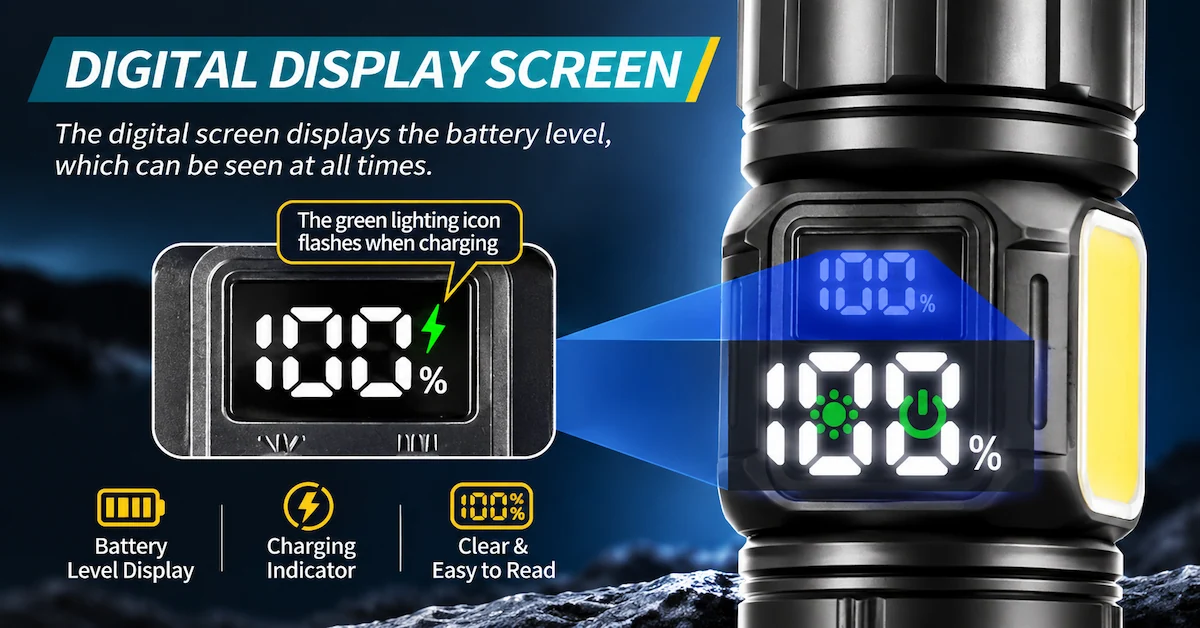
10. What Are the Cost and MOQ Trade-Offs for Wholesale Buyers?
A lower unit price may exclude a battery, charging cable, retail box, accessories, or testing. A 20W light required to operate for multiple hours can also need a larger battery system, which affects mass, size, charging time, shipping, and cost.
Standard platform versus customized design
Logo and artwork changes to an approved existing platform may be simpler than changing the LED, driver, battery architecture, or thermal solution. Technical changes require engineering feasibility review and may need new tests. Quote the projects separately.
Why MOQ varies
Minimum quantities can depend on components, marking methods, printed cartons, special colors, tooling, and development scope. Brightenlux's general OEM/ODM service description does not establish one fixed MOQ for every configuration.
Landed cost instead of the headline number
Use the same approved specification across quotations, then add lighting unit + battery + charging parts + accessories + packaging + customization + tests/inspection + freight/duties/handling. Include warranty and service assumptions using your own data, not fabricated percentages.
Ask for an itemized quotation that identifies inclusions, exclusions, MOQ, Incoterm, sample charges, and production milestones.
11. How Would a Four-Hour 20W Wholesale Project Be Qualified?
The following is an illustrative buyer scenario, not a completed Brightenlux project or an independent laboratory report.
Project requirement and uncertainty
An industrial distributor wants portable rechargeable lighting for non-critical maintenance during temporary outages. The requirement is four hours of useful lighting at an operating condition called 20W. The proposed sample uses a 20W-rated LED, but battery-side operating power is unknown.
Technical evaluation
The distributor requests electrical input measurements at both the LED and battery, measured output over time, thermal behavior, actual battery energy, and complete charging data. If battery-side load is a true continuous 20W, four hours requires 80Wh usable energy. If it is 20W delivered to the LED, battery input may be higher due to driver losses.
Sample validation and decision
The buyer tests the production-intent sample under the proposed environment, then reviews the output curve against minimum task illumination. If the lamp steps down, the buyer decides whether the lower sustained level meets the requirement. They may accept the product with accurate labeling, ask for a battery or mode revision, or reject a configuration that cannot satisfy the job.
Commercial release
Only after technical approval does the buyer compare standard and private-label prices, approve battery and driver revisions, confirm pack-out, and agree quality checks. The case demonstrates how measurable acceptance avoids committing bulk inventory to an ambiguous wattage label.
12. Engineering Selection Checklist: How to Qualify a Supplier in Five Steps
- Define the task: End user, working distance, required light level, format, environment, and duration. Separate portable backup lighting from regulated building emergency luminaires.
- Clarify the 20W claim: LED rated wattage, measured LED power, complete battery-side input, and operating mode. Request a sustained output curve.
- Evaluate the battery: Actual chemistry, nominal Wh, usable reserve, charging input, safety information, and relevant transport records.
- Test the sample: Beam, continuous output, thermal behavior, charging, mounting, and any applicable environmental claim, using defined criteria.
- Freeze the specification: Golden sample, BOM, inspection method, branding, packaging, quantity, MOQ, delivery schedule, and change-control rules.
13. What Should an OEM RFQ Include?
A complete RFQ allows the manufacturer to determine whether an existing platform is adequate or a new design is required.
| RFQ Item | Buyer Information Required |
|---|---|
| Product application | Household emergency, camping, maintenance, or another defined use |
| Product format | Lantern, flashlight, work light, or headlamp |
| Power specification | Exact meaning of the requested 20W |
| Lighting performance | Required output and beam distribution |
| Runtime | Required duration and operating mode |
| Battery | Chemistry, watt-hours, reserve and service requirements |
| Charging | Input, cable, adapter, charge time and behavior |
| Environment | Temperature, weather, storage and mounting |
| Quality documentation | Test methods, reports, inspection and traceability |
| OEM customization | Logo, packaging, accessories, technical changes |
| Commercial terms | Sample volume, forecast, MOQ, Incoterm and target milestones |
Brightenlux's outdoor lighting services provide a starting point for manufacturing and customization discussions. Specifically request current electrical and battery data for any product proposed as continuous 20W.
14. Frequently Asked Questions About 20W Rechargeable Emergency Light Wholesale
1. What does 20W mean on a rechargeable emergency light?
It may describe nominal LED component power, actual operating power, or a charging specification. Ask for the relevant measurement method and conditions. These figures are not interchangeable.
2. How many lumens should a 20W emergency light produce?
There is no fixed lumen output determined by wattage alone. Output depends on LED efficiency, driver, optics, and temperature. Require model-specific photometric evidence.
3. How long can a 20W rechargeable emergency light run?
Runtime depends on battery usable energy and actual load. A true continuous 20W battery load needs approximately 80Wh of usable energy for four hours; verify the complete sample under the intended mode.
4. Is a 20W LED work light better than a 10W light?
Not automatically. The correct choice depends on illumination required, beam, battery reserve, size, and operating duration. Higher power also raises battery and heat-management requirements.
5. What battery capacity is required for four hours of 20W operation?
The theoretical usable energy is 80Wh if the product draws 20W at the battery continuously. Nominal battery energy must allow for real operating limits and conditions.
6. Can a USB-C rechargeable light support fast charging?
Possibly, but the connector alone does not establish any specific charging protocol. Confirm voltage, current, charger, cable, and tested charge time.
7. Are portable rechargeable emergency lights the same as building escape lights?
No. Portable backup lights and regulated building emergency luminaires can face different design and legal requirements. Do not present an ordinary lantern as a compliant substitute without the appropriate evidence.
8. Can Brightenlux provide a customized 20W rechargeable emergency light?
Brightenlux offers OEM/ODM lighting discussions, but a particular 20W model's availability, customization scope, MOQ, testing, and lead time require direct confirmation.
9. Which quality tests matter before bulk purchasing?
Check actual power, sustained output, battery runtime, charging, thermal behavior, assembly, applicable ingress evidence, and correct pack-out. Approve a sample and controlled specification before production.
10. What should I send for a 20W wholesale quote?
Provide the use case, wattage definition, brightness and duration, battery/charging preferences, target market, quantity, documentation, customization and timeline. Contact Brightenlux for a current proposal.
Conclusion
Successful 20W rechargeable emergency light wholesale purchasing depends on verifying what a product's power rating means and whether its complete electrical, optical, and battery system can meet the intended application. A 20W label does not independently establish sustained brightness, battery capacity, charging performance, or runtime.
For overseas B2B buyers, the strongest sourcing approach is to define the use case, measure actual electrical input, verify lumen output over time, calculate battery energy, test production-intent samples, and establish a controlled manufacturing specification. Brightenlux rechargeable camping lanterns, LED flashlights, and outdoor lighting OEM/ODM services offer practical starting points for evaluating portable lighting projects. A specific 20W emergency model should be selected only after its specifications and availability are confirmed.
For importers, distributors, and private-label brands, the next step is to submit a quote-ready brief identifying required power, runtime, battery reserve, target market, and order volume.