

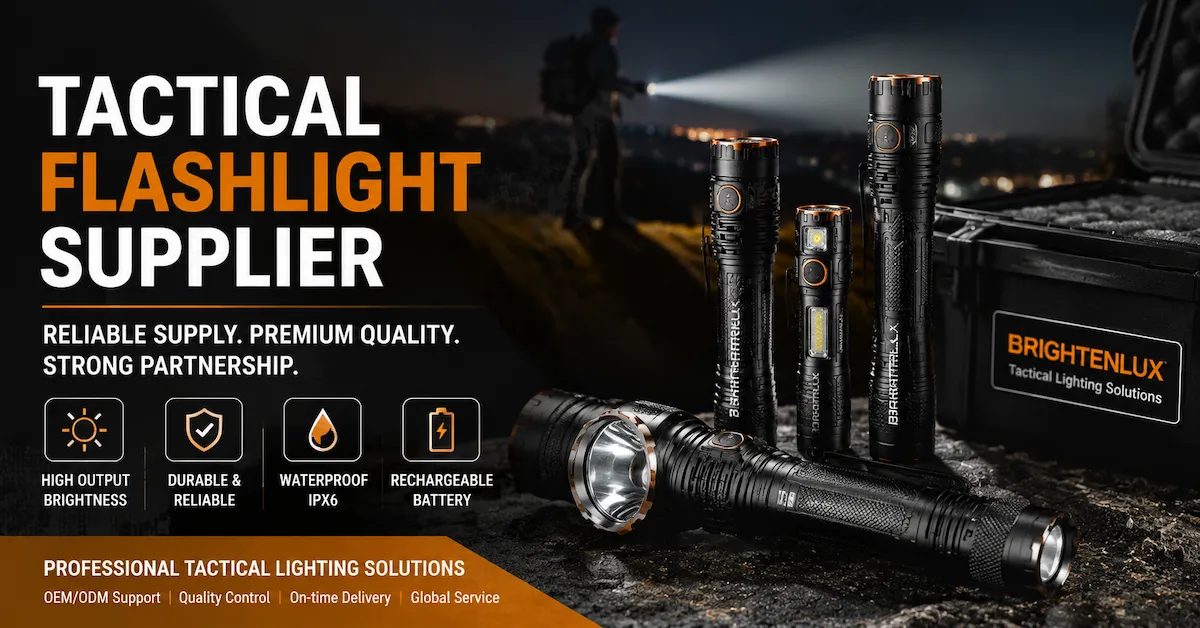
Tactical Flashlight Supplier Guide: Quality, Pricing, and Reliable Sourcing
Choosing a tactical flashlight supplier is a strategic sourcing decision for distributors, retailers, brands, and professional lighting buyers. A supplier is not only a product seller. A professional supplier helps buyers compare suitable products, verify quality expectations, manage orders, support custom requirements, arrange packaging solutions, and coordinate delivery. For businesses serving security, outdoor, industrial, emergency, and professional lighting markets, supplier selection can affect customer satisfaction, product reputation, and repeat purchases.
This nine-step SEO sourcing guide explains how B2B buyers can evaluate tactical flashlight suppliers without relying only on price. It focuses on the practical factors buyers can compare: product quality, durability, battery performance, key specifications, materials, protection features, applications, customization support, and reliable communication. Brightenlux provides LED flashlights, rechargeable flashlights, tactical lighting products, and customized lighting solutions for global customers. Buyers can review the Brightenlux product portfolio when comparing professional lighting options.
Step 1: Define What a Tactical Flashlight Supplier Should Provide
A tactical flashlight supplier provides professional lighting products and sourcing solutions for businesses that require reliable, durable, and high-performance flashlights. The role is broader than offering a catalog. A qualified supplier should understand professional application requirements, product specifications, market trends, quality expectations, and international purchasing needs.
Before comparing suppliers, buyers should define the purchasing goal. A distributor may need multiple flashlight models for different customer groups. A retail brand may need packaging support. A professional equipment buyer may need dependable products for demanding use environments. Clear sourcing goals help prevent mismatched products and reduce unnecessary communication during the buying process.
Step 2: Compare Supplier and Manufacturer Options
Many B2B buyers compare tactical flashlight suppliers with manufacturers. The better choice depends on sourcing requirements. A supplier can be suitable when buyers need wider product choices, flexible purchasing, faster sourcing, or market testing. A manufacturer is often preferred for OEM projects, private label products, customized designs, and long-term product development.
| Aspect | Tactical Flashlight Supplier | Tactical Flashlight Manufacturer |
|---|---|---|
| Product selection | Wider product choices | More focused product range |
| Factory control | Depends on cooperation model | Direct production control |
| Customization | Available depending on capability | Strong customization ability |
| Order flexibility | Usually higher | Depends on production planning |
| Best for | Distributors and buyers | Product development projects |
For sourcing efficiency, buyers should ask whether the supplier can support the required product range, customization level, packaging needs, and order management process. If the project requires product development, the buyer should clarify the supplier’s capability before moving forward.
Step 3: Evaluate Product Quality Before Price
Price is important, but it should not be evaluated before quality. Tactical flashlights are used in professional and demanding environments, so quality issues can damage customer trust. Buyers should assess brightness consistency, beam performance, switch reliability, housing quality, and product durability. These factors directly influence customer satisfaction and repeat purchases.
Quality evaluation should also consider whether the flashlight matches the intended application. Security users may require strong beam distance, while industrial users may need wider area lighting. Outdoor customers may value lightweight design, weather resistance, and portable charging. The same flashlight is not always suitable for every sales channel, so quality must be reviewed in context.
Step 4: Review Durability and Protection Features
Professional tactical flashlights should be designed for demanding environments. Buyers should evaluate aluminum alloy housing, impact resistance, waterproof design, and heat dissipation capability. Durable construction helps products maintain performance during outdoor activities, industrial operations, and emergency situations.
Protection features are also important. Professional tactical flashlights often require waterproof protection, dust resistance, impact protection, and drop resistance. Buyers should not assume that all tactical-style products offer the same protection. Instead, they should confirm which protection features are required for the target market and compare suppliers based on their ability to meet those needs.
Step 5: Compare Battery Performance and Power Options
Battery performance has a direct effect on user experience. Important factors include runtime, battery compatibility, charging system, and safety protection. Rechargeable tactical flashlights are increasingly popular because they provide convenient charging, lower replacement costs, and better long-term usability.
Common power solutions include rechargeable lithium batteries, replaceable batteries, and USB charging systems. Buyers should select battery options based on usage frequency, runtime requirements, and target market. For example, outdoor equipment buyers may prioritize portable charging, while industrial users may focus on reliable battery systems for frequent use.
Step 6: Check Key Specifications and Material Construction
Before placing orders, buyers should compare technical specifications carefully. Important lighting specifications include lumens, beam distance, beam focus, and lighting modes. Different applications require different lighting solutions, so the specification sheet should be matched with the buyer’s market rather than reviewed in isolation.
Material construction is another practical comparison point. Aluminum alloy offers lightweight structure, durability, better heat dissipation, and a professional appearance. Durable plastic components may offer cost efficiency, flexible design, and lightweight structure. The right material depends on the target user, expected environment, and product positioning.
Buyers should also check whether the flashlight design supports the intended use. For professional lighting markets, small details such as switch reliability, grip feel, heat dissipation, and charging convenience can affect long-term satisfaction.
Step 7: Match Products to Application Markets
Tactical flashlights are widely used in security equipment, outdoor products, industrial tools, emergency equipment, and professional lighting markets. A reliable supplier should understand that each market has different product characteristics.
Security customers usually require reliable operation, fast activation, strong illumination, and durable structure. Applications include security equipment, patrol tools, and professional kits. Outdoor brands often focus on lightweight design, long runtime, weather resistance, and portable charging for camping, hiking, and adventure activities.
Industrial users need products that can handle frequent use. Important features include stable performance, strong housing, and reliable battery systems. Applications include equipment inspection, workshop maintenance, and construction environments. Emergency products require dependable performance, quick operation, long standby time, stable brightness, and reliable power.
Step 8: Understand Pricing Without Sacrificing Reliability
Pricing should be analyzed together with product requirements. Lower cost may be attractive, but buyers should also consider housing material, battery option, charging system, lighting modes, packaging needs, and customization requirements. These factors can influence the overall sourcing decision even when two products appear similar.
A practical pricing review should begin with a clear product brief. Buyers can list the intended market, required materials, preferred battery option, protection expectations, packaging needs, and any custom requirements. This helps the supplier recommend relevant options instead of quoting products that do not fit the project.
Reliable sourcing is not only about getting the lowest quotation. It is about selecting products that fit the sales channel, meet quality expectations, and support long-term business performance. Buyers who evaluate quality, durability, specifications, and application fit are better positioned to make sustainable purchasing decisions.
Step 9: Verify Supplier Support, Customization, and Communication
A professional tactical flashlight supplier provides more than product delivery. Supplier support may include product selection, quality verification, order management, custom requirements, packaging solutions, and delivery coordination. For B2B buyers, these services help reduce sourcing risk and improve efficiency.
Customization can be important for brands and distributors. Buyers may require private label support, customized designs, or packaging solutions, depending on project goals and supplier capability. Before confirming a sourcing plan, buyers should explain the intended market and ask what support is available for the project.
Communication is also part of sourcing reliability. Buyers should work with a supplier that can respond clearly to product questions, specification comparisons, and order requirements. If you are preparing a sourcing project, you can contact Brightenlux to discuss professional lighting requirements or submit an inquiry for product selection support.
FAQ: Tactical Flashlight Supplier Sourcing
What is a tactical flashlight supplier?
A tactical flashlight supplier provides professional lighting products and sourcing solutions for businesses that need reliable, durable, and high-performance flashlights. The supplier may support product selection, quality verification, order management, custom requirements, packaging solutions, and delivery coordination.
How should buyers evaluate tactical flashlight quality?
Buyers should compare brightness consistency, beam performance, switch reliability, housing quality, durability, battery performance, charging systems, and protection features. The evaluation should be based on the intended application market.
Are rechargeable tactical flashlights suitable for B2B sourcing?
Rechargeable tactical flashlights are increasingly popular because they provide convenient charging, lower replacement costs, and better long-term usability. Buyers should still compare runtime requirements, battery compatibility, charging system, and safety protection.
Which markets use tactical flashlights?
Tactical flashlights are used in security equipment, outdoor products, industrial tools, emergency equipment, and professional lighting markets. Each market may require different features, such as strong illumination, lightweight design, stable performance, or reliable power.
What should buyers prepare before contacting a supplier?
Buyers should prepare the target market, preferred product type, material expectations, battery option, protection requirements, lighting specifications, packaging needs, and any customization requirements. This helps the supplier recommend more suitable options.
Conclusion: Build a More Reliable Tactical Flashlight Sourcing Process
Selecting a tactical flashlight supplier requires a balanced review of quality, pricing, specifications, market fit, and sourcing support. Buyers should avoid choosing only by price and instead compare durability, battery performance, materials, protection features, and application requirements. With a clear product brief and a structured evaluation process, distributors, retailers, and brands can reduce risk and improve long-term business performance in professional lighting markets.