

TL;DR: A reliable rechargeable LED emergency light manufacturer should verify how long a product delivers usable illumination, how its battery behaves after storage, and whether charging and component specifications remain consistent between production batches. For an eight-hour blackout application, buyers should compare mode-specific runtime, battery energy, charging reliability, and sample-level quality evidence—not maximum lumens alone. Brightenlux offers rechargeable lanterns, headlamps, and flashlights that can be evaluated for portable blackout kits.
For importers, emergency-preparedness brands, distributors, and private-label buyers, the critical purchasing challenge is converting a product specification into dependable performance during an actual power interruption.
A lamp may advertise high brightness, a large lithium battery, and several operating modes. However, these features do not independently establish whether the product can illuminate a room for eight hours or remain ready after extended storage.
A useful procurement decision therefore requires three connected evaluations: optical performance, available electrical energy, and manufacturing consistency.
This guide provides a technical comparison framework, realistic energy-budget calculations, a sample validation process, and an OEM/ODM purchasing method using documented Brightenlux rechargeable lighting products.
Key Takeaways
-
Maximum lumens do not establish emergency runtime. Buyers should request measured output over time at the actual operating mode.
-
Battery capacity must be evaluated in watt-hours. Milliamp-hour figures alone cannot reliably compare different battery arrangements.
-
An eight-hour backup target requires an energy budget. The battery must supply the selected lighting load for the required time under agreed conditions.
-
Charging and storage readiness are separate quality requirements. A product that works immediately after charging may behave differently after extended storage.
-
Product format determines application suitability. Lanterns, headlamps, and handheld flashlights solve different lighting problems.
-
Bulk-order consistency requires a controlled specification. Battery, LED driver, charging electronics, accessories, and packaging should remain consistent with the approved sample.
Procurement recommendation: Start by defining the user's blackout scenario and minimum usable illumination. Then select candidate products, request mode-specific test evidence, validate a production-intent sample, and obtain a configuration-specific quotation.
1. How Do Rechargeable Emergency Lighting Formats Compare for Blackout Applications?
A rechargeable LED emergency light manufacturer may offer multiple portable lighting formats, but not every product should be evaluated using the same criteria.
Lanterns generally provide broader area illumination. Headlamps allow hands-free operation. Flashlights direct light toward a specific task or location.
The fastest way to shortlist candidates is to compare the intended lighting job with the battery, optical, and mechanical requirements.
Quick Reference: Portable Emergency Lighting Selection Matrix
| Evaluation Dimension | Rechargeable Lantern | Rechargeable Headlamp | Rechargeable Flashlight | Purchasing Recommendation |
|---|---|---|---|---|
| Primary lighting function | Area illumination | Hands-free task lighting | Focused directional lighting | Select according to user activity |
| Typical application | Household blackout, camping, shelter | Equipment checks, portable maintenance | Roadside inspection, locating objects | Avoid choosing by lumens alone |
| Beam distribution | Broad or diffused | Focused or mixed | Directional, sometimes adjustable | Test at actual working distance |
| Battery consideration | Energy reserve for prolonged operation | Weight and runtime balance | Cell configuration and reserve | Request mode-specific runtime |
| Mounting and handling | Base, carrying handle, hanging hook | Headband and tilt adjustment | Grip, clip, magnet or lanyard | Check actual usage conditions |
| Charging consideration | Input and possible power-bank output | Cable compatibility and charge status | USB charging and optional alternate cells | Confirm complete electrical configuration |
| Main procurement risk | Short useful runtime or glare | Poor comfort or unstable beam | Excessive peak-output emphasis | Perform task-based sample testing |
How should buyers interpret this matrix?
For a household blackout kit, a rechargeable lantern is often the most relevant primary product because it can illuminate a shared area.
For vehicle or equipment inspection, a flashlight or headlamp may be more useful because it directs illumination toward the task.
For a broader emergency-preparedness assortment, buyers can combine complementary formats instead of purchasing several lights with overlapping functions.
The selection criterion is whether the light meets the customer's operating requirements—not whether it has the highest advertised output.
2. What Technical Evidence Should Buyers Request From an Emergency Lighting Manufacturer?
Before comparing suppliers, distinguish between manufacturer-published product information and independently validated measurements.
A product description may state maximum brightness, nominal battery capacity, operating modes, or water protection. These are useful for initial screening but should be supported by the corresponding specifications and test records before becoming contractual acceptance criteria.
Evidence and technical review methodology
This guide uses three information levels.
Level 1 — Manufacturer-published specifications
These include product descriptions published by Brightenlux, such as nominal battery configurations, lighting modes, USB functions, and advertised maximum output.
They support preliminary product selection but do not substitute for a new test on the actual production configuration.
Level 2 — Recognized technical frameworks
ANSI/PLATO FL 1-2025 establishes uniform performance testing and reporting methods for appropriate portable lighting products, including area lights, flashlights, and headlamps.
IEC 60529 provides the framework for defined enclosure ingress-protection classifications.
IEC 60598-2-22:2021 concerns emergency luminaires within its specified scope. It must not automatically be applied as proof that a portable camping lantern is suitable for a regulated building emergency system.
Level 3 — Project-specific validation
The most decisive evidence comes from an approved sample tested under the buyer's intended conditions.
This includes selected lighting mode, battery configuration, operating duration, charging method, ambient conditions, and applicable quality requirements.
Evidence limitation: The numerical examples below are engineering illustrations. They are not Brightenlux laboratory results, verified customer cases, or claims that a specific model has passed an eight-hour blackout test.
3. Why Does Maximum Brightness Fail to Predict Eight-Hour Emergency Runtime?
Maximum lumen output is useful for describing a lighting product's initial capability, but it does not determine how long the lamp can provide useful illumination.
The operating time depends on the interaction between the LED, driver electronics, battery, thermal management, and selected brightness mode.
Peak output versus sustained output
A rechargeable lantern may produce its maximum advertised brightness under a high-output setting.
However, its electronic driver may later reduce output to manage heat or battery consumption.
This means a lamp can remain switched on for several hours while delivering substantially less light than it did at the beginning.
A purchasing team should therefore ask for an output-versus-time curve.
The curve should show how output changes throughout operation, including initial brightness, any programmed step-down, gradual battery-related decline, and the final operating period.
Why should the test endpoint be defined?
Runtime can mean different things depending on the reporting method.
Under the standard runtime approach used by ANSI/PLATO FL 1 for applicable ordinary modes, the measurement proceeds from the defined initial output until illumination falls to a specified proportion of that value.
That reporting endpoint is useful for standardization. However, the amount of light available near the endpoint may not satisfy a buyer's actual task.
A household user may still require enough light to identify nearby objects, read instructions, or move through a room.
Therefore, a procurement specification should separately define task-usable runtime, using a practical or measured illumination requirement.
What should the manufacturer report?
Request the following information for every important mode:
-
Initial measured output and test conditions.
-
Output after any thermal regulation or programmed reduction.
-
Continuous output behavior over the expected period.
-
Battery and temperature conditions during testing.
-
Defined runtime endpoint.
-
Charging and battery configuration used for the test.
For blackout products, a reliable lower-output mode may be more commercially useful than an impressive peak setting that cannot be maintained.
Section Takeaway
The useful emergency-light specification is a measurable lighting level over a defined period, not a maximum-lumen claim without an operating curve.
4. How Much Battery Energy Is Required for an Eight-Hour Blackout?
Battery energy is a fundamental engineering requirement for portable emergency lighting.
A product cannot maintain its selected electrical load longer than the available usable energy allows.
However, nominal cell capacity alone does not tell buyers how much energy can reach the lighting system.
Step 1: Define the operating load
Consider an illustrative emergency lantern designed to operate at a selected mode drawing 3 watts from its battery system.
The buyer requires eight hours of continuous operation.
The electrical energy required is:
Energy = Power × Time
3 W × 8 hours = 24 Wh
The light would therefore require 24 watt-hours of electrical energy under this simplified constant-load assumption.
Step 2: Allow for usable battery energy
A real battery may not deliver all its nominal stored energy within the product's permitted operating limits.
Suppose the buyer uses an illustrative usable-energy factor of 80%.
The estimated nominal battery requirement becomes:
Required nominal battery energy = 24 Wh ÷ 0.80
Required nominal battery energy = 30 Wh
This gives a preliminary design target of approximately 30 Wh.
The 80% factor is an example assumption, not a universal battery-design rule.
Real requirements depend on discharge limits, temperature, cell aging, operating load, and the product's battery-protection circuitry.
Because the 3 W figure in this example already represents complete electrical input to the lighting system, the same driver loss must not be deducted again.
Step 3: Confirm the calculation with physical samples
The next stage is to measure actual power consumption and operating time on the selected product.
If electrical load changes during operation, a single constant-power estimate becomes less accurate.
The manufacturer or buyer should then record energy consumption across the actual operating profile.
Eight-Hour Backup Energy Calculation
| Parameter | Illustrative Requirement | Verification Method |
|---|---|---|
| Selected lighting load | 3 In | Measure actual battery-side power consumption |
| Required operating period | 8 hours | Define the intended use |
| Theoretical energy use | 24 Wh | Power × time |
| Assumed usable-energy factor | 80% | Replace with product-specific evidence |
| Preliminary nominal battery target | 30 Wh | Validate against actual pack configuration |
| Final accepted runtime | To be determined | Conduct an eight-hour sample trial |
Why shouldn't buyers compare batteries by mAh alone?
Milliamp-hours describe charge capacity, not energy without a corresponding voltage.
Battery watt-hours depend on nominal voltage and capacity.
For example, two battery assemblies with the same milliamp-hour rating but different nominal voltages may store different amounts of energy.
Similarly, a manufacturer listing the combined capacities of multiple cells does not provide enough information to determine the complete pack's nominal watt-hours without knowing how those cells are connected.
Section Takeaway
An eight-hour runtime target becomes procurement-ready only when the required light level, complete electrical load, usable battery energy, and verification method are defined.
5. Which Brightenlux Rechargeable Lighting Models Should OEM Buyers Evaluate?
A rechargeable LED emergency light manufacturer should be able to identify real products suited to different customer requirements.
Brightenlux publishes several portable rechargeable lantern, headlamp, and flashlight platforms that may be evaluated for blackout preparedness and temporary non-critical lighting.
The following product information is based on individual manufacturer listings.
Manufacturer-Published Model Comparison
| Product | Published Configuration | Potential Application | Critical Verification |
|---|---|---|---|
| BT-PL4031R Rechargeable Camping Lantern | Up to 2000 lm; COB LED; three 2200mAh lithium cells; multiple light modes; power-bank feature; IP44 listed | Household blackout and shared-area illumination | Mode runtime, battery arrangement, charging, ingress evidence |
| 1000 lm USB Rechargeable Camping Lantern | 1000 lm maximum; SMD LEDs; 4000mAh 18650 battery listing; dimmable white modes; power-bank function | Compact home emergency and outdoor kits | Energy reserve, output by mode, charge input and accessories |
| BT-HL9040 Rechargeable LED Headlamp | Up to 800 lm; OSRAM P9; included 18650 2200mAh lithium battery; Type-C charging; auxiliary white/red LEDs | Hands-free inspection and maintenance | Wearability, charging time, practical task runtime |
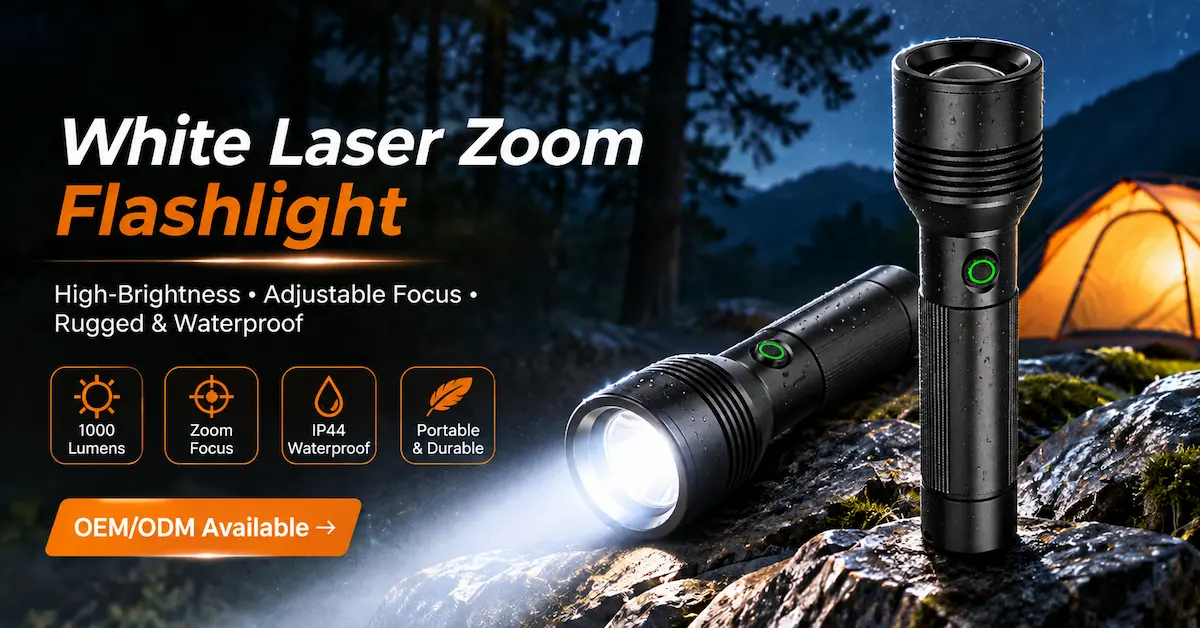
| BT-FL8101 Rechargeable LED Flashlight | Up to 3000 lm; included 26650 4000mAh lithium battery or six AA cells; adjustable focus; power-bank function; IP67 listed | Directed inspection and portable backup kits | Alternate battery operation, output regulation and ingress evidence |
Which model is most relevant for household blackouts?
A rechargeable lantern such as BT-PL4031R is a reasonable starting candidate for household area lighting.
Its multiple modes and dimming function may support different levels of illumination.
However, the advertised maximum brightness and operating duration must be verified at the same selected mode before a buyer promises eight-hour performance.
The published three-cell capacity description also needs clarification of the actual electrical arrangement before energy is calculated in watt-hours.
Which model fits compact preparedness kits?
The 1000-lumen rechargeable camping lantern offers a different size and feature proposition for buyers who want a portable area-light format.
Its published 4000mAh battery and power-bank functionality should be assessed using actual power consumption, battery energy, and charging evidence.
When should buyers include a headlamp?
BT-HL9040 may be considered when users need hands-free illumination.
It should be tested for strap comfort, controls, working distance, and runtime at the intended mode.
The main white-light output and auxiliary red-light function serve different purposes and should not be represented by one common brightness rating.
When is a dual-power flashlight useful?
BT-FL8101 offers a published rechargeable lithium option and an alternative dry-battery configuration.
This may interest preparedness-kit buyers seeking power-source flexibility.
However, the product's exact alternate-cell arrangement, operating differences, accessories, and safe usage instructions must be confirmed.
Disposable batteries should not be charged in the unit unless the manufacturer explicitly documents an approved system designed for that purpose.
Model Selection Recommendation
Choose a rechargeable lantern for area illumination, a headlamp for hands-free tasks, and a flashlight for directed inspection.
Treat the final choice as a sample-based procurement decision—not a guarantee inferred from the product name.
Explore Brightenlux Camping Lanterns
Request Model-Specific Technical Specifications
6. How Should USB Charging and Power-Bank Functions Be Evaluated?
Charging reliability is a separate engineering concern from LED output.
A lamp may deliver satisfactory illumination during a test but fail to meet the customer's requirements if charging is inconsistent or the user cannot understand its indicators.
Verify the charging input
Ask the supplier to confirm the electrical input rating, supported cable, appropriate charger, charging time, and battery-protection configuration.
USB Type-C describes a connector system; it does not automatically establish USB Power Delivery, a particular charging speed, or compatibility with every C-to-C charging arrangement.
The specific implementation must be verified.
Evaluate charge-status indication
A useful emergency product should allow the user to understand whether the battery requires attention.
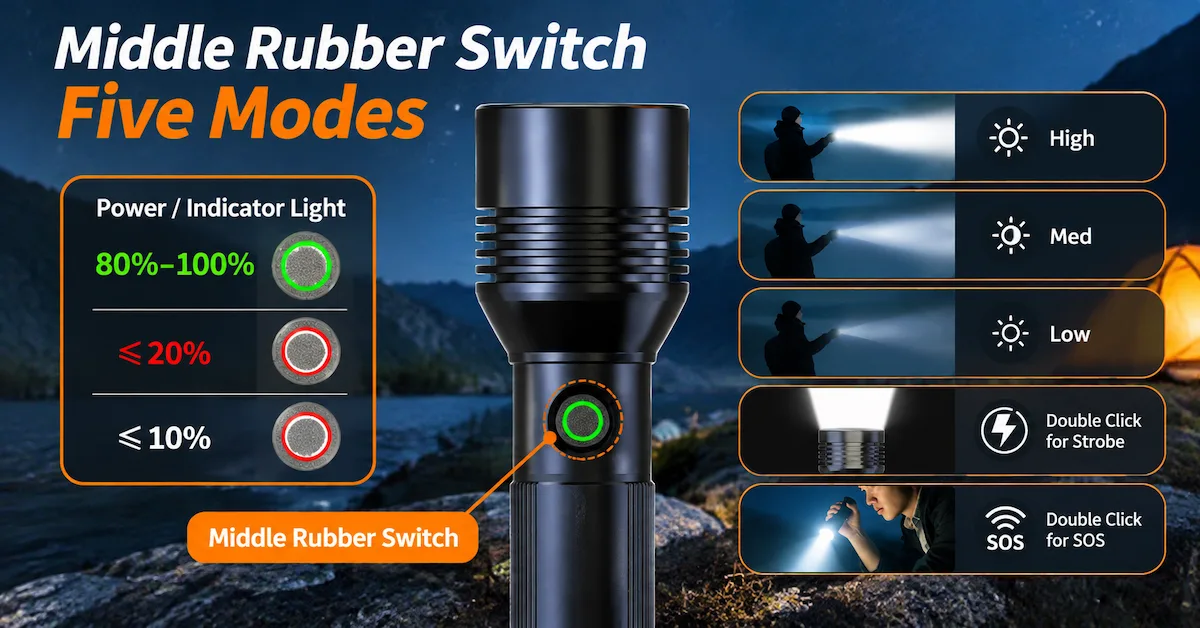
The indicator may use LEDs, colors, flashing patterns, or another scheme depending on the model.
Buyers should request a documented explanation of each indicator state and compare it against actual product behavior.
Test power-bank functions separately
Some Brightenlux lanterns and flashlights list a power-bank capability.
For B2B procurement, confirm whether the function supplies the intended voltage/current, which connector is used, and what happens to the remaining lighting reserve when another device is charged.
A power-bank label should not be interpreted as a promise to recharge a particular phone a specified number of times without supporting measurements.
Control the energy trade-off
If the battery supports both lighting and external USB output, both functions consume the same stored energy reserve.
A buyer can therefore specify whether lighting availability should take priority, and whether the user manual must explain this limitation.
What the buyer should request
The supplier should provide an electrical configuration sheet, charging instructions, defined input/output ratings, and sample-level test results.
This is especially important when the product will be repackaged under a private label.
7. Can Rechargeable Emergency Lights Remain Ready After Months in Storage?
Storage readiness is one of the most important differences between everyday portable lighting and emergency-preparedness products.
A rechargeable lantern used weekly during camping may have frequent opportunities for charging.
A blackout light stored in a cupboard may remain unused for an extended period.
The customer may expect it to operate immediately when needed.
What changes during storage?
Rechargeable batteries can lose charge over time, and their condition can be affected by storage temperature, age, and previous use.
The product's electronics may also draw a small amount of standby current depending on the design.
Consequently, initial factory charging does not establish indefinite readiness.
Define a maintenance procedure
Ask the manufacturer for the permissible storage environment, recommended charge condition, battery-check procedure, and any periodic charging instructions.
The procedure should be based on the actual battery and product design.
Do not invent a universal maintenance interval.
How should buyers test storage readiness?
Select a representative sample and establish its initial condition.
Store it under an agreed environment within the manufacturer's permitted limits.
At predetermined intervals, evaluate battery status and the ability to deliver the intended lighting mode.
If the test reveals a loss of readiness, investigate whether the cause is expected self-discharge, standby consumption, battery deterioration, or another issue.
Section Takeaway
An emergency lighting product should be evaluated not only immediately after charging but also after the storage conditions expected in its actual sales channel.
8. What Are the Main Failure Modes in Rechargeable Emergency Lighting?
The failure modes most relevant to a buyer are those that make the product unavailable, reduce useful illumination, or increase returns.
Understanding the causes helps turn general supplier quality statements into specific acceptance criteria.
Failure Mode and Verification Matrix
| Potential Failure | Likely Technical or Process Concern | Buyer Verification | Procurement Control |
|---|---|---|---|
| Short usable runtime | Battery, driver load, mode setting, aging | Output-versus-time test | Mode-specific runtime requirement |
| Charging failure | USB interface, charging PCB, cable or cell problem | Defined charging test | Approved electrical BOM and functional checks |
| Unexpected dimming | Thermal regulation or battery behavior | Continuous output measurement | Documented regulation profile |
| Unclear battery indicator | Control logic or inconsistent instructions | User-operation trial | Approved control chart and manual |
| Water-related malfunction | Seal, housing, port-cover issue | Model-specific ingress review | Relevant IP evidence and process control |
| Missing accessories | Packing or quotation mismatch | Pack-out inspection | Controlled kit manifest |
| Reorder performance difference | Component substitution | Lot and sample comparison | Change notification and approval |
Why does this matter commercially?
A missing charging cable may be inexpensive but can create customer dissatisfaction.
A battery substitution may appear minor yet change runtime and supporting documentation.
A product that is described as waterproof without a model-specific test record can generate disputes if the end user assumes a higher degree of protection than the design actually offers.
For distributors, each preventable discrepancy increases the cost of customer support, replacement processing, and repeat-order management.
9. How Should a Manufacturer Validate Production Quality Before Bulk Delivery?
A reliable production process connects the approved sample to critical components, assembly instructions, inspection methods, and shipment records.
Incoming material control
Identify critical components such as the lithium cell or pack, LED, driver board, charging PCB, connectors, switches, enclosure components, and sealing materials.
Ask how approved components are identified and whether substitutions require buyer authorization.
Assembly control
The supplier should define relevant process checks for component placement, connections, enclosure closure, controls, and charging functions.
Where a model claims ingress protection, the relevant seals and cover conditions should be included in manufacturing controls.
Final functional checks
Verify the agreed light modes, charging behavior, battery indicators, controls, and included accessories.
The inspection plan should state which checks apply to every unit and which are performed on samples.
Performance verification
Runtime, photometric measurements, environmental qualification, and relevant durability tests should use appropriate methods and sample sizes.
Not every completed unit needs destructive testing, but claims must remain supported by the approved verification plan.
Repeat-order control
Maintain an approved golden sample and revision-controlled bill of materials.
Changes to the battery, LED, driver, firmware, enclosure, or charging components may require a new review.
A visually identical product is not necessarily electrically or optically equivalent.
Manufacturing Quality Takeaway
The purchasing objective is not merely to receive a successful first sample. It is to ensure the production process can repeatedly deliver the approved configuration.
10. How Can OEM Buyers Reduce Cost Without Reducing Emergency Readiness?
A rechargeable LED emergency light manufacturer should provide quotations that allow buyers to compare identical technical configurations.
A low unit price may exclude a battery, cable, printed manual, retail carton, or required technical documentation.
Separate the product from customization costs
A quotation should identify the standard lighting unit and any additional cost for logo printing, packaging, accessories, or engineering changes.
The minimum order quantity may differ between existing products and newly customized configurations.
Compare complete kit costs
For a private-label preparedness kit, the relevant cost includes the light, battery, cable, agreed accessories, packaging, documentation, freight, duties, and inspection requirements.
The buyer should also consider the cost of returns, warranty support, and replenishment.
Avoid unnecessary product changes
If an existing rechargeable platform already matches the target application, modifying only approved packaging and presentation may be easier to evaluate than redesigning the electronics.
Changes to battery chemistry, charging circuits, optics, or enclosure structure can create additional verification requirements.
Confirm MOQ and lead-time stages
Ask for separate estimates covering samples, design approval, artwork, component procurement, production, inspection, and dispatch.
Brightenlux's general OEM/ODM service descriptions do not establish one universal MOQ or delivery period for every product.
The confirmed commercial terms must relate to the exact quoted configuration.
11. An Eight-Hour Blackout Kit: Illustrative Engineering Review
The following example demonstrates how a B2B importer could use the technical principles in this guide.
It is a hypothetical procurement scenario—not a completed Brightenlux customer project, not a field-test report, and not evidence of actual achieved performance.
Application scenario
A preparedness-products importer plans to introduce a rechargeable lantern for household power outages.
The desired customer experience is straightforward:
A family should be able to operate the lantern at a practical brightness setting for eight hours, understand its battery status, and recharge it using the documented charging method.
The importer also wants an accurate product listing, a clear storage-maintenance instruction, and a repeatable private-label packaging configuration.
Initial engineering problem
The importer compares lanterns using maximum lumen ratings and advertised battery capacities.
However, the figures are insufficient to establish eight-hour operation because they do not describe the light's complete output-versus-time behavior.
The engineering team therefore changes the procurement criterion from maximum brightness to a defined working-mode requirement.
Battery planning method
The team creates an illustrative energy budget using 3 W of battery-side load for eight hours.
The theoretical energy requirement is 24 Wh.
With a provisional 80% usable-energy assumption, preliminary nominal storage becomes approximately 30 Wh.
The number is not accepted as a final product specification.
Instead, it is used to determine which battery data and test evidence must be requested.
Sample qualification
The buyer requests a candidate lantern and verifies:
-
The exact supplied battery configuration.
-
The selected working mode and electrical load.
-
An eight-hour output-versus-time record.
-
Charging operation and battery indication.
-
Appropriate storage-maintenance instructions.
-
Packaging and included accessories.
-
Model-specific environmental and safety evidence where applicable.
Procurement decision
The buyer approves the product only if the measured sample meets the defined lighting and battery requirements.
If the proposed lantern does not maintain the required illumination, the buyer may evaluate a lower working mode, a different power configuration, or an alternative product.
No test result is assumed in advance.
What this example demonstrates
The useful outcome of engineering evaluation is a measurable acceptance decision, not an attractive performance claim unsupported by testing.
This framework can be applied to existing Brightenlux lanterns or to a new OEM/ODM project after the supplier confirms technical feasibility.
12. How Should Buyers Prepare an RFQ for Rechargeable Emergency Lighting?
An RFQ should allow the supplier to determine what is available, which requirements need engineering review, and what evidence must be provided before mass production.
The following information helps create a meaningful quotation.
Buyer and market: Company, destination country, and sales channel.
End-user application: Household blackout, preparedness kit, camping backup, roadside inspection, or another appropriate use.
Lighting format: Lantern, headlamp, handheld flashlight, or a coordinated product kit.
Working-mode requirement: Illumination target, operating period, beam distribution, and relevant mode behavior.
Battery system: Cell or pack specification, nominal energy, charging method, and usable-runtime expectations.
Charging and auxiliary output: Input ratings, cable inclusion, charge indication, and any required power-bank function.
Environment: Expected storage, operating temperature, moisture exposure, and applicable tests.
Customization: Branding, packaging, manuals, accessories, or proposed technical changes.
Quality: Sample approval, golden sample, component control, inspection method, and required documents.
Commercial terms: Sample quantity, first-order forecast, pricing basis, MOQ, lead-time milestones, and delivery destination.
The supplier should respond with specific product references, technical specifications, known evidence, unavailable requirements, development needs, and a configuration-based quotation.
Request a Brightenlux OEM/ODM Emergency Lighting Quote
13. Frequently Asked Questions About Rechargeable LED Emergency Light Manufacturing
1. What should buyers look for in a rechargeable LED emergency light manufacturer?
A suitable manufacturer should provide identifiable product configurations, battery and charging specifications, mode-specific lighting evidence, quality-control procedures, and realistic commercial terms. For wholesale programs, the ability to maintain approved components between orders is particularly important.
2. How can buyers verify an eight-hour emergency lighting claim?
Define the actual lighting mode, required illumination, battery configuration, temperature, and runtime endpoint. Then test a representative production-intent sample and record its output throughout the eight-hour period. A maximum-lumen rating or battery-capacity number alone is insufficient.
3. Are rechargeable camping lanterns suitable for household blackouts?
They can be suitable for portable household backup lighting if their output, runtime, charging and operating characteristics match the intended application. They should not automatically be described as certified building emergency escape luminaires.
4. What is the difference between lumen output and battery runtime?
Lumens measure visible light output. Runtime measures how long a product operates under defined conditions. Battery energy, electrical efficiency, selected mode, and output regulation affect duration. The highest-lumen product is not automatically the longest-running one.
5. Why should battery energy be evaluated in watt-hours?
Watt-hours describe energy, while milliamp-hours describe electrical charge capacity. Without voltage information, mAh figures cannot reliably compare different battery assemblies. Buyers should request the actual battery arrangement and appropriate energy data.
6. Can a rechargeable emergency lantern charge a mobile phone?
Some products offer a USB power-bank function, but its output and available energy must be verified. Charging another device reduces the energy remaining for illumination. A power-bank label does not guarantee a specific number of phone recharges.
7. How should a private-label emergency light be maintained during storage?
Follow the approved battery and product instructions for storage temperature, battery condition, inspection, and periodic recharging. Maintenance requirements vary by design. A supplier should provide a model-specific procedure instead of a generic unsupported interval.
8. Does IP67 mean that every rechargeable emergency flashlight is waterproof?
No. An IP rating applies to the tested enclosure configuration and defined conditions. It does not automatically establish resistance to chemicals, unlimited immersion, pressure washing, or all outdoor hazards. Buyers should request relevant model-specific evidence.
9. Can Brightenlux customize rechargeable emergency lights for OEM buyers?
Brightenlux offers OEM/ODM discussions for portable lighting, including branding and product-development support. Actual options, MOQ, technical changes, testing, and delivery schedules must be confirmed for the selected product and order.
10. What should be included in a wholesale rechargeable emergency lighting quotation?
A complete quotation should identify the exact product, battery, accessories, charging cable, packaging, customization, testing or documentation requirements, order quantity, pricing basis, quality acceptance plan, and delivery milestones. Unconfirmed details should be stated as open items rather than assumptions.
Conclusion
Choosing a rechargeable LED emergency light manufacturer requires more than comparing brightness, battery size, and advertised product features.
The strongest procurement decisions connect usable illumination, electrical energy, charging reliability, storage readiness, production consistency, and verified product documentation.
For an eight-hour blackout application, the buyer should begin with a defined lighting requirement, calculate the preliminary energy reserve, and validate the complete system under realistic conditions.
A successful sample is then converted into a controlled production specification with appropriate quality checks and component-change procedures.
Brightenlux offers several portable lighting products that may be evaluated for non-critical blackout and preparedness applications, including the BT-PL4031R rechargeable lantern, 1000-lumen rechargeable lantern, BT-HL9040 headlamp, and BT-FL8101 flashlight.
These are starting references for technical selection, not automatic guarantees of eight-hour runtime or regulated building emergency-lighting approval.
For overseas brands, distributors, and importers, the next step is to define the required application, working mode, battery reserve, target market, customization scope, and purchase quantity.
Explore Brightenlux Portable LED Lighting Products
Contact Brightenlux for a Rechargeable Emergency Lighting OEM/ODM Quotation