

Quick Answer: A reliable portable LED work light supplier should help buyers evaluate illumination at the actual working surface, not simply compare advertised lumen ratings. A nine-point lux map can reveal dark areas, concentrated hotspots, and uneven beam distribution. Combined with glare evaluation, mounting-position checks, and sustained illumination testing, this method provides practical evidence for selecting rechargeable work lights before approving wholesale or OEM production.
Two portable LED work lights may have identical advertised lumen ratings but deliver significantly different results at a workbench.
One may illuminate the entire repair area evenly. Another may produce an intense central hotspot while leaving surrounding components difficult to see.
For industrial distributors, automotive tool brands, and professional maintenance equipment suppliers, this difference matters.
Customers purchase work lights to improve task visibility, not simply to own a product with a larger brightness figure.
Ningbo Brightenlux Electric Appliance Co., Ltd. offers portable LED lighting platforms and OEM/ODM development support for overseas buyers. Its rechargeable magnetic, adjustable-head, and right-angle lighting products provide practical reference points for evaluating different working positions.
This guide explains how buyers can translate lighting requirements into measurable sample approval criteria before committing to bulk production.
1. Why Maximum Lumens Are Not Enough When Choosing a Portable LED Work Light Supplier
A portable work light must deliver illumination where the user needs it.
However, catalogue descriptions commonly emphasize maximum brightness, battery capacity, and the number of operating modes.
These specifications are useful, but they do not establish whether a light performs effectively at a particular working distance or angle.
A Concentrated Beam Can Hide Surrounding Details
A concentrated beam may illuminate a small fastener or inspection point effectively.
However, when technicians need to examine several components simultaneously, surrounding areas may remain too dark.
A Wide Beam May Distribute Light More Effectively
A wider beam can illuminate a larger working surface.
Its maximum central illuminance may be lower, but its overall distribution may be better suited to bench assembly or general maintenance.
Mounting Geometry Changes Lighting Performance
The same work light can produce different illumination patterns when positioned above, beside, or at an angle to the working surface.
The location of nearby components, tools, and the operator also influences visibility.
Therefore, buyers should compare the relationship between light output, beam distribution, mounting position, and the intended task.
Procurement principle: Approve work lights based on useful illumination across the required task area rather than maximum brightness alone.
2. What Is the Difference Between Lumens, Lux and Beam Uniformity?
Understanding basic lighting measurements helps procurement teams communicate more effectively with manufacturers.
| Lighting Metric | Unit | What It Measures | Purchasing Value |
|---|---|---|---|
| Luminous flux | lm | Total visible light output | Compares overall output |
| Illuminance | lx | Light received by a surface | Evaluates task visibility |
| Luminous intensity | cd | Light intensity in a specific direction | Evaluates directional performance |
| Beam angle | Degrees | Angular distribution under a defined method | Helps compare concentrated and broad beams |
| Beam uniformity | Ratio | Relative consistency across measured points | Identifies uneven coverage |
| Useful operating time | Minutes or hours | Duration above agreed task requirements | Supports battery and runtime selection |
What Does Lux Tell a Work Light Buyer?
One lux represents one lumen per square meter.
However, a flashlight rated at 1,000 lumens does not automatically provide 1,000 lux on a particular workbench.
Actual illuminance depends on beam distribution, distance, light direction, and the measurement surface.
A meaningful work light illuminance test should therefore define the distance and position of the product relative to the target.
Why Does Illumination Uniformity Matter?
Uniformity helps determine whether light is distributed consistently across the relevant working area.
A bright central reading alone may conceal insufficient illumination around its edges.
A result closer to 1 indicates more even illuminance across the measured points.
However, uniformity must be considered alongside absolute illuminance. A uniformly dark working surface is not an acceptable lighting solution.
The appropriate targets depend on the actual task and applicable workplace requirements.
The Canadian Centre for Occupational Health and Safety's lighting ergonomics guidance identifies inadequate lighting, glare, poor contrast, and uneven light distribution as important workplace lighting concerns.
This supports the need to assess more than total luminous output during product selection.
3. Which Portable Work Light Designs Match Different Working Environments?
A portable LED work light supplier should understand how the product will be positioned before recommending a lighting platform.
Different applications require different illumination patterns.
| Application | Working Environment | Main Lighting Requirement | Potential Product Format |
|---|---|---|---|
| Workbench assembly | Horizontal working surface | Even coverage across tools and parts | Broad-beam work light |
| Equipment inspection | Restricted spaces | Directional illumination | Right-angle flashlight |
| Automotive maintenance | Reflective metal and obstructed areas | Adjustable light direction | Adjustable-head magnetic light |
| Facility maintenance | Changing work positions | Portable, flexible illumination | Rechargeable magnetic light |
| Mobile repair | Limited access to power outlets | Useful battery-powered operation | Cordless LED work light |
| Component identification | Small labels and fasteners | Controlled close-range beam | Compact inspection light |
| Field service | Variable ambient lighting | Adaptable brightness and positioning | Multi-mode rechargeable light |
Who Should Use This Sourcing Method?
The method is particularly suitable for industrial tool distributors, maintenance equipment importers, private-label lighting brands, automotive supply businesses, and companies developing portable lighting ranges.
It is not a substitute for formal workplace lighting design, hazardous-location certification, specialist inspection equipment, or legally required emergency illumination.
A conventional rechargeable work light should not be promoted for explosive atmospheres unless the specific product has appropriate documented approvals.
4. Which Brightenlux Portable Lighting Products Can Buyers Evaluate?
Brightenlux publishes several rechargeable lighting products that may support workshop, inspection, and maintenance applications.
These models provide useful starting points for evaluating mounting geometry, directional lighting, and working-surface illumination.
Brightenlux Portable LED Lighting Specification Comparison
| Product | Published Maximum Output | LED Source | Power Configuration | Positioning Features |
|---|---|---|---|---|
| Adjustable-Head Magnetic Flashlight | 1,000lm | SST40 | 18650, 2,200mAh | Adjustable head, magnetic tail |
| BT-FL8078 Right-Angle Flashlight | 1,000lm | SST25 | 16340, 800mAh | 90-degree head, magnetic tail, wearable option |
| Compact Magnetic Flashlight | 700lm | SST20 | Type-C rechargeable | 90-degree body, magnetic tail, clip |
The above configurations are manufacturer-published specifications. They do not establish independently measured illuminance, beam uniformity, or sustained output.
1000LM Adjustable-Head Magnetic Flashlight
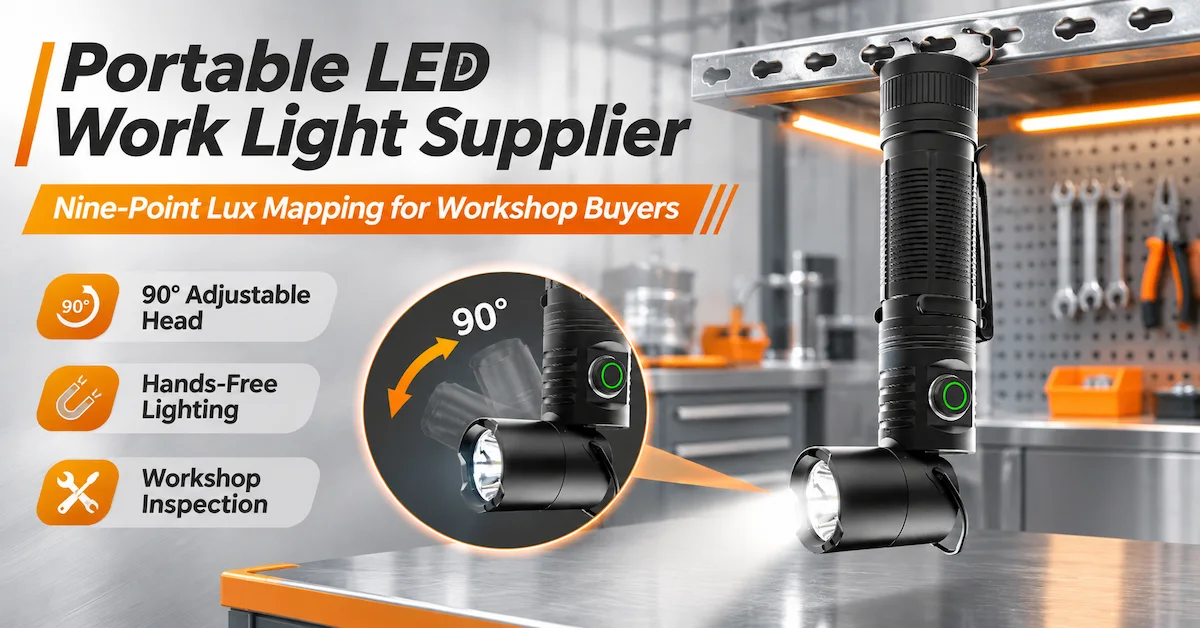
The Brightenlux 1000LM Adjustable-Head LED Flashlight combines an SST40 LED, adjustable lighting direction, magnetic tail, aluminum housing, and rechargeable 18650 battery.
Its adjustable head makes it a relevant candidate for evaluating how beam position influences task coverage.
Buyers can compare different permitted head positions to determine whether the light reaches the intended working area without creating excessive reflections.
BT-FL8078 Right-Angle Rechargeable Flashlight
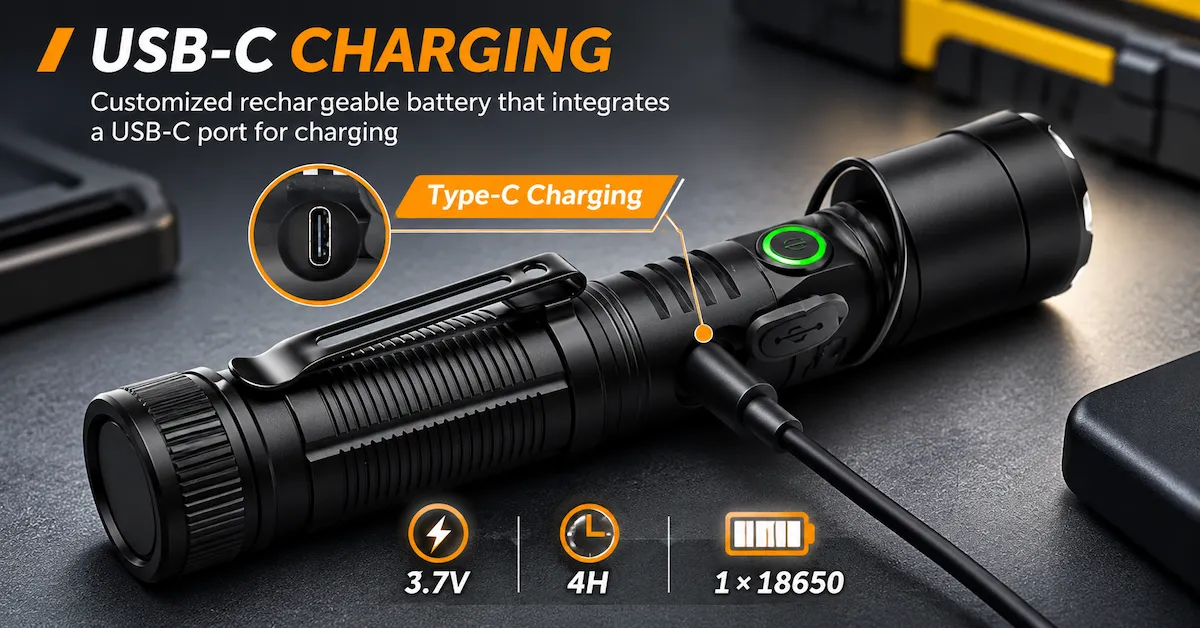
The Brightenlux BT-FL8078 Right-Angle LED Flashlight features a 90-degree design, magnetic mounting, Type-C charging, and an SST25 LED.
This compact platform is relevant to inspection applications where available mounting space is restricted.
Its directional beam should be evaluated at the actual inspection distance rather than assumed to provide uniform illumination across a large workbench.
700LM Compact Magnetic LED Flashlight
The Brightenlux 700LM Compact Magnetic Flashlight combines an SST20 LED, compact right-angle construction, magnetic tail, and Type-C charging.
This product offers another reference point for evaluating close-range illumination and portable hands-free operation.
Product Selection Matrix
| Product Format | Potential Advantage | Main Limitation to Evaluate | Recommended Sample Test |
|---|---|---|---|
| Adjustable-head magnetic light | Flexible beam positioning | Coverage varies with head angle | Lux map at multiple mounting angles |
| 90-degree magnetic light | Compact directional illumination | May concentrate output over a smaller area | Near-field illuminance test |
| Compact magnetic light | Convenient portable inspection | Limited coverage may occur on larger surfaces | Close-range task evaluation |
| Dedicated flood work light | Potentially wider area coverage | Size and mounting requirements | Large-area illuminance mapping |
Brightenlux describes Working Lights as part of its outdoor lighting business. Its currently accessible public work light category does not display dedicated work light models, so buyers requiring COB floodlights, larger workshop lights, or other specialized formats should request the latest product catalogue.
Find a Portable Lighting Platform for Your Market
Compare available lighting configurations and discuss your workshop, inspection, or industrial distribution requirements with Brightenlux.
Explore LED Lighting Products Request Product Information5. How to Conduct a Nine-Point Lux Mapping Test Before Bulk Purchasing
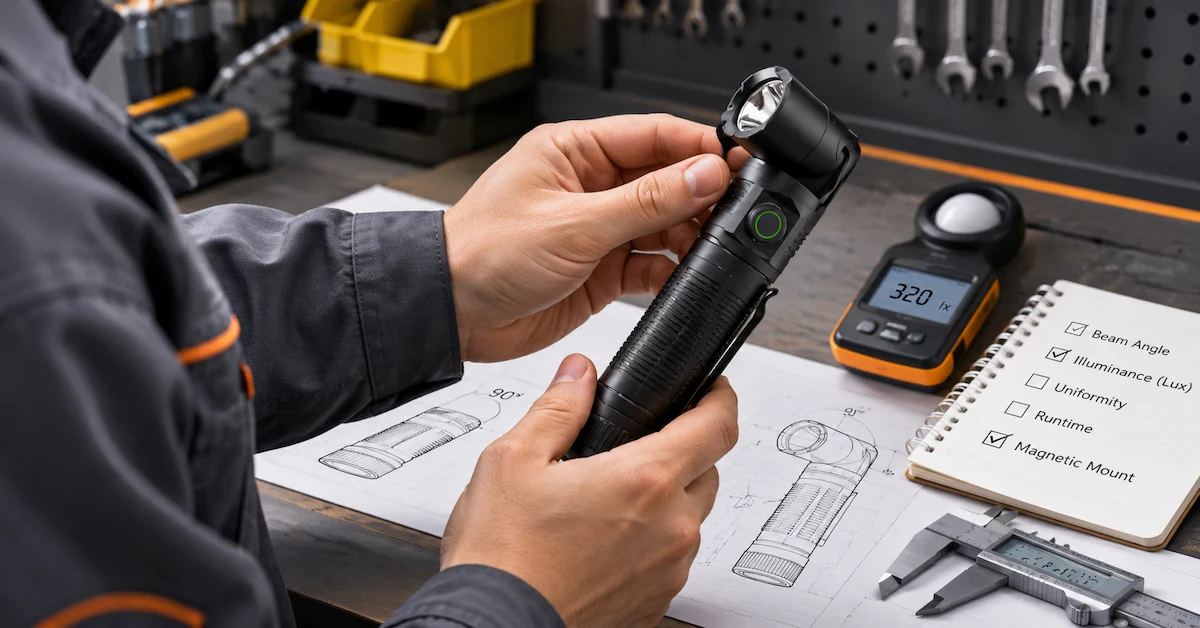
Nine-point lux mapping is a practical buyer-defined method for comparing the distribution of light across a selected working surface.
It provides more information than a single measurement at the center of the beam.
The following procedure is a recommended sample comparison method, not a formal international product certification test.
Step 1: Define the Target Working Surface
Select an area representative of the intended application.
For example, a buyer sourcing portable lights for bench maintenance could define a 60 × 60 cm working surface.
A buyer sourcing compact inspection lights may require a smaller target area.
The dimensions should reflect the actual customer application.
Step 2: Establish Nine Measurement Positions
Divide the target surface into three rows and three columns.
| Left | Center | Right |
|---|---|---|
| P1 — Upper Left | P2 — Upper Center | P3 — Upper Right |
| P4 — Middle Left | P5 — Center | P6 — Middle Right |
| P7 — Lower Left | P8 — Lower Center | P9 — Lower Right |
For a 60 × 60 cm area, measurement points could be positioned at the centers of nine equal 20 × 20 cm sections.
Document the exact coordinates so the test can be repeated.
Step 3: Control the Light Position
Record the distance between the light-emitting surface and the center of the target area.
Also record mounting height, beam direction, tilt angle, and orientation.
A buyer may select several representative distances, such as 30 cm, 50 cm, and 100 cm, depending on the application.
These are illustrative test distances, not mandatory requirements.
Step 4: Standardize the Operating Conditions
Use the approved battery configuration and selected lighting mode.
Control ambient lighting, battery starting condition, and temperature as far as practical.
Allow the product to reach a defined measurement condition before recording results.
Different samples should be compared under equivalent test conditions.
Step 5: Measure the Illuminance
Use an appropriate calibrated lux meter.
Place the sensor at each defined measurement position, aligned with the target surface.
Avoid blocking the beam with the operator, equipment, or measurement fixture.
If ambient illumination is present, record it separately and apply any correction consistently when justified by the test method.
Step 6: Calculate the Results
Record:
- Minimum illuminance.
- Maximum illuminance.
- Average illuminance.
- Center-point illuminance.
- Minimum-to-average uniformity.
- Individual measurement points below the agreed requirement.
Step 7: Compare Alternative Mounting Positions
Repeat the measurement with the light positioned in other permitted working orientations.
A product with an adjustable head may provide different results at different angles.
Document each position rather than comparing only the most favorable result.
Recommended Sample Test Specification
| Test Parameter | Information to Record |
|---|---|
| Sample identity | Model and product revision |
| Target area | Length and width |
| Measurement grid | Nine defined points |
| Measuring instrument | Lux meter identification and calibration status |
| Working distance | Defined measurement distance |
| Mounting angle | Recorded position and orientation |
| Lighting mode | High, medium, or other selected mode |
| Battery condition | Approved battery and initial charge |
| Ambient illumination | Recorded background lux |
| Measurement time | Defined time after activation |
| Minimum illuminance | Buyer-agreed requirement |
| Uniformity | Buyer-agreed minimum-to-average ratio |
| Visual evaluation | Glare, shadows, and task visibility |
This creates a repeatable technical reference that both the buyer and supplier can use during sample approval.
6. What Can a Nine-Point Lux Test Reveal About Work Light Performance?
Consider two hypothetical portable LED work lights evaluated under identical conditions.
The following data are illustrative engineering examples, not measured results from Brightenlux products.
Example A: Concentrated Beam
| Left | Center | Right |
|---|---|---|
| 90 lx | 150 lx | 100 lx |
| 160 lx | 800 lx | 170 lx |
| 85 lx | 150 lx | 95 lx |
Example B: More Even Beam
| Left | Center | Right |
|---|---|---|
| 190 lx | 220 lx | 185 lx |
| 230 lx | 300 lx | 235 lx |
| 180 lx | 225 lx | 195 lx |
Nine-Point Measurement Comparison
| Performance Indicator | Example A | Example B |
|---|---|---|
| Center illuminance | 800 lx | 300 lx |
| Minimum illuminance | 85 lx | 180 lx |
| Maximum illuminance | 800 lx | 300 lx |
| Average illuminance | 200 lx | 217.8 lx |
| Uniformity ratio | 0.43 | 0.83 |
Example A produces much higher center illumination.
However, Example B delivers more consistent coverage across the selected working area.
For a buyer whose customers examine a broad working surface, Example B may provide a more appropriate beam distribution.
For a buyer requiring concentrated illumination of a small inspection point, Example A may be suitable, subject to glare and other application checks.
Suppose the buyer establishes an illustrative minimum requirement of 150 lux at every measurement point and a uniformity ratio of at least 0.65.
Example A would fail those defined criteria, while Example B would pass them.
These figures demonstrate how acceptance criteria can influence purchasing decisions. They are not universal workplace lighting thresholds.
The important conclusion: A higher center lux reading does not necessarily indicate a better portable work light.
7. How Should Buyers Evaluate Glare, Reflections and Shadows?
Lux measurements describe the amount of light received at a surface.
They do not independently establish visual comfort or whether a technician can identify every relevant detail.
Direct Glare
Direct glare can occur when an intense light source is visible within the operator's field of view.
A compact work light positioned close to the user may require careful adjustment of its angle or output mode.
Reflected Glare
Polished metal, glossy plastic, painted components, and reflective tools may redirect light toward the operator.
A concentrated beam can make markings or surface details more difficult to distinguish if reflections dominate the viewing area.
Equipment Shadows
Tools, hands, machine components, and structural obstructions can block the light.
A product that performs well on an unobstructed test board may produce less useful results during actual work.
Glare and Shadow Evaluation Matrix
| Problem | Possible Design or Positioning Cause | Sample Evaluation |
|---|---|---|
| Bright reflections | Beam directed toward a reflective surface | Change light angle and observe task visibility |
| Central hotspot | Concentrated optical distribution | Compare center and surrounding lux readings |
| Dark edges | Insufficient beam coverage | Measure perimeter points |
| Operator shadow | Light positioned behind the user | Evaluate alternative permitted positions |
| Component shadow | Obstructed beam path | Introduce representative task components |
| Distracting brightness | Excessive output for close work | Compare lower operating modes |
The UK's Health and Safety Executive guidance on lighting at work emphasizes suitable lighting practices and assessing risks associated with inadequate lighting.
For product procurement, this reinforces the importance of evaluating the complete working environment rather than approving lights solely from catalogue specifications.
8. How Long Does a Portable LED Work Light Maintain Useful Illumination?
A rechargeable work light may deliver its highest advertised output immediately after activation.
Its output can subsequently change because of thermal management, battery discharge, or driver behavior.
For professional procurement, the relevant question is how long the product maintains the illumination required by the actual task.
Useful Task Illumination Versus Advertised Runtime
Advertised runtime may describe operation until a specified test endpoint.
However, a light can remain switched on after its output becomes insufficient for a particular application.
Buyers should define a separate useful illumination requirement.
For example, a sample may be required to maintain an agreed minimum lux value across the target area throughout a defined maintenance period.
Sustained Illumination Test Plan
| Measurement Time | Recommended Evaluation |
|---|---|
| Initial measurement | Record baseline nine-point lux map |
| 15 minutes | Check early output changes |
| 30 minutes | Review output and distribution |
| 60 minutes | Assess continued task suitability |
| 120 minutes | Verify performance if required by the application |
| Test endpoint | Record when agreed illumination criteria are no longer satisfied |
The measurement intervals should be adapted to the intended usage and approved product configuration.
A portable LED work light supplier should clarify the relevant lighting modes, battery specifications, and available runtime evidence.
Do not assume that a larger battery capacity automatically guarantees higher sustained illumination.
Driver efficiency, optical design, thermal conditions, and selected operating mode also matter.
9. How Do Materials and Optical Manufacturing Affect Work Light Performance?
Consistent task illumination depends on several components working together.
Changes to optics, LED position, electronic controls, or assembly alignment can influence the finished beam.
| Component | Function | Potential Quality Concern |
|---|---|---|
| LED emitter | Produces visible light | Output variation or incorrect component |
| Reflector | Directs the light | Alignment and surface defects |
| Lens | Influences light transmission and distribution | Scratches, contamination, or geometry changes |
| Diffuser, where applicable | Spreads light across a wider area | Uneven material or optical transmission |
| LED driver | Regulates electrical operation | Unintended output variation |
| Aluminum housing | Structural and thermal support | Fit, finish, and thermal contact |
| Adjustable joint | Changes beam direction | Position drift or assembly variation |
| Magnetic mounting | Supports hands-free positioning | Movement on the intended mounting surface |
A small change in LED alignment may alter the location of the beam center.
A lens substitution may change beam spread even if the advertised lumen rating remains unchanged.
An unstable mounting mechanism may gradually redirect the light away from the working area.
Therefore, optical and mechanical configurations should be controlled together.
Brightenlux offers product development, branding customization, and manufacturing coordination through its Outdoor Lighting Solutions business.
Buyers should confirm which optical components, materials, and inspection processes apply to the selected project.
10. How Should Suppliers Maintain Beam Consistency During Bulk Production?
A successful engineering sample does not establish that every production unit will deliver equivalent illumination.
Buyers need a method for transferring the approved optical performance into manufacturing and inspection requirements.
Incoming Material Inspection
Confirm that the LED, reflector, lens, driver, and relevant structural components match the approved specification.
Any alternative component should receive an appropriate engineering review.
Assembly Verification
Check features that influence optical alignment and beam direction.
Depending on the design, these may include LED placement, reflector positioning, lens installation, and adjustable-head assembly.
First-Off Sample Inspection
Evaluate initial production units against the approved optical reference.
Repeat the agreed measurements where appropriate.
Production Acceptance Testing
A routine functional check can confirm that the light operates.
However, switching the light on does not establish beam distribution or uniformity.
Buyers may agree on a sampled optical inspection plan in addition to normal functional testing.
Work Light Quality Control Matrix
| Production Stage | Recommended Control | Supporting Evidence |
|---|---|---|
| Component approval | Confirm LED and optical configuration | Approved specification |
| Incoming inspection | Verify critical component identity | Inspection record |
| Assembly | Check optical positioning | Assembly inspection |
| First-off approval | Compare with approved lux map | Measurement report |
| Finished-goods inspection | Verify operation and agreed optical criteria | Inspection results |
| Repeat orders | Review relevant component changes | Change-control record |
These are recommended buyer-defined quality-control requirements, rather than a claim that Brightenlux currently performs every listed measurement on every unit.
What About Certifications?
Request documentation applicable to the intended market and exact product configuration.
Where a product carries an ingress-protection claim, request appropriate model-specific evidence.
An IP rating, electrical compliance document, or factory audit does not independently prove illumination uniformity.
Optical performance should be supported by relevant measurements and acceptance criteria.
11. How Do Optical Requirements Affect OEM Costs, MOQ and Lead Time?
An OEM work light does not always require a completely new design.
An existing platform may already provide acceptable illumination for the intended application.
The first priority is therefore identifying the closest available product and evaluating representative samples.
Existing Product Customization
For private-label lighting programs, customization may involve branding, packaging, color, and approved accessories.
If the existing optical design meets the buyer's requirements, extensive optical redevelopment may be unnecessary.
Optical Configuration Development
A buyer requiring a different beam distribution may need changes to the reflector, lens, diffuser, LED arrangement, or housing.
Such modifications can affect development time, tooling, component sourcing, and validation requirements.
Potential OEM Cost Factors
| Cost Factor | Reason for Potential Cost Changes |
|---|---|
| Existing optical platform | Availability of suitable standard components |
| Custom lens or reflector | Engineering and potential tooling |
| LED configuration | Component selection and availability |
| Driver modification | Electrical and thermal validation |
| Mechanical adjustment | Housing or mounting development |
| Sample testing | Engineering time and measurement equipment |
| Production inspection | Fixtures and inspection requirements |
| Private-label packaging | Artwork, printing, and packaging configuration |
The appropriate MOQ and production lead time depend on the specific product, customization scope, approved components, testing requirements, and order quantity.
Buyers should request project-specific quotations rather than assume a universal MOQ or delivery schedule.
Production capacity and available manufacturing slots should also be confirmed for the proposed order.
A portable LED work light supplier should distinguish between existing features, configurable options, and newly developed components.
This helps buyers avoid paying for unnecessary development while protecting the lighting performance that matters to their customers.
12. What Should Buyers Include in a Portable LED Work Light Supplier RFQ?
A technically detailed request for quotation allows the supplier to recommend products against actual requirements.
Instead of requesting a high-lumen rechargeable work light without further information, describe the intended working surface, application, mounting conditions, and required illumination.
Technical RFQ Checklist
| RFQ Item | Information to Provide |
|---|---|
| Company and market | Destination country and business type |
| Sales channel | Industrial distribution, hardware retail, or private label |
| Main application | Workshop, inspection, equipment maintenance, or field service |
| Reference product | Existing Brightenlux model or approved design reference |
| Working surface | Dimensions and orientation |
| Working distance | Typical illumination distance |
| Beam requirement | Directional, broad, or adjustable |
| Illuminance | Required minimum and average lux |
| Uniformity | Agreed minimum-to-average ratio |
| Operating duration | Required period above illumination criteria |
| Mounting | Magnetic, handheld, clip, or other arrangement |
| Battery | Preferred power configuration |
| Environmental requirements | Intended exposure and applicable documentation |
| Customization | Logo, housing, packaging, and accessories |
| Sample approval | Required test methods and evidence |
| Order quantity | Initial purchase and estimated annual demand |
| Commercial requirements | MOQ, sample charges, lead time, and trade terms |
Recommended OEM Procurement Workflow
This workflow helps purchasing teams convert a general lighting requirement into a measurable product specification.
If you are sourcing rechargeable portable work lights, magnetic inspection lights, or private-label maintenance lighting products, provide Brightenlux with your target application and technical requirements.
The team can discuss available product platforms, customization feasibility, sample requirements, and project-specific commercial terms.
Request a Portable LED Work Light Quotation
Share your intended application, working distance, illumination requirements, estimated order quantity, and customization needs to discuss suitable product platforms and sample evaluation options.
Request a Quote Explore OEM/ODM Solutions13. Frequently Asked Questions
1. What Should I Look for in a Portable LED Work Light Supplier?
Evaluate the supplier's available product configurations, optical performance evidence, customization options, sample support, quality-control approach, and commercial reliability. The product should be assessed against its intended working conditions.
2. Is a 1,000-Lumen Work Light Better Than a 700-Lumen Model?
Not necessarily. A 700-lumen model may provide more suitable task illumination if its beam distribution, mounting position, and operating distance better match the application. Compare measured performance rather than total output alone.
3. What Is a Nine-Point Lux Mapping Test?
It is a practical measurement method that evaluates illuminance at nine defined positions across a target surface. The readings help identify bright spots, dark areas, average illuminance, and relative uniformity.
4. Is Nine-Point Lux Mapping an International Work Light Certification Standard?
No. The method described in this guide is a buyer-defined sample comparison procedure. Formal product testing or workplace lighting assessment may require different methods, instruments, and measurement arrangements.
5. What Is a Good Lux Level for a Portable LED Work Light?
The appropriate illuminance depends on the task, working distance, surface characteristics, visual requirements, and applicable workplace guidance. There is no single lux value suitable for every maintenance or inspection application.
6. Are Magnetic Work Lights Suitable for Every Metal Surface?
No. Magnetic mounting depends on whether the surface is ferromagnetic, as well as its thickness, geometry, coating, contamination, and mounting orientation. The intended mounting position should be evaluated using representative samples.
7. Why Does Work Light Brightness Decrease During Operation?
Output may change because of battery discharge, thermal regulation, driver behavior, or the selected operating mode. Buyers should measure sustained illumination under documented operating conditions.
8. Can a Manufacturer Customize the Beam Pattern of a Portable LED Work Light?
Optical customization may be possible through changes to lenses, reflectors, LED arrangements, or other components. Engineering feasibility, development cost, MOQ, and validation requirements depend on the selected product.
9. How Can Buyers Prevent Inconsistent Beam Performance Between Bulk Orders?
Maintain an approved reference sample, controlled optical component specification, documented measurement method, and appropriate inspection criteria. Relevant component substitutions should be reviewed before approval.
10. How Can I Request Portable LED Work Light Samples From Brightenlux?
Provide your target application, working distance, required lighting area, preferred product format, battery requirements, customization scope, estimated quantity, and sample acceptance criteria. Request confirmation of available platforms, sample costs, MOQ, and production arrangements through the Brightenlux Contact Us page.
Conclusion
Selecting a portable LED work light supplier requires more than comparing maximum lumens, battery capacity, housing appearance, and unit price.
For industrial distributors, maintenance equipment suppliers, automotive tool brands, and private-label importers, the most valuable lighting product is one that delivers suitable illumination where the customer actually works.
Nine-point lux mapping provides a practical starting point for evaluating beam distribution, identifying dark areas, and comparing alternative lighting configurations.
When combined with glare assessment, sustained illumination testing, controlled optical components, and clear production acceptance criteria, it can support more informed bulk purchasing decisions.
Brightenlux offers rechargeable portable LED lighting platforms and OEM/ODM development support for overseas B2B customers.
Whether you require compact magnetic inspection lights, adjustable-head rechargeable products, or a customized portable lighting program, begin by defining your application and measurable lighting requirements.
Choose the work light that illuminates the task—not simply the one with the highest lumen rating.
Develop Your Portable LED Work Light Product Range
Work with Brightenlux to discuss available lighting platforms, product customization, sample evaluation, and wholesale purchasing requirements for your target market.
Contact Us for a Quote Browse Our Products