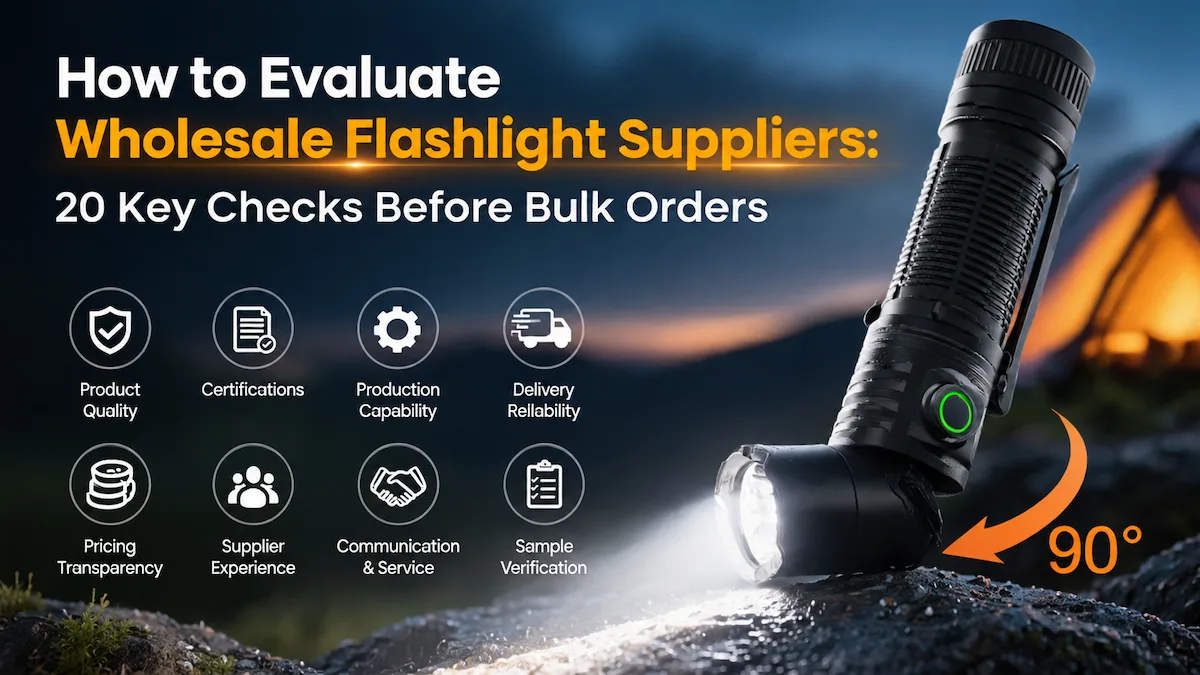


For automotive equipment distributors and industrial tool brands, an LED work light is more than a portable light source.
Technicians frequently reposition it, adjust the head, connect charging cables, place it on repair benches, and carry it between work areas.
A work light may perform well during a short showroom demonstration but develop problems after repeated handling.
An adjustable head may become loose. A charging connector may develop intermittent contact. A protective cover may become difficult to close. A lamp may continue to illuminate after an impact while its mounting mechanism or battery contacts are damaged.
These problems matter to B2B buyers because mechanical failures can affect product usability, customer satisfaction, and the economics of repeat orders.
The purchasing challenge is therefore to define which durability characteristics are necessary for the intended application and how those characteristics will be verified before production approval.
This guide focuses on mechanical durability and production acceptance rather than general supplier selection.
For the complete OEM development process, see the Brightenlux OEM LED Work Light Manufacturer Guide.
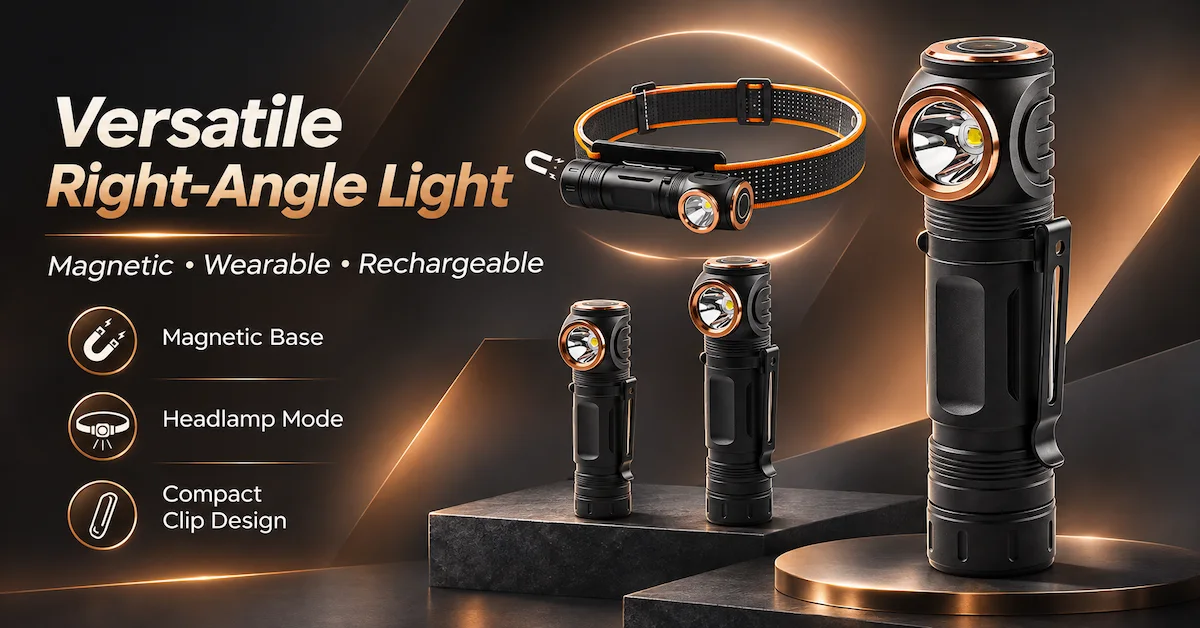
1. Why Should OEM Work Light Buyers Evaluate Mechanical Durability?
A work light's reliability depends on its complete construction, not just the LED module.
The enclosure, mechanical joints, charging connector, fasteners, mounting hardware, and battery-retention system all influence how the product performs during use.
Automotive repair environments
Mechanics regularly work around engines, repair benches, equipment cabinets, and vehicle interiors.
A portable light may be:
- Moved between different mounting positions.
- Operated while wearing work gloves.
- Repeatedly attached to or removed from a fixture.
- Stored with other tools.
- Exposed to occasional knocks.
- Charged after each work period.
These conditions make the controls, enclosure, mounting interfaces, and charging system important parts of product selection.
Industrial maintenance applications
Maintenance technicians may use portable lighting around machinery, service vehicles, and equipment installations.
For these buyers, mechanical durability should be evaluated alongside useful illumination, electrical safety, and portability.
Private-label retail programs
An OEM product with attractive packaging may still generate complaints if the hinge becomes loose or the charging port fails during normal use.
Importers should therefore evaluate whether their supplier can reproduce the approved design across multiple orders.
Who Should Prioritize Durability Testing?
| Buyer Type | Application | Main Durability Concern |
|---|---|---|
| Automotive tool distributors | Repair and inspection | Drops, adjustable heads, charging-port wear |
| Industrial maintenance suppliers | Equipment servicing | Repeated handling and mounting stability |
| Private-label brands | Retail work-light ranges | Consistent product construction |
| Fleet maintenance suppliers | Service vehicles | Storage, charging, and repeated use |
| Professional tool importers | Workshop equipment | Mechanical quality and replacement costs |
| OEM product developers | Customized lighting | Design feasibility and production repeatability |
Buyer takeaway: Durability requirements should be based on the product's intended operating conditions, not a generic description such as “heavy-duty.”
2. Which Components Commonly Require Durability Verification?
Different work-light designs create different mechanical risks.
A compact right-angle flashlight, folding COB inspection light, and portable floodlight should not automatically share an identical test plan.
Main Component Risk Matrix
| Component | Potential Failure | Recommended Evaluation |
|---|---|---|
| Housing | Cracking, permanent deformation | Defined impact and visual inspection |
| Folding hinge | Looseness, excessive friction, fracture | Repeated adjustment and retention tests |
| USB-C connector | Intermittent charging, mechanical movement | Insertion/removal and charging checks |
| Charging-port cover | Poor closure, wear, damage | Repeated operation and sealing inspection |
| Switch | Sticking, inconsistent actuation | Operating-cycle and functional tests |
| Magnetic mounting | Detachment or movement | Application-specific mounting tests |
| Clip or hook | Bending, fracture, loss of retention | Defined load and repeated-use tests |
| Battery contacts | Loss of electrical connection | Impact-related functional assessment |
| Lens or diffuser | Movement, cracking, optical damage | Mechanical and optical inspection |
The correct priorities depend on the actual product architecture.
For example, an adjustable work light may require more detailed hinge verification than a fixed-body flashlight.
A rechargeable inspection lamp used daily may place greater demand on its charging connector than an emergency light used occasionally.
3. How Should an OEM Work Light Manufacturer Design a Drop-Test Plan?
A drop test should simulate reasonably foreseeable handling conditions.
It should not be treated as a universal demonstration of product quality.
The official IEC 60068-2-31:2008 environmental testing standard describes methods for evaluating rough-handling shocks, including certain drops, toppling, and falls relevant to equipment-type products.
The standard distinguishes these situations from other impact conditions, such as impacts during loosely constrained cargo transportation.
For work-light sourcing, it provides a relevant technical reference when selecting an appropriate handling test.
However, the applicable procedure, severity, and acceptance requirements must be established for the proposed product.
Step 1: Define the representative product configuration
Before testing, identify:
- Exact model and engineering revision.
- Approved battery and accessories.
- Product weight.
- Housing material.
- Lens or diffuser configuration.
- Position of folding parts.
- Charging-port cover condition.
- Intended operating environment.
The test sample should represent the proposed production configuration.
Step 2: Define the expected handling conditions
A work light carried in a technician's toolbox may face different conditions from a light permanently mounted on equipment.
Buyers should identify the product's realistic handling risks and select an appropriate test accordingly.
Step 3: Determine test orientations
Different orientations may expose different vulnerable components.
For example, a drop onto a side containing a charging connector may create a different failure risk from an impact onto a reinforced housing corner.
The test plan should identify the relevant faces, edges, or corners.
Step 4: Define the test surface and severity
The buyer and manufacturer should agree on:
- Test surface.
- Drop height or other applicable severity.
- Number and sequence of impacts.
- Product operating state.
- Environmental conditions.
- Acceptance criteria.
There is no single drop height that proves every OEM work light suitable for every industrial application.
Step 5: Inspect the product after testing
A product remaining illuminated does not automatically mean it passed.
Post-test inspection should include mechanical integrity, controls, battery retention, charging, mounting features, and any affected optical components.
Recommended Drop-Test Record
| Test Item | Required Record |
|---|---|
| Sample identification | Model, revision, battery configuration |
| Test method | Selected standard or buyer-approved procedure |
| Impact condition | Surface, severity, orientation |
| Test sequence | Number and order of events |
| Visible damage | Housing, lens, covers, mounting parts |
| Functional result | LED output, switch, charging, indicators |
| Electrical concerns | Battery and connector condition |
| Acceptance decision | Pass, fail, or further investigation |
Important: IEC 60068-2-31 provides testing methods. Mentioning it does not mean any Brightenlux product has passed a specific drop test.
Need a product-specific durability plan?
Discuss drop conditions, sample configuration and acceptance methods with Brightenlux.
4. How Can Buyers Verify Folding Hinge Durability?
Folding work lights use adjustable joints to position illumination.
The design must balance movement with the ability to hold the desired working angle.
A hinge that is too loose may allow the light to change position unexpectedly.
A hinge that is too stiff may make adjustment inconvenient or place unnecessary stress on surrounding components.
Evaluate holding performance
For a work light with a folding head, buyers should define the approved operating angles.
At each relevant position, check whether the head maintains its intended orientation under the agreed test conditions.
Where appropriate, the test may include a specified holding torque or displacement limit.
Evaluate repeated movement
A hinge can behave correctly when new but change after repeated use.
An OEM development plan should consider:
- Initial movement and holding performance.
- Repeated opening and closing.
- Inspection for looseness or abnormal resistance.
- Verification of relevant working angles.
- Examination of fasteners and surrounding housing.
- Final functional inspection.
The required number of cycles must reflect the expected application and agreed product life assumptions.
Check the mechanical construction
Possible design factors include:
- Pivot material.
- Fastener arrangement.
- Friction elements.
- Housing support around the hinge.
- Assembly tolerances.
- Wear of contact surfaces.
- Resistance to unintended loosening.
Changing one component can affect the complete mechanism.
For example, a different friction washer or fastener may alter the hinge's holding behavior.
Hinge Durability Acceptance Matrix
| Inspection | Buyer Requirement |
|---|---|
| Initial operation | Smooth movement without unacceptable play |
| Angle adjustment | All approved positions accessible |
| Holding performance | Meets agreed retention requirement |
| Repeated cycling | Remains functional after defined test |
| Structural condition | No unacceptable cracking or loosening |
| Final assembly | Fasteners and housing remain within specification |
These are suggested acceptance categories, not measured results for a particular Brightenlux product.
5. What Should Buyers Test on USB-C Rechargeable Work Lights?
USB-C charging has become an important feature of portable LED lighting.
However, the presence of a Type-C connector does not establish charging speed, power compatibility, or mechanical durability.
For an OEM work light manufacturer, the charging interface should be evaluated as a complete system.
Connector mechanical retention
The charging socket should remain securely attached and correctly positioned during expected use.
Buyers should check whether repeated cable insertion creates movement or electrical intermittency.
Repeated insertion and removal
A work light charged regularly may experience substantial connector use during its service life.
A practical test should include:
- An approved charging cable.
- Defined insertion/removal cycles.
- Controlled handling conditions.
- Periodic charging verification.
- Inspection for looseness or damage.
Do not assign a universal lifetime cycle requirement without considering the actual connector design and expected use.
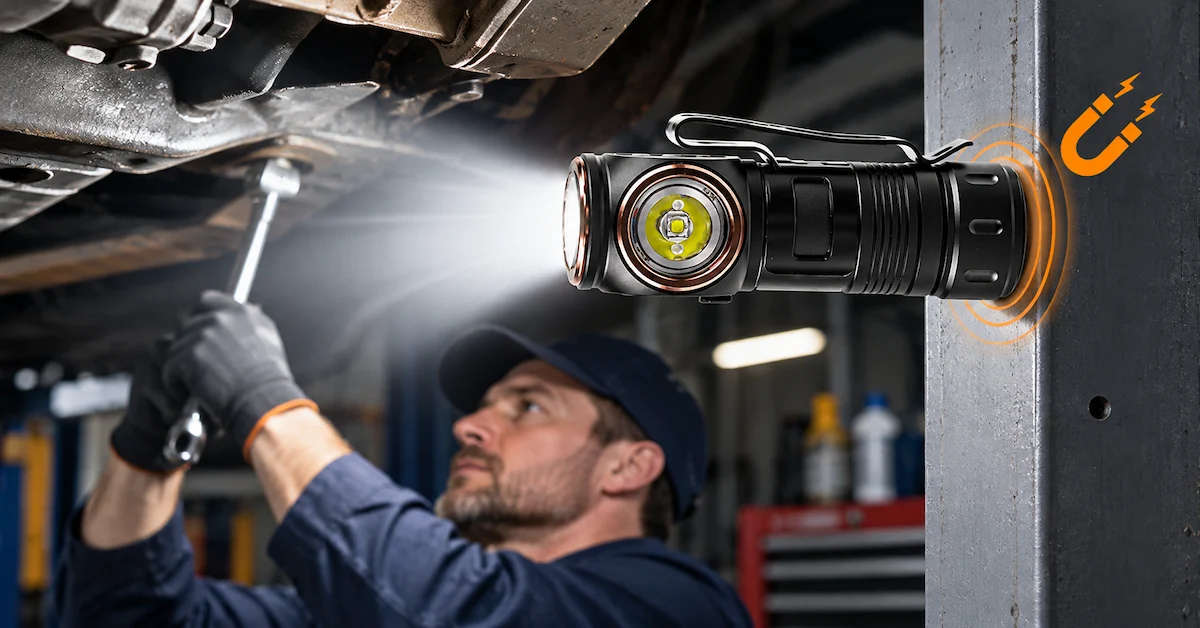
Charging-source compatibility
USB-C describes a connector type.
The supplier should identify the supported charging input and compatible power sources.
Buyers should confirm whether the specific design supports the intended USB-A-to-C, USB-C-to-C, or other charging arrangement.
Additional power-delivery functionality must not be assumed without supporting specifications and tests.
Charging-port cover durability
Some work lights use a protective cover.
The cover must be assessed for:
- Repeated opening and closing.
- Retention.
- Fit against the enclosure.
- Resistance to accidental displacement.
- Compatibility with the approved charging cable.
- Condition after mechanical testing.
Charging Interface Evaluation
| Test Area | What to Verify |
|---|---|
| Connector alignment | Correct fit with approved cable |
| Repeated use | No unacceptable mechanical deterioration |
| Charging function | Correct operation under defined conditions |
| Indicator behavior | Agreed charging-state response |
| Port cover | Reliable opening, closing, and retention |
| Post-impact operation | Charging remains functional after applicable testing |
| Component consistency | Approved connector and charging board |
Why charging-port testing matters commercially
A work light that illuminates correctly but cannot recharge reliably may become unusable to the customer.
Therefore, charging-system verification should be included in the product acceptance criteria rather than treated as a secondary accessory check.
Planning a rechargeable work-light range?
Compare existing lighting platforms before approving a new charging or housing design.
6. Does an IP Rating Prove That an OEM Work Light Is Durable?
No.
Ingress protection and mechanical durability describe different product characteristics.
The IEC 60529 IP Code standard establishes a system for classifying enclosure protection against access, solid foreign objects, and water ingress.
An IP rating does not automatically establish drop resistance, hinge durability, resistance to oil, or suitability for all cleaning chemicals.
Why enclosure details matter
Work lights may include:
- Charging-port covers.
- Battery doors.
- Housing joints.
- Switch seals.
- Lens interfaces.
- Adjustable mechanisms.
These features can influence the condition of the enclosure during testing.
A buyer should request supporting evidence for the actual production configuration.
What happens after mechanical testing?
If a mechanical impact affects a charging cover or enclosure joint, it may be necessary to reassess the relevant ingress-protection claim.
The appropriate retesting depends on the design change, observed damage, and product requirements.
Practical distinction
| Characteristic | Main Question |
|---|---|
| Drop resistance | Does the product tolerate the defined handling event? |
| Hinge durability | Does the adjustable mechanism remain functional? |
| Connector durability | Does charging remain reliable after repeated use? |
| Ingress protection | Does the enclosure meet the claimed IP classification? |
| Chemical resistance | Does the construction tolerate specified substances? |
| Mounting stability | Does the installed light remain properly positioned? |
A product should not be described as fully industrial-grade solely because one of these characteristics has been tested.
7. Which Materials and Manufacturing Details Affect Durability?
Housing materials and construction methods influence how a work light responds to handling and impact.
However, no single material is automatically best for every product.
Aluminum components
Aluminum can provide mechanical strength and a useful thermal path when appropriately designed.
It may be used for housings or structural components in certain portable lighting products.
The final performance depends on geometry, manufacturing quality, thickness, and assembly.
Engineering plastics
Plastic components can help manage weight, grip geometry, and complex product shapes.
Material selection should consider mechanical properties, operating conditions, and the complete enclosure design.
Fasteners and assembly interfaces
Mechanical failures can originate from more than the main housing material.
Fastener installation, dimensional fit, joint alignment, and material compatibility may all influence durability.
Diffusers and lenses
Optical components must remain properly positioned during intended use.
A damaged diffuser may change the product's beam distribution even if the LED continues operating.
Manufacturing Quality Checklist
| Manufacturing Area | Important Control |
|---|---|
| Housing | Approved material and dimensions |
| Hinges | Correct components and assembly condition |
| Charging connector | Approved part and mounting integrity |
| Fasteners | Defined installation process |
| Switch | Correct fit and operation |
| Battery interface | Approved contacts and retention |
| Lens/diffuser | Correct installation and positioning |
| Enclosure seals | Correct material and assembly condition |
For OEM programs, buyers should request component and assembly information appropriate to the exact design.
8. Which Brightenlux Products Can Be Used as OEM Development References?
Ningbo Brightenlux Electric Appliance Co., Ltd. publishes portable rechargeable lighting products and offers OEM/ODM outdoor lighting discussions.
Its publicly documented products include several magnetic, right-angle, and adjustable-head flashlight configurations.
These can be considered reference platforms for selected work-light applications.
They should not be described as confirmed dedicated COB workshop lights or assumed to have passed the durability tests proposed in this guide.
Brightenlux Rechargeable Lighting Platform Comparison
| Product | Manufacturer-Published Features | Relevant Durability Evaluation |
|---|---|---|
| 1000lm SST40 Adjustable-Head Flashlight | Adjustable head, magnetic tail, 18650 battery platform, Type-C charging | Head retention, connector operation, enclosure construction |
| BT-FL8078 Right-Angle Flashlight | SST25 LED, 90° construction, 16340 rechargeable battery, Type-C charging | Housing impact, controls, clip and mounting interfaces |
| BT-FL8088 Magnetic Rechargeable Flashlight | SST40 LED, 21700 4000mAh battery, magnetic tail, Type-C charging | Charging-port integrity, housing, battery retention |
The configurations above come from manufacturer-published product descriptions; they are not independently verified durability results.
Adjustable-head rechargeable flashlight
The Brightenlux 1000-Lumen SST40 Adjustable-Head Flashlight offers a useful reference when discussing adjustable lighting structures.
For an OEM project involving head movement, buyers can use this type of architecture to explain their desired adjustment range, control accessibility, and mechanical requirements.
BT-FL8078 right-angle flashlight
The Brightenlux BT-FL8078 Right-Angle Flashlight combines a compact right-angle construction with Type-C charging and magnetic mounting.
Its published design can support discussions about portable inspection-light ergonomics and mechanical handling.
However, its current public specification does not demonstrate a particular drop-test rating or connector-cycle life.
BT-FL8088 rechargeable flashlight
The Brightenlux BT-FL8088 Rechargeable Flashlight uses a published 21700 rechargeable battery configuration and Type-C charging.
It provides a reference for discussing rechargeable portable-light construction and battery-related design requirements.
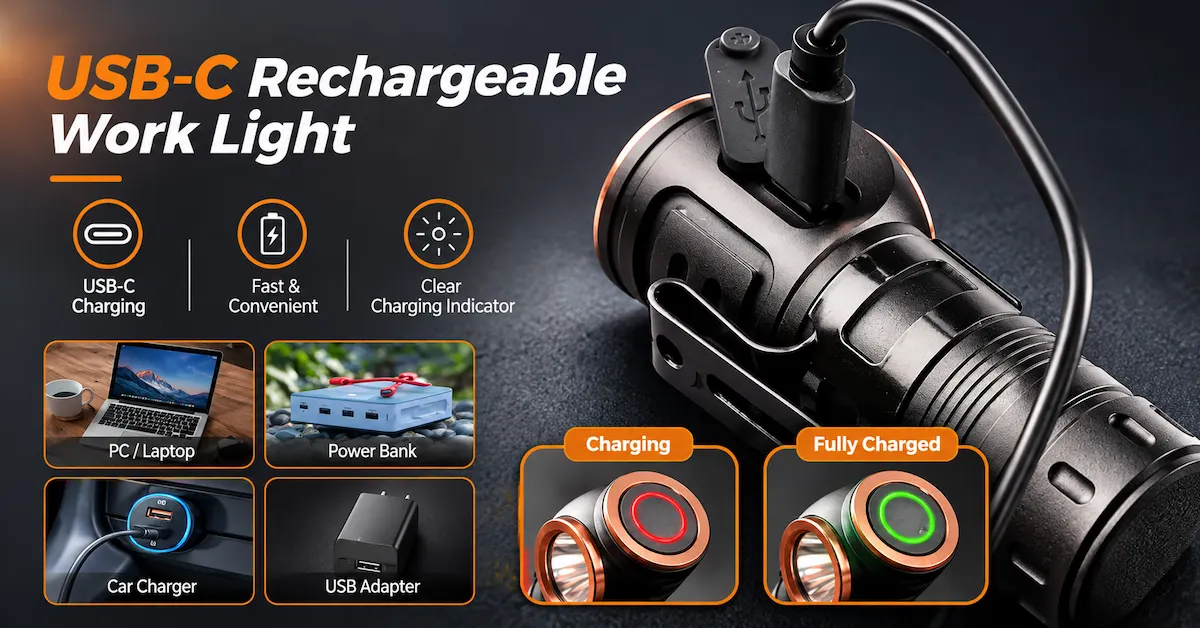
What if buyers need a dedicated folding COB work light?
Request the current work-light catalogue and identify the exact production model.
The supplier should confirm the proposed hinge, COB module, battery, charging connector, housing, accessories, and available customization options.
Explore available products: Brightenlux Product Catalogue
Review application solutions: Brightenlux Work and Repair Lighting
Discuss an OEM project: Contact Brightenlux
Compare existing Brightenlux platforms
Request the current work-light catalogue and model-specific engineering feasibility assessment.
9. How Should Durability Tests Be Connected to Production Quality Control?
An engineering sample may pass a durability test, but buyers still need a process for controlling the approved configuration during manufacturing.
Define the approved sample
The approval package should identify:
- Product model and revision.
- Approved components.
- Housing and mechanical drawings.
- Battery and charging configuration.
- Relevant durability tests.
- Packaging and accessories.
- Inspection requirements.
Control critical components
Examples include hinges, USB-C connectors, fasteners, charging-port covers, and mounting components.
A supplier substitution may require additional validation.
Use first-article inspection
The initial production configuration should be checked against the approved sample and controlled specification.
This helps identify assembly or component differences before a larger quantity is manufactured.
Apply appropriate finished-goods inspection
The ISO 2859-1:2026 acceptance sampling standard provides AQL-indexed sampling procedures for lot-by-lot inspection by attributes.
An appropriately selected plan may be used for relevant finished-goods checks.
However, ordinary sampling inspection is not a substitute for validating the design or controlling safety-critical defects.
Production Acceptance Matrix
| Quality Stage | What Buyers Should Request |
|---|---|
| Engineering approval | Identified test samples and results |
| Component purchasing | Approved BOM and substitutions |
| Assembly | Defined inspection and process controls |
| First production | Comparison with approved configuration |
| Finished goods | Agreed inspection and acceptance records |
| Shipment | Approved packaging and documentation |
| Repeat orders | Change notification and revision traceability |
The sample used for marketing photography should not be assumed to represent the final production configuration unless this has been confirmed.
10. How Can Durability Requirements Affect OEM Work Light Costs?
An OEM work light manufacturer's quotation should account for the agreed product design and testing requirements.
A lower unit price may not represent the lowest overall cost if the product requires more replacements or creates avoidable customer complaints.
However, durability upgrades should also be commercially justified.
Main cost drivers
| Cost Area | Potential Commercial Effect |
|---|---|
| Housing material | Material and processing cost |
| Hinge mechanism | Component cost and assembly complexity |
| Charging connector | Part selection and assembly requirements |
| Protective covers | Material, tooling, and inspection |
| Engineering validation | Test samples and laboratory resources |
| OEM packaging | Custom artwork, materials, and setup |
| Quality inspection | Inspection effort and documentation |
| Service support | Agreed parts, replacement and handling costs |
Example: Why total purchasing cost matters
Consider a hypothetical distributor purchasing 5,000 rechargeable work lights.
Assume the distributor evaluates two proposals that differ in mechanical construction and expected service requirements.
If a lower-priced design requires an additional $0.50 per unit in expected warranty and handling expense, the projected additional cost would be:
5,000 units × $0.50 = $2,500
This hypothetical calculation demonstrates why durability-related ownership costs should be considered.
It does not represent a measured defect rate, an industry benchmark, or a Brightenlux quotation.
What should buyers request?
Ask for a quotation that separates:
- Base product configuration.
- Mechanical modifications.
- Tooling or engineering charges.
- Durability testing.
- OEM branding and packaging.
- Inspection requirements.
- Accessories and charging equipment.
- Relevant commercial terms.
The buyer can then compare equivalent proposals rather than products with different specifications.
11. What OEM/ODM Customization Should Buyers Discuss?
Brightenlux publicly offers OEM/ODM support for portable lighting and outdoor lighting programs.
However, the exact options depend on the product selected and the engineering requirements.
Standard branding requests
Depending on the product, buyers may discuss:
- Logo positioning.
- Housing colors and finishes.
- Product identification.
- Retail packaging.
- Manuals and language versions.
- Approved accessory combinations.
Mechanical customization
Requests involving hinges, clips, mounting geometry, or enclosure construction may require engineering assessment.
Changes to these features can affect tool design, assembly methods, and previously approved tests.
Electrical and charging customization
Modifications to battery systems or charging electronics may introduce additional technical and safety considerations.
Such requests should be evaluated before quotation approval.
Recommended OEM Development Process
Application Brief → Existing Platform Review → Engineering Feasibility → Sample Development → Durability Test Plan → Design Approval → Pilot Production → Quality Inspection → Shipment
This is a recommended buyer-controlled process, not a claim that every Brightenlux order follows the same fixed workflow.
12. What Should Be Included in an OEM Work Light RFQ?
A well-prepared RFQ allows the manufacturer to understand both the proposed product and the evidence required for approval.
OEM Work Light RFQ Checklist
| RFQ Field | Information Required |
|---|---|
| Buyer profile | Company, destination country, sales channel |
| Intended application | Automotive repair, industrial maintenance, field service |
| Product type | COB work light, magnetic inspection lamp, adjustable-head light |
| Lighting requirements | Beam type, working modes, output and operating conditions |
| Battery | Preferred configuration, runtime and charging requirements |
| Mechanical structure | Housing, hinge, clip, magnet or mounting system |
| Durability requirements | Drop, repeated adjustment and charging-port tests |
| Environment | Expected dust, moisture, temperature and handling |
| OEM customization | Logo, color, packaging and accessories |
| Quality requirements | Samples, acceptance limits and inspection records |
| Initial quantity | Proposed order and annual forecast |
| Commercial terms | MOQ, sample costs, lead time and delivery destination |
Questions to ask before placing a wholesale order
An importer should request written confirmation of:
- The exact model and proposed product configuration.
- Which durability tests are available for the model.
- Whether test results apply to the final approved design.
- Which components can be customized.
- What additional validation is required after changes.
- How critical components are controlled during manufacturing.
- What MOQ and lead time apply to the selected configuration.
- Which documentation will accompany sample and production approval.
These questions help reduce misunderstandings and create a more practical basis for comparing suppliers.
Request a product-specific proposal: Contact Brightenlux for an OEM Work Light Quotation.
Ready to send an OEM work light RFQ?
Share application details, quantities, durability requirements and preferred customization.
13. Frequently Asked Questions About OEM Work Light Manufacturers
1. What should I look for in an OEM work light manufacturer?
Look for a supplier that can identify the exact proposed product, discuss relevant customization, provide technical specifications, and support sample validation. For rechargeable work lights, important evaluation areas may include illumination, battery performance, charging compatibility, mechanical durability, mounting stability, and repeat-order consistency.
2. How do I verify whether an LED work light is drop-resistant?
Establish a product-specific handling test that defines the sample configuration, test surface, severity, orientations, sequence, and acceptance criteria. Inspect both mechanical integrity and functionality afterward. IEC 60068-2-31 provides relevant methods for certain rough-handling shocks, but an actual test plan must match the intended application.
3. How many cycles should a folding work light hinge withstand?
There is no single cycle requirement suitable for every folding work light. Buyers should define the expected use, operating positions, mechanical loads, and acceptable changes in hinge performance. The supplier and buyer can then establish a suitable test procedure and acceptance limits.
4. Does Type-C charging mean a work light supports fast charging?
No. USB-C identifies a connector interface and does not guarantee a particular charging speed or protocol. Buyers should confirm the supported charging input, cable and power-source compatibility, charging behavior, and applicable electrical protection for the exact model.
5. Should a USB-C port be tested after mechanical impact?
Yes, when the impact could affect the charging system. A post-impact inspection can check connector alignment, charging operation, indicators, and mechanical attachment. The test scope should reflect the approved product requirements.
6. Does an IP67 rating guarantee that an LED work light is impact-resistant?
No. An IP rating relates to specified enclosure protection conditions. It does not automatically establish drop resistance, hinge durability, or suitability for mechanical impacts. Buyers should request separate evidence for the characteristics relevant to their application.
7. Can Brightenlux customize folding or magnetic LED work lights?
Brightenlux publicly describes OEM/ODM support for portable lighting. However, the availability of a particular folding work light, modified hinge, magnetic arrangement, or charging system must be confirmed for the proposed model. Engineering modifications may require additional development and testing.
8. What is the difference between an engineering sample and a production-intent sample?
An engineering sample is used to evaluate proposed design features and identify technical issues. A production-intent sample should represent the components and construction planned for manufacturing. Buyers should make sure the final approval evidence corresponds to the configuration being ordered.
9. Can I use the same durability requirements for all work-light models?
Not necessarily. Compact magnetic flashlights, folding inspection lights, and portable floodlights have different mechanical arrangements and usage conditions. The test program should be based on the actual product architecture and intended application.
10. How can I request an OEM work light quotation from Brightenlux?
Provide the target application, preferred lighting format, battery and charging requirements, mechanical features, durability expectations, customization scope, estimated order quantity, destination market, and target timeline. Contact Brightenlux to confirm available platforms, engineering feasibility, sample requirements, and quotation conditions.
Conclusion
Selecting an OEM work light manufacturer requires more than comparing advertised brightness, rechargeable battery capacity, housing appearance, and factory prices.
For automotive tool brands, industrial equipment distributors, and private-label importers, mechanical durability can influence whether the product performs reliably throughout its intended use.
A practical OEM sourcing process should therefore define relevant drop conditions, repeated hinge operation, charging-port durability, enclosure protection, and production acceptance criteria.
These requirements should be verified using representative samples and supported by controlled product specifications, component identification, and appropriate inspection records.
Buyers should also recognize that a product modification can affect previously approved performance. Changing a hinge, enclosure, battery configuration, or charging component may require additional validation.
Brightenlux provides rechargeable portable lighting products and discusses OEM/ODM solutions for international buyers.
For a new work-light program, the most valuable next step is to identify the actual application, confirm the available product platform, and request a model-specific durability and manufacturing proposal.
A clear test plan helps buyers make better technical and commercial decisions before committing to wholesale orders.
Explore product platforms: Brightenlux LED Lighting Products
Review work-light solutions: Brightenlux Work and Repair Lighting
Start an OEM project: Request an OEM Work Light Manufacturer Quote
Start your OEM work light project
Ask for product-specific technical information, sample testing and a bulk-order quotation.