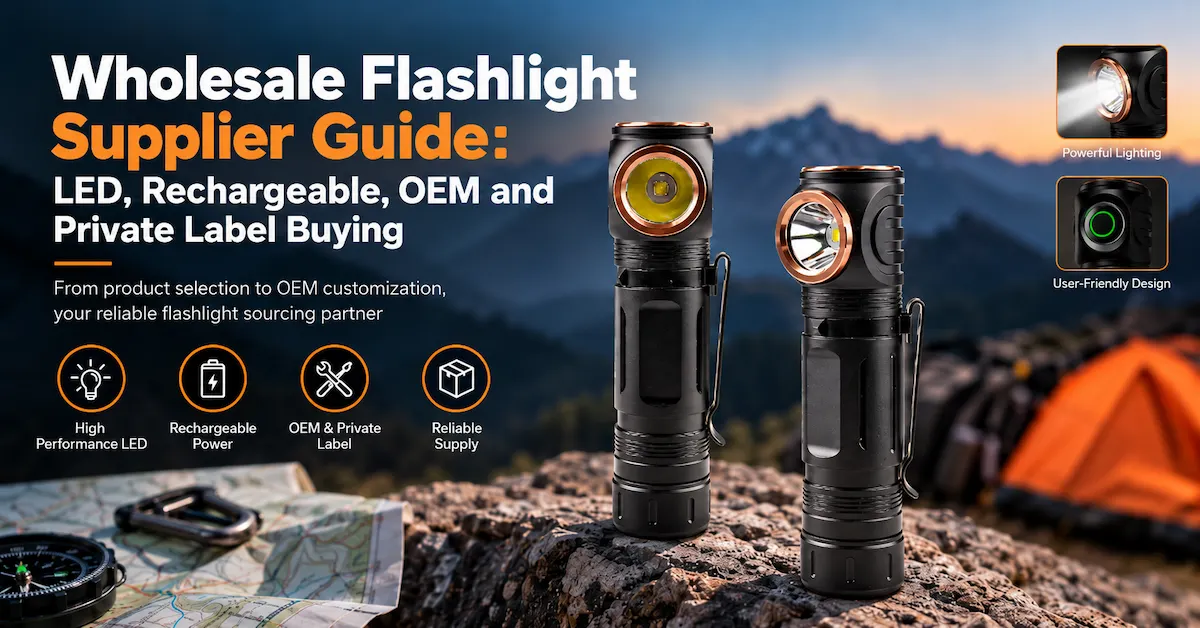


OEM Headlamp Manufacturer Guide: From Product Brief to Reliable Mass Production
Buying a headlamp is simple. Building a dependable headlamp product line for retail, outdoor, industrial, automotive, or emergency markets is more complex. A serious B2B buyer needs more than a low quotation. The right OEM headlamp manufacturer should be able to translate a product brief into a repeatable specification, explain technical trade-offs clearly, protect the approved sample, and keep quality consistent after the first production order.
This guide follows a nine-step sourcing process for buyers who want to move from an idea or market requirement to reliable mass production. It covers the user environment, product architecture, LED and battery decisions, customization options, sample approval, quality control, factory capability, commercial risk, and final order release. If you already have a product concept, you can also share your project details through the Brightenlux inquiry page and request an engineering-led recommendation rather than a simple catalogue list.
Step 1: Start With the Buyer, User, and Working Environment
The first decision in an OEM headlamp project is not the LED package or the highest advertised output. It is the person who will wear the product and the environment where it will be used. A headlamp for weekend camping has a different purpose from a headlamp for a maintenance technician, a roadside emergency kit, or a private-label retail program.
Outdoor users may care about low weight, strap comfort, a beam suitable for trails, red light for preserving night vision, and simple USB-C charging. A mechanic may care more about a stable beam, an independently aimed lamp body, magnetic mounting, oil-resistant surfaces, and a battery system that can be recharged or replaced between shifts. A distributor supplying emergency kits may prioritize shelf life, dependable activation, clear packaging, and a volume-ready price position.
Before asking for a quotation, prepare a short brief that answers these questions:
- Who will wear or use the headlamp?
- Where will it be used: trail, warehouse, workshop, road, home, or emergency kit?
- How many hours of useful light are expected per shift or use cycle?
- What realistic weather, dust, impact, and temperature conditions should be considered?
- Which sales channel and retail position must the product support?
This prevents a common sourcing mistake: asking only for a high lumen number when the real problem is comfort, heat, battery life, beam control, or packaging clarity.
Step 2: Select the Right Headlamp Architecture
“Headlamp” is not a single construction. It is a product family, and the architecture should match the application. A classic front-mounted headlamp places the lamp module on the forehead. It is familiar to consumers and works well for hiking, camping, household jobs, and general outdoor use. Its main challenge is balance, because the lamp, battery, strap, and adjustment system must remain comfortable during long wear.
A top-mounted or dual-strap design adds stability when users run, climb, work on ladders, or wear the product over a helmet. This can create a more secure feeling for professional use, although it also adds components and packaging volume. A rear-battery construction can reduce front weight and improve balance when a larger cell is required, but it adds a cable, rear housing, and another area that must be protected from water and mechanical damage.
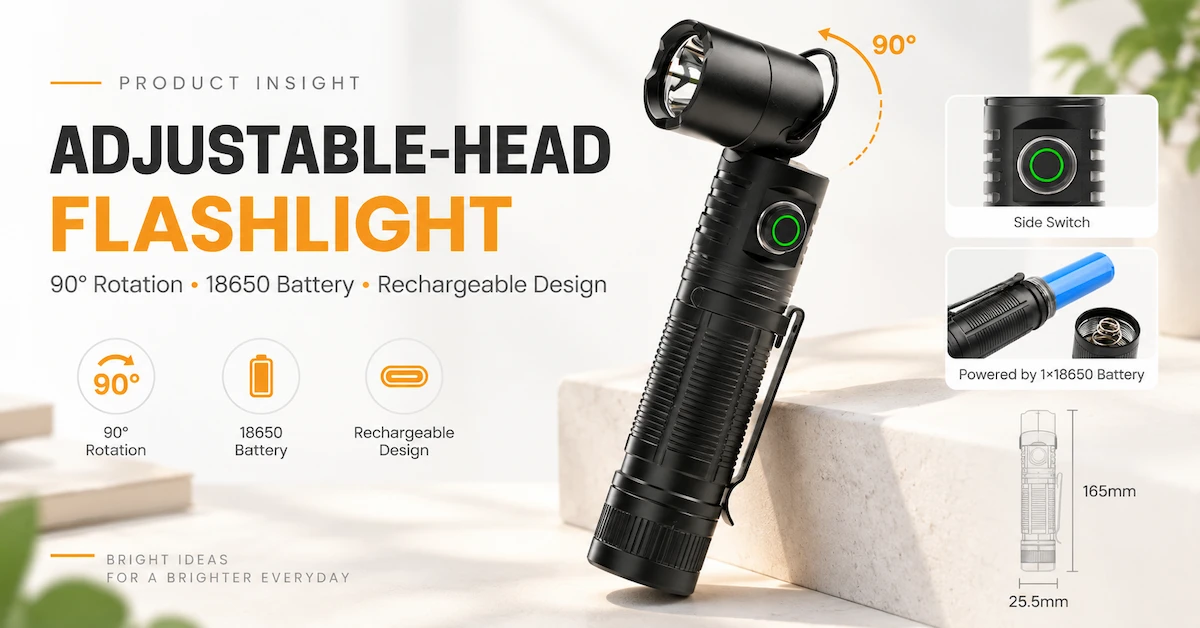
A right-angle multi-use platform is another option. It can clip to clothing, attach to a strap, stand on a work surface, or connect to a magnetic surface. This makes it useful for industrial, automotive, and emergency programs where one product may move between head-worn and handheld use. Brightenlux product platforms show how compact right-angle forms, magnetic tails, red light, and Type-C charging can support several applications. Buyers can review available lighting platforms at Brightenlux products.
Step 3: Define Performance Beyond the Lumen Number
Lumens matter, but they do not describe the full user experience. A product with a larger headline output may still disappoint if the beam is too narrow, the driver is poorly tuned, the battery cannot sustain output, or the housing becomes uncomfortable during use. A professional OEM headlamp manufacturer should help define measurable performance points instead of relying only on one marketing number.
| Performance item | What to confirm | Why it matters |
|---|---|---|
| LED package | LED family, color temperature, tint consistency, and availability | Affects output, color quality, heat, and future supply continuity |
| Output behavior | Initial output and useful sustained output under stated conditions | Shows how the product performs after the first few minutes |
| Beam pattern | Spot, flood, mixed beam, or adjustable focus | Determines whether the user sees a trail, workspace, or wide area |
| Runtime | Runtime by mode, battery type, and cut-off behavior | Helps buyers plan charging and avoid unexpected shutdowns |
| Thermal control | Step-down logic, heat dissipation, and surface temperature control | Protects comfort, electronics, and battery life |
| Controls | Mode order, memory, lockout, red light, SOS, and accidental activation protection | Reduces user frustration and potential returns |
| Beam angle | Fixed or adjustable angle and mechanical stop positions | Allows users to aim light without moving their heads unnecessarily |
When requesting samples, do not ask only for the brightest model. Ask for the proposed LED, driver, battery, lens, firmware or switch logic, and accessories. Then test the sample in the real environment: a workshop bench, a forest path, and a warehouse aisle expose different weaknesses.
Step 4: Review Battery and Charging Choices Early
Battery selection affects weight, runtime, charging time, shipping documentation, thermal design, and even the headlamp housing. It should be discussed together with duty cycle and user expectations. Small cells can support light, compact products for walking, travel, and household use. Larger 18650 or 21700-based solutions can support higher energy requirements, but they require careful balance between weight, output, and comfort.
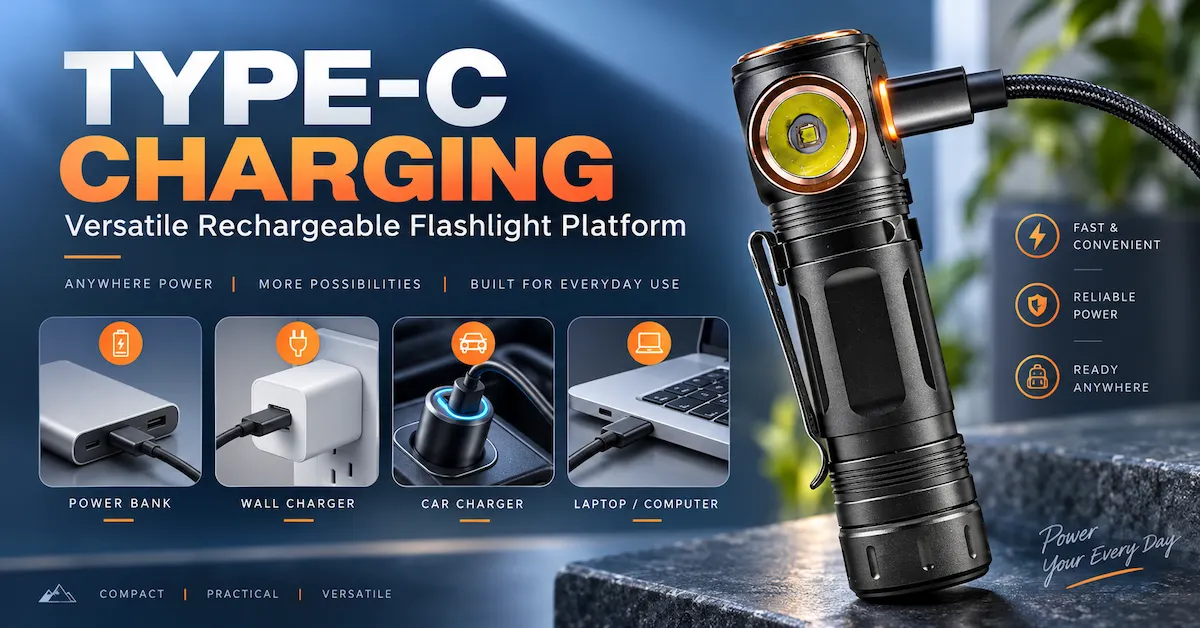
A dual-power platform may help distributors serve markets where users still expect replaceable batteries. A built-in rechargeable design can offer a simpler user experience and a clearer packaging message. Type-C charging is now familiar to many buyers, but the charging port still needs proper protection. Confirm the port cover, charging indicator, overcharge protection, charging current, cable position, and whether the lamp can operate while charging.
A practical battery discussion should include cell chemistry, nominal capacity, approved supplier list, protection circuit, low-voltage cut-off, charging time, indicator behavior, runtime by mode, storage and transport requirements, and replacement policy if the project uses a removable cell. If the product will travel internationally, review battery and packing requirements early, not at the shipping stage.
Step 5: Check Materials, Comfort, and Mechanical Details
A headlamp is worn on the body, so durability alone is not enough. It must feel stable, adjustable, and comfortable during repeated use. Aluminum can help with heat transfer and create a premium, durable impression. ABS and other engineering plastics can reduce weight and support complex shapes, clip systems, and insulated housings. The right choice depends on output, target price, impact expectations, and the visual language of the brand.
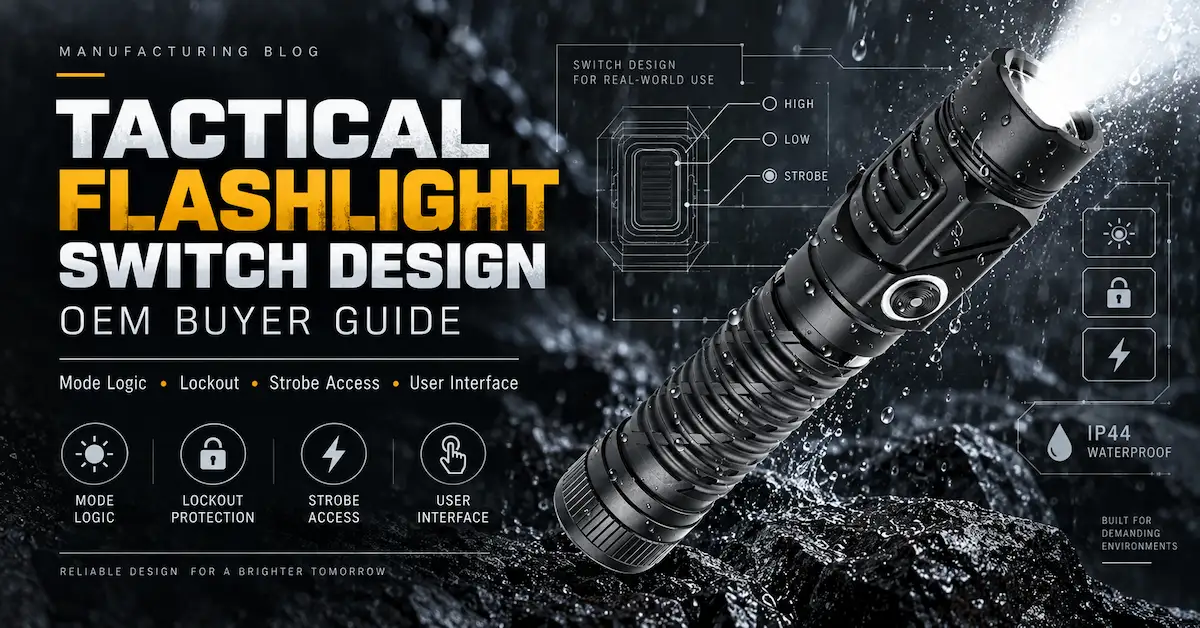
Sample review should include strap width, elasticity, buckle strength, adjustment range, contact points against skin or helmet surfaces, tilt resistance, button size for gloved operation, battery-cover sealing, lens protection, bezel design, scratch resistance, clip retention, and magnetic holding force if the product is intended for vehicle or workshop use. Small details often decide whether users are satisfied. A switch that is difficult to find in the dark, a strap that loosens, or a battery cover that requires excessive force can create more complaints than a modest difference in brightness.
Step 6: Decide What Should Be Customized
OEM does not always require a completely new tool from the first order. In many B2B programs, the efficient path is to begin with a proven platform and customize the elements that matter most to the market. This reduces development risk while still giving the brand a meaningful product identity.
Product-level customization may include LED package, tint, beam profile, diffuser, lens, output modes, red light, SOS, strobe, lockout, mode memory, battery format, charging port, indicator, housing color, surface finish, logo placement, strap color, printed mark, buckle, top strap, magnetic tail, clip, angle mechanism, or mounting bracket. Packaging customization may include retail box, color sleeve, insert card, instruction manual, barcode, compliance marks, battery warnings, language versions, master carton marks, inner-pack quantity, and pallet labeling.
For private-label brands, the larger question is often product-family planning. A supplier may help define an entry model, a core model, and a higher-output or professional model while keeping visual language and packaging consistent across the range.
Step 7: Control the Development Process From Brief to Approved Sample
A disciplined development process protects both buyer and manufacturer. Start with a requirement review that covers application, target user, output expectation, battery preference, dimensions, market, quantity, packaging, and required documents. The supplier should then recommend an existing platform, modified platform, or new design and explain the reason behind the recommendation.
Next, review the quotation and its assumptions. Confirm whether the battery, cable, packaging, logo method, tooling, testing, and delivery terms are included. After that, examine the engineering sample for fit, finish, beam, controls, charging, strap comfort, and accessory compatibility. Once the design is approved, freeze the specification with drawings, bill of materials, colors, labels, and test requirements. A pilot run can then expose assembly, packaging, and process issues before full production. Mass production should begin only after the approved sample and inspection plan are aligned.
Step 8: Ask for Quality Evidence, Not General Promises
“Strict quality control” is not enough. Buyers should ask what is checked, when it is checked, who records the result, and what happens when a result is outside the approved limit. A useful headlamp quality plan may include incoming inspection for LEDs, batteries, plastics, aluminum parts, straps, switches, and packaging; first-article checks for appearance, dimensions, polarity, charging, and mode operation; assembly checks for torque, seals, lens seating, cable routing, and battery contact; and functional tests at a defined level.
Runtime, output, charging, and temperature checks should use documented conditions. Drop, vibration, switch-cycle, and water-resistance checks may be considered when the application requires them. Traceability from component lot to finished product and shipment carton is also important, especially when the same product will be reordered over time. Certification discussions should be precise. Requirements vary by sales region, battery configuration, charger, radio functions, and packaging. Never assume that a generic factory certificate covers every model; ask whether the report matches the final configuration.
Step 9: Verify Factory Capability Before Purchase Order Release
A factory tour is useful, but it does not prove supply reliability by itself. Buyers should connect visible production capability with the records that protect the product after the order is placed. Ask which processes are performed in-house, which are outsourced, how approved and alternate components are controlled, how engineering changes are approved, how critical components are tracked, and how the supplier responds if a pilot batch or inspection fails.
Brightenlux presents itself as a Ningbo-based lighting manufacturer with a 10,000-square-meter-plus factory, more than 150 employees, design and manufacturing teams, and export experience across more than 50 countries. These are useful starting points for due diligence, but serious buyers should still request project-specific evidence such as sample records, production photos, inspection reports, and a clear statement of which processes are covered by the quoted program. To discuss a project directly, buyers can use the Brightenlux contact page.
Before releasing a purchase order, make sure the approved sample, specification, battery plan, packaging artwork, inspection criteria, shipping documents, and change-control process are aligned. The lowest unit price is rarely the lowest project cost if the product is unstable, uncomfortable, or difficult to repeat.
FAQ: OEM Headlamp Manufacturing
What should be included in an OEM headlamp product brief?
A useful brief should define the target user, working environment, expected use time, battery preference, beam requirement, comfort expectations, sales channel, packaging needs, and any required documents for the intended market.
Is it better to customize an existing platform or develop a new headlamp?
Many projects can begin with a proven platform and customize the beam, modes, battery, housing color, logo, strap, accessories, and packaging. A new design may be considered when the market requirement cannot be met by an existing platform.
Why should buyers test samples in the real use environment?
Laboratory or office inspection cannot reveal every issue. Real use helps buyers judge comfort, beam shape, controls, heat, charging convenience, strap stability, and accessory performance in the conditions customers will experience.
What is the most important quality-control question to ask a supplier?
Ask for the actual inspection plan: what is checked, when it is checked, how results are recorded, and how nonconforming results are handled. Specific evidence is more useful than a general quality promise.