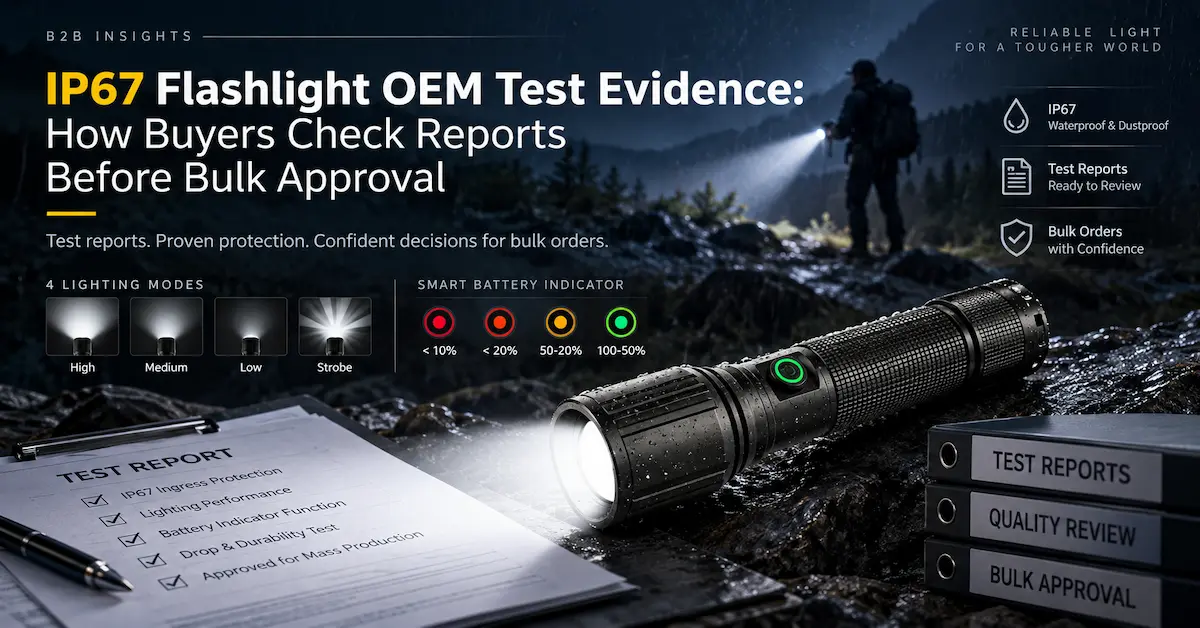


Check the evidence against the flashlight you plan to order
Brightenlux's dual-power catalog flashlight is advertised as IP67 and offered with either a 26650 lithium battery or six AA cells. For a buyer, the rating raises a configuration question before it becomes carton wording: which offered version do the supporting documents describe? IP67 flashlight OEM test evidence should identify that version, the dust/access and water requirements examined, and the conditions relevant to the order.
The page includes a 4000 mAh 26650 lithium battery in one option and lists six AA cells as not included. Specify which arrangement the quote should supply, including any separately agreed cell bundle. Are the enclosure and closures identical between the two arrangements? That requires a supplier comparison; the public page supplies neither that comparison nor a report covering either choice.
The source review for this guide obtained no Brightenlux IP67 report or verified result and establishes no approved IP67 production configuration. It cannot determine whether testing exists elsewhere. The purchasing templates and examples are proposals for obtaining and checking that missing support. Actual laboratory work uses its controlled standard and applicable product requirements, with no electrical test procedure supplied here.
Use the current catalog as a starting record
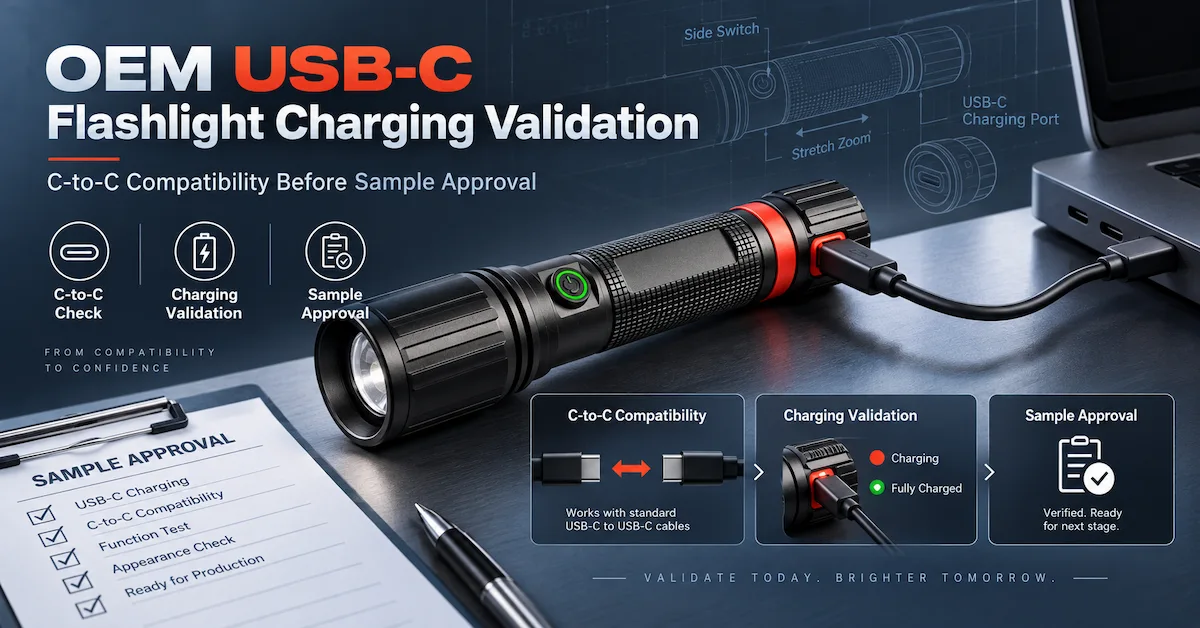
The 3000-lumen dual-power flashlight page describes C-to-C charging, a power-bank function and twist zoom. Its body, captured on 12 October 2026, also states hard-anodized aluminum plus ABS and the two battery choices above. The Durable & Waterproof section expressly declares IP67. These statements establish what is advertised; they do not identify tested caps, interface conditions, immersion details or a matching laboratory record.
For this specific offer, the useful first reply would name the factory model, offered power configuration and supporting report references. Those details are absent from the captured page. Ask whether each reference covers the quoted arrangement and which cover, cap and service position it describes. That is a narrower request than asking for every certificate the company holds.
The comparison below concerns two other linked catalog products. The adjustable-head page states IP44; the 21700 magnetic-tail page supplied no IP67 rating or report in its retrieved body. Their SST40 references do not make them the dual-power construction. A document sent for either one needs its own model comparison before it can support a different order.
| Record | Adjustable-head SST40 flashlight | 21700 SST40 magnetic-tail flashlight |
|---|---|---|
| Published output | Up to 1000 lm | 1500 lm |
| Published power | 18650 lithium battery, 2200 mAh included | 21700 platform, 4000 mAh battery included |
| Published interface/features | Adjustable head; magnetic tail; Type-C charging | Magnetic tail; Type-C charging; holder and headband |
| Published materials | Aluminum body and reflector | Hard-anodized aluminum + ABS |
| Protection information retrieved | Current body states IP44 | No IP67 report or rating retrieved from current body |
| Procurement evidence gap | Requested IP67 configuration and its supporting records | Requested IP67 configuration and its supporting records |
Use the public link to make the initial inquiry unambiguous, then add the supplier's controlled model and variant reference to the quotation. Keep the retailer name beside that reference. If a logo changes later, the drawing and report should still point to a recognizable factory construction and power option.
The public Brightenlux About page gives the legal name Ningbo Brightenlux Electric Appliance Co., Ltd. and publishes the workshop photograph below. Use that name when asking who is supplying the quoted product. The report must separately identify its applicant, manufacturer and factory; the workshop image answers none of the model-testing questions.
Separate the two protection questions in IP67
For the requested IP67 code, the first numeral includes applicable access-protection and solid-object requirements, with dust-tightness associated with 6. The second numeral 7 concerns temporary immersion. Both parts need support for the approved construction. A water result may be relevant to the inquiry while leaving the first-numeral work outstanding.
A method box saying only “IEC 60529” needs its edition clarified. The current IEC catalog entry for IEC 60529 lists edition 2.2, published in 2013: the 1989 standard consolidated with amendments from 1999 and 2013, and listed corrigenda through January 2019. The buyer should retain the report's actual reference, including any relevant product standard, for the technical applicability decision.
The old base year and the examination date are different things. The IEC-authored edition 2.2 preview says amendment 2 added IPX9 without changing existing protection degrees. An older reference therefore deserves an applicability check against the product and current requirement, rather than rejection on year alone. The responsible technical reviewer resolves any edition difference.
Two separate filenames may be needed in the purchasing worksheet. IP6X leaves water unspecified, while IPX7 leaves the first numeral unspecified. Neither alone completes IP67. If the supplier offers separate dust and water reports, establish the construction each one covers and how both connect to the quoted version. Separate documents are acceptable only with that scope and identity relationship resolved.
Jet exposure is another request: temporary-immersion degree 7 does not automatically establish water-jet degrees 5 or 6. Saltwater, chemicals, hot water, repeated opening and protection after a fall also need their own appropriate support. The dual-power page's power-bank offer does not tell us whether any protection applies with a cable connected. Put intended use and additional exposures into the brief for technical review.
Read the immersion conditions behind “one metre for thirty minutes”
Clause 14.2.7 gives “one metre for thirty minutes” a precise reference. The conditions to find in the examination documentation are:
- For height below 850 mm, the enclosure's lowest point is 1000 mm below the water surface. At height of at least 850 mm, its highest point is 150 mm below.
- Duration is 30 minutes in the manufacturer-specified service position.
- Water and equipment temperatures differ by no more than 5 K. The relevant product standard may specify a modified requirement for energized equipment or moving parts.
These fields appear in the IECEE-origin form published within report 14TH0309. That historical document is another manufacturer's IP66 report, with IPX7 marked not applicable. It is used here to explain the fields, not to assert an IPX7 pass or any Brightenlux result. An examining laboratory still needs its controlled applicable standard.
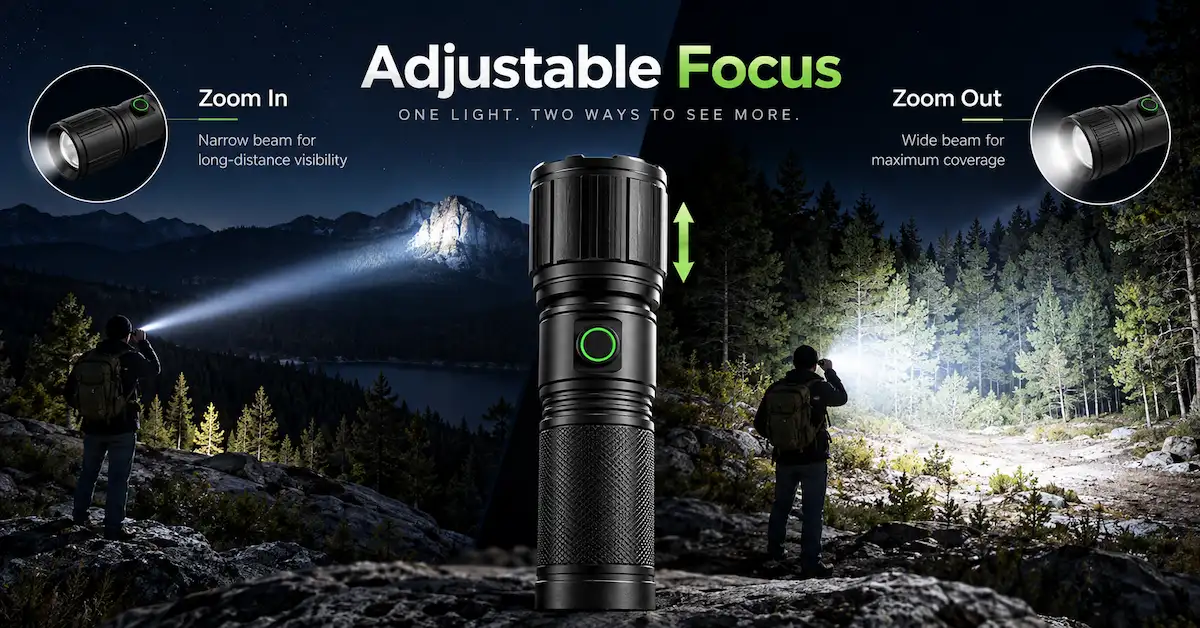
For the advertised twist-zoom option, ask what manufacturer-defined service position the supplied report describes. Do not assume it examined every head position or every intended use. The depth datum and orientation also belong in the conditions page. A tank photograph may help illustrate them, but perspective cannot reliably recover a missing measurement; obtain the laboratory's clarification.
The battery installed, powered state and charging-interface arrangement should be stated where relevant to the examination. C-to-C charging and power-bank capability do not answer those questions. Before commissioning new work, the laboratory and responsible product specialist agree preparation, inspection and any additional safety assessment. Purchasing supplies the intended use and retains the agreed scope; qualified parties determine the examination.
Build one evidence chain from quotation to approved sample
In the acceptance brief, name the quoted dual-power option and the protection decision awaiting review. Include the selected battery arrangement and intended interface use, distinguishing mandatory release conditions from optional development questions. This gives the supplier a defined task to quote and gives the technical reviewer a requirement against which to read the eventual report.
If the buyer instead starts from the adjustable-head IP44 page, an IP67 request may require another documented option, development or feasibility work. Ask which of those stages the quotation covers. A price for a catalog product and a price for a changed construction can look similar on a sales sheet while carrying different document and schedule assumptions.
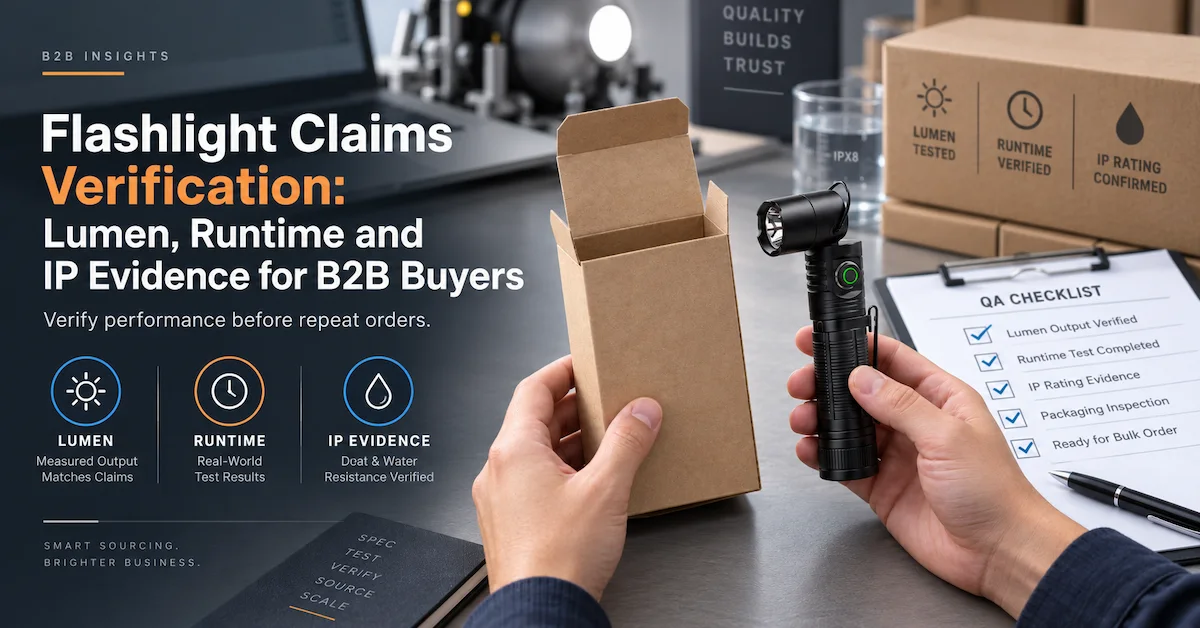
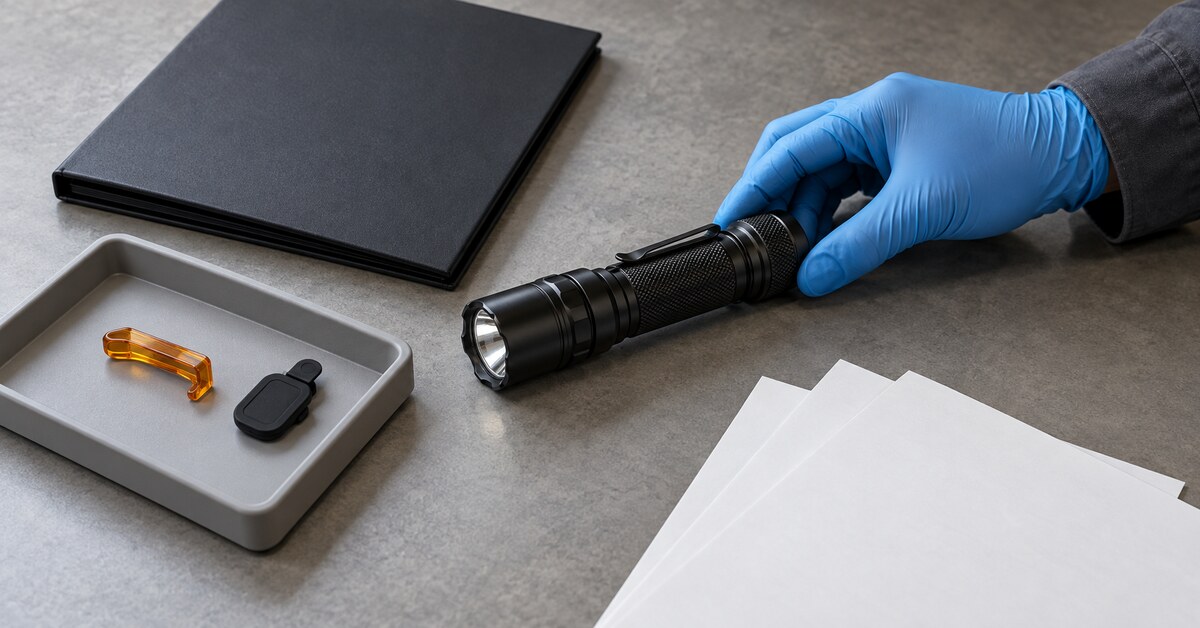
When a sample is provided, its label should retain the factory model, revision and any laboratory identifier, alongside the buyer's sample ID. Photograph that particular assembled unit and its relevant closures. The catalog image above is useful for identifying the offer, but it has no sample ID connecting it to a report. Keep promotional and approval photographs in their respective roles.
If the laboratory used another trade name, request a mapping to the quoted model, power option and construction revision. The comparison must explain differences, not merely repeat “same product.” A retail rename is manageable when this link is clear. An enclosure revision remains a technical question even where the names match perfectly.
The release document should name the approved factory version, power option, accepted reports and any conditions or exclusions. Production needs that reference.Without it, the retail name could remain unchanged while a different cover or interface is supplied. The buyer should be able to show which arrangement was accepted, rather than identify it only by appearance.
Organize IP67 flashlight OEM test evidence for review
Request the complete issue, not just the page containing pass. The cover identifies the issuer and report; the conditions, conclusions and referenced attachments show what it examined. Authorized controlled access may be needed for confidential material.Retain the exact issue reviewed so a later amendment cannot silently change the file behind the approval decision.
| Evidence item | Review question | Action when unresolved |
|---|---|---|
| Report identity | Number, issue date, revision, page count and issuing laboratory agree? | Obtain the complete current issue and issuer clarification |
| Applicant/manufacturer | Can the entities be linked to the quotation and actual factory? | Request a documented relationship and configuration mapping |
| Sample identity | Model, unit IDs, photographs and enclosure revision identify the tested item? | Hold technical approval until the item can be matched |
| Method | Applicable standard, edition, clauses and deviations are stated? | Have the responsible specialist confirm applicability |
| First-numeral evidence | Applicable IP6X dust work, other required clauses and conclusions are present? | Request missing coverage; water evidence is insufficient |
| Water result | Applicable IPX7 conditions, inspection and conclusion are present? | Resolve condition/result gaps before supporting IP67 |
| Closures/configuration | Caps, seals, covers, connectors and assembly state match the order? | Record differences and obtain their technical disposition |
| Laboratory scope | Claimed competence/accreditation can be verified for the relevant work? | Check the issuing body and official scope records |
| Exceptions | Omissions, modifications, failures and repeats are explained? | Request the complete history and final disposition |
| Release link | Approved sample, drawing and claims reference the reviewed evidence? | Update the approval package before bulk release |
Treat the following checklist as a list of questions that need answers. It has no points or certification grades. A missing dust result is still missing when the file contains good photographs and several unrelated certificates. Resolve that release condition or document an authorized change to the requirement.
Where sharing is restricted, establish what the issuer can disclose or confirm under authorization. The buyer needs sufficient identity, scope, conditions and conclusions for the decision.If access does not establish those points, the limitation stays open. Confidentiality may explain why a file is difficult to obtain, but is not a result supporting the claim.
Match names, dates and revisions without guessing
Preserve the report's applicant, manufacturer, factory and trade mark alongside the buyer SKU. An OEM document can legitimately differ from the retail branding. Its names should not be overwritten to make it resemble the carton. Obtain the commercial and construction links that explain why the report is being supplied for this order.
For this offer, the About page identifies Electric Appliance. If a received report names Outdoor Products or another entity, ask how the named party connects to the quotation and actual factory. Similar branding cannot establish that relationship or permit documents and production metrics to be combined. The original identities stay visible while the supplier supplies the explanation.
Read the dates with the drawing revision. A report issued recently may describe an older specimen; an older examination may still concern an unchanged design. Review intervening changes and current applicability. An invented fixed expiry period would not settle whether the tested construction is the one now being quoted under the agreed requirement.
A revised report needs a change explanation. Did it correct identification, add a variant or change the conclusion? Obtain the complete final issue, identify what it supersedes, and mark earlier copies appropriately. They can remain for traceability without being confused with the issue to use for release.
Model spelling, report numbers, dates and photographs sometimes raise an identity question. A discrepancy is not proof of fraud. If the pages cannot be reconciled, obtain the issuer's contact details independently and ask it to confirm the relevant record. Keep the response with the issue reviewed so the next buyer can recover the clarification.
Examine closures and seals as configuration evidence
For the dual-power offer, which lens joint, head/body connection, battery closure, switch and charging arrangement are actually present? The public materials description cannot answer their sealing construction. Ask for the applicable drawings and part references, then compare them with the laboratory specimen. The table below identifies fields to check without assuming every flashlight uses the same arrangement.
The product image shows offered components but cannot identify seal grade or compressed geometry. Where such details matter, use controlled drawings or specifications. Purchasing can gather the compared versions; the responsible technical party interprets their differences and the laboratory method. Appearance alone would leave hidden construction details unresolved.
| Feature to identify | Evidence to compare | Question for a difference |
|---|---|---|
| Lens/head joint | Drawing revision, retaining features and sealing parts | Does the change affect the reviewed boundary? |
| Head/body connection | Part references, joint geometry and assembly specification | Is the reported assembly still representative? |
| Tail/battery closure | Cap, seal, threads and approved closed condition | Was the ordered closure configuration examined? |
| Switch area | Switch arrangement, boot or other boundary parts | Does the variant introduce a different opening or interface? |
| Charging interface | Port, cover, connector and stated test/use condition | Is protection claimed with a cover closed or another defined state? |
| Sealing components | Controlled material, dimensions and revision where relevant | Has a substitute received an appropriate change review? |
| Assembly controls | Specified seating, fastening and inspection records | How will production reproduce the approved arrangement? |
| OEM alterations | Logo, housing, mounting or other changed parts | Which evidence remains applicable to the altered configuration? |
Close each relevant difference with an authorized disposition and its basis. The answer may be no relevant effect established or further evaluation needed. If equivalence cannot be determined, the revised version's protection claim remains open. A familiar model name cannot make the difference disappear.
There is no universal cap torque, gasket hardness or opening-cycle limit for this purchasing task. These values belong to the selected design and assembly specification. Request what is needed to reproduce its approved condition and identify who controls changes. A number borrowed from another joint would not supply an applicable basis.
Verify the laboratory and the document type
A laboratory reference needs its own scope check. ISO/IEC 17025:2017 concerns competence, impartiality and consistent laboratory operation; ISO lists edition 3 and confirmation in 2023. This is not product IP67 certification. Establish which facility performed the work and what competence is claimed for it before treating a mention of the standard as useful laboratory information.
For an accreditation claim, the official directory should identify the actual facility, location and relevant testing activity. The ILAC MRA information and signatory route leads to accreditation bodies and their facility directories. Clarify uncertain entries with the issuer. The logo on a PDF is a clue for the search, not confirmation of the applicable scope.
A supplier's internal sheet and an outside report can both contribute information, but name who performed each examination and its conditions. If the purchasing agreement requires outside work, the internal sheet does not fulfil that task. Agree the responsible party and timing rather than changing its title to make the document seem equivalent.
Read the document type literally. A report, declaration, certificate and supplier summary are not interchangeable. A test report form identifier describes the format without establishing issued certification. For a claimed CB document, request the associated references and verify what was issued through the issuing body and relevant IECEE route.
The IECEE OCS User Guide, version 7.0, identifies separate applicant, manufacturer, factory, model and test-report fields. It also explains public abstract visibility and restricted records. A missing public search result therefore needs issuer clarification before an authenticity conclusion. The model and construction still have to be connected through the document's identifiers.
Save the directory checked, date, facility, scope and issuer response. Where access is limited, state which points were confirmed and which were not. This makes the laboratory check repeatable for the next order instead of letting the recognizable issuer name become the entire explanation.
Read results and exceptions beyond the pass summary
Find the requirement beside its reported outcome. Dust/access and water sections need their own applicable conditions and conclusions. A pass in one does not answer an omitted section. An entry marked not applicable likewise does not establish a passing examination of that requirement. Preserve these distinctions in the purchasing summary.
The acceptance basis matters as much as the conclusion. Water-ingress and dust-tight criteria cannot be collapsed into “nothing entered.” Applicable standards and product requirements govern water outcomes and checks. TL23065B, issued in 2023 for another manufacturer's signalling product, specifies specimen identity, unpowered state and acceptance criteria. It illustrates documentation fields only; its results cannot support a Brightenlux flashlight.
For IP6X, request the applicable clauses, specimen preparation, exposure conditions, inspection and conclusion linked to the model. A dust-chamber picture supplies none of those relationships by itself. Procurement can identify missing fields and seek clarification, with method interpretation left to the laboratory or responsible specialist.
A flashlight appearing lit after exposure cannot replace the required outcome assessment. Ask where observations and further required checks are recorded. Any electrical-safety examination belongs with qualified responsible parties and its applicable documentation. Apparent operation is one visible observation, not a complete assessment.
Where a repeat followed a modification, identify the changed part and final specimen. A reseated cover or revised assembly can separate an earlier attempt from the accepted version. Keep the history and disposition if they explain that difference. Production needs the corrected arrangement rather than whichever one happened to appear in an earlier photograph.
Understand what the tested samples represent
The laboratory should identify received specimens and their status. Ask who selected them and whether they were completed production-like units or specially prepared prototypes. A prototype examination can be useful development information when stated as such. Its connection to the version intended for production remains something to establish, rather than assume.
The dual-power page offers two power arrangements. Ask whether supplied reports cover both quoted variants and what construction comparison supports any shared coverage. Do not infer the answer from the common page.Across a wider range, the same question applies to different caps, ports or housings under one retail family: coverage needs an authorized technical basis.
A report describes the submitted specimens. The order also needs the parts, assembly and inspection arrangements that keep production consistent with the accepted design. These are separate responsibilities. The examination alone says little about every unit in a bulk order, even when its specimens have been matched correctly to the approved version.
Keep each specimen ID attached to its own result. Dust and water examinations may use different units if the applicable method or agreed sequence permits. That creates a need to establish how both constructions relate to the approved version, not a universal requirement to use one physical flashlight. Sharing a report filename must not merge conclusions for different specimens.
Connect the approved sample ID to drawings, part references and accepted reports. The physical sample cannot preserve every hidden material or assembly detail over time. These links let the next batch be compared with what was approved even after the sample ages or the retailer updates its packaging.
Review IP67 flashlight OEM test evidence before release
In waterproof flashlight supplier verification, “selected” and “approved” should mean different things. Price and features may justify continuing an inquiry while the protection question is open. The proposed states below make that status explicit. A commercially attractive offer belongs in evidence review until the required technical questions are answered.
| State | Evidence position | Next step |
|---|---|---|
| Candidate selected | Catalog and application appear relevant; requested protection not established | Confirm configuration and evidence feasibility |
| Evidence review open | Reports supplied; identity, conditions or scope questions remain | Assign each question to supplier, issuer or reviewer |
| Configuration approved | Required evidence is accepted for a named configuration and stated conditions | Carry the controlled version into order and claims approval |
| Change review required | Order or assembly differs from the approved evidence basis | Resolve applicability and obtain further evidence where needed |
Name the release authority and the technical and artwork decision-makers before a deadline compresses their work. Each sign-off uses the same factory version reference. The states describe project handoffs, not certification levels; their purpose is to show which person still has a decision to make.
A promised new report belongs in pending work with its scope and deliverable. It becomes a reviewed result only after the document arrives and the relevant questions are resolved. Keeping these columns separate prevents an intended examination from appearing on the carton approval as a completed outcome.
Share your target protection, candidate model and order conditions to discuss the configuration-specific evidence needed before approval.
Discuss Your OEM Evidence BriefReopen the evidence question after a relevant design change
For a later order, identify any changed charging cover, seal, joint or assembly against the accepted drawing and report. Ask whether the earlier conclusion remains applicable to that difference. The retail name may stay unchanged, so the change request needs part and version references rather than a statement that it is still the same product.
A new cap or interface can affect an enclosure boundary even if described as a small commercial update. An artwork-only revision may leave the construction untouched. Review the actual difference, rather than infer its effect from cost or visual size. Retain why the chosen technical disposition is appropriate.
The authorized reviewer may establish no relevant effect on a documented basis, request further comparison or require new testing. Keep that decision against the changed reference.A purchase-order amendment records the requested commercial version; it does not establish which earlier result covers its construction.
For a seal or material substitution, obtain the controlled details before production uses it. Shared material wording may leave geometry or formulation differences unresolved. Compare the proposed part with the accepted one under the design requirements, so the technical party can decide the substitution without assuming equivalent performance from a name.
Retain earlier reports with the changed drawing, disposition and any new results. They explain why an old sample or carton differs from the current release. The latest approval can point to its accepted issue while the underlying history stays available instead of being overwritten.
Opening cycles, wear and drops may be additional requirements where the application needs them. Agree their sequence and acceptance basis with the responsible specialist. An ingress examination on an as-submitted sample supports its recorded conditions; it cannot automatically establish protection after every later service exposure.
Resolve three common gaps with a specific document request
The following situations remain illustrative purchasing examples, not Brightenlux reports, projects or customer results. They show three different missing links: one part of the code, a changed interface and a named party. Each calls for a particular answer rather than more unrelated attachments.
A water result arrives, but the dust section is missing
A quotation uses IP67 while the supplied pages describe temporary immersion only. Request the applicable dust report reference, conclusion and construction covered. Water performance cannot establish dust-tightness by implication. The code remains unresolved until the missing first-numeral requirements have support for the approved version.
A second file might simply have been omitted. If it arrives, match its tested construction to the water result and order. If the work is absent or describes a different design, retain the open point. The immediate task is locating applicable coverage, rather than judging the official appearance of the water pages.
The report photographs show a different charging cover
The order drawing shows a revised charging arrangement while report photographs show an earlier cover. A current sales sheet cannot resolve this construction difference. Obtain both part references and drawing issues, the comparison and authorized disposition. They give the reviewer the actual change to assess.
Coverage may remain applicable or further evaluation may be necessary. Leave that outcome open until its basis is supplied. Carry the accepted arrangement into production, keeping old and new references with the decision. Otherwise the earlier cover may be reused because it is still pictured in the original report.
A valid-looking document names another applicant
An applicant different from the retail brand may be explained by the OEM arrangement. Obtain its connection to the manufacturer, factory and quoted model, then compare construction references. A name difference alone justifies neither acceptance nor rejection. Close the supply-route question and the tested-version question separately.
A relationship letter may establish representation but omit the examined enclosure. Use it for that commercial link, then request the model mapping. Familiar contacts and shared branding cannot identify the specimen without the relevant construction references.
Write a clarification that can be closed
A proposed IP67 flashlight OEM test evidence request can be specific: “Please identify the dust result for the quoted enclosure revision and supply its report reference.” For a changed cover, attach the drawing issues and request their technical disposition. These examples identify the missing item, while “send certification” can return a file that answers neither question.
Keep the dated drawing or photograph with the question, response and accepted disposition. Name who must answer and what document will support it. A later buyer should be able to tell an accepted clarification from a promise still awaiting material, without reconstructing the exchange from disconnected messages.
Control the claims on labels, cartons and retailer pages
The carton writer needs the approved factory version, claim wording, supporting reference and essential use conditions. Put them in a claims register and compare the artwork and retailer page with that entry. The purpose is to preserve the technical decision where the customer reads it, rather than expand a limited approval during copywriting.
Where the supporting conditions require a cover closed, check the instructions and pictures alongside the wording. An open interface shown in a wet setting can contradict that basis despite accurate nearby text. Refer unresolved differences to technical and claims review, including the state of the product depicted.
Temporary immersion is distinct from underwater operation, jets, saltwater and cleaning. Safety and warranty statements also need their own basis. The IP report has a role in the product and destination-market file, without replacing every applicable document. Limit each published assurance to what its appropriate support establishes.
Connect retailer SKU and artwork issue to the accepted factory reference. A logo or color change must not hide a revised housing or closure. If the construction reference changes, retain the corresponding sample, report disposition and claim wording so the order remains identifiable beyond its retail name.
If support is unavailable, record the authorized choice: development, another documented option, a changed requirement or a paused claim. State its effect on the order. Deadlines do not supply a result. An open point closes through applicable support or an authorized change to what the project requires.
Prepare an RFQ that makes the evidence work quotable
For a dual-power inquiry, state whether the quote should include the listed 26650 battery or supply the six-AA option, and describe intended charging and power-bank use. Add application, market, quantity, branding, packaging and timeline. The acceptance brief identifies the protection requirement and distinguishes a catalog inquiry from development work.
Ask what already exists for that offer and what must be commissioned. Allocate sample preparation, shipment, laboratory engagement, report access, interpretation and release responsibility. Outside work may require a separate quote. Product supply and evidence development should be identifiable activities, so the first price is not read as a promise to deliver every requested document.
MOQ, sample timing, delivery assumptions and quote validity require current confirmation for the selected model. Historical Brightenlux platform terms differ, and the reviewed public pages make no universal commitment for a new IP67 request.Terms on another SKU cannot settle this offer's commercial conditions.
The version must be defined before its final examination; supported wording precedes artwork release. A late cover change can reopen both tasks. Show these dependencies in the schedule and identify the document still holding up each decision, rather than treating report delivery as an isolated date.
Agree how redesign, added samples, repeats and outside work affect cost and timing if the initial design falls short. That allocation belongs in the contract. This guide supplies no standard fee or guaranteed outcome. The quotation should make its assumptions visible before commitment.
Use the verified Brightenlux contact page, which lists admin@brightenlux.com and 0086-574-65130100. Name the catalog link and selected configuration in the brief. The current reply should establish what is being offered, which supporting files are available and which further work needs agreement.
Copy an evidence request into your project file
This proposed worksheet is for procurement references, open questions and release decisions. It is not a laboratory report or a passed-sample record. Leave outstanding fields open until their supporting material arrives. An assumed answer could make the sheet appear complete without resolving the question.
Project / buyer SKU: ____
Application / market / quantity: ____
Supplier and contracted manufacturer: ____
Factory model / enclosure revision / approved drawing: ____
Power / port / cap / seal configuration: ____
Requested protection and additional exposure requirements: ____
Laboratory / report number / issue / revision: ____
Dust evidence reference and applicable configuration: ____
Water evidence reference, conditions and applicable configuration: ____
Report attachments and authorized clarifications: ____
Differences between tested sample and ordered version: ____
Open questions / responsible owner / due date: ____
Technical disposition / approved claim wording: ____
Approved sample ID / artwork revision / order reference: ____
Change-review triggers and release authority: ____
Use the worksheet as an index into laboratory, engineering, purchasing and artwork files. Each conclusion keeps its proper owner and version reference. The index makes their connections visible to the order reviewer without replacing those specialist files with one informal summary.
Before handoff, compare the sample ID, report, drawing, quote and carton with the accepted arrangement. Confirm that open items have accepted dispositions and essential conditions survive in instructions and claims. This carries the reviewed construction into supply without changing the meaning of its approval.
FAQ
What counts as IP67 flashlight OEM test evidence?
It identifies the examined sample, applicable dust/access and water work, conditions, conclusions and the link to the order. For the dual-power catalog option, establish the quoted power arrangement and closure state as part of that comparison. The advertised rating is the claim to verify, not a substitute for the supporting package.
Can an IPX7 report alone support an IP67 claim?
IPX7 covers water while leaving the first numeral unspecified. Applicable dust-tight and other required first-numeral work is also needed for IP67. Separate files can support the two sides once their scope and construction relationship to the approved order have been established.
Is the one-metre depth measured from the flashlight's top?
Below 850 mm enclosure height, the lowest point is 1000 mm below the water surface. At least 850 mm high, the highest point is 150 mm below. Clause 14.2.7 conditions should identify the actual datum and manufacturer-specified service position rather than leave them to interpretation of a picture.
Does IP67 automatically establish water-jet protection?
No. Temporary-immersion degree 7 does not automatically establish water-jet degrees 5 or 6. Specify the separately supported protection the application needs. Saltwater, chemicals and other additional exposures also require an appropriate basis, rather than being inferred from the IP67 wording.
Can I use a report with a different private-label name?
A private-label name can differ when controlled documents establish the factory model and construction relationship, with an authorized coverage decision. Keep both identifiers. Visual similarity or a “same product” assurance leaves unanswered whether the report covers the ordered variant.
Does an accreditation logo establish that the report covers the right work?
Verify the issuing facility, location and relevant scope in official accreditation records, clarifying uncertainty with the issuer. That addresses the claimed competence. The report's specimen and conditions still need comparison with the order; recognition of the laboratory cannot settle which construction its document describes.
What if the supplier will not release the complete report?
Discuss authorized access or issuer confirmation sufficient to establish identity, scope, conditions and conclusion. If the required material remains unavailable, retain the limitation and leave that approval open. A confidentiality explanation describes access, not the result the buyer needs to review.
Must every seal change trigger a new test?
The authorized technical party reviews whether earlier support still applies or further evaluation is needed. It is not an automatic yes or no on new testing. Keep the disposition with the changed part and drawing so production can identify the accepted arrangement.
Can a workshop photograph replace a model-specific report?
The photograph supplies company-published factory context. It has no specimen identity, method, exposure or result for the selected model. Keep it in supplier background material while requesting the separate model report; the visible workshop cannot fill those examination fields.
What should the buyer send with an evidence inquiry?
Provide application, market, model, power and interface arrangement, quantity, customization, packaging and timeline, with the protection request and acceptance brief. Ask which documents exist for that offer and which development or laboratory work requires separate agreement, quotation or later approval.
Conclusion
Use IP67 flashlight OEM test evidence to connect the examined construction with the order: both protection elements, recorded conditions, laboratory scope and sample identity matter. For the dual-power offer, establish the quoted power and interface arrangement rather than assume the catalog covers every use. Resolve differences before production and artwork release; retain the references through changes.
Send your application, candidate model and evidence requirements to discuss the next configuration-specific step. Keep the accepted references with the order.
Bring the model, protection requirement and order brief to a configuration-specific discussion.
Request an Evidence-Based OEM Discussion