

How to Evaluate a Reliable Outdoor Lighting Factory in China
Finding a reliable outdoor lighting factory China buyers can work with is not simply a matter of comparing catalog photos or asking for the lowest unit price. Portable LED work lights used on construction sites, maintenance projects, and utility jobs must match the real working environment: dust, handling, movement, changing weather, awkward mounting positions, and long periods of use. This article explains what sourcing managers and product teams should examine when evaluating a Chinese supplier of portable outdoor lighting, and which technical questions should be answered before samples or production are approved.
What decision does the buyer need to make?
The central decision is whether a factory can do more than assemble an attractive light. A suitable supplier should be able to translate an intended application into a dependable product specification, control the mechanical and electrical assembly process, document test results, and maintain consistency from sample to production batch.
That distinction matters because portable work lighting covers several different jobs. A broad floodlight may illuminate a construction work zone, while a lantern-style product may provide local area lighting. A slim upright light can be more useful for inspection or close work, and a compact dual-lamp design may suit a technician who needs portability or flexible positioning. These products can look similar in a sales image while having very different performance requirements.
Quick reference: match the light form to the job
| Product form | Likely use | Points to verify with the factory |
|---|---|---|
| Adjustable-panel floodlight | Broad illumination for construction and temporary work zones | Panel adjustment, stability, diffuser durability, beam distribution, heat management, and mounting options |
| Cylindrical lantern | Localized or wraparound area lighting | Handle strength, diffuser protection, balance, controls, charging or power system, and cleanability |
| Compact dual-lamp light | Handheld, bench, service, or close-range work | Grip, adjustment range, switch life, magnetic or mounting features, and cable or battery protection |
| Tall inspection light | Inspection, maintenance, interior fit-out, and vertical task lighting | Base stability, impact protection, glare control, controls, and resistance to tipping during use |
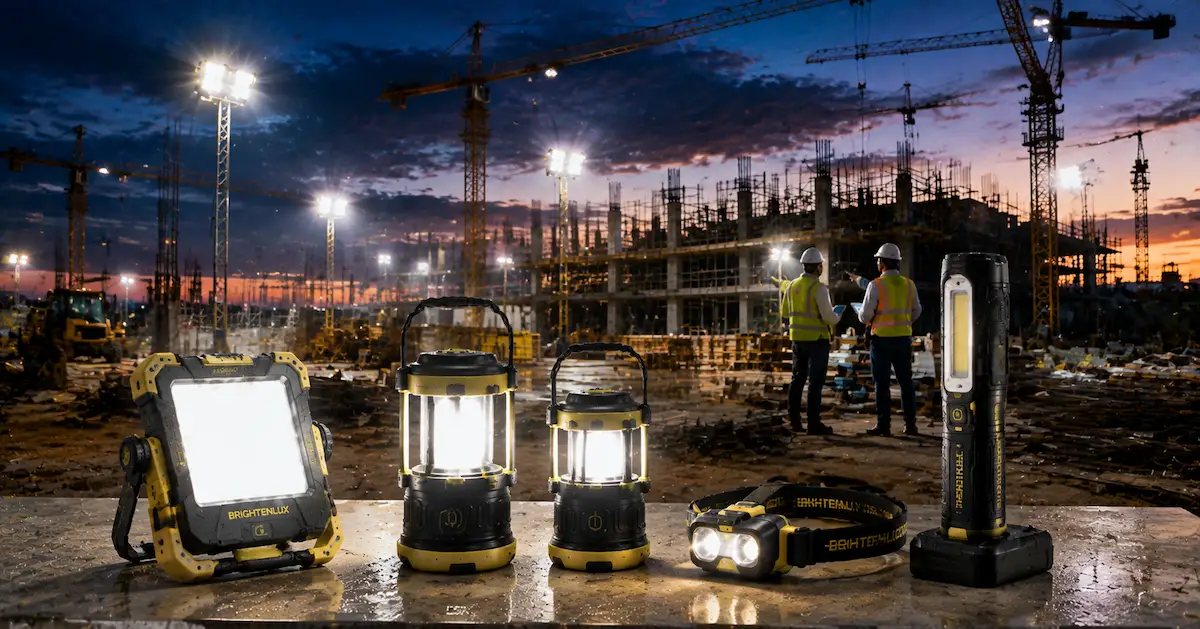
The visible product range associated with this category uses black and yellow molded-looking housings, protective outer sections, handles, support structures, and white diffusers or translucent covers. Those design features suggest a focus on job-site portability and visibility, but appearance alone does not establish a technical rating. Treat the visual design as a starting point for questions, not as proof of performance.
Assess the product architecture before discussing price
Housing and mechanical protection
Portable lighting is repeatedly moved, placed on uneven surfaces, and exposed to accidental knocks. Ask how the housing is constructed and which parts are intended to absorb impact. The products shown appear to use molded polymer or plastic housings with rubberized or reinforced-looking sections, although the exact material should be confirmed in the supplier’s technical documentation.
Review the design around corners, handles, hinges, support frames, battery compartments, switches, and lens edges. These are common failure points. A broad floodlight with side adjustment supports needs enough friction or locking strength to hold its angle. A lantern needs a handle that remains comfortable and secure when the product is carried or hung. A tall light needs a base that resists tipping without making transport unnecessarily difficult.
Optics and light distribution
Ask for measured information rather than relying on phrases such as “high brightness” or “professional LED.” Useful data may include lumen output, beam angle, center-beam intensity, color temperature, color rendering, flicker behavior, and the way output changes as the product warms. Not every application needs the highest possible output. Construction workers may need broad, low-glare illumination, while inspection teams may value visual detail and consistent color.
Diffusers can improve comfort and reduce harsh shadows, but they may also reduce optical efficiency. Their material, thickness, surface finish, and resistance to yellowing should be discussed if the product will be used for extended periods or in exposed locations. If the supplier cannot provide optical test information, the buyer should arrange independent sample evaluation.
Power system and thermal design
The available information does not establish whether these lights are rechargeable, battery-powered, mains-powered, or compatible with a specific battery platform. That is not a minor detail. Power architecture affects product weight, runtime, charging logistics, replacement cost, field safety, and regional compliance requirements.
Request a clear power specification covering input voltage, battery chemistry if applicable, capacity, charging interface, protection functions, expected operating time under defined modes, and charging time. Ask how the product controls heat around the LED modules and power electronics. A light that performs well for ten minutes but reduces output sharply after warming may not meet a contractor’s expectations, even if its initial test looks impressive.
What a reliable outdoor lighting factory China sourcing team should be able to show
A serious supplier should be willing to explain its manufacturing and quality-control process in practical terms. For products of this type, likely operations may include injection molding for housings, diffuser production, LED and electronic module assembly, wiring, fastening, labeling, and final functional testing. These processes are inferred from the product forms and must be confirmed by the manufacturer.
During a factory review, ask to see how incoming components are checked, how assembly instructions are controlled, and how finished units are tested. The exact test plan will depend on the product, but it may include power-on testing, charging checks, switch operation, LED function, mechanical inspection, and a review of housing fit. If the supplier claims outdoor suitability, request the relevant water-resistance and ingress test method rather than accepting a photograph showing the product in wet-looking conditions.
The same caution applies to impact resistance, electrical safety, operating temperature, and battery performance. A promotional image cannot verify an IP or IK rating, certification, runtime, or warranty. If a rating is important to the project, it should appear on controlled technical documents and, where necessary, be supported by an accredited test report for the actual model.
Questions to include in the supplier qualification process
- Which product models are standard designs, and which can be modified?
- What are the confirmed housing, diffuser, handle, and base materials?
- What LED modules, drivers, batteries, connectors, and switches are used?
- Can the supplier provide a complete drawing, bill of materials, and electrical specification?
- What tests are performed on every unit, and which tests are performed by sampling?
- How are design changes, substitute components, and engineering deviations approved?
- Can the factory provide traceability for critical electronic and battery components?
- Which markings, packaging details, manuals, and plug or charger configurations are available for the target market?
- What inspection access is permitted before shipment?
Do not ask only for a certificate list. Ask which document applies to the exact model, power configuration, and destination market. A certificate for one light does not automatically cover another light that uses a different battery, driver, enclosure, or charger.
Common mistakes when buying from an outdoor lighting manufacturer China
Choosing from images alone
Catalog images are useful for identifying form factors, but they do not reveal glare, balance, heat, switch feel, charging behavior, or output stability. Request samples and test them in a setting that resembles actual use. A workshop evaluation is better than a desk review, and a short field trial is better still.
Leaving the operating environment vague
“Outdoor use” can mean a covered building site, an exposed road project, a damp basement, a utility service area, or an emergency-response kit. These conditions impose different requirements. Define exposure to rain, dust, mud, vibration, cold, heat, chemicals, and repeated transport. Also define whether the light will be used near energized equipment or in a location where special hazardous-area requirements apply. Do not assume a general-purpose portable light is suitable for a hazardous location.
Comparing wattage instead of useful illumination
Input power is not the same as useful light at the work surface. Compare measured output, distribution, glare, runtime, and thermal behavior. A lower-power light with a well-designed diffuser and useful beam pattern may be more effective than a nominally stronger product that creates glare or leaves dark areas.
Approving a sample without locking the specification
Before production, freeze the critical details: housing color and finish, logo treatment, LED and driver configuration, power system, charger, switch behavior, labels, packaging, and acceptance tests. Otherwise, a visually similar substitute component may appear in a later batch. This is a routine sourcing risk, not an accusation of poor intent.
Practical advice for comparing a China outdoor lighting factory
Use a weighted comparison rather than a simple quotation table. Product performance, engineering responsiveness, component transparency, quality systems, communication, packaging, and total landed cost should all be considered. Price still matters, but a low unit price can lose its advantage if the product has unstable output, damaged handles, inconsistent charging, or excessive inspection failures.
For a new program, begin with one or two representative models rather than an entire range. The adjustable floodlight, lantern, compact work light, and tall inspection light each expose different engineering issues. A pilot evaluation can reveal whether the supplier understands mechanical durability, optical performance, power management, and packaging protection across more than one design.
It is also sensible to define acceptance criteria before the sample arrives. Record the required operating modes, measured light output, charging behavior, allowable cosmetic defects, mechanical checks, labeling, and carton condition. If the factory cannot meet an important requirement, find that out during qualification rather than after a container has shipped.
FAQ
Are the products shown suitable for heavy-duty construction work?
The designs appear intended for portable work and area lighting in construction, maintenance, utility, and outdoor job-site settings. However, the available information does not verify impact ratings, ingress protection, operating temperature, runtime, or electrical certifications. Those claims should be confirmed through model-specific documentation and testing.
Can the same supplier provide several light formats?
The visible range includes a broad adjustable floodlight, cylindrical lanterns, a compact dual-lamp light, and a tall slim inspection light. This suggests that multiple form factors may be available, but the buyer should confirm whether they come from one production system, several partner factories, or a mixture of standard and custom products.
What should be tested first?
Start with the intended use case: light distribution at the work area, stability, handle and hinge strength, switch operation, charging or power behavior, heat after extended operation, and resistance to normal transport. Add water, dust, impact, or cold-weather testing only when those conditions are relevant and the test method is defined.
Next step for buyers
Prepare a short technical brief before contacting suppliers. Include the application, operating environment, desired form factor, power source, target market, packaging needs, branding requirements, and required documentation. Then request drawings, a bill of materials or critical-component list, sample units, test evidence, and a written quotation based on the same specification.
The best sourcing decision is rarely the factory with the most polished product image. It is the supplier that can explain how the light is built, show how it is tested, identify what remains unknown, and hold the approved specification through production. That is the standard to apply when evaluating a reliable outdoor lighting factory China program or comparing an outdoor lighting manufacturer China buyers may be considering for a new product line.